MATTER
T Y P E S , S TAT E S , A N D P R O P E R T I E S ,
MATTER
• Anything that occupies space and has mass.
• It has two types:
1. PURE SUBSTANCES – have uniform and definite composition. They
have constant physical and chemical properties.
2. MIXTURE – different substances are combined with no chemical
reaction taking place.
PURE SUBSTANCES has two types:
a. ELEMENT
b. COMPOUND
MIXTURE has two types:
a. HOMOGENEOUS MIXTURE
b. HETEROGENEOUS MIXTURE
PURE
SUBSTANCES
ELEMENTS
• Contains only one type of atom
• Cannot be broken down into simpler forms of matter.
• There are 118 known elements, most of them are naturally occurring
while some are synthesized or made in the laboratory.
Example:
C – Carbon (C – symbol, carbon – name)
Ne – neon; Pb – lead; W – tungsten; Mn – manganese
COMPOUNDS
• Contains two or more atoms that are chemically combined, elements
have undergone a chemical reaction.
• When compounds are formed, a new set of properties can be seen.
• Can still be broken down to simpler compounds or their corresponding
elemental components through chemical processes
• ELECTROLYSIS – splitting of compounds into the corresponding
elements with the use of electricity.
Example: salt (C6H12O6) – carbon, hydrogen, & oxygen
baking soda (NaHCO₃) – sodium, hydrogen, carbon, & oxygen
magnesium oxide (MgO2) – magnesium & oxygen
MIXTURE
• Can be separated into their individual components by physical
methods
• Methods in separating mixtures:
- distillation - evaporation
- extraction
- filtration
- using of magnet
- decantation
HOMOGENEOUS MIXTURE
• Also called as solution, are uniform all throughout, components are not
easily separated.
• Examples:
– Salt solution (salt and water)
– Coffee (coffee powder, hot water & sugar)
– Sea water (salt and water)
– Air (O, H, N, C)
– Soft drinks (water, sweetener, CO2, flavorings, etc.)
HETEROGENEOUS MIXTURE
• Have to or more phases, that is not uniform in appearance.
• Examples:
– Sugar and sand
– Vegetable salad (different vegetables, mayonnaise, etc.)
– Fruit salad (different fruits, creamer, condense, etc.)
– Salt and pepper
– Concrete (cement & water)
PROPERTIES OF
MATTERT R A I T S O F A N Y M A T E R I A L , P H Y S I C A L O R
C H E M I C A L P R O P E R T I E S .
PHYSICAL PROPERTIES
• Pertain to those that are measured without changing the composition
of the substance.
• This include color, odor, texture, boiling point, density, etc.
• It is categorized into:
A. Intensive properties – those that are inherent to the pure substance such
as density, color, melting point, and boiling point.
B. Extensive properties – incidental to the pure substance such as length,
mass, volume, height, and shape.
Difference between Intensive and Extensive
properties
INTENSIVE EXTENSIVE
Independent property Dependent property
Size does not change Size changes
It cannot be computed It can be computed
Can be easily identified Cannot be easily
identified
Example: melting point,
colour, ductility,
conductivity, pressure,
boiling point, lustre,
freezing point, odour,
density, etc
Example: length, mass,
weight, volume
Extensive examples:
• Lemon juice differ in volume
• Aluminum differ in sizes and
length depending on how it used
• Metals have different mass
according to its size
Intensive Properties Example
• Color - Aluminum metal is gray
colored.
• Taste - Lemon juice (citric acid) is
sour.
• melting point - Aluminum has
melting point of 660°C.
• boiling point - Water has a
boiling point of 100°C.
• Density - Water has a density of 1
g/mL.
• Luster - Metals are lustrous
(shiny).
• Hardness - Diamond is the
hardest substance known
1. Which of the following is an intensive property of a box of crackers?
A. Calories per serving.
B. Total grams.
C. Total number of crackers.
D. Total calories.
2. Which of the following is an extensive property?
A. The color of charcoal is black.
B. Gold is shiny.
C. The volume of orange juice is 25 mL
CHANGES OF MATTER
1. Physical change – change without affecting the chemical composition
of matter. Example: grinding, breaking, crushing, breaking, and
changes in matter (E, C, F, S, S, D).
2. Chemical change – involves a change in the substance’s chemical
composition, new substance is formed/produced. Examples: rusting,
ripening of fruits, decomposition of plants/animals, and changing of
taste, etc.
STATES
OF
MATTERT H I N G S M A Y E X I S T I N T H R E E D I F F E R E N T
F O R M S O R P H Y S I C A L S T A T E S , T H E Y D I F F E R I N
T H E D I S T A N C E S B E T W E E N P A R T I C L E S A N D
T H E I R A R R A N G E M E N T .
SOLID STATE
• Particles are fixed in crystal lattices forming cubic structure, tetragonal
structure, etc.
• Particles are tightly packed together and as such movement is very
limited, molecules or atoms tend to only vibrate.
• Limited movement of the particles contributed to the rigid shape of
solid
• No free spaces can be found between the particles
• Particles cannot slide with one another, their position is fixed.
• Have definite shape and volume
LIQUID STATE
• Has a definite volume but always take the shape of the container
• Particles are not too tightly and as such they can move past each other.
• The molecules have greater kinetic energy and the attraction between
them is only large enough to hold these molecules or atoms together.
GASEOUS STATE
• Distance between particles are larger compared to their sizes and thus
there is freedom of movement
• Kinetic energy is much greater than the force of attraction.
• Do not have definite shape and volume
• Particles are far from each other, gases can be compressed.
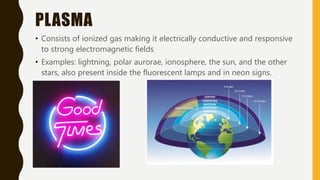
PLASMA
• Consists of ionized gas making it electrically conductive and responsive
to strong electromagnetic fields
• Examples: lightning, polar aurorae, ionosphere, the sun, and the other
stars, also present inside the fluorescent lamps and in neon signs.
BOSE-EINSTEIN CONDENSATE
• Works of Albert Einstein and Satyendra Nath Bose
• Formed by a system of bosons that is confined in an external potential
and cooler near 0 K or absolute zero.
• First condensate was produced in 1995 by Eric Cornell and Carl
Weimann at the University of Colorado.
• such as cold liquid helium, or superconductors, such as the nucleons
inside a neutron star.

Matter

  • 1.
    MATTER T Y PE S , S TAT E S , A N D P R O P E R T I E S ,
  • 2.
    MATTER • Anything thatoccupies space and has mass. • It has two types: 1. PURE SUBSTANCES – have uniform and definite composition. They have constant physical and chemical properties. 2. MIXTURE – different substances are combined with no chemical reaction taking place.
  • 3.
    PURE SUBSTANCES hastwo types: a. ELEMENT b. COMPOUND MIXTURE has two types: a. HOMOGENEOUS MIXTURE b. HETEROGENEOUS MIXTURE
  • 4.
  • 5.
    ELEMENTS • Contains onlyone type of atom • Cannot be broken down into simpler forms of matter. • There are 118 known elements, most of them are naturally occurring while some are synthesized or made in the laboratory. Example: C – Carbon (C – symbol, carbon – name) Ne – neon; Pb – lead; W – tungsten; Mn – manganese
  • 6.
    COMPOUNDS • Contains twoor more atoms that are chemically combined, elements have undergone a chemical reaction. • When compounds are formed, a new set of properties can be seen. • Can still be broken down to simpler compounds or their corresponding elemental components through chemical processes • ELECTROLYSIS – splitting of compounds into the corresponding elements with the use of electricity. Example: salt (C6H12O6) – carbon, hydrogen, & oxygen baking soda (NaHCO₃) – sodium, hydrogen, carbon, & oxygen magnesium oxide (MgO2) – magnesium & oxygen
  • 7.
    MIXTURE • Can beseparated into their individual components by physical methods • Methods in separating mixtures: - distillation - evaporation - extraction - filtration - using of magnet - decantation
  • 8.
    HOMOGENEOUS MIXTURE • Alsocalled as solution, are uniform all throughout, components are not easily separated. • Examples: – Salt solution (salt and water) – Coffee (coffee powder, hot water & sugar) – Sea water (salt and water) – Air (O, H, N, C) – Soft drinks (water, sweetener, CO2, flavorings, etc.)
  • 9.
    HETEROGENEOUS MIXTURE • Haveto or more phases, that is not uniform in appearance. • Examples: – Sugar and sand – Vegetable salad (different vegetables, mayonnaise, etc.) – Fruit salad (different fruits, creamer, condense, etc.) – Salt and pepper – Concrete (cement & water)
  • 10.
    PROPERTIES OF MATTERT RA I T S O F A N Y M A T E R I A L , P H Y S I C A L O R C H E M I C A L P R O P E R T I E S .
  • 11.
    PHYSICAL PROPERTIES • Pertainto those that are measured without changing the composition of the substance. • This include color, odor, texture, boiling point, density, etc. • It is categorized into: A. Intensive properties – those that are inherent to the pure substance such as density, color, melting point, and boiling point. B. Extensive properties – incidental to the pure substance such as length, mass, volume, height, and shape.
  • 12.
    Difference between Intensiveand Extensive properties INTENSIVE EXTENSIVE Independent property Dependent property Size does not change Size changes It cannot be computed It can be computed Can be easily identified Cannot be easily identified Example: melting point, colour, ductility, conductivity, pressure, boiling point, lustre, freezing point, odour, density, etc Example: length, mass, weight, volume
  • 13.
    Extensive examples: • Lemonjuice differ in volume • Aluminum differ in sizes and length depending on how it used • Metals have different mass according to its size Intensive Properties Example • Color - Aluminum metal is gray colored. • Taste - Lemon juice (citric acid) is sour. • melting point - Aluminum has melting point of 660°C. • boiling point - Water has a boiling point of 100°C. • Density - Water has a density of 1 g/mL. • Luster - Metals are lustrous (shiny). • Hardness - Diamond is the hardest substance known
  • 14.
    1. Which ofthe following is an intensive property of a box of crackers? A. Calories per serving. B. Total grams. C. Total number of crackers. D. Total calories. 2. Which of the following is an extensive property? A. The color of charcoal is black. B. Gold is shiny. C. The volume of orange juice is 25 mL
  • 15.
    CHANGES OF MATTER 1.Physical change – change without affecting the chemical composition of matter. Example: grinding, breaking, crushing, breaking, and changes in matter (E, C, F, S, S, D). 2. Chemical change – involves a change in the substance’s chemical composition, new substance is formed/produced. Examples: rusting, ripening of fruits, decomposition of plants/animals, and changing of taste, etc.
  • 16.
    STATES OF MATTERT H IN G S M A Y E X I S T I N T H R E E D I F F E R E N T F O R M S O R P H Y S I C A L S T A T E S , T H E Y D I F F E R I N T H E D I S T A N C E S B E T W E E N P A R T I C L E S A N D T H E I R A R R A N G E M E N T .
  • 17.
    SOLID STATE • Particlesare fixed in crystal lattices forming cubic structure, tetragonal structure, etc. • Particles are tightly packed together and as such movement is very limited, molecules or atoms tend to only vibrate. • Limited movement of the particles contributed to the rigid shape of solid • No free spaces can be found between the particles • Particles cannot slide with one another, their position is fixed. • Have definite shape and volume
  • 18.
    LIQUID STATE • Hasa definite volume but always take the shape of the container • Particles are not too tightly and as such they can move past each other. • The molecules have greater kinetic energy and the attraction between them is only large enough to hold these molecules or atoms together.
  • 19.
    GASEOUS STATE • Distancebetween particles are larger compared to their sizes and thus there is freedom of movement • Kinetic energy is much greater than the force of attraction. • Do not have definite shape and volume • Particles are far from each other, gases can be compressed.
  • 20.
    PLASMA • Consists ofionized gas making it electrically conductive and responsive to strong electromagnetic fields • Examples: lightning, polar aurorae, ionosphere, the sun, and the other stars, also present inside the fluorescent lamps and in neon signs.
  • 21.
    BOSE-EINSTEIN CONDENSATE • Worksof Albert Einstein and Satyendra Nath Bose • Formed by a system of bosons that is confined in an external potential and cooler near 0 K or absolute zero. • First condensate was produced in 1995 by Eric Cornell and Carl Weimann at the University of Colorado. • such as cold liquid helium, or superconductors, such as the nucleons inside a neutron star.