Warm Up California Standards Lesson Presentation Preview
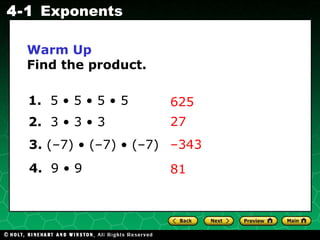
Warm Up Find the product. 625 1.   5 • 5 • 5 • 5 2.   3 • 3 • 3 3.  (–7) • (–7) • (–7) 4.  9 • 9 27 – 343 81
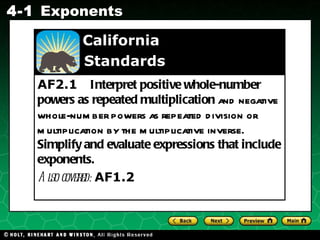
AF2.1  Interpret positive whole-number powers as repeated multiplication  and negative whole-number powers as repeated division or multiplication by the multiplicative inverse.  Simplify and evaluate expressions that include exponents. Also covered:   AF1.2   California    Standards
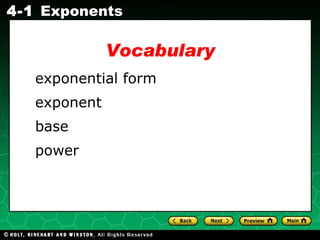
Vocabulary exponential form exponent base power
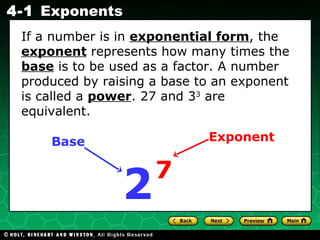
If a number is in  exponential form , the  exponent   represents how many times the  base  is to be used as a factor. A number produced by raising a base to an exponent is called a  power . 27 and 3 3  are equivalent. 7 Exponent Base 2
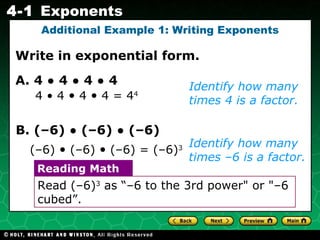
Identify how many times 4 is a factor. Write in exponential form. Additional Example 1: Writing Exponents A. 4  •  4  •  4  •  4 Identify how many times –6 is a factor. (–6)  •  (–6)  •  (–6) = (–6) 3   B. (–6)  •  (–6)  •  (–6) 4 • 4  •  4  •  4 = 4 4   Read (–6) 3  as “–6 to the 3rd power" or "–6 cubed”. Reading Math
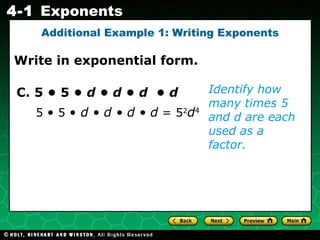
Identify how many times 5 and d are each used as a factor. Additional Example 1: Writing Exponents C. 5 • 5 •  d • d • d  • d Write in exponential form. 5  •  5  •  d • d • d • d  = 5 2 d 4
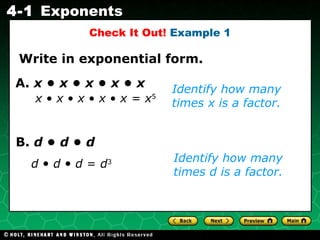
Identify how many times x is a factor. Write in exponential form. Check It Out!  Example 1 A.  x  •  x  •  x  •  x  •  x Identify how many times d is a factor. B.  d  •  d  •  d x  •  x  •  x  •  x  •  x   =  x 5 d   •   d   •   d  =  d 3
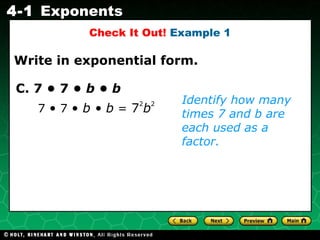
Identify how many times 7 and b are each used as a factor. 7  •  7  •  b • b  =  7 2 b 2   Check It Out!  Example 1 C. 7 • 7 •  b • b   Write in exponential form.
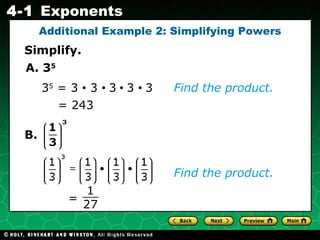
= 243 3 5  = 3  •  3  •  3  •  3  •  3 Find the product. Find the product. B.  Simplify. Additional Example 2: Simplifying Powers A. 3 5 =  1 27
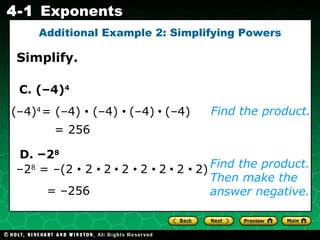
= 256 – 2 8  = –(2  •  2  •  2  •  2  •  2  •  2  •  2  •  2) = –256 Simplify. Additional Example 2: Simplifying Powers Find the product. Find the product. Then make the answer negative. D.  – 2 8 = (–4)  •  (–4)  •  (–4)  •  (–4) (–4) 4 C. (–4) 4
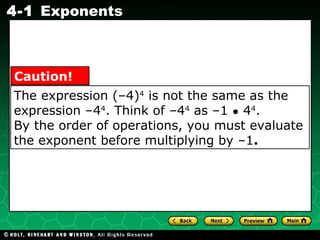
The expression (–4) 4  is not the same as the expression –4 4 . Think of –4 4  as –1  ●  4 4 .  By the order of operations, you must evaluate the exponent before multiplying by –1 . Caution!
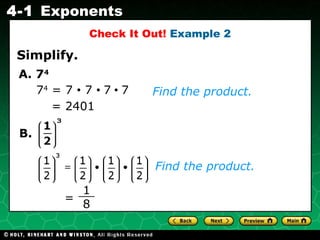
= 2401 7 4  = 7  •  7  •  7  •  7  Find the product. Simplify. Check It Out!  Example 2 Find the product. A. 7 4 B.  =  1 8
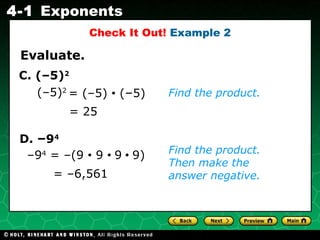
= 25 – 9 4  = –(9  •  9  •  9  •  9) = –6,561 Evaluate. Find the product.  Find the product. Then make the answer negative. Check It Out!  Example 2 D.  – 9 4 = (–5)  •  ( – 5) (–5) 2 C. (–5) 2
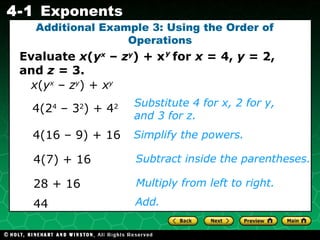
Additional Example 3: Using the Order of  Operations 4(7) + 16 Substitute 4 for x, 2 for y, and 3 for z. Simplify the powers. Subtract inside the parentheses. Multiply from left to right.  4(2 4  – 3 2 ) + 4 2 4(16 – 9) + 16 28 + 16 Add.  44 Evaluate  x ( y x  –  z y ) + x  for  x  = 4,  y  = 2, and  z  = 3. y x ( y x  –  z y ) +  x y
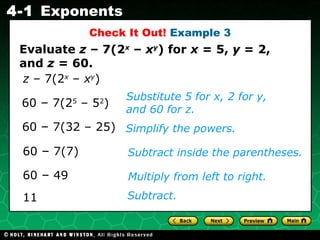
Check It Out!  Example 3 60  –  7(7)  Substitute 5 for x, 2 for y, and 60 for z. Simplify the powers. Subtract inside the parentheses. Multiply from left to right.  60  –  7(2 5  – 5 2 ) 60  –  7(32 – 25)  60  –  49 Subtract.  11 Evaluate  z  –   7(2 x  –  x y ) for  x  = 5,  y  = 2, and  z  = 60. z  –   7(2 x  –  x y )
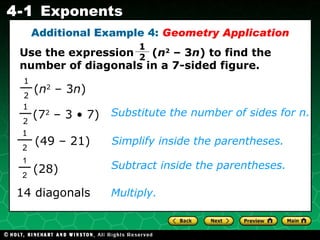
Additional Example 4:  Geometry Application Simplify inside the parentheses. Multiply. Substitute the number of sides for n. Subtract inside the parentheses. 14 diagonals Use the expression  ( n 2  – 3 n ) to find the number of diagonals in a 7-sided figure. (7 2  – 3 • 7) 1 2 (49 – 21) 1 2 ( n 2  – 3 n ) 1 2 (28) 1 2 1 2
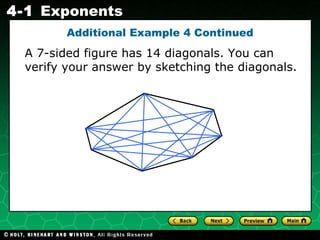
A 7-sided figure has 14 diagonals. You can verify your answer by sketching the diagonals. Additional Example 4 Continued
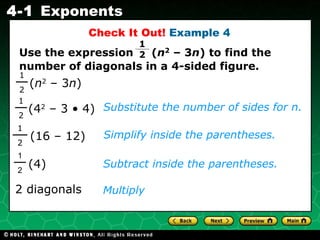
Check It Out!  Example 4 Simplify inside the parentheses. Multiply Substitute the number of sides for n. Subtract inside the parentheses. 2 diagonals Use the expression  ( n 2  – 3 n ) to find the number of diagonals in a 4-sided figure. (4 2  – 3 • 4) 1 2 (16 – 12) 1 2 ( n 2  – 3 n ) 1 2 (4) 1 2 1 2
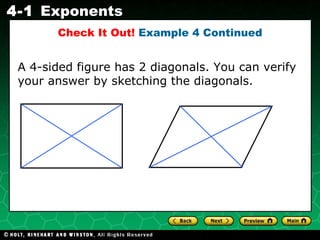
A 4-sided figure has 2 diagonals. You can verify your answer by sketching the diagonals. Check It Out!  Example 4 Continued
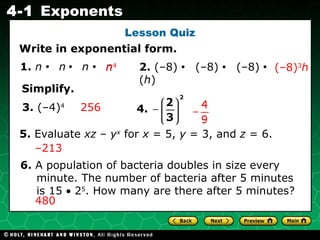
Lesson Quiz Write in exponential form. 1.  n   •   n   •   n   •   n   2.  (–8)  •  (–8)  •  (–8)   •  ( h )  256 – 213 (–8) 3 h 3.  (–4) 4 5.  Evaluate  xz  –  y x  for  x  = 5,  y  = 3, and  z  = 6. 6.  A population of bacteria doubles in size every minute. The number of bacteria after 5 minutes is 15    2 5 . How many are there after 5 minutes? 480  Simplify. 4.   n 4

Chapter4.1

  • 1.
    Warm Up CaliforniaStandards Lesson Presentation Preview
  • 2.
    Warm Up Findthe product. 625 1. 5 • 5 • 5 • 5 2. 3 • 3 • 3 3. (–7) • (–7) • (–7) 4. 9 • 9 27 – 343 81
  • 3.
    AF2.1 Interpretpositive whole-number powers as repeated multiplication and negative whole-number powers as repeated division or multiplication by the multiplicative inverse. Simplify and evaluate expressions that include exponents. Also covered: AF1.2 California Standards
  • 4.
    Vocabulary exponential formexponent base power
  • 5.
    If a numberis in exponential form , the exponent represents how many times the base is to be used as a factor. A number produced by raising a base to an exponent is called a power . 27 and 3 3 are equivalent. 7 Exponent Base 2
  • 6.
    Identify how manytimes 4 is a factor. Write in exponential form. Additional Example 1: Writing Exponents A. 4 • 4 • 4 • 4 Identify how many times –6 is a factor. (–6) • (–6) • (–6) = (–6) 3 B. (–6) • (–6) • (–6) 4 • 4 • 4 • 4 = 4 4 Read (–6) 3 as “–6 to the 3rd power" or "–6 cubed”. Reading Math
  • 7.
    Identify how manytimes 5 and d are each used as a factor. Additional Example 1: Writing Exponents C. 5 • 5 • d • d • d • d Write in exponential form. 5 • 5 • d • d • d • d = 5 2 d 4
  • 8.
    Identify how manytimes x is a factor. Write in exponential form. Check It Out! Example 1 A. x • x • x • x • x Identify how many times d is a factor. B. d • d • d x • x • x • x • x = x 5 d • d • d = d 3
  • 9.
    Identify how manytimes 7 and b are each used as a factor. 7 • 7 • b • b = 7 2 b 2 Check It Out! Example 1 C. 7 • 7 • b • b Write in exponential form.
  • 10.
    = 243 35 = 3 • 3 • 3 • 3 • 3 Find the product. Find the product. B. Simplify. Additional Example 2: Simplifying Powers A. 3 5 = 1 27
  • 11.
    = 256 –2 8 = –(2 • 2 • 2 • 2 • 2 • 2 • 2 • 2) = –256 Simplify. Additional Example 2: Simplifying Powers Find the product. Find the product. Then make the answer negative. D. – 2 8 = (–4) • (–4) • (–4) • (–4) (–4) 4 C. (–4) 4
  • 12.
    The expression (–4)4 is not the same as the expression –4 4 . Think of –4 4 as –1 ● 4 4 . By the order of operations, you must evaluate the exponent before multiplying by –1 . Caution!
  • 13.
    = 2401 74 = 7 • 7 • 7 • 7 Find the product. Simplify. Check It Out! Example 2 Find the product. A. 7 4 B. = 1 8
  • 14.
    = 25 –9 4 = –(9 • 9 • 9 • 9) = –6,561 Evaluate. Find the product. Find the product. Then make the answer negative. Check It Out! Example 2 D. – 9 4 = (–5) • ( – 5) (–5) 2 C. (–5) 2
  • 15.
    Additional Example 3:Using the Order of Operations 4(7) + 16 Substitute 4 for x, 2 for y, and 3 for z. Simplify the powers. Subtract inside the parentheses. Multiply from left to right. 4(2 4 – 3 2 ) + 4 2 4(16 – 9) + 16 28 + 16 Add. 44 Evaluate x ( y x – z y ) + x for x = 4, y = 2, and z = 3. y x ( y x – z y ) + x y
  • 16.
    Check It Out! Example 3 60 – 7(7) Substitute 5 for x, 2 for y, and 60 for z. Simplify the powers. Subtract inside the parentheses. Multiply from left to right. 60 – 7(2 5 – 5 2 ) 60 – 7(32 – 25) 60 – 49 Subtract. 11 Evaluate z – 7(2 x – x y ) for x = 5, y = 2, and z = 60. z – 7(2 x – x y )
  • 17.
    Additional Example 4: Geometry Application Simplify inside the parentheses. Multiply. Substitute the number of sides for n. Subtract inside the parentheses. 14 diagonals Use the expression ( n 2 – 3 n ) to find the number of diagonals in a 7-sided figure. (7 2 – 3 • 7) 1 2 (49 – 21) 1 2 ( n 2 – 3 n ) 1 2 (28) 1 2 1 2
  • 18.
    A 7-sided figurehas 14 diagonals. You can verify your answer by sketching the diagonals. Additional Example 4 Continued
  • 19.
    Check It Out! Example 4 Simplify inside the parentheses. Multiply Substitute the number of sides for n. Subtract inside the parentheses. 2 diagonals Use the expression ( n 2 – 3 n ) to find the number of diagonals in a 4-sided figure. (4 2 – 3 • 4) 1 2 (16 – 12) 1 2 ( n 2 – 3 n ) 1 2 (4) 1 2 1 2
  • 20.
    A 4-sided figurehas 2 diagonals. You can verify your answer by sketching the diagonals. Check It Out! Example 4 Continued
  • 21.
    Lesson Quiz Writein exponential form. 1. n • n • n • n 2. (–8) • (–8) • (–8) • ( h ) 256 – 213 (–8) 3 h 3. (–4) 4 5. Evaluate xz – y x for x = 5, y = 3, and z = 6. 6. A population of bacteria doubles in size every minute. The number of bacteria after 5 minutes is 15  2 5 . How many are there after 5 minutes? 480 Simplify. 4. n 4