Downloaded 39 times
![Matrix Multiply
MATRIX-MULTIPLY (A,B)
if columns [A] ≠ rows [B]
then error “incompatible dimensions”
else for i←1 to rows [A]
do for j←1 to columns [B]
do C[i, j]←0
for k←1 to columns [A]
do C[ i, j ]← C[ i, j] +A[ i, k]*B[ k, j]
return C](https://image.slidesharecdn.com/matrixchainmultiplicationbymasud-180914130549/75/Matrix-chain-multiplication-by-MHM-3-2048.jpg)
![The structure of an optimal paranthesization
Let Ai...j where i ≤ j, denote the matrix product
Ai Ai+1 ... Aj
Any parenthesization of Ai Ai+1 ... Aj must split
the product between Ak and Ak+1 for i ≤ k < j
Example: k = 4 (A1A2A3A4)(A5A6)
Total Cost of computing A[i,j] = minimum cost of A1..k
and Cost of computing Ak+1..j + Cost of multiplying
A1..k * Ak+1..j](https://image.slidesharecdn.com/matrixchainmultiplicationbymasud-180914130549/75/Matrix-chain-multiplication-by-MHM-6-2048.jpg)
![Algorithm to Optimal Cost
MATRIX-CHAIN-ORDER(p[ ], n)
for i ← 1 to n
m[i, i] ← 0
for l ← 2 to n
for i ← 1 to n-l+1
j ← i+l-1
m[i, j] ←
for k ← i to j-1
q ← m[i, k] + m[k+1, j] + p[i-1] p[k] p[j]
if q < m[i, j]
m[i, j] ← q
s[i, j] ← k
return m and s](https://image.slidesharecdn.com/matrixchainmultiplicationbymasud-180914130549/75/Matrix-chain-multiplication-by-MHM-7-2048.jpg)
![Recursively def. value of opt. solution
Recursive defination for the minimum cost of
paranthesization:
We also keep track of optimal splits:
jipppjkmkim
ji
jim
jki
jki
if}],1[],[min
if0
],[
1](https://image.slidesharecdn.com/matrixchainmultiplicationbymasud-180914130549/75/Matrix-chain-multiplication-by-MHM-8-2048.jpg)
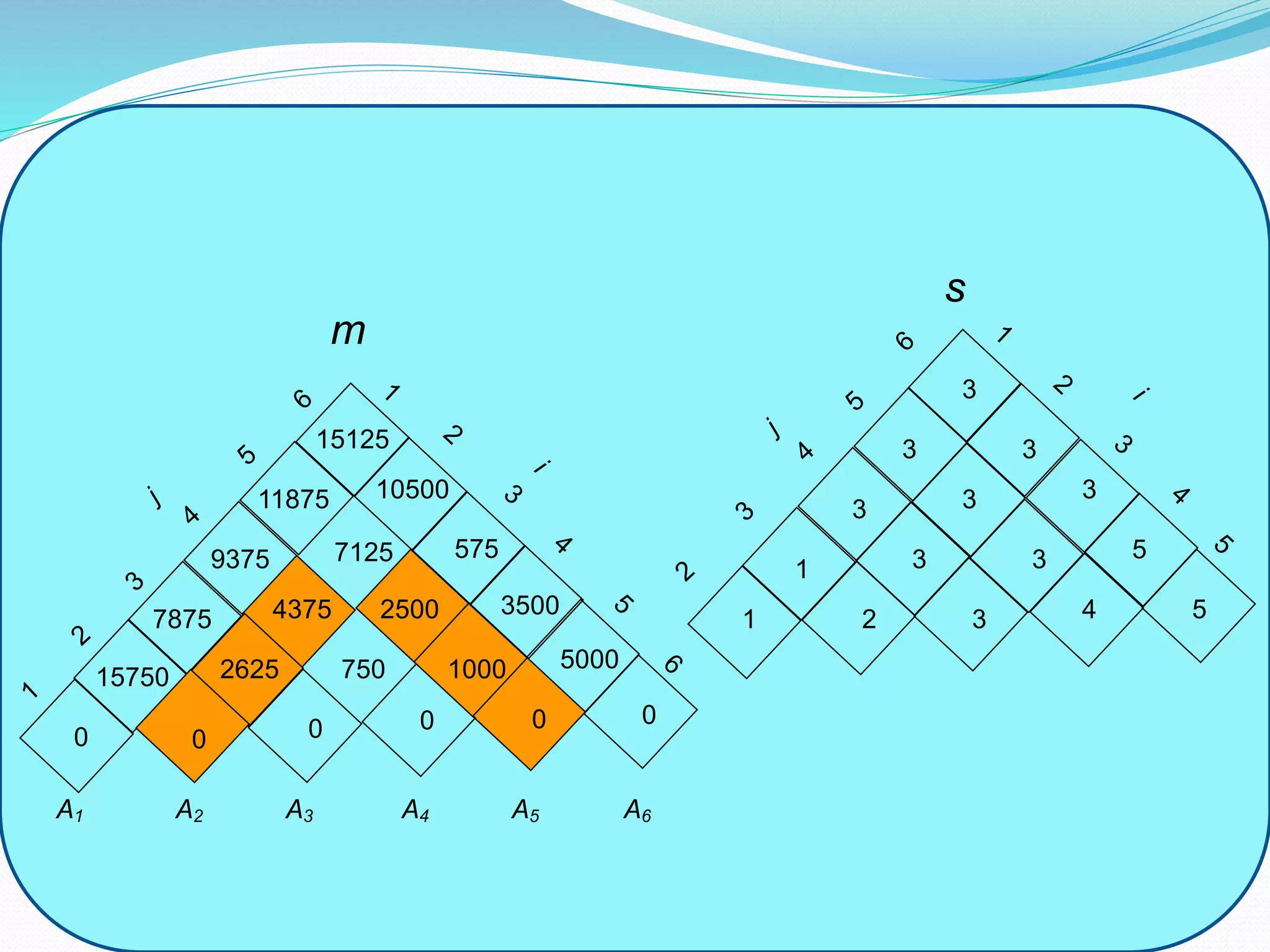
![Example of Matrix Chain Multiplication
matrix dimension
A1 30 x 35
A2 35 x 15
A3 15 x 5
A4 5 x 10
A5 10 x 20
A6 20 x 25
7125
11375201035043754]5,5[]4,2[
7125205351002625]5,4[]3,2[
1300020153525000]5,3[]2,2[
min]5,2[
51
531
521
pppmm
pppmm
pppmm
m](https://image.slidesharecdn.com/matrixchainmultiplicationbymasud-180914130549/75/Matrix-chain-multiplication-by-MHM-9-2048.jpg)


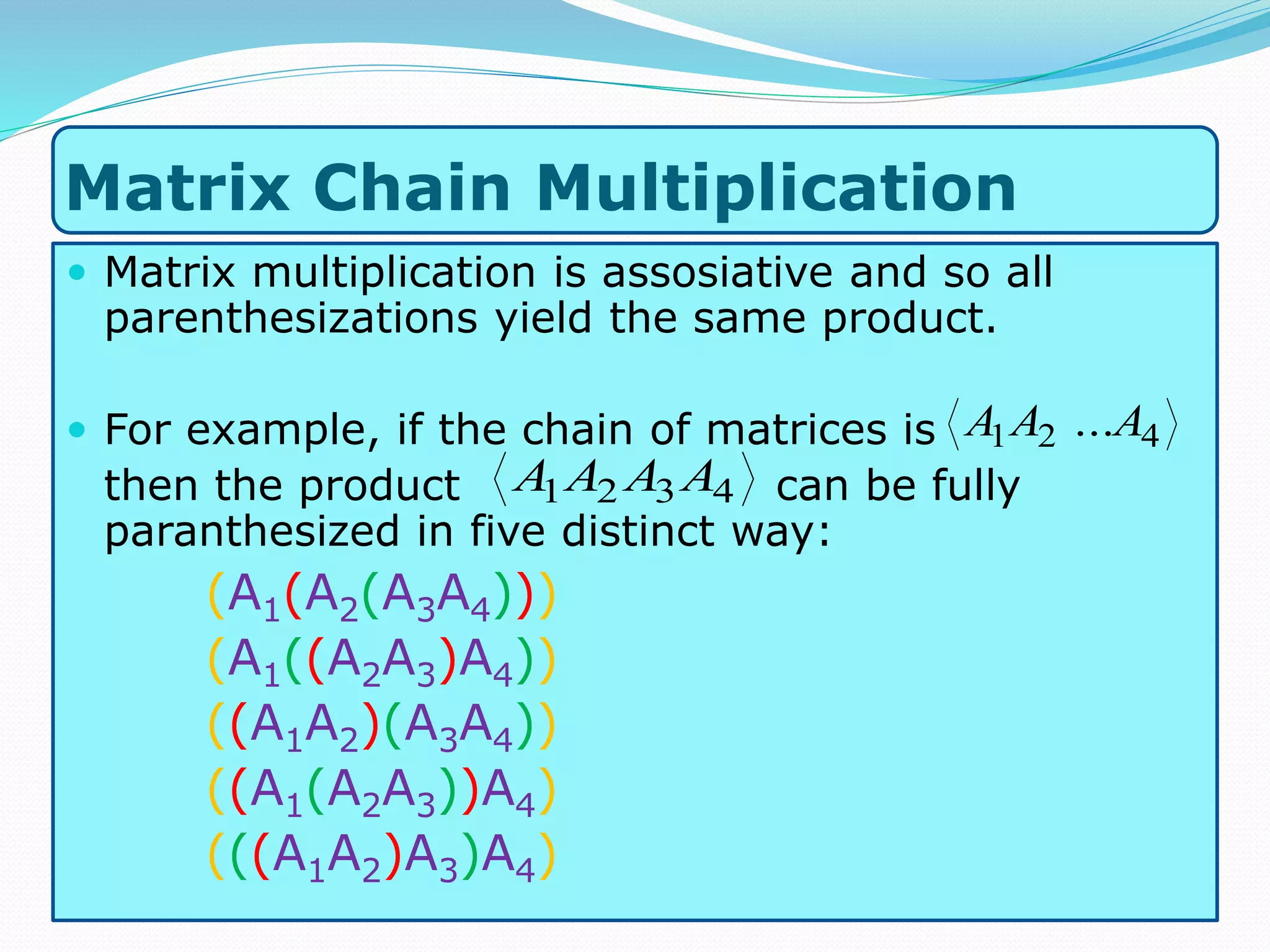
The document discusses matrix chain multiplication and algorithms for finding the optimal parenthesization of matrices. It explains that the product of matrices is associative but different parenthesizations may have different costs. It presents an algorithm called MATRIX-CHAIN-ORDER that uses dynamic programming to find a parenthesization with minimum calculation cost in O(n^3) time by trying all possible split points. The algorithm returns both the minimum cost and the optimal splitting positions.


