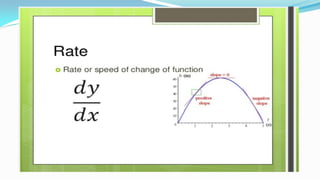
CALCULUS & MATRICES
Differential calculus
MATRICES
Matrices - Introduction
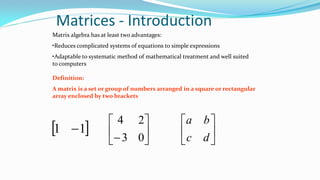
Matrix algebra has at least two advantages:
•Reduces complicated systems of equations to simple expressions
•Adaptable to systematic method of mathematical treatment and well suited
to computers
Definition:
A matrix is a set or group of numbers arranged in a square or rectangular
array enclosed by two brackets
 11  





 03
24






dc
ba
Matrices - Introduction
Properties:
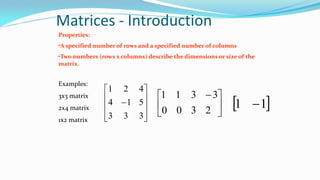
•A specified number of rows and a specified number of columns
•Two numbers (rows x columns) describe the dimensions or size of the
matrix.
Examples:
3x3 matrix
2x4 matrix
1x2 matrix











333
514
421





 
2
3
3
3
0
1
0
1
 11 
Matrices - Introduction
A matrix is denoted by a bold capital letter and the elements within the matrix
are denoted by lower case letters
e.g. matrix [A] with elements aij














mnijmm
nij
inij
aaaa
aaaa
aaaa
21
22221
1211
...
...

i goes from 1 to m
j goes from 1 to n
Amxn=
mAn
Matrices - Introduction
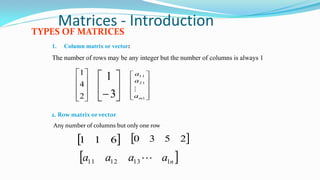
TYPES OF MATRICES
1. Column matrix or vector:
The number of rows may be any integer but the number of columns is always 1










2
4
1






3
1












1
21
11
ma
a
a

2. Row matrix or vector
Any number of columns but only one row
 611  2530
 naaaa 1131211 
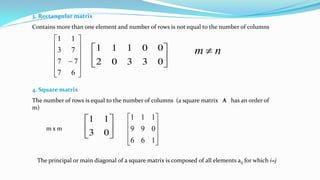
3. Rectangular matrix
Contains more than one element and number of rows is not equal to the number of columns













67
77
73
11






03302
00111 nm 
4. Square matrix
The number of rows is equal to the number of columns (a square matrix A has an order of
m)
m x m 





03
11










166
099
111
The principal or main diagonal of a square matrix is composed of all elements aij for which i=j
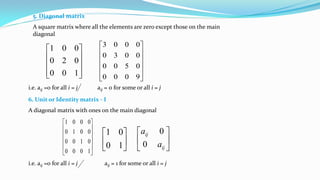
5. Diagonal matrix
A square matrix where all the elements are zero except those on the main
diagonal










100
020
001












9000
0500
0030
0003
i.e. aij =0 for all i = j aij = 0 for some or all i = j
6. Unit or Identity matrix - I
A diagonal matrix with ones on the main diagonal












1000
0100
0010
0001






10
01






ij
ij
a
a
0
0
i.e. aij =0 for all i = j aij = 1 for some or all i = j
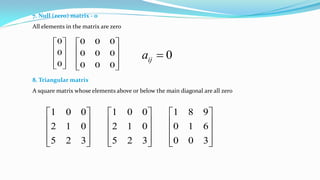
7. Null (zero) matrix - 0
All elements in the matrix are zero










0
0
0










000
000
000
0ija
8. Triangular matrix
A square matrix whose elements above or below the main diagonal are all zero










325
012
001










325
012
001










300
610
981
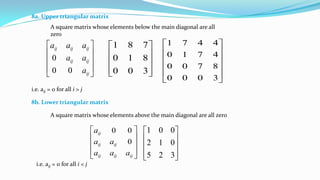
8a. Upper triangular matrix
A square matrix whose elements below the main diagonal are all
zero
i.e. aij = 0 for all i > j










300
810
781












3000
8700
4710
4471










ij
ijij
ijijij
a
aa
aaa
00
0
8b. Lower triangular matrix
A square matrix whose elements above the main diagonal are all zero










ijijij
ijij
ij
aaa
aa
a
0
00










325
012
001
i.e. aij = 0 for all i < j
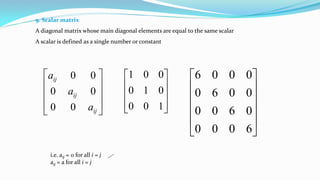
9. Scalar matrix
A diagonal matrix whose main diagonal elements are equal to the same scalar
A scalar is defined as a single number or constant










100
010
001












6000
0600
0060
0006
i.e. aij = 0 for all i = j
aij = a for all i = j










ij
ij
ij
a
a
a
00
00
00
Matrix Operations
Matrices - Operations
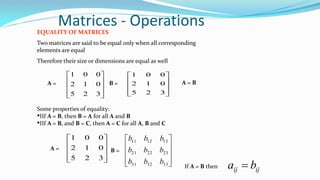
EQUALITY OF MATRICES
Two matrices are said to be equal only when all corresponding
elements are equal
Therefore their size or dimensions are equal as well










325
012
001










325
012
001
A = B = A = B
Some properties of equality:
•IIf A = B, then B = A for all A and B
•IIf A = B, and B = C, then A = C for all A, B and C










325
012
001










333231
232221
131211
bbb
bbb
bbb
A = B =
If A = B then
ijij ba 
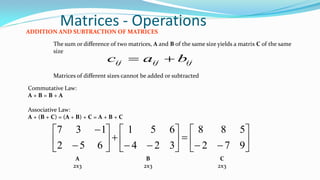
Matrices - OperationsADDITION AND SUBTRACTION OF MATRICES
The sum or difference of two matrices, A and B of the same size yields a matrix C of the same
size
ijijij bac 
Matrices of different sizes cannot be added or subtracted
Commutative Law:
A + B = B + A
Associative Law:
A + (B + C) = (A + B) + C = A + B + C






















972
588
324
651
652
137
A
2x3
B
2x3
C
2x3
Matrices - Operations























2221
1211
3231
2221
1211
232221
131211
cc
cc
bb
bb
bb
aaa
aaa
22322322221221
21312321221121
12321322121211
11311321121111
)()()(
)()()(
)()()(
)()()(
cbababa
cbababa
cbababa
cbababa




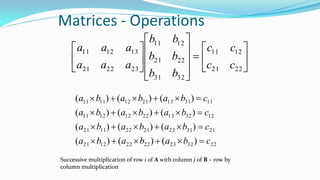
Successive multiplication of row i of A with column j of B – row by
column multiplication
Matrices - Operations

























)37()22()84()57()62()44(
)33()22()81()53()62()41(
35
26
84
724
321







5763
2131
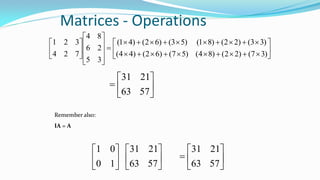
Remember also:
IA = A






10
01






5763
2131







5763
2131
Matrices - Operations
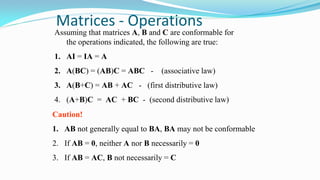
Assuming that matrices A, B and C are conformable for
the operations indicated, the following are true:
1. AI = IA = A
2. A(BC) = (AB)C = ABC - (associative law)
3. A(B+C) = AB + AC - (first distributive law)
4. (A+B)C = AC + BC - (second distributive law)
Caution!
1. AB not generally equal to BA, BA may not be conformable
2. If AB = 0, neither A nor B necessarily = 0
3. If AB = AC, B not necessarily = C
Matrices - Operations
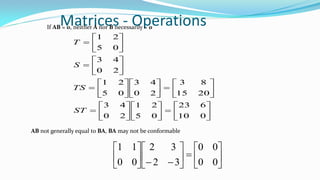
AB not generally equal to BA, BA may not be conformable




















































010
623
05
21
20
43
2015
83
20
43
05
21
20
43
05
21
ST
TS
S
T
If AB = 0, neither A nor B necessarily = 0


















00
00
32
32
00
11
Matrices - Operations
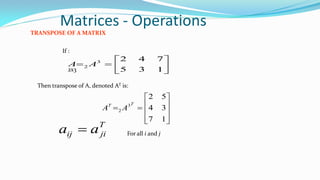
TRANSPOSE OF A MATRIX
If :







135
7423
2 AA
2x3











17
34
52
3
2
TT
AA
Then transpose of A, denoted AT is:
T
jiij aa  For all i and j
Matrices - OperationsTo transpose:
Interchange rows and columns
The dimensions of AT are the reverse of the dimensions of A







135
7423
2 AA











17
34
52
2
3
TT
AA
2 x 3
3 x 2
Matrices - OperationsProperties of transposed matrices:
1. (A+B)T = AT + BT
2. (AB)T = BT AT
3. (kA)T = kAT
4. (AT)T = A
1. (A+B)T = AT + BT






















972
588
324
651
652
137












95
78
28






































95
78
28
36
25
41
61
53
27
Matrices - Operations
(AB)T = BT AT
 
   82
30
21
01
211
82
8
2
2
1
1
320
011


































Matrices - Operations
SYMMETRIC MATRICES
A Square matrix is symmetric if it is equal to its
transpose:
A = AT














db
ba
A
db
ba
A
T
Matrices - Operations
When the original matrix is square, transposition does not
affect the elements of the main diagonal














db
ca
A
dc
ba
A
T
The identity matrix, I, a diagonal matrix D, and a scalar matrix, K,
are equal to their transpose since the diagonal is unaffected.
Matrices - Operations
INVERSE OF A MATRIX
Consider a scalar k. The inverse is the reciprocal or division of 1
by the scalar.
Example:
k=7 the inverse of k or k-1 = 1/k = 1/7
Division of matrices is not defined since there may be AB = AC
while B = C
Instead matrix inversion is used.
The inverse of a square matrix, A, if it exists, is the unique matrix
A-1 where:
AA-1 = A-1 A = I
Matrices - Operations
Example:

















32
11
12
13
1
2
2
A
AA








































10
01
32
11
12
13
10
01
12
13
32
11
Because:
Matrices - Operations
ADJOINT MATRICES
A cofactor matrix C of a matrix A is the square matrix of the same
order as A in which each element aij is replaced by its cofactor cij .
Example:








43
21
A








12
34
C
If
The cofactor C of A is
Matrices - Operations
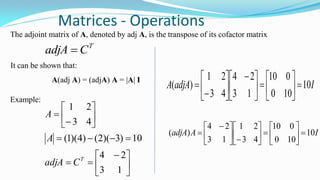
The adjoint matrix of A, denoted by adj A, is the transpose of its cofactor matrix
T
CadjA 
It can be shown that:
A(adj A) = (adjA) A = |A| I
Example:





 










13
24
10)3)(2()4)(1(
43
21
T
CadjA
A
A
IadjAA 10
100
010
13
24
43
21
)( 










 








IAadjA 10
100
010
43
21
13
24
)( 
















 

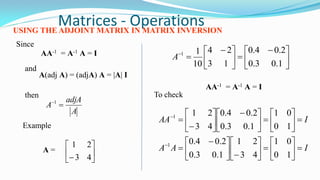
Matrices - OperationsUSING THE ADJOINT MATRIX IN MATRIX INVERSION
A
adjA
A 1
Since
AA-1 = A-1 A = I
and
A(adj A) = (adjA) A = |A| I
then
Example






 43
21
A =





 





 

1.03.0
2.04.0
13
24
10
11
A
AA-1 = A-1 A = I
IAA
IAA

















 












 










10
01
43
21
1.03.0
2.04.0
10
01
1.03.0
2.04.0
43
21
1
1
To check
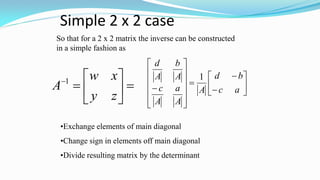
Simple 2 x 2 case
So that for a 2 x 2 matrix the inverse can be constructed
in a simple fashion as





















 ac
bd
A
A
a
A
c
A
b
A
d
1
•Exchange elements of main diagonal
•Change sign in elements off main diagonal
•Divide resulting matrix by the determinant







zy
xw
A 1
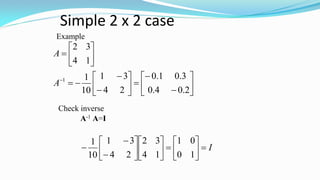
Simple 2 x 2 case
Example

























2.04.0
3.01.0
24
31
10
1
14
32
1
A
A
Check inverse
A-1 A=I
I




















10
01
14
32
24
31
10
1
Linear Equations
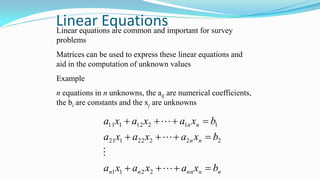
Linear EquationsLinear equations are common and important for survey
problems
Matrices can be used to express these linear equations and
aid in the computation of unknown values
Example
n equations in n unknowns, the aij are numerical coefficients,
the bi are constants and the xj are unknowns
nnnnnn
nn
nn
bxaxaxa
bxaxaxa
bxaxaxa







2211
22222121
11212111
Linear Equations
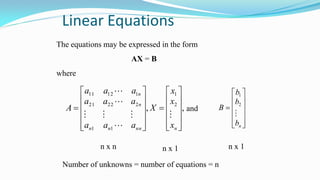
The equations may be expressed in the form
AX = B
where
,, 2
1
11
22221
11211


























nnnnn
n
n
x
x
x
X
aaa
aaa
aaa
A






and













nb
b
b
B

2
1
n x n n x 1 n x 1
Number of unknowns = number of equations = n
Linear Equations
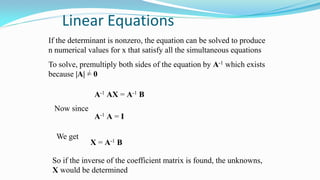
If the determinant is nonzero, the equation can be solved to produce
n numerical values for x that satisfy all the simultaneous equations
To solve, premultiply both sides of the equation by A-1 which exists
because |A| = 0
A-1 AX = A-1 B
Now since
A-1 A = I
We get
X = A-1 B
So if the inverse of the coefficient matrix is found, the unknowns,
X would be determined
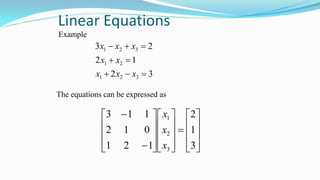
Linear Equations
Example
32
12
23
321
21
321



xxx
xx
xxx
The equations can be expressed as

































3
1
2
121
012
113
3
2
1
x
x
x

R.Ganesh Kumar

  • 1.
  • 18.
  • 27.
  • 28.
    Matrices - Introduction Matrixalgebra has at least two advantages: •Reduces complicated systems of equations to simple expressions •Adaptable to systematic method of mathematical treatment and well suited to computers Definition: A matrix is a set or group of numbers arranged in a square or rectangular array enclosed by two brackets  11         03 24       dc ba
  • 29.
    Matrices - Introduction Properties: •Aspecified number of rows and a specified number of columns •Two numbers (rows x columns) describe the dimensions or size of the matrix. Examples: 3x3 matrix 2x4 matrix 1x2 matrix            333 514 421        2 3 3 3 0 1 0 1  11 
  • 30.
    Matrices - Introduction Amatrix is denoted by a bold capital letter and the elements within the matrix are denoted by lower case letters e.g. matrix [A] with elements aij               mnijmm nij inij aaaa aaaa aaaa 21 22221 1211 ... ...  i goes from 1 to m j goes from 1 to n Amxn= mAn
  • 31.
    Matrices - Introduction TYPESOF MATRICES 1. Column matrix or vector: The number of rows may be any integer but the number of columns is always 1           2 4 1       3 1             1 21 11 ma a a  2. Row matrix or vector Any number of columns but only one row  611  2530  naaaa 1131211 
  • 32.
    3. Rectangular matrix Containsmore than one element and number of rows is not equal to the number of columns              67 77 73 11       03302 00111 nm  4. Square matrix The number of rows is equal to the number of columns (a square matrix A has an order of m) m x m       03 11           166 099 111 The principal or main diagonal of a square matrix is composed of all elements aij for which i=j
  • 33.
    5. Diagonal matrix Asquare matrix where all the elements are zero except those on the main diagonal           100 020 001             9000 0500 0030 0003 i.e. aij =0 for all i = j aij = 0 for some or all i = j 6. Unit or Identity matrix - I A diagonal matrix with ones on the main diagonal             1000 0100 0010 0001       10 01       ij ij a a 0 0 i.e. aij =0 for all i = j aij = 1 for some or all i = j
  • 34.
    7. Null (zero)matrix - 0 All elements in the matrix are zero           0 0 0           000 000 000 0ija 8. Triangular matrix A square matrix whose elements above or below the main diagonal are all zero           325 012 001           325 012 001           300 610 981
  • 35.
    8a. Upper triangularmatrix A square matrix whose elements below the main diagonal are all zero i.e. aij = 0 for all i > j           300 810 781             3000 8700 4710 4471           ij ijij ijijij a aa aaa 00 0 8b. Lower triangular matrix A square matrix whose elements above the main diagonal are all zero           ijijij ijij ij aaa aa a 0 00           325 012 001 i.e. aij = 0 for all i < j
  • 36.
    9. Scalar matrix Adiagonal matrix whose main diagonal elements are equal to the same scalar A scalar is defined as a single number or constant           100 010 001             6000 0600 0060 0006 i.e. aij = 0 for all i = j aij = a for all i = j           ij ij ij a a a 00 00 00
  • 37.
  • 38.
    Matrices - Operations EQUALITYOF MATRICES Two matrices are said to be equal only when all corresponding elements are equal Therefore their size or dimensions are equal as well           325 012 001           325 012 001 A = B = A = B Some properties of equality: •IIf A = B, then B = A for all A and B •IIf A = B, and B = C, then A = C for all A, B and C           325 012 001           333231 232221 131211 bbb bbb bbb A = B = If A = B then ijij ba 
  • 39.
    Matrices - OperationsADDITIONAND SUBTRACTION OF MATRICES The sum or difference of two matrices, A and B of the same size yields a matrix C of the same size ijijij bac  Matrices of different sizes cannot be added or subtracted Commutative Law: A + B = B + A Associative Law: A + (B + C) = (A + B) + C = A + B + C                       972 588 324 651 652 137 A 2x3 B 2x3 C 2x3
  • 40.
  • 41.
  • 42.
    Matrices - Operations Assumingthat matrices A, B and C are conformable for the operations indicated, the following are true: 1. AI = IA = A 2. A(BC) = (AB)C = ABC - (associative law) 3. A(B+C) = AB + AC - (first distributive law) 4. (A+B)C = AC + BC - (second distributive law) Caution! 1. AB not generally equal to BA, BA may not be conformable 2. If AB = 0, neither A nor B necessarily = 0 3. If AB = AC, B not necessarily = C
  • 43.
    Matrices - Operations ABnot generally equal to BA, BA may not be conformable                                                     010 623 05 21 20 43 2015 83 20 43 05 21 20 43 05 21 ST TS S T If AB = 0, neither A nor B necessarily = 0                   00 00 32 32 00 11
  • 44.
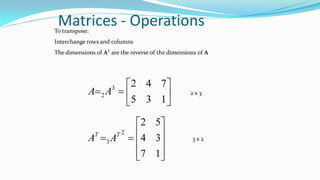
    Matrices - Operations TRANSPOSEOF A MATRIX If :        135 7423 2 AA 2x3            17 34 52 3 2 TT AA Then transpose of A, denoted AT is: T jiij aa  For all i and j
  • 45.
    Matrices - OperationsTotranspose: Interchange rows and columns The dimensions of AT are the reverse of the dimensions of A        135 7423 2 AA            17 34 52 2 3 TT AA 2 x 3 3 x 2
  • 46.
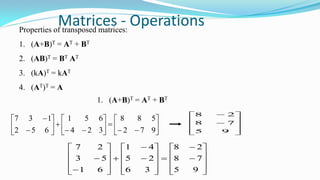
    Matrices - OperationsPropertiesof transposed matrices: 1. (A+B)T = AT + BT 2. (AB)T = BT AT 3. (kA)T = kAT 4. (AT)T = A 1. (A+B)T = AT + BT                       972 588 324 651 652 137             95 78 28                                       95 78 28 36 25 41 61 53 27
  • 47.
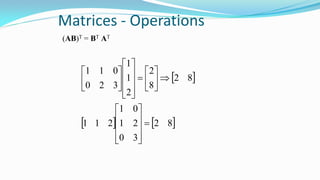
    Matrices - Operations (AB)T= BT AT      82 30 21 01 211 82 8 2 2 1 1 320 011                                  
  • 48.
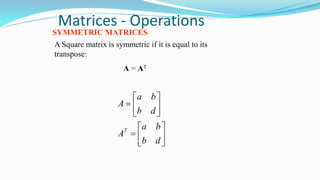
    Matrices - Operations SYMMETRICMATRICES A Square matrix is symmetric if it is equal to its transpose: A = AT               db ba A db ba A T
  • 49.
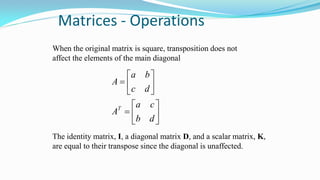
    Matrices - Operations Whenthe original matrix is square, transposition does not affect the elements of the main diagonal               db ca A dc ba A T The identity matrix, I, a diagonal matrix D, and a scalar matrix, K, are equal to their transpose since the diagonal is unaffected.
  • 50.
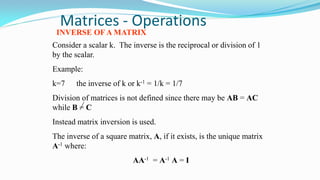
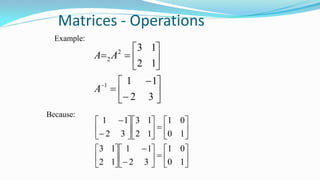
    Matrices - Operations INVERSEOF A MATRIX Consider a scalar k. The inverse is the reciprocal or division of 1 by the scalar. Example: k=7 the inverse of k or k-1 = 1/k = 1/7 Division of matrices is not defined since there may be AB = AC while B = C Instead matrix inversion is used. The inverse of a square matrix, A, if it exists, is the unique matrix A-1 where: AA-1 = A-1 A = I
  • 51.
  • 52.
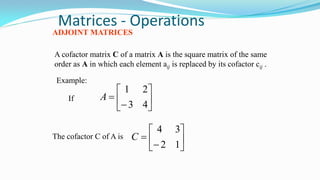
    Matrices - Operations ADJOINTMATRICES A cofactor matrix C of a matrix A is the square matrix of the same order as A in which each element aij is replaced by its cofactor cij . Example:         43 21 A         12 34 C If The cofactor C of A is
  • 53.
    Matrices - Operations Theadjoint matrix of A, denoted by adj A, is the transpose of its cofactor matrix T CadjA  It can be shown that: A(adj A) = (adjA) A = |A| I Example:                  13 24 10)3)(2()4)(1( 43 21 T CadjA A A IadjAA 10 100 010 13 24 43 21 )(                      IAadjA 10 100 010 43 21 13 24 )(                    
  • 54.
    Matrices - OperationsUSINGTHE ADJOINT MATRIX IN MATRIX INVERSION A adjA A 1 Since AA-1 = A-1 A = I and A(adj A) = (adjA) A = |A| I then Example        43 21 A =                1.03.0 2.04.0 13 24 10 11 A AA-1 = A-1 A = I IAA IAA                                            10 01 43 21 1.03.0 2.04.0 10 01 1.03.0 2.04.0 43 21 1 1 To check
  • 55.
    Simple 2 x2 case So that for a 2 x 2 matrix the inverse can be constructed in a simple fashion as                       ac bd A A a A c A b A d 1 •Exchange elements of main diagonal •Change sign in elements off main diagonal •Divide resulting matrix by the determinant        zy xw A 1
  • 56.
    Simple 2 x2 case Example                          2.04.0 3.01.0 24 31 10 1 14 32 1 A A Check inverse A-1 A=I I                     10 01 14 32 24 31 10 1
  • 57.
  • 58.
    Linear EquationsLinear equationsare common and important for survey problems Matrices can be used to express these linear equations and aid in the computation of unknown values Example n equations in n unknowns, the aij are numerical coefficients, the bi are constants and the xj are unknowns nnnnnn nn nn bxaxaxa bxaxaxa bxaxaxa        2211 22222121 11212111
  • 59.
    Linear Equations The equationsmay be expressed in the form AX = B where ,, 2 1 11 22221 11211                           nnnnn n n x x x X aaa aaa aaa A       and              nb b b B  2 1 n x n n x 1 n x 1 Number of unknowns = number of equations = n
  • 60.
    Linear Equations If thedeterminant is nonzero, the equation can be solved to produce n numerical values for x that satisfy all the simultaneous equations To solve, premultiply both sides of the equation by A-1 which exists because |A| = 0 A-1 AX = A-1 B Now since A-1 A = I We get X = A-1 B So if the inverse of the coefficient matrix is found, the unknowns, X would be determined
  • 61.
    Linear Equations Example 32 12 23 321 21 321    xxx xx xxx The equationscan be expressed as                                  3 1 2 121 012 113 3 2 1 x x x