INTRODUCTION OF DIFFERENTIAL
EQUATIONS.
INVENTIONOF DIFFERENTIAL
EQUATIONS
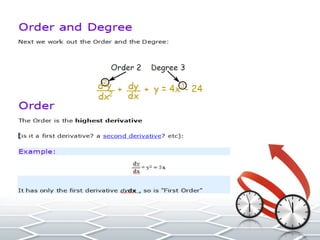
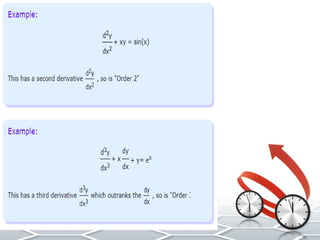
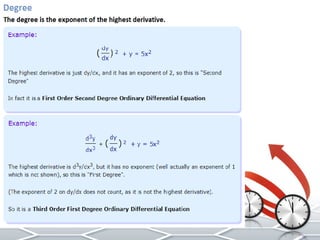
ORDER AND DEGREE OF DIFFERENTIAL
EQUATIONS.
FORMATION OF DIFFERENTIAL
EQUATIONS.
ORDINARY DIFFERENTIAL EQUATIONS
(ODE).
SOLUTION OF DIFFERENTIAL
CONTENTS :
3.
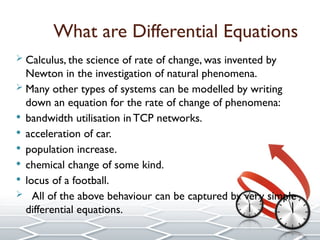
What are DifferentialEquations
Calculus, the science of rate of change, was invented by
Newton in the investigation of natural phenomena.
Many other types of systems can be modelled by writing
down an equation for the rate of change of phenomena:
bandwidth utilisation in TCP networks.
acceleration of car.
population increase.
chemical change of some kind.
locus of a football.
All of the above behaviour can be captured by very simple
differential equations.
4.
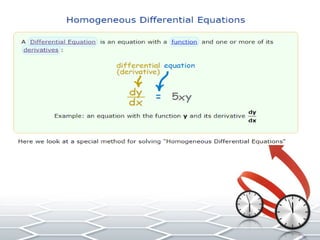
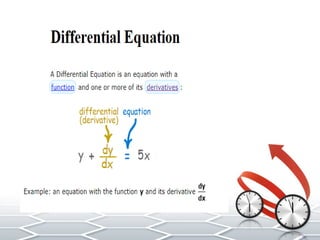
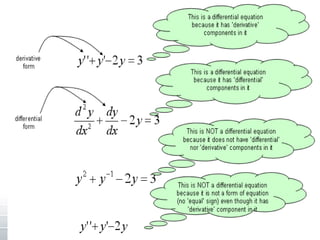
A mathematical equationthat
relates a function with its
derivatives is called
differential equation,
the function usually represent
physical quantities,
derivatives represent its rate of
change
differential equation defines
a relationship between the two.
5.
Origin of differentialequations
Who invented idea
Background idea.
History of Differential Equations
6.
Origin of differentialequations
In mathematics history of differential equations traces
the development of differential equations form calculus,
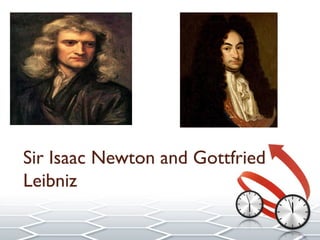
itself independently invented by English physicist Isaac
Newton and German mathematician Gottfried Leibniz.
The history of the subject of differential equations in
concise form a synopsis of the recent article ‘’The
History of Differential Equations 1670-1950’’.
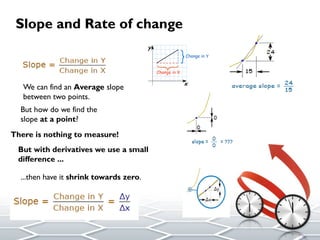
Slope and Rateof change
We can find an Average slope
between two points.
But how do we find the
slope at a point?
There is nothing to measure!
...then have it shrink towards zero.
But with derivatives we use a small
difference ...
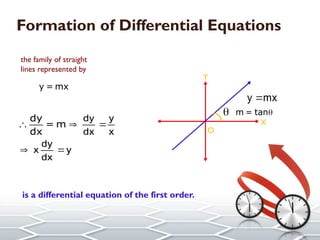
Formation of DifferentialEquations
the family of straight
lines represented by
dy
= m
dx
dy y
dx x
dy
x y
dx
is a differential equation of the first order.
X
Y
O
y = mx
dy
= m
dx
dy y
dx x
dy
x y
dx
y mx
m = tan
13.
Formation of DifferentialEquations
Assume the family of curves represented by
where A and B are arbitrary constants.
[Differentiating (i) w.r.t. x]
[Differentiating (ii) w.r.t. x]
y = Acos x +B … (i)
dy
A sin x B ... ii
dx
2
2
d y
and A cos x B
dx
14.
Formation of DifferentialEquations
[Using (i)]
is a differential equation of second order
Similarly, by eliminating three arbitrary constants, a differential equation
of third order is obtained.
Generally eliminating n arbitrary constants, a differential
equation of nth order is obtained.
2
2
d y
y
dx
2
2
d y
+ y = 0
dx
18.
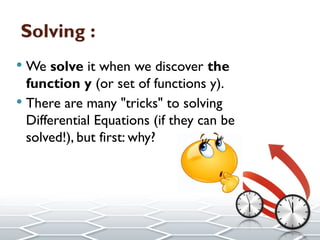
Solving :
Wesolve it when we discover the
function y (or set of functions y).
There are many "tricks" to solving
Differential Equations (if they can be
solved!), but first: why?
19.
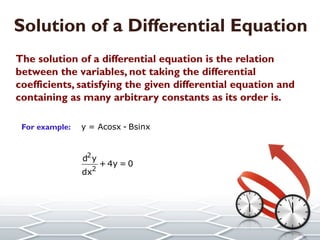
Solution of aDifferential Equation
The solution of a differential equation is the relation
between the variables, not taking the differential
coefficients, satisfying the given differential equation and
containing as many arbitrary constants as its order is.
For example:
is a solution of the differential equation
y = Acosx - Bsinx
2
2
d y
+ 4y = 0
dx
20.
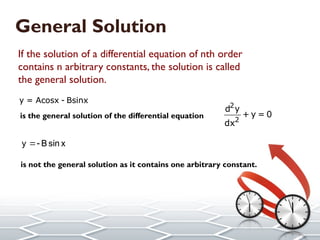
General Solution
If thesolution of a differential equation of nth order contains n arbitrary
constants, the solution is called the general solution.
is the general solution of the differential equation
y B sin x
is not the general solution as it contains one arbitrary constant.
y = Acosx - Bsinx
If the solution of a differential equation of nth order
contains n arbitrary constants, the solution is called
the general solution.
is the general solution of the differential equation
is not the general solution as it contains one arbitrary constant.
2
2
d y
+ y = 0
dx
y Bsin x
y = Acosx - Bsinx
21.
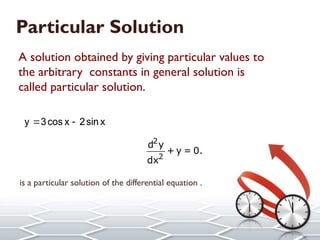
Particular Solution
A solutionobtained by giving particular values to
the arbitrary constants in general solution is
called particular solution.
y 3cos x 2sin x
is a particular solution of the differential equation .
y 3cos x 2sin x
2
2
d y
+ y = 0.
dx
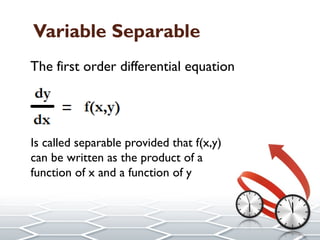
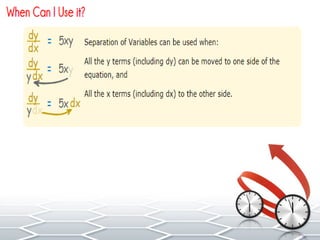
Variable Separable
The firstorder differential equation
Is called separable provided that f(x,y)
can be written as the product of a
function of x and a function of y
24.
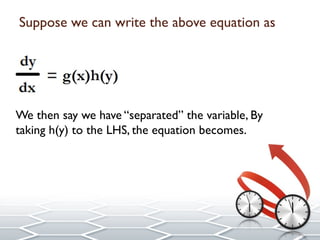
Suppose we canwrite the above equation as
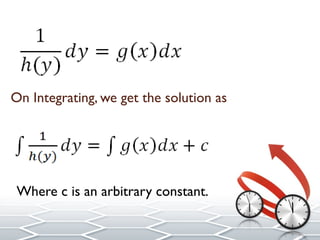
We then say we have “separated” the variable, By
taking h(y) to the LHS, the equation becomes.
![Formation of Differential Equations
Assume the family of curves represented by
where A and B are arbitrary constants.
[Differentiating (i) w.r.t. x]
[Differentiating (ii) w.r.t. x]
y = Acos x +B … (i)
dy
A sin x B ... ii
dx
2
2
d y
and A cos x B
dx
](https://image.slidesharecdn.com/diffrentialequations-250406103334-6358dddc/85/Diffrential-Equations-and-their-applications-pptx-13-320.jpg)
![Formation of Differential Equations
[Using (i)]
is a differential equation of second order
Similarly, by eliminating three arbitrary constants, a differential equation
of third order is obtained.
Generally eliminating n arbitrary constants, a differential
equation of nth order is obtained.
2
2
d y
y
dx
2
2
d y
+ y = 0
dx
](https://image.slidesharecdn.com/diffrentialequations-250406103334-6358dddc/85/Diffrential-Equations-and-their-applications-pptx-14-320.jpg)