JSS Mahavidhyapeeta, Mysore-04
JSS Institute of Education, sakaleshpura
Seminar in: Mathematics pedagogy
Topic: Mathematics programmed instruction
Submitted by
Krupanidhi A K
Second B.Ed
U01HY21E0028
JSS institute of
Education, sakaleshpura
Programmed instructions
Programmed instruction was developed by B.F
Skinner. Programmed instruction is a technique
which developed has a result of the application of
the scientific method to the teaching learning
process. It is a method which uses highly
structural materials which takes place of a teacher
for the learner.
The basic idea of mathematics is to start with
the most motivating task which is likely to be the
best operation which completes the process.
Hence mathematical program utilises this factor
start from the last it ask in the series and
retrogreses. This procedure is called retrogressive
chaining.
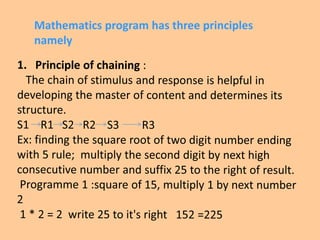
Mathematics program has three principles
namely
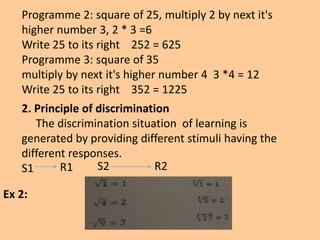
Programme 2: square of 25, multiply 2 by next it's
higher number 3, 2 * 3 =6
Write 25 to its right 252 = 625
Programme 3: square of 35
multiply by next it's higher number 4 3 *4 = 12
Write 25 to its right 352 = 1225
2. Principle of discrimination
The discrimination situation of learning is
generated by providing different stimuli having the
different responses.
S1 R1 S2 R2
Ex 2:
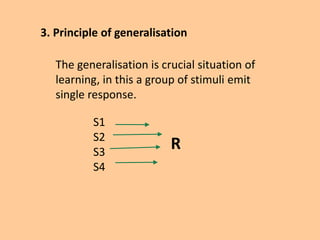
3. Principle of generalisation
The generalisation is crucial situation of
learning, in this a group of stimuli emit
single response.
S1
S2
S3
S4
R
Steps of mathematics program
1. Data collection :Topic of content is analysed
into sub unit then into element and arranged in
sequence.
2. Prescription for mastery: The basic unit of
prescription is the operant ,consisting of single
at of behaviour together with is associated
stimulus condition.
3. Characteristics :It includes detailed analysis of
decision about the order operate the use of
stimulus and analysis of the SR relationship.
4. Exercise writing: An exercise design is divised in a
sequence consisting with characteristic the
sequence of mathematics is number of long
operation presented in riverse order to the
customary way of teaching.
5.Editing: language difficulty and ambiguity is
removed.The frames are modified and improved
logically then the group tries out and students
responses are evaluated.
Mathematics program is based on following
assumptions
1. Training of responses helps in learning to reach
up to master level.
2. Riverse chaining of stimuli helps in learning I. e
from hole to part from complex to simple.
3. completion of task provides motivations to
student.
Advantages
• It is task oriented program.
• Result can be link auto concrete goals which we
intend to achieve through a mathematics
program.
• It is relevant ,significant ,meaningful and valid
in eyes of the learner and programmer.
Limitations
• it is very technical in nature and such as
demandsa lot of skill labour on the part of
programmer.
• it is not suitable for learning the material of all
subjects. Mathematics cannot be used for factual
content.
Conclusion
Programmed learning represent one of the effective
innovations in teaching learning process. In order in
order to Cater individual differences books in
programmes learning need to be written and they Serve
purpose of individualisation. Beside it used for
instructional purpose programming learning can be
used as a feedback device for the modification of
teacher behaviour and improving his teaching efficiency.
Refrences
Pedagogy of school subject mathematics -B.
R Ramachandraiah
• https://www.acdemia.edu
• https://www.studocu.com
Maths programming.pptx

Maths programming.pptx

  • 1.
    JSS Mahavidhyapeeta, Mysore-04 JSSInstitute of Education, sakaleshpura Seminar in: Mathematics pedagogy Topic: Mathematics programmed instruction Submitted by Krupanidhi A K Second B.Ed U01HY21E0028 JSS institute of Education, sakaleshpura
  • 3.
    Programmed instructions Programmed instructionwas developed by B.F Skinner. Programmed instruction is a technique which developed has a result of the application of the scientific method to the teaching learning process. It is a method which uses highly structural materials which takes place of a teacher for the learner.
  • 4.
    The basic ideaof mathematics is to start with the most motivating task which is likely to be the best operation which completes the process. Hence mathematical program utilises this factor start from the last it ask in the series and retrogreses. This procedure is called retrogressive chaining.
  • 5.
    Mathematics program hasthree principles namely
  • 6.
    Programme 2: squareof 25, multiply 2 by next it's higher number 3, 2 * 3 =6 Write 25 to its right 252 = 625 Programme 3: square of 35 multiply by next it's higher number 4 3 *4 = 12 Write 25 to its right 352 = 1225 2. Principle of discrimination The discrimination situation of learning is generated by providing different stimuli having the different responses. S1 R1 S2 R2 Ex 2:
  • 7.
    3. Principle ofgeneralisation The generalisation is crucial situation of learning, in this a group of stimuli emit single response. S1 S2 S3 S4 R
  • 8.
    Steps of mathematicsprogram 1. Data collection :Topic of content is analysed into sub unit then into element and arranged in sequence. 2. Prescription for mastery: The basic unit of prescription is the operant ,consisting of single at of behaviour together with is associated stimulus condition. 3. Characteristics :It includes detailed analysis of decision about the order operate the use of stimulus and analysis of the SR relationship.
  • 9.
    4. Exercise writing:An exercise design is divised in a sequence consisting with characteristic the sequence of mathematics is number of long operation presented in riverse order to the customary way of teaching. 5.Editing: language difficulty and ambiguity is removed.The frames are modified and improved logically then the group tries out and students responses are evaluated.
  • 10.
    Mathematics program isbased on following assumptions 1. Training of responses helps in learning to reach up to master level. 2. Riverse chaining of stimuli helps in learning I. e from hole to part from complex to simple. 3. completion of task provides motivations to student.
  • 11.
    Advantages • It istask oriented program. • Result can be link auto concrete goals which we intend to achieve through a mathematics program. • It is relevant ,significant ,meaningful and valid in eyes of the learner and programmer. Limitations • it is very technical in nature and such as demandsa lot of skill labour on the part of programmer. • it is not suitable for learning the material of all subjects. Mathematics cannot be used for factual content.
  • 12.
    Conclusion Programmed learning representone of the effective innovations in teaching learning process. In order in order to Cater individual differences books in programmes learning need to be written and they Serve purpose of individualisation. Beside it used for instructional purpose programming learning can be used as a feedback device for the modification of teacher behaviour and improving his teaching efficiency.
  • 13.
    Refrences Pedagogy of schoolsubject mathematics -B. R Ramachandraiah • https://www.acdemia.edu • https://www.studocu.com