



UNIT


Unit Two: Developing Understanding in
            Mathematics
                        From the module:
    Teaching and Learning Mathematics in Diverse Classrooms


                  South African Institute for Distance Education (SAIDE)
Copyright
© South African Institute for Distance Education (SAIDE), 2008


The work is licensed under the Creative Commons Attribution-Non-commercial-Share Alike 2.5
South Africa license. To view a copy of this license, visit

http://creativecommons.org/licenses/by-nc-sa/2.5/za


                                               South African Institute for Distance Education (SAIDE)


                                                                                         Box 31822
                                                                                       Braamfontein
                                                                                               2017
                                                                                        South Africa

                                                                             Fax: +27 11 4032814
                                                                         E-mail: info@saide.org.za
                                                                         Website: www.saide.org.za
Acknowledgements
The South African Institute for Distance Education (SAIDE) wishes to thank those below:

   For adapting and revising the module

 Ingrid Sapire – writer

 Tony Mays – writer

 Commonwealth of Learning (COL) – for the OER instructional design template

 Andre Plant – for the illustrations

 Tessa Welch – project manager

For participation in preparing and piloting the module

 Judith Inglis (University of the Witwatersrand)

 Sam Kaheru / Nicholas Muthambi (University of Venda)

 Sharon Mc Auliffe (Cape Peninsula University of Technology)

 Ronel Paulsen / Barbara Posthuma (University of South Africa)

 Tom Penlington (RUMEP at Rhodes University)

 Thelma Rosenberg / Sally Hobden (University of KwaZulu-Natal)

 Ingrid Sapire (RADMASTE at the University of the Witwatersrand)

 Marinda van Zyl / Lonnie King (Nelson Mandela Metropolitan University)

For permission to adapt the following study guide for the module

UNISA (2006). Learning and teaching of Intermediate and Senior Mathematics (ACE ME1-C).
Pretoria: UNISA

For permission to use in Unit Two

 UNISA (2006). Study Unit 3: Learning and Teaching of Intermediate and Senior Phase Mathematics.

 Penlington, T (2000). The four basic operations. ACE Lecture Notes. RUMEP, Rhodes University,
  Grahamstown.

 RADMASTE Centre, University of the Witwatersrand (2006). Number Algebra and Pattern (EDUC
  264).
Unit Two: Developing Understanding in Mathematics


Contents
How the unit fits into the module.............................................................................................................1
        Overview of content of module.........................................................................................1
        How this unit is structured.................................................................................................3

Unit Two: Developing Understanding in Mathematics .........................................................................4
        Welcome ...........................................................................................................................4
        Unit outcomes....................................................................................................................6
        Introduction.......................................................................................................................7
        A constructivist view of learning.......................................................................................8
                    The construction of ideas..............................................................................10
                    Implications for teaching..............................................................................13
                    Examples of constructed learning.................................................................13
                    Construction in rote learning........................................................................15
                    Understanding...............................................................................................16
                    Examples of understanding...........................................................................18
                    Benefits of relational understanding.............................................................21
        Types of mathematical knowledge..................................................................................28
                    Conceptual understanding of mathematics...................................................29
                    Procedural knowledge of mathematics.........................................................34
                    Procedural knowledge and doing mathematics............................................36
        A constructivist approach to teaching the four operations..............................................38
                    Classroom exercises on the basic operations................................................38
        The role of models in developing understanding............................................................43
                    Models for mathematical concepts...............................................................44
                    Using models in the teaching of place value................................................47
                    Models and constructing mathematics..........................................................51
                    Explaining the idea of a model.....................................................................53
                    Using models in the classroom.....................................................................54
                    Models in your classroom.............................................................................55
        Strategies for effective teaching......................................................................................56
        Unit Summary..................................................................................................................57
        Self assessment................................................................................................................59
        References.......................................................................................................................60
Unit Two: Developing Understanding in Mathematics


How the unit fits into the module

Overview of content of module
               The module Teaching and Learning Mathematics in Diverse Classrooms
               is intended as a guide to teaching mathematics for in-service teachers in
               primary schools. It is informed by the inclusive education policy
               (Education White Paper 6 Special Needs Education, 2001) and supports
               teachers in dealing with the diversity of learners in South African
               classrooms.

               In order to teach mathematics in South Africa today, teachers need an
               awareness of where we (the teachers and the learners) have come from as
               well as where we are going. Key questions are:

               Where will the journey of mathematics education take our learners? How
               can we help them?

               To help learners, we need to be able to answer a few key questions:

                What is mathematics? What is mathematics learning and teaching in
                 South Africa about today?

                How does mathematical learning take place?

                How can we teach mathematics effectively, particularly in diverse
                 classrooms?

                What is ‘basic’ in mathematics? What is the fundamental
                 mathematical knowledge that all learners need, irrespective of the
                 level of mathematics learning they will ultimately achieve?

                How do we assess mathematics learning most effectively?

               These questions are important for all learning and teaching, but
               particularly for learning and teaching mathematics in diverse classrooms.
               In terms of the policy on inclusive education, all learners – whatever their
               barriers to learning or their particular circumstances in life – must learn
               mathematics.

               The units in this module were adapted from a module entitled Learning
               and Teaching of Intermediate and Senior Mathematics, produced in 2006
               as one of the study guide for UNISA’s Advanced Certificate in Education
               programme.

               The module is divided into six units, each of which addresses the above
               questions, from a different perspective. Although the units can be studied
               separately, they should be read together to provide comprehensive
               guidance in answering the above questions.


                                                                                       1
Unit Two: Developing Understanding in Mathematics   Error! No text
of specified style in document.

                              Unit 1: Exploring what it means to ‘do’ mathematics

                              This unit gives a historical background to mathematics education in
                              South Africa, to outcomes-based education and to the national curriculum
                              statement for mathematics. The traditional approach to teaching
                              mathematics is then contrasted with an approach to teaching mathematics
                              that focuses on ‘doing’ mathematics, and mathematics as a science of
                              pattern and order, in which learners actively explore mathematical ideas
                              in a conducive classroom environment.

                              Unit 2: Developing understanding in mathematics

                              In this unit, the theoretical basis for teaching mathematics –
                              constructivism – is explored. Varieties of teaching strategies based on
                              constructivist understandings of how learning best takes place are
                              described.

                              Unit 3: Teaching through problem solving

                              In this unit, the shift from the rule-based, teaching-by-telling approach to
                              a problem-solving approach to mathematics teaching is explained and
                              illustrated with numerous mathematics examples.

                              Unit 4: Planning in the problem-based classroom

                              In addition to outlining a step-by-step approach for a problem-based
                              lesson, this unit looks at the role of group work and co-operative learning
                              in the mathematics class, as well as the role of practice in problem-based
                              mathematics classes.

                              Unit 5: Building assessment into teaching and learning

                              This unit explores outcomes-based assessment of mathematics in terms of
                              five main questions – Why assess? (the purposes of assessment); What to
                              assess? (achievement of outcomes, but also understanding, reasoning and
                              problem-solving ability); How to assess? (methods, tools and
                              techniques); How to interpret the results of assessment? (the importance
                              of criteria and rubrics for outcomes-based assessment) ; and How to
                              report on assessment? (developing meaningful report cards).

                              Unit 6: Teaching all children mathematics

                              This unit explores the implications of the fundamental assumption in this
                              module – that ALL children can learn mathematics, whatever their
                              background or language or sex, and regardless of learning disabilities
                              they may have. It gives practical guidance on how teachers can adapt
                              their lessons according to the specific needs of their learners.

                              During the course of this module we engage with the ideas of three
                              teachers - Bobo Diphoko, Jackson Segoe and Millicent Sekesi. Bobo,
                              Jackson and Millicent are all teachers and close neighbours.

                              Bobo teaches Senior Phase and Grade 10-12 Mathematics in the former
                              Model C High School in town;


2
Unit Two: Developing Understanding in Mathematics

                Jackson is actually an Economics teacher but has been co-opted to teach
                Intermediate Phase Mathematics and Grade 10-12 Mathematical Literacy
                at the public Combined High School in the township;

                Millicent is the principal of a small farm-based primary school just
                outside town. Together with two other teachers, she provides Foundation
                Phase learning to an average 200 learners a year.

                Each unit in the module begins with a conversation between these three
                teachers that will help you to begin to reflect upon the issues that will be
                explored further in that unit. This should help you to build the framework
                on which to peg your new understandings about teaching and learning
                Mathematics in diverse classrooms.

                .


How this unit is structured
                    The unit consists of the following:

                 Welcome to the unit – from the three teachers who discuss their
                  challenges and discoveries about mathematics teaching.

                 Unit outcomes.

                 Content of the unit, divided into sections.

                 A unit summary.

                 Self assessment.

                 References (sources used in the unit).


                                                                                         3
Unit Two: Developing Understanding in Mathematics   Error! No text
of specified style in document.


Unit Two: Developing Understanding in
Mathematics

Welcome


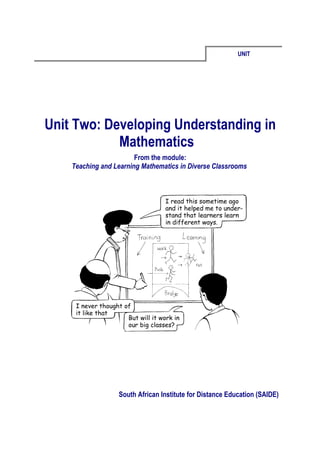
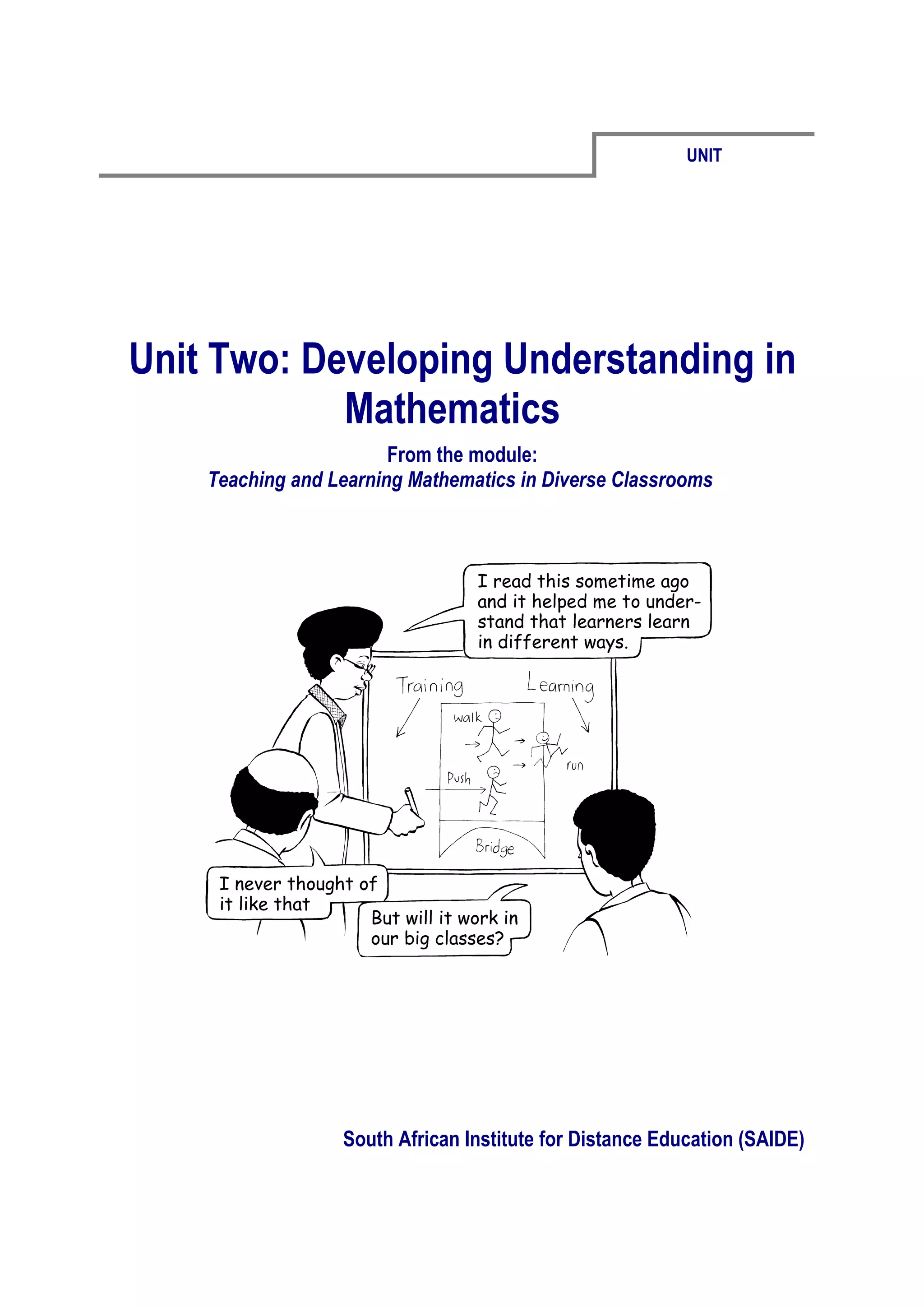
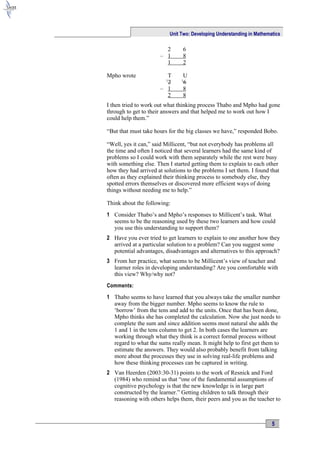
                              “I was thinking about our conversation last week,” said Millicent. “I
                              remembered something I read a long time ago. The writers said that
                              teaching and learning was a bit like building a bridge; we can provide the
                              means and the support but the learners have to physically cross the bridge
                              themselves – some will walk, some will run and some will need a lot of
                              prompting to get to the other side.”

                              “That sounds a bit philosophical to me,” remarked Bobo, “how does that
                              help in practice?”

                              “Well,” Millicent replied, “it helped me to understand that my learners
                              learn in different ways; if I could understand how they thought about
                              things I could probably help them better.

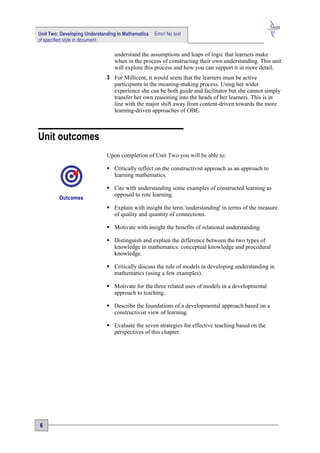
                              Let me give you an example. I gave some of my learners the following
                              problem: 26 – 18. This is how Thabo and Mpho responded:


                              Thabo wrote                  T         U


4
Unit Two: Developing Understanding in Mathematics

                        2         6
                      – 1         8
                        1         2

Mpho wrote              T         U
                         1
                        2         1
                                  6
                      – 1         8
                        2         8
I then tried to work out what thinking process Thabo and Mpho had gone
through to get to their answers and that helped me to work out how I
could help them.”

“But that must take hours for the big classes we have,” responded Bobo.

“Well, yes it can,” said Millicent, “but not everybody has problems all
the time and often I noticed that several learners had the same kind of
problems so I could work with them separately while the rest were busy
with something else. Then I started getting them to explain to each other
how they had arrived at solutions to the problems I set them. I found that
often as they explained their thinking process to somebody else, they
spotted errors themselves or discovered more efficient ways of doing
things without needing me to help.”

Think about the following:
1 Consider Thabo’s and Mpho’s responses to Millicent’s task. What
  seems to be the reasoning used by these two learners and how could
  you use this understanding to support them?
2 Have you ever tried to get learners to explain to one another how they
  arrived at a particular solution to a problem? Can you suggest some
  potential advantages, disadvantages and alternatives to this approach?
3 From her practice, what seems to be Millicent’s view of teacher and
  learner roles in developing understanding? Are you comfortable with
  this view? Why/why not?
Comments:

1 Thabo seems to have learned that you always take the smaller number
  away from the bigger number. Mpho seems to know the rule to
  ‘borrow’ from the tens and add to the units. Once that has been done,
  Mpho thinks she has completed the calculation. Now she just needs to
  complete the sum and since addition seems most natural she adds the
  1 and 1 in the tens column to get 2. In both cases the learners are
  working through what they think is a correct formal process without
  regard to what the sums really mean. It might help to first get them to
  estimate the answers. They would also probably benefit from talking
  more about the processes they use in solving real-life problems and
  how these thinking processes can be captured in writing.
2 Van Heerden (2003:30-31) points to the work of Resnick and Ford
  (1984) who remind us that “one of the fundamental assumptions of
  cognitive psychology is that the new knowledge is in large part
  constructed by the learner.” Getting children to talk through their
  reasoning with others helps them, their peers and you as the teacher to


                                                                          5
Unit Two: Developing Understanding in Mathematics   Error! No text
of specified style in document.

                                 understand the assumptions and leaps of logic that learners make
                                 when in the process of constructing their own understanding. This unit
                                 will explore this process and how you can support it in more detail.
                              3 For Millicent, it would seem that the learners must be active
                                participants in the meaning-making process. Using her wider
                                experience she can be both guide and facilitator but she cannot simply
                                transfer her own reasoning into the heads of her learners. This is in
                                line with the major shift away from content-driven towards the more
                                learning-driven approaches of OBE.


Unit outcomes
                              Upon completion of Unit Two you will be able to:

                               Critically reflect on the constructivist approach as an approach to
                                learning mathematics.

                               Cite with understanding some examples of constructed learning as
                                opposed to rote learning.
         Outcomes
                               Explain with insight the term 'understanding' in terms of the measure
                                of quality and quantity of connections.

                               Motivate with insight the benefits of relational understanding.

                               Distinguish and explain the difference between the two types of
                                knowledge in mathematics: conceptual knowledge and procedural
                                knowledge.

                               Critically discuss the role of models in developing understanding in
                                mathematics (using a few examples).

                               Motivate for the three related uses of models in a developmental
                                approach to teaching.

                               Describe the foundations of a developmental approach based on a
                                constructivist view of learning.

                               Evaluate the seven strategies for effective teaching based on the
                                perspectives of this chapter.


6
Unit Two: Developing Understanding in Mathematics


Introduction
               In recent years there has been an interesting move away from the idea
               that teachers can best help their learners to learn mathematics by deciding
               in what order and through what steps new material should be presented to
               learners. It has become a commonly accepted goal among mathematics
               educators that learners should be enabled to understand mathematics.

                A widely accepted theory, known as constructivism, suggests that
                 learners must be active participants in the development of their own
                 understanding.

                Each learner, it is now believed, constructs his/her own meaning in
                 his/her own special way.

                This happens as learners interact with their environment, as they
                 process different experiences and as they build on the knowledge (or
                 schema) which they already have.

               Njisane (1992) in Mathematics Education explains that learners never
               mirror or reflect what they are told or what they read: It is in the nature of
               the human mind to look for meaning , to find regularity in events in the
               environment whether or not there is suitable information available. The
               verb ‘to construct’ implies that the mental structures (schemas) the child
               ultimately possesses are built up gradually from separate components in a
               manner initially different from that of an adult.

               Constructivism derives from the cognitive school of psychology and the
               theories of Piaget and Vygotsky. It first began to influence the
               educational world in the 1960s. More recently, the ideas of
               constructivism have spread and gained strong support throughout the
               world, in countries like Britain, Europe, Australia and many others.

               Here in South Africa, the constructivist theory of mathematics learning
               has been strongly supported by researchers, by teachers and by the
               education department. The so-called Problem-centred Approach of
               Curriculum 2005 (which preceded the NCS) was implemented in the
               Foundation, Intermediate and Senior Primary phases in many South
               African schools. This was based on constructivist principles. The NCS
               also promotes a constructivist approach to teaching and learning
               mathematics, as you will have seen in unit one, particularly in the section
               where the action words of doing maths were discussed.

               Constructivism provides the teachers with insights concerning how
               children learn mathematics and guides us to use instructional strategies
               developmentally, that begin with the children and not ourselves. This
               chapter focuses on understanding mathematics from a constructivist
               perspective and reaping the benefits of relational understanding of
               mathematics, that is, linking procedural and conceptual knowledge to set
               the foundations of a developmental approach.


                                                                                        7
Unit Two: Developing Understanding in Mathematics   Error! No text
of specified style in document.


A constructivist view of learning
                              The constructivist view requires a shift from the traditional approach of
                              direct teaching to facilitation of learning by the teacher. Teaching by
                              negotiation has to replace teaching by imposition; learners have to be
                              actively involved in ‘doing’ mathematics. This doing need not always be
                              active and involve peer discussion, though it often does. Learners will
                              also engage in constructive learning on their own, working quietly
                              through set tasks, allowing their minds to sift through the materials they
                              are working with, and consolidate new ideas together with existing ideas.
                              Constructivism rejects the notion that children are 'blank slates' with no
                              ideas, concepts and mental structures. They do not absorb ideas as
                              teachers present them, but rather, children are creators of their own
                              knowledge. The question you should be asking now is: How are ideas
                              constructed by the learners?

                              The activity below will get you thinking about different ways in which
                              teachers try to help learners construct their own understanding of key
                              concepts. You should complete the activity according to your own
                              experience as a mathematics learner and teacher.


8
Unit Two: Developing Understanding in Mathematics


             Constructing ideas

             Read through the following approaches that a teacher may employ to help
             learners to construct concepts, rules or principles.
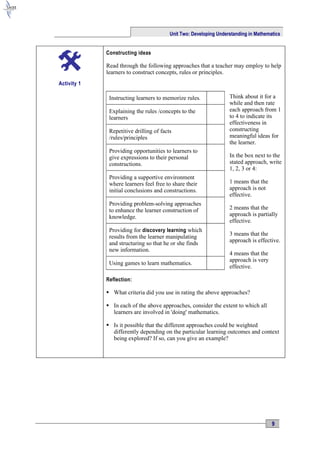
Activity 1

              Instructing learners to memorize rules.              Think about it for a
                                                                   while and then rate
              Explaining the rules /concepts to the                each approach from 1
              learners                                             to 4 to indicate its
                                                                   effectiveness in
              Repetitive drilling of facts                         constructing
              /rules/principles                                    meaningful ideas for
                                                                   the learner.
              Providing opportunities to learners to
              give expressions to their personal                   In the box next to the
              constructions.                                       stated approach, write
                                                                   1, 2, 3 or 4:
              Providing a supportive environment
              where learners feel free to share their              1 means that the
              initial conclusions and constructions.               approach is not
                                                                   effective.
              Providing problem-solving approaches
              to enhance the learner construction of               2 means that the
              knowledge.                                           approach is partially
                                                                   effective.
              Providing for discovery learning which
              results from the learner manipulating                3 means that the
              and structuring so that he or she finds              approach is effective.
              new information.
                                                                   4 means that the
                                                                   approach is very
              Using games to learn mathematics.
                                                                   effective.

             Reflection:

              What criteria did you use in rating the above approaches?

              In each of the above approaches, consider the extent to which all
               learners are involved in 'doing' mathematics.

              Is it possible that the different approaches could be weighted
               differently depending on the particular learning outcomes and context
               being explored? If so, can you give an example?


                                                                                      9
Unit Two: Developing Understanding in Mathematics   Error! No text
of specified style in document.


                              The construction of ideas
                              A key idea of constructivism is simply this: children construct their own
                              knowledge. It is not just children who do this: everyone is involved all
                              the time in making meaning and constructing their own understanding of
                              the world.

                              The constructivist approach views the learner as someone with a certain
                              amount of knowledge already inside his or her head , not as an empty
                              vessel which must be filled. The learner adds new knowledge to the
                              existing knowledge by making sense of what is already inside his or her
                              head . We, therefore, infer that the constructive process is one in which an
                              individual tries to organize, structure and restructure his / her experiences
                              in the light of available schemes of thought. In the process these schemes
                              are modified or changed . Njisane (1992) explains that concepts, ideas,
                              theories and models as individual constructs in the mind are constantly
                              being tested by individual experiences and they last as long as they are
                              interpreted by the individual. No lasting learning takes place if the learner
                              is not actively involved in constructing his or her knowledge.

                              Piaget (Farrell: 1980) insists that knowledge is active, that is, to know an
                              idea or an object requires that the learner manipulates it physically or
                              mentally and thereby transforms (or modifies) it. According to this
                              concept, when you want to solve a problem relating to finance, in the
                              home or at the garage or at the church, you will spontaneously and
                              actively interact with the characteristics of the real situation that you see
                              as relevant to your problem.

                              A banker, faced with a business problem, may 'turn it over in his mind',
                              he may prepare charts or look over relevant data, and may confer with
                              colleagues − in so doing, he transforms the set of ideas in a combination
                              of symbolic and concrete ways and so understands or 'knows' the
                              problem.

                              The tools we use to build understanding are our existing ideas, the
                              knowledge that we already possess. The materials we act on to build
                              understanding may be things we see, hear or touch − elements of our
                              physical world. Sometimes the materials are our own thoughts and ideas
                              − to build our mental constructs upon. The effort that must be supplied by
                              the learner is active and reflective thought. If the learner's mind is not
                              actively thinking, nothing happens.

                              In order to construct and understand a new idea, you have to think
                              actively about it. Mathematical ideas cannot be 'poured into' a passive
                              learner with an inactive mind. Learners must be encouraged to wrestle
                              with new ideas, to work at fitting them into existing networks of ideas,
                              and to challenge their own ideas and those of others.

                              Van de Walle (2004) aptly uses the term 'reflective thought' to explain
                              how learners actively think about or mentally work on an idea. He
                              says:


10
Unit Two: Developing Understanding in Mathematics

         Reflective thought means sifting through existing ideas to find
         those that seem to be the most useful in giving meaning to the new
         idea.

 Through reflective thought, we create an integrated network of
 connections between ideas (also referred to as cognitive schemas ). As
 we are exposed to more information or experience, the networks are
 added to or changed – so our cognitive or mental schemas are always
 being modified to include new ideas.

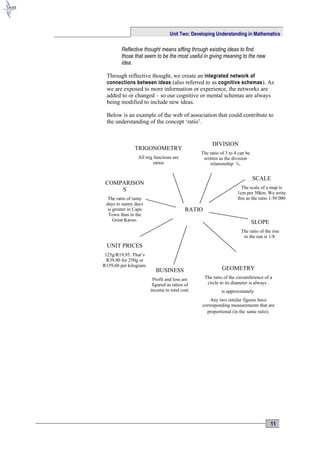
 Below is an example of the web of association that could contribute to
 the understanding of the concept ‘ratio’.


                                                     DIVISION
               TRIGONOMETRY
                                                The ratio of 3 to 4 can be
                 All trig functions are          written as the division
                          ratios                    relationship ¾.


                                                                             SCALE
 COMPARISON
     S                                                               The scale of a map is
                                                                   1cm per 50km. We write
  The ratio of rainy                                               this as the ratio 1:50 000
 days to sunny days
  is greater in Cape                      RATIO
  Town than in the
     Great Karoo.                                                            SLOPE
                                                                     The ratio of the rise
                                                                      to the run is 1/8.
 UNIT PRICES
 125g/R19,95. That’s
  R39,90 for 250g or
R159,60 per kilogram.
                           BUSINESS                        GEOMETRY
                         Profit and loss are      The ratio of the circumference of a
                         figured as ratios of      circle to its diameter is always .
                        income to total cost.             is approximately
                                                    Any two similar figures have
                                                corresponding measurements that are
                                                  proportional (in the same ratio).


                                                                                     11
Unit Two: Developing Understanding in Mathematics   Error! No text
of specified style in document.

                              Cognitive schema: a network of connections between ideas.

                              Select a particular skill (with operations, addition of fractions for
                              example) that you would want your learners to acquire with
                              understanding. Develop a cognitive schema (mental picture) for the newly
         Activity 2           emerging concept (or rule).

                              You should consider the following:

                                  Develop a network of connections between existing ideas (e.g.
                                     whole numbers, concept of a fraction, operations etc).

                                  Add the new idea (addition of fractions for example).

                              Draw in the connecting lines between the existing ideas and the new ideas
                              used and formed during the acquisition of the skill.


                              The general principles of constructivism are based largely on the work of
                              Piaget.

                              He says that when a person interacts with an experience/situation/idea,
                              one of two things happens. Either the new experience is integrated into
                              his existing schema (a process called assimilation ) or the existing schema
                              has to be adapted to accommodate the new idea/experience (a process
                              called adaptation ).

                                  Assimilation refers to the use of an existing schema to give
                                     meaning to new experiences. Assimilation is based on the learner’s
                                     ability to notice similarities among objects and match the new
                                     ideas to those he/she already possesses.

                                  Accommodation is the process of altering existing ways of seeing
                                     things or ideas that do not fit into existing schemata.
                                     Accommodation is facilitated by reflective thought and results in
                                     the changing or modification of existing schemata.

                              The following activity will help you work through these ideas with a
                              mathematical example.


12
Unit Two: Developing Understanding in Mathematics


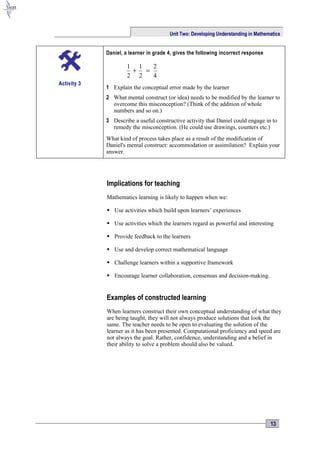
             Daniel, a learner in grade 4, gives the following incorrect response

                     1 1   2
                      +  =
                     2 2   4
Activity 3
             1 Explain the conceptual error made by the learner
             2 What mental construct (or idea) needs to be modified by the learner to
               overcome this misconception? (Think of the addition of whole
               numbers and so on.)
             3 Describe a useful constructive activity that Daniel could engage in to
               remedy the misconception. (He could use drawings, counters etc.)
             What kind of process takes place as a result of the modification of
             Daniel's mental construct: accommodation or assimilation? Explain your
             answer.


             Implications for teaching
             Mathematics learning is likely to happen when we:

              Use activities which build upon learners’ experiences

              Use activities which the learners regard as powerful and interesting

              Provide feedback to the learners

              Use and develop correct mathematical language

              Challenge learners within a supportive framework

              Encourage learner collaboration, consensus and decision-making.


             Examples of constructed learning
             When learners construct their own conceptual understanding of what they
             are being taught, they will not always produce solutions that look the
             same. The teacher needs to be open to evaluating the solution of the
             learner as it has been presented. Computational proficiency and speed are
             not always the goal. Rather, confidence, understanding and a belief in
             their ability to solve a problem should also be valued.


                                                                                    13
Unit Two: Developing Understanding in Mathematics   Error! No text
of specified style in document.

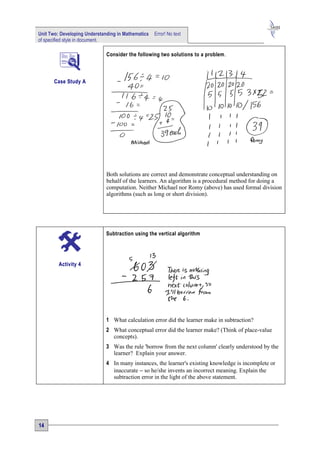
                              Consider the following two solutions to a problem .


       Case Study A


                              Both solutions are correct and demonstrate conceptual understanding on
                              behalf of the learners. An algorithm is a procedural method for doing a
                              computation. Neither Michael nor Romy (above) has used formal division
                              algorithms (such as long or short division).


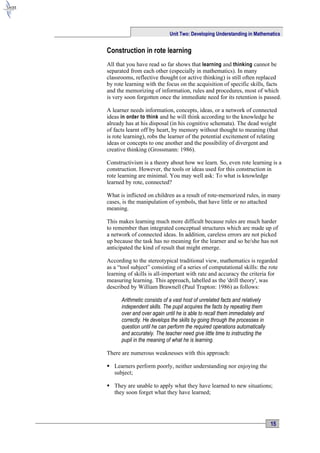
                              Subtraction using the vertical algorithm


         Activity 4


                              1 What calculation error did the learner make in subtraction?
                              2 What conceptual error did the learner make? (Think of place-value
                                concepts).
                              3 Was the rule 'borrow from the next column' clearly understood by the
                                learner? Explain your answer.
                              4 In many instances, the learner's existing knowledge is incomplete or
                                inaccurate − so he/she invents an incorrect meaning. Explain the
                                subtraction error in the light of the above statement.


14
Unit Two: Developing Understanding in Mathematics


Construction in rote learning
All that you have read so far shows that learning and thinking cannot be
separated from each other (especially in mathematics). In many
classrooms, reflective thought (or active thinking) is still often replaced
by rote learning with the focus on the acquisition of specific skills, facts
and the memorizing of information, rules and procedures, most of which
is very soon forgotten once the immediate need for its retention is passed.

A learner needs information, concepts, ideas, or a network of connected
ideas in order to think and he will think according to the knowledge he
already has at his disposal (in his cognitive schemata). The dead weight
of facts learnt off by heart, by memory without thought to meaning (that
is rote learning), robs the learner of the potential excitement of relating
ideas or concepts to one another and the possibility of divergent and
creative thinking (Grossmann: 1986).

Constructivism is a theory about how we learn. So, even rote learning is a
construction. However, the tools or ideas used for this construction in
rote learning are minimal. You may well ask: To what is knowledge
learned by rote, connected?

What is inflicted on children as a result of rote-memorized rules, in many
cases, is the manipulation of symbols, that have little or no attached
meaning.

This makes learning much more difficult because rules are much harder
to remember than integrated conceptual structures which are made up of
a network of connected ideas. In addition, careless errors are not picked
up because the task has no meaning for the learner and so he/she has not
anticipated the kind of result that might emerge.

According to the stereotypical traditional view, mathematics is regarded
as a “tool subject” consisting of a series of computational skills: the rote
learning of skills is all-important with rate and accuracy the criteria for
measuring learning. This approach, labelled as the 'drill theory', was
described by William Brawnell (Paul Trapton: 1986) as follows:

      Arithmetic consists of a vast host of unrelated facts and relatively
      independent skills. The pupil acquires the facts by repeating them
      over and over again until he is able to recall them immediately and
      correctly. He develops the skills by going through the processes in
      question until he can perform the required operations automatically
      and accurately. The teacher need give little time to instructing the
      pupil in the meaning of what he is learning.

There are numerous weaknesses with this approach:

 Learners perform poorly, neither understanding nor enjoying the
  subject;

 They are unable to apply what they have learned to new situations;
  they soon forget what they have learned;


                                                                             15
Unit Two: Developing Understanding in Mathematics   Error! No text
of specified style in document.

                               Learning occurs in a vacuum; the link to the real world is rarely made;

                               Little attention is paid to the needs, interest and development of the
                                learner;

                               Knowledge learned by rote is hardly connected to the child’s existing
                                ideas (that is, the child's cognitive schemata) so that useful cognitive
                                networks are not formed - each newly-formed idea is isolated;

                               Rote learning will almost never contribute to a useful network of
                                ideas.

                               Rote learning can be thought of as a 'weak construction'.


                              Rote learning

                              An enthusiastic class in the Senior Phase is put through a rigorous process
                              of rote learning in mathematics.
         Activity 5           1 From an OBE perspective, would you approve of this approach?
                                Explain your response. List your major concerns with regard to
                                effective and meaningful learning taking place in this class.
                              2 Set a task for your learners to think of creative ways to remember that
                                7 × 8 = 56. They should create their own useful mathematical
                                networks.
                                  (You could engage your learners in the Intermediate Phase with
                                     this activity). Consider the clever ways the class figured out the
                                     product.

                                  Now explain some clever ways the class could use to remember
                                     that 16 × 25 = 400.

                                  Compare the memorization of these facts (7 × 8 = 56 or 6 × 9 = 54)
                                     by rote to the network of profitable mental constructions
                                     (leading to these products). Which approach would you prefer?
                                     Explain your response briefly.

                              Do you think that ultimately all senior phase learners should have the
                              multiplication tables at their fingertips? Give reasons for your answers.


                              Understanding
                              We are now in a position to say what we mean by understanding .
                              Grossman (1986) explains that to understand something means to
                              assimilate it into an appropriate schema (cognitive structure). Recall that
                              assimilation refers to the use of an existing schema (or a network of
                              connected ideas) to give meaning to new experiences and new ideas. It is
                              important to note that the assimilation of information or ideas to an


16
Unit Two: Developing Understanding in Mathematics

inappropriate (faulty, confusing, or incorrect) schema will make the
assimilation to later ideas more difficult and in some cases perhaps
impossible (depending on how inappropriate the schema is).

Grossmann (1986) cites another obstacle to understanding: the belief that
one already understands fully - learners are very often unaware that they
have not understood a concept until they put it into practice. How often
has a teacher given a class a number of similar problems to do (after
demonstrating a particular number process on the board) only to find a
number of children who cannot solve the problems? Those children
thought that they understood, but they did not. The situation becomes just
as problematic when there is an absence of a schema: that is, no schema
to assimilate to, just a collection of memorised rules and facts. For
teachers in the intermediate phase the danger lies in the fact that
mechanical computation can obscure the fact that schemata are not being
constructed or built up, especially in the first few years – this is to the
detriment of the learners’ understanding in later years.

Understanding can be thought of as the measure of the quality and
quantity of connections that an idea has with existing ideas.
Understanding depends on the existence of appropriate ideas and the
creation of new connections. The greater the number of appropriate
connections to a network of ideas, the better the understanding will be. A
person’s understanding exists along a continuum . At one pole, an idea is
associated with many others in a rich network of related ideas. This is the
pole of so-called ‘relational understanding’. At the other, the ideas are
loosely connected, or isolated from each other. This is the pole of so-
called ‘instrumental understanding’.

Knowledge learned by rote is almost always at the pole of instrumental
understanding - where ideas are nearly always isolated and disconnected.

Grossman (1986) draws attention to one of Piaget’s teaching and learning
principles: the importance of the child learning by his or her own
discovery. When learners come to knowledge through self discovery , the
knowledge has more meaning because discovery facilitates the process of
building cognitive structures (constructing a network of connected ideas).
Recall of information (concepts, procedures) is easier than recall of
unrelated knowledge transmitted to the learner.

Through the process of discovery (or investigation), a learner passes
through a process of grasping the basic relations (or connections) of an
event while discarding irrelevant relations and so he or she arrives at a
concept (idea) together with an understanding of the relations that give
the concept meaning: the learner can, therefore, go on to handle and cope
with a good deal of meaningful new, but in fact highly related
information.

We infer from the above that the learner arrives at a concept that is
derived from a schema (a network of connected ideas) rather than from
direct instruction from the teacher. This produces the kind of learner who
is independent, able to think, able to express ideas, and solve problems.
This represents a shift to learner centeredness − where learners are
knowledge developers and users rather than storage systems and
performers (Grossman: 1986).


                                                                       17
Unit Two: Developing Understanding in Mathematics   Error! No text
of specified style in document.


                              Relational and instrumental understanding

                              1 Explain the difference between relational understanding and
                                instrumental understanding.

         Activity 6           2 Explain why relational understanding has a far greater potential for
                                promoting reflective thinking than instrumental understanding .
                              3 Explain what it means to say that understanding exists on a continuum
                                from relational to instrumental. Give an example of a mathematical
                                concept and explain how it might be understood at different places
                                along this continuum.
                              Explain the difference between the use of a rule, an algorithm or an idea,
                              and the thinking strategies, processes and concepts used to construct a
                              solution (or a new idea).


                              Examples of understanding
                              Understanding is about being able to connect ideas together, rather than
                              simply knowing isolated facts. The question 'Does the learner know it?'
                              must be replaced with 'How well does the learner understand it?' The first
                              question refers to instrumental understanding and the second leads to
                              relational understanding. Memorising rules and using recipe methods
                              diligently in computations is knowing the idea. Where the learner
                              connects a network of ideas to form a new idea and arrive at solutions,
                              this is 'understanding the idea' and contributes to how a learner
                              understands.

                              Let’s illustrate this with an example. Look at the subtraction skill
                              involved in the following:

                              15
                              −6

                                .

                              Reflect on the thought processes at different places along the
                              understanding continuum (that is, the continuous closing of 'gaps' for the
                              understanding of the idea at hand).


18
Unit Two: Developing Understanding in Mathematics


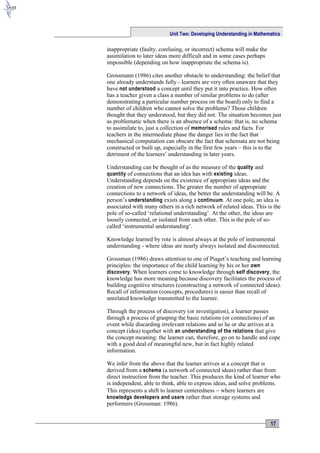
               E                     D                         C                   B                   A

       Relational                                                                                Instrumental
       understanding                     Connection of a network of ideas                        understanding


IDEA A             Instrumental understanding − concept of subtraction is isolated, vague or flawed

IDEA B             Concept of whole numbers (including the skill involved in counting)

IDEA C             Existing concept of the operation 'addition' and its application to the whole
                   numbers (e.g. 4 + 11 = 15 and so on).

IDEA D             Addition and subtraction are opposite operations

                   (e.g. if 5 + 4 = 9, then 9 − 4 = 5 or 9 − 5 = 4).

IDEA E             Relational understanding of the operation subtraction.

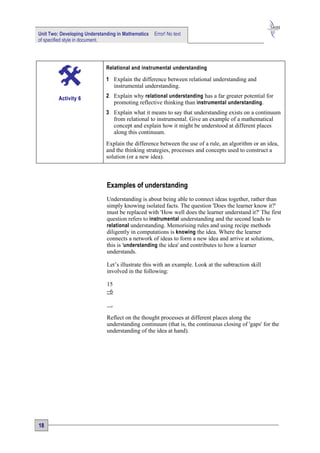
Three strategies are referred to below indicating the connecting ideas required for 15 − 9 = 6.


Strategy 1: Start with 6 and work up to 10.

That is, 6 and 4 more is 10, and 5 more makes 15. The difference between 6 and 15 is 4 + 5 = 9

                                                                                                       15
           6                     4                    10                       5


On the number line

                                                 4                             5


 1     2       3      4      5       6      7     8        9       10   11    12       13   14    15    16


 15     9=6


                                                                                                                 19
Unit Two: Developing Understanding in Mathematics     Error! No text
of specified style in document.

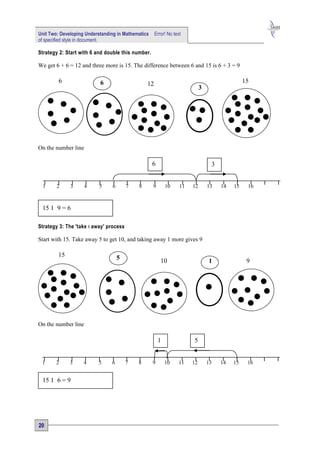
Strategy 2: Start with 6 and double this number.

We get 6 + 6 = 12 and three more is 15. The difference between 6 and 15 is 6 + 3 = 9

         6                 6                     12                                             15
                                                                             3


On the number line

                                                    6                             3


  1     2     3      4     5     6       7   8      9       10     11   12       13   14   15    16


 15 1 9 = 6

Strategy 3: The 'take t away' process

Start with 15. Take away 5 to get 10, and taking away 1 more gives 9

        15                           5                   10                      1               9


On the number line

                                                        1               5


 1     2      3     4     5     6        7   8      9       10     11   12       13   14   15    16


 15 1 6 = 9


20
Unit Two: Developing Understanding in Mathematics


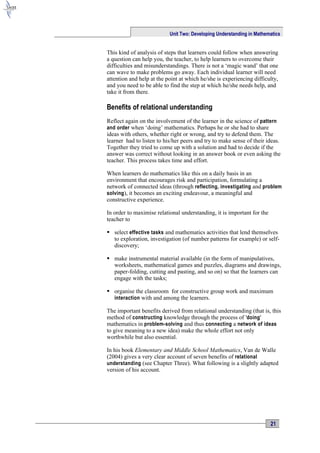
This kind of analysis of steps that learners could follow when answering
a question can help you, the teacher, to help learners to overcome their
difficulties and misunderstandings. There is not a ‘magic wand’ that one
can wave to make problems go away. Each individual learner will need
attention and help at the point at which he/she is experiencing difficulty,
and you need to be able to find the step at which he/she needs help, and
take it from there.

Benefits of relational understanding
Reflect again on the involvement of the learner in the science of pattern
and order when ‘doing’ mathematics. Perhaps he or she had to share
ideas with others, whether right or wrong, and try to defend them. The
learner had to listen to his/her peers and try to make sense of their ideas.
Together they tried to come up with a solution and had to decide if the
answer was correct without looking in an answer book or even asking the
teacher. This process takes time and effort.

When learners do mathematics like this on a daily basis in an
environment that encourages risk and participation, formulating a
network of connected ideas (through reflecting, investigating and problem
solving ), it becomes an exciting endeavour, a meaningful and
constructive experience.

In order to maximise relational understanding, it is important for the
teacher to

 select effective tasks and mathematics activities that lend themselves
  to exploration, investigation (of number patterns for example) or self-
  discovery;

 make instrumental material available (in the form of manipulatives,
  worksheets, mathematical games and puzzles, diagrams and drawings,
  paper-folding, cutting and pasting, and so on) so that the learners can
  engage with the tasks;

 organise the classroom for constructive group work and maximum
  interaction with and among the learners.

The important benefits derived from relational understanding (that is, this
method of constructing knowledge through the process of 'doing '
mathematics in problem-solving and thus connecting a network of ideas
to give meaning to a new idea) make the whole effort not only
worthwhile but also essential.

In his book Elementary and Middle School Mathematics, Van de Walle
(2004) gives a very clear account of seven benefits of relational
understanding (see Chapter Three). What following is a slightly adapted
version of his account.


                                                                         21
Unit Two: Developing Understanding in Mathematics   Error! No text
of specified style in document.

                              Benefit 1: It is intrinsically rewarding

                              Nearly all people, and certainly children, enjoy learning ('what type of
                              learning?', you may ask). This is especially true when new information,
                              new concepts and principles connect with ideas already at the learner’s
                              disposal. The new knowledge now makes sense, it fits (into the learner’s
                              schema) and it feels good. The learner experiences an inward satisfaction
                              and derives an inward motivation to continue, to search and explore
                              further - he or she finds it intrinsically rewarding.

                              Children who learn by rote (memorisation of facts and rules without
                              understanding) must be motivated by external means: for the sake of a
                              test, to please a parent, from fear of failure, or to receive some reward.
                              Such learning may not result in sincere inward motivation and
                              stimulation. It will neither encourage the learner nor create a love for the
                              subject when the rewards are removed.

                              Benefit 2: It enhances memory

                              Memory is a process of recalling or remembering or retrieving of
                              information.

                              When mathematics is learned relationally (with understanding) the
                              connected information , or the network of connected ideas, is simply more
                              likely to be retained over time than disconnected information.

                              Retrieval of information is also much easier. Connected information
                              provides an entire web of ideas (or network of ideas). If what you need to
                              recall seems distant, reflecting on ideas that are related can usually lead
                              you to the desired idea eventually.

                              Retrieving disconnected information or disorganised information is more
                              like finding a needle in haystack.

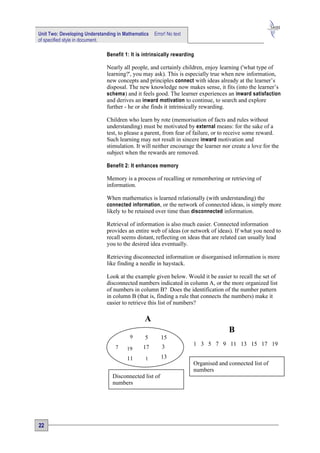
                              Look at the example given below. Would it be easier to recall the set of
                              disconnected numbers indicated in column A, or the more organized list
                              of numbers in column B? Does the identification of the number pattern
                              in column B (that is, finding a rule that connects the numbers) make it
                              easier to retrieve this list of numbers?

                                               A
                                                                                   B
                                        9      5       15
                                                                     1 3 5 7 9 11 13 15 17 19
                                  7    19     17       3
                                       11      1       13
                                                                     Organised and connected list of
                                                                     numbers
                                Disconnected list of
                                numbers


22
Unit Two: Developing Understanding in Mathematics

               Benefit 3: There is less to remember

               Traditional approaches have tended to fragment mathematics into
               seemingly endless lists of isolated skills, concepts, rules and symbols.
               The lists are so lengthy that teachers and learners become overwhelmed
               from remembering or retrieving hosts of isolated and disconnected
               information .

               Constructivists, for their part, talk about how ‘big ideas’ are developed
               from constructing large networks of interrelated concepts. Ideas are
               learned relationally when they are integrated into a web of information, a
               ‘big idea’. For a network of ideas that is well constructed, whole chunks
               of information are stored and retrieved as a single entity or as a single
               ground of related concepts rather than isolated bits.

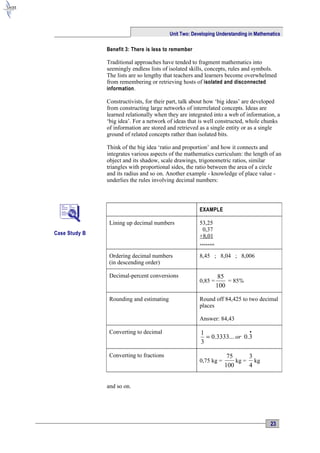
               Think of the big idea ‘ratio and proportion’ and how it connects and
               integrates various aspects of the mathematics curriculum: the length of an
               object and its shadow, scale drawings, trigonometric ratios, similar
               triangles with proportional sides, the ratio between the area of a circle
               and its radius and so on. Another example - knowledge of place value -
               underlies the rules involving decimal numbers:


                                                       EXAMPLE

                Lining up decimal numbers              53,25
                                                        0,37
Case Study B
                                                       +8,01
                                                       ……..

                Ordering decimal numbers               8,45 ; 8,04 ; 8,006
                (in descending order)

                Decimal-percent conversions                      85
                                                       0,85 =       = 85%
                                                                100

                Rounding and estimating                Round off 84,425 to two decimal
                                                       places

                                                       Answer: 84,43

                Converting to decimal                  1                  •
                                                         = 0.3333... or 0.3
                                                       3

                Converting to fractions                             75     3
                                                       0,75 kg =       kg = kg
                                                                   100     4


               and so on.


                                                                                      23
Unit Two: Developing Understanding in Mathematics   Error! No text
of specified style in document.

                              Benefit 4: It helps with learning new concepts and procedures

                              An idea which is fully understood in mathematics is more easily extended
                              to learn a new idea.

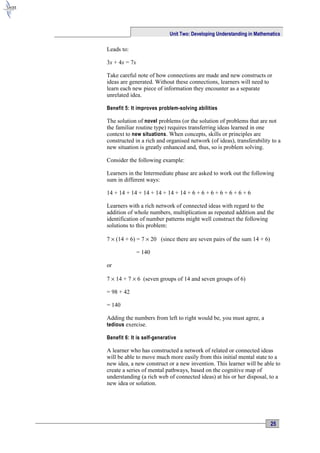
                               Number concepts and relationships help in the mastery of basic facts:

                              For example:

                                           8 + 7 =15                 35
                                                                        =5
                                                                      7
                                           15 − 8 = 7
                                                                     5 × 7 =35
                                           15 − 7 = 8


                               Fraction knowledge and place-value knowledge come together to
                                make decimal learning easier.

                              For example:

                              0,65 + 0,07
                                 65     7
                              =      +
                                100 100
                                 72
                              =
                                100
                              = 0,72

                               Proper construction of decimal concepts will directly enhance an
                                understanding of percentage concepts and procedures.

                              For example:

                              Convert 0,125 to a percentage.

                                        1     2      5
                              0,125 =      +      +
                                       10 100 1000
                                        10      2    0,5 12,5
                                     =      +      +    =     = 12,5%
                                       100 100 100 100

                               Many of the ideas of elementary arithmetic become the model for
                                ideas in algebra.

                              For example:     3×5+4×5=7×5

                                      3×7+4×7=7×7

                                      3 × 12 + 4 × 12 = 7 × 12


24
Unit Two: Developing Understanding in Mathematics

Leads to:

3x + 4x = 7x

Take careful note of how connections are made and new constructs or
ideas are generated. Without these connections, learners will need to
learn each new piece of information they encounter as a separate
unrelated idea.

Benefit 5: It improves problem-solving abilities

The solution of novel problems (or the solution of problems that are not
the familiar routine type) requires transferring ideas learned in one
context to new situations. When concepts, skills or principles are
constructed in a rich and organised network (of ideas), transferability to a
new situation is greatly enhanced and, thus, so is problem solving.

Consider the following example:

Learners in the Intermediate phase are asked to work out the following
sum in different ways:

14 + 14 + 14 + 14 + 14 + 14 + 14 + 6 + 6 + 6 + 6 + 6 + 6 + 6

Learners with a rich network of connected ideas with regard to the
addition of whole numbers, multiplication as repeated addition and the
identification of number patterns might well construct the following
solutions to this problem:

7 × (14 + 6) = 7 × 20 (since there are seven pairs of the sum 14 + 6)

               = 140

or

7 × 14 + 7 × 6 (seven groups of 14 and seven groups of 6)

= 98 + 42

= 140

Adding the numbers from left to right would be, you must agree, a
tedious exercise.

Benefit 6: It is self-generative

A learner who has constructed a network of related or connected ideas
will be able to move much more easily from this initial mental state to a
new idea, a new construct or a new invention. This learner will be able to
create a series of mental pathways, based on the cognitive map of
understanding (a rich web of connected ideas) at his or her disposal, to a
new idea or solution.


                                                                         25
Unit Two: Developing Understanding in Mathematics   Error! No text
of specified style in document.

                              That is, the learner finds a path to a new goal state. Van de Walle agrees
                              with Hiebert and Carpenter that a rich base of understanding can generate
                              new understandings:

                                    Inventions that operate on understanding can generate new
                                    understanding, suggesting a kind of snowball effect. As networks
                                    grow and become more structured, they increase the potential for
                                    invention.

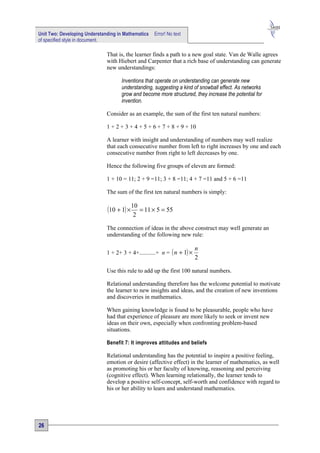
                              Consider as an example, the sum of the first ten natural numbers:

                              1 + 2 + 3 + 4 + 5 + 6 + 7 + 8 + 9 + 10

                              A learner with insight and understanding of numbers may well realize
                              that each consecutive number from left to right increases by one and each
                              consecutive number from right to left decreases by one.

                              Hence the following five groups of eleven are formed:

                              1 + 10 = 11; 2 + 9 =11; 3 + 8 =11; 4 + 7 =11 and 5 + 6 =11

                              The sum of the first ten natural numbers is simply:


                              (10 + 1) × 10 = 11 × 5 = 55
                                          2

                              The connection of ideas in the above construct may well generate an
                              understanding of the following new rule:

                                                                         n
                              1 + 2+ 3 + 4+...........+ n = ( n + 1) ×
                                                                         2

                              Use this rule to add up the first 100 natural numbers.

                              Relational understanding therefore has the welcome potential to motivate
                              the learner to new insights and ideas, and the creation of new inventions
                              and discoveries in mathematics.

                              When gaining knowledge is found to be pleasurable, people who have
                              had that experience of pleasure are more likely to seek or invent new
                              ideas on their own, especially when confronting problem-based
                              situations.

                              Benefit 7: It improves attitudes and beliefs

                              Relational understanding has the potential to inspire a positive feeling,
                              emotion or desire (affective effect) in the learner of mathematics, as well
                              as promoting his or her faculty of knowing, reasoning and perceiving
                              (cognitive effect). When learning relationally, the learner tends to
                              develop a positive self-concept, self-worth and confidence with regard to
                              his or her ability to learn and understand mathematics.


26
Unit Two: Developing Understanding in Mathematics

Relational understanding is the product of a learning process where
learners are engaged in a series of carefully designed tasks which are
solved in a social environment .

Learners make discoveries for themselves, share experiences with others,
engage in helpful debates about methods and solutions, invent new
methods, articulate their thoughts, borrow ideas from their peers and
solve problems − in so doing, conceptual knowledge is constructed and
internalised by the learner improving the quality and quantity of the
network of connected and related ideas.

The effects may be summarized as follows:

 promotes self-reliance and self-esteem

 promotes confidence to tackle new problems

 reduces anxiety and pressure

 develops an honest understanding of concepts

 learners do not rely on interpretive learning but on the construction of
  knowledge

 learners develop investigative and problem-solving strategies

 learners do not forget knowledge they have constructed

 learners enjoy mathematics.

There is no reason to fear or to be in awe of knowledge learned
relationally. Mathematics now makes sense - it is not some mysterious
world that only ‘smart people’ dare enter. At the other end of the
continuum, instrumental understanding has the potential of producing
mathematics anxiety, or fear and avoidance behaviour towards
mathematics.

Relational understanding also promotes a positive view about
mathematics itself. Sensing the connectedness and logic of mathematics,
learners are more likely to be attracted to it or to describe it in positive
terms.

In concluding this section on relational understanding, let us remind
ourselves that the principles of OBE make it clear that learning with
understanding is both essential and possible. That is, all learners can and
must learn mathematics with understanding. Learning with understanding
is the only way to ensure that learners will be able to cope with the many
unknown problems that will confront them in the future.


                                                                         27
Unit Two: Developing Understanding in Mathematics   Error! No text
of specified style in document.


                              Benefits of relational understanding

                              Examine the seven benefits of relational understanding given above.

                              Select the benefits that you think are most important for the learning (with
         Activity 7           understanding) of mathematics. Discuss this with fellow mathematics
                              teachers.

                              Describe each of the benefits chosen above and then explain why you
                              personally believe each one is significant. Try to illustrate your thinking
                              with a practical example from your own classroom.


Types of mathematical knowledge
                              All knowledge, whether mathematical or other knowledge, consists of
                              internal or mental representations of ideas that the mind has constructed.
                              The concept itself, then, exists in the mind as an abstraction . To illustrate
                              this point Farrell and Farmer (1980) refer to the formation of the concept
                              of a 'triangle' as follows:

                                    When you learned the concept of 'triangle' you may have been
                                    shown all kinds of triangular shapes like cardboard cut-outs,
                                    three pipe cleaners tied together, or pictures of triangular
                                    structures on bridges or pictures of triangle in general.
                                    Eventually, you learned that these objects and drawings were
                                    representations or physical models of a triangle, not the
                                    triangle itself. In fact, you probably learned the concept of
                                    triangle before you were taught to give a definition and you may
                                    have even learned quite a bit about the concept before anyone
                                    told you its name. So a concept is not its label, nor is it any
                                    physical model or single example. The concept of the triangle,
                                    therefore, resides in the mental representation of the idea that
                                    the mind has constructed.

                              You may also include terms such as integer, pi (π), locus, congruence, set
                              addition, equality and inequality as some of the mental representations of
                              ideas that the mind has constructed in mathematics.

                              According to Njisane (1992) in Mathematics Education, Piaget
                              distinguishes three types of knowledge, namely, social, physical and
                              logico-mathematical knowledge:

                               Social knowledge is dependent on the particular culture. In one culture
                                it is accepted to eat with one's fingers, in another it may be considered
                                as bad manners. Social knowledge is acquired through interaction with


28
Unit Two: Developing Understanding in Mathematics

                other people. Presumably the best way to teach it in the classroom
                would be through telling.

              Physical knowledge is gained when one abstracts information about
               the objects themselves. The colour of an object, its shape, what
               happens to it when it is knocked against a wall and so on are examples
               of physical knowledge.

              Logico-mathematical knowledge is made up of relationships between
               objects, which are not inherent in the objects themselves but are
               introduced through mental activity.

             For example, to acquire a concept of the number 3, a learner needs to
             experience different situations where three objects or elements are
             encountered. Logico- mathematical knowledge is acquired through
             reflective abstraction , depending on the child’s mind and the way he or
             she organizes and interprets reality. It seems that each one of us arrives at
             our own logico-mathematical knowledge.

             It is important to note that the acquisition of logico-mathematical
             knowledge without using social and physical knowledge as a foundation
             is bound to be ineffective. Since relational understanding depends on the
             integration of ideas into abstract networks of ideas (or a network of
             interconnected ideas), teachers of mathematics may just view
             mathematics as something that exists 'out there', while forgetting the
             concrete roots of mathematical ideas. This could result in a serious
             mistake - teachers must take into account how these mental
             representations of the mind are constructed. That is, through effective
             interaction and 'doing mathematics'.


             Logico-mathematical knowledge

             Read the text above and then answer the following question:

             Can logico-mathematical knowledge be transmitted from the teacher to
Activity 8   the learner while the learner plays a passive role? Explain your response.

             In your response remember to consider that:

              mental ideas or representations need to be constructed by the learner.

              the learner requires interaction and mental activity to establish
               relationships between objects.


             Conceptual understanding of mathematics
             Conceptual knowledge of mathematics consists of logical relationships
             constructed internally and existing in the mind as a part of the greater
             network of ideas:


                                                                                     29
Unit Two: Developing Understanding in Mathematics   Error! No text
of specified style in document.

                               It is the type of knowledge Piaget referred to as logico-mathematical
                                knowledge. That is, knowledge made up of relationships between
                                objects, which are not inherent in the objects themselves, but are
                                introduced through mental activity.

                               By its very nature, conceptual knowledge is knowledge that is
                                understood.

                              You have formed many mathematical concepts. Ideas such as seven,
                              nine, rectangle, one/tens/hundreds (as in place value), sum, difference,
                              quotient, product, equivalent, ratio, positive, negative are all examples of
                              mathematical relationships or concepts.

                              It would be appropriate at this stage to focus on the nature of
                              mathematical concepts. Richard R Skemp (1964) emphasises the
                              following (which should draw your attention):

                              Mathematics is not a collection of facts, which can be demonstrated, seen
                              or verified in the physical world (or external world), but a structure of
                              closely related concepts, arrived at by a process of pure thought.

                              Think about this: that the subject matter of mathematics (or the concepts
                              and relationships) is not to be found in the external world (outside the
                              mind), and is not accessible to our vision, hearing and other sense organs.
                              These mathematical concepts have only mental existence - so in order to
                              construct a mathematical concept or relationship, one has to turn it away
                              from the physical world of sensory objects to an inner world of purely
                              mental objects.

                              This ability of the mind to turn inwards on itself, that is, to reflect , is
                              something that most of us use so naturally that we may fail to realize
                              what a remarkable ability it is. Do you not consider it odd that we can
                              'hear' our own verbal thoughts and 'see' our own mental images, although
                              no one has revealed any internal sense organs which could explain these
                              activities? Skemp (1964) refers to this ability of the mind as reflective
                              intelligence.

                              Are mathematical concepts different from scientific concepts? Farrell
                              and Farmer (1980) explains that unlike other kinds of concepts such as
                              cow, dog, glass, ant, water, flower, and the like, you cannot see or
                              subject to the other senses examples of triangle, points, pi, congruence,
                              ratio, negative numbers and so on. ‘But we write numbers, don't we?’ you
                              may ask. No, we write symbols which some prefer to call numerals , the
                              names for numbers. Now reflect on the following key difference between
                              mathematics and science:

                              Scientific concepts include all those examples which can be perceived by
                              the senses, such as insect and flower, and those whose examples cannot
                              be perceived by the senses, such as atom and gravity. These latter
                              concepts are taught by using physical models or representations of the
                              concepts (as in the case of mathematics). (Farrell & Farmer: 1980).

                              Skemp (1964) urges us to see that the data of sensori-motor learning are
                              sense data present in the external world - however, the data for reflective


30
Unit Two: Developing Understanding in Mathematics

intelligence are concepts, so these must have been formed in the learner’s
own mind before he or she could reflect on them. A basic question that
you may ask at this stage is: How are mathematical concepts formed?

Skemp (1964) points out that to give someone a concept in a field of
experiences which is quite new to him or her, we must do two things:

Arrange for him or her a group of experiences which have the concept as
common and if it is a secondary concept (that is a concept derived from
the primary concepts), we also have to make sure that he or she has the
other concepts from which it is derived (that is the prerequisite concepts
need to be in place in the mental schema of the learner).

Returning now to mathematics: ‘seven’ is a primary concept , representing
that which all collections of seven objects have in common. ‘Addition’ is
another concept, derived from all actions or processes which make two
collections into one. These concepts require for their learning a variety of
direct sensory experiences (counters, manipulative and so on) from the
external world to exemplify them.

The weakness of our present teaching methods comes, according to
Skemp (1964), during and after the transition from primary to secondary
concepts, and other concepts in the hierarchy. For example, from working
through the properties of individual numbers to generalization about
these properties ; from statements like

9 × 6 = 54 to those like 9(x + y) = 9x + 9y.

Do you agree that many learners never do understand what these
algebraic statements really mean, although they may, by rote-learning,
acquire some skills in performing as required certain tricks with the
symbols? Understanding these statements requires the formation or
construction of the appropriate mathematical concepts.

Are there any limitations in the understanding of mathematical concepts
learnt through the use of physical objects and concrete manipulatives
from the external world? Skemp (1964) agrees fully with Diennes that to
enable a learner to form a new concept, we must give him (or her) a
number of different examples from which to form the concept in his or
her own mind - for this purpose some clever and attractive concrete
embodiments (or representations) of algebraic concepts in the form of
balances, peg-boards, coloured shapes and frames and the like are
available.

However, these concrete embodiments fail to take into account the
essential difference between primary and higher order concepts - that is,
only primary concepts can be exemplified in physical or concrete objects,
and higher order concepts can only be symbolised .

To explain this, think of the concept 3 + 4 = 7, which can be
demonstrated physically with three blocks and four blocks or with beads
or coins, But

3x + 4x = 7x


                                                                       31
Unit Two: Developing Understanding in Mathematics   Error! No text
of specified style in document.

                              is a statement that generalises what is common to all statements such as

                              3×5+4×5=7×5

                              3 × 8 + 4 × 8 = 7 × 8 etc.

                              and which ignores particular results such as:

                              3 × 5 + 4 × 5 = 35.

                              Do you agree, therefore, that understanding of the algebraic statement is
                              derived from a discovery of what is common to all arithmetical statements
                              of this kind, not of what is common to any act or actions with physical
                              objects?

                              As new concepts and relationships are being assimilated in the network
                              of connected ideas, the direction of progress is never away from the
                              primary concepts. This progress results in the dependence of secondary
                              concepts upon primary concepts. Once concepts are sufficiently well
                              formed and independent of their origins, they become the generators of
                              the next higher set - and in so doing lead to the construction of a
                              hierarchy of concepts.

                              Van de Walle (2004: 26) cautions us that the use of physical (or concrete)
                              objects in teaching may compromise meaningful understanding of
                              concepts. This happens if there are insufficient opportunities for the
                              learner to generalise the concept:

                                    Diennes’ blocks are commonly used to represent ones, tens and
                                    hundreds. Learners who have seen pictures of these or have used
                                    actual blocks may labour under the misconception that the rod is
                                    the 'ten' piece and the large square block is the 'hundreds' piece.
                                    Does this mean that they have constructed the concepts of ten and
                                    hundred? All that is known for sure is that they have learned the
                                    names for these objects, the conventional names of the blocks.
                                    The mathematical concept of ten is that a ten is the same as ten
                                    ones. Ten is not a rod. The concept is the relationship
                                    between the rod and the small cube - the concept is not the rod
                                    or a bundle of ten sticks or any other model of a ten. This
                                    relationship called 'ten' must be created by learners in their own
                                    minds.

                              Here is another interesting example that distinguishes the concept from
                              the physical object. In this example the shapes are used to represent
                              wholes and parts of wholes, in other words, this is an example dealing
                              with the concept of a fraction.

                              Reflect carefully on the three shapes (A, B and C) which can be used to
                              represent different relationships.


32
Unit Two: Developing Understanding in Mathematics


  A                     B                             C


If we call shape B 'one' or a whole, then we might refer to shape A as
'one-half '. The idea of 'half' is the relationship between shapes A and B, a
relationship that must be constructed in our mind as it is not in the
rectangle.

If we decide to call shape C the whole, shape A now becomes 'one-
fourth'. The physical model of the rectangle did not change in any way.
You will agree that the concepts of 'half' and 'fourth' are not in rectangle
A - we construct them in our mind . The rectangles help us to 'see' the
relationship, but what we see are rectangles, not concepts. Assigning
different rectangles the status of the ‘whole’ can lead to generalisation of
the concept.


                                                                        33
Unit Two: Developing Understanding in Mathematics   Error! No text
of specified style in document.

                              The formation of concepts

                              For this activity you are required to reflect on conceptual knowledge in
                              mathematics.
         Activity 9           1 Richard R Skemp states that 'mathematics is not a collection of facts
                                which can be demonstrated and verified in the physical world, but a
                                structure of closely related concepts, arrived at by a process of pure
                                thought'.
                                  Discuss the above statement critically with fellow teachers of
                                      mathematics. Take into account how concepts and logical
                                      relationships are constructed internally and exist in the mind as
                                      part of a network of ideas.

                                  In the light of the above statement explain what Skemp means
                                       when he refers to 'reflective intelligence' (the ability of the mind
                                       to turn inwards on itself).

                                  Why are 'scientific concepts' different from 'mathematical
                                     concepts'? Explain this difference clearly using appropriate
                                     examples.
                              2 Skemp points out that to help a learner construct a concept in a field of
                                experience which is quite new to him or her, we must do two things.
                                Mention the two activities that the teacher needs to follow to help the
                                learner acquire 'primary concepts', 'secondary concepts', and other
                                concepts in the hierarchy of concepts.
                              3 Skemp distinguishes between 'primary concepts' and 'secondary
                                concepts' in the learning of mathematics. Reflect on the difference
                                between concepts which are on different levels. Name some secondary
                                concepts that learners in the Senior Phase may encounter.
                              4 Analyse the three shapes (A, B and C) shown in the text on the
                                previous page. Explain why the concepts ‘half’ and ‘quarter’ are not
                                physically in rectangle A - but in the mind of the learner. Explain the
                                implications of this for teaching using manipulatives (concrete
                                apparatus).

                              Procedural knowledge of mathematics
                              Procedural knowledge of mathematics is knowledge of the rules and
                              procedures that one uses in carrying out routine mathematical tasks. It
                              includes the symbolism that is used to represent mathematics.

                              You could, therefore, infer that knowledge of mathematics consists of
                              more than concepts. Step-by-step procedures exist for performing tasks
                              such as:

                              56 × 74          (Multiplying two digit numbers)

                              1 932 ÷ 28       (Long division)


34
Unit Two: Developing Understanding in Mathematics


              3 5
                +             (Adding fractions)
              8   6

              0,85 × 0,25     (Multiplying decimal numbers)

              and so on.

              Concepts are represented by special words and mathematical symbols
              (such as π , =, < , >, //, ≡, ∠ABC = 45° and so on). These procedures
              and symbols can be connected to or supported by concepts − but very few
              cognitive relationships are needed to have knowledge of a procedure
              (since these could be diligently memorized through drill and practice).

              In mathematics, we use a number of different symbols which indicate
              procedures that need to be followed. For example, if we write
              (8 + 7) ÷ 3 + 10, it means a different procedure has to be followed than if
              we write this as 8 + 7 ÷ (3 + 10). We get different answers when we
              follow the different procedures. So we find that

              (8 + 7) ÷ 3 + 10 = 15÷ 3 + 10 = 5 + 10 = 15 and

                                             15     2
              8 + 7 ÷ (3 + 10) = 15 ÷ 13 =      =1
                                             13    13

              However, the meaning we attach to symbolic knowledge depends on how
              it is understood – what concepts and other ideas we connect to the
              symbols.

              What are procedures? These are the step-by-step routines learned to
              accomplish some task - like a computation in the classroom situation.


              Procedures

              Reflect on the following example of a procedure:

              To add two three-digit numbers, first add the numbers in the right-hand
Activity 10   column. If the answer is 10 or more, put the 1 above the second column,
              and write the other digit under the first column. Proceed in a similar
              manner for the second two columns in order.

               Use an appropriate example to test the above procedure (or recipe) for
                the addition of two three-digit numbers.

               Give another example for a procedure for the purpose of computation.
                Describe the step-by-step procedure operative in the calculation.


              We can say that someone who can work through the variations of the
              procedures in activity 10 has knowledge of those procedures. The


                                                                                     35
Unit Two: Developing Understanding in Mathematics   Error! No text
of specified style in document.

                              conceptual understanding that may or may not support the procedural
                              knowledge can vary considerably from one learner to the next.

                              In mathematics, we often use the term ‘algorithm’ to refer to a procedure.
                              An algorithm , according to Njisane (Moodly: 1992), is

                                    a procedure which consists of a finite number of steps that lead
                                    to a result.

                              A simple example of an algorithm is the set of steps used to perform the
                                                            1 1
                              addition of fractions, e.g.    + .
                                                            5 3

                              The use of algorithms is often helpful, but, to be helpful, algorithms must
                              be understood. Njisane (Moodly: 1992) comments that an algorithm
                              which is properly understood may free the mind for further thinking
                              whereas using an algorithm without insight may be frustrating. This is the
                              difference between the 'how' and 'why' or between procedural and
                              relational understanding (that is, forming a network of connected ideas).
                              If the procedure refers to what we do when following a set of steps, then
                              relational understanding refers to why we do whatever we do.

                              Procedural knowledge and doing mathematics
                              As you read further it will be important for you to understand why the
                              connections between procedural knowledge and the underlying
                              conceptual knowledge and relationships are vital for the construction of
                              relational understanding in mathematics. You will also see that the ability
                              to make connections plays a very important role both in learning and in
                              'doing' mathematics.

                               Algorithmic procedures help us to do routine tasks easily and, thus,
                                free our minds to concentrate on more important tasks (like thinking
                                out problem-solving strategies for example).

                               Symbolism (which is part of procedural knowledge) is a powerful
                                mechanism for conveying mathematical ideas to others and for
                                manipulating an idea as we do mathematics.

                               Efficient use of the procedures and symbolism of mathematics does
                                not necessarily imply an understanding of these things.

                              For example, think of the endless long-division and long-multiplications
                              exercises in the classroom. Will these algorithmic exercises help the
                              learner understand what division and multiplication mean? Carrying out
                              the step-by-step computation does not necessarily translate into
                              understanding the underlying concepts and relationships. In fact, learners
                              who are skilful with a particular procedure are often reluctant to attach
                              meaning to it after the fact.

                              Why the focus on concept and relationships? Recall that we said that
                              learning and thinking cannot be separated from each other.


36
Unit Two: Developing Understanding in Mathematics

              If the focus of learning is on the acquisition of specific skills, facts,
              procedures and the memorisation of information and rules, then thinking
              is suppressed. The learner requires concepts and information in order to
              think and he or she will think according to the knowledge already at his
              or her disposal. As mentioned before, you should reflect on how the
              weight of facts, rules and procedures robs the learner of the potential
              excitement of relating concepts to one another and the possibility of
              divergent and creative thinking . It also instils in the learner the habit of
              separating thinking and learning, and it often leaves learners with feelings
              of low self-esteem (Grossman: 1986). Procedural knowledge with little or
              no attached meaning results in inflicting on the learner the manipulation
              of symbols according to a number of rote memorised rules, which makes
              learning much harder to remember than an integrated conceptual
              structure – a network of connected ideas.

              To construct and understand a new idea (or concept) requires active
              thinking about it . Recall again that mathematical ideas cannot be 'poured
              into' a passive learner. They must be mentally active for learning to take
              place – they must be seriously engaged in 'doing mathematics'. In the
              classroom, the learners must be encouraged to:

               grapple with new ideas

               work at fitting them into existing networks

               and to challenge their own ideas and those of others.

              Simply put, constructing knowledge requires reflective thought, actively
              thinking about or mentally working on an idea – all this to overcome the
              acquisition of procedural knowledge without relational understanding.


              Meaningful constructing of procedural knowledge

              Reflect on the following statement:

                    From the view of learning mathematics, the question of how
Activity 11         procedures and conceptual ideas can be linked is much more
                    important than the usefulness of the standard procedure.

              Use this statement to motivate why the inventions made by the two
              learners on their own to solve 156 ÷ 4 (illustrated earlier in section 2.2 in
              Case Study A) are considered more meaningful and enduring than the
              recipe type solutions.


                                                                                       37
Unit Two: Developing Understanding in Mathematics   Error! No text
of specified style in document.


A constructivist approach to
teaching the four operations
                              The understanding of the four basic operations is crucial to all other areas
                              of mathematics. A solid foundation needs to be established in basic
                              number work especially in the earlier phases of schooling. But, in order
                              to support constructivist teaching of mathematics, this should not be done
                              simply by using traditional algorithms. Though the aim is for learners to
                              calculate fluently using all four basic operations, they should learn to do
                              this by creating or inventing their own strategies. They must be able to
                              explain what they have done, rather than simply do it mechanically.

                              Devising strategies for doing operations relates to the problem-solving
                              approach of devising a plan, carrying out the plan and then evaluating the
                              plan which will be explored fully in Unit Three. But if taught properly,
                              the four basic operations also illustrate the constructivist theory of
                              learning, the subject of this unit.

                              For constructivist teaching of mathematics, it is critical to develop a
                              variety of strategies, rather than simply teaching a single strategy. In this
                              section, we therefore provide a range of alternative strategies so that you
                              can vary your teaching and assessment of the operations.

                              Mental mathematics should be done daily, as drill and practice plays an
                              important role in the mastery of computational skills. But even when
                              doing mental mathematics learners need to explain how they arrived at a
                              solution. Posing problems on flash cards for 5 to 10 minutes each day
                              helps learners to think about alternative problem solving strategies and
                              encourages reasoning skills, mental speed, accuracy, interaction and
                              communication.

                              Classroom exercises on the basic operations
                              The following exercises for developing a number sense were developed
                              by Tom Penlington (RUMEP: 2000). They will help learners refine their
                              basic operation strategies and can be adapted for decimal fractions and
                              percentages. These exercises will give you the opportunity to develop
                              your own understanding of the operations (which fall under LO1 in the
                              NCS for Mathematics).
                              1 Let learners count on the back of multiples. For example start at 21
                                and count in 7’s, or count back from 64 in 8’s
                              2 Doubling and halving of whole numbers, decimals and fractions.
                              3 Tables: draw up tables of patterns using the doubling strategy.
                              4 Breaking up numbers : 3 584 = 3 000 + 500 + 80 + 4
                                (decomposition).
                              5 Add on and back in multiples.
                              6 Pattern recognition      (see number 3)


38
Unit Two: Developing Understanding in Mathematics

   32 – 5 = 27       27 + 5 = 32
   42 – 5 = 37       37 + 5 = 42 Do + and – together
   52 – 5 = 47       47 + 5 = 52
Do x and ÷ together
   1 x 4 = 4                      4 ÷ 4 = 1
   2 x 4 = 8                      8 ÷ 4 = 2
   4 x 4 = 16                     16 ÷ 4 = 4
   8 x 4 = 32                     32 ÷ 4 = 8
   3 x 4 = 12                     12 ÷ 4 = 3
   6 x 4 = 24                     24 ÷ 4 = 6
   9 x 4 = 36                     36 ÷ 4 = 9
7 How many …
   i   6’s in 42?
   ii 60’s in 420?         WHY?
8 Which numbers without a remainder can be divided into 24?
9 What numbers between 70 and 700 are divisible by 7?
10 Take the number 48. Make it 100, make it 500, make it 1000
11 How much must I go back from 36 to get to 3?
12 How much must I add to get from 31 to 46?
13 What minus 6 is 5?
14 What is the difference between 32 and 21?
15 What is the total of 45, 2 and 9?
16 What is the product of 9 and 12?
Strategies for addition for foundation phase learners

1. Putting the larger number first when counting on or adding:

   3 + 12 → 12 + 3
2. Partitioning problem:

   24 + 13       → 20 + 4 + 10 + 3
                 → 20 + 10 + 3 + 4
                 =    30 + 7 = 37
3. Bridging through 10 using familiar numbers bonds 1 to 10:

   18 + 6 = 18 + 2 + 4 = 24
4. Counting on in 10’s:

   23 + 40 to find the answer, count on in tens… 23; 33; 43; 53; 63


                                                                         39
Unit Two: Developing Understanding in Mathematics   Error! No text
of specified style in document.

                              5. Compensation for example adding by using ‘+ 10 – 1’:

                                 43 + 9 = 43 + 10 – 1 = 53 – 1 = 52
                                 An example of a simple word problem using four different strategies:
                                 I have 27c. I get 35c more. How much do I now have?
                                 27 + 35 = *
                                     1) 20 + 30 → 50 + 7 → 57 + 5 → 62
                                     2) 20 + 30 = 50
                                          7 + 5      = 12
                                         50 + 12 = 62
                                     3) 27 + 3 =30 ; 35 – 3 = 32 ; 30 + 32 = 62
                                     4) 27 + 30 → 57 + 5 → 62
                              Strategies for subtraction for foundation and intermediate phase learners

                              1. Partitioning:

                                 23 – 5 = 20 – 5 + 3 = 15 + 3 = 18
                              2. Complementary addition or ‘shopkeeper’s addition’ (adding on):

                                 31 – 18 =
                                 18 + 2 → 20 + 10 → 30 + 1 → 31
                              3. Compensation:

                                 28 – 9 = 28 – 10 + 1 = 19


                              Strategies for multiplication for foundation and intermediate phase
                              learners

                              1. Using doubles:

                                 I want to know what 6 x 6 is.
                                 I want to know what 2 x 6 is.            It is 12, so 3 x 6 = 18
                                 doubled is 36
                                 1 x 6 = 6
                                 3 x 6 = 18.        This doubled is 6 x 6 = 36
                              2. Using repeated doubling:

                                 13 x 4 = 4 x 13
                                            2 x 13 = 26
                                            2 x 13 = 26              So 26 doubled is 52
                                            4 x 13 = 52              So 13 x 4 is 52


40
Unit Two: Developing Understanding in Mathematics

3. Using the effect of multiplying numbers by 10:

   E.g.    20 x 7 = 2 x 7 x 10 = 14 x 10 = 140
Strategies for division for foundation and intermediate phase learners

1. Using known facts:

   Half of 46 is 23
2. Using repeated halving:

   100 ÷ 4 =
   Half of 100 = 50
   Halve again: half of 50 is 25
3. Using multiplication facts:

     28 ÷ 7 = 4       since 4 x 7 = 28
   180 ÷ 3 = 60         since 18 ÷ 3 = 6
4. Partitioning larger numbers:

   116 ÷ 4
   100 ÷ 4 = 25
     16 ÷ 4 = 4
    116 ÷ 4 = 29
   An example: A farmer picks 338 oranges. They are packed into bags
   with 13 oranges in each bag. How many bags of oranges are there?
       1) 338 ÷ 13 = *
            13 x 10 → 130 + 130 → 260 + 52 → 312 + 26 → 338
            10 + 10 + 4 + 2 = 26. There are 26 bags of oranges.
       2) 338 ÷ 13 = 26. We can do this calculation by partitioning:
            260 ÷ 13 = 20             13 x 20 = 260
             78 ÷ 13 = 6              13 x 6 = 78
                           So 26 x 13 = 338
Strategies for addition for intermediate and senior phase learners

1. Bridging through a decade uses multiples of 10 and makes use of
complements (number bonds within 10 or 20):

           67 + 35 is solved by using 3 + 7 = 10 and expressing the 5
   (from the 35) as the sum of 3 and 2.
            67 + 35 → 67 + 3 = 70 then add 70 + 30 + 2
            or 67 + 35 → 35 + 5 = 40 then add 40 + 60 + 2
   A more sophisticated ‘bridge’ might be:
   78 + 27 → 78 + 22 = 100


                                                                             41
Unit Two: Developing Understanding in Mathematics     Error! No text
of specified style in document.

                                 100 + 5 = 105
                              2. Partitioning splits numbers into 10’s and 1’s using place value:

                                 24 + 37            20 + 30 + 7 + 4
                                 this can develop so that only the smaller number is split.
                                 24 + 37 → 37 + 20 + 4
                              3. Using known facts:

                                 75 + 30. I know 75 plus 25 is 100, so 75 plus 30 must be 105.
                              4. Using known fact flexibly: doubles

                                 35 + 38 → (2 x 35) + 3
                              5. Using known facts flexibly: compensating

                                 Round off the 38 to 40 and subtract 2
                                 35 + 38 → (35 + 40) – 2
                              Strategies for subtraction for intermediate and senior phase learners

                              1. Counting on:

                                 75 – 38 is solved as :
                                 75 – 5 → 70 – 30              → 40 – 3 → 37
                                 -5 + -30 + -3 = -38
                              2. Partitioning as in the addition strategy uses place value to split numbers into
                              10’s and 1’s:

                                 74 – 42 is broken into 70 – 40 and 4 - 2
                                 Look at this example: 34 – 27 is broken into (30 - 27) + 4 or (34
                                 – 20) -7
                                 Even this is a good way learners use : (30 - 20) + (4 - 7) =              10
                                 + -3 = 7
                              Strategies for multiplication for intermediate and senior phase learners

                              1. Making use of number patterns:

                                 35 x 100 = 3 500
                                 35 x 300 = 35 x 3 (100)
                                 Extend this to decimals : 4,7 x 20 → 4,7 x 2 x 10.
                                 Another example : 3,4 x 8 = (3,4 x 10) – 6,8 = 34 – 6,8 = 27,2.
                                 This is a very sophisticated approach indicating a well developed
                                 number sense.
                              2. Extending the doubling strategy with some recording:

                                 24 x 13 =
                                 13 = 8 + 4 + 1 and 1 x 24 = 24


42
Unit Two: Developing Understanding in Mathematics

                                          2 x 24 = 48
                                          4 x 24 = 96
                                          8 x 24 = 192 so my 13 is made up of 8
                  which is 192,           4, which is 96 and 1 which is 24
                  Or, since 24 x 13 = 24 x (8 + 4 + 1) = (24 x 8) + (24 x 4) + (24 x 1)
                  we get 24 x 13 = 192 + 96 + 24 = 312


               Strategies for division for intermediate and senior phase learners

               Doubling and halving may be combined:

                  1)       48 ÷ 5 →      48 ÷ 10 x 2 =       4,8 x 2 → 9,6
                  2)       140 ÷ 4 = (140 ÷ 2) ÷ 2 = 70 ÷ 2 → 35


The role of models in developing
understanding
               Today we find common agreement that effective mathematics instruction
               in the primary grades includes liberal use of concrete materials. However,
               we shouldn’t simply use concrete materials uncritically in the teaching of
               mathematics. The aim in this section is to reflect on how to use concrete
               materials and models in teaching judiciously and reflectively for
               understanding.

               Our primary question should always be:

               What in principle, do I want my learners to understand?

               But too often it is,

               What shall I have my learners learn to do?

               If you can answer only the second question, then you have not given
               sufficient thought to what you hope to achieve by a particular set of
               instructions on the use of models. The activities that you plan for your
               learners to do must be guided by what you would like them to
               understand .


                                                                                      43
Unit Two: Developing Understanding in Mathematics   Error! No text
of specified style in document.

                              Manipulatives, or concrete, physical materials used to model
                              mathematical concepts, are certainly important tools available for helping
                              children learn mathematics, but they are not the miracle cure that some
                              educators seem to believe them to be.

                              It is important that you have a good perspective on how manipulatives
                              (concrete, physical models) can help or fail to help learners to construct
                              ideas.

                              Models for mathematical concepts
                              Mathematical concepts have only mental existence - that is, the subject
                              matter of mathematics is not to be found in the external world, accessible
                              to our vision, hearing and other sense organs. We can only ‘do’
                              mathematics because our minds have what Skemp (1964) refers to as
                              'reflective intelligence ': the ability of the mind to turn away from the
                              physical world and turn towards itself. We can use physical objects to
                              represent mathematical ideas, and to help us in the teaching of these
                              ideas, but in the end, the learner has to form the idea in his/her own head,
                              as a concept, unattached to any real object.


                              Models

                              1 You may talk of 100 people, 100 rand or 100 acts of kindness. Reflect
                                on the above statement and then explain what is meant by the concept
                                of 100. Discuss this concept of 100 with fellow colleagues. If you do
        Activity 12             not agree, establish why there is a difference of opinion in your
                                understanding.
                              2 Explain what a 'model' for a mathematical concept refers to. Provide
                                an example.
                              3 List some models (apparatus/manipulatives) that you have used in
                                your mathematics teaching. Indicate in each case how you have used
                                the particular model mentioned.
                              4 Why is it not correct to say that a model illustrates a concept? Explain
                                your answer.


                              Seeing mathematical ideas in materials can be challenging. The material
                              may be physical (or visual) but the idea that learners are intended to see is
                              not in the material. The idea, according to Thompson (1994: Arithmetic
                              Teacher) is in the way the learner understands the material and
                              understands his or her actions with it. Let’s follow this idea through by
                              considering the use of models in the teaching of fractions.

                              A common approach to teaching fractions is to have learners consider
                              collections of objects, some of which are distinct from the rest as
                              depicted in the following figure:


44
Unit Two: Developing Understanding in Mathematics


 What does this collection represent?


The above collection is certainly concrete (or visual). But what does it
mean to the learners?

Three circles out of five? If so, they see a part and a whole, but not a
fraction.

Three-fifths of one? Perhaps. Depending on how they think of the circle
and collections, they could also see three-fifths of five, five-thirds of one,
or five-thirds of three.

Thompson (1994) provides the following example of multiple
interpretations of materials (or models) of the figure you see on the next
page.


                                                                           45
Unit Two: Developing Understanding in Mathematics    Error! No text
of specified style in document.

                              Multiple interpretations of models

                              Various ways to think about the circles and collections in the figure:
                              1 If we see                                        as one collection, then
        Activity 13

                                 is one fifth of one, so,                       is three-fifths of one.


                              2 If we see                             as one collection, then       is one-third


                                 of one, so,                                    is five thirds of one.


                              3 If we see           as one circle then                                    is five


                                 circles, so        is one-fifth of five and                     is three-fifths

                                 of five.
                              4 If we see           as one circle and                       as three circles,


                                 so         is one-third of three and                                       is
                                 five-


                                 thirds of three.
                              1 Analyse each example in the above figures in order to reach a specific
                                interpretation of the fraction involved.
                              2 It is important for learners to construct multiple interpretations of
                                materials (or physical models). Discuss the implications of multiple
                                interpretations with fellow colleagues in mathematics teaching.
                              3 Present this example to learners at your school and then direct them to
                                make multiple interpretations. Observe the learners’ activities during
                                this lesson. Record your observations.
                              4 Discuss your observations of the lesson above.
                              A teacher of mathematics needs to be aware of multiple interpretations of
                              models in order to hear the different hints that learners actually come up
                              with. Without this awareness it is easy to presume that learners see what
                              we intend them to see, and communication between teacher and learner
                              can break down when learners see something different from what we
                              presume.

                              Good models (or concrete materials) can be an effective aid to the
                              learners' thinking and to successful teaching. However, effectiveness is
                              dependent on what you are trying to achieve. To make maximum use of


46
Unit Two: Developing Understanding in Mathematics

the learners' use of models, you as the teacher must continually direct
your actions, keeping in mind the question: What do I want my learners to
understand? The question that follows this is: How will I know that my
learners understand it? Your assessment of the learners will enable you
to answer this question. The unit on assessment in this guide will help
you to answer this question. Learning and assessment are integral
processes which inform each other.

Remember that we construct the concept or relationship in our minds – so
that the learner needs to separate the physical model from the relationship
that is imposed on the model in order to ‘see’ the concept. Models can be
effectively used in the teaching of place value to young learners.

Using models in the teaching of place value
A knowledge and understanding of our numeration system is part of a
learner’s fundamental mathematical knowledge. Place value in our base
ten numeration system must be fully understood by learners. LO1 in the
NCS expands on the development of learners’ understanding of place
value. The material on the next four pages comes from the RADMASTE
ACE guide for their module on Number, Algebra and Pattern. These
exercises will give you the opportunity to develop your own
understanding of place value (which falls under LO1 in the NCS for
Mathematics).

We need to take into account that, if learners are competent in using
numbers up to 100 or 1 000, this does not mean that they have fully
grasped the meaning of very big (for example 1 293 460 503) or very
small numbers (for example 0,09856002948456 or even just
0,00000000007). Such numbers can be written very easily using our
numeration system, and learners can read their face values very easily
once they know the names of the ten digits we use. The ability to read
face values (what you see) is not necessarily an indication of an
understanding of place value (the actual size of the digits, according to
their position in the numeral).


                    This is the number three thousand four hundred and
                    seventy eight. When I read the numeral like this, I
                    indicate an understanding of place value. I am
                    giving the total value of the number represented
                    using these digits. If I read the number as ‘three
3 478               four seven eight’ I am reading the face values of the
                    digits, in order, as they appear in the numeral. I can
                    read these face values without necessarily
                    understanding the total value of the number.


                                                                             47
Unit Two: Developing Understanding in Mathematics   Error! No text
of specified style in document.

                              Using Diennes’ blocks to explain grouping in tens up to 1 000

                              Establishing a very firm understanding of the place values up to 1 000
                              lays an excellent foundation for further understanding of place value.
                              Activities with Diennes’ blocks can be useful in this regard.
        Activity 14
                              1 You could work with Diennes’ blocks in the following type of
                                exercise, to demonstrate the relationship between units in different
                                places. Complete the following:
                                  60 tinies can be exchanged for _____ longs, so 60 units = ____
                                      tens.

                                  480 tinies can be exchanged for _____ longs, so 480 units = ____
                                      tens.

                                  40 longs can be exchanged for _____ flats, so 40 tens = ____
                                      hundreds.

                                  500 longs can be exchanged for _____ flats, so 500 tens = ____
                                      hundreds.

                                  33 longs can be exchanged for _____ tinies, so 33 tens = ____
                                      units.

                                  83 flats can be exchanged for _____ tinies, so 83 hundreds = ____
                                      units.

                                  765 tinies can be exchanged for _____ tinies, _____ longs, and
                                      _____ flats, and so 765 units = _____ units, ____ tens, and
                                      _____ hundreds.

                                  299 tinies can be exchanged for _____ tinies, _____ longs, and
                                      _____ flats, and so 299 units = _____ units, ____ tens, and
                                      _____ hundreds.
                              2 In what way do the Diennes’ blocks clarify the ideas of face value,
                                place value and total value? Explain your answer using an example.
                              3 Reflect on each of the concepts and the corresponding model.
                              4 Separate the physical model from the relationship embedded in the
                                model and then explain, in each case, the relationship that you need to
                                impose on the model in order to ‘see’ the concept.


                              Using an abacus to explain grouping in tens

                              An abacus is another useful apparatus in the teaching of number concept.
                              An abacus can be used in very early counting activities. Counting in ones,
                              twos, threes and so on, as specified in LO1 AS 1. An abacus can also be
                              used to show the grouping in tens and movement from place to place in
                              our base ten system. They are useful in the teaching of bigger numbers,
                              because most abaci can be used to represent about ten different place
                              values.


48
Unit Two: Developing Understanding in Mathematics


                                                  This abacus has 10 levels. This means it
                                                  can be used to represent units, tens,
                                                  hundreds and so on, right up to milliards
                                                  (or American billions). When you count
                                                  on an abacus you start at the bottom (the
                                                  units strand) with all the beads on one
                                                  side. As you count, you move the beads
                                                  to the other side. Once you have counted
                                                  ten beads on the first strand, you push
                                                  them all back, and push out one bead on
                                                  the tens strand (the next strand up). This
                                                  shows regrouping according to base ten.
                                                  Once you have ten tens, you push them
                                                  all back and push out one bead on the 3rd
                                                  (hundreds) strand, and so on.


                                                                                               This
              1 An abacus can be used to count and display numbers. If you use an              abacus has
                abacus to count up to 37 (starting from one), which of the properties of       10 levels.
                our numeration system will this reveal?                                        This
                                                                                               means it
              2 If you display the number 752 on an abacus, which of the properties of         can be
Activity 15     our numeration system does this reveal?
              3 Illustrate the following numbers on the abacus, and then write out the
                number in expanded notation.
                  3

                  68

                  502

                  594
              4 In what way does an abacus clarify the ideas of face value, place value
                and total value?
              5 Engage your learners in some of the examples given above. Reflect on
                whether they are able to separate the physical model from the concept.


              Flard Cards

              “Flard cards” is the name given to cards on which numbers are written
              out in separate sets of units, tens, hundreds, thousands and so on. The
              spacing of the numerals on the cards needs to be precise, so that the cards
              can be used to illustrate building up and breaking down of numbers
              according to place value. The cards also need to be cut neatly, so that
              they can be placed on top of each other to build up bigger numbers.


                                                                                       49
Unit Two: Developing Understanding in Mathematics     Error! No text
of specified style in document.

                              We can use Flard cards to create the number 439 by using three separate
                              cards, which could be placed one behind the other to look like this:


                              400                30                9                4 3 9


                              Using these cards we can say that 400 is the total value of the first digit in
                              the numeral which has a face value of 4 in the 100’s place. The cards can
                              be lifted up and checked to see the ‘total value’ of a digit, whose face
                              value only is visible in the full display.

                              You could make yourself an abacus, a set of Diennes’ blocks and a set of
                              Flard cards to assist you in your teaching of our numeration system.

                              Flard cards can be used to show learners the relative values of numbers in
                              different places very effectively. Look at the example below:


                              3 555    =    3000       +     500       +   50   +    5


                              From this display, where the Flard cards are laid out separately to reveal
                              the total value of each digit in the number, learners can compare the
                              relative values of the digits. They can say things like:

                               The value of the 5 on the far left is 100 times the value of the 5 on the
                                far right.

                               The value of the middle 5 is 10 times the value of the 5 on the far
                                right.

                                                                             1
                               The value of the 5 on the far right is          times the value of the 5 on
                                                                            100
                                 the far left.

                                                                             1
                               The value of the 5 on the far right is         times the value of the 5 in
                                                                            10
                                 the middle.

                              Your learners ultimately need to be able to answer questions relating to
                              the understanding of the relative positioning of numerals. They need to be
                              able to complete activities such as the one below. Learners must also read
                              ‘right’ and ‘left’ carefully to answer these questions correctly!


50
Unit Two: Developing Understanding in Mathematics


              1 In the number 10 212 the 2 on the left is _____________ times the 2
                on the right.
              2 In the number 10 212 the 1 on the left is _____________ times the 1
                on the right.
Activity 16   3 In the number 80 777 the 7 on the far left is _____________ times the
                7 immediately to the right of it.
              4 In the number 80 777 the 7 on the far left is _____________ times the
                7 on the far right.
              5 In the number 566 the 6 on the right is _____________ times the 6 on
                the left.
              6 In the number 202 the 2 on the right is _____________ times the 2 on
                the left.
              7 In the number 1 011 the 1 on the far right is _____________ times
                the 1 on the far left.
              8 In the number 387, the face values of the digits are _____, ______ and
                _____; the place value of the digits (from left to right) are _________,
                ___________ and __________; and the total values represented by the
                digits (from left to right) are ____, ______ and _____.


              Models and constructing mathematics
              To ‘see’ or connect in the model the concept represented by it, you must
              already have the concept (that relationship) in your mind . If you do not,
              then you will have no relationship to impose on the model.

              This can explain why models are often more meaningful to teachers than
              to the learners:

               The teacher already has the concept and can see it in the model.

               A learner without the concept only sees the physical object.

              There are ways to get around this, however. For example, when learners
              don’t have the concept you are trying to teach, a calculator is very useful
              to model a wide variety of number relationships by quickly and easily
              demonstrating the effect of ideas.

              A calculator game that can be used to develop a sense (the concept) of
              place value is called ‘ZAP’. The rules for this game are as follows:
              1 One player calls out a number for the other players to enter onto their
                calculator displays (e.g. 4 789).
              2 The player then says ‘ZAP the 8’, which means that the other players
                must replace the 8 with the digit 0, using one operation (i.e. to change
                it into 4 709).
              3 The player who is the quickest to decide on how to ZAP the given
                digit could call out the next number.


                                                                                     51
Unit Two: Developing Understanding in Mathematics   Error! No text
of specified style in document.

                              (In this case the correct answer would be that you have to subtract 80
                              from the number to ‘ZAP’ the 8.)


                              The calculator used as a common model to illustrate number relationships

                              1 What property of a number does the calculator game above exercise?
                              2 Find or design another calculator game that can be used in the
        Activity 17             teaching of place value.
                              Van de Walle gives the following example to illustrate the relationship of
                              one-hundredth to a whole.

                              The calculator is made to count by increments. To count in intervals of
                              0,01, press:

                              0,01    +        =         =           =    …

                              On a DAL calculator, press:

                              0,01    +        0,01      =           +    0,01      +       +          +

                              Try this out!

                              Can you see that the calculator 'counts' in 0,01's?

                              How many one-hundredths are there in one whole?


                              Take note of the very important question posed by Van de Walle (2004)
                              with regard to models:

                                     If the concept does not come from the model – and it does not –
                                     how does the model help the learner get it?

                              Perhaps the answer lies in the notion of an evolving idea.

                              New ideas are formulated or connected little by little over time. In the
                              process, learners:

                               reflect on their new ideas

                               test these ideas through many different avenues

                               discuss and engage in group work

                               talk through the idea, listen to others

                               argue for a viewpoint, describe and explain.


52
Unit Two: Developing Understanding in Mathematics

              These are mentally active ways of testing an emerging idea against
              external reality. As this testing process goes on, the developing idea gets
              modified, elaborated and further integrated with existing ideas. Hence
              models can play this same role, that of a testing ground for emerging
              ideas.

              When there is a good fit with external reality, the likelihood of a correct
              concept having been formed is high.

              Explaining the idea of a model
              Van de Walle (2004) concurs with Lesch, Post and Behr in identifying
              five 'representations' or models for concepts. These are:

               manipulative models

               pictures

               written symbols

               oral language

               real-world situations.

              One of the things learners need to do is move between these various
              representations – for example, by explaining in oral language the
              procedures that symbols refer to, or writing down a formula that
              expresses a relationship between two objects in the real world.
              Researchers have found that those learners who cannot move between
              representations in this way are the same learners who have difficulty
              solving problems and understanding computations.

              So it is very important to help learners move between and among these
              representations, because it will improve the growth and construction of
              conceptual understanding. The more ways the learner is given to think
              about and test out an emerging idea, the better chance it has of being
              formed correctly and integrated into a rich web of ideas and relational
              understanding.


              Expanding the idea of a model

              1 Reflect on the translations between and within each representation
                given above which can help develop a new concept.

Activity 18   2 With the help of colleagues, identify an appropriate mathematical
                example that explains a translation between different representations –
                to help develop new concepts.


              If the task requires finding the area of a rectangle, look at the following
              example of translations between different model representations.


                                                                                      53
Unit Two: Developing Understanding in Mathematics   Error! No text
of specified style in document.

                              Real-world situation: Find the area of a rectangular kitchen floor, a soccer
                              field or a hockey track and so on.

                              Manipulative models: Make use of a geoboard or dot paper, and so on.

                              Written symbols:         Area (A) = 7 × 4 = 28 square units

                                                       General rule: A = l × b

                              Oral language: The area is the total number of square units that cover the
                              surface of the rectangle.

                              Pictures: Make scale drawings of rectangles showing the units used for
                              calculation.


                                                      l


                                                                                 Area = 28 square units


                              Using models in the classroom
                              Models can be used in the following way to develop new concepts:
                              1 When the learner is in the process of creating the concept and uses the
                                models to test an emerging idea.
                              2 When the teacher wants learners to think with models, to work
                                actively at the test – revise – test – revise process until the new
                                concept fits with the physical model he or she has offered (note: a
                                teacher should only provide models on which a mathematical
                                relationship or concept can be imposed).
                              3 When the teacher wants learners to connect symbols and concepts.
                              4 When learners already have ideas, and can make sense of written
                                mathematics as expressions or recordings of these ideas in symbolic
                                form.
                              Models can be used to assess learners' understanding of concepts:

                               When learners use models in ways that make sense to them, classroom
                                observation becomes possible.


54
Unit Two: Developing Understanding in Mathematics

 Learners can explain with manipulative materials (or drawings) the
  ideas they have constructed.

 They can draw pictures to show what they are thinking.

Models in your classroom
It is a very good idea for you to build up a resource room, or box,
depending on your constraints. You don’t have to spend a lot of money to
do so, as there are many things that you can use as mathematical models
which can be made from waste materials. Some mathematics Teacher
Centres, and also mathematics teacher education projects attached to
universities have well-established resource rooms that you could visit to
inspire you when you start to build up your own collection of resources.
Here are some ideas of resources you can start to collect and use,
depending on the grades you are teaching.
1 Bottle tops – as many as you can get. These can be used for counting
  work, establishing base and place value, fraction, ratio and rate and so
  on.
2 Containers of all shapes and sizes. These can be used in your teaching
  of 3-D shapes and measurement (capacity, volume, mass and so on).
3 Scrap paper. Never throw away paper that you can use. It can be used
  for folding activities (fractions and symmetry for example), learners
  can use it to develop their skill of sketching geometric shapes without
  worrying about wasting paper, and they can generally use it to draw
  grids and other things as the need arises.
4 Make your own Diennes’ blocks, fraction cards and multiplication
  grids and laminate them for re-use, if you are able to. You can also get
  learners to make their own, but this will take longer. If you do factor
  in the time taken for learners to make their own manipulatives,
  remember that this is not time wasted. Learners will gain in
  understanding of the concepts they are working with while they
  handle the concrete materials.
5 Dotty paper and squared grid paper are essential in a maths classroom.
  Keep a stock of it if you can, for doing sketches, working with
  fractions and even for drawing up multiplication tables grids, for
  example.
This list is just a start. As you read more and teach more of the
mathematics curriculum, take note of other resources that you find out
about, and store them for future use.


                                                                      55
Unit Two: Developing Understanding in Mathematics   Error! No text
of specified style in document.


Strategies for effective teaching
                              In concluding this unit we pose a critical question for the teacher who
                              wants to teach for understanding:

                              How can you construct lessons to promote appropriate reflective thought
                              on the part of the learners?

                              Purposeful mental engagement or reflective thought about the ideas we
                              want students to develop is the single most important key to effective
                              teaching. If the learners do not think actively about the important
                              concepts of the lesson, learning simply will not take place. How can we
                              make it happen?

                              Van de Walle (2004) provides us with the following seven effective
                              suggestions that could empower the teacher to teach developmentally:
                              1 Create a mathematical environment.
                              2 Pose worthwhile mathematical tasks.
                              3 Use cooperative learning groups.
                              4 Use models and calculators as thinking tools.
                              5 Encourage discourse and writing.
                              6 Require justification of learners' responses.
                              7 Listen actively.


                              Strategies for effective teaching

                              Reflect on the seven strategies given above for effective teaching of
                              mathematics
        Activity 19           1 Go through the list of strategies and tick off the ones you use in the
                                classroom.
                              2 In what way do these strategies support a developmental approach to
                                teaching mathematics?
                              3 From the seven strategies for effective teaching, pick three that you
                                think are the most important. Motivate your responses in terms of how
                                children learn.
                              4 You may discuss your responses with members of your group of
                                fellow mathematics teachers. Do they concur with you? Take note of
                                their views.


56
Unit Two: Developing Understanding in Mathematics


Unit Summary
               In this unit, a distinction has been drawn between two approaches to the
               teaching of mathematics – rote learning versus reasoning and
               understanding. Similar distinctions have been made by others. For
               example, Garofalo and Mtetwa (1990) distinguish between two
               approaches that they believe actually teach two different kinds of
               mathematics:

                one based on instrumental understanding – using rules without
                 understanding, and

                another based on relational understanding – knowing what to do and
                 why.

               Instrumental understanding is easier to achieve, and because less
               knowledge is involved, it leads to correct answers rather quickly.

               However, there are more powerful advantages to relational
               understanding.

                It is more adaptable to new situations;

                Once learned, it is easier to remember, because when learners know
                 why formulas and procedures work, they are better able to assess their
                 applicability to new situations and make alterations when necessary
                 and possible.

               Also, when learners can see how various concepts and procedures relate
               to each other, they can remember parts of a connected whole, rather than
               separate items. Relational mathematics may be more satisfying than
               instrumental mathematics.

               Teaching mathematics for understanding means involving the learners in
               activities and tasks that call on them to reason and communicate their
               reasoning, rather than to reproduce memorised rules and procedures. The
               classroom atmosphere should be non-threatening and supportive and
               encourage the verbalisation and justification of thoughts, actions and
               conclusions.

               This study unit focuses on developing understanding in mathematics. In
               the unit it is suggested that this can be done through the purposeful use
               and implementation of a widely accepted theory, known as
               constructivism.

               According to this theory, learners must be active participants in the
               development of their own understanding. They construct their own
               knowledge, giving their own meaning to things they perceive or think
               about. The tools that learners use to build understanding are their own
               existing ideas – the knowledge they already possess. All mathematical
               concepts and relationships are constructed internally and exist in the mind
               as a part of a network of ideas. These are not transmitted by the teacher.
               Existing ideas are connected to the new emerging idea because they give


                                                                                     57
Unit Two: Developing Understanding in Mathematics   Error! No text
of specified style in document.

                              meaning to it – the learners must be mentally active to give meaning to it.
                              Constructing knowledge requires reflective thought, actively thinking
                              about or mentally working on an idea. Ideas are constructed, or are made
                              meaningful when the learner integrates them into existing structures of
                              knowledge (or cognitive schemas). As learning occurs, the networks are
                              rearranged, added or modified.

                              The general principles of constructivism are largely based on Piaget's
                              principles of

                               Assimilation (the use of existing schemas to give meaning to
                                experiences)

                               Accommodation (altering existing ways of viewing ideas that
                                contradict or do not fit into existing schema).

                              The constructivist classroom is a place where all learners can be involved
                              in:

                               sharing and socially interacting (cooperative learning)

                               inventing and investigating new ideas

                               challenging

                               negotiating

                               solving problems

                               conjecturing

                               generalising

                               testing.

                              Take note that the main focus of constructivism lies in the mentally active
                              movement from instrumental learning along a continuum of connected
                              ideas to relational understanding. That is, from a situation of isolated and
                              unconnected ideas to a network of interrelated ideas. The process requires
                              reflective thought – active thinking and mentally working on an idea.


58
Unit Two: Developing Understanding in Mathematics


Self assessment
                Tick the boxes to assess whether you have achieved the outcomes for this
                unit. If you cannot tick the boxes, you should go back and work through
                the relevant part of the unit again.
   Assessment   I am able to:

                      #                              Checklist                              
                  1       Critically reflect on the constructivist approach as an           
                          approach to learning mathematics.

                  2       Cite with understanding some examples of constructed              
                          learning as opposed to rote learning.

                  3       Explain with insight the term 'understanding' in terms of the     
                          measure of quality and quantity of connections.

                  4       Motivate with insight the benefits of relational                  
                          understanding.

                  5       Distinguish and explain the difference between the two types      
                          of knowledge in mathematics, conceptual knowledge and
                          procedural knowledge.

                  6       Critically discuss the role of models in developing               
                          understanding in mathematics (using a few examples).

                  7       Motivate for the three related uses of models in a                
                          developmental approach to teaching.

                  8       Describe the foundations of a developmental approach based        
                          on a constructivist view of learning.

                  9       Evaluate the seven strategies for effective teaching based on     
                          the perspectives of this chapter.


                                                                                           59
Unit Two: Developing Understanding in Mathematics   Error! No text
of specified style in document.


References
                              Farrell, MA & Falmer, A (1980). Systematic Instruction in Mathematics
                              for the Middle and High School Years. Addison Wesley: Massachusetts.

                              Garofalo, J & Mtetwa, DK (1990) Mathematics as reasoning. Arithmetic
                              Teacher 37, (5) NCTM.

                              Grossman, R (1986). A finger on mathematics. RL Esson & Co. Ltd.

                              Njisane, RA (1992). Mathematical Thinking. In Moodley, Mathematics
                              education for in-service and pre-service teachers. Shuter and Shooter:
                              Pietermaritzburg.

                              Penlington, T (2000). The four basic operations. ACE lecture notes.
                              RUMEP, Rhodes University, Grahamstown.

                              RADMASTE Centre, University of the Witwatersrand (2006). Number
                              Algebra and Pattern. (EDUC 264).

                              Reber, AS (1985). The Penguin Dictionary of Psychology. Penguin:
                              London.

                              Skemp, RR (1964).A three-part theory for learning mathematics. In FW
                              Land, New Approaches to Mathematics Teaching. Macmillan & Co. Ltd:
                              London.

                              Thompson, PW (1994). Concrete materials and teaching for mathematical
                              understanding. In Arithmetic Teacher 41 (9) NCTM

                              Trapton, P (1986). Mathematical learning in early childhood. NCTM
                              37th Yearbook.

                              Van de Walle, JA (2004). Elementary and middle school mathematics –
                              teaching developmentally. Pearson: New York

                              Van Heerden, J. With Brown, C. 2003. Numeracy 2 – Only study guide
                              for NPD005-9. National Diploma in Education. Pretoria: UNISA.


60

Ace Maths Unit Two: Developing Understanding in Mathematics (word)

  • 1.
    UNIT Unit Two: DevelopingUnderstanding in Mathematics From the module: Teaching and Learning Mathematics in Diverse Classrooms South African Institute for Distance Education (SAIDE)
  • 3.
    Copyright © South AfricanInstitute for Distance Education (SAIDE), 2008 The work is licensed under the Creative Commons Attribution-Non-commercial-Share Alike 2.5 South Africa license. To view a copy of this license, visit http://creativecommons.org/licenses/by-nc-sa/2.5/za South African Institute for Distance Education (SAIDE) Box 31822 Braamfontein 2017 South Africa Fax: +27 11 4032814 E-mail: info@saide.org.za Website: www.saide.org.za
  • 5.
    Acknowledgements The South AfricanInstitute for Distance Education (SAIDE) wishes to thank those below: For adapting and revising the module  Ingrid Sapire – writer  Tony Mays – writer  Commonwealth of Learning (COL) – for the OER instructional design template  Andre Plant – for the illustrations  Tessa Welch – project manager For participation in preparing and piloting the module  Judith Inglis (University of the Witwatersrand)  Sam Kaheru / Nicholas Muthambi (University of Venda)  Sharon Mc Auliffe (Cape Peninsula University of Technology)  Ronel Paulsen / Barbara Posthuma (University of South Africa)  Tom Penlington (RUMEP at Rhodes University)  Thelma Rosenberg / Sally Hobden (University of KwaZulu-Natal)  Ingrid Sapire (RADMASTE at the University of the Witwatersrand)  Marinda van Zyl / Lonnie King (Nelson Mandela Metropolitan University) For permission to adapt the following study guide for the module UNISA (2006). Learning and teaching of Intermediate and Senior Mathematics (ACE ME1-C). Pretoria: UNISA For permission to use in Unit Two  UNISA (2006). Study Unit 3: Learning and Teaching of Intermediate and Senior Phase Mathematics.  Penlington, T (2000). The four basic operations. ACE Lecture Notes. RUMEP, Rhodes University, Grahamstown.  RADMASTE Centre, University of the Witwatersrand (2006). Number Algebra and Pattern (EDUC 264).
  • 7.
    Unit Two: DevelopingUnderstanding in Mathematics Contents How the unit fits into the module.............................................................................................................1 Overview of content of module.........................................................................................1 How this unit is structured.................................................................................................3 Unit Two: Developing Understanding in Mathematics .........................................................................4 Welcome ...........................................................................................................................4 Unit outcomes....................................................................................................................6 Introduction.......................................................................................................................7 A constructivist view of learning.......................................................................................8 The construction of ideas..............................................................................10 Implications for teaching..............................................................................13 Examples of constructed learning.................................................................13 Construction in rote learning........................................................................15 Understanding...............................................................................................16 Examples of understanding...........................................................................18 Benefits of relational understanding.............................................................21 Types of mathematical knowledge..................................................................................28 Conceptual understanding of mathematics...................................................29 Procedural knowledge of mathematics.........................................................34 Procedural knowledge and doing mathematics............................................36 A constructivist approach to teaching the four operations..............................................38 Classroom exercises on the basic operations................................................38 The role of models in developing understanding............................................................43 Models for mathematical concepts...............................................................44 Using models in the teaching of place value................................................47 Models and constructing mathematics..........................................................51 Explaining the idea of a model.....................................................................53 Using models in the classroom.....................................................................54 Models in your classroom.............................................................................55 Strategies for effective teaching......................................................................................56 Unit Summary..................................................................................................................57 Self assessment................................................................................................................59 References.......................................................................................................................60
  • 9.
    Unit Two: DevelopingUnderstanding in Mathematics How the unit fits into the module Overview of content of module The module Teaching and Learning Mathematics in Diverse Classrooms is intended as a guide to teaching mathematics for in-service teachers in primary schools. It is informed by the inclusive education policy (Education White Paper 6 Special Needs Education, 2001) and supports teachers in dealing with the diversity of learners in South African classrooms. In order to teach mathematics in South Africa today, teachers need an awareness of where we (the teachers and the learners) have come from as well as where we are going. Key questions are: Where will the journey of mathematics education take our learners? How can we help them? To help learners, we need to be able to answer a few key questions:  What is mathematics? What is mathematics learning and teaching in South Africa about today?  How does mathematical learning take place?  How can we teach mathematics effectively, particularly in diverse classrooms?  What is ‘basic’ in mathematics? What is the fundamental mathematical knowledge that all learners need, irrespective of the level of mathematics learning they will ultimately achieve?  How do we assess mathematics learning most effectively? These questions are important for all learning and teaching, but particularly for learning and teaching mathematics in diverse classrooms. In terms of the policy on inclusive education, all learners – whatever their barriers to learning or their particular circumstances in life – must learn mathematics. The units in this module were adapted from a module entitled Learning and Teaching of Intermediate and Senior Mathematics, produced in 2006 as one of the study guide for UNISA’s Advanced Certificate in Education programme. The module is divided into six units, each of which addresses the above questions, from a different perspective. Although the units can be studied separately, they should be read together to provide comprehensive guidance in answering the above questions. 1
  • 10.
    Unit Two: DevelopingUnderstanding in Mathematics Error! No text of specified style in document. Unit 1: Exploring what it means to ‘do’ mathematics This unit gives a historical background to mathematics education in South Africa, to outcomes-based education and to the national curriculum statement for mathematics. The traditional approach to teaching mathematics is then contrasted with an approach to teaching mathematics that focuses on ‘doing’ mathematics, and mathematics as a science of pattern and order, in which learners actively explore mathematical ideas in a conducive classroom environment. Unit 2: Developing understanding in mathematics In this unit, the theoretical basis for teaching mathematics – constructivism – is explored. Varieties of teaching strategies based on constructivist understandings of how learning best takes place are described. Unit 3: Teaching through problem solving In this unit, the shift from the rule-based, teaching-by-telling approach to a problem-solving approach to mathematics teaching is explained and illustrated with numerous mathematics examples. Unit 4: Planning in the problem-based classroom In addition to outlining a step-by-step approach for a problem-based lesson, this unit looks at the role of group work and co-operative learning in the mathematics class, as well as the role of practice in problem-based mathematics classes. Unit 5: Building assessment into teaching and learning This unit explores outcomes-based assessment of mathematics in terms of five main questions – Why assess? (the purposes of assessment); What to assess? (achievement of outcomes, but also understanding, reasoning and problem-solving ability); How to assess? (methods, tools and techniques); How to interpret the results of assessment? (the importance of criteria and rubrics for outcomes-based assessment) ; and How to report on assessment? (developing meaningful report cards). Unit 6: Teaching all children mathematics This unit explores the implications of the fundamental assumption in this module – that ALL children can learn mathematics, whatever their background or language or sex, and regardless of learning disabilities they may have. It gives practical guidance on how teachers can adapt their lessons according to the specific needs of their learners. During the course of this module we engage with the ideas of three teachers - Bobo Diphoko, Jackson Segoe and Millicent Sekesi. Bobo, Jackson and Millicent are all teachers and close neighbours. Bobo teaches Senior Phase and Grade 10-12 Mathematics in the former Model C High School in town; 2
  • 11.
    Unit Two: DevelopingUnderstanding in Mathematics Jackson is actually an Economics teacher but has been co-opted to teach Intermediate Phase Mathematics and Grade 10-12 Mathematical Literacy at the public Combined High School in the township; Millicent is the principal of a small farm-based primary school just outside town. Together with two other teachers, she provides Foundation Phase learning to an average 200 learners a year. Each unit in the module begins with a conversation between these three teachers that will help you to begin to reflect upon the issues that will be explored further in that unit. This should help you to build the framework on which to peg your new understandings about teaching and learning Mathematics in diverse classrooms. . How this unit is structured The unit consists of the following:  Welcome to the unit – from the three teachers who discuss their challenges and discoveries about mathematics teaching.  Unit outcomes.  Content of the unit, divided into sections.  A unit summary.  Self assessment.  References (sources used in the unit). 3
  • 12.
    Unit Two: DevelopingUnderstanding in Mathematics Error! No text of specified style in document. Unit Two: Developing Understanding in Mathematics Welcome “I was thinking about our conversation last week,” said Millicent. “I remembered something I read a long time ago. The writers said that teaching and learning was a bit like building a bridge; we can provide the means and the support but the learners have to physically cross the bridge themselves – some will walk, some will run and some will need a lot of prompting to get to the other side.” “That sounds a bit philosophical to me,” remarked Bobo, “how does that help in practice?” “Well,” Millicent replied, “it helped me to understand that my learners learn in different ways; if I could understand how they thought about things I could probably help them better. Let me give you an example. I gave some of my learners the following problem: 26 – 18. This is how Thabo and Mpho responded: Thabo wrote T U 4
  • 13.
    Unit Two: DevelopingUnderstanding in Mathematics 2 6 – 1 8 1 2 Mpho wrote T U 1 2 1 6 – 1 8 2 8 I then tried to work out what thinking process Thabo and Mpho had gone through to get to their answers and that helped me to work out how I could help them.” “But that must take hours for the big classes we have,” responded Bobo. “Well, yes it can,” said Millicent, “but not everybody has problems all the time and often I noticed that several learners had the same kind of problems so I could work with them separately while the rest were busy with something else. Then I started getting them to explain to each other how they had arrived at solutions to the problems I set them. I found that often as they explained their thinking process to somebody else, they spotted errors themselves or discovered more efficient ways of doing things without needing me to help.” Think about the following: 1 Consider Thabo’s and Mpho’s responses to Millicent’s task. What seems to be the reasoning used by these two learners and how could you use this understanding to support them? 2 Have you ever tried to get learners to explain to one another how they arrived at a particular solution to a problem? Can you suggest some potential advantages, disadvantages and alternatives to this approach? 3 From her practice, what seems to be Millicent’s view of teacher and learner roles in developing understanding? Are you comfortable with this view? Why/why not? Comments: 1 Thabo seems to have learned that you always take the smaller number away from the bigger number. Mpho seems to know the rule to ‘borrow’ from the tens and add to the units. Once that has been done, Mpho thinks she has completed the calculation. Now she just needs to complete the sum and since addition seems most natural she adds the 1 and 1 in the tens column to get 2. In both cases the learners are working through what they think is a correct formal process without regard to what the sums really mean. It might help to first get them to estimate the answers. They would also probably benefit from talking more about the processes they use in solving real-life problems and how these thinking processes can be captured in writing. 2 Van Heerden (2003:30-31) points to the work of Resnick and Ford (1984) who remind us that “one of the fundamental assumptions of cognitive psychology is that the new knowledge is in large part constructed by the learner.” Getting children to talk through their reasoning with others helps them, their peers and you as the teacher to 5
  • 14.
    Unit Two: DevelopingUnderstanding in Mathematics Error! No text of specified style in document. understand the assumptions and leaps of logic that learners make when in the process of constructing their own understanding. This unit will explore this process and how you can support it in more detail. 3 For Millicent, it would seem that the learners must be active participants in the meaning-making process. Using her wider experience she can be both guide and facilitator but she cannot simply transfer her own reasoning into the heads of her learners. This is in line with the major shift away from content-driven towards the more learning-driven approaches of OBE. Unit outcomes Upon completion of Unit Two you will be able to:  Critically reflect on the constructivist approach as an approach to learning mathematics.  Cite with understanding some examples of constructed learning as opposed to rote learning. Outcomes  Explain with insight the term 'understanding' in terms of the measure of quality and quantity of connections.  Motivate with insight the benefits of relational understanding.  Distinguish and explain the difference between the two types of knowledge in mathematics: conceptual knowledge and procedural knowledge.  Critically discuss the role of models in developing understanding in mathematics (using a few examples).  Motivate for the three related uses of models in a developmental approach to teaching.  Describe the foundations of a developmental approach based on a constructivist view of learning.  Evaluate the seven strategies for effective teaching based on the perspectives of this chapter. 6
  • 15.
    Unit Two: DevelopingUnderstanding in Mathematics Introduction In recent years there has been an interesting move away from the idea that teachers can best help their learners to learn mathematics by deciding in what order and through what steps new material should be presented to learners. It has become a commonly accepted goal among mathematics educators that learners should be enabled to understand mathematics.  A widely accepted theory, known as constructivism, suggests that learners must be active participants in the development of their own understanding.  Each learner, it is now believed, constructs his/her own meaning in his/her own special way.  This happens as learners interact with their environment, as they process different experiences and as they build on the knowledge (or schema) which they already have. Njisane (1992) in Mathematics Education explains that learners never mirror or reflect what they are told or what they read: It is in the nature of the human mind to look for meaning , to find regularity in events in the environment whether or not there is suitable information available. The verb ‘to construct’ implies that the mental structures (schemas) the child ultimately possesses are built up gradually from separate components in a manner initially different from that of an adult. Constructivism derives from the cognitive school of psychology and the theories of Piaget and Vygotsky. It first began to influence the educational world in the 1960s. More recently, the ideas of constructivism have spread and gained strong support throughout the world, in countries like Britain, Europe, Australia and many others. Here in South Africa, the constructivist theory of mathematics learning has been strongly supported by researchers, by teachers and by the education department. The so-called Problem-centred Approach of Curriculum 2005 (which preceded the NCS) was implemented in the Foundation, Intermediate and Senior Primary phases in many South African schools. This was based on constructivist principles. The NCS also promotes a constructivist approach to teaching and learning mathematics, as you will have seen in unit one, particularly in the section where the action words of doing maths were discussed. Constructivism provides the teachers with insights concerning how children learn mathematics and guides us to use instructional strategies developmentally, that begin with the children and not ourselves. This chapter focuses on understanding mathematics from a constructivist perspective and reaping the benefits of relational understanding of mathematics, that is, linking procedural and conceptual knowledge to set the foundations of a developmental approach. 7
  • 16.
    Unit Two: DevelopingUnderstanding in Mathematics Error! No text of specified style in document. A constructivist view of learning The constructivist view requires a shift from the traditional approach of direct teaching to facilitation of learning by the teacher. Teaching by negotiation has to replace teaching by imposition; learners have to be actively involved in ‘doing’ mathematics. This doing need not always be active and involve peer discussion, though it often does. Learners will also engage in constructive learning on their own, working quietly through set tasks, allowing their minds to sift through the materials they are working with, and consolidate new ideas together with existing ideas. Constructivism rejects the notion that children are 'blank slates' with no ideas, concepts and mental structures. They do not absorb ideas as teachers present them, but rather, children are creators of their own knowledge. The question you should be asking now is: How are ideas constructed by the learners? The activity below will get you thinking about different ways in which teachers try to help learners construct their own understanding of key concepts. You should complete the activity according to your own experience as a mathematics learner and teacher. 8
  • 17.
    Unit Two: DevelopingUnderstanding in Mathematics Constructing ideas Read through the following approaches that a teacher may employ to help learners to construct concepts, rules or principles. Activity 1 Instructing learners to memorize rules. Think about it for a while and then rate Explaining the rules /concepts to the each approach from 1 learners to 4 to indicate its effectiveness in Repetitive drilling of facts constructing /rules/principles meaningful ideas for the learner. Providing opportunities to learners to give expressions to their personal In the box next to the constructions. stated approach, write 1, 2, 3 or 4: Providing a supportive environment where learners feel free to share their 1 means that the initial conclusions and constructions. approach is not effective. Providing problem-solving approaches to enhance the learner construction of 2 means that the knowledge. approach is partially effective. Providing for discovery learning which results from the learner manipulating 3 means that the and structuring so that he or she finds approach is effective. new information. 4 means that the approach is very Using games to learn mathematics. effective. Reflection:  What criteria did you use in rating the above approaches?  In each of the above approaches, consider the extent to which all learners are involved in 'doing' mathematics.  Is it possible that the different approaches could be weighted differently depending on the particular learning outcomes and context being explored? If so, can you give an example? 9
  • 18.
    Unit Two: DevelopingUnderstanding in Mathematics Error! No text of specified style in document. The construction of ideas A key idea of constructivism is simply this: children construct their own knowledge. It is not just children who do this: everyone is involved all the time in making meaning and constructing their own understanding of the world. The constructivist approach views the learner as someone with a certain amount of knowledge already inside his or her head , not as an empty vessel which must be filled. The learner adds new knowledge to the existing knowledge by making sense of what is already inside his or her head . We, therefore, infer that the constructive process is one in which an individual tries to organize, structure and restructure his / her experiences in the light of available schemes of thought. In the process these schemes are modified or changed . Njisane (1992) explains that concepts, ideas, theories and models as individual constructs in the mind are constantly being tested by individual experiences and they last as long as they are interpreted by the individual. No lasting learning takes place if the learner is not actively involved in constructing his or her knowledge. Piaget (Farrell: 1980) insists that knowledge is active, that is, to know an idea or an object requires that the learner manipulates it physically or mentally and thereby transforms (or modifies) it. According to this concept, when you want to solve a problem relating to finance, in the home or at the garage or at the church, you will spontaneously and actively interact with the characteristics of the real situation that you see as relevant to your problem. A banker, faced with a business problem, may 'turn it over in his mind', he may prepare charts or look over relevant data, and may confer with colleagues − in so doing, he transforms the set of ideas in a combination of symbolic and concrete ways and so understands or 'knows' the problem. The tools we use to build understanding are our existing ideas, the knowledge that we already possess. The materials we act on to build understanding may be things we see, hear or touch − elements of our physical world. Sometimes the materials are our own thoughts and ideas − to build our mental constructs upon. The effort that must be supplied by the learner is active and reflective thought. If the learner's mind is not actively thinking, nothing happens. In order to construct and understand a new idea, you have to think actively about it. Mathematical ideas cannot be 'poured into' a passive learner with an inactive mind. Learners must be encouraged to wrestle with new ideas, to work at fitting them into existing networks of ideas, and to challenge their own ideas and those of others. Van de Walle (2004) aptly uses the term 'reflective thought' to explain how learners actively think about or mentally work on an idea. He says: 10
  • 19.
    Unit Two: DevelopingUnderstanding in Mathematics Reflective thought means sifting through existing ideas to find those that seem to be the most useful in giving meaning to the new idea. Through reflective thought, we create an integrated network of connections between ideas (also referred to as cognitive schemas ). As we are exposed to more information or experience, the networks are added to or changed – so our cognitive or mental schemas are always being modified to include new ideas. Below is an example of the web of association that could contribute to the understanding of the concept ‘ratio’. DIVISION TRIGONOMETRY The ratio of 3 to 4 can be All trig functions are written as the division ratios relationship ¾. SCALE COMPARISON S The scale of a map is 1cm per 50km. We write The ratio of rainy this as the ratio 1:50 000 days to sunny days is greater in Cape RATIO Town than in the Great Karoo. SLOPE The ratio of the rise to the run is 1/8. UNIT PRICES 125g/R19,95. That’s R39,90 for 250g or R159,60 per kilogram. BUSINESS GEOMETRY Profit and loss are The ratio of the circumference of a figured as ratios of circle to its diameter is always . income to total cost. is approximately Any two similar figures have corresponding measurements that are proportional (in the same ratio). 11
  • 20.
    Unit Two: DevelopingUnderstanding in Mathematics Error! No text of specified style in document. Cognitive schema: a network of connections between ideas. Select a particular skill (with operations, addition of fractions for example) that you would want your learners to acquire with understanding. Develop a cognitive schema (mental picture) for the newly Activity 2 emerging concept (or rule). You should consider the following:  Develop a network of connections between existing ideas (e.g. whole numbers, concept of a fraction, operations etc).  Add the new idea (addition of fractions for example). Draw in the connecting lines between the existing ideas and the new ideas used and formed during the acquisition of the skill. The general principles of constructivism are based largely on the work of Piaget. He says that when a person interacts with an experience/situation/idea, one of two things happens. Either the new experience is integrated into his existing schema (a process called assimilation ) or the existing schema has to be adapted to accommodate the new idea/experience (a process called adaptation ).  Assimilation refers to the use of an existing schema to give meaning to new experiences. Assimilation is based on the learner’s ability to notice similarities among objects and match the new ideas to those he/she already possesses.  Accommodation is the process of altering existing ways of seeing things or ideas that do not fit into existing schemata. Accommodation is facilitated by reflective thought and results in the changing or modification of existing schemata. The following activity will help you work through these ideas with a mathematical example. 12
  • 21.
    Unit Two: DevelopingUnderstanding in Mathematics Daniel, a learner in grade 4, gives the following incorrect response 1 1 2 + = 2 2 4 Activity 3 1 Explain the conceptual error made by the learner 2 What mental construct (or idea) needs to be modified by the learner to overcome this misconception? (Think of the addition of whole numbers and so on.) 3 Describe a useful constructive activity that Daniel could engage in to remedy the misconception. (He could use drawings, counters etc.) What kind of process takes place as a result of the modification of Daniel's mental construct: accommodation or assimilation? Explain your answer. Implications for teaching Mathematics learning is likely to happen when we:  Use activities which build upon learners’ experiences  Use activities which the learners regard as powerful and interesting  Provide feedback to the learners  Use and develop correct mathematical language  Challenge learners within a supportive framework  Encourage learner collaboration, consensus and decision-making. Examples of constructed learning When learners construct their own conceptual understanding of what they are being taught, they will not always produce solutions that look the same. The teacher needs to be open to evaluating the solution of the learner as it has been presented. Computational proficiency and speed are not always the goal. Rather, confidence, understanding and a belief in their ability to solve a problem should also be valued. 13
  • 22.
    Unit Two: DevelopingUnderstanding in Mathematics Error! No text of specified style in document. Consider the following two solutions to a problem . Case Study A Both solutions are correct and demonstrate conceptual understanding on behalf of the learners. An algorithm is a procedural method for doing a computation. Neither Michael nor Romy (above) has used formal division algorithms (such as long or short division). Subtraction using the vertical algorithm Activity 4 1 What calculation error did the learner make in subtraction? 2 What conceptual error did the learner make? (Think of place-value concepts). 3 Was the rule 'borrow from the next column' clearly understood by the learner? Explain your answer. 4 In many instances, the learner's existing knowledge is incomplete or inaccurate − so he/she invents an incorrect meaning. Explain the subtraction error in the light of the above statement. 14
  • 23.
    Unit Two: DevelopingUnderstanding in Mathematics Construction in rote learning All that you have read so far shows that learning and thinking cannot be separated from each other (especially in mathematics). In many classrooms, reflective thought (or active thinking) is still often replaced by rote learning with the focus on the acquisition of specific skills, facts and the memorizing of information, rules and procedures, most of which is very soon forgotten once the immediate need for its retention is passed. A learner needs information, concepts, ideas, or a network of connected ideas in order to think and he will think according to the knowledge he already has at his disposal (in his cognitive schemata). The dead weight of facts learnt off by heart, by memory without thought to meaning (that is rote learning), robs the learner of the potential excitement of relating ideas or concepts to one another and the possibility of divergent and creative thinking (Grossmann: 1986). Constructivism is a theory about how we learn. So, even rote learning is a construction. However, the tools or ideas used for this construction in rote learning are minimal. You may well ask: To what is knowledge learned by rote, connected? What is inflicted on children as a result of rote-memorized rules, in many cases, is the manipulation of symbols, that have little or no attached meaning. This makes learning much more difficult because rules are much harder to remember than integrated conceptual structures which are made up of a network of connected ideas. In addition, careless errors are not picked up because the task has no meaning for the learner and so he/she has not anticipated the kind of result that might emerge. According to the stereotypical traditional view, mathematics is regarded as a “tool subject” consisting of a series of computational skills: the rote learning of skills is all-important with rate and accuracy the criteria for measuring learning. This approach, labelled as the 'drill theory', was described by William Brawnell (Paul Trapton: 1986) as follows: Arithmetic consists of a vast host of unrelated facts and relatively independent skills. The pupil acquires the facts by repeating them over and over again until he is able to recall them immediately and correctly. He develops the skills by going through the processes in question until he can perform the required operations automatically and accurately. The teacher need give little time to instructing the pupil in the meaning of what he is learning. There are numerous weaknesses with this approach:  Learners perform poorly, neither understanding nor enjoying the subject;  They are unable to apply what they have learned to new situations; they soon forget what they have learned; 15
  • 24.
    Unit Two: DevelopingUnderstanding in Mathematics Error! No text of specified style in document.  Learning occurs in a vacuum; the link to the real world is rarely made;  Little attention is paid to the needs, interest and development of the learner;  Knowledge learned by rote is hardly connected to the child’s existing ideas (that is, the child's cognitive schemata) so that useful cognitive networks are not formed - each newly-formed idea is isolated;  Rote learning will almost never contribute to a useful network of ideas.  Rote learning can be thought of as a 'weak construction'. Rote learning An enthusiastic class in the Senior Phase is put through a rigorous process of rote learning in mathematics. Activity 5 1 From an OBE perspective, would you approve of this approach? Explain your response. List your major concerns with regard to effective and meaningful learning taking place in this class. 2 Set a task for your learners to think of creative ways to remember that 7 × 8 = 56. They should create their own useful mathematical networks.  (You could engage your learners in the Intermediate Phase with this activity). Consider the clever ways the class figured out the product.  Now explain some clever ways the class could use to remember that 16 × 25 = 400.  Compare the memorization of these facts (7 × 8 = 56 or 6 × 9 = 54) by rote to the network of profitable mental constructions (leading to these products). Which approach would you prefer? Explain your response briefly. Do you think that ultimately all senior phase learners should have the multiplication tables at their fingertips? Give reasons for your answers. Understanding We are now in a position to say what we mean by understanding . Grossman (1986) explains that to understand something means to assimilate it into an appropriate schema (cognitive structure). Recall that assimilation refers to the use of an existing schema (or a network of connected ideas) to give meaning to new experiences and new ideas. It is important to note that the assimilation of information or ideas to an 16
  • 25.
    Unit Two: DevelopingUnderstanding in Mathematics inappropriate (faulty, confusing, or incorrect) schema will make the assimilation to later ideas more difficult and in some cases perhaps impossible (depending on how inappropriate the schema is). Grossmann (1986) cites another obstacle to understanding: the belief that one already understands fully - learners are very often unaware that they have not understood a concept until they put it into practice. How often has a teacher given a class a number of similar problems to do (after demonstrating a particular number process on the board) only to find a number of children who cannot solve the problems? Those children thought that they understood, but they did not. The situation becomes just as problematic when there is an absence of a schema: that is, no schema to assimilate to, just a collection of memorised rules and facts. For teachers in the intermediate phase the danger lies in the fact that mechanical computation can obscure the fact that schemata are not being constructed or built up, especially in the first few years – this is to the detriment of the learners’ understanding in later years. Understanding can be thought of as the measure of the quality and quantity of connections that an idea has with existing ideas. Understanding depends on the existence of appropriate ideas and the creation of new connections. The greater the number of appropriate connections to a network of ideas, the better the understanding will be. A person’s understanding exists along a continuum . At one pole, an idea is associated with many others in a rich network of related ideas. This is the pole of so-called ‘relational understanding’. At the other, the ideas are loosely connected, or isolated from each other. This is the pole of so- called ‘instrumental understanding’. Knowledge learned by rote is almost always at the pole of instrumental understanding - where ideas are nearly always isolated and disconnected. Grossman (1986) draws attention to one of Piaget’s teaching and learning principles: the importance of the child learning by his or her own discovery. When learners come to knowledge through self discovery , the knowledge has more meaning because discovery facilitates the process of building cognitive structures (constructing a network of connected ideas). Recall of information (concepts, procedures) is easier than recall of unrelated knowledge transmitted to the learner. Through the process of discovery (or investigation), a learner passes through a process of grasping the basic relations (or connections) of an event while discarding irrelevant relations and so he or she arrives at a concept (idea) together with an understanding of the relations that give the concept meaning: the learner can, therefore, go on to handle and cope with a good deal of meaningful new, but in fact highly related information. We infer from the above that the learner arrives at a concept that is derived from a schema (a network of connected ideas) rather than from direct instruction from the teacher. This produces the kind of learner who is independent, able to think, able to express ideas, and solve problems. This represents a shift to learner centeredness − where learners are knowledge developers and users rather than storage systems and performers (Grossman: 1986). 17
  • 26.
    Unit Two: DevelopingUnderstanding in Mathematics Error! No text of specified style in document. Relational and instrumental understanding 1 Explain the difference between relational understanding and instrumental understanding. Activity 6 2 Explain why relational understanding has a far greater potential for promoting reflective thinking than instrumental understanding . 3 Explain what it means to say that understanding exists on a continuum from relational to instrumental. Give an example of a mathematical concept and explain how it might be understood at different places along this continuum. Explain the difference between the use of a rule, an algorithm or an idea, and the thinking strategies, processes and concepts used to construct a solution (or a new idea). Examples of understanding Understanding is about being able to connect ideas together, rather than simply knowing isolated facts. The question 'Does the learner know it?' must be replaced with 'How well does the learner understand it?' The first question refers to instrumental understanding and the second leads to relational understanding. Memorising rules and using recipe methods diligently in computations is knowing the idea. Where the learner connects a network of ideas to form a new idea and arrive at solutions, this is 'understanding the idea' and contributes to how a learner understands. Let’s illustrate this with an example. Look at the subtraction skill involved in the following: 15 −6 . Reflect on the thought processes at different places along the understanding continuum (that is, the continuous closing of 'gaps' for the understanding of the idea at hand). 18
  • 27.
    Unit Two: DevelopingUnderstanding in Mathematics E D C B A Relational Instrumental understanding Connection of a network of ideas understanding IDEA A Instrumental understanding − concept of subtraction is isolated, vague or flawed IDEA B Concept of whole numbers (including the skill involved in counting) IDEA C Existing concept of the operation 'addition' and its application to the whole numbers (e.g. 4 + 11 = 15 and so on). IDEA D Addition and subtraction are opposite operations (e.g. if 5 + 4 = 9, then 9 − 4 = 5 or 9 − 5 = 4). IDEA E Relational understanding of the operation subtraction. Three strategies are referred to below indicating the connecting ideas required for 15 − 9 = 6. Strategy 1: Start with 6 and work up to 10. That is, 6 and 4 more is 10, and 5 more makes 15. The difference between 6 and 15 is 4 + 5 = 9 15 6 4 10 5 On the number line 4 5 1 2 3 4 5 6 7 8 9 10 11 12 13 14 15 16 15 9=6 19
  • 28.
    Unit Two: DevelopingUnderstanding in Mathematics Error! No text of specified style in document. Strategy 2: Start with 6 and double this number. We get 6 + 6 = 12 and three more is 15. The difference between 6 and 15 is 6 + 3 = 9 6 6 12 15 3 On the number line 6 3 1 2 3 4 5 6 7 8 9 10 11 12 13 14 15 16 15 1 9 = 6 Strategy 3: The 'take t away' process Start with 15. Take away 5 to get 10, and taking away 1 more gives 9 15 5 10 1 9 On the number line 1 5 1 2 3 4 5 6 7 8 9 10 11 12 13 14 15 16 15 1 6 = 9 20
  • 29.
    Unit Two: DevelopingUnderstanding in Mathematics This kind of analysis of steps that learners could follow when answering a question can help you, the teacher, to help learners to overcome their difficulties and misunderstandings. There is not a ‘magic wand’ that one can wave to make problems go away. Each individual learner will need attention and help at the point at which he/she is experiencing difficulty, and you need to be able to find the step at which he/she needs help, and take it from there. Benefits of relational understanding Reflect again on the involvement of the learner in the science of pattern and order when ‘doing’ mathematics. Perhaps he or she had to share ideas with others, whether right or wrong, and try to defend them. The learner had to listen to his/her peers and try to make sense of their ideas. Together they tried to come up with a solution and had to decide if the answer was correct without looking in an answer book or even asking the teacher. This process takes time and effort. When learners do mathematics like this on a daily basis in an environment that encourages risk and participation, formulating a network of connected ideas (through reflecting, investigating and problem solving ), it becomes an exciting endeavour, a meaningful and constructive experience. In order to maximise relational understanding, it is important for the teacher to  select effective tasks and mathematics activities that lend themselves to exploration, investigation (of number patterns for example) or self- discovery;  make instrumental material available (in the form of manipulatives, worksheets, mathematical games and puzzles, diagrams and drawings, paper-folding, cutting and pasting, and so on) so that the learners can engage with the tasks;  organise the classroom for constructive group work and maximum interaction with and among the learners. The important benefits derived from relational understanding (that is, this method of constructing knowledge through the process of 'doing ' mathematics in problem-solving and thus connecting a network of ideas to give meaning to a new idea) make the whole effort not only worthwhile but also essential. In his book Elementary and Middle School Mathematics, Van de Walle (2004) gives a very clear account of seven benefits of relational understanding (see Chapter Three). What following is a slightly adapted version of his account. 21
  • 30.
    Unit Two: DevelopingUnderstanding in Mathematics Error! No text of specified style in document. Benefit 1: It is intrinsically rewarding Nearly all people, and certainly children, enjoy learning ('what type of learning?', you may ask). This is especially true when new information, new concepts and principles connect with ideas already at the learner’s disposal. The new knowledge now makes sense, it fits (into the learner’s schema) and it feels good. The learner experiences an inward satisfaction and derives an inward motivation to continue, to search and explore further - he or she finds it intrinsically rewarding. Children who learn by rote (memorisation of facts and rules without understanding) must be motivated by external means: for the sake of a test, to please a parent, from fear of failure, or to receive some reward. Such learning may not result in sincere inward motivation and stimulation. It will neither encourage the learner nor create a love for the subject when the rewards are removed. Benefit 2: It enhances memory Memory is a process of recalling or remembering or retrieving of information. When mathematics is learned relationally (with understanding) the connected information , or the network of connected ideas, is simply more likely to be retained over time than disconnected information. Retrieval of information is also much easier. Connected information provides an entire web of ideas (or network of ideas). If what you need to recall seems distant, reflecting on ideas that are related can usually lead you to the desired idea eventually. Retrieving disconnected information or disorganised information is more like finding a needle in haystack. Look at the example given below. Would it be easier to recall the set of disconnected numbers indicated in column A, or the more organized list of numbers in column B? Does the identification of the number pattern in column B (that is, finding a rule that connects the numbers) make it easier to retrieve this list of numbers? A B 9 5 15 1 3 5 7 9 11 13 15 17 19 7 19 17 3 11 1 13 Organised and connected list of numbers Disconnected list of numbers 22
  • 31.
    Unit Two: DevelopingUnderstanding in Mathematics Benefit 3: There is less to remember Traditional approaches have tended to fragment mathematics into seemingly endless lists of isolated skills, concepts, rules and symbols. The lists are so lengthy that teachers and learners become overwhelmed from remembering or retrieving hosts of isolated and disconnected information . Constructivists, for their part, talk about how ‘big ideas’ are developed from constructing large networks of interrelated concepts. Ideas are learned relationally when they are integrated into a web of information, a ‘big idea’. For a network of ideas that is well constructed, whole chunks of information are stored and retrieved as a single entity or as a single ground of related concepts rather than isolated bits. Think of the big idea ‘ratio and proportion’ and how it connects and integrates various aspects of the mathematics curriculum: the length of an object and its shadow, scale drawings, trigonometric ratios, similar triangles with proportional sides, the ratio between the area of a circle and its radius and so on. Another example - knowledge of place value - underlies the rules involving decimal numbers: EXAMPLE Lining up decimal numbers 53,25 0,37 Case Study B +8,01 …….. Ordering decimal numbers 8,45 ; 8,04 ; 8,006 (in descending order) Decimal-percent conversions 85 0,85 = = 85% 100 Rounding and estimating Round off 84,425 to two decimal places Answer: 84,43 Converting to decimal 1 • = 0.3333... or 0.3 3 Converting to fractions 75 3 0,75 kg = kg = kg 100 4 and so on. 23
  • 32.
    Unit Two: DevelopingUnderstanding in Mathematics Error! No text of specified style in document. Benefit 4: It helps with learning new concepts and procedures An idea which is fully understood in mathematics is more easily extended to learn a new idea.  Number concepts and relationships help in the mastery of basic facts: For example: 8 + 7 =15 35 =5 7 15 − 8 = 7 5 × 7 =35 15 − 7 = 8  Fraction knowledge and place-value knowledge come together to make decimal learning easier. For example: 0,65 + 0,07 65 7 = + 100 100 72 = 100 = 0,72  Proper construction of decimal concepts will directly enhance an understanding of percentage concepts and procedures. For example: Convert 0,125 to a percentage. 1 2 5 0,125 = + + 10 100 1000 10 2 0,5 12,5 = + + = = 12,5% 100 100 100 100  Many of the ideas of elementary arithmetic become the model for ideas in algebra. For example: 3×5+4×5=7×5 3×7+4×7=7×7 3 × 12 + 4 × 12 = 7 × 12 24
  • 33.
    Unit Two: DevelopingUnderstanding in Mathematics Leads to: 3x + 4x = 7x Take careful note of how connections are made and new constructs or ideas are generated. Without these connections, learners will need to learn each new piece of information they encounter as a separate unrelated idea. Benefit 5: It improves problem-solving abilities The solution of novel problems (or the solution of problems that are not the familiar routine type) requires transferring ideas learned in one context to new situations. When concepts, skills or principles are constructed in a rich and organised network (of ideas), transferability to a new situation is greatly enhanced and, thus, so is problem solving. Consider the following example: Learners in the Intermediate phase are asked to work out the following sum in different ways: 14 + 14 + 14 + 14 + 14 + 14 + 14 + 6 + 6 + 6 + 6 + 6 + 6 + 6 Learners with a rich network of connected ideas with regard to the addition of whole numbers, multiplication as repeated addition and the identification of number patterns might well construct the following solutions to this problem: 7 × (14 + 6) = 7 × 20 (since there are seven pairs of the sum 14 + 6) = 140 or 7 × 14 + 7 × 6 (seven groups of 14 and seven groups of 6) = 98 + 42 = 140 Adding the numbers from left to right would be, you must agree, a tedious exercise. Benefit 6: It is self-generative A learner who has constructed a network of related or connected ideas will be able to move much more easily from this initial mental state to a new idea, a new construct or a new invention. This learner will be able to create a series of mental pathways, based on the cognitive map of understanding (a rich web of connected ideas) at his or her disposal, to a new idea or solution. 25
  • 34.
    Unit Two: DevelopingUnderstanding in Mathematics Error! No text of specified style in document. That is, the learner finds a path to a new goal state. Van de Walle agrees with Hiebert and Carpenter that a rich base of understanding can generate new understandings: Inventions that operate on understanding can generate new understanding, suggesting a kind of snowball effect. As networks grow and become more structured, they increase the potential for invention. Consider as an example, the sum of the first ten natural numbers: 1 + 2 + 3 + 4 + 5 + 6 + 7 + 8 + 9 + 10 A learner with insight and understanding of numbers may well realize that each consecutive number from left to right increases by one and each consecutive number from right to left decreases by one. Hence the following five groups of eleven are formed: 1 + 10 = 11; 2 + 9 =11; 3 + 8 =11; 4 + 7 =11 and 5 + 6 =11 The sum of the first ten natural numbers is simply: (10 + 1) × 10 = 11 × 5 = 55 2 The connection of ideas in the above construct may well generate an understanding of the following new rule: n 1 + 2+ 3 + 4+...........+ n = ( n + 1) × 2 Use this rule to add up the first 100 natural numbers. Relational understanding therefore has the welcome potential to motivate the learner to new insights and ideas, and the creation of new inventions and discoveries in mathematics. When gaining knowledge is found to be pleasurable, people who have had that experience of pleasure are more likely to seek or invent new ideas on their own, especially when confronting problem-based situations. Benefit 7: It improves attitudes and beliefs Relational understanding has the potential to inspire a positive feeling, emotion or desire (affective effect) in the learner of mathematics, as well as promoting his or her faculty of knowing, reasoning and perceiving (cognitive effect). When learning relationally, the learner tends to develop a positive self-concept, self-worth and confidence with regard to his or her ability to learn and understand mathematics. 26
  • 35.
    Unit Two: DevelopingUnderstanding in Mathematics Relational understanding is the product of a learning process where learners are engaged in a series of carefully designed tasks which are solved in a social environment . Learners make discoveries for themselves, share experiences with others, engage in helpful debates about methods and solutions, invent new methods, articulate their thoughts, borrow ideas from their peers and solve problems − in so doing, conceptual knowledge is constructed and internalised by the learner improving the quality and quantity of the network of connected and related ideas. The effects may be summarized as follows:  promotes self-reliance and self-esteem  promotes confidence to tackle new problems  reduces anxiety and pressure  develops an honest understanding of concepts  learners do not rely on interpretive learning but on the construction of knowledge  learners develop investigative and problem-solving strategies  learners do not forget knowledge they have constructed  learners enjoy mathematics. There is no reason to fear or to be in awe of knowledge learned relationally. Mathematics now makes sense - it is not some mysterious world that only ‘smart people’ dare enter. At the other end of the continuum, instrumental understanding has the potential of producing mathematics anxiety, or fear and avoidance behaviour towards mathematics. Relational understanding also promotes a positive view about mathematics itself. Sensing the connectedness and logic of mathematics, learners are more likely to be attracted to it or to describe it in positive terms. In concluding this section on relational understanding, let us remind ourselves that the principles of OBE make it clear that learning with understanding is both essential and possible. That is, all learners can and must learn mathematics with understanding. Learning with understanding is the only way to ensure that learners will be able to cope with the many unknown problems that will confront them in the future. 27
  • 36.
    Unit Two: DevelopingUnderstanding in Mathematics Error! No text of specified style in document. Benefits of relational understanding Examine the seven benefits of relational understanding given above. Select the benefits that you think are most important for the learning (with Activity 7 understanding) of mathematics. Discuss this with fellow mathematics teachers. Describe each of the benefits chosen above and then explain why you personally believe each one is significant. Try to illustrate your thinking with a practical example from your own classroom. Types of mathematical knowledge All knowledge, whether mathematical or other knowledge, consists of internal or mental representations of ideas that the mind has constructed. The concept itself, then, exists in the mind as an abstraction . To illustrate this point Farrell and Farmer (1980) refer to the formation of the concept of a 'triangle' as follows: When you learned the concept of 'triangle' you may have been shown all kinds of triangular shapes like cardboard cut-outs, three pipe cleaners tied together, or pictures of triangular structures on bridges or pictures of triangle in general. Eventually, you learned that these objects and drawings were representations or physical models of a triangle, not the triangle itself. In fact, you probably learned the concept of triangle before you were taught to give a definition and you may have even learned quite a bit about the concept before anyone told you its name. So a concept is not its label, nor is it any physical model or single example. The concept of the triangle, therefore, resides in the mental representation of the idea that the mind has constructed. You may also include terms such as integer, pi (π), locus, congruence, set addition, equality and inequality as some of the mental representations of ideas that the mind has constructed in mathematics. According to Njisane (1992) in Mathematics Education, Piaget distinguishes three types of knowledge, namely, social, physical and logico-mathematical knowledge:  Social knowledge is dependent on the particular culture. In one culture it is accepted to eat with one's fingers, in another it may be considered as bad manners. Social knowledge is acquired through interaction with 28
  • 37.
    Unit Two: DevelopingUnderstanding in Mathematics other people. Presumably the best way to teach it in the classroom would be through telling.  Physical knowledge is gained when one abstracts information about the objects themselves. The colour of an object, its shape, what happens to it when it is knocked against a wall and so on are examples of physical knowledge.  Logico-mathematical knowledge is made up of relationships between objects, which are not inherent in the objects themselves but are introduced through mental activity. For example, to acquire a concept of the number 3, a learner needs to experience different situations where three objects or elements are encountered. Logico- mathematical knowledge is acquired through reflective abstraction , depending on the child’s mind and the way he or she organizes and interprets reality. It seems that each one of us arrives at our own logico-mathematical knowledge. It is important to note that the acquisition of logico-mathematical knowledge without using social and physical knowledge as a foundation is bound to be ineffective. Since relational understanding depends on the integration of ideas into abstract networks of ideas (or a network of interconnected ideas), teachers of mathematics may just view mathematics as something that exists 'out there', while forgetting the concrete roots of mathematical ideas. This could result in a serious mistake - teachers must take into account how these mental representations of the mind are constructed. That is, through effective interaction and 'doing mathematics'. Logico-mathematical knowledge Read the text above and then answer the following question: Can logico-mathematical knowledge be transmitted from the teacher to Activity 8 the learner while the learner plays a passive role? Explain your response. In your response remember to consider that:  mental ideas or representations need to be constructed by the learner.  the learner requires interaction and mental activity to establish relationships between objects. Conceptual understanding of mathematics Conceptual knowledge of mathematics consists of logical relationships constructed internally and existing in the mind as a part of the greater network of ideas: 29
  • 38.
    Unit Two: DevelopingUnderstanding in Mathematics Error! No text of specified style in document.  It is the type of knowledge Piaget referred to as logico-mathematical knowledge. That is, knowledge made up of relationships between objects, which are not inherent in the objects themselves, but are introduced through mental activity.  By its very nature, conceptual knowledge is knowledge that is understood. You have formed many mathematical concepts. Ideas such as seven, nine, rectangle, one/tens/hundreds (as in place value), sum, difference, quotient, product, equivalent, ratio, positive, negative are all examples of mathematical relationships or concepts. It would be appropriate at this stage to focus on the nature of mathematical concepts. Richard R Skemp (1964) emphasises the following (which should draw your attention): Mathematics is not a collection of facts, which can be demonstrated, seen or verified in the physical world (or external world), but a structure of closely related concepts, arrived at by a process of pure thought. Think about this: that the subject matter of mathematics (or the concepts and relationships) is not to be found in the external world (outside the mind), and is not accessible to our vision, hearing and other sense organs. These mathematical concepts have only mental existence - so in order to construct a mathematical concept or relationship, one has to turn it away from the physical world of sensory objects to an inner world of purely mental objects. This ability of the mind to turn inwards on itself, that is, to reflect , is something that most of us use so naturally that we may fail to realize what a remarkable ability it is. Do you not consider it odd that we can 'hear' our own verbal thoughts and 'see' our own mental images, although no one has revealed any internal sense organs which could explain these activities? Skemp (1964) refers to this ability of the mind as reflective intelligence. Are mathematical concepts different from scientific concepts? Farrell and Farmer (1980) explains that unlike other kinds of concepts such as cow, dog, glass, ant, water, flower, and the like, you cannot see or subject to the other senses examples of triangle, points, pi, congruence, ratio, negative numbers and so on. ‘But we write numbers, don't we?’ you may ask. No, we write symbols which some prefer to call numerals , the names for numbers. Now reflect on the following key difference between mathematics and science: Scientific concepts include all those examples which can be perceived by the senses, such as insect and flower, and those whose examples cannot be perceived by the senses, such as atom and gravity. These latter concepts are taught by using physical models or representations of the concepts (as in the case of mathematics). (Farrell & Farmer: 1980). Skemp (1964) urges us to see that the data of sensori-motor learning are sense data present in the external world - however, the data for reflective 30
  • 39.
    Unit Two: DevelopingUnderstanding in Mathematics intelligence are concepts, so these must have been formed in the learner’s own mind before he or she could reflect on them. A basic question that you may ask at this stage is: How are mathematical concepts formed? Skemp (1964) points out that to give someone a concept in a field of experiences which is quite new to him or her, we must do two things: Arrange for him or her a group of experiences which have the concept as common and if it is a secondary concept (that is a concept derived from the primary concepts), we also have to make sure that he or she has the other concepts from which it is derived (that is the prerequisite concepts need to be in place in the mental schema of the learner). Returning now to mathematics: ‘seven’ is a primary concept , representing that which all collections of seven objects have in common. ‘Addition’ is another concept, derived from all actions or processes which make two collections into one. These concepts require for their learning a variety of direct sensory experiences (counters, manipulative and so on) from the external world to exemplify them. The weakness of our present teaching methods comes, according to Skemp (1964), during and after the transition from primary to secondary concepts, and other concepts in the hierarchy. For example, from working through the properties of individual numbers to generalization about these properties ; from statements like 9 × 6 = 54 to those like 9(x + y) = 9x + 9y. Do you agree that many learners never do understand what these algebraic statements really mean, although they may, by rote-learning, acquire some skills in performing as required certain tricks with the symbols? Understanding these statements requires the formation or construction of the appropriate mathematical concepts. Are there any limitations in the understanding of mathematical concepts learnt through the use of physical objects and concrete manipulatives from the external world? Skemp (1964) agrees fully with Diennes that to enable a learner to form a new concept, we must give him (or her) a number of different examples from which to form the concept in his or her own mind - for this purpose some clever and attractive concrete embodiments (or representations) of algebraic concepts in the form of balances, peg-boards, coloured shapes and frames and the like are available. However, these concrete embodiments fail to take into account the essential difference between primary and higher order concepts - that is, only primary concepts can be exemplified in physical or concrete objects, and higher order concepts can only be symbolised . To explain this, think of the concept 3 + 4 = 7, which can be demonstrated physically with three blocks and four blocks or with beads or coins, But 3x + 4x = 7x 31
  • 40.
    Unit Two: DevelopingUnderstanding in Mathematics Error! No text of specified style in document. is a statement that generalises what is common to all statements such as 3×5+4×5=7×5 3 × 8 + 4 × 8 = 7 × 8 etc. and which ignores particular results such as: 3 × 5 + 4 × 5 = 35. Do you agree, therefore, that understanding of the algebraic statement is derived from a discovery of what is common to all arithmetical statements of this kind, not of what is common to any act or actions with physical objects? As new concepts and relationships are being assimilated in the network of connected ideas, the direction of progress is never away from the primary concepts. This progress results in the dependence of secondary concepts upon primary concepts. Once concepts are sufficiently well formed and independent of their origins, they become the generators of the next higher set - and in so doing lead to the construction of a hierarchy of concepts. Van de Walle (2004: 26) cautions us that the use of physical (or concrete) objects in teaching may compromise meaningful understanding of concepts. This happens if there are insufficient opportunities for the learner to generalise the concept: Diennes’ blocks are commonly used to represent ones, tens and hundreds. Learners who have seen pictures of these or have used actual blocks may labour under the misconception that the rod is the 'ten' piece and the large square block is the 'hundreds' piece. Does this mean that they have constructed the concepts of ten and hundred? All that is known for sure is that they have learned the names for these objects, the conventional names of the blocks. The mathematical concept of ten is that a ten is the same as ten ones. Ten is not a rod. The concept is the relationship between the rod and the small cube - the concept is not the rod or a bundle of ten sticks or any other model of a ten. This relationship called 'ten' must be created by learners in their own minds. Here is another interesting example that distinguishes the concept from the physical object. In this example the shapes are used to represent wholes and parts of wholes, in other words, this is an example dealing with the concept of a fraction. Reflect carefully on the three shapes (A, B and C) which can be used to represent different relationships. 32
  • 41.
    Unit Two: DevelopingUnderstanding in Mathematics A B C If we call shape B 'one' or a whole, then we might refer to shape A as 'one-half '. The idea of 'half' is the relationship between shapes A and B, a relationship that must be constructed in our mind as it is not in the rectangle. If we decide to call shape C the whole, shape A now becomes 'one- fourth'. The physical model of the rectangle did not change in any way. You will agree that the concepts of 'half' and 'fourth' are not in rectangle A - we construct them in our mind . The rectangles help us to 'see' the relationship, but what we see are rectangles, not concepts. Assigning different rectangles the status of the ‘whole’ can lead to generalisation of the concept. 33
  • 42.
    Unit Two: DevelopingUnderstanding in Mathematics Error! No text of specified style in document. The formation of concepts For this activity you are required to reflect on conceptual knowledge in mathematics. Activity 9 1 Richard R Skemp states that 'mathematics is not a collection of facts which can be demonstrated and verified in the physical world, but a structure of closely related concepts, arrived at by a process of pure thought'.  Discuss the above statement critically with fellow teachers of mathematics. Take into account how concepts and logical relationships are constructed internally and exist in the mind as part of a network of ideas.  In the light of the above statement explain what Skemp means when he refers to 'reflective intelligence' (the ability of the mind to turn inwards on itself).  Why are 'scientific concepts' different from 'mathematical concepts'? Explain this difference clearly using appropriate examples. 2 Skemp points out that to help a learner construct a concept in a field of experience which is quite new to him or her, we must do two things. Mention the two activities that the teacher needs to follow to help the learner acquire 'primary concepts', 'secondary concepts', and other concepts in the hierarchy of concepts. 3 Skemp distinguishes between 'primary concepts' and 'secondary concepts' in the learning of mathematics. Reflect on the difference between concepts which are on different levels. Name some secondary concepts that learners in the Senior Phase may encounter. 4 Analyse the three shapes (A, B and C) shown in the text on the previous page. Explain why the concepts ‘half’ and ‘quarter’ are not physically in rectangle A - but in the mind of the learner. Explain the implications of this for teaching using manipulatives (concrete apparatus). Procedural knowledge of mathematics Procedural knowledge of mathematics is knowledge of the rules and procedures that one uses in carrying out routine mathematical tasks. It includes the symbolism that is used to represent mathematics. You could, therefore, infer that knowledge of mathematics consists of more than concepts. Step-by-step procedures exist for performing tasks such as: 56 × 74 (Multiplying two digit numbers) 1 932 ÷ 28 (Long division) 34
  • 43.
    Unit Two: DevelopingUnderstanding in Mathematics 3 5 + (Adding fractions) 8 6 0,85 × 0,25 (Multiplying decimal numbers) and so on. Concepts are represented by special words and mathematical symbols (such as π , =, < , >, //, ≡, ∠ABC = 45° and so on). These procedures and symbols can be connected to or supported by concepts − but very few cognitive relationships are needed to have knowledge of a procedure (since these could be diligently memorized through drill and practice). In mathematics, we use a number of different symbols which indicate procedures that need to be followed. For example, if we write (8 + 7) ÷ 3 + 10, it means a different procedure has to be followed than if we write this as 8 + 7 ÷ (3 + 10). We get different answers when we follow the different procedures. So we find that (8 + 7) ÷ 3 + 10 = 15÷ 3 + 10 = 5 + 10 = 15 and 15 2 8 + 7 ÷ (3 + 10) = 15 ÷ 13 = =1 13 13 However, the meaning we attach to symbolic knowledge depends on how it is understood – what concepts and other ideas we connect to the symbols. What are procedures? These are the step-by-step routines learned to accomplish some task - like a computation in the classroom situation. Procedures Reflect on the following example of a procedure: To add two three-digit numbers, first add the numbers in the right-hand Activity 10 column. If the answer is 10 or more, put the 1 above the second column, and write the other digit under the first column. Proceed in a similar manner for the second two columns in order.  Use an appropriate example to test the above procedure (or recipe) for the addition of two three-digit numbers.  Give another example for a procedure for the purpose of computation. Describe the step-by-step procedure operative in the calculation. We can say that someone who can work through the variations of the procedures in activity 10 has knowledge of those procedures. The 35
  • 44.
    Unit Two: DevelopingUnderstanding in Mathematics Error! No text of specified style in document. conceptual understanding that may or may not support the procedural knowledge can vary considerably from one learner to the next. In mathematics, we often use the term ‘algorithm’ to refer to a procedure. An algorithm , according to Njisane (Moodly: 1992), is a procedure which consists of a finite number of steps that lead to a result. A simple example of an algorithm is the set of steps used to perform the 1 1 addition of fractions, e.g. + . 5 3 The use of algorithms is often helpful, but, to be helpful, algorithms must be understood. Njisane (Moodly: 1992) comments that an algorithm which is properly understood may free the mind for further thinking whereas using an algorithm without insight may be frustrating. This is the difference between the 'how' and 'why' or between procedural and relational understanding (that is, forming a network of connected ideas). If the procedure refers to what we do when following a set of steps, then relational understanding refers to why we do whatever we do. Procedural knowledge and doing mathematics As you read further it will be important for you to understand why the connections between procedural knowledge and the underlying conceptual knowledge and relationships are vital for the construction of relational understanding in mathematics. You will also see that the ability to make connections plays a very important role both in learning and in 'doing' mathematics.  Algorithmic procedures help us to do routine tasks easily and, thus, free our minds to concentrate on more important tasks (like thinking out problem-solving strategies for example).  Symbolism (which is part of procedural knowledge) is a powerful mechanism for conveying mathematical ideas to others and for manipulating an idea as we do mathematics.  Efficient use of the procedures and symbolism of mathematics does not necessarily imply an understanding of these things. For example, think of the endless long-division and long-multiplications exercises in the classroom. Will these algorithmic exercises help the learner understand what division and multiplication mean? Carrying out the step-by-step computation does not necessarily translate into understanding the underlying concepts and relationships. In fact, learners who are skilful with a particular procedure are often reluctant to attach meaning to it after the fact. Why the focus on concept and relationships? Recall that we said that learning and thinking cannot be separated from each other. 36
  • 45.
    Unit Two: DevelopingUnderstanding in Mathematics If the focus of learning is on the acquisition of specific skills, facts, procedures and the memorisation of information and rules, then thinking is suppressed. The learner requires concepts and information in order to think and he or she will think according to the knowledge already at his or her disposal. As mentioned before, you should reflect on how the weight of facts, rules and procedures robs the learner of the potential excitement of relating concepts to one another and the possibility of divergent and creative thinking . It also instils in the learner the habit of separating thinking and learning, and it often leaves learners with feelings of low self-esteem (Grossman: 1986). Procedural knowledge with little or no attached meaning results in inflicting on the learner the manipulation of symbols according to a number of rote memorised rules, which makes learning much harder to remember than an integrated conceptual structure – a network of connected ideas. To construct and understand a new idea (or concept) requires active thinking about it . Recall again that mathematical ideas cannot be 'poured into' a passive learner. They must be mentally active for learning to take place – they must be seriously engaged in 'doing mathematics'. In the classroom, the learners must be encouraged to:  grapple with new ideas  work at fitting them into existing networks  and to challenge their own ideas and those of others. Simply put, constructing knowledge requires reflective thought, actively thinking about or mentally working on an idea – all this to overcome the acquisition of procedural knowledge without relational understanding. Meaningful constructing of procedural knowledge Reflect on the following statement: From the view of learning mathematics, the question of how Activity 11 procedures and conceptual ideas can be linked is much more important than the usefulness of the standard procedure. Use this statement to motivate why the inventions made by the two learners on their own to solve 156 ÷ 4 (illustrated earlier in section 2.2 in Case Study A) are considered more meaningful and enduring than the recipe type solutions. 37
  • 46.
    Unit Two: DevelopingUnderstanding in Mathematics Error! No text of specified style in document. A constructivist approach to teaching the four operations The understanding of the four basic operations is crucial to all other areas of mathematics. A solid foundation needs to be established in basic number work especially in the earlier phases of schooling. But, in order to support constructivist teaching of mathematics, this should not be done simply by using traditional algorithms. Though the aim is for learners to calculate fluently using all four basic operations, they should learn to do this by creating or inventing their own strategies. They must be able to explain what they have done, rather than simply do it mechanically. Devising strategies for doing operations relates to the problem-solving approach of devising a plan, carrying out the plan and then evaluating the plan which will be explored fully in Unit Three. But if taught properly, the four basic operations also illustrate the constructivist theory of learning, the subject of this unit. For constructivist teaching of mathematics, it is critical to develop a variety of strategies, rather than simply teaching a single strategy. In this section, we therefore provide a range of alternative strategies so that you can vary your teaching and assessment of the operations. Mental mathematics should be done daily, as drill and practice plays an important role in the mastery of computational skills. But even when doing mental mathematics learners need to explain how they arrived at a solution. Posing problems on flash cards for 5 to 10 minutes each day helps learners to think about alternative problem solving strategies and encourages reasoning skills, mental speed, accuracy, interaction and communication. Classroom exercises on the basic operations The following exercises for developing a number sense were developed by Tom Penlington (RUMEP: 2000). They will help learners refine their basic operation strategies and can be adapted for decimal fractions and percentages. These exercises will give you the opportunity to develop your own understanding of the operations (which fall under LO1 in the NCS for Mathematics). 1 Let learners count on the back of multiples. For example start at 21 and count in 7’s, or count back from 64 in 8’s 2 Doubling and halving of whole numbers, decimals and fractions. 3 Tables: draw up tables of patterns using the doubling strategy. 4 Breaking up numbers : 3 584 = 3 000 + 500 + 80 + 4 (decomposition). 5 Add on and back in multiples. 6 Pattern recognition (see number 3) 38
  • 47.
    Unit Two: DevelopingUnderstanding in Mathematics 32 – 5 = 27 27 + 5 = 32 42 – 5 = 37 37 + 5 = 42 Do + and – together 52 – 5 = 47 47 + 5 = 52 Do x and ÷ together 1 x 4 = 4 4 ÷ 4 = 1 2 x 4 = 8 8 ÷ 4 = 2 4 x 4 = 16 16 ÷ 4 = 4 8 x 4 = 32 32 ÷ 4 = 8 3 x 4 = 12 12 ÷ 4 = 3 6 x 4 = 24 24 ÷ 4 = 6 9 x 4 = 36 36 ÷ 4 = 9 7 How many … i 6’s in 42? ii 60’s in 420? WHY? 8 Which numbers without a remainder can be divided into 24? 9 What numbers between 70 and 700 are divisible by 7? 10 Take the number 48. Make it 100, make it 500, make it 1000 11 How much must I go back from 36 to get to 3? 12 How much must I add to get from 31 to 46? 13 What minus 6 is 5? 14 What is the difference between 32 and 21? 15 What is the total of 45, 2 and 9? 16 What is the product of 9 and 12? Strategies for addition for foundation phase learners 1. Putting the larger number first when counting on or adding: 3 + 12 → 12 + 3 2. Partitioning problem: 24 + 13 → 20 + 4 + 10 + 3 → 20 + 10 + 3 + 4 = 30 + 7 = 37 3. Bridging through 10 using familiar numbers bonds 1 to 10: 18 + 6 = 18 + 2 + 4 = 24 4. Counting on in 10’s: 23 + 40 to find the answer, count on in tens… 23; 33; 43; 53; 63 39
  • 48.
    Unit Two: DevelopingUnderstanding in Mathematics Error! No text of specified style in document. 5. Compensation for example adding by using ‘+ 10 – 1’: 43 + 9 = 43 + 10 – 1 = 53 – 1 = 52 An example of a simple word problem using four different strategies: I have 27c. I get 35c more. How much do I now have? 27 + 35 = * 1) 20 + 30 → 50 + 7 → 57 + 5 → 62 2) 20 + 30 = 50 7 + 5 = 12 50 + 12 = 62 3) 27 + 3 =30 ; 35 – 3 = 32 ; 30 + 32 = 62 4) 27 + 30 → 57 + 5 → 62 Strategies for subtraction for foundation and intermediate phase learners 1. Partitioning: 23 – 5 = 20 – 5 + 3 = 15 + 3 = 18 2. Complementary addition or ‘shopkeeper’s addition’ (adding on): 31 – 18 = 18 + 2 → 20 + 10 → 30 + 1 → 31 3. Compensation: 28 – 9 = 28 – 10 + 1 = 19 Strategies for multiplication for foundation and intermediate phase learners 1. Using doubles: I want to know what 6 x 6 is. I want to know what 2 x 6 is. It is 12, so 3 x 6 = 18 doubled is 36 1 x 6 = 6 3 x 6 = 18. This doubled is 6 x 6 = 36 2. Using repeated doubling: 13 x 4 = 4 x 13 2 x 13 = 26 2 x 13 = 26 So 26 doubled is 52 4 x 13 = 52 So 13 x 4 is 52 40
  • 49.
    Unit Two: DevelopingUnderstanding in Mathematics 3. Using the effect of multiplying numbers by 10: E.g. 20 x 7 = 2 x 7 x 10 = 14 x 10 = 140 Strategies for division for foundation and intermediate phase learners 1. Using known facts: Half of 46 is 23 2. Using repeated halving: 100 ÷ 4 = Half of 100 = 50 Halve again: half of 50 is 25 3. Using multiplication facts: 28 ÷ 7 = 4 since 4 x 7 = 28 180 ÷ 3 = 60 since 18 ÷ 3 = 6 4. Partitioning larger numbers: 116 ÷ 4 100 ÷ 4 = 25 16 ÷ 4 = 4 116 ÷ 4 = 29 An example: A farmer picks 338 oranges. They are packed into bags with 13 oranges in each bag. How many bags of oranges are there? 1) 338 ÷ 13 = * 13 x 10 → 130 + 130 → 260 + 52 → 312 + 26 → 338 10 + 10 + 4 + 2 = 26. There are 26 bags of oranges. 2) 338 ÷ 13 = 26. We can do this calculation by partitioning: 260 ÷ 13 = 20 13 x 20 = 260 78 ÷ 13 = 6 13 x 6 = 78 So 26 x 13 = 338 Strategies for addition for intermediate and senior phase learners 1. Bridging through a decade uses multiples of 10 and makes use of complements (number bonds within 10 or 20): 67 + 35 is solved by using 3 + 7 = 10 and expressing the 5 (from the 35) as the sum of 3 and 2. 67 + 35 → 67 + 3 = 70 then add 70 + 30 + 2 or 67 + 35 → 35 + 5 = 40 then add 40 + 60 + 2 A more sophisticated ‘bridge’ might be: 78 + 27 → 78 + 22 = 100 41
  • 50.
    Unit Two: DevelopingUnderstanding in Mathematics Error! No text of specified style in document. 100 + 5 = 105 2. Partitioning splits numbers into 10’s and 1’s using place value: 24 + 37 20 + 30 + 7 + 4 this can develop so that only the smaller number is split. 24 + 37 → 37 + 20 + 4 3. Using known facts: 75 + 30. I know 75 plus 25 is 100, so 75 plus 30 must be 105. 4. Using known fact flexibly: doubles 35 + 38 → (2 x 35) + 3 5. Using known facts flexibly: compensating Round off the 38 to 40 and subtract 2 35 + 38 → (35 + 40) – 2 Strategies for subtraction for intermediate and senior phase learners 1. Counting on: 75 – 38 is solved as : 75 – 5 → 70 – 30 → 40 – 3 → 37 -5 + -30 + -3 = -38 2. Partitioning as in the addition strategy uses place value to split numbers into 10’s and 1’s: 74 – 42 is broken into 70 – 40 and 4 - 2 Look at this example: 34 – 27 is broken into (30 - 27) + 4 or (34 – 20) -7 Even this is a good way learners use : (30 - 20) + (4 - 7) = 10 + -3 = 7 Strategies for multiplication for intermediate and senior phase learners 1. Making use of number patterns: 35 x 100 = 3 500 35 x 300 = 35 x 3 (100) Extend this to decimals : 4,7 x 20 → 4,7 x 2 x 10. Another example : 3,4 x 8 = (3,4 x 10) – 6,8 = 34 – 6,8 = 27,2. This is a very sophisticated approach indicating a well developed number sense. 2. Extending the doubling strategy with some recording: 24 x 13 = 13 = 8 + 4 + 1 and 1 x 24 = 24 42
  • 51.
    Unit Two: DevelopingUnderstanding in Mathematics 2 x 24 = 48 4 x 24 = 96 8 x 24 = 192 so my 13 is made up of 8 which is 192, 4, which is 96 and 1 which is 24 Or, since 24 x 13 = 24 x (8 + 4 + 1) = (24 x 8) + (24 x 4) + (24 x 1) we get 24 x 13 = 192 + 96 + 24 = 312 Strategies for division for intermediate and senior phase learners Doubling and halving may be combined: 1) 48 ÷ 5 → 48 ÷ 10 x 2 = 4,8 x 2 → 9,6 2) 140 ÷ 4 = (140 ÷ 2) ÷ 2 = 70 ÷ 2 → 35 The role of models in developing understanding Today we find common agreement that effective mathematics instruction in the primary grades includes liberal use of concrete materials. However, we shouldn’t simply use concrete materials uncritically in the teaching of mathematics. The aim in this section is to reflect on how to use concrete materials and models in teaching judiciously and reflectively for understanding. Our primary question should always be: What in principle, do I want my learners to understand? But too often it is, What shall I have my learners learn to do? If you can answer only the second question, then you have not given sufficient thought to what you hope to achieve by a particular set of instructions on the use of models. The activities that you plan for your learners to do must be guided by what you would like them to understand . 43
  • 52.
    Unit Two: DevelopingUnderstanding in Mathematics Error! No text of specified style in document. Manipulatives, or concrete, physical materials used to model mathematical concepts, are certainly important tools available for helping children learn mathematics, but they are not the miracle cure that some educators seem to believe them to be. It is important that you have a good perspective on how manipulatives (concrete, physical models) can help or fail to help learners to construct ideas. Models for mathematical concepts Mathematical concepts have only mental existence - that is, the subject matter of mathematics is not to be found in the external world, accessible to our vision, hearing and other sense organs. We can only ‘do’ mathematics because our minds have what Skemp (1964) refers to as 'reflective intelligence ': the ability of the mind to turn away from the physical world and turn towards itself. We can use physical objects to represent mathematical ideas, and to help us in the teaching of these ideas, but in the end, the learner has to form the idea in his/her own head, as a concept, unattached to any real object. Models 1 You may talk of 100 people, 100 rand or 100 acts of kindness. Reflect on the above statement and then explain what is meant by the concept of 100. Discuss this concept of 100 with fellow colleagues. If you do Activity 12 not agree, establish why there is a difference of opinion in your understanding. 2 Explain what a 'model' for a mathematical concept refers to. Provide an example. 3 List some models (apparatus/manipulatives) that you have used in your mathematics teaching. Indicate in each case how you have used the particular model mentioned. 4 Why is it not correct to say that a model illustrates a concept? Explain your answer. Seeing mathematical ideas in materials can be challenging. The material may be physical (or visual) but the idea that learners are intended to see is not in the material. The idea, according to Thompson (1994: Arithmetic Teacher) is in the way the learner understands the material and understands his or her actions with it. Let’s follow this idea through by considering the use of models in the teaching of fractions. A common approach to teaching fractions is to have learners consider collections of objects, some of which are distinct from the rest as depicted in the following figure: 44
  • 53.
    Unit Two: DevelopingUnderstanding in Mathematics What does this collection represent? The above collection is certainly concrete (or visual). But what does it mean to the learners? Three circles out of five? If so, they see a part and a whole, but not a fraction. Three-fifths of one? Perhaps. Depending on how they think of the circle and collections, they could also see three-fifths of five, five-thirds of one, or five-thirds of three. Thompson (1994) provides the following example of multiple interpretations of materials (or models) of the figure you see on the next page. 45
  • 54.
    Unit Two: DevelopingUnderstanding in Mathematics Error! No text of specified style in document. Multiple interpretations of models Various ways to think about the circles and collections in the figure: 1 If we see as one collection, then Activity 13 is one fifth of one, so, is three-fifths of one. 2 If we see as one collection, then is one-third of one, so, is five thirds of one. 3 If we see as one circle then is five circles, so is one-fifth of five and is three-fifths of five. 4 If we see as one circle and as three circles, so is one-third of three and is five- thirds of three. 1 Analyse each example in the above figures in order to reach a specific interpretation of the fraction involved. 2 It is important for learners to construct multiple interpretations of materials (or physical models). Discuss the implications of multiple interpretations with fellow colleagues in mathematics teaching. 3 Present this example to learners at your school and then direct them to make multiple interpretations. Observe the learners’ activities during this lesson. Record your observations. 4 Discuss your observations of the lesson above. A teacher of mathematics needs to be aware of multiple interpretations of models in order to hear the different hints that learners actually come up with. Without this awareness it is easy to presume that learners see what we intend them to see, and communication between teacher and learner can break down when learners see something different from what we presume. Good models (or concrete materials) can be an effective aid to the learners' thinking and to successful teaching. However, effectiveness is dependent on what you are trying to achieve. To make maximum use of 46
  • 55.
    Unit Two: DevelopingUnderstanding in Mathematics the learners' use of models, you as the teacher must continually direct your actions, keeping in mind the question: What do I want my learners to understand? The question that follows this is: How will I know that my learners understand it? Your assessment of the learners will enable you to answer this question. The unit on assessment in this guide will help you to answer this question. Learning and assessment are integral processes which inform each other. Remember that we construct the concept or relationship in our minds – so that the learner needs to separate the physical model from the relationship that is imposed on the model in order to ‘see’ the concept. Models can be effectively used in the teaching of place value to young learners. Using models in the teaching of place value A knowledge and understanding of our numeration system is part of a learner’s fundamental mathematical knowledge. Place value in our base ten numeration system must be fully understood by learners. LO1 in the NCS expands on the development of learners’ understanding of place value. The material on the next four pages comes from the RADMASTE ACE guide for their module on Number, Algebra and Pattern. These exercises will give you the opportunity to develop your own understanding of place value (which falls under LO1 in the NCS for Mathematics). We need to take into account that, if learners are competent in using numbers up to 100 or 1 000, this does not mean that they have fully grasped the meaning of very big (for example 1 293 460 503) or very small numbers (for example 0,09856002948456 or even just 0,00000000007). Such numbers can be written very easily using our numeration system, and learners can read their face values very easily once they know the names of the ten digits we use. The ability to read face values (what you see) is not necessarily an indication of an understanding of place value (the actual size of the digits, according to their position in the numeral). This is the number three thousand four hundred and seventy eight. When I read the numeral like this, I indicate an understanding of place value. I am giving the total value of the number represented using these digits. If I read the number as ‘three 3 478 four seven eight’ I am reading the face values of the digits, in order, as they appear in the numeral. I can read these face values without necessarily understanding the total value of the number. 47
  • 56.
    Unit Two: DevelopingUnderstanding in Mathematics Error! No text of specified style in document. Using Diennes’ blocks to explain grouping in tens up to 1 000 Establishing a very firm understanding of the place values up to 1 000 lays an excellent foundation for further understanding of place value. Activities with Diennes’ blocks can be useful in this regard. Activity 14 1 You could work with Diennes’ blocks in the following type of exercise, to demonstrate the relationship between units in different places. Complete the following:  60 tinies can be exchanged for _____ longs, so 60 units = ____ tens.  480 tinies can be exchanged for _____ longs, so 480 units = ____ tens.  40 longs can be exchanged for _____ flats, so 40 tens = ____ hundreds.  500 longs can be exchanged for _____ flats, so 500 tens = ____ hundreds.  33 longs can be exchanged for _____ tinies, so 33 tens = ____ units.  83 flats can be exchanged for _____ tinies, so 83 hundreds = ____ units.  765 tinies can be exchanged for _____ tinies, _____ longs, and _____ flats, and so 765 units = _____ units, ____ tens, and _____ hundreds.  299 tinies can be exchanged for _____ tinies, _____ longs, and _____ flats, and so 299 units = _____ units, ____ tens, and _____ hundreds. 2 In what way do the Diennes’ blocks clarify the ideas of face value, place value and total value? Explain your answer using an example. 3 Reflect on each of the concepts and the corresponding model. 4 Separate the physical model from the relationship embedded in the model and then explain, in each case, the relationship that you need to impose on the model in order to ‘see’ the concept. Using an abacus to explain grouping in tens An abacus is another useful apparatus in the teaching of number concept. An abacus can be used in very early counting activities. Counting in ones, twos, threes and so on, as specified in LO1 AS 1. An abacus can also be used to show the grouping in tens and movement from place to place in our base ten system. They are useful in the teaching of bigger numbers, because most abaci can be used to represent about ten different place values. 48
  • 57.
    Unit Two: DevelopingUnderstanding in Mathematics This abacus has 10 levels. This means it can be used to represent units, tens, hundreds and so on, right up to milliards (or American billions). When you count on an abacus you start at the bottom (the units strand) with all the beads on one side. As you count, you move the beads to the other side. Once you have counted ten beads on the first strand, you push them all back, and push out one bead on the tens strand (the next strand up). This shows regrouping according to base ten. Once you have ten tens, you push them all back and push out one bead on the 3rd (hundreds) strand, and so on. This 1 An abacus can be used to count and display numbers. If you use an abacus has abacus to count up to 37 (starting from one), which of the properties of 10 levels. our numeration system will this reveal? This means it 2 If you display the number 752 on an abacus, which of the properties of can be Activity 15 our numeration system does this reveal? 3 Illustrate the following numbers on the abacus, and then write out the number in expanded notation.  3  68  502  594 4 In what way does an abacus clarify the ideas of face value, place value and total value? 5 Engage your learners in some of the examples given above. Reflect on whether they are able to separate the physical model from the concept. Flard Cards “Flard cards” is the name given to cards on which numbers are written out in separate sets of units, tens, hundreds, thousands and so on. The spacing of the numerals on the cards needs to be precise, so that the cards can be used to illustrate building up and breaking down of numbers according to place value. The cards also need to be cut neatly, so that they can be placed on top of each other to build up bigger numbers. 49
  • 58.
    Unit Two: DevelopingUnderstanding in Mathematics Error! No text of specified style in document. We can use Flard cards to create the number 439 by using three separate cards, which could be placed one behind the other to look like this: 400 30 9 4 3 9 Using these cards we can say that 400 is the total value of the first digit in the numeral which has a face value of 4 in the 100’s place. The cards can be lifted up and checked to see the ‘total value’ of a digit, whose face value only is visible in the full display. You could make yourself an abacus, a set of Diennes’ blocks and a set of Flard cards to assist you in your teaching of our numeration system. Flard cards can be used to show learners the relative values of numbers in different places very effectively. Look at the example below: 3 555 = 3000 + 500 + 50 + 5 From this display, where the Flard cards are laid out separately to reveal the total value of each digit in the number, learners can compare the relative values of the digits. They can say things like:  The value of the 5 on the far left is 100 times the value of the 5 on the far right.  The value of the middle 5 is 10 times the value of the 5 on the far right. 1  The value of the 5 on the far right is times the value of the 5 on 100 the far left. 1  The value of the 5 on the far right is times the value of the 5 in 10 the middle. Your learners ultimately need to be able to answer questions relating to the understanding of the relative positioning of numerals. They need to be able to complete activities such as the one below. Learners must also read ‘right’ and ‘left’ carefully to answer these questions correctly! 50
  • 59.
    Unit Two: DevelopingUnderstanding in Mathematics 1 In the number 10 212 the 2 on the left is _____________ times the 2 on the right. 2 In the number 10 212 the 1 on the left is _____________ times the 1 on the right. Activity 16 3 In the number 80 777 the 7 on the far left is _____________ times the 7 immediately to the right of it. 4 In the number 80 777 the 7 on the far left is _____________ times the 7 on the far right. 5 In the number 566 the 6 on the right is _____________ times the 6 on the left. 6 In the number 202 the 2 on the right is _____________ times the 2 on the left. 7 In the number 1 011 the 1 on the far right is _____________ times the 1 on the far left. 8 In the number 387, the face values of the digits are _____, ______ and _____; the place value of the digits (from left to right) are _________, ___________ and __________; and the total values represented by the digits (from left to right) are ____, ______ and _____. Models and constructing mathematics To ‘see’ or connect in the model the concept represented by it, you must already have the concept (that relationship) in your mind . If you do not, then you will have no relationship to impose on the model. This can explain why models are often more meaningful to teachers than to the learners:  The teacher already has the concept and can see it in the model.  A learner without the concept only sees the physical object. There are ways to get around this, however. For example, when learners don’t have the concept you are trying to teach, a calculator is very useful to model a wide variety of number relationships by quickly and easily demonstrating the effect of ideas. A calculator game that can be used to develop a sense (the concept) of place value is called ‘ZAP’. The rules for this game are as follows: 1 One player calls out a number for the other players to enter onto their calculator displays (e.g. 4 789). 2 The player then says ‘ZAP the 8’, which means that the other players must replace the 8 with the digit 0, using one operation (i.e. to change it into 4 709). 3 The player who is the quickest to decide on how to ZAP the given digit could call out the next number. 51
  • 60.
    Unit Two: DevelopingUnderstanding in Mathematics Error! No text of specified style in document. (In this case the correct answer would be that you have to subtract 80 from the number to ‘ZAP’ the 8.) The calculator used as a common model to illustrate number relationships 1 What property of a number does the calculator game above exercise? 2 Find or design another calculator game that can be used in the Activity 17 teaching of place value. Van de Walle gives the following example to illustrate the relationship of one-hundredth to a whole. The calculator is made to count by increments. To count in intervals of 0,01, press: 0,01 + = = = … On a DAL calculator, press: 0,01 + 0,01 = + 0,01 + + + Try this out! Can you see that the calculator 'counts' in 0,01's? How many one-hundredths are there in one whole? Take note of the very important question posed by Van de Walle (2004) with regard to models: If the concept does not come from the model – and it does not – how does the model help the learner get it? Perhaps the answer lies in the notion of an evolving idea. New ideas are formulated or connected little by little over time. In the process, learners:  reflect on their new ideas  test these ideas through many different avenues  discuss and engage in group work  talk through the idea, listen to others  argue for a viewpoint, describe and explain. 52
  • 61.
    Unit Two: DevelopingUnderstanding in Mathematics These are mentally active ways of testing an emerging idea against external reality. As this testing process goes on, the developing idea gets modified, elaborated and further integrated with existing ideas. Hence models can play this same role, that of a testing ground for emerging ideas. When there is a good fit with external reality, the likelihood of a correct concept having been formed is high. Explaining the idea of a model Van de Walle (2004) concurs with Lesch, Post and Behr in identifying five 'representations' or models for concepts. These are:  manipulative models  pictures  written symbols  oral language  real-world situations. One of the things learners need to do is move between these various representations – for example, by explaining in oral language the procedures that symbols refer to, or writing down a formula that expresses a relationship between two objects in the real world. Researchers have found that those learners who cannot move between representations in this way are the same learners who have difficulty solving problems and understanding computations. So it is very important to help learners move between and among these representations, because it will improve the growth and construction of conceptual understanding. The more ways the learner is given to think about and test out an emerging idea, the better chance it has of being formed correctly and integrated into a rich web of ideas and relational understanding. Expanding the idea of a model 1 Reflect on the translations between and within each representation given above which can help develop a new concept. Activity 18 2 With the help of colleagues, identify an appropriate mathematical example that explains a translation between different representations – to help develop new concepts. If the task requires finding the area of a rectangle, look at the following example of translations between different model representations. 53
  • 62.
    Unit Two: DevelopingUnderstanding in Mathematics Error! No text of specified style in document. Real-world situation: Find the area of a rectangular kitchen floor, a soccer field or a hockey track and so on. Manipulative models: Make use of a geoboard or dot paper, and so on. Written symbols: Area (A) = 7 × 4 = 28 square units General rule: A = l × b Oral language: The area is the total number of square units that cover the surface of the rectangle. Pictures: Make scale drawings of rectangles showing the units used for calculation. l Area = 28 square units Using models in the classroom Models can be used in the following way to develop new concepts: 1 When the learner is in the process of creating the concept and uses the models to test an emerging idea. 2 When the teacher wants learners to think with models, to work actively at the test – revise – test – revise process until the new concept fits with the physical model he or she has offered (note: a teacher should only provide models on which a mathematical relationship or concept can be imposed). 3 When the teacher wants learners to connect symbols and concepts. 4 When learners already have ideas, and can make sense of written mathematics as expressions or recordings of these ideas in symbolic form. Models can be used to assess learners' understanding of concepts:  When learners use models in ways that make sense to them, classroom observation becomes possible. 54
  • 63.
    Unit Two: DevelopingUnderstanding in Mathematics  Learners can explain with manipulative materials (or drawings) the ideas they have constructed.  They can draw pictures to show what they are thinking. Models in your classroom It is a very good idea for you to build up a resource room, or box, depending on your constraints. You don’t have to spend a lot of money to do so, as there are many things that you can use as mathematical models which can be made from waste materials. Some mathematics Teacher Centres, and also mathematics teacher education projects attached to universities have well-established resource rooms that you could visit to inspire you when you start to build up your own collection of resources. Here are some ideas of resources you can start to collect and use, depending on the grades you are teaching. 1 Bottle tops – as many as you can get. These can be used for counting work, establishing base and place value, fraction, ratio and rate and so on. 2 Containers of all shapes and sizes. These can be used in your teaching of 3-D shapes and measurement (capacity, volume, mass and so on). 3 Scrap paper. Never throw away paper that you can use. It can be used for folding activities (fractions and symmetry for example), learners can use it to develop their skill of sketching geometric shapes without worrying about wasting paper, and they can generally use it to draw grids and other things as the need arises. 4 Make your own Diennes’ blocks, fraction cards and multiplication grids and laminate them for re-use, if you are able to. You can also get learners to make their own, but this will take longer. If you do factor in the time taken for learners to make their own manipulatives, remember that this is not time wasted. Learners will gain in understanding of the concepts they are working with while they handle the concrete materials. 5 Dotty paper and squared grid paper are essential in a maths classroom. Keep a stock of it if you can, for doing sketches, working with fractions and even for drawing up multiplication tables grids, for example. This list is just a start. As you read more and teach more of the mathematics curriculum, take note of other resources that you find out about, and store them for future use. 55
  • 64.
    Unit Two: DevelopingUnderstanding in Mathematics Error! No text of specified style in document. Strategies for effective teaching In concluding this unit we pose a critical question for the teacher who wants to teach for understanding: How can you construct lessons to promote appropriate reflective thought on the part of the learners? Purposeful mental engagement or reflective thought about the ideas we want students to develop is the single most important key to effective teaching. If the learners do not think actively about the important concepts of the lesson, learning simply will not take place. How can we make it happen? Van de Walle (2004) provides us with the following seven effective suggestions that could empower the teacher to teach developmentally: 1 Create a mathematical environment. 2 Pose worthwhile mathematical tasks. 3 Use cooperative learning groups. 4 Use models and calculators as thinking tools. 5 Encourage discourse and writing. 6 Require justification of learners' responses. 7 Listen actively. Strategies for effective teaching Reflect on the seven strategies given above for effective teaching of mathematics Activity 19 1 Go through the list of strategies and tick off the ones you use in the classroom. 2 In what way do these strategies support a developmental approach to teaching mathematics? 3 From the seven strategies for effective teaching, pick three that you think are the most important. Motivate your responses in terms of how children learn. 4 You may discuss your responses with members of your group of fellow mathematics teachers. Do they concur with you? Take note of their views. 56
  • 65.
    Unit Two: DevelopingUnderstanding in Mathematics Unit Summary In this unit, a distinction has been drawn between two approaches to the teaching of mathematics – rote learning versus reasoning and understanding. Similar distinctions have been made by others. For example, Garofalo and Mtetwa (1990) distinguish between two approaches that they believe actually teach two different kinds of mathematics:  one based on instrumental understanding – using rules without understanding, and  another based on relational understanding – knowing what to do and why. Instrumental understanding is easier to achieve, and because less knowledge is involved, it leads to correct answers rather quickly. However, there are more powerful advantages to relational understanding.  It is more adaptable to new situations;  Once learned, it is easier to remember, because when learners know why formulas and procedures work, they are better able to assess their applicability to new situations and make alterations when necessary and possible. Also, when learners can see how various concepts and procedures relate to each other, they can remember parts of a connected whole, rather than separate items. Relational mathematics may be more satisfying than instrumental mathematics. Teaching mathematics for understanding means involving the learners in activities and tasks that call on them to reason and communicate their reasoning, rather than to reproduce memorised rules and procedures. The classroom atmosphere should be non-threatening and supportive and encourage the verbalisation and justification of thoughts, actions and conclusions. This study unit focuses on developing understanding in mathematics. In the unit it is suggested that this can be done through the purposeful use and implementation of a widely accepted theory, known as constructivism. According to this theory, learners must be active participants in the development of their own understanding. They construct their own knowledge, giving their own meaning to things they perceive or think about. The tools that learners use to build understanding are their own existing ideas – the knowledge they already possess. All mathematical concepts and relationships are constructed internally and exist in the mind as a part of a network of ideas. These are not transmitted by the teacher. Existing ideas are connected to the new emerging idea because they give 57
  • 66.
    Unit Two: DevelopingUnderstanding in Mathematics Error! No text of specified style in document. meaning to it – the learners must be mentally active to give meaning to it. Constructing knowledge requires reflective thought, actively thinking about or mentally working on an idea. Ideas are constructed, or are made meaningful when the learner integrates them into existing structures of knowledge (or cognitive schemas). As learning occurs, the networks are rearranged, added or modified. The general principles of constructivism are largely based on Piaget's principles of  Assimilation (the use of existing schemas to give meaning to experiences)  Accommodation (altering existing ways of viewing ideas that contradict or do not fit into existing schema). The constructivist classroom is a place where all learners can be involved in:  sharing and socially interacting (cooperative learning)  inventing and investigating new ideas  challenging  negotiating  solving problems  conjecturing  generalising  testing. Take note that the main focus of constructivism lies in the mentally active movement from instrumental learning along a continuum of connected ideas to relational understanding. That is, from a situation of isolated and unconnected ideas to a network of interrelated ideas. The process requires reflective thought – active thinking and mentally working on an idea. 58
  • 67.
    Unit Two: DevelopingUnderstanding in Mathematics Self assessment Tick the boxes to assess whether you have achieved the outcomes for this unit. If you cannot tick the boxes, you should go back and work through the relevant part of the unit again. Assessment I am able to: # Checklist  1 Critically reflect on the constructivist approach as an  approach to learning mathematics. 2 Cite with understanding some examples of constructed  learning as opposed to rote learning. 3 Explain with insight the term 'understanding' in terms of the  measure of quality and quantity of connections. 4 Motivate with insight the benefits of relational  understanding. 5 Distinguish and explain the difference between the two types  of knowledge in mathematics, conceptual knowledge and procedural knowledge. 6 Critically discuss the role of models in developing  understanding in mathematics (using a few examples). 7 Motivate for the three related uses of models in a  developmental approach to teaching. 8 Describe the foundations of a developmental approach based  on a constructivist view of learning. 9 Evaluate the seven strategies for effective teaching based on  the perspectives of this chapter. 59
  • 68.
    Unit Two: DevelopingUnderstanding in Mathematics Error! No text of specified style in document. References Farrell, MA & Falmer, A (1980). Systematic Instruction in Mathematics for the Middle and High School Years. Addison Wesley: Massachusetts. Garofalo, J & Mtetwa, DK (1990) Mathematics as reasoning. Arithmetic Teacher 37, (5) NCTM. Grossman, R (1986). A finger on mathematics. RL Esson & Co. Ltd. Njisane, RA (1992). Mathematical Thinking. In Moodley, Mathematics education for in-service and pre-service teachers. Shuter and Shooter: Pietermaritzburg. Penlington, T (2000). The four basic operations. ACE lecture notes. RUMEP, Rhodes University, Grahamstown. RADMASTE Centre, University of the Witwatersrand (2006). Number Algebra and Pattern. (EDUC 264). Reber, AS (1985). The Penguin Dictionary of Psychology. Penguin: London. Skemp, RR (1964).A three-part theory for learning mathematics. In FW Land, New Approaches to Mathematics Teaching. Macmillan & Co. Ltd: London. Thompson, PW (1994). Concrete materials and teaching for mathematical understanding. In Arithmetic Teacher 41 (9) NCTM Trapton, P (1986). Mathematical learning in early childhood. NCTM 37th Yearbook. Van de Walle, JA (2004). Elementary and middle school mathematics – teaching developmentally. Pearson: New York Van Heerden, J. With Brown, C. 2003. Numeracy 2 – Only study guide for NPD005-9. National Diploma in Education. Pretoria: UNISA. 60