TYPE THE SUBJECTNAME HERE
SUBJECT CODE
TYPE THE SUBJECT NAME HERE
SUBJECT CODE
TYPE THE SUBJECT NAME HERE
SUBJECT CODE
IV
VI
I
20ITPC701
CRYPTOGRAPHY AND NETWORK SECURITY
(Common to CSE & IT)
UNIT NO 2
SYMMETRIC CRYPTOGRAPHY
2.3 Euclid’s Algorithm
2.
TYPE THE SUBJECTNAME HERE
SUBJECT CODE
20ITPC701
INFORMATION TECHNOLOGY
LE O M
.
N U
L T
.
F
H
J
U
M
F
s
o
n
u
o
n
i
d
t
e
u
t
r
i
C
t
s
h
n
a
I
i r m m
a
a n i r
- S a
CRYPTOGRAPHY AND NETWORK SECURITY (Common to CSE & IT)
Euclidean Algorithm
• One of the basic techniques of number theory
• a simple procedure for determining the greatest common divisor of two positive integers.
• Definition: Two integers are relatively prime if their only common positive integer factor is 1.
• use the notation gcd(a, b)
• The greatest common divisor of a and b is the largest integer that divides both a and b.
• Also define gcd(0, 0) = 0.
• the positive integer c is said to be the greatest common divisor of a and b if
• 1. c is a divisor of a and of b.
• 2. Any divisor of a and b is a divisor of c.
• An equivalent definition is the following:
• gcd(a, b) = max[k, such that k a and k b]
• Because , it require that the greatest common divisor be positive,
• gcd(a, b) = gcd(a, -b) = gcd(-a, b) = gcd(-a,-b).
• In general, gcd(a, b) = gcd( a , b ).
• Eg - gcd(60, 24) = gcd(60, -24) = 12
3.
TYPE THE SUBJECTNAME HERE
SUBJECT CODE
20ITPC701
INFORMATION TECHNOLOGY
LE O M
.
N U
L T
.
F
H
J
U
M
F
s
o
n
u
o
n
i
d
t
e
u
t
r
i
C
t
s
h
n
a
I
i r m m
a
a n i r
- S a
CRYPTOGRAPHY AND NETWORK SECURITY (Common to CSE & IT)
Euclidean Algorithm
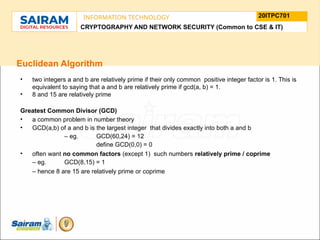
• two integers a and b are relatively prime if their only common positive integer factor is 1. This is
equivalent to saying that a and b are relatively prime if gcd(a, b) = 1.
• 8 and 15 are relatively prime
Greatest Common Divisor (GCD)
• a common problem in number theory
• GCD(a,b) of a and b is the largest integer that divides exactly into both a and b
– eg. GCD(60,24) = 12
define GCD(0,0) = 0
• often want no common factors (except 1) such numbers relatively prime / coprime
– eg. GCD(8,15) = 1
– hence 8 are 15 are relatively prime or coprime
4.
TYPE THE SUBJECTNAME HERE
SUBJECT CODE
20ITPC701
INFORMATION TECHNOLOGY
LE O M
.
N U
L T
.
F
H
J
U
M
F
s
o
n
u
o
n
i
d
t
e
u
t
r
i
C
t
s
h
n
a
I
i r m m
a
a n i r
- S a
CRYPTOGRAPHY AND NETWORK SECURITY (Common to CSE & IT)
Euclidean Algorithm
Greatest Common Divisor (GCD)
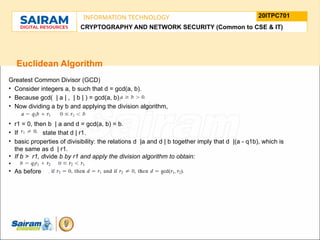
• Consider integers a, b such that d = gcd(a, b).
• Because gcd( | a | , | b | ) = gcd(a, b),
• Now dividing a by b and applying the division algorithm,
• r1 = 0, then b | a and d = gcd(a, b) = b.
• If state that d | r1.
• basic properties of divisibility: the relations d |a and d | b together imply that d |(a - q1b), which is
the same as d | r1.
• If b > r1, divide b by r1 and apply the division algorithm to obtain:
•
• As before
5.
TYPE THE SUBJECTNAME HERE
SUBJECT CODE
20ITPC701
INFORMATION TECHNOLOGY
LE O M
.
N U
L T
.
F
H
J
U
M
F
s
o
n
u
o
n
i
d
t
e
u
t
r
i
C
t
s
h
n
a
I
i r m m
a
a n i r
- S a
CRYPTOGRAPHY AND NETWORK SECURITY (Common to CSE & IT)
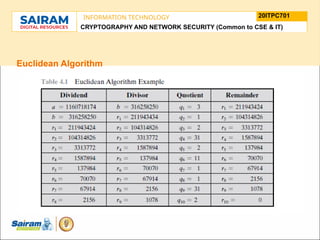
Euclidean Algorithm
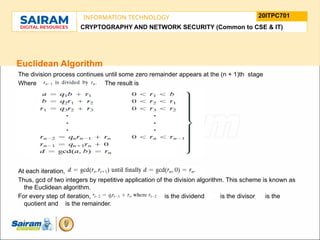
The division process continues until some zero remainder appears at the (n + 1)th stage
Where The result is
At each iteration,
Thus, gcd of two integers by repetitive application of the division algorithm. This scheme is known as
the Euclidean algorithm.
For every step of iteration, is the dividend is the divisor, is the
quotient and is the remainder.
6.
TYPE THE SUBJECTNAME HERE
SUBJECT CODE
20ITPC701
INFORMATION TECHNOLOGY
LE O M
.
N U
L T
.
F
H
J
U
M
F
s
o
n
u
o
n
i
d
t
e
u
t
r
i
C
t
s
h
n
a
I
i r m m
a
a n i r
- S a
CRYPTOGRAPHY AND NETWORK SECURITY (Common to CSE & IT)
Euclidean Algorithm
7.
TYPE THE SUBJECTNAME HERE
SUBJECT CODE
20ITPC701
INFORMATION TECHNOLOGY
LE O M
.
N U
L T
.
F
H
J
U
M
F
s
o
n
u
o
n
i
d
t
e
u
t
r
i
C
t
s
h
n
a
I
i r m m
a
a n i r
- S a
CRYPTOGRAPHY AND NETWORK SECURITY (Common to CSE & IT)
Euclidean Algorithm
8.
TYPE THE SUBJECTNAME HERE
SUBJECT CODE
20ITPC701
INFORMATION TECHNOLOGY
LE O M
.
N U
L T
.
F
H
J
U
M
F
s
o
n
u
o
n
i
d
t
e
u
t
r
i
C
t
s
h
n
a
I
i r m m
a
a n i r
- S a
CRYPTOGRAPHY AND NETWORK SECURITY (Common to CSE & IT)
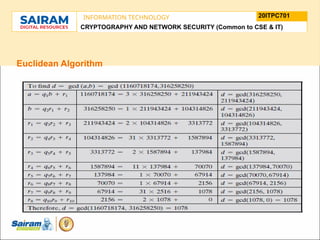
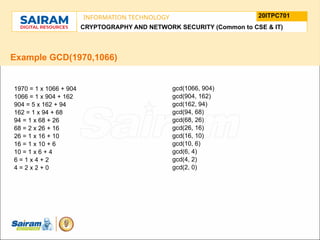
Example GCD(1970,1066)
1970 = 1 x 1066 + 904
1066 = 1 x 904 + 162
904 = 5 x 162 + 94
162 = 1 x 94 + 68
94 = 1 x 68 + 26
68 = 2 x 26 + 16
26 = 1 x 16 + 10
16 = 1 x 10 + 6
10 = 1 x 6 + 4
6 = 1 x 4 + 2
4 = 2 x 2 + 0
gcd(1066, 904)
gcd(904, 162)
gcd(162, 94)
gcd(94, 68)
gcd(68, 26)
gcd(26, 16)
gcd(16, 10)
gcd(10, 6)
gcd(6, 4)
gcd(4, 2)
gcd(2, 0)
9.
TYPE THE SUBJECTNAME HERE
SUBJECT CODE
20ITPC701
INFORMATION TECHNOLOGY
LE O M
.
N U
L T
.
F
H
J
U
M
F
s
o
n
u
o
n
i
d
t
e
u
t
r
i
C
t
s
h
n
a
I
i r m m
a
a n i r
- S a
CRYPTOGRAPHY AND NETWORK SECURITY (Common to CSE & IT)
Euclidean Algorithm
VIDEO LINK
https://www.youtube.com/watch?v=b1ZV2VzNqAo


![TYPE THE SUBJECT NAME HERE
SUBJECT CODE
20ITPC701
INFORMATION TECHNOLOGY
LE O M
.
N U
L T
.
F
H
J
U
M
F
s
o
n
u
o
n
i
d
t
e
u
t
r
i
C
t
s
h
n
a
I
i r m m
a
a n i r
- S a
CRYPTOGRAPHY AND NETWORK SECURITY (Common to CSE & IT)
Euclidean Algorithm
• One of the basic techniques of number theory
• a simple procedure for determining the greatest common divisor of two positive integers.
• Definition: Two integers are relatively prime if their only common positive integer factor is 1.
• use the notation gcd(a, b)
• The greatest common divisor of a and b is the largest integer that divides both a and b.
• Also define gcd(0, 0) = 0.
• the positive integer c is said to be the greatest common divisor of a and b if
• 1. c is a divisor of a and of b.
• 2. Any divisor of a and b is a divisor of c.
• An equivalent definition is the following:
• gcd(a, b) = max[k, such that k a and k b]
• Because , it require that the greatest common divisor be positive,
• gcd(a, b) = gcd(a, -b) = gcd(-a, b) = gcd(-a,-b).
• In general, gcd(a, b) = gcd( a , b ).
• Eg - gcd(60, 24) = gcd(60, -24) = 12](https://image.slidesharecdn.com/2-260209141600-f70e52cd/85/2-3-Euclid-algorithm-pptx-cryptography-security-2-320.jpg)


![[Deck] What's New in Spark-Iceberg Integration via DSV2.pptx](https://cdn.slidesharecdn.com/ss_thumbnails/deckwhatsnewinspark-icebergintegrationviadsv2-260210005337-25955b12-thumbnail.jpg?width=640&height=640&fit=bounds)


