Advance Quantum
Mechanics
Assignment + Presentation
Syeda Nimra Salamat
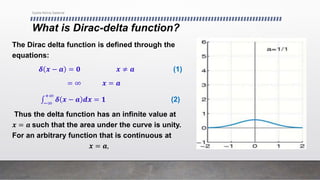
What is Dirac-delta function?
The Dirac delta function is defined through the
equations:
𝜹 𝒙 − 𝒂 = 𝟎 𝒙 ≠ 𝒂 (1)
= ∞ 𝒙 = 𝒂
−∞
+∞
𝜹 𝒙 − 𝒂 𝒅𝒙 = 𝟏 (2)
Thus the delta function has an infinite value at
𝒙 = 𝒂 such that the area under the curve is unity.
For an arbitrary function that is continuous at
𝒙 = 𝒂,
Syeda Nimra Salamat
What are expectation values? Explain it with
mathematical interpretation?
‘In quantum mechanics, the expectation value is the probabilistic expected value
of the result (measurement) of an experiment. It can be thought of as an average
of all the possible outcomes of a measurement as weighted by their likelihood,
and as such it is not the most probable value of a measurement; indeed the
expectation value may have zero probability of occurring.’
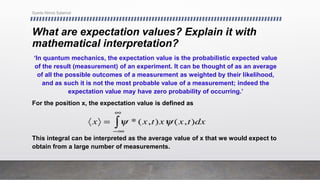
For the position x, the expectation value is defined as
This integral can be interpreted as the average value of x that we would expect to
obtain from a large number of measurements.
Syeda Nimra Salamat
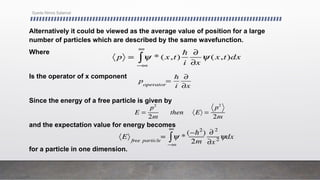
Alternatively it could be viewed as the average value of position for a large
number of particles which are described by the same wavefunction.
Where
Is the operator of x component
Since the energy of a free particle is given by
and the expectation value for energy becomes
for a particle in one dimension.
Syeda Nimra Salamat
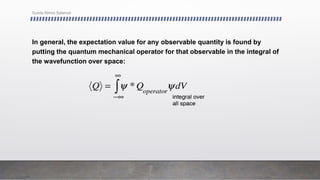
In general, the expectation value for any observable quantity is found by
putting the quantum mechanical operator for that observable in the integral of
the wavefunction over space:
Syeda Nimra Salamat
Explain compatible observable?
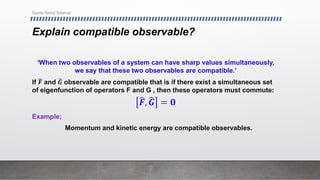
‘When two observables of a system can have sharp values simultaneously,
we say that these two observables are compatible.’
If 𝑭 and 𝑮 observable are compatible that is if there exist a simultaneous set
of eigenfunction of operators F and G , then these operators must commute:
𝑭, 𝑮 = 𝟎
Example;
Momentum and kinetic energy are compatible observables.
Syeda Nimra Salamat
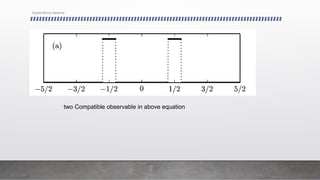
two Compatible observable in above equation
Syeda Nimra Salamat
Explain incompatible observable?
A crucial difference between classical quantities and quantum mechanical
observables is that the latter may not be simultaneously measurable, a
property referred to as complementarity. This is mathematically expressed by
non-commutativity of the corresponding operators, to the effect that the
commutator.
[𝑨, 𝑩]≔ 𝑨𝑩 − 𝑩𝑨 ≠ 𝟎
This inequality expresses a dependence of measurement results on the order
in which measurements of observables 𝑨 and 𝑩 are performed.
Syeda Nimra Salamat
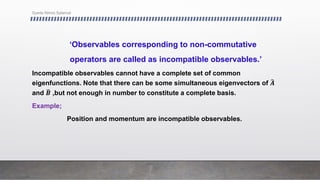
‘Observables corresponding to non-commutative
operators are called as incompatible observables.’
Incompatible observables cannot have a complete set of common
eigenfunctions. Note that there can be some simultaneous eigenvectors of 𝑨
and 𝑩 ,but not enough in number to constitute a complete basis.
Example;
Position and momentum are incompatible observables.
Syeda Nimra Salamat
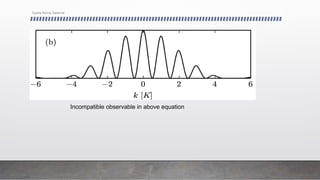
Incompatible observable in above equation
Syeda Nimra Salamat
Write the difference between?
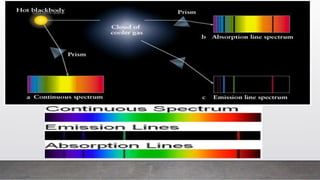
Continuous spectra:
(Unbound state)
1. ‘A continuous spectrum contains
all the wavelengths in a given range
and generates when both adsorption
and emission spectra are put
together.’’
2. It is produced by white light.
3. It is characteristic of white light.
4. There are no dark spaces between
colours.
Discrete/Line spectra:
(Bound state)
1. ‘Discrete spectrum contains only
a few wavelengths and generates
either in adsorption or emission.’’
2. It is produced by vaporization of
salt or gas in discharge tube.
3. It is characteristic of atom.
4. There are dark spaces between
colours.
Syeda Nimra Salamat
Syeda Nimra Salamat
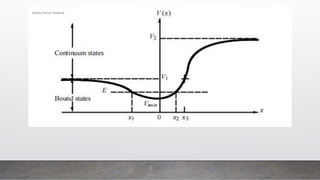
5. Unbound states occur in those cases
where the motion of the system is not
confined; a typical example is the free
particle. For the potential displayed in
Figure there are two energy ranges
where the particle’s motion is infinite:
𝑽𝟏 < 𝑬 < 𝑽𝟐 𝒂𝒏𝒅 𝑬 < 𝑽𝟐
5. If the motion of the particle is confined
to a limited region of space by potential
energy so that the particle move back
and forth in the region then the particle
is bound.
6. The motion of the particle is bounded
between the classical turning points x1
and x2 when the particle’s energy lies
between 𝑽𝒎𝒊𝒏 𝒂𝒏𝒅 𝑽𝟏
𝑽𝒎𝒊𝒏 < 𝑬 < 𝑽𝟏
7. The states corresponding to this
energy range are called bound states.
Syeda Nimra Salamat
Syeda Nimra Salamat
A particle of charge q and mass m which is moving in one dimensional
harmonic potential of frequency is subject to a weak electric potential field
in x-direction
(a) Find the exact expression for the energy?
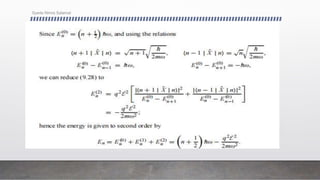
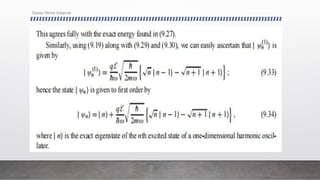
(b) Calculate the energy to first nonzero correction and compare it
with the exact result obtained in (a)?
a) Find the exact expression for the energy?
The interaction between the oscillating charge and the external electric field gives
rise to a term 𝑯𝑷 = 𝒒𝜺𝑿 that needs to be added to the Hamiltonian of the oscillator:
𝑯 = 𝑯𝟎 + 𝑯𝑷 = −
ℏ
𝟐𝒎
𝒅𝟐
𝒅𝑿𝟐
+
𝟏
𝟐
𝒎𝝎𝟐𝑿𝟐 + 𝒒ℰ𝑿
First, note that the eigen energies of this Hamiltonian can be obtained exactly without
resorting to any perturbative treatment. A variable change 𝒚 = 𝑿 𝒒ℰ
(𝒎𝝎𝟐)
Syeda Nimra Salamat
𝑯 = −
ℏ𝟐
𝟐𝒎
𝒅𝟐
𝒅𝒚𝟐 +
𝟏
𝟐
𝒎𝝎𝟐𝒚𝟐 −
𝒒𝟐𝓔𝟐
𝟐𝒎𝝎𝟐
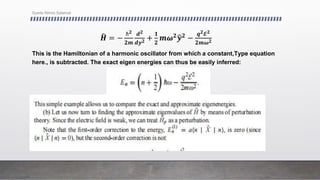
This is the Hamiltonian of a harmonic oscillator from which a constant,Type equation
here., is subtracted. The exact eigen energies can thus be easily inferred:
Syeda Nimra Salamat
Syeda Nimra Salamat
Syeda Nimra Salamat
Thank You
Hope for the best
Syeda Nimra Salamat

Advance Quantum Mechanics

  • 1.
    Advance Quantum Mechanics Assignment +Presentation Syeda Nimra Salamat
  • 2.
    What is Dirac-deltafunction? The Dirac delta function is defined through the equations: 𝜹 𝒙 − 𝒂 = 𝟎 𝒙 ≠ 𝒂 (1) = ∞ 𝒙 = 𝒂 −∞ +∞ 𝜹 𝒙 − 𝒂 𝒅𝒙 = 𝟏 (2) Thus the delta function has an infinite value at 𝒙 = 𝒂 such that the area under the curve is unity. For an arbitrary function that is continuous at 𝒙 = 𝒂, Syeda Nimra Salamat
  • 3.
    What are expectationvalues? Explain it with mathematical interpretation? ‘In quantum mechanics, the expectation value is the probabilistic expected value of the result (measurement) of an experiment. It can be thought of as an average of all the possible outcomes of a measurement as weighted by their likelihood, and as such it is not the most probable value of a measurement; indeed the expectation value may have zero probability of occurring.’ For the position x, the expectation value is defined as This integral can be interpreted as the average value of x that we would expect to obtain from a large number of measurements. Syeda Nimra Salamat
  • 4.
    Alternatively it couldbe viewed as the average value of position for a large number of particles which are described by the same wavefunction. Where Is the operator of x component Since the energy of a free particle is given by and the expectation value for energy becomes for a particle in one dimension. Syeda Nimra Salamat
  • 5.
    In general, theexpectation value for any observable quantity is found by putting the quantum mechanical operator for that observable in the integral of the wavefunction over space: Syeda Nimra Salamat
  • 6.
    Explain compatible observable? ‘Whentwo observables of a system can have sharp values simultaneously, we say that these two observables are compatible.’ If 𝑭 and 𝑮 observable are compatible that is if there exist a simultaneous set of eigenfunction of operators F and G , then these operators must commute: 𝑭, 𝑮 = 𝟎 Example; Momentum and kinetic energy are compatible observables. Syeda Nimra Salamat
  • 7.
    two Compatible observablein above equation Syeda Nimra Salamat
  • 8.
    Explain incompatible observable? Acrucial difference between classical quantities and quantum mechanical observables is that the latter may not be simultaneously measurable, a property referred to as complementarity. This is mathematically expressed by non-commutativity of the corresponding operators, to the effect that the commutator. [𝑨, 𝑩]≔ 𝑨𝑩 − 𝑩𝑨 ≠ 𝟎 This inequality expresses a dependence of measurement results on the order in which measurements of observables 𝑨 and 𝑩 are performed. Syeda Nimra Salamat
  • 9.
    ‘Observables corresponding tonon-commutative operators are called as incompatible observables.’ Incompatible observables cannot have a complete set of common eigenfunctions. Note that there can be some simultaneous eigenvectors of 𝑨 and 𝑩 ,but not enough in number to constitute a complete basis. Example; Position and momentum are incompatible observables. Syeda Nimra Salamat
  • 10.
    Incompatible observable inabove equation Syeda Nimra Salamat
  • 11.
    Write the differencebetween? Continuous spectra: (Unbound state) 1. ‘A continuous spectrum contains all the wavelengths in a given range and generates when both adsorption and emission spectra are put together.’’ 2. It is produced by white light. 3. It is characteristic of white light. 4. There are no dark spaces between colours. Discrete/Line spectra: (Bound state) 1. ‘Discrete spectrum contains only a few wavelengths and generates either in adsorption or emission.’’ 2. It is produced by vaporization of salt or gas in discharge tube. 3. It is characteristic of atom. 4. There are dark spaces between colours. Syeda Nimra Salamat
  • 12.
  • 13.
    5. Unbound statesoccur in those cases where the motion of the system is not confined; a typical example is the free particle. For the potential displayed in Figure there are two energy ranges where the particle’s motion is infinite: 𝑽𝟏 < 𝑬 < 𝑽𝟐 𝒂𝒏𝒅 𝑬 < 𝑽𝟐 5. If the motion of the particle is confined to a limited region of space by potential energy so that the particle move back and forth in the region then the particle is bound. 6. The motion of the particle is bounded between the classical turning points x1 and x2 when the particle’s energy lies between 𝑽𝒎𝒊𝒏 𝒂𝒏𝒅 𝑽𝟏 𝑽𝒎𝒊𝒏 < 𝑬 < 𝑽𝟏 7. The states corresponding to this energy range are called bound states. Syeda Nimra Salamat
  • 14.
  • 15.
    A particle ofcharge q and mass m which is moving in one dimensional harmonic potential of frequency is subject to a weak electric potential field in x-direction (a) Find the exact expression for the energy? (b) Calculate the energy to first nonzero correction and compare it with the exact result obtained in (a)? a) Find the exact expression for the energy? The interaction between the oscillating charge and the external electric field gives rise to a term 𝑯𝑷 = 𝒒𝜺𝑿 that needs to be added to the Hamiltonian of the oscillator: 𝑯 = 𝑯𝟎 + 𝑯𝑷 = − ℏ 𝟐𝒎 𝒅𝟐 𝒅𝑿𝟐 + 𝟏 𝟐 𝒎𝝎𝟐𝑿𝟐 + 𝒒ℰ𝑿 First, note that the eigen energies of this Hamiltonian can be obtained exactly without resorting to any perturbative treatment. A variable change 𝒚 = 𝑿 𝒒ℰ (𝒎𝝎𝟐) Syeda Nimra Salamat
  • 16.
    𝑯 = − ℏ𝟐 𝟐𝒎 𝒅𝟐 𝒅𝒚𝟐+ 𝟏 𝟐 𝒎𝝎𝟐𝒚𝟐 − 𝒒𝟐𝓔𝟐 𝟐𝒎𝝎𝟐 This is the Hamiltonian of a harmonic oscillator from which a constant,Type equation here., is subtracted. The exact eigen energies can thus be easily inferred: Syeda Nimra Salamat
  • 17.
  • 18.
  • 19.
    Thank You Hope forthe best Syeda Nimra Salamat