CCGPS
                   Frameworks


           Mathematics


Kindergarten
Unit 1: Counting With Friends
Georgia Department of Education
                                 Common Core Georgia Performance Standards Framework
                                                         Kindergarten Mathematics Unit 1


Unit 1: Counting With Friends (5 weeks)

TABLE OF CONTENTS

Overview ............................................................................................................................................

Key Standards and Related Standards                                              ........................................................................

Number Sense Trajectory ..................................................................................................................

Enduring Understandings...................................................................................................................

Essential Questions ............................................................................................................................

Concepts and Skills to Maintain ........................................................................................................

Select Terms and Symbols .................................................................................................................

Strategies for Teaching and Learning ................................................................................................

Common Misconceptions ..................................................................................................................

Evidence of Learning .........................................................................................................................

Tasks ..................................................................................................................................................


           Got Dots? (0-10)
           Numerals, Pictures, Words (0-10)
           Fill the Line (0-9)
           What the Heck is Rekenrek?
           Fill the Chutes
           Race to 20
           The Cardinal Cup (0-10)
           Order the Dice
           More or Less
           How Many Are in the Bag?
           More or Less-Make a Guess
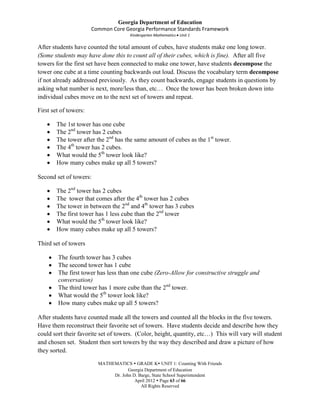
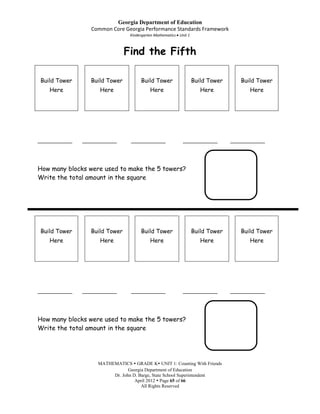
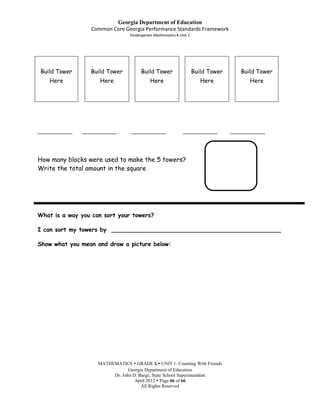
           Find the 5th Tower


                                     MATHEMATICS  GRADE K UNIT 1: Counting With Friends
                                                 Georgia Department of Education
                                          Dr. John D. Barge, State School Superintendent
                                                    April 2012  Page 2 of 66
                                                       All Rights Reserved
Georgia Department of Education
                      Common Core Georgia Performance Standards Framework
                                      Kindergarten Mathematics Unit 1


The Critical Areas are designed to bring focus to the standards at each grade by describing
the big ideas that educators can use to build their curriculum and to guide instruction.

Students use numbers, including written numerals, to represent quantities and to solve
quantitative problems, such as counting objects in a set; counting out a given number of objects;
comparing sets or numerals; and modeling simple joining and separating situations with sets of
objects, or eventually with equations such as 5 + 2 = 7 and 7 – 2 = 5. (Kindergarten students
should see addition and subtraction equations, and student writing of equations in kindergarten is
encouraged, but it is not required.) Students choose, combine, and apply effective strategies for
answering quantitative questions, including quickly recognizing the cardinalities of small sets of
objects, counting and producing sets of given sizes, counting the number of objects in combined
sets, or counting the number of objects that remain in a set after some are taken away.

OVERVIEW
In this unit, students will start kindergarten thinking of counting as a string of words, but then
they make a gradual transition to using counting as a tool for describing their world. They must
construct the idea of counting using manipulatives and other resources to see the numbers
visually (dot cards, tens frames). To count successfully, students must remember the rote
counting sequence, assign one counting number to each object counted, and at the same time
have a strategy for keeping track of what has already been counted and what still needs to be
counted. Only the counting sequence is a rote procedure. The meaning students attach to
counting is the key conceptual idea on which all other number concepts are developed. Students
will develop successful and meaningful counting strategies as they practice counting and as they
listen to and watch others count.

Although the units in this instructional framework emphasize key standards and big ideas at
specific times of the year, routine topics such as counting, positional word, time should be
addressed on an ongoing basis through the use of calendar, centers (tubs), and games. This unit
should allow students to understand the concepts of numbers and counting.

To assure that this unit is taught with the appropriate emphasis, depth, and rigor, it is important
that the tasks listed under “Evidence of Learning” be reviewed early in the planning process. A
variety of resources should be utilized to supplement this unit. This unit provides much needed
content information as well as excellent learning activities. The task in this unit illustrates the
types of learning activities that should be utilized from a variety of sources.

The Critical Areas are designed to bring focus to the standards at each grade by describing the
big ideas that educators can use to build their curriculum and to guide instruction. In
Kindergarten, instructional time should focus on two critical areas: (1) representing, relating, and
operating on whole numbers, initially with sets of objects. Students choose, combine, and apply
effective strategies for answering quantitative questions, including quickly recognizing the
cardinalities of small sets of objects, counting and producing sets of given sizes, counting the
number of objects in combined sets, or counting the number of objects that remain in a set after
some are taken away. Students use numbers, including written numerals, to represent quantities
and to solve quantitative problems, such as counting objects in a set; counting out a given number
                         MATHEMATICS  GRADE K UNIT 1: Counting With Friends
                                     Georgia Department of Education
                              Dr. John D. Barge, State School Superintendent
                                        April 2012  Page 3 of 66
                                           All Rights Reserved
Georgia Department of Education
                      Common Core Georgia Performance Standards Framework
                                     Kindergarten Mathematics Unit 1


of objects; comparing sets or numerals; and modeling simple joining and separating situations
with sets of objects, or eventually with equations such as 5 + 2 = 7 and 7 – 2 = 5. (Kindergarten
students should see addition and subtraction equations, and student writing of equations in
kindergarten is encouraged, but it is not required.)

STANDARDS FOR MATHEMATICAL CONTENT

Counting and Cardinality

Know number names and the count sequence.

MCC.K.CC.1.       Count to 100 by ones and by tens.

MCC.K.CC.2.       Count forward beginning from a given number within the known sequence
                  (instead of having to begin at 1).

MCC.K.CC.3.       Write numbers from 0 to 20. Represent a number of objects with a written
                  numeral 0-20 (with 0 representing a count of no objects).

Count to tell the number of objects.

MCC.K.CC.4.       Understand the relationship between numbers and quantities; connect
                  counting to cardinality.
                      a. When counting objects, say the number names in the standard order,
                          pairing each object with one and only one number name and each
                          number name with one and only one object.
                      b. Understand that the last number name said tells the number of objects
                          counted. The number of objects is the same regardless of their
                          arrangement or the order in which they were counted.
                      c. Understand that each successive number name refers to a quantity that
                          is one larger.

Classify objects and count the number of objects in each category.

MCC.K.MD.3. Classify objects into given categories; count the numbers of objects in each
            category and sort the categories by count.

         (For descriptors of standard cluster please see the Grade Level Overview)


STANDARDS FOR MATHEMATICAL PRACTICE

The standards for mathematical practice describe varieties of expertise that mathematics
educators at all levels should seek to develop in their students. These practices rest on important
“processes and proficiencies” with longstanding importance in mathematics education.


                        MATHEMATICS  GRADE K UNIT 1: Counting With Friends
                                    Georgia Department of Education
                             Dr. John D. Barge, State School Superintendent
                                       April 2012  Page 4 of 66
                                          All Rights Reserved
Georgia Department of Education
                     Common Core Georgia Performance Standards Framework
                                     Kindergarten Mathematics Unit 1


Students are expected to:

1. Make sense of problems and persevere in solving them.
2. Reason abstractly and quantitatively.
3. Construct viable arguments and critique the reasoning of others.
4. Model with mathematics.
5. Use appropriate tools strategically.
6. Attend to precision.
7. Look for and make use of structure.
8. Look for and express regularity in repeated reasoning.

         ***Mathematical Practices 1 and 6 should be evident in EVERY lesson***


                        MATHEMATICS  GRADE K UNIT 1: Counting With Friends
                                    Georgia Department of Education
                             Dr. John D. Barge, State School Superintendent
                                       April 2012  Page 5 of 66
                                          All Rights Reserved
Georgia Department of Education
                                                            Common Core Georgia Performance Standards Framework
                                                                             Kindergarten Mathematics Unit 1


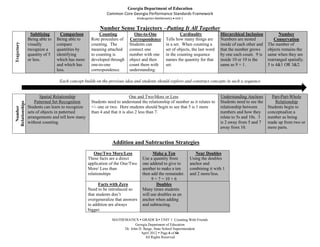
                                                        Number Sense Trajectory –Putting It All Together
                  Subitizing      Comparison            Counting          One-to-One                     Cardinality            Hierarchical Inclusion           Number
                Being able to   Being able to      Rote procedure of    Correspondence          Tells how many things are       Numbers are nested             Conservation
Trajectory


                visually        compare            counting. The        Students can            in a set. When counting a       inside of each other and   The number of
                recognize a     quantities by      meaning attached     connect one             set of objects, the last word   that the number grows      objects remains the
                quantity of 5   identifying        to counting is       number with one         in the counting sequence        by one each count. 9 is    same when they are
                or less.        which has more     developed through    object and then         names the quantity for that     inside 10 or 10 is the     rearranged spatially.
                                and which has      one-to-one           count them with         set.                            same as 9 + 1.             5 is 4&1 OR 3&2.
                                less.              correspondence.      understanding.

                                 Each concept builds on the previous idea and students should explore and construct concepts in such a sequence


                       Spatial Relationship                                One and Two-More or Less                             Understanding Anchors        Part-Part-Whole
                    Patterned Set Recognition      Students need to understand the relationship of number as it relates to      Students need to see the       Relationship
Relationships


                Students can learn to recognize    +/- one or two. Here students should begin to see that 5 is 1 more           relationship between       Students begin to
  Number


                sets of objects in patterned       than 4 and that it is also 2 less than 7.                                    numbers and how they       conceptualize a
                arrangements and tell how many                                                                                  relate to 5s and 10s. 3    number as being
                without counting.                                                                                               is 2 away from 5 and 7     made up from two or
                                                                                                                                away from 10.              more parts.


                                                               Addition and Subtraction Strategies
                                                      One/Two More/Less               Make a Ten                  Near Doubles
                                                  These facts are a direct      Use a quantity from            Using the doubles
                                                  application of the One/Two    one addend to give to          anchor and
                                                  More/ Less than               another to make a ten          combining it with 1
                                                  relationships                 then add the remainder.        and 2 more/less.
                                                                                     9 + 7 = 10 + 6
                                                        Facts with Zero                 Doubles
                                                  Need to be introduced so      Many times students
                                                  that students don’t           will use doubles as an
                                                  overgeneralize that answers   anchor when adding
                                                  to addition are always        and subtracting.
                                                  bigger.

                                                               MATHEMATICS  GRADE K UNIT 1: Counting With Friends
                                                                           Georgia Department of Education
                                                                    Dr. John D. Barge, State School Superintendent
                                                                              April 2012  Page 6 of 66
                                                                                 All Rights Reserved
Georgia Department of Education
                    Common Core Georgia Performance Standards Framework
                                   Kindergarten Mathematics Unit 1


ENDURING UNDERSTANDINGS

Number Properties

      Understand numbers, ways of representing numbers, relationships among numbers, and
      number systems.
      Count with understanding and recognize “how many” in a set of objects.
      Develop a sense of whole numbers and represent and use them in flexible ways.
      Develop understanding of the relative magnitude and position of whole numbers.
      Use multiple models to develop initial understandings of the base-ten number system.
      Connect number words and numerals to the quantities they represent, using various
      physical models and representation
      Counting tells how many things are in a set.
      The last number word, when counting, names the quantity in a set.
      A number can be represented by a set of objects, then by a word, and finally by a
      numeral.
      Numbers are related to each other through a variety of relationships. For example, 6 is
      one more than 5, and is 4 less than 10.
      Counting can be a way to gather information.

   Coins are not explicitly taught in kindergarten, but the connections to patterns and skip
   counting should be made. Coins can be used as a manipulative for patterns, skip counting
   and counting.

ESSENTIAL QUESTIONS

      How can numbers be represented?
      How can playing board games make me a better mathematician?
      How can we record what we count?
      How can we show numbers in different ways?
      How can you know an amount without counting each object?
      How do we know if a number is more or less than another number?
      How do we use counting in our everyday life?
      How do we use counting in our everyday life?
      How do we use numbers every day?
      How does putting things in order keep things organized?
      How many ways can I group objects using cardinal and ordinal numbers?
      What do numbers mean to us?
      What is a numeral?
      What is the difference between “more” and “less”?
      What types of questions should I ask myself or my partner when playing a math game?
      Why are numbers important?
      Why do we need to be able to count forwards and backwards?
      Why do we need to be able to count objects?
      Why do we need to be able to put things in order?
                      MATHEMATICS  GRADE K UNIT 1: Counting With Friends
                                  Georgia Department of Education
                           Dr. John D. Barge, State School Superintendent
                                     April 2012  Page 7 of 66
                                        All Rights Reserved
Georgia Department of Education
                     Common Core Georgia Performance Standards Framework
                                     Kindergarten Mathematics Unit 1


       Why do we need to be able to read ordinal numbers?
       Why is it important to know how to put things in number order?
       Why would we need to be able to read number words?

CONCEPTS/SKILLS TO MAINTAIN

Although many students may have attended pre-school prior to entering kindergarten, this is the
first year of school for some students. For that reason, no concepts/skills to maintain will be
listed at this time. It is expected that teachers will differentiate to accommodate those students
that may enter kindergarten with prior knowledge.

SELECTED TERMS AND SYMBOLS

The following terms and symbols are often misunderstood. These concepts are not an inclusive
list and should not be taught in isolation. However, due to evidence of frequent difficulty and
misunderstanding associated with these concepts, instructors should pay particular attention to
them and how their students are able to explain and apply them.

Teachers should first present these concepts to students with models and real life examples.
Students should understand the concepts involved and be able to recognize and/or use them with
words, models, pictures, or numbers.

       Zero
       Order
       Number Line
       Forward
       Backward
       Count
       Counting-On
       Compare
       Digits
       Number
       Numeral
       Less than
       More than/Greater than
       Model
       Number
       Numeral
       Ones
       Pair
       Quantity
       Same
       Sequence
       Set

                        MATHEMATICS  GRADE K UNIT 1: Counting With Friends
                                    Georgia Department of Education
                             Dr. John D. Barge, State School Superintendent
                                       April 2012  Page 8 of 66
                                          All Rights Reserved
Georgia Department of Education
                      Common Core Georgia Performance Standards Framework
                                      Kindergarten Mathematics Unit 1


STRATEGIES FOR TEACHING AND LEARNING

Provide settings that connect mathematical language and symbols to the everyday lives of
kindergarteners. Support students’ ability to make meaning and mathematize the real world. Help
them see patterns, make connections and provide repeated experiences that give students time
and opportunities to develop understandings and increase fluency. Encourage students to explain
their reasoning by asking probing questions, such as, “How do you know?"
Students view counting as a mechanism used to land on a number. Young students mimic
counting often with initial lack of purpose or meaning. Coordinating the number words, touching
or moving objects in a one-to-one correspondence may be little more than a matching activity.
However, saying number words as a chant or a rote procedure plays a part in students
constructing meaning for the conceptual idea of counting. They will learn how to count before
they understand cardinality, i.e. that the last count word is the amount of the set.
Counting on or counting from a given number conflicts with the learned strategy of counting
from the beginning. In order to be successful in counting on, students must understand
cardinality. Students often merge or separate two groups of objects and then re-count from the
beginning to determine the final number of objects represented. For these students, counting is
still a rote skill or the benefits of counting on have not been realized. Games that require students
to add on to a previous count to reach a goal number encourage developing this concept.
Frequent and brief opportunities utilizing counting on and counting back are recommended.
These concepts emerge over time and cannot be forced.
Like counting to 100 by either ones or tens, writing numbers from 0 to 20 is a rote process.
Initially, students mimic the actual formation of the written numerals while also assigning it a
name. Over time, children create the understanding that number symbols signify the meaning of
counting. Numerals are used to communicate across cultures and through time a certain meaning.
Numbers have meaning when children can see mental images of the number symbols and use
those images with which to think. Practice count words and written numerals paired with
pictures, representations of objects, and objects that represent quantities within the context of life
experiences for kindergarteners. For example, dot cards, dominoes and number cubes all create
different mental images for relating quantity to number words and numerals.
One way students can learn the left to right orientation of numbers is to use a finger to write
numbers in air (sky writing). Children will see mathematics as something that is alive and that
they are involved.
Students should study and write numbers 0 to 20 in this order: numbers 1 to 9, the number 0, and
then numbers 10 to 20. They need to know that 0 is the number items left after all items in a set
are taken away. Do not accept “none” as the answer to “How many items are left?” for this
situation.

                         MATHEMATICS  GRADE K UNIT 1: Counting With Friends
                                     Georgia Department of Education
                              Dr. John D. Barge, State School Superintendent
                                        April 2012  Page 9 of 66
                                           All Rights Reserved
Georgia Department of Education
                      Common Core Georgia Performance Standards Framework
                                      Kindergarten Mathematics Unit 1


One of the first major concepts in a student’s mathematical development is cardinality.
Cardinality, knowing that the number word said tells the quantity you have and that the number
you end on when counting represents the entire amount counted. The big idea is that number
means amount and, no matter how you arrange and rearrange the items, the amount is the same.
Until this concept is developed, counting is merely a routine procedure done when a number is
needed. To determine if students have the cardinality rule, listen to their responses when you
discuss counting tasks with them. For example, ask, “How many are here?”. The student counts
correctly and says that there are seven. Then ask, “Are there seven?”. Students may count or
hesitate if they have not developed cardinality. Students with cardinality may emphasize the last
count or explain that there are seven because they counted them. These students can now use
counting to find a matching set.
Students develop the understanding of counting and cardinality from experience. Almost any
activity or game that engages children in counting and comparing quantities, such as board
games, will encourage the development of cardinality. Frequent opportunities to use and discuss
counting as a means of solving problems relevant to kindergarteners, is more beneficial than
repeating the same routine day after day. For example, ask students questions that can be
answered by counting up to 20 items before they change, and as they change, locations
throughout the school building.
As students develop meaning for numerals, they also compare numerals to the quantities they
represent. Models that can represent numbers – such as dot cards and dominoes – become tools
for such comparisons. Students can concretely, pictorially or mentally look for similarities and
differences in the representations of numbers. They begin to “see” the relationship of one more,
one less, two more and two less, thus landing on the concept that successive numbers name
quantities that are one larger. In order to encourage this idea, children need discussion and
reflection of pairs of numbers from 1 to 10. Activities that utilize anchors of 5 and 10 are helpful
in securing understanding of the relationships between numbers. This flexibility with numbers
will build students’ ability to break numbers into parts.
Provide a variety of experiences in which students connect count words or number words to the
numerals that represent the quantities. Students will arrive at an understanding of a number when
they acquire cardinality and can connect a number with the numerals and the number word for
the quantity they all represent.

Special Note:
Although the standard MCC.K.CC.1. (Count to 100 by ones and by tens) is included throughout
this unit, students should be given ample time to count and really focus on numbers through 20.
This standard is seen as a progression that is to be met by the end of the year. Although the
standard states “to 100”, this unit (in particular the tasks), focus on numbers and number
relationships through 10. It is because of the aforementioned reasons that skip counting is not
specifically addressed in this unit.


                        MATHEMATICS  GRADE K UNIT 1: Counting With Friends
                                    Georgia Department of Education
                             Dr. John D. Barge, State School Superintendent
                                       April 2012  Page 10 of 66
                                          All Rights Reserved
Georgia Department of Education
                      Common Core Georgia Performance Standards Framework
                                      Kindergarten Mathematics Unit 1


COMMON MISCONCEPTIONS
Some students might not see zero as a number. Ask students to write 0 and say zero to
represent the number of items left when all items have been taken away. Avoid using the
word none to represent this situation.
Some students might think that the count word used to tag an item is permanently connected to
that item. So when the item is used again for counting and should be tagged with a different
count word, the student uses the original count word. For example, a student counts four
geometric figures: triangle, square, circle and rectangle with the count words: one, two, three,
and four. If these items are rearranged as rectangle, triangle, circle and square and counted, the
student says these count words: four, one, three, and two.

EVIDENCE OF LEARNING

By the conclusion of this unit, students should be able to demonstrate the following
competencies:
      begin to count by ones and tens to 100 (rote count)
      continue count sequence when beginning from a number greater than 1
      subitize quantity up to 5
      count objects to 20
      sequence numbers to 20
      one to one correspondence
      identify a number quantity for numerals and words
      represent numbers with numerals, pictures and words
      understand numbers and the relationships between quantities
      understand positional and ordinal words
      understand the concept of “more” and “less”


                        MATHEMATICS  GRADE K UNIT 1: Counting With Friends
                                    Georgia Department of Education
                             Dr. John D. Barge, State School Superintendent
                                       April 2012  Page 11 of 66
                                          All Rights Reserved
Georgia Department of Education
                       Common Core Georgia Performance Standards Framework
                                      Kindergarten Mathematics Unit 1


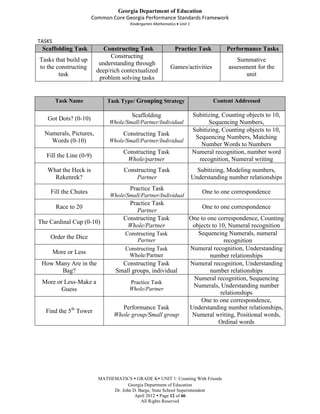
TASKS
 Scaffolding Task           Constructing Task                Practice Task           Performance Tasks
                              Constructing
Tasks that build up                                                                      Summative
                          understanding through
to the constructing                                       Games/activities            assessment for the
                         deep/rich contextualized
        task                                                                                 unit
                          problem solving tasks


        Task Name            Task Type/ Grouping Strategy                       Content Addressed

                                       Scaffolding                      Subitizing, Counting objects to 10,
   Got Dots? (0-10)
                              Whole/Small/Partner/Individual                  Sequencing Numbers,
                                                                        Subitizing, Counting objects to 10,
  Numerals, Pictures,              Constructing Task
                                                                         Sequencing Numbers, Matching
    Words (0-10)              Whole/Small/Partner/Individual
                                                                           Number Words to Numbers
                                   Constructing Task                    Numeral recognition, number word
   Fill the Line (0-9)
                                    Whole/partner                         recognition, Numeral writing
   What the Heck is                Constructing Task                      Subitizing, Modeling numbers,
     Rekenrek?                         Partner                          Understanding number relationships
                                      Practice Task
    Fill the Chutes                                                         One to one correspondence
                              Whole/Small/Partner/Individual
                                     Practice Task
         Race to 20                                                         One to one correspondence
                                        Partner
                                   Constructing Task                One to one correspondence, Counting
The Cardinal Cup (0-10)
                                    Whole/Partner                    objects to 10, Numeral recognition
                                    Constructing Task                  Sequencing Numerals, numeral
    Order the Dice                      Partner                                   recognition
                                    Constructing Task               Numeral recognition, Understanding
        More or Less                 Whole/Partner                          number relationships
 How Many Are in the              Constructing Task                 Numeral recognition, Understanding
       Bag?                     Small groups, individual                    number relationships
                                                                     Numeral recognition, Sequencing
 More or Less-Make a                  Practice Task
                                                                     Numerals, Understanding number
        Guess                         Whole/Partner
                                                                                 relationships
                                                                        One to one correspondence,
                                 Performance Task                   Understanding number relationships,
  Find the 5th Tower
                               Whole group/Small group               Numeral writing, Positional words,
                                                                                Ordinal words


                         MATHEMATICS  GRADE K UNIT 1: Counting With Friends
                                     Georgia Department of Education
                              Dr. John D. Barge, State School Superintendent
                                        April 2012  Page 12 of 66
                                           All Rights Reserved
Georgia Department of Education
                       Common Core Georgia Performance Standards Framework
                                      Kindergarten Mathematics Unit 1


SCAFFOLDING TASK: Got Dots? (0-10)
This task contains numerous activities where students can engage using
different the different representations of numbers. (Adapted from VdW Backline Masters)

STANDARDS FOR MATHEMATICAL CONTENT

MCC.K.CC.1 Count to 100 by ones and by tens.

MCC.K.CC.2. Count forward beginning from a given number within the known sequence
(instead of having to begin at 1).

MCC.K.CC.3. Write numbers from 0 to 20. Represent a number of objects with a written
numeral 0-20 (with 0 representing a count of no objects).

MCC.K.CC.4. Understand the relationship between numbers and quantities; connect counting to
cardinality.
    a. When counting objects, say the number names in the standard order, pairing each object
       with one and only one number name and each number name with one and only one
       object.
    b. Understand that the last number name said tells the number of objects counted. The
       number of objects is the same regardless of their arrangement or the order in which they
       were counted.
    c. Understand that each successive number name refers to a quantity that is one larger.

STANDARDS FOR MATHEMATICAL PRACTICE

1.   Make sense of problems and persevere in solving them.
2.   Reason abstractly and quantitatively.
3.   Construct viable arguments and critique the reasoning of others.
4.   Model with mathematics.
5.   Use appropriate tools strategically.
6.   Attend to precision.

BACKGROUND KNOWLEDGE

This task contains numerous activities where students engage in subitizing activities.
Subitizing introduces basic ideas of cardinality- “how many”, ideas of “more” and “less,” ideas
of parts and wholes and their relationships, beginning arithmetic, and, in general, ideas of
quantity. Developed well, these are related, forming webs of connected ideas that are the
building blocks of mathematics through elementary, middle, and high school, and beyond.
(Clementes & Sarama, Learning and Teaching Early Math, 2009)

The subitizing of quantities can be achieved with dot cards, ten frames, and base-ten
manipulatives later on. Using recognizable patterns like the ones found on dice are patterns that
are instantly recognizable to most kindergarten students to game play. Many of the tasks

                         MATHEMATICS  GRADE K UNIT 1: Counting With Friends
                                     Georgia Department of Education
                              Dr. John D. Barge, State School Superintendent
                                        April 2012  Page 13 of 66
                                           All Rights Reserved
Georgia Department of Education
                     Common Core Georgia Performance Standards Framework
                                    Kindergarten Mathematics Unit 1


included throughout this unit involving subitizing and dot cards should be continued throughout
the year.

ESSENTIAL QUESTIONS

       Why do we need to be able to count objects?
       How do we use numbers every day?
       How do we use counting in our everyday life?
       How can you know an amount without counting each object?

MATERIALS

       Dot cards (recommend printing multiple sets of cards on tag board and laminating)

GROUPING

Whole group and partner task

TASK DESCRIPTION, DEVELOPMENT, AND DISCUSSION

       Dot Flash: Teacher/Student flashes a dot card to class/partner and quickly covers it up.
       Students must say the quantity of dots they saw and describe how they know what they
       saw. Example: I saw 4 dots because I saw a group of 3 dots and there was one left over
       to make 4.The difficulty in the game can be increased by the amount of time that the dots
       are shown to students.

       Count ‘Em: a card is turned over. The first player to say the quantity of dots on the
       cards keeps that card. Partner must count the dots on the card to verify. No assuming

       One More/Less: same as dot flash but students need to say either 1 more or less than the
       dots on the card. Whether it is more or less must be established before the game begins.

       Who Has More/Less/Same?: 2 players turn over 1 card at the same time. first player to
       identify which card has more/less/same keeps the 2 cards.

       Line ‘Em Up: give a student a set of cards and have them line the cards up in a specific
       order. (least to greatest – forward counting sequence, greatest to least-backward counting
       sequence)

Kindergarten students are extremely creative and continuously invent new games. Have students
create a game using the cards and share with classmates. Van de Walle’s Teaching Student
Centered Mathematics k-3, lists numerous ways to incorporate subitizing activities into the
classroom. A greater variety of dot cards and dot plates can be found online and Van de Walle’s
Blackline Masters Series at http://www.ablongman.com/vandewalleseries/volume_1.html. In
addition Van de Walle suggests numerous ways that activities and tasks can be repeated
throughout the school year as centers or stations.
                       MATHEMATICS  GRADE K UNIT 1: Counting With Friends
                                   Georgia Department of Education
                            Dr. John D. Barge, State School Superintendent
                                      April 2012  Page 14 of 66
                                         All Rights Reserved
Georgia Department of Education
                     Common Core Georgia Performance Standards Framework
                                     Kindergarten Mathematics Unit 1


FORMATIVE ASSESSMENT QUESTIONS

       How do you know that you counted correctly?
       How many dots did you see?
       How do you know?
       What way did you see the dots grouped together?
       How many dots away from 5 is 8? How many dots would you need to make 10?
       (anchoring 5&10)

DIFFERENTIATION

Extension and Intervention
      Increasing or decreasing the quantity of dots on a card can help with differentiating
      subitizing


                        MATHEMATICS  GRADE K UNIT 1: Counting With Friends
                                    Georgia Department of Education
                             Dr. John D. Barge, State School Superintendent
                                       April 2012  Page 15 of 66
                                          All Rights Reserved
Georgia Department of Education
                       Common Core Georgia Performance Standards Framework
                                      Kindergarten Mathematics Unit 1


CONSTRUCTING TASK: Numerals-Pictures-Words
This task contains numerous activities where students can engage
using different the different representations of numbers.

STANDARDS FOR MATHEMATICAL CONTENT

MCC.K.CC.2. Count forward beginning from a given number within the known sequence
(instead of having to begin at 1).

MCC.K.CC.4. Understand the relationship between numbers and quantities; connect counting to
cardinality.
    a. When counting objects, say the number names in the standard order, pairing each object
       with one and only one number name and each number name with one and only one
       object.
    b. Understand that the last number name said tells the number of objects counted. The
       number of objects is the same regardless of their arrangement or the order in which they
       were counted.
    c. Understand that each successive number name refers to a quantity that is one larger.

STANDARDS FOR MATHEMATICAL PRACTICE

1.   Make sense of problems and persevere in solving them.
2.   Reason abstractly and quantitatively.
3.   Construct viable arguments and critique the reasoning of others.
4.   Model with mathematics.
5.   Use appropriate tools strategically.
6.   Attend to precision.

BACKGROUND KNOWLEDGE

Students need to understand that quantity can be represented through numerals, pictures, and
words. Students should be given ample time to explore this concept early on in kindergarten.
These task cards are designed for students to see and recognize the different forms in which a
quantity can be represented.
ESSENTIAL QUESTIONS

         How do we know if a number is more or less than another number?
         How can we show numbers in different ways?
         How do we use counting in our everyday life?
         Why are numbers important?
         What do numbers mean to us?

MATERIALS

         Numerals, Pictures, Words playing cards

                         MATHEMATICS  GRADE K UNIT 1: Counting With Friends
                                     Georgia Department of Education
                              Dr. John D. Barge, State School Superintendent
                                        April 2012  Page 17 of 66
                                           All Rights Reserved
Georgia Department of Education
                     Common Core Georgia Performance Standards Framework
                                     Kindergarten Mathematics Unit 1


GROUPING

Whole group, small group, partner, individual

TASK DESCRIPTION, DEVELOPMENT, AND DISCUSSION

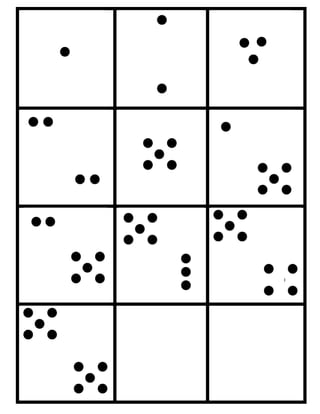
Concentration/Memory: Shuffle the cards and lay them face down in a pattern. Let students
decide the pattern but they need to explain their patter. On each turn, a player turns over two
cards (one at a time) and keeps them if they match numbers. If they successfully match a pair of
numbers, that player also gets to take another turn. When a player turns over two cards that do
not match numbers, those cards are turned face down again and it becomes the next player’s turn.
Players keep each pair they find. At the end of the game, each pair scores one point. When all the
pairs have been found, the player with the most points wins.

Squeeze: Cards are placed face down in a stack on the table. The first player takes two cards and
places them face up on the table with a space between them and in order from smallest to largest.
The second player does the same. They then turn up the top card in the pile. If this card squeezes
between the two cards that player gets a point. If Payer 1 has “2” and “5” and Player 2 has “4”
and “9” and a “3” is flipped over, only Player 1 gets a point because “3” fits between their
numbers. Keep score on a ten-frame. First player to 10 wins.

Got Dots: The subitizing activities listed in Got Dots can also be included and played with the
Numerals, Pictures,Words Cards.

FORMATIVE ASSESSMENT QUESTIONS

       How do you know that you counted correctly?
       How many dots did you see?
       How do you know?
       What way did you see the dots grouped together?
       How many dots is 8 from 5? How many dots would you need to make 10? (anchoring
       5&10)

DIFFERENTIATION

Extension and Intervention

       Increasing or decreasing the quantity of dots on a card can help with differentiating
       subitizing activities.


                        MATHEMATICS  GRADE K UNIT 1: Counting With Friends
                                    Georgia Department of Education
                             Dr. John D. Barge, State School Superintendent
                                       April 2012  Page 18 of 66
                                          All Rights Reserved
Georgia Department of Education
    Common Core Georgia Performance Standards Framework
                   Kindergarten Mathematics Unit 1


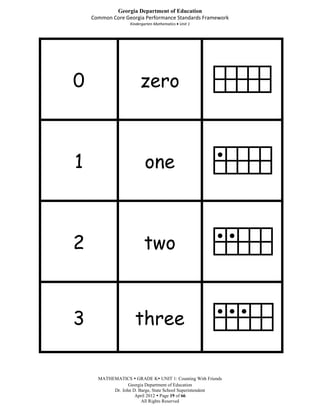
0                       zero


1                         one
                                                       ●


2                         two
                                                       ● ●


3                    three
                                                       ● ● ●


      MATHEMATICS  GRADE K UNIT 1: Counting With Friends
                  Georgia Department of Education
           Dr. John D. Barge, State School Superintendent
                     April 2012  Page 19 of 66
                        All Rights Reserved
Georgia Department of Education
    Common Core Georgia Performance Standards Framework
                   Kindergarten Mathematics Unit 1


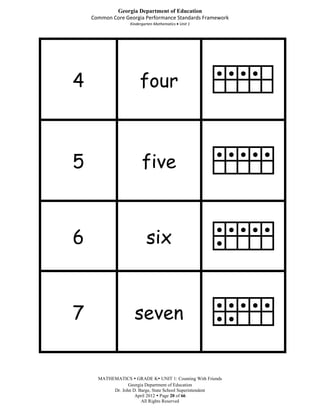
4                       four
                                                       ● ● ● ●


5                        five
                                                       ● ● ● ● ●


6                          six
                                                       ● ● ● ● ●
                                                       ●


7                    seven
                                                       ● ● ● ● ●
                                                       ● ●


      MATHEMATICS  GRADE K UNIT 1: Counting With Friends
                  Georgia Department of Education
           Dr. John D. Barge, State School Superintendent
                     April 2012  Page 20 of 66
                        All Rights Reserved
Georgia Department of Education
     Common Core Georgia Performance Standards Framework
                    Kindergarten Mathematics Unit 1


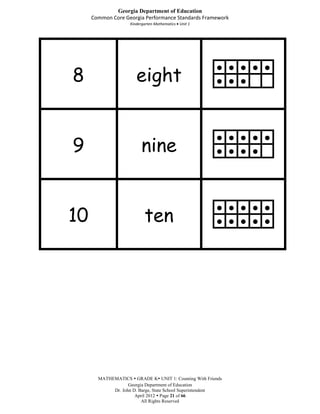
8                      eight
                                                        ● ● ● ● ●
                                                        ● ● ●


9                        nine
                                                        ● ● ● ● ●
                                                        ● ● ● ●


10                         ten
                                                        ● ● ● ● ●
                                                        ● ● ● ● ●


       MATHEMATICS  GRADE K UNIT 1: Counting With Friends
                   Georgia Department of Education
            Dr. John D. Barge, State School Superintendent
                      April 2012  Page 21 of 66
                         All Rights Reserved
Georgia Department of Education
                       Common Core Georgia Performance Standards Framework
                                      Kindergarten Mathematics Unit 1


CONSTRUCTING TASK: Fill in the Line 0 to 9
Approximately 1 Day repeated as a station (Adapted from Race to Trace from
www.K-5TeacherResources.com

STANDARDS FOR MATHEMATICAL CONTENT

MCC.K.CC.1. Count to 100 by ones and by tens.

MCC.K.CC.2. Count forward beginning from a given number within the known sequence
(instead of having to begin at 1).

MCC.K.CC.3. Write numbers from 0 to 20. Represent a number of objects with a written
numeral 0-20 (with 0 representing a count of no objects).

MCC.K.CC.4. Understand the relationship between numbers and quantities; connect counting to
cardinality.
    a) When counting objects, say the number names in the standard order, pairing each object
       with one and only one number name and each number name with one and only one
       object.
    b) Understand that the last number name said tells the number of objects counted. The
       number of objects is the same regardless of their arrangement or the order in which they
       were counted.
    c) Understand that each successive number name refers to a quantity that is one larger.

STANDARDS FOR MATHEMATICAL PRACTICE

1.   Make sense of problems and persevere in solving them.
2.   Reason abstractly and quantitatively.
3.   Construct viable arguments and critique the reasoning of others.
4.   Model with mathematics.
5.   Use appropriate tools strategically.
6.   Attend to precision.
7.   Look for and make use of structure.
8.   Look for and express regularity in repeated reasoning.

 BACKGROUND KNOWLEDGE
Students need practice writing numerals. Fill in the Line 0-9 allows students and opportunity for
repeated practice.

ESSENTIAL QUESTIONS

         How can we use counting in our everyday life?
         What is a numeral?
         Why would we need to be able to read number words?
         How can we record what we count?

                         MATHEMATICS  GRADE K UNIT 1: Counting With Friends
                                     Georgia Department of Education
                              Dr. John D. Barge, State School Superintendent
                                        April 2012  Page 22 of 66
                                           All Rights Reserved
Georgia Department of Education
                     Common Core Georgia Performance Standards Framework
                                      Kindergarten Mathematics Unit 1


MATERIALS

       ten sided die or 0-9 spinner
       game board for each student
       pencil

GROUPING

Whole group and partner task

TASK DESCRIPTION, DEVELOPMENT, AND DISCUSSION

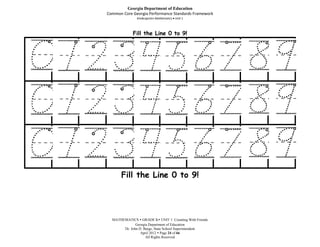
The object of the game is to be the first person to trace a complete line 0-9. To play the game,
player 1 will roll the die and trace the number the die lands on. He/she may choose any row to
trace the number. Next, Player 2 will roll the die and trace the number the die lands on. He/she
may choose any row to trace the number. If a number has already been traced in all 4 rows then
they player loses that turn. The first player to trace all the numbers in one row wins!

FORMATIVE ASSESSMENT QUESTIONS

       How many numbers do you need to win?
       What numbers do you need to win?
       Who is closer to winning? How do you know?
       What number do you have the most of? Least of?

DIFFERENTIATION

Extension
      Have students play Fill in the Line without the recording sheets. Have them record the
      numerals in their math journal. Spatial recognition will be critical as students need to
      leave space for the unwritten numerals.
      Using a ten sided dice or spinner, students could record the numeral that is one less or 1
      more than what was rolled. (Example: if a 3 was rolled, the student would record 2 or 4
      depending on the rule)

Intervention
       Correctly writing digits/numbers is an ongoing process that requires ongoing practice
       throughout the year.
       Students can practice writing numerals in the sand, with finger paint, or with a dry erase
       marker on the desk.


                        MATHEMATICS  GRADE K UNIT 1: Counting With Friends
                                    Georgia Department of Education
                             Dr. John D. Barge, State School Superintendent
                                       April 2012  Page 23 of 66
                                          All Rights Reserved
Georgia Department of Education
Common Core Georgia Performance Standards Framework
               Kindergarten Mathematics Unit 1


             Fill the Line 0 to 9!


      Fill the Line 0 to 9!


  MATHEMATICS  GRADE K UNIT 1: Counting With Friends
              Georgia Department of Education
       Dr. John D. Barge, State School Superintendent
                 April 2012  Page 24 of 66
                    All Rights Reserved
Georgia Department of Education
                 Common Core Georgia Performance Standards Framework
                                Kindergarten Mathematics Unit 1


_____ _____ _____ _____ _____ _____ _____ _____ _____ _____


_____ _____ _____ _____ _____ _____ _____ _____ _____ _____


_____ _____ _____ _____ _____ _____ _____ _____ _____ _____


_____ _____ _____ _____ _____ _____ _____ _____ _____ _____


                   MATHEMATICS  GRADE K UNIT 1: Counting With Friends
                               Georgia Department of Education
                        Dr. John D. Barge, State School Superintendent
                                  April 2012  Page 25 of 66
                                     All Rights Reserved
Georgia Department of Education
                                   Common Core Georgia Performance Standards Framework
                                                   Kindergarten Mathematics Unit 1


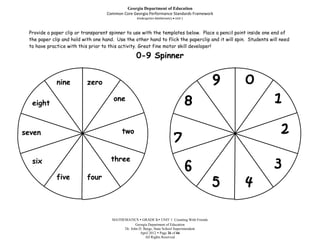
 Provide a paper clip or transparent spinner to use with the templates below. Place a pencil point inside one end of
 the paper clip and hold with one hand. Use the other hand to flick the paperclip and it will spin. Students will need
 to have practice with this prior to this activity. Great fine motor skill developer!

                                                   0-9 Spinner


             nine          zero                                                              9    0
  eight
                                       one
                                                                                     8                         1

seven                                      two                                                                    2
                                                                           7
  six                                three
                                                                                     6                         3
             five          four
                                                                                             5    4

                                      MATHEMATICS  GRADE K UNIT 1: Counting With Friends
                                                  Georgia Department of Education
                                           Dr. John D. Barge, State School Superintendent
                                                     April 2012  Page 26 of 66
                                                        All Rights Reserved
Georgia Department of Education
                       Common Core Georgia Performance Standards Framework
                                      Kindergarten Mathematics Unit 1


CONSTRUCTING TASK: The Rekenrek?
The Rekenrek can be used throughout the year and incorporated in a variety of tasks
to enforce concrete representation of numbers and strategies. Adapted from
www.k-5teachingresources.com

STANDARDS FOR MATHEMATICAL CONTENT

MCC.K.CC.1. Count to 100 by ones and by tens.

MCC.K.CC.2. Count forward beginning from a given number within the known sequence
(instead of having to begin at 1).

MCC.K.CC.3. Write numbers from 0 to 20. Represent a number of objects with a written
numeral 0-20 (with 0 representing a count of no objects).

MCC.K.CC.4. Understand the relationship between numbers and quantities; connect counting to
cardinality.
    a. When counting objects, say the number names in the standard order, pairing each object
       with one and only one number name and each number name with one and only one
       object.
    b. Understand that the last number name said tells the number of objects counted. The
       number of objects is the same regardless of their arrangement or the order in which they
       were counted.
    c. Understand that each successive number name refers to a quantity that is one larger.

MCC.K.MD.3. Classify objects into given categories; count the numbers of objects in each
category and sort the categories by count.

STANDARDS FOR MATHEMATICAL PRACTICE

1.   Make sense of problems and persevere in solving them.
2.   Reason abstractly and quantitatively.
3.   Construct viable arguments and critique the reasoning of others.
4.   Model with mathematics.
5.   Use appropriate tools strategically.
6.   Attend to precision.
7.   Look for and make use of structure.
8.   Look for and express regularity in repeated reasoning.

BACKGROUND KNOWLEDGE

The Rekenrek is a math tool created by Adrian Treffers at the Freudenthal Institute in Holland.
Translated to English, Rekenrek means “counting rack”. The Rekenrek is composed of 20
                         MATHEMATICS  GRADE K UNIT 1: Counting With Friends
                                     Georgia Department of Education
                              Dr. John D. Barge, State School Superintendent
                                        April 2012  Page 27 of 66
                                           All Rights Reserved
Georgia Department of Education
                      Common Core Georgia Performance Standards Framework
                                       Kindergarten Mathematics Unit 1

beads in two rows of ten with five red and five white on each rod. Although the Rekenrek may
look similar to an abacus, it differs because its structure is based around fives as opposed to tens.
The five-structure represents the five fingers on each of our hands and five toes on each of our
feet. Tournaki et al (2008) concluded that the structure of five utilized by the Rekenrek was extremely
helpful in the advancement of students’ number sense. In addition to increasing number sense,
Tournaki et al (2008) recognized that the Rekenrek acted as a facilitator of knowledge as
students develop efficient thinking strategies. Gravemeijer (1991) stated that materials
themselves cannot transmit knowledge to the learner, however it can make numbers and
relationships accessible to students to later obtain fact mastery and fluency. More information
on the Rekenrek can be found at http://www.mathlearningcenter.org/media/Rekenrek_0308.pdf.

Gravenmeijer, K. (1991). An Instruction-Theoretical Reflection On The Use Of Manipulatives.
Tournaki, N., Bae, Y., & Kerekes, J. (2008). Rekenrek: A manipulative used to teach addition
and subtraction to students with learning disabilities.

ESSENTIAL QUESTIONS

       How can the Rekenrek help me as a mathematician?
       How can we show numbers in different ways?
       How do we use counting in our everyday life?
       Why are numbers important?
       What do numbers mean to us?

MATERIALS

       Cardboard
       2 Pipe Cleaners or beading elastics
       20 Beads (10 red/10 white)
       Rekenrek Recording Sheet (optional)

GROUPING

The Rekenrek can be used whole group, small group, partner task, and individually

TASK DESCRIPTION, DEVELOPMENT, AND DISCUSSION

Making the Rekenrek:
     Poke two small holes at each end of the cardboard, about 1in. in from the side.
     Cut two 5in. lengths of elastic or use pipe cleaners. Place one end of each piece of elastic
     into the holes at one end of the board and tie in a knot at the back or poke a pipe cleaner
     through the hole and bend it.
     Place five white beads and five red beads on each length of elastic or pipe cleaner.

                         MATHEMATICS  GRADE K UNIT 1: Counting With Friends
                                     Georgia Department of Education
                              Dr. John D. Barge, State School Superintendent
                                        April 2012  Page 28 of 66
                                           All Rights Reserved
Georgia Department of Education
                       Common Core Georgia Performance Standards Framework
                                        Kindergarten Mathematics Unit 1


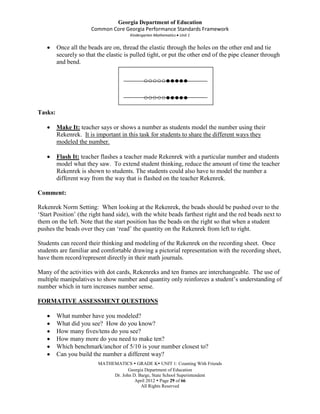
         Once all the beads are on, thread the elastic through the holes on the other end and tie
         securely so that the elastic is pulled tight, or put the other end of the pipe cleaner through
         and bend.


                                               ○○○○○●●●●●

                                               ○○○○○●●●●●
Tasks:

         Make It: teacher says or shows a number as students model the number using their
         Rekenrek. It is important in this task for students to share the different ways they
         modeled the number.

         Flash It: teacher flashes a teacher made Rekenrek with a particular number and students
         model what they saw. To extend student thinking, reduce the amount of time the teacher
         Rekenrek is shown to students. The students could also have to model the number a
         different way from the way that is flashed on the teacher Rekenrek.

Comment:

Rekenrek Norm Setting: When looking at the Rekenrek, the beads should be pushed over to the
‘Start Position’ (the right hand side), with the white beads farthest right and the red beads next to
them on the left. Note that the start position has the beads on the right so that when a student
pushes the beads over they can ‘read’ the quantity on the Rekenrek from left to right.

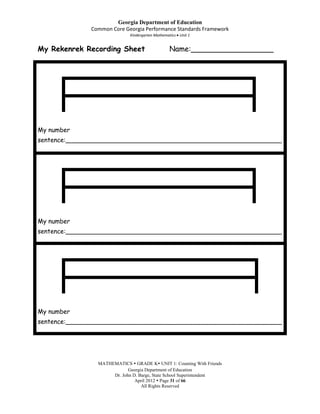
Students can record their thinking and modeling of the Rekenrek on the recording sheet. Once
students are familiar and comfortable drawing a pictorial representation with the recording sheet,
have them record/represent directly in their math journals.

Many of the activities with dot cards, Rekenreks and ten frames are interchangeable. The use of
multiple manipulatives to show number and quantity only reinforces a student’s understanding of
number which in turn increases number sense.
FORMATIVE ASSESSMENT QUESTIONS

         What number have you modeled?
         What did you see? How do you know?
         How many fives/tens do you see?
         How many more do you need to make ten?
         Which benchmark/anchor of 5/10 is your number closest to?
         Can you build the number a different way?
                          MATHEMATICS  GRADE K UNIT 1: Counting With Friends
                                      Georgia Department of Education
                               Dr. John D. Barge, State School Superintendent
                                         April 2012  Page 29 of 66
                                            All Rights Reserved
Georgia Department of Education
                    Common Core Georgia Performance Standards Framework
                                    Kindergarten Mathematics Unit 1

DIFFERENTIATION

Extension/Invention
      Differentiating with the Rekenrek can be achieved through a variety of techniques which
      are controlled by the teacher:
          o The amount of time the Rekenrek is shown or flashed to students
          o Increasing or decreasing the quantity made on the Rekenrek can help with
             differentiating.


                       MATHEMATICS  GRADE K UNIT 1: Counting With Friends
                                   Georgia Department of Education
                            Dr. John D. Barge, State School Superintendent
                                      April 2012  Page 30 of 66
                                         All Rights Reserved
Georgia Department of Education
              Common Core Georgia Performance Standards Framework
                             Kindergarten Mathematics Unit 1


My Rekenrek Recording Sheet                      Name:__________________


My number
sentence:_______________________________________________________


My number
sentence:_______________________________________________________


My number
sentence:_______________________________________________________


                MATHEMATICS  GRADE K UNIT 1: Counting With Friends
                            Georgia Department of Education
                     Dr. John D. Barge, State School Superintendent
                               April 2012  Page 31 of 66
                                  All Rights Reserved
Georgia Department of Education
                       Common Core Georgia Performance Standards Framework
                                      Kindergarten Mathematics Unit 1


PRACTICE TASK: Fill the Chutes
Approximately 1 Day then as Center (Van de Walle Activity 2.3)

STANDARDS FOR MATHEMATICAL CONTENT

MCC.K.CC.2. Count forward beginning from a given number within the known sequence
(instead of having to begin at 1).

MCC.K.CC.4. Understand the relationship between numbers and quantities; connect counting to
cardinality.
    a. When counting objects, say the number names in the standard order, pairing each object
       with one and only one number name and each number name with one and only one
       object.
    b. Understand that the last number name said tells the number of objects counted. The
       number of objects is the same regardless of their arrangement or the order in which they
       were counted.
    c. Understand that each successive number name refers to a quantity that is one larger.

STANDARDS FOR MATHEMATICAL PRACTICE

1.   Make sense of problems and persevere in solving them.
2.   Reason abstractly and quantitatively.
3.   Construct viable arguments and critique the reasoning of others.
4.   Model with mathematics.
5.   Use appropriate tools strategically.
6.   Attend to precision.
7.   Look for and make use of structure.
8.   Look for and express regularity in repeated reasoning.

BACKGROUND IKNOWLEDGE

Children will learn how to count (matching counting words with objects) before they understand
that the last count word indicates the amount of a set or the cardinality of a set. Children who
have made this connection are said to have the cardinality principle, which is a refinement of
their early ideas about quantity. (Van de Walle, 2006)

ESSENTIAL QUESTIONS

         How can playing board games make me a better mathematician?
         What types of questions should I ask myself or my partner when playing a math game?


                         MATHEMATICS  GRADE K UNIT 1: Counting With Friends
                                     Georgia Department of Education
                              Dr. John D. Barge, State School Superintendent
                                        April 2012  Page 32 of 66
                                           All Rights Reserved
Georgia Department of Education
                     Common Core Georgia Performance Standards Framework
                                     Kindergarten Mathematics Unit 1

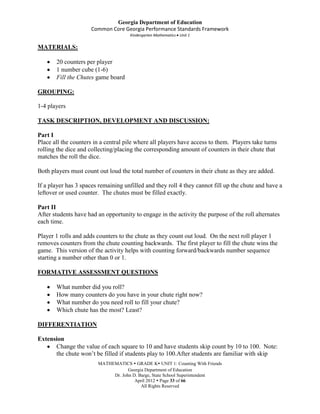
MATERIALS:

       20 counters per player
       1 number cube (1-6)
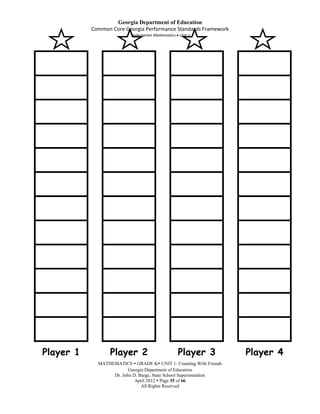
       Fill the Chutes game board

GROUPING:

1-4 players

TASK DESCRIPTION, DEVELOPMENT AND DISCUSSION:

Part I
Place all the counters in a central pile where all players have access to them. Players take turns
rolling the dice and collecting/placing the corresponding amount of counters in their chute that
matches the roll the dice.

Both players must count out loud the total number of counters in their chute as they are added.

If a player has 3 spaces remaining unfilled and they roll 4 they cannot fill up the chute and have a
leftover or used counter. The chutes must be filled exactly.

Part II
After students have had an opportunity to engage in the activity the purpose of the roll alternates
each time.

Player 1 rolls and adds counters to the chute as they count out loud. On the next roll player 1
removes counters from the chute counting backwards. The first player to fill the chute wins the
game. This version of the activity helps with counting forward/backwards number sequence
starting a number other than 0 or 1.

FORMATIVE ASSESSMENT QUESTIONS

       What number did you roll?
       How many counters do you have in your chute right now?
       What number do you need roll to fill your chute?
       Which chute has the most? Least?

DIFFERENTIATION

Extension
      Change the value of each square to 10 and have students skip count by 10 to 100. Note:
      the chute won’t be filled if students play to 100.After students are familiar with skip
                        MATHEMATICS  GRADE K UNIT 1: Counting With Friends
                                    Georgia Department of Education
                             Dr. John D. Barge, State School Superintendent
                                       April 2012  Page 33 of 66
                                          All Rights Reserved
Georgia Department of Education
                   Common Core Georgia Performance Standards Framework
                                   Kindergarten Mathematics Unit 1

      counting forward by tens, have them alternate rolls to skip count backwards and
      forwards.


Intervention
      Because the students must say the total number of counters out loud, the numerals for
      each square could be written on the game board to help with number recognition and
      counting forward and backwards..


                      MATHEMATICS  GRADE K UNIT 1: Counting With Friends
                                  Georgia Department of Education
                           Dr. John D. Barge, State School Superintendent
                                     April 2012  Page 34 of 66
                                        All Rights Reserved
Georgia Department of Education
           Common Core Georgia Performance Standards Framework
                          Kindergarten Mathematics Unit 1


Player 1          Player 2                        Player 3          Player 4
             MATHEMATICS  GRADE K UNIT 1: Counting With Friends
                         Georgia Department of Education
                  Dr. John D. Barge, State School Superintendent
                            April 2012  Page 35 of 66
                               All Rights Reserved
Georgia Department of Education
                       Common Core Georgia Performance Standards Framework
                                      Kindergarten Mathematics Unit 1


PRACTICE TASK: Race to 20
Approximately 1-2 days

STANDARDS FOR MATHEMATICAL CONTENT

MCC.K.CC.1. Count to 100 by ones and by tens.

MCC.K.CC.2. Count forward beginning from a given number within the known sequence
(instead of having to begin at 1).

MCC.K.CC.4. Understand the relationship between numbers and quantities; connect counting to
cardinality.
    d. When counting objects, say the number names in the standard order, pairing each object
       with one and only one number name and each number name with one and only one
       object.
    e. Understand that the last number name said tells the number of objects counted. The
       number of objects is the same regardless of their arrangement or the order in which they
       were counted.
    f. Understand that each successive number name refers to a quantity that is one larger.

             (For descriptors of standard cluster, please see the Grade Level Overview)

STANDARDS FOR MATHEMATICAL PRACTICE

1.   Make sense of problems and persevere in solving them.
2.   Reason abstractly and quantitatively.
3.   Construct viable arguments and critique the reasoning of others.
4.   Model with mathematics.
5.   Use appropriate tools strategically.
6.   Attend to precision.
7.   Look for and make use of structure.
8.   Look for and express regularity in repeated reasoning.

BACKGROUND KNOWLEDGE

Children will learn how to count (matching counting words with objects) before they understand
that the last count word indicates the amount of a set or the cardinality of a set. Children who
have made this connection are said to have the cardinality principle, which is a refinement of
their early ideas about quantity. (Van de Walle, 2006)

ESSENTIAL QUESTIONS

         How can playing board games make me a better mathematician?
                         MATHEMATICS  GRADE K UNIT 1: Counting With Friends
                                     Georgia Department of Education
                              Dr. John D. Barge, State School Superintendent
                                        April 2012  Page 36 of 66
                                           All Rights Reserved
Georgia Department of Education
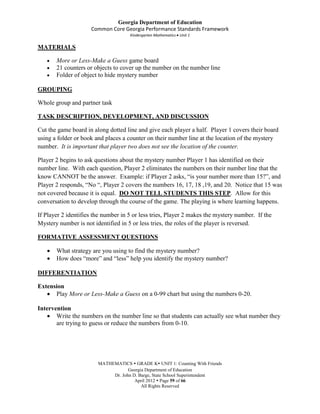
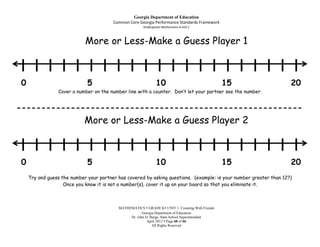
                       Common Core Georgia Performance Standards Framework
                                      Kindergarten Mathematics Unit 1


       What types of questions should I ask myself or my partner when playing a math game?

MATERIALS:

       2 different colored counters
       1 number cube (1-6)
       Race to 20 game board

GROUPING:

Partners (2 players)

TASK DESCRIPTION, DEVELOPMENT AND DISCUSSION:

       Each player places their counter in the starting square.
       Players take turns using the spinner and move their counter the corresponding number of
       spaces. Players must state what square they are on and count out loud in sequence to the
       new square.
       Player alternate turns with his/her partner until one player reaches 20.

FORMATIVE ASSESSMENT QUESTIONS

As students are engaged in Race to 20, observe how students move the counter to locate the new
place on the game board. Is the student counting by ones, or are they using a strategy? If so,
which one?
       How many squares do you need to win the game?
       What square are you on now?
       What is the number of the next square?
       How can playing board games make me a better mathematician?

DIFFERENTIATION:

Extension
      Each time a student rolls a die they alternate between counting spaces forwards and
      backwards. The number of spaces is determined by the amount shown on the die.
      Example: If player one rolled a six, they would move forward six spaces. If on the next
      turn, player one rolled a three, they would move backwards three spaces. Students would
      continue on until a player reached 20.

Intervention
       Because the students must say the numerals aloud, the numerals could also be written on
       the game board to assist with location identification and sequential counting.

                         MATHEMATICS  GRADE K UNIT 1: Counting With Friends
                                     Georgia Department of Education
                              Dr. John D. Barge, State School Superintendent
                                        April 2012  Page 37 of 66
                                           All Rights Reserved
Georgia Department of Education
                                    Common Core Georgia Performance Standards Framework
                                                   Kindergarten Mathematics Unit 1


Start

                                                                        5
   0
    Materials:
    2 different colored counters
                                                                                                  10
    1 number cube (1-6)                                                              Race to 20
    Directions:
    -Each player places their counter in the starting square
    numbered 0.
    -Players take turns using the spinner and move their counter the
    corresponding number of spaces. Players must state what square
    they are on and count out loud in sequence (forward or backward)
    to the new square.
    -Players alternate turns until one player reaches 20.


Finish

                                                                   15
 20
                                      MATHEMATICS  GRADE K UNIT 1: Counting With Friends
                                                  Georgia Department of Education
                                           Dr. John D. Barge, State School Superintendent
                                                     April 2012  Page 38 of 66
                                                        All Rights Reserved
Georgia Department of Education
                       Common Core Georgia Performance Standards Framework
                                      Kindergarten Mathematics Unit 1


CONSTRUCTING TASK: The Cardinal Cup (0-10)
Approximately 1-2 days then repeated

STANDARDS FOR MATHEMATICAL CONTENT

MCC.K.CC.1 Count to 100 by ones and by tens.

MCC.K.CC.2. Count forward beginning from a given number within the known sequence
(instead of having to begin at 1).

MCC.K.CC.4. Understand the relationship between numbers and quantities; connect counting to
cardinality.
    a. When counting objects, say the number names in the standard order, pairing each object
       with one and only one number name and each number name with one and only one
       object.
    b. Understand that the last number name said tells the number of objects counted. The
       number of objects is the same regardless of their arrangement or the order in which they
       were counted.
    c. Understand that each successive number name refers to a quantity that is one larger.

             (For descriptors of standard cluster please see the Grade Level Overview)

STANDARDS FOR MATHEMATICAL PRACTICE

1.   Make sense of problems and persevere in solving them.
2.   Reason abstractly and quantitatively.
3.   Construct viable arguments and critique the reasoning of others.
4.   Model with mathematics.
5.   Use appropriate tools strategically.
6.   Attend to precision.
7.   Look for and make use of structure.
8.   Look for and express regularity in repeated reasoning.

BACKGROUND KNOWLEDGE

Students should learn that counting objects in a different order does not alter the result, and they
may notice that the next whole number in the counting sequence is one more than the number
just named. Children should learn that the last number named represents the last object as well as
the total number of objects in the collection (NCTM Principles and Standards, 2012).

ESSENTIAL QUESTIONS
     Why do we need to be able to count objects?
     How do we use numbers every day?
                         MATHEMATICS  GRADE K UNIT 1: Counting With Friends
                                     Georgia Department of Education
                              Dr. John D. Barge, State School Superintendent
                                        April 2012  Page 39 of 66
                                           All Rights Reserved
Georgia Department of Education
                      Common Core Georgia Performance Standards Framework
                                      Kindergarten Mathematics Unit 1


       How do we use counting in our everyday life?
       Why do we need to be able to count forwards and backwards?

MATERIALS

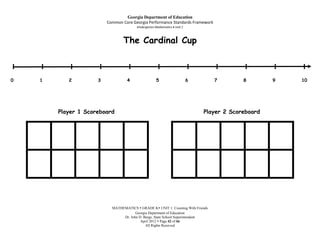
       Cardinal Cup playing mat
       Playing cards from Numerals, Pictures, Words Task
       (10) cubes or counters for the cup and 20 counters to keep score
       Cup
       Math journal to record numbers

GROUPING

Whole group and partner task

TASK DESCRIPTION, DEVELOPMENT, AND DISCUSSION

Part I(counting forward)

Students use the task cards from Numbers, Pictures, Words and place them in a pile face down.
Player 1 turns over the top card and places that many cubes in the cup and counts out loud as
each cube is placed into the cup. Once Player 1 is finished counting, Player 2 removes the
contents from the cup and verifies that the correct number of cubes was placed in the cup by
placing the counters on the counting mat. (1-to-1 correspondence). If the player was correct in
counting out the cubes they receive 1 chip to be placed on their ten-frame. The first player to fill
up their ten frame wins.

As students place cubes on the number line ask questions that pertain to ordinal numbers and
positional words. What color is the 5th cube? What color is next to the 7th cube?

Part II (counting forward and/or backwards)

Students use the task cards from Numbers, Pictures, Words and place them in a pile face down.
Player 1 turns over the top card and places that many cubes in the cup and counts out loud as
each cube is placed into the cup. Once Player 1 has finished placing all the counters into the cup,
they turn over the next card from the pile and add/ remove cubes to/ from the cup to match the
second card. As player 1 adds/removes cubes from the cup they must count out loud forward or
backward in sequence, with the starting number being the quantity in the cup. The key is that
player 1 must mentally retain the number of cubes that were in the cup after the first card and
adjust the quantity in the cup without recounting the initial set of cubes. The new quantity must
match the number displayed on the second card.


                         MATHEMATICS  GRADE K UNIT 1: Counting With Friends
                                     Georgia Department of Education
                              Dr. John D. Barge, State School Superintendent
                                        April 2012  Page 40 of 66
                                           All Rights Reserved
Georgia Department of Education
                      Common Core Georgia Performance Standards Framework
                                      Kindergarten Mathematics Unit 1

After Player 1 has made the necessary change to the cup, Player 2 dumps the cup out to verify
that the quantity in the cup matches the second card by using the counting mat. If the card and
quantity match, player 1 gets a chip to place on their ten frame. The first player to fill up their
ten frame wins.

Comment:
    Students can record the numeral they counted in their journal for practice.
    Ordinal numbers and understanding of positional words can be introduced /revisited
    through teacher questioning. (Example: What was the second number you had to count?)
    Only using two different colored cubes would allow students to count while creating a
    pattern. (Example: 1st cube red, 2nd cube blue, 3rd cube red, etc…)

FORMATIVE ASSESSMENT QUESTIONS

       How many cubes are there in this set?
       How do you know that you counted correctly?
       What color is the 5th cube? (ordinal numbers)
       What color comes after the blue cube? (positional words)
       If you created a pattern using red, blue, red, blue (ABAB) what color would the 7th cube
       be?

DIFFERENTIATION

Extension
      Ordinal numbers and understanding of positional words can be introduced /revisited
      through teacher questioning.
      Only using two different colored cubes would allow students to count while creating a
      pattern. (Example: 1st cube red, 2nd cube blue, 3rd cube red, etc…)

Intervention
       Repeated practice is the best intervention. To develop counting engage students in
       almost any game or activity that involves counts and comparison.
       Have students model the Cardinal Cup with their Rekenrek or ten-frame.


                         MATHEMATICS  GRADE K UNIT 1: Counting With Friends
                                     Georgia Department of Education
                              Dr. John D. Barge, State School Superintendent
                                        April 2012  Page 41 of 66
                                           All Rights Reserved
Georgia Department of Education
                         Common Core Georgia Performance Standards Framework
                                        Kindergarten Mathematics Unit 1


                                 The Cardinal Cup

I   I       I        I              I                 I                   I       I        I        I   I
0   1      2         3             4                5                     6       7        8        9   10


        Player 1 Scoreboard                                                   Player 2 Scoreboard


                           MATHEMATICS  GRADE K UNIT 1: Counting With Friends
                                       Georgia Department of Education
                                Dr. John D. Barge, State School Superintendent
                                          April 2012  Page 42 of 66
                                             All Rights Reserved
Georgia Department of Education
                       Common Core Georgia Performance Standards Framework
                                      Kindergarten Mathematics Unit 1


CONSTRUCTING TASK: Order the Dice
Approximately 1 day

STANDARDS FOR MATHEMATICAL CONTENT

MCC.K.CC.1 Count to 100 by ones and by tens.

MCC.K.CC.2. Count forward beginning from a given number within the known sequence
(instead of having to begin at 1).

MCC.K.CC.4 Understand the relationship between numbers and quantities; connect counting to
cardinality.
    a. When counting objects, say the number names in the standard order, pairing each object
       with one and only one number name and each number name with one and only one
       object.
    b. Understand that the last number name said tells the number of objects counted. The
       number of objects is the same regardless of their arrangement or the order in which they
       were counted.
    c. Understand that each successive number name refers to a quantity that is one larger.

MCC.K.MD.3.Classify objects into given categories; count the numbers of objects in each
category and sort the categories by count.

             (For descriptors of standard cluster please see the Grade Level Overview)

STANDARDS FOR MATHEMATICAL PRACTICE

1.   Make sense of problems and persevere in solving them.
2.   Reason abstractly and quantitatively.
3.   Construct viable arguments and critique the reasoning of others.
4.   Model with mathematics.
5.   Use appropriate tools strategically.
6.   Attend to precision.
7.   Look for and make use of structure.
8.   Look for and express regularity in repeated reasoning.

BACKGROUND KNOWLEDGE

This activity task is designed for number sequence and recognition. It will also help students
start at a number that may not be one and continue counting forward.

ESSENTIAL QUESTIONS

                         MATHEMATICS  GRADE K UNIT 1: Counting With Friends
                                     Georgia Department of Education
                              Dr. John D. Barge, State School Superintendent
                                        April 2012  Page 43 of 66
                                           All Rights Reserved
Georgia Department of Education
                       Common Core Georgia Performance Standards Framework
                                        Kindergarten Mathematics Unit 1


        How can we use counting in our everyday life?
        Why is it important to know how to put things in number order?
        How does putting things in order keep things organized?
        Why do we need to be able to put things in order?

MATERIALS

        Order the Dice game board
        Dice

GROUPING

Partner task

TASK DESCRIPTION, DEVELOPMENT, AND DISCUSSION

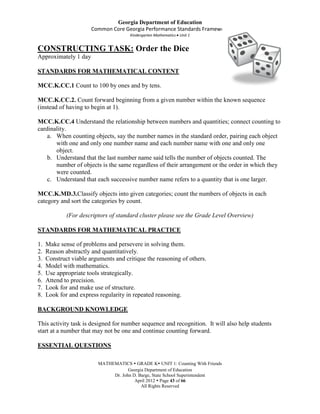
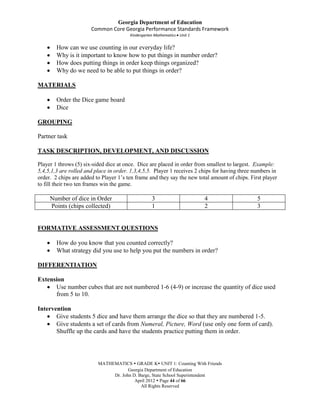
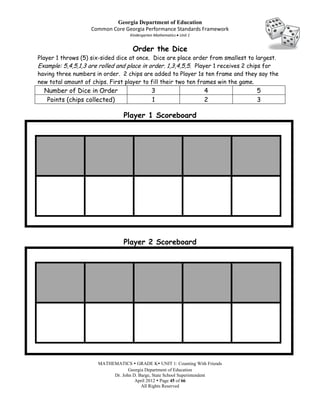
Player 1 throws (5) six-sided dice at once. Dice are placed in order from smallest to largest. Example:
5,4,5,1,3 are rolled and place in order. 1,3,4,5,5. Player 1 receives 2 chips for having three numbers in
order. 2 chips are added to Player 1’s ten frame and they say the new total amount of chips. First player
to fill their two ten frames win the game.

     Number of dice in Order                       3                      4                     5
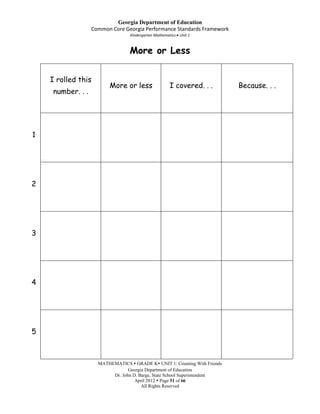
     Points (chips collected)                      1                      2                     3


FORMATIVE ASSESSMENT QUESTIONS

        How do you know that you counted correctly?
        What strategy did you use to help you put the numbers in order?

DIFFERENTIATION

Extension
      Use number cubes that are not numbered 1-6 (4-9) or increase the quantity of dice used
      from 5 to 10.

Intervention
       Give students 5 dice and have them arrange the dice so that they are numbered 1-5.
       Give students a set of cards from Numeral, Picture, Word (use only one form of card).
       Shuffle up the cards and have the students practice putting them in order.


                          MATHEMATICS  GRADE K UNIT 1: Counting With Friends
                                      Georgia Department of Education
                               Dr. John D. Barge, State School Superintendent
                                         April 2012  Page 44 of 66
                                            All Rights Reserved
Georgia Department of Education
                    Common Core Georgia Performance Standards Framework
                                   Kindergarten Mathematics Unit 1


                                    Order the Dice
Player 1 throws (5) six-sided dice at once. Dice are place order from smallest to largest.
Example: 5,4,5,1,3 are rolled and place in order. 1,3,4,5,5. Player 1 receives 2 chips for
having three numbers in order. 2 chips are added to Player 1s ten frame and they say the
new total amount of chips. First player to fill their two ten frames win the game.
  Number of Dice in Order                     3                      4           5
   Points (chips collected)                   1                      2           3

                                Player 1 Scoreboard


                                Player 2 Scoreboard


                      MATHEMATICS  GRADE K UNIT 1: Counting With Friends
                                  Georgia Department of Education
                           Dr. John D. Barge, State School Superintendent
                                     April 2012  Page 45 of 66
                                        All Rights Reserved
Georgia Department of Education
                       Common Core Georgia Performance Standards Framework
                                       Kindergarten Mathematics Unit 1


CONSTRUCTING TASK: More or Less
Approximately 1 day (Adapted from Van De Walle 2.1)

STANDARDS FOR MATHEMATICAL CONTENT

MCC.K.CC.1 Count to 100 by ones and by tens.

MCC.K.CC.2. Count forward beginning from a given number within the known sequence
(instead of having to begin at 1).

MCC.K.CC.3.Write numbers from 0 to 20. Represent a number of objects with a written
numeral 0-20 (with 0 representing a count of no objects).

MCC.K.CC.4.Understand the relationship between numbers and quantities; connect counting to
cardinality.
    b. Understand that the last number name said tells the number of objects counted. The
number of objects is the same regardless of their arrangement or the order in which they were
counted.
    c. Understand that each successive number name refers to a quantity that is one larger.

STANDARDS FOR MATHEMATICAL PRACTICE

1.   Make sense of problems and persevere in solving them.
2.   Reason abstractly and quantitatively.
3.   Construct viable arguments and critique the reasoning of others.
4.   Model with mathematics.
5.   Use appropriate tools strategically.
6.   Attend to precision.
7.   Look for and make use of structure.
8.   Look for and express regularity in repeated reasoning.

BACKGROUND KNOWLEDGE

The concept of “more, “less” and the “same” are basic relationships contributing to the overall
concept of number. Children begin to develop these ideas before they begin school. Children
entering kindergarten can almost always choose the set that is “more” if presented with sets that
are quite obviously different in number.

ESSENTIAL QUESTIONS

         What is the difference between “more” and “less”?
         What types of questions should I ask myself or my partner when playing a math game?


                          MATHEMATICS  GRADE K UNIT 1: Counting With Friends
                                      Georgia Department of Education
                               Dr. John D. Barge, State School Superintendent
                                         April 2012  Page 46 of 66
                                            All Rights Reserved
Georgia Department of Education
                     Common Core Georgia Performance Standards Framework
                                     Kindergarten Mathematics Unit 1

MATERIALS

Version 1 (Numbers 0-8)
       Recording Sheet and game board
       20 red/yellow counters
       6 sided dice (1-6)
       More/Less Spinner or Dice

Version 2 (Numbers 2-11)
       Recording Sheet and game board
       20 red/yellow counters
       6 sided dice (4-9) (use wooden block)
       More/Less Spinner or Dice

GROUPING

Whole group and partner task

TASK DESCRIPTION, DEVELOPMENT, AND DISCUSSION

Comment
There are 2 version of this game. Each version can be played with more/less OR more/less 1&2.
The spinners provided can be used or dice/wooden blocks can be used to take place of the
spinners. The following description is generic for both games.

Player 1 rolls the dice (1-6) or (4-9) and spins the spinner (more/less or more/less 1&2). The
player covers the number in the way the dice relates to the spinner.

Part I (More/Less):
Example: if player 1 rolls a 5 then spin less, they can cover any number less than 5. (4,3,2,1, or
0) Watch the number the student covers as it relates to getting 3 in a row. Are they randomly
picking a number to cover? Or are they choosing the number to cover based on their best chance
to get 3 in a row?

Part II (More/Less 1&2):
Example: if you roll a 5 and spin 2 more, you count forward 2 from 5 to end at seven.

As students play, they record the number they rolled on the recording sheet. Then they record
what they spun (more/less, 1, more 1 less, etc….). Students then record what they covered on
the game board. They justify this in the “because” section by writing an equation or another
justification for covering. (Example: A player could say she rolled one more than 8. That’s 9,
because one more is the next number, so in the space she wrote “it’s next.”) First player to get 3
counters in a row wins.
                        MATHEMATICS  GRADE K UNIT 1: Counting With Friends
                                    Georgia Department of Education
                             Dr. John D. Barge, State School Superintendent
                                       April 2012  Page 47 of 66
                                          All Rights Reserved
Georgia Department of Education
                     Common Core Georgia Performance Standards Framework
                                    Kindergarten Mathematics Unit 1

FORMATIVE ASSESSMENT QUESTIONS

       How do you know that you counted correctly?
       What does “more” mean? What does “less” mean?
       What numbers do you need to win?
       Why did you choose that number?
       If you spun “2 more” what number would need to roll to win?

DIFFERENTIATION

Extension
      Have the students model their actions using a ten-frame or Rekenrek. This will also help
      students to record their actions.

Intervention
       Allow the students to model with a ten frame or through the use of a number line.


                       MATHEMATICS  GRADE K UNIT 1: Counting With Friends
                                   Georgia Department of Education
                            Dr. John D. Barge, State School Superintendent
                                      April 2012  Page 48 of 66
                                         All Rights Reserved
Georgia Department of Education
             Common Core Georgia Performance Standards Framework
                             Kindergarten Mathematics Unit 1


              (0-8) More or Less -3 in a Row
Materials:   Rules: Player 1 rolls the dice and spins the spinner. Player 1 covers a
spinner      number square that relates to the spinner.
dice         (Example: if player 1 rolls a 5 and spins “less”, they can cover any
counters     number less than 5. (4, 3, 2, 1, 0). If player 1 spins “2 less “ they would
             cover 3. Record what you did on the More or Less recording sheet.
             First player to get 3 counters in a row wins.


      7                      8                             6               0
      4                      5                             4               2
      3                      3                             6               5
       1                     0                             2               4
      5                      7                                 1           8
                MATHEMATICS  GRADE K UNIT 1: Counting With Friends
                            Georgia Department of Education
                     Dr. John D. Barge, State School Superintendent
                               April 2012  Page 49 of 66
                                  All Rights Reserved
Georgia Department of Education
              Common Core Georgia Performance Standards Framework
                              Kindergarten Mathematics Unit 1


(2-11) More or Less -3 in a Row
 Materials:   Rules: Player 1 rolls the dice and spins the spinner. Player 1 covers a
 spinner,     number square that relates to the spinner.
 dice,        (Example: if player 1 rolls a 5 and spins “less”, they can cover any
 counters     number less than 5. (4, 3, 2, 1, 0). If player 1 spins “2 less “ they would
              cover 3. First player to get 3 counters in a row wins.


        9                  10                               5               6
        6                     8                             7               9
      11                      6                             5            10
     10                       7                             6               8
        9                  10                               9               6
                 MATHEMATICS  GRADE K UNIT 1: Counting With Friends
                             Georgia Department of Education
                      Dr. John D. Barge, State School Superintendent
                                April 2012  Page 50 of 66
                                   All Rights Reserved
Georgia Department of Education
                   Common Core Georgia Performance Standards Framework
                                  Kindergarten Mathematics Unit 1


                                  More or Less


    I rolled this
                         More or less                 I covered. . .        Because. . .
     number. . .


1


2


3


4


5


                     MATHEMATICS  GRADE K UNIT 1: Counting With Friends
                                 Georgia Department of Education
                          Dr. John D. Barge, State School Superintendent
                                    April 2012  Page 51 of 66
                                       All Rights Reserved
Georgia Department of Education
                    Common Core Georgia Performance Standards Framework
                                   Kindergarten Mathematics Unit 1


                                   More or Less


     I rolled this
                          More or less                 I covered. . .        Because. . .
      number. . .


6


7


8


9


10


                      MATHEMATICS  GRADE K UNIT 1: Counting With Friends
                                  Georgia Department of Education
                           Dr. John D. Barge, State School Superintendent
                                     April 2012  Page 52 of 66
                                        All Rights Reserved
Georgia Department of Education
               Common Core Georgia Performance Standards Framework
                              Kindergarten Mathematics Unit 1


                          more                       less

                           less                      more


Place the end of the paper clip at the center of the spinner and hold in
      place with the pencil. Flick the paperclip with your finger.


                          1 more                   2 less


                         2 more                     1 less


                 MATHEMATICS  GRADE K UNIT 1: Counting With Friends
                             Georgia Department of Education
                      Dr. John D. Barge, State School Superintendent
                                April 2012  Page 53 of 66
                                   All Rights Reserved
Georgia Department of Education
                       Common Core Georgia Performance Standards Framework
                                       Kindergarten Mathematics Unit 1


        CONSTRUCTING TASK: How Many Are in the Bag (0-9)
STANDARDS FOR MATHEMATICAL CONTENT

MCC.K.CC.1.        Count to 100 by ones and by tens.

MCC.K.CC.2.        Count forward beginning from a given number within the known sequence
                   (instead of having to begin at 1).

MCC.K.CC.3.        Write numbers from 0 to 20. Represent a number of objects with a written numeral 0-
                   20 (with 0 representing a count of no objects).

MCC.K.CC.4.        Understand the relationship between numbers and quantities; connect counting
                   to cardinality.
                        a. When counting objects, say the number names in the standard order,
                            pairing each object with one and only one number name and each
                            number name with one and only one object.
                        b. Understand that the last number name said tells the number of objects
                            counted. The number of objects is the same regardless of their
                            arrangement or the order in which they were counted.
                        c. Understand that each successive number name refers to a quantity that
                            is one larger.

MCC.K.MD.3. Classify objects into given categories; count the numbers of objects in each
            category and sort the categories by count.

             (For descriptors of standard cluster please see the Grade Level Overview)

STANDARDS FOR MATHEMATICAL PRACTICE

1.   Make sense of problems and persevere in solving them.
2.   Reason abstractly and quantitatively.
3.   Construct viable arguments and critique the reasoning of others.
4.   Model with mathematics.
5.   Use appropriate tools strategically.
6.   Attend to precision.
7.   Look for and make use of structure.
8.   Look for and express regularity in repeated reasoning.

BACKGROUND KNOWLEDGE

We want to help students relate a given number to other numbers, specifically to 5 and 10.
These relationships are especially useful in thinking about various combinations of numbers.

                         MATHEMATICS  GRADE K UNIT 1: Counting With Friends
                                     Georgia Department of Education
                              Dr. John D. Barge, State School Superintendent
                                        April 2012  Page 54 of 66
                                           All Rights Reserved
Georgia Department of Education
                       Common Core Georgia Performance Standards Framework
                                        Kindergarten Mathematics Unit 1

(Example: students need to recognize that 8 is not a number in isolation. 8 is 3 more than 5 and
2 less than ten). This understanding of number and relationships has a tremendous impact on a
student’s ability to mentally compute in the later years as opposed to rote memorization. (Van
de Walle, p45)

ESSENTIAL QUESTIONS

    •       How can we use counting in our everyday life?
    •       How can numbers be represented?
    •       Why do we need to be able to count objects?
    •       How do we use numbers every day?
    •       Why would we need to be able to read number words?
    •       How can we record what we count?
    •       How do we use counting in our everyday life?
    •       What is a numeral?

MATERIALS

        How Many Are in the Bag? Recording Sheet
        Small bags
        Small items to place in each bag

GROUPING

Students can work in small groups if you aren’t using this as a performance task, individually (each child
would need 3 bags with objects in each bag), or this can be placed in a work station for students to visit
with recording done individually as a performance task.

TASK DESCRIPTION, DEVELOPMENT AND DISCUSSION

Comments

Prepare and label three bags A, B, and the last bag with C filled with 0-10 objects for each group of 3
students. You can put any small object in the bags (e.g. beans, counting cubes, small centimeter
blocks, paper clips, crayons, pencils etc.) Be sure each bag has the same item in it (there should only
be one kind of manipulative per bag, (i.e. Bag A could be filled with butter beans, Bag B could be
filled with pennies and Bag C could be filled with paperclips.)

Task Directions

Instruct students to look in each bag, count the number of objects and record it on their recording
sheet. They should also be able to answer the questions below in order to show understanding.

    While students are working, ask students such as:

                          MATHEMATICS  GRADE K UNIT 1: Counting With Friends
                                      Georgia Department of Education
                               Dr. John D. Barge, State School Superintendent
                                         April 2012  Page 55 of 66
                                            All Rights Reserved
Georgia Department of Education
                       Common Core Georgia Performance Standards Framework
                                        Kindergarten Mathematics Unit 1

        Which bag had the most? Least?
        Which bag contained the least amount of objects?
        Did either of the bags have the same amount?
        Which bag had an amount closest to 10? Closest to 20?

Comment

Students have a difficult time determining which benchmark number the quantity is closer to (anchoring 5
& 10). DO NOT TELL STUDENTS A MNEMONIC or RYHME THAT MAKES NO SENSE
CONCEPTUALLY! Instead, have student locate the number on a number line and compare which
anchor it is closer to. For this, incorporate a 0-10 number line to lead the discussion. Students need to
see and recognize that zero is a number. The number “0” needs to be recognized as part of the set.

   0         1        2         3         4           5           6       7       8         9        10


If a 0-10 number line is used students can conceptually begin to see that 3 and 7 are closer to 5. A 0-9
and 1-10 number line are both composed of 10 numerals meaning there is no defined middle. Using a 0-
10 line will help students see that the number 5 falls exactly in the middle of 0 and 10. Using a 0-9
or 1-10 number line will cause confusion and many students will not be able to make sense of
benchmarks.

Once in first grade students will benchmark numbers to the nearest ten. It is strongly encouraged that
students use a 0-99 chart to understand rounding.

FORMATIVE ASSESSMENT QUESTIONS

        What are some of the different ways you can represent numbers?
        How did you decide which benchmark number your quantity was closest to?
        If you had 1 more in your bag, how many would you have? If you had 1 less?


DIFFERENTIATION

Extension
       Provide students with bags that have 11-19 items and have them create quantity drawings
       using their own drawing of a ten frame.

Intervention
       Allow students to use ten frames to place the small items on once they take them out of the
       bag. Have number words displayed in the room to assist with spelling.
       If you hear them skipping numbers, assist by giving them a number line or another counting
       device (number chart that has numbers and words along with illustrations).


                          MATHEMATICS  GRADE K UNIT 1: Counting With Friends
                                      Georgia Department of Education
                               Dr. John D. Barge, State School Superintendent
                                         April 2012  Page 56 of 66
                                            All Rights Reserved
Georgia Department of Education
                         Common Core Georgia Performance Standards Framework
                                        Kindergarten Mathematics Unit 1


      Name:___________________________

                                                                          How many more to   Benchmark
Bag       Quantity      Number word                Ten frame
                                                                                10?           Number


A                                                                                            5 10


B                                                                                            5 10


C                                                                                            5 10


      Which bag has the most?                     A                   B           C

      Which bag has the least?                    A                   B           C

      Which bag was closest to 5?                 A                   B           C

      Which bag was closest to 10?                A                   B           C

                           MATHEMATICS  GRADE K UNIT 1: Counting With Friends
                                       Georgia Department of Education
                                Dr. John D. Barge, State School Superintendent
                                          April 2012  Page 57 of 66
                                             All Rights Reserved
Georgia Department of Education
                       Common Core Georgia Performance Standards Framework
                                      Kindergarten Mathematics Unit 1


PRACTICE TASK: More or Less-Make a Guess?
Approximately 1-2 days

STANDARDS FOR MATHEMATICAL CONTENT

MCC.K.CC.1.        Count to 100 by ones and by tens.

MCC.K.CC.2.        Count forward beginning from a given number within the known sequence
                   (instead of having to begin at 1).

MCC.K.CC.4.        Understand the relationship between numbers and quantities; connect counting
                   to cardinality.
                        d. When counting objects, say the number names in the standard order,
                            pairing each object with one and only one number name and each
                            number name with one and only one object.
                        e. Understand that each successive number name refers to a quantity that
                            is one larger.

STANDARDS FOR MATHEMATICAL PRACTICE

1.   Make sense of problems and persevere in solving them.
2.   Reason abstractly and quantitatively.
3.   Construct viable arguments and critique the reasoning of others.
4.   Model with mathematics.
5.   Use appropriate tools strategically.
6.   Attend to precision.
7.   Look for and make use of structure.
8.   Look for and express regularity in repeated reasoning.

BACKGROUND KNOWLEDGE

“Though the concept of less is logically related to the concept of more (selecting the set with
more is the same as not selecting the set with less), the word less proves to be more difficult for
children than more. A possible explanation is that children have many opportunities to use the
word more but have limited exposure with the term less”. Having students focus on which
quantity is less through questioning will help students better understand the meaning of less (Van
de Walle, 2010).

ESSENTIAL QUESTIONS
  •    What is the difference between “more” and “less”?
  •    What types of questions should I ask myself or my partner when playing a math
       game?
  •    How do we know if a number is more or less than another number?

                         MATHEMATICS  GRADE K UNIT 1: Counting With Friends
                                     Georgia Department of Education
                              Dr. John D. Barge, State School Superintendent
                                        April 2012  Page 58 of 66
                                           All Rights Reserved
Georgia Department of Education
                     Common Core Georgia Performance Standards Framework
                                     Kindergarten Mathematics Unit 1

MATERIALS

       More or Less-Make a Guess game board
       21 counters or objects to cover up the number on the number line
       Folder of object to hide mystery number

GROUPING

Whole group and partner task

TASK DESCRIPTION, DEVELOPMENT, AND DISCUSSION

Cut the game board in along dotted line and give each player a half. Player 1 covers their board
using a folder or book and places a counter on their number line at the location of the mystery
number. It is important that player two does not see the location of the counter.

Player 2 begins to ask questions about the mystery number Player 1 has identified on their
number line. With each question, Player 2 eliminates the numbers on their number line that the
know CANNOT be the answer. Example: if Player 2 asks, “is your number more than 15?”, and
Player 2 responds, “No “, Player 2 covers the numbers 16, 17, 18 ,19, and 20. Notice that 15 was
not covered because it is equal. DO NOT TELL STUDENTS THIS STEP. Allow for this
conversation to develop through the course of the game. The playing is where learning happens.

If Player 2 identifies the number in 5 or less tries, Player 2 makes the mystery number. If the
Mystery number is not identified in 5 or less tries, the roles of the player is reversed.

FORMATIVE ASSESSMENT QUESTIONS

       What strategy are you using to find the mystery number?
       How does “more” and “less” help you identify the mystery number?

DIFFERENTIATION

Extension
      Play More or Less-Make a Guess on a 0-99 chart but using the numbers 0-20.

Intervention
       Write the numbers on the number line so that students can actually see what number they
       are trying to guess or reduce the numbers from 0-10.


                        MATHEMATICS  GRADE K UNIT 1: Counting With Friends
                                    Georgia Department of Education
                             Dr. John D. Barge, State School Superintendent
                                       April 2012  Page 59 of 66
                                          All Rights Reserved
Georgia Department of Education
                                        Common Core Georgia Performance Standards Framework
                                                       Kindergarten Mathematics Unit 1


                            More or Less-Make a Guess Player 1

I I I I I I I I I I I I I I I I I I I I I
0                            5                                 10                                15                 20
                Cover a number on the number line with a counter. Don’t let your partner see the number.


----------------------------------------------------------
                            More or Less-Make a Guess Player 2

I I I I I I I I I I I I I I I I I I I I I
0                            5                                 10                                15                 20
    Try and guess the number your partner has covered by asking questions. (example: is your number greater than 12?)
                   Once you know it is not a number(s), cover it up on your board so that you eliminate it.


                                          MATHEMATICS  GRADE K UNIT 1: Counting With Friends
                                                      Georgia Department of Education
                                               Dr. John D. Barge, State School Superintendent
                                                         April 2012  Page 60 of 66
                                                            All Rights Reserved
Georgia Department of Education
                       Common Core Georgia Performance Standards Framework
                                       Kindergarten Mathematics Unit 1


CULMINATING TASK: Find the 5th Tower
Approximately 1-2 days

STANDARDS FOR MATHEMATICAL CONTENT

MCC.K.CC.1.        Count to 100 by ones and by tens.

MCC.K.CC.2.        Count forward beginning from a given number within the known sequence
                   (instead of having to begin at 1).

MCC.K.CC.3.        Write numbers from 0 to 20. Represent a number of objects with a written numeral 0-
                   20 (with 0 representing a count of no objects).

MCC.K.CC.4.        Understand the relationship between numbers and quantities; connect counting
                   to cardinality.
                        f. When counting objects, say the number names in the standard order,
                            pairing each object with one and only one number name and each
                            number name with one and only one object.
                        g. Understand that the last number name said tells the number of objects
                            counted. The number of objects is the same regardless of their
                            arrangement or the order in which they were counted.
                        h. Understand that each successive number name refers to a quantity that
                            is one larger.

MCC.K.G.1. Describe objects in the environment using names of shapes, and describe the
           relative positions of these objects using terms such as above, below, beside, in
           front of, behind, and next to.

MCC.K.MD.3. Classify objects into given categories; count the numbers of objects in each
            category and sort the categories by count.

STANDARDS FOR MATHEMATICAL PRACTICE

1.   Make sense of problems and persevere in solving them.
2.   Reason abstractly and quantitatively.
3.   Construct viable arguments and critique the reasoning of others.
4.   Model with mathematics.
5.   Use appropriate tools strategically.
6.   Attend to precision.
7.   Look for and make use of structure.
8.   Look for and express regularity in repeated reasoning.


                         MATHEMATICS  GRADE K UNIT 1: Counting With Friends
                                     Georgia Department of Education
                              Dr. John D. Barge, State School Superintendent
                                        April 2012  Page 61 of 66
                                           All Rights Reserved
Georgia Department of Education
                       Common Core Georgia Performance Standards Framework
                                        Kindergarten Mathematics Unit 1

BACKGROUND KNOWLEDGE

Numbers are related to each other through a variety of number relationships. The number 7, for example,
is 3 more than 4, two less than 9, composed of 3 and 4, as well as 2 and 5, is three away from 10, and can
be quickly recognized in several patterned arrangements of dots. These ideas further extend to an
understanding of 17, 77, and beyond. Number concepts are intimately tied to the world around us.
Application of number relationships to the real world marks the beginning of making sense of the world
in a mathematical manner (Van de Walle, 2010).


ESSENTIAL QUESTIONS

        Why is it important to know how to put things in number order?
        How does putting things in order keep things organized?
        Why do we need to be able to put things in order?
        Why do we need to be able to read ordinal numbers?
        What is the difference between “more” and “less”?

MATERIALS

        Recording Sheet
        10 cubes (let students count out the 10 cubes)

GROUPING

Whole group and small group

TASK DESCRIPTION, DEVELOPMENT, AND DISCUSSION

Students count 10 cubes. Students choose the colors.

Allow time for students to build towers of no more than 5 and practice placing them on the
recording sheet. Allow students time to describe and share what their towers look like and the
order in which their towers appear.

Teacher reads the directions as students build towers and place them in the correct location/order
according to what the teacher says. The teacher will give the directions for (4) towers and
students must determine what the 5th tower would look like based from what they see (patterns).
As the teacher identifies what each tower should look like, the students recreate the tower to
match what the teacher is saying. Students should identify the pattern and be able to count the
total number of cubes used to make all the 5 towers. Students must record the quantity for each
tower in the box provided.

                          MATHEMATICS  GRADE K UNIT 1: Counting With Friends
                                      Georgia Department of Education
                               Dr. John D. Barge, State School Superintendent
                                         April 2012  Page 62 of 66
                                            All Rights Reserved
Georgia Department of Education
                       Common Core Georgia Performance Standards Framework
                                      Kindergarten Mathematics Unit 1

After students have counted the total amount of cubes, have students make one long tower.
(Some students may have done this to count all of their cubes, which is fine). After all five
towers for the first set have been connected to make one tower, have students decompose the
tower one cube at a time counting backwards out loud. Discuss the vocabulary term decompose
if not already addressed previously. As they count backwards, engage students in questions by
asking what number is next, more/less than, etc… Once the tower has been broken down into
individual cubes move on to the next set of towers and repeat.

First set of towers:

        The 1st tower has one cube
        The 2nd tower has 2 cubes
        The tower after the 2nd has the same amount of cubes as the 1st tower.
        The 4th tower has 2 cubes.
        What would the 5th tower look like?
        How many cubes make up all 5 towers?

Second set of towers:

        The 2nd tower has 2 cubes
        The tower that comes after the 4th tower has 2 cubes
        The tower in between the 2nd and 4th tower has 3 cubes
        The first tower has 1 less cube than the 2nd tower
        What would the 5th tower look like?
        How many cubes make up all 5 towers?

Third set of towers

        The fourth tower has 3 cubes
        The second tower has 1 cube
        The first tower has less than one cube (Zero-Allow for constructive struggle and
        conversation)
        The third tower has 1 more cube than the 2nd tower.
        What would the 5th tower look like?
        How many cubes make up all 5 towers?

After students have counted made all the towers and counted all the blocks in the five towers.
Have them reconstruct their favorite set of towers. Have students decide and describe how they
could sort their favorite set of towers. (Color, height, quantity, etc…) This will vary will student
and chosen set. Student then sort towers by the way they described and draw a picture of how
they sorted.

                         MATHEMATICS  GRADE K UNIT 1: Counting With Friends
                                     Georgia Department of Education
                              Dr. John D. Barge, State School Superintendent
                                        April 2012  Page 63 of 66
                                           All Rights Reserved
Georgia Department of Education
                     Common Core Georgia Performance Standards Framework
                                     Kindergarten Mathematics Unit 1

FORMATIVE ASSESSMENT QUESTIONS

       How do you know that you counted correctly?
       What did you do to find the 5th tower?
       How did you decide what the 5th tower would look like?
       Did you have a strategy for counting all your cubes? Describe?
       What does decompose mean?
       What are some ways that we can sort objects?

DIFFERENTIATION

Extension
      Increase the complexity by adding the terms “more” and “less” into the descriptors.
      Example:
          o The 2nd tower has 1 less cube than 3 cubes.
          o The 1st tower has one less cube than the 2nd tower.
          o The tower after the 4th tower has 1 more cube than the 1st tower.
          o The tower between the 2nd and 4th has one less than the towers it is between.
          o What would the 5th tower look like?
      Allow student to make a pattern with towers and describe the pattern to their partner.
      The partner must predict what the 5th tower looks like.

Intervention
       Be explicit in the description of each tower and describe each tower in order. For
       example:
          o The 1st tower has 2 cubes
          o The next tower has 1 cube
          o The 3rd tower has 2 cubes
          o The 4th tower has 1 cube
          o What would the 5th tower look like?


                        MATHEMATICS  GRADE K UNIT 1: Counting With Friends
                                    Georgia Department of Education
                             Dr. John D. Barge, State School Superintendent
                                       April 2012  Page 64 of 66
                                          All Rights Reserved
Georgia Department of Education
                  Common Core Georgia Performance Standards Framework
                                 Kindergarten Mathematics Unit 1


                                Find the Fifth

Build Tower       Build Tower         Build Tower                  Build Tower      Build Tower
    Here             Here                  Here                       Here             Here


____________   ____________      ____________               ____________         ____________


How many blocks were used to make the 5 towers?
Write the total amount in the square


Build Tower       Build Tower         Build Tower                  Build Tower      Build Tower
    Here             Here                  Here                       Here             Here


____________   ____________      ____________               ____________         ____________


How many blocks were used to make the 5 towers?
Write the total amount in the square


                    MATHEMATICS  GRADE K UNIT 1: Counting With Friends
                                Georgia Department of Education
                         Dr. John D. Barge, State School Superintendent
                                   April 2012  Page 65 of 66
                                      All Rights Reserved
Georgia Department of Education
                  Common Core Georgia Performance Standards Framework
                                 Kindergarten Mathematics Unit 1


Build Tower       Build Tower         Build Tower                  Build Tower      Build Tower
    Here             Here                  Here                       Here             Here


____________   ____________      ____________               ____________         ____________


How many blocks were used to make the 5 towers?
Write the total amount in the square


What is a way you can sort your towers?

I can sort my towers by _______________________________________________

Show what you mean and draw a picture below:


                    MATHEMATICS  GRADE K UNIT 1: Counting With Friends
                                Georgia Department of Education
                         Dr. John D. Barge, State School Superintendent
                                   April 2012  Page 66 of 66
                                      All Rights Reserved

Math Unit 1

  • 1.
    CCGPS Frameworks Mathematics Kindergarten Unit 1: Counting With Friends
  • 2.
    Georgia Department ofEducation Common Core Georgia Performance Standards Framework Kindergarten Mathematics Unit 1 Unit 1: Counting With Friends (5 weeks) TABLE OF CONTENTS Overview ............................................................................................................................................ Key Standards and Related Standards ........................................................................ Number Sense Trajectory .................................................................................................................. Enduring Understandings................................................................................................................... Essential Questions ............................................................................................................................ Concepts and Skills to Maintain ........................................................................................................ Select Terms and Symbols ................................................................................................................. Strategies for Teaching and Learning ................................................................................................ Common Misconceptions .................................................................................................................. Evidence of Learning ......................................................................................................................... Tasks .................................................................................................................................................. Got Dots? (0-10) Numerals, Pictures, Words (0-10) Fill the Line (0-9) What the Heck is Rekenrek? Fill the Chutes Race to 20 The Cardinal Cup (0-10) Order the Dice More or Less How Many Are in the Bag? More or Less-Make a Guess Find the 5th Tower MATHEMATICS  GRADE K UNIT 1: Counting With Friends Georgia Department of Education Dr. John D. Barge, State School Superintendent April 2012  Page 2 of 66 All Rights Reserved
  • 3.
    Georgia Department ofEducation Common Core Georgia Performance Standards Framework Kindergarten Mathematics Unit 1 The Critical Areas are designed to bring focus to the standards at each grade by describing the big ideas that educators can use to build their curriculum and to guide instruction. Students use numbers, including written numerals, to represent quantities and to solve quantitative problems, such as counting objects in a set; counting out a given number of objects; comparing sets or numerals; and modeling simple joining and separating situations with sets of objects, or eventually with equations such as 5 + 2 = 7 and 7 – 2 = 5. (Kindergarten students should see addition and subtraction equations, and student writing of equations in kindergarten is encouraged, but it is not required.) Students choose, combine, and apply effective strategies for answering quantitative questions, including quickly recognizing the cardinalities of small sets of objects, counting and producing sets of given sizes, counting the number of objects in combined sets, or counting the number of objects that remain in a set after some are taken away. OVERVIEW In this unit, students will start kindergarten thinking of counting as a string of words, but then they make a gradual transition to using counting as a tool for describing their world. They must construct the idea of counting using manipulatives and other resources to see the numbers visually (dot cards, tens frames). To count successfully, students must remember the rote counting sequence, assign one counting number to each object counted, and at the same time have a strategy for keeping track of what has already been counted and what still needs to be counted. Only the counting sequence is a rote procedure. The meaning students attach to counting is the key conceptual idea on which all other number concepts are developed. Students will develop successful and meaningful counting strategies as they practice counting and as they listen to and watch others count. Although the units in this instructional framework emphasize key standards and big ideas at specific times of the year, routine topics such as counting, positional word, time should be addressed on an ongoing basis through the use of calendar, centers (tubs), and games. This unit should allow students to understand the concepts of numbers and counting. To assure that this unit is taught with the appropriate emphasis, depth, and rigor, it is important that the tasks listed under “Evidence of Learning” be reviewed early in the planning process. A variety of resources should be utilized to supplement this unit. This unit provides much needed content information as well as excellent learning activities. The task in this unit illustrates the types of learning activities that should be utilized from a variety of sources. The Critical Areas are designed to bring focus to the standards at each grade by describing the big ideas that educators can use to build their curriculum and to guide instruction. In Kindergarten, instructional time should focus on two critical areas: (1) representing, relating, and operating on whole numbers, initially with sets of objects. Students choose, combine, and apply effective strategies for answering quantitative questions, including quickly recognizing the cardinalities of small sets of objects, counting and producing sets of given sizes, counting the number of objects in combined sets, or counting the number of objects that remain in a set after some are taken away. Students use numbers, including written numerals, to represent quantities and to solve quantitative problems, such as counting objects in a set; counting out a given number MATHEMATICS  GRADE K UNIT 1: Counting With Friends Georgia Department of Education Dr. John D. Barge, State School Superintendent April 2012  Page 3 of 66 All Rights Reserved
  • 4.
    Georgia Department ofEducation Common Core Georgia Performance Standards Framework Kindergarten Mathematics Unit 1 of objects; comparing sets or numerals; and modeling simple joining and separating situations with sets of objects, or eventually with equations such as 5 + 2 = 7 and 7 – 2 = 5. (Kindergarten students should see addition and subtraction equations, and student writing of equations in kindergarten is encouraged, but it is not required.) STANDARDS FOR MATHEMATICAL CONTENT Counting and Cardinality Know number names and the count sequence. MCC.K.CC.1. Count to 100 by ones and by tens. MCC.K.CC.2. Count forward beginning from a given number within the known sequence (instead of having to begin at 1). MCC.K.CC.3. Write numbers from 0 to 20. Represent a number of objects with a written numeral 0-20 (with 0 representing a count of no objects). Count to tell the number of objects. MCC.K.CC.4. Understand the relationship between numbers and quantities; connect counting to cardinality. a. When counting objects, say the number names in the standard order, pairing each object with one and only one number name and each number name with one and only one object. b. Understand that the last number name said tells the number of objects counted. The number of objects is the same regardless of their arrangement or the order in which they were counted. c. Understand that each successive number name refers to a quantity that is one larger. Classify objects and count the number of objects in each category. MCC.K.MD.3. Classify objects into given categories; count the numbers of objects in each category and sort the categories by count. (For descriptors of standard cluster please see the Grade Level Overview) STANDARDS FOR MATHEMATICAL PRACTICE The standards for mathematical practice describe varieties of expertise that mathematics educators at all levels should seek to develop in their students. These practices rest on important “processes and proficiencies” with longstanding importance in mathematics education. MATHEMATICS  GRADE K UNIT 1: Counting With Friends Georgia Department of Education Dr. John D. Barge, State School Superintendent April 2012  Page 4 of 66 All Rights Reserved
  • 5.
    Georgia Department ofEducation Common Core Georgia Performance Standards Framework Kindergarten Mathematics Unit 1 Students are expected to: 1. Make sense of problems and persevere in solving them. 2. Reason abstractly and quantitatively. 3. Construct viable arguments and critique the reasoning of others. 4. Model with mathematics. 5. Use appropriate tools strategically. 6. Attend to precision. 7. Look for and make use of structure. 8. Look for and express regularity in repeated reasoning. ***Mathematical Practices 1 and 6 should be evident in EVERY lesson*** MATHEMATICS  GRADE K UNIT 1: Counting With Friends Georgia Department of Education Dr. John D. Barge, State School Superintendent April 2012  Page 5 of 66 All Rights Reserved
  • 6.
    Georgia Department ofEducation Common Core Georgia Performance Standards Framework Kindergarten Mathematics Unit 1 Number Sense Trajectory –Putting It All Together Subitizing Comparison Counting One-to-One Cardinality Hierarchical Inclusion Number Being able to Being able to Rote procedure of Correspondence Tells how many things are Numbers are nested Conservation Trajectory visually compare counting. The Students can in a set. When counting a inside of each other and The number of recognize a quantities by meaning attached connect one set of objects, the last word that the number grows objects remains the quantity of 5 identifying to counting is number with one in the counting sequence by one each count. 9 is same when they are or less. which has more developed through object and then names the quantity for that inside 10 or 10 is the rearranged spatially. and which has one-to-one count them with set. same as 9 + 1. 5 is 4&1 OR 3&2. less. correspondence. understanding. Each concept builds on the previous idea and students should explore and construct concepts in such a sequence Spatial Relationship One and Two-More or Less Understanding Anchors Part-Part-Whole Patterned Set Recognition Students need to understand the relationship of number as it relates to Students need to see the Relationship Relationships Students can learn to recognize +/- one or two. Here students should begin to see that 5 is 1 more relationship between Students begin to Number sets of objects in patterned than 4 and that it is also 2 less than 7. numbers and how they conceptualize a arrangements and tell how many relate to 5s and 10s. 3 number as being without counting. is 2 away from 5 and 7 made up from two or away from 10. more parts. Addition and Subtraction Strategies One/Two More/Less Make a Ten Near Doubles These facts are a direct Use a quantity from Using the doubles application of the One/Two one addend to give to anchor and More/ Less than another to make a ten combining it with 1 relationships then add the remainder. and 2 more/less. 9 + 7 = 10 + 6 Facts with Zero Doubles Need to be introduced so Many times students that students don’t will use doubles as an overgeneralize that answers anchor when adding to addition are always and subtracting. bigger. MATHEMATICS  GRADE K UNIT 1: Counting With Friends Georgia Department of Education Dr. John D. Barge, State School Superintendent April 2012  Page 6 of 66 All Rights Reserved
  • 7.
    Georgia Department ofEducation Common Core Georgia Performance Standards Framework Kindergarten Mathematics Unit 1 ENDURING UNDERSTANDINGS Number Properties Understand numbers, ways of representing numbers, relationships among numbers, and number systems. Count with understanding and recognize “how many” in a set of objects. Develop a sense of whole numbers and represent and use them in flexible ways. Develop understanding of the relative magnitude and position of whole numbers. Use multiple models to develop initial understandings of the base-ten number system. Connect number words and numerals to the quantities they represent, using various physical models and representation Counting tells how many things are in a set. The last number word, when counting, names the quantity in a set. A number can be represented by a set of objects, then by a word, and finally by a numeral. Numbers are related to each other through a variety of relationships. For example, 6 is one more than 5, and is 4 less than 10. Counting can be a way to gather information. Coins are not explicitly taught in kindergarten, but the connections to patterns and skip counting should be made. Coins can be used as a manipulative for patterns, skip counting and counting. ESSENTIAL QUESTIONS How can numbers be represented? How can playing board games make me a better mathematician? How can we record what we count? How can we show numbers in different ways? How can you know an amount without counting each object? How do we know if a number is more or less than another number? How do we use counting in our everyday life? How do we use counting in our everyday life? How do we use numbers every day? How does putting things in order keep things organized? How many ways can I group objects using cardinal and ordinal numbers? What do numbers mean to us? What is a numeral? What is the difference between “more” and “less”? What types of questions should I ask myself or my partner when playing a math game? Why are numbers important? Why do we need to be able to count forwards and backwards? Why do we need to be able to count objects? Why do we need to be able to put things in order? MATHEMATICS  GRADE K UNIT 1: Counting With Friends Georgia Department of Education Dr. John D. Barge, State School Superintendent April 2012  Page 7 of 66 All Rights Reserved
  • 8.
    Georgia Department ofEducation Common Core Georgia Performance Standards Framework Kindergarten Mathematics Unit 1 Why do we need to be able to read ordinal numbers? Why is it important to know how to put things in number order? Why would we need to be able to read number words? CONCEPTS/SKILLS TO MAINTAIN Although many students may have attended pre-school prior to entering kindergarten, this is the first year of school for some students. For that reason, no concepts/skills to maintain will be listed at this time. It is expected that teachers will differentiate to accommodate those students that may enter kindergarten with prior knowledge. SELECTED TERMS AND SYMBOLS The following terms and symbols are often misunderstood. These concepts are not an inclusive list and should not be taught in isolation. However, due to evidence of frequent difficulty and misunderstanding associated with these concepts, instructors should pay particular attention to them and how their students are able to explain and apply them. Teachers should first present these concepts to students with models and real life examples. Students should understand the concepts involved and be able to recognize and/or use them with words, models, pictures, or numbers. Zero Order Number Line Forward Backward Count Counting-On Compare Digits Number Numeral Less than More than/Greater than Model Number Numeral Ones Pair Quantity Same Sequence Set MATHEMATICS  GRADE K UNIT 1: Counting With Friends Georgia Department of Education Dr. John D. Barge, State School Superintendent April 2012  Page 8 of 66 All Rights Reserved
  • 9.
    Georgia Department ofEducation Common Core Georgia Performance Standards Framework Kindergarten Mathematics Unit 1 STRATEGIES FOR TEACHING AND LEARNING Provide settings that connect mathematical language and symbols to the everyday lives of kindergarteners. Support students’ ability to make meaning and mathematize the real world. Help them see patterns, make connections and provide repeated experiences that give students time and opportunities to develop understandings and increase fluency. Encourage students to explain their reasoning by asking probing questions, such as, “How do you know?" Students view counting as a mechanism used to land on a number. Young students mimic counting often with initial lack of purpose or meaning. Coordinating the number words, touching or moving objects in a one-to-one correspondence may be little more than a matching activity. However, saying number words as a chant or a rote procedure plays a part in students constructing meaning for the conceptual idea of counting. They will learn how to count before they understand cardinality, i.e. that the last count word is the amount of the set. Counting on or counting from a given number conflicts with the learned strategy of counting from the beginning. In order to be successful in counting on, students must understand cardinality. Students often merge or separate two groups of objects and then re-count from the beginning to determine the final number of objects represented. For these students, counting is still a rote skill or the benefits of counting on have not been realized. Games that require students to add on to a previous count to reach a goal number encourage developing this concept. Frequent and brief opportunities utilizing counting on and counting back are recommended. These concepts emerge over time and cannot be forced. Like counting to 100 by either ones or tens, writing numbers from 0 to 20 is a rote process. Initially, students mimic the actual formation of the written numerals while also assigning it a name. Over time, children create the understanding that number symbols signify the meaning of counting. Numerals are used to communicate across cultures and through time a certain meaning. Numbers have meaning when children can see mental images of the number symbols and use those images with which to think. Practice count words and written numerals paired with pictures, representations of objects, and objects that represent quantities within the context of life experiences for kindergarteners. For example, dot cards, dominoes and number cubes all create different mental images for relating quantity to number words and numerals. One way students can learn the left to right orientation of numbers is to use a finger to write numbers in air (sky writing). Children will see mathematics as something that is alive and that they are involved. Students should study and write numbers 0 to 20 in this order: numbers 1 to 9, the number 0, and then numbers 10 to 20. They need to know that 0 is the number items left after all items in a set are taken away. Do not accept “none” as the answer to “How many items are left?” for this situation. MATHEMATICS  GRADE K UNIT 1: Counting With Friends Georgia Department of Education Dr. John D. Barge, State School Superintendent April 2012  Page 9 of 66 All Rights Reserved
  • 10.
    Georgia Department ofEducation Common Core Georgia Performance Standards Framework Kindergarten Mathematics Unit 1 One of the first major concepts in a student’s mathematical development is cardinality. Cardinality, knowing that the number word said tells the quantity you have and that the number you end on when counting represents the entire amount counted. The big idea is that number means amount and, no matter how you arrange and rearrange the items, the amount is the same. Until this concept is developed, counting is merely a routine procedure done when a number is needed. To determine if students have the cardinality rule, listen to their responses when you discuss counting tasks with them. For example, ask, “How many are here?”. The student counts correctly and says that there are seven. Then ask, “Are there seven?”. Students may count or hesitate if they have not developed cardinality. Students with cardinality may emphasize the last count or explain that there are seven because they counted them. These students can now use counting to find a matching set. Students develop the understanding of counting and cardinality from experience. Almost any activity or game that engages children in counting and comparing quantities, such as board games, will encourage the development of cardinality. Frequent opportunities to use and discuss counting as a means of solving problems relevant to kindergarteners, is more beneficial than repeating the same routine day after day. For example, ask students questions that can be answered by counting up to 20 items before they change, and as they change, locations throughout the school building. As students develop meaning for numerals, they also compare numerals to the quantities they represent. Models that can represent numbers – such as dot cards and dominoes – become tools for such comparisons. Students can concretely, pictorially or mentally look for similarities and differences in the representations of numbers. They begin to “see” the relationship of one more, one less, two more and two less, thus landing on the concept that successive numbers name quantities that are one larger. In order to encourage this idea, children need discussion and reflection of pairs of numbers from 1 to 10. Activities that utilize anchors of 5 and 10 are helpful in securing understanding of the relationships between numbers. This flexibility with numbers will build students’ ability to break numbers into parts. Provide a variety of experiences in which students connect count words or number words to the numerals that represent the quantities. Students will arrive at an understanding of a number when they acquire cardinality and can connect a number with the numerals and the number word for the quantity they all represent. Special Note: Although the standard MCC.K.CC.1. (Count to 100 by ones and by tens) is included throughout this unit, students should be given ample time to count and really focus on numbers through 20. This standard is seen as a progression that is to be met by the end of the year. Although the standard states “to 100”, this unit (in particular the tasks), focus on numbers and number relationships through 10. It is because of the aforementioned reasons that skip counting is not specifically addressed in this unit. MATHEMATICS  GRADE K UNIT 1: Counting With Friends Georgia Department of Education Dr. John D. Barge, State School Superintendent April 2012  Page 10 of 66 All Rights Reserved
  • 11.
    Georgia Department ofEducation Common Core Georgia Performance Standards Framework Kindergarten Mathematics Unit 1 COMMON MISCONCEPTIONS Some students might not see zero as a number. Ask students to write 0 and say zero to represent the number of items left when all items have been taken away. Avoid using the word none to represent this situation. Some students might think that the count word used to tag an item is permanently connected to that item. So when the item is used again for counting and should be tagged with a different count word, the student uses the original count word. For example, a student counts four geometric figures: triangle, square, circle and rectangle with the count words: one, two, three, and four. If these items are rearranged as rectangle, triangle, circle and square and counted, the student says these count words: four, one, three, and two. EVIDENCE OF LEARNING By the conclusion of this unit, students should be able to demonstrate the following competencies: begin to count by ones and tens to 100 (rote count) continue count sequence when beginning from a number greater than 1 subitize quantity up to 5 count objects to 20 sequence numbers to 20 one to one correspondence identify a number quantity for numerals and words represent numbers with numerals, pictures and words understand numbers and the relationships between quantities understand positional and ordinal words understand the concept of “more” and “less” MATHEMATICS  GRADE K UNIT 1: Counting With Friends Georgia Department of Education Dr. John D. Barge, State School Superintendent April 2012  Page 11 of 66 All Rights Reserved
  • 12.
    Georgia Department ofEducation Common Core Georgia Performance Standards Framework Kindergarten Mathematics Unit 1 TASKS Scaffolding Task Constructing Task Practice Task Performance Tasks Constructing Tasks that build up Summative understanding through to the constructing Games/activities assessment for the deep/rich contextualized task unit problem solving tasks Task Name Task Type/ Grouping Strategy Content Addressed Scaffolding Subitizing, Counting objects to 10, Got Dots? (0-10) Whole/Small/Partner/Individual Sequencing Numbers, Subitizing, Counting objects to 10, Numerals, Pictures, Constructing Task Sequencing Numbers, Matching Words (0-10) Whole/Small/Partner/Individual Number Words to Numbers Constructing Task Numeral recognition, number word Fill the Line (0-9) Whole/partner recognition, Numeral writing What the Heck is Constructing Task Subitizing, Modeling numbers, Rekenrek? Partner Understanding number relationships Practice Task Fill the Chutes One to one correspondence Whole/Small/Partner/Individual Practice Task Race to 20 One to one correspondence Partner Constructing Task One to one correspondence, Counting The Cardinal Cup (0-10) Whole/Partner objects to 10, Numeral recognition Constructing Task Sequencing Numerals, numeral Order the Dice Partner recognition Constructing Task Numeral recognition, Understanding More or Less Whole/Partner number relationships How Many Are in the Constructing Task Numeral recognition, Understanding Bag? Small groups, individual number relationships Numeral recognition, Sequencing More or Less-Make a Practice Task Numerals, Understanding number Guess Whole/Partner relationships One to one correspondence, Performance Task Understanding number relationships, Find the 5th Tower Whole group/Small group Numeral writing, Positional words, Ordinal words MATHEMATICS  GRADE K UNIT 1: Counting With Friends Georgia Department of Education Dr. John D. Barge, State School Superintendent April 2012  Page 12 of 66 All Rights Reserved
  • 13.
    Georgia Department ofEducation Common Core Georgia Performance Standards Framework Kindergarten Mathematics Unit 1 SCAFFOLDING TASK: Got Dots? (0-10) This task contains numerous activities where students can engage using different the different representations of numbers. (Adapted from VdW Backline Masters) STANDARDS FOR MATHEMATICAL CONTENT MCC.K.CC.1 Count to 100 by ones and by tens. MCC.K.CC.2. Count forward beginning from a given number within the known sequence (instead of having to begin at 1). MCC.K.CC.3. Write numbers from 0 to 20. Represent a number of objects with a written numeral 0-20 (with 0 representing a count of no objects). MCC.K.CC.4. Understand the relationship between numbers and quantities; connect counting to cardinality. a. When counting objects, say the number names in the standard order, pairing each object with one and only one number name and each number name with one and only one object. b. Understand that the last number name said tells the number of objects counted. The number of objects is the same regardless of their arrangement or the order in which they were counted. c. Understand that each successive number name refers to a quantity that is one larger. STANDARDS FOR MATHEMATICAL PRACTICE 1. Make sense of problems and persevere in solving them. 2. Reason abstractly and quantitatively. 3. Construct viable arguments and critique the reasoning of others. 4. Model with mathematics. 5. Use appropriate tools strategically. 6. Attend to precision. BACKGROUND KNOWLEDGE This task contains numerous activities where students engage in subitizing activities. Subitizing introduces basic ideas of cardinality- “how many”, ideas of “more” and “less,” ideas of parts and wholes and their relationships, beginning arithmetic, and, in general, ideas of quantity. Developed well, these are related, forming webs of connected ideas that are the building blocks of mathematics through elementary, middle, and high school, and beyond. (Clementes & Sarama, Learning and Teaching Early Math, 2009) The subitizing of quantities can be achieved with dot cards, ten frames, and base-ten manipulatives later on. Using recognizable patterns like the ones found on dice are patterns that are instantly recognizable to most kindergarten students to game play. Many of the tasks MATHEMATICS  GRADE K UNIT 1: Counting With Friends Georgia Department of Education Dr. John D. Barge, State School Superintendent April 2012  Page 13 of 66 All Rights Reserved
  • 14.
    Georgia Department ofEducation Common Core Georgia Performance Standards Framework Kindergarten Mathematics Unit 1 included throughout this unit involving subitizing and dot cards should be continued throughout the year. ESSENTIAL QUESTIONS Why do we need to be able to count objects? How do we use numbers every day? How do we use counting in our everyday life? How can you know an amount without counting each object? MATERIALS Dot cards (recommend printing multiple sets of cards on tag board and laminating) GROUPING Whole group and partner task TASK DESCRIPTION, DEVELOPMENT, AND DISCUSSION Dot Flash: Teacher/Student flashes a dot card to class/partner and quickly covers it up. Students must say the quantity of dots they saw and describe how they know what they saw. Example: I saw 4 dots because I saw a group of 3 dots and there was one left over to make 4.The difficulty in the game can be increased by the amount of time that the dots are shown to students. Count ‘Em: a card is turned over. The first player to say the quantity of dots on the cards keeps that card. Partner must count the dots on the card to verify. No assuming One More/Less: same as dot flash but students need to say either 1 more or less than the dots on the card. Whether it is more or less must be established before the game begins. Who Has More/Less/Same?: 2 players turn over 1 card at the same time. first player to identify which card has more/less/same keeps the 2 cards. Line ‘Em Up: give a student a set of cards and have them line the cards up in a specific order. (least to greatest – forward counting sequence, greatest to least-backward counting sequence) Kindergarten students are extremely creative and continuously invent new games. Have students create a game using the cards and share with classmates. Van de Walle’s Teaching Student Centered Mathematics k-3, lists numerous ways to incorporate subitizing activities into the classroom. A greater variety of dot cards and dot plates can be found online and Van de Walle’s Blackline Masters Series at http://www.ablongman.com/vandewalleseries/volume_1.html. In addition Van de Walle suggests numerous ways that activities and tasks can be repeated throughout the school year as centers or stations. MATHEMATICS  GRADE K UNIT 1: Counting With Friends Georgia Department of Education Dr. John D. Barge, State School Superintendent April 2012  Page 14 of 66 All Rights Reserved
  • 15.
    Georgia Department ofEducation Common Core Georgia Performance Standards Framework Kindergarten Mathematics Unit 1 FORMATIVE ASSESSMENT QUESTIONS How do you know that you counted correctly? How many dots did you see? How do you know? What way did you see the dots grouped together? How many dots away from 5 is 8? How many dots would you need to make 10? (anchoring 5&10) DIFFERENTIATION Extension and Intervention Increasing or decreasing the quantity of dots on a card can help with differentiating subitizing MATHEMATICS  GRADE K UNIT 1: Counting With Friends Georgia Department of Education Dr. John D. Barge, State School Superintendent April 2012  Page 15 of 66 All Rights Reserved
  • 17.
    Georgia Department ofEducation Common Core Georgia Performance Standards Framework Kindergarten Mathematics Unit 1 CONSTRUCTING TASK: Numerals-Pictures-Words This task contains numerous activities where students can engage using different the different representations of numbers. STANDARDS FOR MATHEMATICAL CONTENT MCC.K.CC.2. Count forward beginning from a given number within the known sequence (instead of having to begin at 1). MCC.K.CC.4. Understand the relationship between numbers and quantities; connect counting to cardinality. a. When counting objects, say the number names in the standard order, pairing each object with one and only one number name and each number name with one and only one object. b. Understand that the last number name said tells the number of objects counted. The number of objects is the same regardless of their arrangement or the order in which they were counted. c. Understand that each successive number name refers to a quantity that is one larger. STANDARDS FOR MATHEMATICAL PRACTICE 1. Make sense of problems and persevere in solving them. 2. Reason abstractly and quantitatively. 3. Construct viable arguments and critique the reasoning of others. 4. Model with mathematics. 5. Use appropriate tools strategically. 6. Attend to precision. BACKGROUND KNOWLEDGE Students need to understand that quantity can be represented through numerals, pictures, and words. Students should be given ample time to explore this concept early on in kindergarten. These task cards are designed for students to see and recognize the different forms in which a quantity can be represented. ESSENTIAL QUESTIONS How do we know if a number is more or less than another number? How can we show numbers in different ways? How do we use counting in our everyday life? Why are numbers important? What do numbers mean to us? MATERIALS Numerals, Pictures, Words playing cards MATHEMATICS  GRADE K UNIT 1: Counting With Friends Georgia Department of Education Dr. John D. Barge, State School Superintendent April 2012  Page 17 of 66 All Rights Reserved
  • 18.
    Georgia Department ofEducation Common Core Georgia Performance Standards Framework Kindergarten Mathematics Unit 1 GROUPING Whole group, small group, partner, individual TASK DESCRIPTION, DEVELOPMENT, AND DISCUSSION Concentration/Memory: Shuffle the cards and lay them face down in a pattern. Let students decide the pattern but they need to explain their patter. On each turn, a player turns over two cards (one at a time) and keeps them if they match numbers. If they successfully match a pair of numbers, that player also gets to take another turn. When a player turns over two cards that do not match numbers, those cards are turned face down again and it becomes the next player’s turn. Players keep each pair they find. At the end of the game, each pair scores one point. When all the pairs have been found, the player with the most points wins. Squeeze: Cards are placed face down in a stack on the table. The first player takes two cards and places them face up on the table with a space between them and in order from smallest to largest. The second player does the same. They then turn up the top card in the pile. If this card squeezes between the two cards that player gets a point. If Payer 1 has “2” and “5” and Player 2 has “4” and “9” and a “3” is flipped over, only Player 1 gets a point because “3” fits between their numbers. Keep score on a ten-frame. First player to 10 wins. Got Dots: The subitizing activities listed in Got Dots can also be included and played with the Numerals, Pictures,Words Cards. FORMATIVE ASSESSMENT QUESTIONS How do you know that you counted correctly? How many dots did you see? How do you know? What way did you see the dots grouped together? How many dots is 8 from 5? How many dots would you need to make 10? (anchoring 5&10) DIFFERENTIATION Extension and Intervention Increasing or decreasing the quantity of dots on a card can help with differentiating subitizing activities. MATHEMATICS  GRADE K UNIT 1: Counting With Friends Georgia Department of Education Dr. John D. Barge, State School Superintendent April 2012  Page 18 of 66 All Rights Reserved
  • 19.
    Georgia Department ofEducation Common Core Georgia Performance Standards Framework Kindergarten Mathematics Unit 1 0 zero 1 one ● 2 two ● ● 3 three ● ● ● MATHEMATICS  GRADE K UNIT 1: Counting With Friends Georgia Department of Education Dr. John D. Barge, State School Superintendent April 2012  Page 19 of 66 All Rights Reserved
  • 20.
    Georgia Department ofEducation Common Core Georgia Performance Standards Framework Kindergarten Mathematics Unit 1 4 four ● ● ● ● 5 five ● ● ● ● ● 6 six ● ● ● ● ● ● 7 seven ● ● ● ● ● ● ● MATHEMATICS  GRADE K UNIT 1: Counting With Friends Georgia Department of Education Dr. John D. Barge, State School Superintendent April 2012  Page 20 of 66 All Rights Reserved
  • 21.
    Georgia Department ofEducation Common Core Georgia Performance Standards Framework Kindergarten Mathematics Unit 1 8 eight ● ● ● ● ● ● ● ● 9 nine ● ● ● ● ● ● ● ● ● 10 ten ● ● ● ● ● ● ● ● ● ● MATHEMATICS  GRADE K UNIT 1: Counting With Friends Georgia Department of Education Dr. John D. Barge, State School Superintendent April 2012  Page 21 of 66 All Rights Reserved
  • 22.
    Georgia Department ofEducation Common Core Georgia Performance Standards Framework Kindergarten Mathematics Unit 1 CONSTRUCTING TASK: Fill in the Line 0 to 9 Approximately 1 Day repeated as a station (Adapted from Race to Trace from www.K-5TeacherResources.com STANDARDS FOR MATHEMATICAL CONTENT MCC.K.CC.1. Count to 100 by ones and by tens. MCC.K.CC.2. Count forward beginning from a given number within the known sequence (instead of having to begin at 1). MCC.K.CC.3. Write numbers from 0 to 20. Represent a number of objects with a written numeral 0-20 (with 0 representing a count of no objects). MCC.K.CC.4. Understand the relationship between numbers and quantities; connect counting to cardinality. a) When counting objects, say the number names in the standard order, pairing each object with one and only one number name and each number name with one and only one object. b) Understand that the last number name said tells the number of objects counted. The number of objects is the same regardless of their arrangement or the order in which they were counted. c) Understand that each successive number name refers to a quantity that is one larger. STANDARDS FOR MATHEMATICAL PRACTICE 1. Make sense of problems and persevere in solving them. 2. Reason abstractly and quantitatively. 3. Construct viable arguments and critique the reasoning of others. 4. Model with mathematics. 5. Use appropriate tools strategically. 6. Attend to precision. 7. Look for and make use of structure. 8. Look for and express regularity in repeated reasoning. BACKGROUND KNOWLEDGE Students need practice writing numerals. Fill in the Line 0-9 allows students and opportunity for repeated practice. ESSENTIAL QUESTIONS How can we use counting in our everyday life? What is a numeral? Why would we need to be able to read number words? How can we record what we count? MATHEMATICS  GRADE K UNIT 1: Counting With Friends Georgia Department of Education Dr. John D. Barge, State School Superintendent April 2012  Page 22 of 66 All Rights Reserved
  • 23.
    Georgia Department ofEducation Common Core Georgia Performance Standards Framework Kindergarten Mathematics Unit 1 MATERIALS ten sided die or 0-9 spinner game board for each student pencil GROUPING Whole group and partner task TASK DESCRIPTION, DEVELOPMENT, AND DISCUSSION The object of the game is to be the first person to trace a complete line 0-9. To play the game, player 1 will roll the die and trace the number the die lands on. He/she may choose any row to trace the number. Next, Player 2 will roll the die and trace the number the die lands on. He/she may choose any row to trace the number. If a number has already been traced in all 4 rows then they player loses that turn. The first player to trace all the numbers in one row wins! FORMATIVE ASSESSMENT QUESTIONS How many numbers do you need to win? What numbers do you need to win? Who is closer to winning? How do you know? What number do you have the most of? Least of? DIFFERENTIATION Extension Have students play Fill in the Line without the recording sheets. Have them record the numerals in their math journal. Spatial recognition will be critical as students need to leave space for the unwritten numerals. Using a ten sided dice or spinner, students could record the numeral that is one less or 1 more than what was rolled. (Example: if a 3 was rolled, the student would record 2 or 4 depending on the rule) Intervention Correctly writing digits/numbers is an ongoing process that requires ongoing practice throughout the year. Students can practice writing numerals in the sand, with finger paint, or with a dry erase marker on the desk. MATHEMATICS  GRADE K UNIT 1: Counting With Friends Georgia Department of Education Dr. John D. Barge, State School Superintendent April 2012  Page 23 of 66 All Rights Reserved
  • 24.
    Georgia Department ofEducation Common Core Georgia Performance Standards Framework Kindergarten Mathematics Unit 1 Fill the Line 0 to 9! Fill the Line 0 to 9! MATHEMATICS  GRADE K UNIT 1: Counting With Friends Georgia Department of Education Dr. John D. Barge, State School Superintendent April 2012  Page 24 of 66 All Rights Reserved
  • 25.
    Georgia Department ofEducation Common Core Georgia Performance Standards Framework Kindergarten Mathematics Unit 1 _____ _____ _____ _____ _____ _____ _____ _____ _____ _____ _____ _____ _____ _____ _____ _____ _____ _____ _____ _____ _____ _____ _____ _____ _____ _____ _____ _____ _____ _____ _____ _____ _____ _____ _____ _____ _____ _____ _____ _____ MATHEMATICS  GRADE K UNIT 1: Counting With Friends Georgia Department of Education Dr. John D. Barge, State School Superintendent April 2012  Page 25 of 66 All Rights Reserved
  • 26.
    Georgia Department ofEducation Common Core Georgia Performance Standards Framework Kindergarten Mathematics Unit 1 Provide a paper clip or transparent spinner to use with the templates below. Place a pencil point inside one end of the paper clip and hold with one hand. Use the other hand to flick the paperclip and it will spin. Students will need to have practice with this prior to this activity. Great fine motor skill developer! 0-9 Spinner nine zero 9 0 eight one 8 1 seven two 2 7 six three 6 3 five four 5 4 MATHEMATICS  GRADE K UNIT 1: Counting With Friends Georgia Department of Education Dr. John D. Barge, State School Superintendent April 2012  Page 26 of 66 All Rights Reserved
  • 27.
    Georgia Department ofEducation Common Core Georgia Performance Standards Framework Kindergarten Mathematics Unit 1 CONSTRUCTING TASK: The Rekenrek? The Rekenrek can be used throughout the year and incorporated in a variety of tasks to enforce concrete representation of numbers and strategies. Adapted from www.k-5teachingresources.com STANDARDS FOR MATHEMATICAL CONTENT MCC.K.CC.1. Count to 100 by ones and by tens. MCC.K.CC.2. Count forward beginning from a given number within the known sequence (instead of having to begin at 1). MCC.K.CC.3. Write numbers from 0 to 20. Represent a number of objects with a written numeral 0-20 (with 0 representing a count of no objects). MCC.K.CC.4. Understand the relationship between numbers and quantities; connect counting to cardinality. a. When counting objects, say the number names in the standard order, pairing each object with one and only one number name and each number name with one and only one object. b. Understand that the last number name said tells the number of objects counted. The number of objects is the same regardless of their arrangement or the order in which they were counted. c. Understand that each successive number name refers to a quantity that is one larger. MCC.K.MD.3. Classify objects into given categories; count the numbers of objects in each category and sort the categories by count. STANDARDS FOR MATHEMATICAL PRACTICE 1. Make sense of problems and persevere in solving them. 2. Reason abstractly and quantitatively. 3. Construct viable arguments and critique the reasoning of others. 4. Model with mathematics. 5. Use appropriate tools strategically. 6. Attend to precision. 7. Look for and make use of structure. 8. Look for and express regularity in repeated reasoning. BACKGROUND KNOWLEDGE The Rekenrek is a math tool created by Adrian Treffers at the Freudenthal Institute in Holland. Translated to English, Rekenrek means “counting rack”. The Rekenrek is composed of 20 MATHEMATICS  GRADE K UNIT 1: Counting With Friends Georgia Department of Education Dr. John D. Barge, State School Superintendent April 2012  Page 27 of 66 All Rights Reserved
  • 28.
    Georgia Department ofEducation Common Core Georgia Performance Standards Framework Kindergarten Mathematics Unit 1 beads in two rows of ten with five red and five white on each rod. Although the Rekenrek may look similar to an abacus, it differs because its structure is based around fives as opposed to tens. The five-structure represents the five fingers on each of our hands and five toes on each of our feet. Tournaki et al (2008) concluded that the structure of five utilized by the Rekenrek was extremely helpful in the advancement of students’ number sense. In addition to increasing number sense, Tournaki et al (2008) recognized that the Rekenrek acted as a facilitator of knowledge as students develop efficient thinking strategies. Gravemeijer (1991) stated that materials themselves cannot transmit knowledge to the learner, however it can make numbers and relationships accessible to students to later obtain fact mastery and fluency. More information on the Rekenrek can be found at http://www.mathlearningcenter.org/media/Rekenrek_0308.pdf. Gravenmeijer, K. (1991). An Instruction-Theoretical Reflection On The Use Of Manipulatives. Tournaki, N., Bae, Y., & Kerekes, J. (2008). Rekenrek: A manipulative used to teach addition and subtraction to students with learning disabilities. ESSENTIAL QUESTIONS How can the Rekenrek help me as a mathematician? How can we show numbers in different ways? How do we use counting in our everyday life? Why are numbers important? What do numbers mean to us? MATERIALS Cardboard 2 Pipe Cleaners or beading elastics 20 Beads (10 red/10 white) Rekenrek Recording Sheet (optional) GROUPING The Rekenrek can be used whole group, small group, partner task, and individually TASK DESCRIPTION, DEVELOPMENT, AND DISCUSSION Making the Rekenrek: Poke two small holes at each end of the cardboard, about 1in. in from the side. Cut two 5in. lengths of elastic or use pipe cleaners. Place one end of each piece of elastic into the holes at one end of the board and tie in a knot at the back or poke a pipe cleaner through the hole and bend it. Place five white beads and five red beads on each length of elastic or pipe cleaner. MATHEMATICS  GRADE K UNIT 1: Counting With Friends Georgia Department of Education Dr. John D. Barge, State School Superintendent April 2012  Page 28 of 66 All Rights Reserved
  • 29.
    Georgia Department ofEducation Common Core Georgia Performance Standards Framework Kindergarten Mathematics Unit 1 Once all the beads are on, thread the elastic through the holes on the other end and tie securely so that the elastic is pulled tight, or put the other end of the pipe cleaner through and bend. ○○○○○●●●●● ○○○○○●●●●● Tasks: Make It: teacher says or shows a number as students model the number using their Rekenrek. It is important in this task for students to share the different ways they modeled the number. Flash It: teacher flashes a teacher made Rekenrek with a particular number and students model what they saw. To extend student thinking, reduce the amount of time the teacher Rekenrek is shown to students. The students could also have to model the number a different way from the way that is flashed on the teacher Rekenrek. Comment: Rekenrek Norm Setting: When looking at the Rekenrek, the beads should be pushed over to the ‘Start Position’ (the right hand side), with the white beads farthest right and the red beads next to them on the left. Note that the start position has the beads on the right so that when a student pushes the beads over they can ‘read’ the quantity on the Rekenrek from left to right. Students can record their thinking and modeling of the Rekenrek on the recording sheet. Once students are familiar and comfortable drawing a pictorial representation with the recording sheet, have them record/represent directly in their math journals. Many of the activities with dot cards, Rekenreks and ten frames are interchangeable. The use of multiple manipulatives to show number and quantity only reinforces a student’s understanding of number which in turn increases number sense. FORMATIVE ASSESSMENT QUESTIONS What number have you modeled? What did you see? How do you know? How many fives/tens do you see? How many more do you need to make ten? Which benchmark/anchor of 5/10 is your number closest to? Can you build the number a different way? MATHEMATICS  GRADE K UNIT 1: Counting With Friends Georgia Department of Education Dr. John D. Barge, State School Superintendent April 2012  Page 29 of 66 All Rights Reserved
  • 30.
    Georgia Department ofEducation Common Core Georgia Performance Standards Framework Kindergarten Mathematics Unit 1 DIFFERENTIATION Extension/Invention Differentiating with the Rekenrek can be achieved through a variety of techniques which are controlled by the teacher: o The amount of time the Rekenrek is shown or flashed to students o Increasing or decreasing the quantity made on the Rekenrek can help with differentiating. MATHEMATICS  GRADE K UNIT 1: Counting With Friends Georgia Department of Education Dr. John D. Barge, State School Superintendent April 2012  Page 30 of 66 All Rights Reserved
  • 31.
    Georgia Department ofEducation Common Core Georgia Performance Standards Framework Kindergarten Mathematics Unit 1 My Rekenrek Recording Sheet Name:__________________ My number sentence:_______________________________________________________ My number sentence:_______________________________________________________ My number sentence:_______________________________________________________ MATHEMATICS  GRADE K UNIT 1: Counting With Friends Georgia Department of Education Dr. John D. Barge, State School Superintendent April 2012  Page 31 of 66 All Rights Reserved
  • 32.
    Georgia Department ofEducation Common Core Georgia Performance Standards Framework Kindergarten Mathematics Unit 1 PRACTICE TASK: Fill the Chutes Approximately 1 Day then as Center (Van de Walle Activity 2.3) STANDARDS FOR MATHEMATICAL CONTENT MCC.K.CC.2. Count forward beginning from a given number within the known sequence (instead of having to begin at 1). MCC.K.CC.4. Understand the relationship between numbers and quantities; connect counting to cardinality. a. When counting objects, say the number names in the standard order, pairing each object with one and only one number name and each number name with one and only one object. b. Understand that the last number name said tells the number of objects counted. The number of objects is the same regardless of their arrangement or the order in which they were counted. c. Understand that each successive number name refers to a quantity that is one larger. STANDARDS FOR MATHEMATICAL PRACTICE 1. Make sense of problems and persevere in solving them. 2. Reason abstractly and quantitatively. 3. Construct viable arguments and critique the reasoning of others. 4. Model with mathematics. 5. Use appropriate tools strategically. 6. Attend to precision. 7. Look for and make use of structure. 8. Look for and express regularity in repeated reasoning. BACKGROUND IKNOWLEDGE Children will learn how to count (matching counting words with objects) before they understand that the last count word indicates the amount of a set or the cardinality of a set. Children who have made this connection are said to have the cardinality principle, which is a refinement of their early ideas about quantity. (Van de Walle, 2006) ESSENTIAL QUESTIONS How can playing board games make me a better mathematician? What types of questions should I ask myself or my partner when playing a math game? MATHEMATICS  GRADE K UNIT 1: Counting With Friends Georgia Department of Education Dr. John D. Barge, State School Superintendent April 2012  Page 32 of 66 All Rights Reserved
  • 33.
    Georgia Department ofEducation Common Core Georgia Performance Standards Framework Kindergarten Mathematics Unit 1 MATERIALS: 20 counters per player 1 number cube (1-6) Fill the Chutes game board GROUPING: 1-4 players TASK DESCRIPTION, DEVELOPMENT AND DISCUSSION: Part I Place all the counters in a central pile where all players have access to them. Players take turns rolling the dice and collecting/placing the corresponding amount of counters in their chute that matches the roll the dice. Both players must count out loud the total number of counters in their chute as they are added. If a player has 3 spaces remaining unfilled and they roll 4 they cannot fill up the chute and have a leftover or used counter. The chutes must be filled exactly. Part II After students have had an opportunity to engage in the activity the purpose of the roll alternates each time. Player 1 rolls and adds counters to the chute as they count out loud. On the next roll player 1 removes counters from the chute counting backwards. The first player to fill the chute wins the game. This version of the activity helps with counting forward/backwards number sequence starting a number other than 0 or 1. FORMATIVE ASSESSMENT QUESTIONS What number did you roll? How many counters do you have in your chute right now? What number do you need roll to fill your chute? Which chute has the most? Least? DIFFERENTIATION Extension Change the value of each square to 10 and have students skip count by 10 to 100. Note: the chute won’t be filled if students play to 100.After students are familiar with skip MATHEMATICS  GRADE K UNIT 1: Counting With Friends Georgia Department of Education Dr. John D. Barge, State School Superintendent April 2012  Page 33 of 66 All Rights Reserved
  • 34.
    Georgia Department ofEducation Common Core Georgia Performance Standards Framework Kindergarten Mathematics Unit 1 counting forward by tens, have them alternate rolls to skip count backwards and forwards. Intervention Because the students must say the total number of counters out loud, the numerals for each square could be written on the game board to help with number recognition and counting forward and backwards.. MATHEMATICS  GRADE K UNIT 1: Counting With Friends Georgia Department of Education Dr. John D. Barge, State School Superintendent April 2012  Page 34 of 66 All Rights Reserved
  • 35.
    Georgia Department ofEducation Common Core Georgia Performance Standards Framework Kindergarten Mathematics Unit 1 Player 1 Player 2 Player 3 Player 4 MATHEMATICS  GRADE K UNIT 1: Counting With Friends Georgia Department of Education Dr. John D. Barge, State School Superintendent April 2012  Page 35 of 66 All Rights Reserved
  • 36.
    Georgia Department ofEducation Common Core Georgia Performance Standards Framework Kindergarten Mathematics Unit 1 PRACTICE TASK: Race to 20 Approximately 1-2 days STANDARDS FOR MATHEMATICAL CONTENT MCC.K.CC.1. Count to 100 by ones and by tens. MCC.K.CC.2. Count forward beginning from a given number within the known sequence (instead of having to begin at 1). MCC.K.CC.4. Understand the relationship between numbers and quantities; connect counting to cardinality. d. When counting objects, say the number names in the standard order, pairing each object with one and only one number name and each number name with one and only one object. e. Understand that the last number name said tells the number of objects counted. The number of objects is the same regardless of their arrangement or the order in which they were counted. f. Understand that each successive number name refers to a quantity that is one larger. (For descriptors of standard cluster, please see the Grade Level Overview) STANDARDS FOR MATHEMATICAL PRACTICE 1. Make sense of problems and persevere in solving them. 2. Reason abstractly and quantitatively. 3. Construct viable arguments and critique the reasoning of others. 4. Model with mathematics. 5. Use appropriate tools strategically. 6. Attend to precision. 7. Look for and make use of structure. 8. Look for and express regularity in repeated reasoning. BACKGROUND KNOWLEDGE Children will learn how to count (matching counting words with objects) before they understand that the last count word indicates the amount of a set or the cardinality of a set. Children who have made this connection are said to have the cardinality principle, which is a refinement of their early ideas about quantity. (Van de Walle, 2006) ESSENTIAL QUESTIONS How can playing board games make me a better mathematician? MATHEMATICS  GRADE K UNIT 1: Counting With Friends Georgia Department of Education Dr. John D. Barge, State School Superintendent April 2012  Page 36 of 66 All Rights Reserved
  • 37.
    Georgia Department ofEducation Common Core Georgia Performance Standards Framework Kindergarten Mathematics Unit 1 What types of questions should I ask myself or my partner when playing a math game? MATERIALS: 2 different colored counters 1 number cube (1-6) Race to 20 game board GROUPING: Partners (2 players) TASK DESCRIPTION, DEVELOPMENT AND DISCUSSION: Each player places their counter in the starting square. Players take turns using the spinner and move their counter the corresponding number of spaces. Players must state what square they are on and count out loud in sequence to the new square. Player alternate turns with his/her partner until one player reaches 20. FORMATIVE ASSESSMENT QUESTIONS As students are engaged in Race to 20, observe how students move the counter to locate the new place on the game board. Is the student counting by ones, or are they using a strategy? If so, which one? How many squares do you need to win the game? What square are you on now? What is the number of the next square? How can playing board games make me a better mathematician? DIFFERENTIATION: Extension Each time a student rolls a die they alternate between counting spaces forwards and backwards. The number of spaces is determined by the amount shown on the die. Example: If player one rolled a six, they would move forward six spaces. If on the next turn, player one rolled a three, they would move backwards three spaces. Students would continue on until a player reached 20. Intervention Because the students must say the numerals aloud, the numerals could also be written on the game board to assist with location identification and sequential counting. MATHEMATICS  GRADE K UNIT 1: Counting With Friends Georgia Department of Education Dr. John D. Barge, State School Superintendent April 2012  Page 37 of 66 All Rights Reserved
  • 38.
    Georgia Department ofEducation Common Core Georgia Performance Standards Framework Kindergarten Mathematics Unit 1 Start 5 0 Materials: 2 different colored counters 10 1 number cube (1-6) Race to 20 Directions: -Each player places their counter in the starting square numbered 0. -Players take turns using the spinner and move their counter the corresponding number of spaces. Players must state what square they are on and count out loud in sequence (forward or backward) to the new square. -Players alternate turns until one player reaches 20. Finish 15 20 MATHEMATICS  GRADE K UNIT 1: Counting With Friends Georgia Department of Education Dr. John D. Barge, State School Superintendent April 2012  Page 38 of 66 All Rights Reserved
  • 39.
    Georgia Department ofEducation Common Core Georgia Performance Standards Framework Kindergarten Mathematics Unit 1 CONSTRUCTING TASK: The Cardinal Cup (0-10) Approximately 1-2 days then repeated STANDARDS FOR MATHEMATICAL CONTENT MCC.K.CC.1 Count to 100 by ones and by tens. MCC.K.CC.2. Count forward beginning from a given number within the known sequence (instead of having to begin at 1). MCC.K.CC.4. Understand the relationship between numbers and quantities; connect counting to cardinality. a. When counting objects, say the number names in the standard order, pairing each object with one and only one number name and each number name with one and only one object. b. Understand that the last number name said tells the number of objects counted. The number of objects is the same regardless of their arrangement or the order in which they were counted. c. Understand that each successive number name refers to a quantity that is one larger. (For descriptors of standard cluster please see the Grade Level Overview) STANDARDS FOR MATHEMATICAL PRACTICE 1. Make sense of problems and persevere in solving them. 2. Reason abstractly and quantitatively. 3. Construct viable arguments and critique the reasoning of others. 4. Model with mathematics. 5. Use appropriate tools strategically. 6. Attend to precision. 7. Look for and make use of structure. 8. Look for and express regularity in repeated reasoning. BACKGROUND KNOWLEDGE Students should learn that counting objects in a different order does not alter the result, and they may notice that the next whole number in the counting sequence is one more than the number just named. Children should learn that the last number named represents the last object as well as the total number of objects in the collection (NCTM Principles and Standards, 2012). ESSENTIAL QUESTIONS Why do we need to be able to count objects? How do we use numbers every day? MATHEMATICS  GRADE K UNIT 1: Counting With Friends Georgia Department of Education Dr. John D. Barge, State School Superintendent April 2012  Page 39 of 66 All Rights Reserved
  • 40.
    Georgia Department ofEducation Common Core Georgia Performance Standards Framework Kindergarten Mathematics Unit 1 How do we use counting in our everyday life? Why do we need to be able to count forwards and backwards? MATERIALS Cardinal Cup playing mat Playing cards from Numerals, Pictures, Words Task (10) cubes or counters for the cup and 20 counters to keep score Cup Math journal to record numbers GROUPING Whole group and partner task TASK DESCRIPTION, DEVELOPMENT, AND DISCUSSION Part I(counting forward) Students use the task cards from Numbers, Pictures, Words and place them in a pile face down. Player 1 turns over the top card and places that many cubes in the cup and counts out loud as each cube is placed into the cup. Once Player 1 is finished counting, Player 2 removes the contents from the cup and verifies that the correct number of cubes was placed in the cup by placing the counters on the counting mat. (1-to-1 correspondence). If the player was correct in counting out the cubes they receive 1 chip to be placed on their ten-frame. The first player to fill up their ten frame wins. As students place cubes on the number line ask questions that pertain to ordinal numbers and positional words. What color is the 5th cube? What color is next to the 7th cube? Part II (counting forward and/or backwards) Students use the task cards from Numbers, Pictures, Words and place them in a pile face down. Player 1 turns over the top card and places that many cubes in the cup and counts out loud as each cube is placed into the cup. Once Player 1 has finished placing all the counters into the cup, they turn over the next card from the pile and add/ remove cubes to/ from the cup to match the second card. As player 1 adds/removes cubes from the cup they must count out loud forward or backward in sequence, with the starting number being the quantity in the cup. The key is that player 1 must mentally retain the number of cubes that were in the cup after the first card and adjust the quantity in the cup without recounting the initial set of cubes. The new quantity must match the number displayed on the second card. MATHEMATICS  GRADE K UNIT 1: Counting With Friends Georgia Department of Education Dr. John D. Barge, State School Superintendent April 2012  Page 40 of 66 All Rights Reserved
  • 41.
    Georgia Department ofEducation Common Core Georgia Performance Standards Framework Kindergarten Mathematics Unit 1 After Player 1 has made the necessary change to the cup, Player 2 dumps the cup out to verify that the quantity in the cup matches the second card by using the counting mat. If the card and quantity match, player 1 gets a chip to place on their ten frame. The first player to fill up their ten frame wins. Comment: Students can record the numeral they counted in their journal for practice. Ordinal numbers and understanding of positional words can be introduced /revisited through teacher questioning. (Example: What was the second number you had to count?) Only using two different colored cubes would allow students to count while creating a pattern. (Example: 1st cube red, 2nd cube blue, 3rd cube red, etc…) FORMATIVE ASSESSMENT QUESTIONS How many cubes are there in this set? How do you know that you counted correctly? What color is the 5th cube? (ordinal numbers) What color comes after the blue cube? (positional words) If you created a pattern using red, blue, red, blue (ABAB) what color would the 7th cube be? DIFFERENTIATION Extension Ordinal numbers and understanding of positional words can be introduced /revisited through teacher questioning. Only using two different colored cubes would allow students to count while creating a pattern. (Example: 1st cube red, 2nd cube blue, 3rd cube red, etc…) Intervention Repeated practice is the best intervention. To develop counting engage students in almost any game or activity that involves counts and comparison. Have students model the Cardinal Cup with their Rekenrek or ten-frame. MATHEMATICS  GRADE K UNIT 1: Counting With Friends Georgia Department of Education Dr. John D. Barge, State School Superintendent April 2012  Page 41 of 66 All Rights Reserved
  • 42.
    Georgia Department ofEducation Common Core Georgia Performance Standards Framework Kindergarten Mathematics Unit 1 The Cardinal Cup I I I I I I I I I I I 0 1 2 3 4 5 6 7 8 9 10 Player 1 Scoreboard Player 2 Scoreboard MATHEMATICS  GRADE K UNIT 1: Counting With Friends Georgia Department of Education Dr. John D. Barge, State School Superintendent April 2012  Page 42 of 66 All Rights Reserved
  • 43.
    Georgia Department ofEducation Common Core Georgia Performance Standards Framework Kindergarten Mathematics Unit 1 CONSTRUCTING TASK: Order the Dice Approximately 1 day STANDARDS FOR MATHEMATICAL CONTENT MCC.K.CC.1 Count to 100 by ones and by tens. MCC.K.CC.2. Count forward beginning from a given number within the known sequence (instead of having to begin at 1). MCC.K.CC.4 Understand the relationship between numbers and quantities; connect counting to cardinality. a. When counting objects, say the number names in the standard order, pairing each object with one and only one number name and each number name with one and only one object. b. Understand that the last number name said tells the number of objects counted. The number of objects is the same regardless of their arrangement or the order in which they were counted. c. Understand that each successive number name refers to a quantity that is one larger. MCC.K.MD.3.Classify objects into given categories; count the numbers of objects in each category and sort the categories by count. (For descriptors of standard cluster please see the Grade Level Overview) STANDARDS FOR MATHEMATICAL PRACTICE 1. Make sense of problems and persevere in solving them. 2. Reason abstractly and quantitatively. 3. Construct viable arguments and critique the reasoning of others. 4. Model with mathematics. 5. Use appropriate tools strategically. 6. Attend to precision. 7. Look for and make use of structure. 8. Look for and express regularity in repeated reasoning. BACKGROUND KNOWLEDGE This activity task is designed for number sequence and recognition. It will also help students start at a number that may not be one and continue counting forward. ESSENTIAL QUESTIONS MATHEMATICS  GRADE K UNIT 1: Counting With Friends Georgia Department of Education Dr. John D. Barge, State School Superintendent April 2012  Page 43 of 66 All Rights Reserved
  • 44.
    Georgia Department ofEducation Common Core Georgia Performance Standards Framework Kindergarten Mathematics Unit 1 How can we use counting in our everyday life? Why is it important to know how to put things in number order? How does putting things in order keep things organized? Why do we need to be able to put things in order? MATERIALS Order the Dice game board Dice GROUPING Partner task TASK DESCRIPTION, DEVELOPMENT, AND DISCUSSION Player 1 throws (5) six-sided dice at once. Dice are placed in order from smallest to largest. Example: 5,4,5,1,3 are rolled and place in order. 1,3,4,5,5. Player 1 receives 2 chips for having three numbers in order. 2 chips are added to Player 1’s ten frame and they say the new total amount of chips. First player to fill their two ten frames win the game. Number of dice in Order 3 4 5 Points (chips collected) 1 2 3 FORMATIVE ASSESSMENT QUESTIONS How do you know that you counted correctly? What strategy did you use to help you put the numbers in order? DIFFERENTIATION Extension Use number cubes that are not numbered 1-6 (4-9) or increase the quantity of dice used from 5 to 10. Intervention Give students 5 dice and have them arrange the dice so that they are numbered 1-5. Give students a set of cards from Numeral, Picture, Word (use only one form of card). Shuffle up the cards and have the students practice putting them in order. MATHEMATICS  GRADE K UNIT 1: Counting With Friends Georgia Department of Education Dr. John D. Barge, State School Superintendent April 2012  Page 44 of 66 All Rights Reserved
  • 45.
    Georgia Department ofEducation Common Core Georgia Performance Standards Framework Kindergarten Mathematics Unit 1 Order the Dice Player 1 throws (5) six-sided dice at once. Dice are place order from smallest to largest. Example: 5,4,5,1,3 are rolled and place in order. 1,3,4,5,5. Player 1 receives 2 chips for having three numbers in order. 2 chips are added to Player 1s ten frame and they say the new total amount of chips. First player to fill their two ten frames win the game. Number of Dice in Order 3 4 5 Points (chips collected) 1 2 3 Player 1 Scoreboard Player 2 Scoreboard MATHEMATICS  GRADE K UNIT 1: Counting With Friends Georgia Department of Education Dr. John D. Barge, State School Superintendent April 2012  Page 45 of 66 All Rights Reserved
  • 46.
    Georgia Department ofEducation Common Core Georgia Performance Standards Framework Kindergarten Mathematics Unit 1 CONSTRUCTING TASK: More or Less Approximately 1 day (Adapted from Van De Walle 2.1) STANDARDS FOR MATHEMATICAL CONTENT MCC.K.CC.1 Count to 100 by ones and by tens. MCC.K.CC.2. Count forward beginning from a given number within the known sequence (instead of having to begin at 1). MCC.K.CC.3.Write numbers from 0 to 20. Represent a number of objects with a written numeral 0-20 (with 0 representing a count of no objects). MCC.K.CC.4.Understand the relationship between numbers and quantities; connect counting to cardinality. b. Understand that the last number name said tells the number of objects counted. The number of objects is the same regardless of their arrangement or the order in which they were counted. c. Understand that each successive number name refers to a quantity that is one larger. STANDARDS FOR MATHEMATICAL PRACTICE 1. Make sense of problems and persevere in solving them. 2. Reason abstractly and quantitatively. 3. Construct viable arguments and critique the reasoning of others. 4. Model with mathematics. 5. Use appropriate tools strategically. 6. Attend to precision. 7. Look for and make use of structure. 8. Look for and express regularity in repeated reasoning. BACKGROUND KNOWLEDGE The concept of “more, “less” and the “same” are basic relationships contributing to the overall concept of number. Children begin to develop these ideas before they begin school. Children entering kindergarten can almost always choose the set that is “more” if presented with sets that are quite obviously different in number. ESSENTIAL QUESTIONS What is the difference between “more” and “less”? What types of questions should I ask myself or my partner when playing a math game? MATHEMATICS  GRADE K UNIT 1: Counting With Friends Georgia Department of Education Dr. John D. Barge, State School Superintendent April 2012  Page 46 of 66 All Rights Reserved
  • 47.
    Georgia Department ofEducation Common Core Georgia Performance Standards Framework Kindergarten Mathematics Unit 1 MATERIALS Version 1 (Numbers 0-8) Recording Sheet and game board 20 red/yellow counters 6 sided dice (1-6) More/Less Spinner or Dice Version 2 (Numbers 2-11) Recording Sheet and game board 20 red/yellow counters 6 sided dice (4-9) (use wooden block) More/Less Spinner or Dice GROUPING Whole group and partner task TASK DESCRIPTION, DEVELOPMENT, AND DISCUSSION Comment There are 2 version of this game. Each version can be played with more/less OR more/less 1&2. The spinners provided can be used or dice/wooden blocks can be used to take place of the spinners. The following description is generic for both games. Player 1 rolls the dice (1-6) or (4-9) and spins the spinner (more/less or more/less 1&2). The player covers the number in the way the dice relates to the spinner. Part I (More/Less): Example: if player 1 rolls a 5 then spin less, they can cover any number less than 5. (4,3,2,1, or 0) Watch the number the student covers as it relates to getting 3 in a row. Are they randomly picking a number to cover? Or are they choosing the number to cover based on their best chance to get 3 in a row? Part II (More/Less 1&2): Example: if you roll a 5 and spin 2 more, you count forward 2 from 5 to end at seven. As students play, they record the number they rolled on the recording sheet. Then they record what they spun (more/less, 1, more 1 less, etc….). Students then record what they covered on the game board. They justify this in the “because” section by writing an equation or another justification for covering. (Example: A player could say she rolled one more than 8. That’s 9, because one more is the next number, so in the space she wrote “it’s next.”) First player to get 3 counters in a row wins. MATHEMATICS  GRADE K UNIT 1: Counting With Friends Georgia Department of Education Dr. John D. Barge, State School Superintendent April 2012  Page 47 of 66 All Rights Reserved
  • 48.
    Georgia Department ofEducation Common Core Georgia Performance Standards Framework Kindergarten Mathematics Unit 1 FORMATIVE ASSESSMENT QUESTIONS How do you know that you counted correctly? What does “more” mean? What does “less” mean? What numbers do you need to win? Why did you choose that number? If you spun “2 more” what number would need to roll to win? DIFFERENTIATION Extension Have the students model their actions using a ten-frame or Rekenrek. This will also help students to record their actions. Intervention Allow the students to model with a ten frame or through the use of a number line. MATHEMATICS  GRADE K UNIT 1: Counting With Friends Georgia Department of Education Dr. John D. Barge, State School Superintendent April 2012  Page 48 of 66 All Rights Reserved
  • 49.
    Georgia Department ofEducation Common Core Georgia Performance Standards Framework Kindergarten Mathematics Unit 1 (0-8) More or Less -3 in a Row Materials: Rules: Player 1 rolls the dice and spins the spinner. Player 1 covers a spinner number square that relates to the spinner. dice (Example: if player 1 rolls a 5 and spins “less”, they can cover any counters number less than 5. (4, 3, 2, 1, 0). If player 1 spins “2 less “ they would cover 3. Record what you did on the More or Less recording sheet. First player to get 3 counters in a row wins. 7 8 6 0 4 5 4 2 3 3 6 5 1 0 2 4 5 7 1 8 MATHEMATICS  GRADE K UNIT 1: Counting With Friends Georgia Department of Education Dr. John D. Barge, State School Superintendent April 2012  Page 49 of 66 All Rights Reserved
  • 50.
    Georgia Department ofEducation Common Core Georgia Performance Standards Framework Kindergarten Mathematics Unit 1 (2-11) More or Less -3 in a Row Materials: Rules: Player 1 rolls the dice and spins the spinner. Player 1 covers a spinner, number square that relates to the spinner. dice, (Example: if player 1 rolls a 5 and spins “less”, they can cover any counters number less than 5. (4, 3, 2, 1, 0). If player 1 spins “2 less “ they would cover 3. First player to get 3 counters in a row wins. 9 10 5 6 6 8 7 9 11 6 5 10 10 7 6 8 9 10 9 6 MATHEMATICS  GRADE K UNIT 1: Counting With Friends Georgia Department of Education Dr. John D. Barge, State School Superintendent April 2012  Page 50 of 66 All Rights Reserved
  • 51.
    Georgia Department ofEducation Common Core Georgia Performance Standards Framework Kindergarten Mathematics Unit 1 More or Less I rolled this More or less I covered. . . Because. . . number. . . 1 2 3 4 5 MATHEMATICS  GRADE K UNIT 1: Counting With Friends Georgia Department of Education Dr. John D. Barge, State School Superintendent April 2012  Page 51 of 66 All Rights Reserved
  • 52.
    Georgia Department ofEducation Common Core Georgia Performance Standards Framework Kindergarten Mathematics Unit 1 More or Less I rolled this More or less I covered. . . Because. . . number. . . 6 7 8 9 10 MATHEMATICS  GRADE K UNIT 1: Counting With Friends Georgia Department of Education Dr. John D. Barge, State School Superintendent April 2012  Page 52 of 66 All Rights Reserved
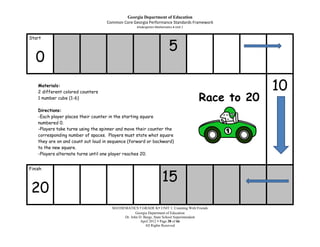
  • 53.
    Georgia Department ofEducation Common Core Georgia Performance Standards Framework Kindergarten Mathematics Unit 1 more less less more Place the end of the paper clip at the center of the spinner and hold in place with the pencil. Flick the paperclip with your finger. 1 more 2 less 2 more 1 less MATHEMATICS  GRADE K UNIT 1: Counting With Friends Georgia Department of Education Dr. John D. Barge, State School Superintendent April 2012  Page 53 of 66 All Rights Reserved
  • 54.
    Georgia Department ofEducation Common Core Georgia Performance Standards Framework Kindergarten Mathematics Unit 1 CONSTRUCTING TASK: How Many Are in the Bag (0-9) STANDARDS FOR MATHEMATICAL CONTENT MCC.K.CC.1. Count to 100 by ones and by tens. MCC.K.CC.2. Count forward beginning from a given number within the known sequence (instead of having to begin at 1). MCC.K.CC.3. Write numbers from 0 to 20. Represent a number of objects with a written numeral 0- 20 (with 0 representing a count of no objects). MCC.K.CC.4. Understand the relationship between numbers and quantities; connect counting to cardinality. a. When counting objects, say the number names in the standard order, pairing each object with one and only one number name and each number name with one and only one object. b. Understand that the last number name said tells the number of objects counted. The number of objects is the same regardless of their arrangement or the order in which they were counted. c. Understand that each successive number name refers to a quantity that is one larger. MCC.K.MD.3. Classify objects into given categories; count the numbers of objects in each category and sort the categories by count. (For descriptors of standard cluster please see the Grade Level Overview) STANDARDS FOR MATHEMATICAL PRACTICE 1. Make sense of problems and persevere in solving them. 2. Reason abstractly and quantitatively. 3. Construct viable arguments and critique the reasoning of others. 4. Model with mathematics. 5. Use appropriate tools strategically. 6. Attend to precision. 7. Look for and make use of structure. 8. Look for and express regularity in repeated reasoning. BACKGROUND KNOWLEDGE We want to help students relate a given number to other numbers, specifically to 5 and 10. These relationships are especially useful in thinking about various combinations of numbers. MATHEMATICS  GRADE K UNIT 1: Counting With Friends Georgia Department of Education Dr. John D. Barge, State School Superintendent April 2012  Page 54 of 66 All Rights Reserved
  • 55.
    Georgia Department ofEducation Common Core Georgia Performance Standards Framework Kindergarten Mathematics Unit 1 (Example: students need to recognize that 8 is not a number in isolation. 8 is 3 more than 5 and 2 less than ten). This understanding of number and relationships has a tremendous impact on a student’s ability to mentally compute in the later years as opposed to rote memorization. (Van de Walle, p45) ESSENTIAL QUESTIONS • How can we use counting in our everyday life? • How can numbers be represented? • Why do we need to be able to count objects? • How do we use numbers every day? • Why would we need to be able to read number words? • How can we record what we count? • How do we use counting in our everyday life? • What is a numeral? MATERIALS How Many Are in the Bag? Recording Sheet Small bags Small items to place in each bag GROUPING Students can work in small groups if you aren’t using this as a performance task, individually (each child would need 3 bags with objects in each bag), or this can be placed in a work station for students to visit with recording done individually as a performance task. TASK DESCRIPTION, DEVELOPMENT AND DISCUSSION Comments Prepare and label three bags A, B, and the last bag with C filled with 0-10 objects for each group of 3 students. You can put any small object in the bags (e.g. beans, counting cubes, small centimeter blocks, paper clips, crayons, pencils etc.) Be sure each bag has the same item in it (there should only be one kind of manipulative per bag, (i.e. Bag A could be filled with butter beans, Bag B could be filled with pennies and Bag C could be filled with paperclips.) Task Directions Instruct students to look in each bag, count the number of objects and record it on their recording sheet. They should also be able to answer the questions below in order to show understanding. While students are working, ask students such as: MATHEMATICS  GRADE K UNIT 1: Counting With Friends Georgia Department of Education Dr. John D. Barge, State School Superintendent April 2012  Page 55 of 66 All Rights Reserved
  • 56.
    Georgia Department ofEducation Common Core Georgia Performance Standards Framework Kindergarten Mathematics Unit 1 Which bag had the most? Least? Which bag contained the least amount of objects? Did either of the bags have the same amount? Which bag had an amount closest to 10? Closest to 20? Comment Students have a difficult time determining which benchmark number the quantity is closer to (anchoring 5 & 10). DO NOT TELL STUDENTS A MNEMONIC or RYHME THAT MAKES NO SENSE CONCEPTUALLY! Instead, have student locate the number on a number line and compare which anchor it is closer to. For this, incorporate a 0-10 number line to lead the discussion. Students need to see and recognize that zero is a number. The number “0” needs to be recognized as part of the set. 0 1 2 3 4 5 6 7 8 9 10 If a 0-10 number line is used students can conceptually begin to see that 3 and 7 are closer to 5. A 0-9 and 1-10 number line are both composed of 10 numerals meaning there is no defined middle. Using a 0- 10 line will help students see that the number 5 falls exactly in the middle of 0 and 10. Using a 0-9 or 1-10 number line will cause confusion and many students will not be able to make sense of benchmarks. Once in first grade students will benchmark numbers to the nearest ten. It is strongly encouraged that students use a 0-99 chart to understand rounding. FORMATIVE ASSESSMENT QUESTIONS What are some of the different ways you can represent numbers? How did you decide which benchmark number your quantity was closest to? If you had 1 more in your bag, how many would you have? If you had 1 less? DIFFERENTIATION Extension Provide students with bags that have 11-19 items and have them create quantity drawings using their own drawing of a ten frame. Intervention Allow students to use ten frames to place the small items on once they take them out of the bag. Have number words displayed in the room to assist with spelling. If you hear them skipping numbers, assist by giving them a number line or another counting device (number chart that has numbers and words along with illustrations). MATHEMATICS  GRADE K UNIT 1: Counting With Friends Georgia Department of Education Dr. John D. Barge, State School Superintendent April 2012  Page 56 of 66 All Rights Reserved
  • 57.
    Georgia Department ofEducation Common Core Georgia Performance Standards Framework Kindergarten Mathematics Unit 1 Name:___________________________ How many more to Benchmark Bag Quantity Number word Ten frame 10? Number A 5 10 B 5 10 C 5 10 Which bag has the most? A B C Which bag has the least? A B C Which bag was closest to 5? A B C Which bag was closest to 10? A B C MATHEMATICS  GRADE K UNIT 1: Counting With Friends Georgia Department of Education Dr. John D. Barge, State School Superintendent April 2012  Page 57 of 66 All Rights Reserved
  • 58.
    Georgia Department ofEducation Common Core Georgia Performance Standards Framework Kindergarten Mathematics Unit 1 PRACTICE TASK: More or Less-Make a Guess? Approximately 1-2 days STANDARDS FOR MATHEMATICAL CONTENT MCC.K.CC.1. Count to 100 by ones and by tens. MCC.K.CC.2. Count forward beginning from a given number within the known sequence (instead of having to begin at 1). MCC.K.CC.4. Understand the relationship between numbers and quantities; connect counting to cardinality. d. When counting objects, say the number names in the standard order, pairing each object with one and only one number name and each number name with one and only one object. e. Understand that each successive number name refers to a quantity that is one larger. STANDARDS FOR MATHEMATICAL PRACTICE 1. Make sense of problems and persevere in solving them. 2. Reason abstractly and quantitatively. 3. Construct viable arguments and critique the reasoning of others. 4. Model with mathematics. 5. Use appropriate tools strategically. 6. Attend to precision. 7. Look for and make use of structure. 8. Look for and express regularity in repeated reasoning. BACKGROUND KNOWLEDGE “Though the concept of less is logically related to the concept of more (selecting the set with more is the same as not selecting the set with less), the word less proves to be more difficult for children than more. A possible explanation is that children have many opportunities to use the word more but have limited exposure with the term less”. Having students focus on which quantity is less through questioning will help students better understand the meaning of less (Van de Walle, 2010). ESSENTIAL QUESTIONS • What is the difference between “more” and “less”? • What types of questions should I ask myself or my partner when playing a math game? • How do we know if a number is more or less than another number? MATHEMATICS  GRADE K UNIT 1: Counting With Friends Georgia Department of Education Dr. John D. Barge, State School Superintendent April 2012  Page 58 of 66 All Rights Reserved
  • 59.
    Georgia Department ofEducation Common Core Georgia Performance Standards Framework Kindergarten Mathematics Unit 1 MATERIALS More or Less-Make a Guess game board 21 counters or objects to cover up the number on the number line Folder of object to hide mystery number GROUPING Whole group and partner task TASK DESCRIPTION, DEVELOPMENT, AND DISCUSSION Cut the game board in along dotted line and give each player a half. Player 1 covers their board using a folder or book and places a counter on their number line at the location of the mystery number. It is important that player two does not see the location of the counter. Player 2 begins to ask questions about the mystery number Player 1 has identified on their number line. With each question, Player 2 eliminates the numbers on their number line that the know CANNOT be the answer. Example: if Player 2 asks, “is your number more than 15?”, and Player 2 responds, “No “, Player 2 covers the numbers 16, 17, 18 ,19, and 20. Notice that 15 was not covered because it is equal. DO NOT TELL STUDENTS THIS STEP. Allow for this conversation to develop through the course of the game. The playing is where learning happens. If Player 2 identifies the number in 5 or less tries, Player 2 makes the mystery number. If the Mystery number is not identified in 5 or less tries, the roles of the player is reversed. FORMATIVE ASSESSMENT QUESTIONS What strategy are you using to find the mystery number? How does “more” and “less” help you identify the mystery number? DIFFERENTIATION Extension Play More or Less-Make a Guess on a 0-99 chart but using the numbers 0-20. Intervention Write the numbers on the number line so that students can actually see what number they are trying to guess or reduce the numbers from 0-10. MATHEMATICS  GRADE K UNIT 1: Counting With Friends Georgia Department of Education Dr. John D. Barge, State School Superintendent April 2012  Page 59 of 66 All Rights Reserved
  • 60.
    Georgia Department ofEducation Common Core Georgia Performance Standards Framework Kindergarten Mathematics Unit 1 More or Less-Make a Guess Player 1 I I I I I I I I I I I I I I I I I I I I I 0 5 10 15 20 Cover a number on the number line with a counter. Don’t let your partner see the number. ---------------------------------------------------------- More or Less-Make a Guess Player 2 I I I I I I I I I I I I I I I I I I I I I 0 5 10 15 20 Try and guess the number your partner has covered by asking questions. (example: is your number greater than 12?) Once you know it is not a number(s), cover it up on your board so that you eliminate it. MATHEMATICS  GRADE K UNIT 1: Counting With Friends Georgia Department of Education Dr. John D. Barge, State School Superintendent April 2012  Page 60 of 66 All Rights Reserved
  • 61.
    Georgia Department ofEducation Common Core Georgia Performance Standards Framework Kindergarten Mathematics Unit 1 CULMINATING TASK: Find the 5th Tower Approximately 1-2 days STANDARDS FOR MATHEMATICAL CONTENT MCC.K.CC.1. Count to 100 by ones and by tens. MCC.K.CC.2. Count forward beginning from a given number within the known sequence (instead of having to begin at 1). MCC.K.CC.3. Write numbers from 0 to 20. Represent a number of objects with a written numeral 0- 20 (with 0 representing a count of no objects). MCC.K.CC.4. Understand the relationship between numbers and quantities; connect counting to cardinality. f. When counting objects, say the number names in the standard order, pairing each object with one and only one number name and each number name with one and only one object. g. Understand that the last number name said tells the number of objects counted. The number of objects is the same regardless of their arrangement or the order in which they were counted. h. Understand that each successive number name refers to a quantity that is one larger. MCC.K.G.1. Describe objects in the environment using names of shapes, and describe the relative positions of these objects using terms such as above, below, beside, in front of, behind, and next to. MCC.K.MD.3. Classify objects into given categories; count the numbers of objects in each category and sort the categories by count. STANDARDS FOR MATHEMATICAL PRACTICE 1. Make sense of problems and persevere in solving them. 2. Reason abstractly and quantitatively. 3. Construct viable arguments and critique the reasoning of others. 4. Model with mathematics. 5. Use appropriate tools strategically. 6. Attend to precision. 7. Look for and make use of structure. 8. Look for and express regularity in repeated reasoning. MATHEMATICS  GRADE K UNIT 1: Counting With Friends Georgia Department of Education Dr. John D. Barge, State School Superintendent April 2012  Page 61 of 66 All Rights Reserved
  • 62.
    Georgia Department ofEducation Common Core Georgia Performance Standards Framework Kindergarten Mathematics Unit 1 BACKGROUND KNOWLEDGE Numbers are related to each other through a variety of number relationships. The number 7, for example, is 3 more than 4, two less than 9, composed of 3 and 4, as well as 2 and 5, is three away from 10, and can be quickly recognized in several patterned arrangements of dots. These ideas further extend to an understanding of 17, 77, and beyond. Number concepts are intimately tied to the world around us. Application of number relationships to the real world marks the beginning of making sense of the world in a mathematical manner (Van de Walle, 2010). ESSENTIAL QUESTIONS Why is it important to know how to put things in number order? How does putting things in order keep things organized? Why do we need to be able to put things in order? Why do we need to be able to read ordinal numbers? What is the difference between “more” and “less”? MATERIALS Recording Sheet 10 cubes (let students count out the 10 cubes) GROUPING Whole group and small group TASK DESCRIPTION, DEVELOPMENT, AND DISCUSSION Students count 10 cubes. Students choose the colors. Allow time for students to build towers of no more than 5 and practice placing them on the recording sheet. Allow students time to describe and share what their towers look like and the order in which their towers appear. Teacher reads the directions as students build towers and place them in the correct location/order according to what the teacher says. The teacher will give the directions for (4) towers and students must determine what the 5th tower would look like based from what they see (patterns). As the teacher identifies what each tower should look like, the students recreate the tower to match what the teacher is saying. Students should identify the pattern and be able to count the total number of cubes used to make all the 5 towers. Students must record the quantity for each tower in the box provided. MATHEMATICS  GRADE K UNIT 1: Counting With Friends Georgia Department of Education Dr. John D. Barge, State School Superintendent April 2012  Page 62 of 66 All Rights Reserved
  • 63.
    Georgia Department ofEducation Common Core Georgia Performance Standards Framework Kindergarten Mathematics Unit 1 After students have counted the total amount of cubes, have students make one long tower. (Some students may have done this to count all of their cubes, which is fine). After all five towers for the first set have been connected to make one tower, have students decompose the tower one cube at a time counting backwards out loud. Discuss the vocabulary term decompose if not already addressed previously. As they count backwards, engage students in questions by asking what number is next, more/less than, etc… Once the tower has been broken down into individual cubes move on to the next set of towers and repeat. First set of towers: The 1st tower has one cube The 2nd tower has 2 cubes The tower after the 2nd has the same amount of cubes as the 1st tower. The 4th tower has 2 cubes. What would the 5th tower look like? How many cubes make up all 5 towers? Second set of towers: The 2nd tower has 2 cubes The tower that comes after the 4th tower has 2 cubes The tower in between the 2nd and 4th tower has 3 cubes The first tower has 1 less cube than the 2nd tower What would the 5th tower look like? How many cubes make up all 5 towers? Third set of towers The fourth tower has 3 cubes The second tower has 1 cube The first tower has less than one cube (Zero-Allow for constructive struggle and conversation) The third tower has 1 more cube than the 2nd tower. What would the 5th tower look like? How many cubes make up all 5 towers? After students have counted made all the towers and counted all the blocks in the five towers. Have them reconstruct their favorite set of towers. Have students decide and describe how they could sort their favorite set of towers. (Color, height, quantity, etc…) This will vary will student and chosen set. Student then sort towers by the way they described and draw a picture of how they sorted. MATHEMATICS  GRADE K UNIT 1: Counting With Friends Georgia Department of Education Dr. John D. Barge, State School Superintendent April 2012  Page 63 of 66 All Rights Reserved
  • 64.
    Georgia Department ofEducation Common Core Georgia Performance Standards Framework Kindergarten Mathematics Unit 1 FORMATIVE ASSESSMENT QUESTIONS How do you know that you counted correctly? What did you do to find the 5th tower? How did you decide what the 5th tower would look like? Did you have a strategy for counting all your cubes? Describe? What does decompose mean? What are some ways that we can sort objects? DIFFERENTIATION Extension Increase the complexity by adding the terms “more” and “less” into the descriptors. Example: o The 2nd tower has 1 less cube than 3 cubes. o The 1st tower has one less cube than the 2nd tower. o The tower after the 4th tower has 1 more cube than the 1st tower. o The tower between the 2nd and 4th has one less than the towers it is between. o What would the 5th tower look like? Allow student to make a pattern with towers and describe the pattern to their partner. The partner must predict what the 5th tower looks like. Intervention Be explicit in the description of each tower and describe each tower in order. For example: o The 1st tower has 2 cubes o The next tower has 1 cube o The 3rd tower has 2 cubes o The 4th tower has 1 cube o What would the 5th tower look like? MATHEMATICS  GRADE K UNIT 1: Counting With Friends Georgia Department of Education Dr. John D. Barge, State School Superintendent April 2012  Page 64 of 66 All Rights Reserved
  • 65.
    Georgia Department ofEducation Common Core Georgia Performance Standards Framework Kindergarten Mathematics Unit 1 Find the Fifth Build Tower Build Tower Build Tower Build Tower Build Tower Here Here Here Here Here ____________ ____________ ____________ ____________ ____________ How many blocks were used to make the 5 towers? Write the total amount in the square Build Tower Build Tower Build Tower Build Tower Build Tower Here Here Here Here Here ____________ ____________ ____________ ____________ ____________ How many blocks were used to make the 5 towers? Write the total amount in the square MATHEMATICS  GRADE K UNIT 1: Counting With Friends Georgia Department of Education Dr. John D. Barge, State School Superintendent April 2012  Page 65 of 66 All Rights Reserved
  • 66.
    Georgia Department ofEducation Common Core Georgia Performance Standards Framework Kindergarten Mathematics Unit 1 Build Tower Build Tower Build Tower Build Tower Build Tower Here Here Here Here Here ____________ ____________ ____________ ____________ ____________ How many blocks were used to make the 5 towers? Write the total amount in the square What is a way you can sort your towers? I can sort my towers by _______________________________________________ Show what you mean and draw a picture below: MATHEMATICS  GRADE K UNIT 1: Counting With Friends Georgia Department of Education Dr. John D. Barge, State School Superintendent April 2012  Page 66 of 66 All Rights Reserved