MATH ED 3220
Here starts the
lesson!
ASSESSMENT AND
LEARNING
IN
MATHEMATICS
Table of
Contents!
Authentic
Assessment
Methods in
Mathematics
Education
GRASPS Framework
Project-Based
Learning
Three Modes of
Authentic
Assessment
01
Authentic Assessment
Methods in Mathematics
Education
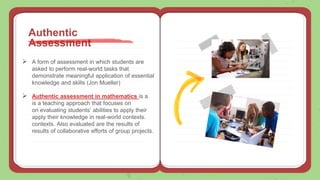
 A form of assessment in which students are
asked to perform real-world tasks that
demonstrate meaningful application of essential
knowledge and skills (Jon Mueller)
 Authentic assessment in mathematics is a
is a teaching approach that focuses on
on evaluating students’ abilities to apply their
apply their knowledge in real-world contexts.
contexts. Also evaluated are the results of
results of collaborative efforts of group projects.
Authentic
Assessment
Six ways to use
AUTHENTIC
ASSESSMENT
MATH
in the classroom
Students collaborate to solve complex problems
together. This approach not only hones
teamwork skills but also encourages them to
combine their individual knowledge
effectively.
—Short
Investigations
These tasks involve basic math
problems that allow students to
demonstrate their mastery of
fundamental concepts and skills.
Students interpret, calculate,
explain, describe, or predict
outcomes related to the problem.
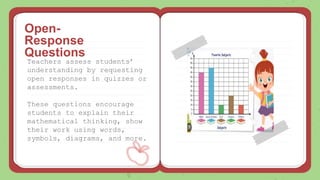
Teachers assess students’
understanding by requesting
open responses in quizzes or
assessments.
These questions encourage
students to explain their
mathematical thinking, show
their work using words,
symbols, diagrams, and more.
Open-
Response
Questions
—PORTFOLIOS
Throughout the school year,
students document their
learning progress.
They allow for self-assessment,
revisions, and improvements.
Once the teacher explains
the project expectations
and the students finish
their projects, they
assess their own work and
participation.
SELF-
ASSESSME
NT
•What was the most difficult part of
this project for you?
•What do you think you should do
next?
•If you could do this task again,
would you do anything differently? If
yes, what?
•What did you learn from this
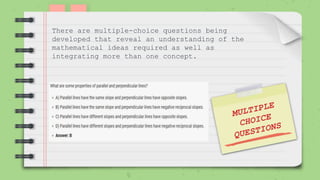
There are multiple-choice questions being
developed that reveal an understanding of the
mathematical ideas required as well as
integrating more than one concept.
”Authentic assessment not
only evaluates knowledge
but also nurtures critical
thinking, creativity, and
problem-solving skills.”
PROJECT-
BASED
LEARNING
02
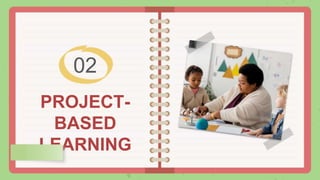
- Project-based learning is a dynamic approach to education
in which students actively participate in real-world
initiatives.
- It's hands-on, encouraging critical thinking,
cooperation, and problem-solving abilities.
- Students generally work on projects that require them to
research, develop, and present their findings or solutions.
- It's an excellent method to make learning more meaningful
and relevant to the actual world.
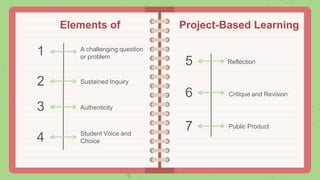
Elements of
Authenticity
Reflection
Sustained Inquiry
Student Voice and
Choice
Critique and Revision
Public Product
1
2
3
4
5
6
Project-Based Learning
7
A challenging question
or problem
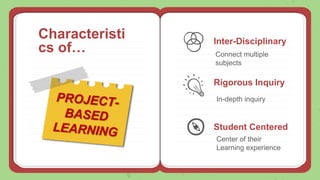
Characteristi
cs of…
Inter-Disciplinary
Connect multiple
subjects
Rigorous Inquiry
Student Centered
In-depth inquiry
Center of their
Learning experience
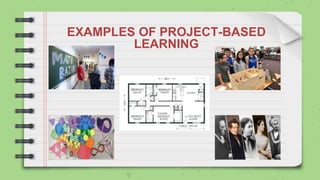
EXAMPLES OF PROJECT-BASED
LEARNING
03
GRASPS
FRAMEWORK
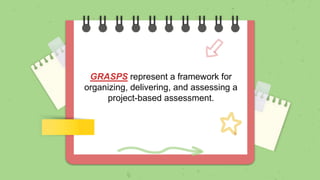
GRASPS represent a framework for
organizing, delivering, and assessing a
project-based assessment.
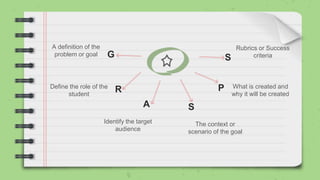
Identify the target
audience
Rubrics or Success
criteria
What is created and
why it will be created
A definition of the
problem or goal G
Define the role of the
student
R
A S
P
S
The context or
scenario of the goal
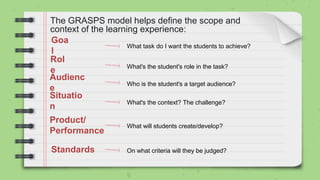
The GRASPS model helps define the scope and
context of the learning experience:
What task do I want the students to achieve?
Goa
l
Rol
e
Audienc
e
Situatio
n
Product/
Performance
Standards
What's the student's role in the task?
Who is the student's a target audience?
What's the context? The challenge?
On what criteria will they be judged?
What will students create/develop?
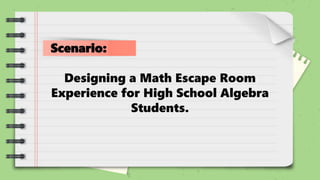
Scenario:
Designing a Math Escape Room
Experience for High School Algebra
Students.
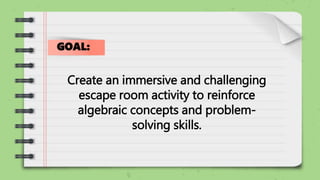
Create an immersive and challenging
escape room activity to reinforce
algebraic concepts and problem-
solving skills.
GOAL:
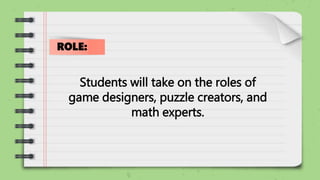
Students will take on the roles of
game designers, puzzle creators, and
math experts.
ROLE:
High school algebra students, math
teachers, and school
administrators.
AUDIENCE:
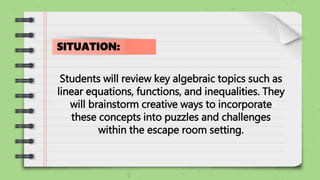
Students will review key algebraic topics such as
linear equations, functions, and inequalities. They
will brainstorm creative ways to incorporate
these concepts into puzzles and challenges
within the escape room setting.
SITUATION:
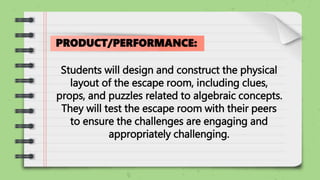
Students will design and construct the physical
layout of the escape room, including clues,
props, and puzzles related to algebraic concepts.
They will test the escape room with their peers
to ensure the challenges are engaging and
appropriately challenging.
PRODUCT/PERFORMANCE:
The math escape room experience aligns with
high school algebra standards, emphasizing
algebraic reasoning, problem-solving strategies,
and mathematical modeling.
STANDARDS:
3 MODES OF
AUTHENTIC
ASSESSMENT
04
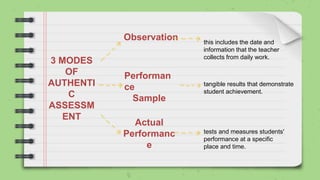
3 MODES
OF
AUTHENTI
C
ASSESSM
ENT
this includes the date and
information that the teacher
collects from daily work.
Performan
ce
Sample
Observation
Actual
Performanc
e
tangible results that demonstrate
student achievement.
tests and measures students'
performance at a specific
place and time.
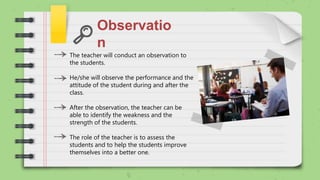
Observatio
n
The teacher will conduct an observation to
the students.
He/she will observe the performance and the
attitude of the student during and after the
class.
After the observation, the teacher can be
able to identify the weakness and the
strength of the students.
The role of the teacher is to assess the
students and to help the students improve
themselves into a better one.
Performance
Sample
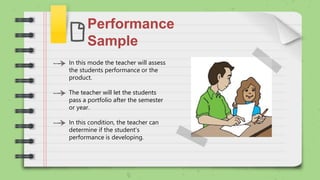
In this mode the teacher will assess
the students performance or the
product.
The teacher will let the students
pass a portfolio after the semester
or year.
In this condition, the teacher can
determine if the student's
performance is developing.
Actual
Performance
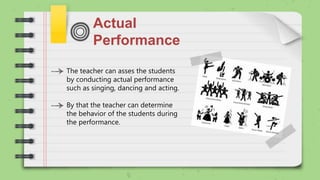
The teacher can asses the students
by conducting actual performance
such as singing, dancing and acting.
By that the teacher can determine
the behavior of the students during
the performance.
I. Observation
Based
Assessment Tools
Guidelines
Observation must be as frequent and
as regular as possible.
Observe not only one but all students.
Observation must be recorded in
writing.
Observations should cover both
routine and exceptional occurrences.
Reliability of observation records is
enhanced if multiple observations
are gathered and synthesized.
II. Performance
Samples
Assessment
Tools
Purpose of Portfolio
The teacher can assess the
growth and development of the
students at various levels.
Parents are informed of the
progress of their children in
school.
Instructional supervisor are
able to evaluate the
strengths and weakness of the
academic program.
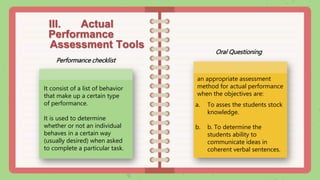
III. Actual
Performance
Assessment Tools
Oral Questioning
Performance checklist
It consist of a list of behavior
that make up a certain type
of performance.
It is used to determine
whether or not an individual
behaves in a certain way
(usually desired) when asked
to complete a particular task.
an appropriate assessment
method for actual performance
when the objectives are:
a. To asses the students stock
knowledge.
b. b. To determine the
students ability to
communicate ideas in
coherent verbal sentences.
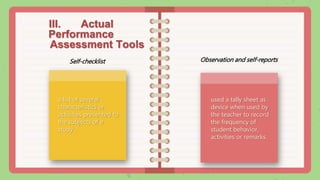
III. Actual
Performance
Assessment Tools
Self-checklist Observation and self-reports
a list of several
characteristics or
activities presented to
the subjects of a
study.
used a tally sheet as
device when used by
the teacher to record
the frequency of
student behavior,
activities or remarks.
DO YOU HAVE ANY…
CLARIFICATI
ONS?
NIERE,
DONDEE
ROMARATE,
GENEVIEVE
QUILATON,
SCARLET RIZA
VIRTUCIO,
SANNY JOHN
THANK YOU!
AND
HAVE A
WONDERFUL
AFTERNOON!

Authentic Assessment, its three modes and Project Based Learning.pptx

  • 1.
    MATH ED 3220 Herestarts the lesson! ASSESSMENT AND LEARNING IN MATHEMATICS
  • 2.
    Table of Contents! Authentic Assessment Methods in Mathematics Education GRASPSFramework Project-Based Learning Three Modes of Authentic Assessment
  • 3.
  • 4.
     A formof assessment in which students are asked to perform real-world tasks that demonstrate meaningful application of essential knowledge and skills (Jon Mueller)  Authentic assessment in mathematics is a is a teaching approach that focuses on on evaluating students’ abilities to apply their apply their knowledge in real-world contexts. contexts. Also evaluated are the results of results of collaborative efforts of group projects. Authentic Assessment
  • 5.
    Six ways touse AUTHENTIC ASSESSMENT MATH in the classroom
  • 6.
    Students collaborate tosolve complex problems together. This approach not only hones teamwork skills but also encourages them to combine their individual knowledge effectively.
  • 7.
    —Short Investigations These tasks involvebasic math problems that allow students to demonstrate their mastery of fundamental concepts and skills. Students interpret, calculate, explain, describe, or predict outcomes related to the problem.
  • 8.
    Teachers assess students’ understandingby requesting open responses in quizzes or assessments. These questions encourage students to explain their mathematical thinking, show their work using words, symbols, diagrams, and more. Open- Response Questions
  • 9.
    —PORTFOLIOS Throughout the schoolyear, students document their learning progress. They allow for self-assessment, revisions, and improvements.
  • 10.
    Once the teacherexplains the project expectations and the students finish their projects, they assess their own work and participation. SELF- ASSESSME NT •What was the most difficult part of this project for you? •What do you think you should do next? •If you could do this task again, would you do anything differently? If yes, what? •What did you learn from this
  • 11.
    There are multiple-choicequestions being developed that reveal an understanding of the mathematical ideas required as well as integrating more than one concept.
  • 12.
    ”Authentic assessment not onlyevaluates knowledge but also nurtures critical thinking, creativity, and problem-solving skills.”
  • 13.
  • 14.
    - Project-based learningis a dynamic approach to education in which students actively participate in real-world initiatives. - It's hands-on, encouraging critical thinking, cooperation, and problem-solving abilities. - Students generally work on projects that require them to research, develop, and present their findings or solutions. - It's an excellent method to make learning more meaningful and relevant to the actual world.
  • 15.
    Elements of Authenticity Reflection Sustained Inquiry StudentVoice and Choice Critique and Revision Public Product 1 2 3 4 5 6 Project-Based Learning 7 A challenging question or problem
  • 16.
    Characteristi cs of… Inter-Disciplinary Connect multiple subjects RigorousInquiry Student Centered In-depth inquiry Center of their Learning experience
  • 17.
  • 18.
  • 19.
    GRASPS represent aframework for organizing, delivering, and assessing a project-based assessment.
  • 20.
    Identify the target audience Rubricsor Success criteria What is created and why it will be created A definition of the problem or goal G Define the role of the student R A S P S The context or scenario of the goal
  • 21.
    The GRASPS modelhelps define the scope and context of the learning experience: What task do I want the students to achieve? Goa l Rol e Audienc e Situatio n Product/ Performance Standards What's the student's role in the task? Who is the student's a target audience? What's the context? The challenge? On what criteria will they be judged? What will students create/develop?
  • 22.
    Scenario: Designing a MathEscape Room Experience for High School Algebra Students.
  • 23.
    Create an immersiveand challenging escape room activity to reinforce algebraic concepts and problem- solving skills. GOAL:
  • 24.
    Students will takeon the roles of game designers, puzzle creators, and math experts. ROLE:
  • 25.
    High school algebrastudents, math teachers, and school administrators. AUDIENCE:
  • 26.
    Students will reviewkey algebraic topics such as linear equations, functions, and inequalities. They will brainstorm creative ways to incorporate these concepts into puzzles and challenges within the escape room setting. SITUATION:
  • 27.
    Students will designand construct the physical layout of the escape room, including clues, props, and puzzles related to algebraic concepts. They will test the escape room with their peers to ensure the challenges are engaging and appropriately challenging. PRODUCT/PERFORMANCE:
  • 28.
    The math escaperoom experience aligns with high school algebra standards, emphasizing algebraic reasoning, problem-solving strategies, and mathematical modeling. STANDARDS:
  • 29.
  • 30.
    3 MODES OF AUTHENTI C ASSESSM ENT this includesthe date and information that the teacher collects from daily work. Performan ce Sample Observation Actual Performanc e tangible results that demonstrate student achievement. tests and measures students' performance at a specific place and time.
  • 31.
    Observatio n The teacher willconduct an observation to the students. He/she will observe the performance and the attitude of the student during and after the class. After the observation, the teacher can be able to identify the weakness and the strength of the students. The role of the teacher is to assess the students and to help the students improve themselves into a better one.
  • 32.
    Performance Sample In this modethe teacher will assess the students performance or the product. The teacher will let the students pass a portfolio after the semester or year. In this condition, the teacher can determine if the student's performance is developing.
  • 33.
    Actual Performance The teacher canasses the students by conducting actual performance such as singing, dancing and acting. By that the teacher can determine the behavior of the students during the performance.
  • 34.
    I. Observation Based Assessment Tools Guidelines Observationmust be as frequent and as regular as possible. Observe not only one but all students. Observation must be recorded in writing. Observations should cover both routine and exceptional occurrences. Reliability of observation records is enhanced if multiple observations are gathered and synthesized.
  • 35.
    II. Performance Samples Assessment Tools Purpose ofPortfolio The teacher can assess the growth and development of the students at various levels. Parents are informed of the progress of their children in school. Instructional supervisor are able to evaluate the strengths and weakness of the academic program.
  • 36.
    III. Actual Performance Assessment Tools OralQuestioning Performance checklist It consist of a list of behavior that make up a certain type of performance. It is used to determine whether or not an individual behaves in a certain way (usually desired) when asked to complete a particular task. an appropriate assessment method for actual performance when the objectives are: a. To asses the students stock knowledge. b. b. To determine the students ability to communicate ideas in coherent verbal sentences.
  • 37.
    III. Actual Performance Assessment Tools Self-checklistObservation and self-reports a list of several characteristics or activities presented to the subjects of a study. used a tally sheet as device when used by the teacher to record the frequency of student behavior, activities or remarks.
  • 38.
    DO YOU HAVEANY… CLARIFICATI ONS?
  • 39.