CCGPS
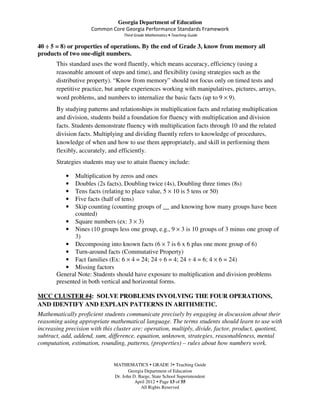
                  Frameworks
                 Teacher Edition


           Mathematics


Third Grade
Grade Level Overview
Georgia Department of Education
                      Common Core Georgia Performance Standards Framework
                                   Third Grade Mathematics • Teaching Guide

                                      Grade Level Overview

TABLE OF CONTENTS

Curriculum Map and pacing Guide…………………………………………………………………

Unpacking the Standards

   •   Standards of Mathematical Practice………………………..……………...…………..……

   •   Content Standards………………………………………….………………………….……

Arc of Lesson/Math Instructional Framework………………………………………………..……

Unpacking a Task………………………………………………………………………………..…

Routines and Rituals………………………………………………………………………………..

General Questions for Teacher Use………………………………………………………………...

Questions for Teacher Reflection……………………………………………………….………….

Depth of Knowledge……………………………………………………………………….…….…

Depth and Rigor Statement…………………………………………………………………………

Additional Resources Available

   •   K-2 Problem Solving Rubric……………………………………………………………….

   •   Literature Resources……………………………………………………………….……….

   •   Technology Links…………………………………………………………………………..


Resources Consulted


                              MATHEMATICS GRADE 3 Teaching Guide
                                     Georgia Department of Education
                              Dr. John D. Barge, State School Superintendent
                                        April 2012 Page 2 of 55
                                           All Rights Reserved
Georgia Department of Education
                                                    Common Core Georgia Performance Standards Framework
                                                                   Third Grade Mathematics • Teaching Guide


                                             Common Core Georgia Performance Standards
                                                  Elementary School Mathematics
                                                          Third Grade
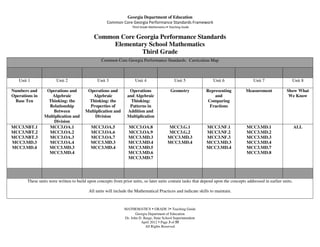
                                                 Common Core Georgia Performance Standards: Curriculum Map


   Unit 1              Unit 2                  Unit 3                Unit 4                     Unit 5            Unit 6                Unit 7                Unit 8

Numbers and      Operations and          Operations and          Operations                   Geometry         Representing         Measurement            Show What
Operations in      Algebraic               Algebraic            and Algebraic                                      and                                      We Know
 Base Ten         Thinking: the           Thinking: the           Thinking:                                     Comparing
                  Relationship            Properties of          Patterns in                                     Fractions
                    Between             Multiplication and      Addition and
                Multiplication and          Division            Multiplication
                    Division
MCC3.NBT.1        MCC3.OA.1                MCC3.OA.5            MCC3.OA.8                  MCC3.G.1            MCC3.NF.1            MCC3.MD.1                     ALL
MCC3.NBT.2        MCC3.OA.2                MCC3.OA.6            MCC3.OA.9                  MCC3.G.2            MCC3.NF.2            MCC3.MD.2
MCC3.NBT.3        MCC3.OA.3                MCC3.OA.7            MCC3.MD.3                  MCC3.MD.3           MCC3.NF.3            MCC3.MD.3
MCC3.MD.3         MCC3.OA.4                MCC3.MD.3            MCC3.MD.4                  MCC3.MD.4           MCC3.MD.3            MCC3.MD.4
MCC3.MD.4         MCC3.MD.3                MCC3.MD.4            MCC3.MD.5                                      MCC3.MD.4            MCC3.MD.7
                  MCC3.MD.4                                     MCC3.MD.6                                                           MCC3.MD.8
                                                                MCC3.MD.7


       These units were written to build upon concepts from prior units, so later units contain tasks that depend upon the concepts addressed in earlier units.

                                          All units will include the Mathematical Practices and indicate skills to maintain.


                                                              MATHEMATICS GRADE 3 Teaching Guide
                                                                     Georgia Department of Education
                                                              Dr. John D. Barge, State School Superintendent
                                                                        April 2012 Page 3 of 55
                                                                           All Rights Reserved
Georgia Department of Education
                      Common Core Georgia Performance Standards Framework
                                    Third Grade Mathematics • Teaching Guide

STANDARDS FOR
MATHEMATICAL PRACTICE

         Mathematical Practices are listed with each grade’s mathematical content standards to
reflect the need to connect the mathematical practices to mathematical content in instruction.
The Standards for Mathematical Practice describe varieties of expertise that mathematics
educators at all levels should seek to develop in their students. These practices rest on important
“processes and proficiencies” with longstanding importance in mathematics education.
         The first of these are the NCTM process standards of problem solving, reasoning and
proof, communication, representation, and connections. The second are the strands of
mathematical proficiency specified in the National Research Council’s report Adding It Up:
adaptive reasoning, strategic competence, conceptual understanding (comprehension of
mathematical concepts, operations and relations), procedural fluency (skill in carrying out
procedures flexibly, accurately, efficiently and appropriately), and productive disposition
(habitual inclination to see mathematics as sensible, useful, and worthwhile, coupled
with a belief in diligence and one’s own efficacy).

Students are expected to:

1. Make sense of problems and persevere in solving them.
In third grade, students know that doing mathematics involves solving problems and discussing
how they solved them. Students explain to themselves the meaning of a problem and look for
ways to solve it. Third graders may use concrete objects or pictures to help them conceptualize
and solve problems. They may check their thinking by asking themselves, “Does this make
sense?” They listen to the strategies of others and will try different approaches. They often will
use another method to check their answers.

2. Reason abstractly and quantitatively.
Third graders should recognize that a number represents a specific quantity. They connect the
quantity to written symbols and create a logical representation of the problem at hand,
considering both the appropriate units involved and the meaning of quantities.

3. Construct viable arguments and critique the reasoning of others.
In third grade, students may construct arguments using concrete referents, such as objects,
pictures, and drawings. They refine their mathematical communication skills as they participate
in mathematical discussions involving questions like “How did you get that?” and “Why is that
true?” They explain their thinking to others and respond to others’ thinking.

4. Model with mathematics.
Students experiment with representing problem situations in multiple ways including numbers,
words (mathematical language), drawing pictures, using objects, acting out, making a chart, list,
or graph, creating equations, etc. Students need opportunities to connect the different
representations and explain the connections. They should be able to use all of these

                               MATHEMATICS GRADE 3 Teaching Guide
                                      Georgia Department of Education
                               Dr. John D. Barge, State School Superintendent
                                         April 2012 Page 4 of 55
                                            All Rights Reserved
Georgia Department of Education
                      Common Core Georgia Performance Standards Framework
                                    Third Grade Mathematics • Teaching Guide

representations as needed. Third graders should evaluate their results in the context of the
situation and reflect on whether the results make sense.

5. Use appropriate tools strategically.
Third graders consider the available tools (including estimation) when solving a mathematical
problem and decide when certain tools might be helpful. For instance, they may use graph paper
to find all the possible rectangles that have a given perimeter. They compile the possibilities into
an organized list or a table, and determine whether they have all the possible rectangles

6. Attend to precision.
As third graders develop their mathematical communication skills, they try to use clear and
precise language in their discussions with others and in their own reasoning. They are careful
about specifying units of measure and state the meaning of the symbols they choose. For
instance, when figuring out the area of a rectangle they record their answers in square units.

7. Look for and make use of structure.
In third grade, students look closely to discover a pattern or structure. For instance, students use
properties of operations as strategies to multiply and divide (commutative and distributive
properties).

8. Look for and express regularity in repeated reasoning.
Students in third grade should notice repetitive actions in computation and look for more shortcut
methods. For example, students may use the distributive property as a strategy for using products
they know to solve products that they don’t know. For example, if students are asked to find the
product of 7 x 8, they might decompose 7 into 5 and 2 and then multiply 5 x 8 and 2 x 8 to arrive
at 40 + 16 or 56. In addition, third graders continually evaluate their work by asking themselves,
“Does this make sense?”


          ***Mathematical Practices 1 and 6 should be evident in EVERY lesson***


                               MATHEMATICS GRADE 3 Teaching Guide
                                      Georgia Department of Education
                               Dr. John D. Barge, State School Superintendent
                                         April 2012 Page 5 of 55
                                            All Rights Reserved
Georgia Department of Education
                    Common Core Georgia Performance Standards Framework
                                  Third Grade Mathematics • Teaching Guide

CONTENT STANDARDS

OPERATIONS AND ALGEBRAIC THINKING (OA)

CLUSTER #1: REPRESENT AND SOLVE PROBLEMS INVOLVING
MULTIPLICATION AND DIVISION.
    Students develop an understanding of the meanings of multiplication and division of
    whole numbers through activities and problems involving equal-sized groups, arrays, and
    area models; multiplication is finding an unknown product, and division is finding an
    unknown factor in these situations. For equal-sized group situations, division can require
    finding the unknown number of groups or the unknown group size. The terms students
    should learn to use with increasing precision with this cluster are: products, groups of,
    quotients, partitioned equally, multiplication, division, equal groups, arrays, equations,
    unknown.

MCC.3.OA.1 Interpret products of whole numbers, e.g., interpret 5 × 7 as the total number
of objects in 5 groups of 7 objects each.
For example, describe a context in which a total number of objects can be expressed as 5 × 7.
       This standard interprets products of whole numbers. Students recognize multiplication as
       a means to determine the total number of objects when there are a specific number of
       groups with the same number of objects in each group. Multiplication requires students to
       think in terms of groups of things rather than individual things. Students learn that the
       multiplication symbol ‘×’ means “groups of” and problems such as 5 × 7 refer to 5
       groups of 7.
       Example: Jim purchased 5 packages of muffins. Each package contained 3 muffins. How
       many muffins did Jim purchase? (5 groups of 3, 5 × 3 = 15)
       Describe another situation where there would be 5 groups of 3 or 5 × 3.


MCC.3.OA.2 Interpret whole-number quotients of whole numbers, e.g., interpret 56 ÷ 8 as
the number of objects in each share when 56 objects are partitioned equally into 8 shares,
or as a number of shares when 56 objects are partitioned into equal shares of 8 objects
each.
For example, describe a context in which a number of shares or a number of groups can be
expressed as 56 ÷ 8.


                             MATHEMATICS GRADE 3 Teaching Guide
                                    Georgia Department of Education
                             Dr. John D. Barge, State School Superintendent
                                       April 2012 Page 6 of 55
                                          All Rights Reserved
Georgia Department of Education
                   Common Core Georgia Performance Standards Framework
                                 Third Grade Mathematics • Teaching Guide

      This standard focuses on two distinct models of division: partition models and
      measurement (repeated subtraction) models.
      Partition models focus on the question, “How many in each group?” A context for
      partition models would be: There are 12 cookies on the counter. If you are sharing the
      cookies equally among three bags, how many cookies will go in each bag?


      Measurement (repeated subtraction) models focus on the question, “How many groups
      can you make?” A context for measurement models would be: There are 12 cookies on
      the counter. If you put 3 cookies in each bag, how many bags will you fill?


MCC.3.OA.3 Use multiplication and division within 100 to solve word problems in
situations involving equal groups, arrays, and measurement quantities, e.g., by using
drawings and equations with a symbol for the unknown number to represent the problem.
      This standard references various strategies that can be used to solve word problems
      involving multiplication and division. Students should apply their skills to solve word
      problems. Students should use a variety of representations for creating and solving one-
      step word problems, such as: If you divide 4 packs of 9 brownies among 6 people, how
      many cookies does each person receive? (4 × 9 = 36, 36 ÷ 6 = 6).
      Table 2, located at the end of this document, gives examples of a variety of problem
      solving contexts, in which students need to find the product, the group size, or the
      number of groups. Students should be given ample experiences to explore all of the
      different problem structures.


      Examples of multiplication: There are 24 desks in the classroom. If the teacher puts 6
      desks in each row, how many rows are there?
      This task can be solved by drawing an array by putting 6 desks in each row. This is an
      array model:


                            MATHEMATICS GRADE 3 Teaching Guide
                                   Georgia Department of Education
                            Dr. John D. Barge, State School Superintendent
                                      April 2012 Page 7 of 55
                                         All Rights Reserved
Georgia Department of Education
              Common Core Georgia Performance Standards Framework
                            Third Grade Mathematics • Teaching Guide

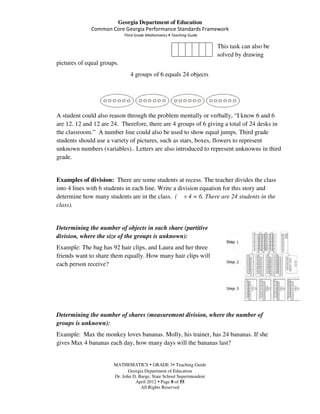
                                                                        This task can also be
                                                                        solved by drawing
pictures of equal groups.
                               4 groups of 6 equals 24 objects


A student could also reason through the problem mentally or verbally, “I know 6 and 6
are 12. 12 and 12 are 24. Therefore, there are 4 groups of 6 giving a total of 24 desks in
the classroom.” A number line could also be used to show equal jumps. Third grade
students should use a variety of pictures, such as stars, boxes, flowers to represent
unknown numbers (variables).. Letters are also introduced to represent unknowns in third
grade.


Examples of division: There are some students at recess. The teacher divides the class
into 4 lines with 6 students in each line. Write a division equation for this story and
determine how many students are in the class. ( ÷ 4 = 6. There are 24 students in the
class).


Determining the number of objects in each share (partitive
division, where the size of the groups is unknown):
Example: The bag has 92 hair clips, and Laura and her three
friends want to share them equally. How many hair clips will
each person receive?


Determining the number of shares (measurement division, where the number of
groups is unknown):
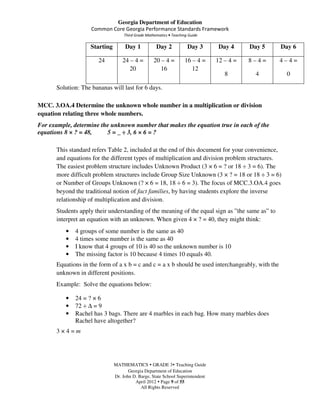
Example: Max the monkey loves bananas. Molly, his trainer, has 24 bananas. If she
gives Max 4 bananas each day, how many days will the bananas last?


                       MATHEMATICS GRADE 3 Teaching Guide
                              Georgia Department of Education
                       Dr. John D. Barge, State School Superintendent
                                 April 2012 Page 8 of 55
                                    All Rights Reserved
Georgia Department of Education
                    Common Core Georgia Performance Standards Framework
                                   Third Grade Mathematics • Teaching Guide

                   Starting        Day 1            Day 2            Day 3      Day 4     Day 5   Day 6

                       24         24 – 4 =         20 – 4 =         16 – 4 =   12 – 4 =   8–4=    4–4=
                                     20               16               12
                                                                                  8         4       0

      Solution: The bananas will last for 6 days.

MCC. 3.OA.4 Determine the unknown whole number in a multiplication or division
equation relating three whole numbers.
For example, determine the unknown number that makes the equation true in each of the
equations 8 × ? = 48,    5 = _ ÷ 3, 6 × 6 = ?

      This standard refers Table 2, included at the end of this document for your convenience,
      and equations for the different types of multiplication and division problem structures.
      The easiest problem structure includes Unknown Product (3 × 6 = ? or 18 ÷ 3 = 6). The
      more difficult problem structures include Group Size Unknown (3 × ? = 18 or 18 ÷ 3 = 6)
      or Number of Groups Unknown (? × 6 = 18, 18 ÷ 6 = 3). The focus of MCC.3.OA.4 goes
      beyond the traditional notion of fact families, by having students explore the inverse
      relationship of multiplication and division.
      Students apply their understanding of the meaning of the equal sign as ”the same as” to
      interpret an equation with an unknown. When given 4 × ? = 40, they might think:
          •   4 groups of some number is the same as 40
          •   4 times some number is the same as 40
          •   I know that 4 groups of 10 is 40 so the unknown number is 10
          •   The missing factor is 10 because 4 times 10 equals 40.
      Equations in the form of a x b = c and c = a x b should be used interchangeably, with the
      unknown in different positions.
      Example: Solve the equations below:

          •   24 = ? × 6
          •   72 ÷ ∆ = 9
          •   Rachel has 3 bags. There are 4 marbles in each bag. How many marbles does
              Rachel have altogether?
      3×4=m


                              MATHEMATICS GRADE 3 Teaching Guide
                                     Georgia Department of Education
                              Dr. John D. Barge, State School Superintendent
                                        April 2012 Page 9 of 55
                                           All Rights Reserved
Georgia Department of Education
                      Common Core Georgia Performance Standards Framework
                                    Third Grade Mathematics • Teaching Guide

CLUSTER #2: MCC CLUSTER: UNDERSTAND PROPERTIES OF MULTIPLICATION
AND THE RELATIONSHIP BETWEEN MULTIPLICATION AND DIVISION.
Students use properties of operations to calculate products of whole numbers, using increasingly
sophisticated strategies based on these properties to solve multiplication and division problems
involving single-digit factors. By comparing a variety of solution strategies, students learn the
relationship between multiplication and division. Mathematically proficient students
communicate precisely by engaging in discussion about their reasoning using appropriate
mathematical language. The terms students should learn to use with increasing precision with
this cluster are: operation, multiply, divide, factor, product, quotient, strategies, (properties)-
rules about how numbers work.

MCC.3.OA.5 Apply properties of operations as strategies to multiply and divide.
Examples:
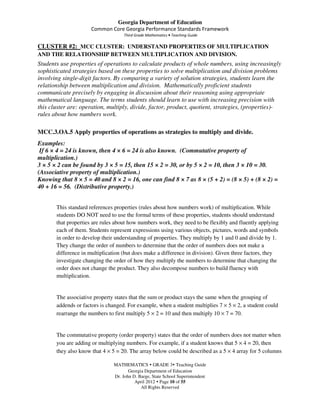
 If 6 × 4 = 24 is known, then 4 × 6 = 24 is also known. (Commutative property of
multiplication.)
3 × 5 × 2 can be found by 3 × 5 = 15, then 15 × 2 = 30, or by 5 × 2 = 10, then 3 × 10 = 30.
(Associative property of multiplication.)
Knowing that 8 × 5 = 40 and 8 × 2 = 16, one can find 8 × 7 as 8 × (5 + 2) = (8 × 5) + (8 × 2) =
40 + 16 = 56. (Distributive property.)


       This standard references properties (rules about how numbers work) of multiplication. While
       students DO NOT need to use the formal terms of these properties, students should understand
       that properties are rules about how numbers work, they need to be flexibly and fluently applying
       each of them. Students represent expressions using various objects, pictures, words and symbols
       in order to develop their understanding of properties. They multiply by 1 and 0 and divide by 1.
       They change the order of numbers to determine that the order of numbers does not make a
       difference in multiplication (but does make a difference in division). Given three factors, they
       investigate changing the order of how they multiply the numbers to determine that changing the
       order does not change the product. They also decompose numbers to build fluency with
       multiplication.


       The associative property states that the sum or product stays the same when the grouping of
       addends or factors is changed. For example, when a student multiplies 7 × 5 × 2, a student could
       rearrange the numbers to first multiply 5 × 2 = 10 and then multiply 10 × 7 = 70.


       The commutative property (order property) states that the order of numbers does not matter when
       you are adding or multiplying numbers. For example, if a student knows that 5 × 4 = 20, then
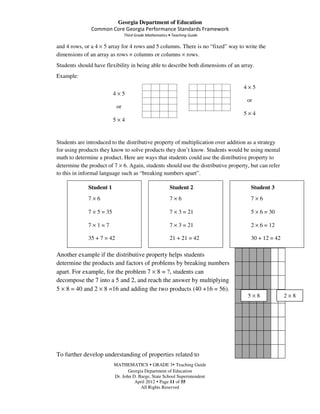
       they also know that 4 × 5 = 20. The array below could be described as a 5 × 4 array for 5 columns

                               MATHEMATICS GRADE 3 Teaching Guide
                                      Georgia Department of Education
                               Dr. John D. Barge, State School Superintendent
                                         April 2012 Page 10 of 55
                                            All Rights Reserved
Georgia Department of Education
               Common Core Georgia Performance Standards Framework
                                 Third Grade Mathematics • Teaching Guide

and 4 rows, or a 4 × 5 array for 4 rows and 5 columns. There is no “fixed” way to write the
dimensions of an array as rows × columns or columns × rows.
Students should have flexibility in being able to describe both dimensions of an array.
Example:
                                                                                  4×5
                           4×5
                                                                                    or
                            or
                                                                                  5×4
                           5×4


Students are introduced to the distributive property of multiplication over addition as a strategy
for using products they know to solve products they don’t know. Students would be using mental
math to determine a product. Here are ways that students could use the distributive property to
determine the product of 7 × 6. Again, students should use the distributive property, but can refer
to this in informal language such as “breaking numbers apart”.

              Student 1                                  Student 2                    Student 3
              7×6                                        7×6                          7×6

              7 × 5 = 35                                 7 × 3 = 21                   5 × 6 = 30

              7×1=7                                      7 × 3 = 21                   2 × 6 = 12

              35 + 7 = 42                                21 + 21 = 42                 30 + 12 = 42

Another example if the distributive property helps students
determine the products and factors of problems by breaking numbers
apart. For example, for the problem 7 × 8 = ?, students can
decompose the 7 into a 5 and 2, and reach the answer by multiplying
5 × 8 = 40 and 2 × 8 =16 and adding the two products (40 +16 = 56).
                                                                                    5×8               2×8


To further develop understanding of properties related to
                           MATHEMATICS GRADE 3 Teaching Guide
                                  Georgia Department of Education
                           Dr. John D. Barge, State School Superintendent
                                     April 2012 Page 11 of 55
                                        All Rights Reserved
Georgia Department of Education
                       Common Core Georgia Performance Standards Framework
                                     Third Grade Mathematics • Teaching Guide

       multiplication and division, students use different representations and their understanding
       of the relationship between multiplication and division to determine if the following types
       of equations are true or false.

                   •    0 × 7 = 7 × 0 = 0 (Zero Property of Multiplication)
                   •    1 × 9 = 9 × 1 = 9 (Multiplicative Identity Property of 1)
                   •    3 × 6 = 6 × 3 (Commutative Property)
                   •    8 ÷ 2 = 2 ÷ 8 (Students are only to determine that these are not equal)
                   •    2×3×5=6×5
                   •    10 × 2 < 5 × 2 × 2
                   •    2 × 3 × 5 = 10 × 3
                   •    0×6>3×0×2


MCC.3.OA.6 Understand division as an unknown-factor problem.
For example, find 32 ÷ 8 by finding the number that makes 32 when multiplied by 8.
       This standard refers to Table 2, included at the end of this document for your convenience, and
       the various problem structures. Since multiplication and division are inverse operations, students
       are expected to solve problems and explain their processes of solving division problems that can
       also be represented as unknown factor multiplication problems.
       Example: A student knows that 2 x 9 = 18. How can they use that fact to determine the answer to
       the following question: 18 people are divided into pairs in P.E. class. How many pairs are there?
       Write a division equation and explain your reasoning.
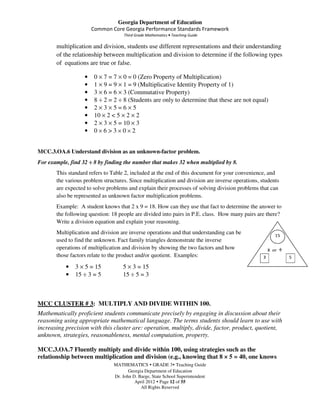
       Multiplication and division are inverse operations and that understanding can be
       used to find the unknown. Fact family triangles demonstrate the inverse
       operations of multiplication and division by showing the two factors and how
       those factors relate to the product and/or quotient. Examples:

           •   3 × 5 = 15           5 × 3 = 15
           •   15 ÷ 3 = 5           15 ÷ 5 = 3


MCC CLUSTER # 3: MULTIPLY AND DIVIDE WITHIN 100.
Mathematically proficient students communicate precisely by engaging in discussion about their
reasoning using appropriate mathematical language. The terms students should learn to use with
increasing precision with this cluster are: operation, multiply, divide, factor, product, quotient,
unknown, strategies, reasonableness, mental computation, property.

MCC.3.OA.7 Fluently multiply and divide within 100, using strategies such as the
relationship between multiplication and division (e.g., knowing that 8 × 5 = 40, one knows
                                MATHEMATICS GRADE 3 Teaching Guide
                                       Georgia Department of Education
                                Dr. John D. Barge, State School Superintendent
                                          April 2012 Page 12 of 55
                                             All Rights Reserved
Georgia Department of Education
                     Common Core Georgia Performance Standards Framework
                                   Third Grade Mathematics • Teaching Guide

40 ÷ 5 = 8) or properties of operations. By the end of Grade 3, know from memory all
products of two one-digit numbers.
       This standard uses the word fluently, which means accuracy, efficiency (using a
       reasonable amount of steps and time), and flexibility (using strategies such as the
       distributive property). “Know from memory” should not focus only on timed tests and
       repetitive practice, but ample experiences working with manipulatives, pictures, arrays,
       word problems, and numbers to internalize the basic facts (up to 9 × 9).
       By studying patterns and relationships in multiplication facts and relating multiplication
       and division, students build a foundation for fluency with multiplication and division
       facts. Students demonstrate fluency with multiplication facts through 10 and the related
       division facts. Multiplying and dividing fluently refers to knowledge of procedures,
       knowledge of when and how to use them appropriately, and skill in performing them
       flexibly, accurately, and efficiently.
       Strategies students may use to attain fluency include:

           •  Multiplication by zeros and ones
           •  Doubles (2s facts), Doubling twice (4s), Doubling three times (8s)
           •  Tens facts (relating to place value, 5 × 10 is 5 tens or 50)
           •  Five facts (half of tens)
           •  Skip counting (counting groups of __ and knowing how many groups have been
              counted)
           • Square numbers (ex: 3 × 3)
           • Nines (10 groups less one group, e.g., 9 × 3 is 10 groups of 3 minus one group of
              3)
           • Decomposing into known facts (6 × 7 is 6 x 6 plus one more group of 6)
           • Turn-around facts (Commutative Property)
           • Fact families (Ex: 6 × 4 = 24; 24 ÷ 6 = 4; 24 ÷ 4 = 6; 4 × 6 = 24)
           • Missing factors
       General Note: Students should have exposure to multiplication and division problems
       presented in both vertical and horizontal forms.

MCC CLUSTER #4: SOLVE PROBLEMS INVOLVING THE FOUR OPERATIONS,
AND IDENTIFY AND EXPLAIN PATTERNS IN ARITHMETIC.
Mathematically proficient students communicate precisely by engaging in discussion about their
reasoning using appropriate mathematical language. The terms students should learn to use with
increasing precision with this cluster are: operation, multiply, divide, factor, product, quotient,
subtract, add, addend, sum, difference, equation, unknown, strategies, reasonableness, mental
computation, estimation, rounding, patterns, (properties) – rules about how numbers work.


                              MATHEMATICS GRADE 3 Teaching Guide
                                     Georgia Department of Education
                              Dr. John D. Barge, State School Superintendent
                                        April 2012 Page 13 of 55
                                           All Rights Reserved
Georgia Department of Education
                     Common Core Georgia Performance Standards Framework
                                    Third Grade Mathematics • Teaching Guide

MCC.3.OA.8 Solve two-step word problems using the four operations. Represent these
problems using equations with a letter standing for the unknown quantity. Assess the
reasonableness of answers using mental computation and estimation strategies including
rounding.
      This standard refers to two-step word problems using the four operations. The size of the numbers
      should be limited to related 3rd grade standards (e.g., 3.OA.7 and 3.NBT.2). Adding and
      subtracting numbers should include numbers within 1,000, and multiplying and dividing numbers
      should include single-digit factors and products less than 100.
      This standard calls for students to represent problems using equations with a letter to represent
      unknown quantities.
      Example:
            Mike runs 2 miles a day. His goal is to run 25 miles. After 5 days, how many miles
            does Mike have left to run in order to meet his goal? Write an equation and find the
            solution (2 × 5 + m = 25).
      This standard refers to estimation strategies, including using compatible numbers (numbers that
      sum to 10, 50, or 100) or rounding. The focus in this standard is to have students use and discuss
      various strategies. Students should estimate during problem solving, and then revisit their
      estimate to check for reasonableness.
      Example: Here are some typical estimation strategies for the problem:
            On a vacation, your family travels 267 miles on the first day, 194 miles on the second
            day and 34 miles on the third day. How many total miles did they travel?

            Student 1                              Student 2                        Student 3
            I first thought about 267 and          I first thought about 194. It    I rounded 267 to 300. I
            34. I noticed that their sum           is really close to 200. I also   rounded 194 to 200. I
            is about 300. Then I knew              have 2 hundreds in 267.          rounded 34 to 30. When I
            that 194 is close to 200.              That gives me a total of 4       added 300, 200, and 30, I
            When I put 300 and 200                 hundreds. Then I have 67 in      know my answer will be
            together, I get 500.                   267 and the 34. When I put       about 530.
                                                   67 and 34 together that is
                                                   really close to 100. When I
                                                   add that hundred to the 4
                                                   hundreds that I already had, I
                                                   end up with 500.

      The assessment of estimation strategies should only have one reasonable answer (500 or 530), or
      a range (between 500 and 550). Problems should be structured so that all acceptable estimation
      strategies will arrive at a reasonable answer.


                               MATHEMATICS GRADE 3 Teaching Guide
                                      Georgia Department of Education
                               Dr. John D. Barge, State School Superintendent
                                         April 2012 Page 14 of 55
                                            All Rights Reserved
Georgia Department of Education
                     Common Core Georgia Performance Standards Framework
                                   Third Grade Mathematics • Teaching Guide


MCC.3.OA.9 Identify arithmetic patterns (including patterns in the addition table or
multiplication table), and explain them using properties of operations. For example, observe
that 4 times a number is always even, and explain why 4 times a number can be decomposed
into two equal addends.
       This standard calls for students to examine arithmetic patterns involving both addition
       and multiplication. Arithmetic patterns are patterns that change by the same rate, such as
       adding the same number. For example, the series 2, 4, 6, 8, 10 is an arithmetic pattern
       that increases by 2 between each term.
       This standard also mentions identifying patterns related to the properties of operations.
       Examples:

          •   Even numbers are always divisible by 2. Even
              numbers can always be decomposed into 2
              equal addends (14 = 7 + 7).
          •   Multiples of even numbers (2, 4, 6, and 8) are
              always even numbers.
          •   On a multiplication chart, the products in each
              row and column increase by the same amount
              (skip counting).
          •   On an addition chart, the sums in each row and
              column increase by the same amount.
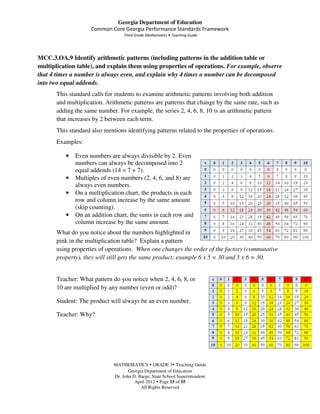
       What do you notice about the numbers highlighted in
       pink in the multiplication table? Explain a pattern
       using properties of operations. When one changes the order of the factors (commutative
       property), they will still gets the same product; example 6 x 5 = 30 and 5 x 6 = 30.


       Teacher: What pattern do you notice when 2, 4, 6, 8, or
       10 are multiplied by any number (even or odd)?

       Student: The product will always be an even number.

       Teacher: Why?


                              MATHEMATICS GRADE 3 Teaching Guide
                                     Georgia Department of Education
                              Dr. John D. Barge, State School Superintendent
                                        April 2012 Page 15 of 55
                                           All Rights Reserved
Georgia Department of Education
                     Common Core Georgia Performance Standards Framework
                                   Third Grade Mathematics • Teaching Guide

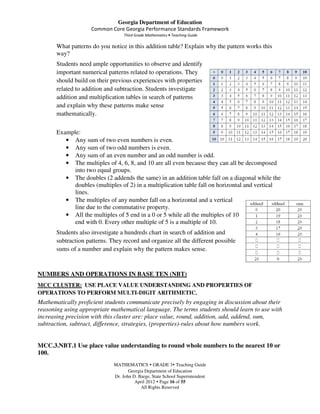
       What patterns do you notice in this addition table? Explain why the pattern works this
       way?
       Students need ample opportunities to observe and identify
       important numerical patterns related to operations. They
       should build on their previous experiences with properties
       related to addition and subtraction. Students investigate
       addition and multiplication tables in search of patterns
       and explain why these patterns make sense
       mathematically.

       Example:
          • Any sum of two even numbers is even.
          • Any sum of two odd numbers is even.
          • Any sum of an even number and an odd number is odd.
          • The multiples of 4, 6, 8, and 10 are all even because they can all be decomposed
             into two equal groups.
          • The doubles (2 addends the same) in an addition table fall on a diagonal while the
             doubles (multiples of 2) in a multiplication table fall on horizontal and vertical
             lines.
          • The multiples of any number fall on a horizontal and a vertical
             line due to the commutative property.
          • All the multiples of 5 end in a 0 or 5 while all the multiples of 10
             end with 0. Every other multiple of 5 is a multiple of 10.
       Students also investigate a hundreds chart in search of addition and
       subtraction patterns. They record and organize all the different possible
       sums of a number and explain why the pattern makes sense.


NUMBERS AND OPERATIONS IN BASE TEN (NBT)
MCC CLUSTER: USE PLACE VALUE UNDERSTANDING AND PROPERTIES OF
OPERATIONS TO PERFORM MULTI-DIGIT ARITHMETIC.
Mathematically proficient students communicate precisely by engaging in discussion about their
reasoning using appropriate mathematical language. The terms students should learn to use with
increasing precision with this cluster are: place value, round, addition, add, addend, sum,
subtraction, subtract, difference, strategies, (properties)-rules about how numbers work.


MCC.3.NBT.1 Use place value understanding to round whole numbers to the nearest 10 or
100.
                              MATHEMATICS GRADE 3 Teaching Guide
                                     Georgia Department of Education
                              Dr. John D. Barge, State School Superintendent
                                        April 2012 Page 16 of 55
                                           All Rights Reserved
Georgia Department of Education
                        Common Core Georgia Performance Standards Framework
                                     Third Grade Mathematics • Teaching Guide

       This standard refers to place value understanding, which extends beyond an algorithm or
       procedure for rounding. The expectation is that students have a deep understanding of
       place value and number sense and can explain and reason about the answers they get
       when they round. Students should have numerous experiences using a number line and a
       hundreds chart as tools to support their work with rounding.


MCC.3.NBT.2 Fluently add and subtract within 1000 using strategies and algorithms
based on place value, properties of operations, and/or the relationship between addition
and subtraction.
       This standard refers to fluently, which means accuracy, efficiency (using a reasonable amount of
       steps and time), and flexibility (using strategies such as the distributive property). The word
       algorithm refers to a procedure or a series of steps. There are other algorithms other than the
       standard algorithm. Third grade students should have experiences beyond the standard algorithm.
       A variety of algorithms will be assessed.
       Problems should include both vertical and horizontal forms, including opportunities for students
       to apply the commutative and associative properties. Students explain their thinking and show
       their work by using strategies and algorithms, and verify that their answer is reasonable.
       Example: There are 178 fourth graders and 225 fifth graders on the playground. What is the total
       number of students on the playground?

           Student 1                               Student 2                        Student 3
           100 + 200 = 300                         I added 2 to 178 to get 180. I   I know the 75 plus 25 equals
                                                   added 220 to get 400. I          100. Then I added 1 hundred
           70 + 20 = 90                            added the 3 left over to get     from 178 and 2 hundreds
           8 + 5 = 13                              403.                             from 275. I had a total of 4
                                                                                    hundreds and I had 3 more
           300+90+13 = 403 students                                                 left to add. So I have 4
                                                                                    hundreds plus 3 more which
                                                                                    is 403.
       Student 4
       178 + 225 = ?

       178 + 200 = 378

       378 + 20 = 398

       398 + 5 = 403

                                MATHEMATICS GRADE 3 Teaching Guide
                                       Georgia Department of Education
                                Dr. John D. Barge, State School Superintendent
                                          April 2012 Page 17 of 55
                                             All Rights Reserved
Georgia Department of Education
                      Common Core Georgia Performance Standards Framework
                                     Third Grade Mathematics • Teaching Guide

MCC.3.NBT.3 Multiply one-digit whole numbers by multiples of 10 in the range 10–90
(e.g., 9 × 80, 5 × 60) using strategies based on place value and properties of operations.

       This standard extends students’ work in multiplication by having them apply their
       understanding of place value.
       This standard expects that students go beyond tricks that hinder understanding such as
       “just adding zeros” and explain and reason about their products. For example, for the
       problem 50 x 4, students should think of this as 4 groups of 5 tens or 20 tens. Twenty tens
       equals 200.

Common Misconceptions
The use of terms like “round up” and “round down” confuses many students. For example, the
number 37 would round to 40 or they say it “rounds up”. The digit in the tens place is changed
from 3 to 4 (rounds up). This misconception is what causes the problem when applied to
rounding down. The number 32 should be rounded (down) to 30, but using the logic mentioned
for rounding up, some students may look at the digit in the tens place and take it to the previous
number, resulting in the incorrect value of 20. To remedy this misconception, students need to
use a number line to visualize the placement of the number and/or ask questions such as: “What
tens are 32 between and which one is it closer to?” Developing the understanding of what the
answer choices are before rounding can alleviate much of the misconception and confusion
related to rounding.


NUMBER AND OPERATIONS IN FRACTIONS (NF)

MCC CLUSTER : DEVELOP UNDERSTANDING OF FRACTIONS AS NUMBERS.
Students develop an understanding of fractions, beginning with unit fractions. Students view
fractions in general as being built out of unit fractions, and they use fractions along with visual
fraction models to represent parts of a whole. Students understand that the size of a fractional
part is relative to the size of the whole. For example, 1/2 of the paint in a small bucket could be
less paint than 1/3 of the paint in a larger bucket, but 1/3 of a ribbon is longer than 1/5 of the
same ribbon because when the ribbon is divided into 3 equal parts, the parts are longer than
when the ribbon is divided into 5 equal parts. Students are able to use fractions to represent
numbers equal to, less than, and greater than one. They solve problems that involve comparing
fractions by using visual fraction models and strategies based on noticing equal numerators or
denominators.

MCC.3.NF.1 Understand a fraction 1/b as the quantity formed by 1 part when a whole is
partitioned into b equal parts; understand a fraction a/b as the quantity formed by a parts
of size 1/b.
       This standard refers to the sharing of a whole being partitioned or split. Fraction models in third
       grade include area (parts of a whole) models (circles, rectangles, squares) and number lines. Set
                                MATHEMATICS GRADE 3 Teaching Guide
                                       Georgia Department of Education
                                Dr. John D. Barge, State School Superintendent
                                          April 2012 Page 18 of 55
                                             All Rights Reserved
Georgia Department of Education
                      Common Core Georgia Performance Standards Framework
                                      Third Grade Mathematics • Teaching Guide

       models (parts of a group) are not introduced in Third Grade. In 3.NF.1 students should focus on
       the concept that a fraction is made up (composed) of many pieces of a unit fraction, which has a
       numerator of 1. For example, the fraction 3/5 is composed of 3 pieces that each have a size of 1/5.
       Some important concepts related to developing understanding of fractions include:

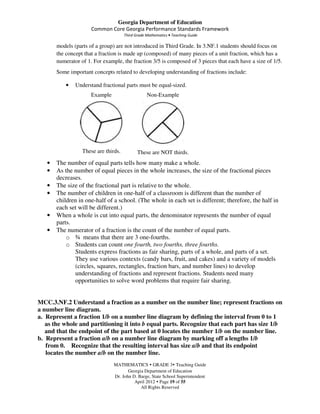
           •   Understand fractional parts must be equal-sized.
                      Example                     Non-Example


                  These are thirds.          These are NOT thirds.
   •   The number of equal parts tells how many make a whole.
   •   As the number of equal pieces in the whole increases, the size of the fractional pieces
       decreases.
   •   The size of the fractional part is relative to the whole.
   •   The number of children in one-half of a classroom is different than the number of
       children in one-half of a school. (The whole in each set is different; therefore, the half in
       each set will be different.)
   •   When a whole is cut into equal parts, the denominator represents the number of equal
       parts.
   •   The numerator of a fraction is the count of the number of equal parts.
           o ¾ means that there are 3 one-fourths.
           o Students can count one fourth, two fourths, three fourths.
              Students express fractions as fair sharing, parts of a whole, and parts of a set.
              They use various contexts (candy bars, fruit, and cakes) and a variety of models
              (circles, squares, rectangles, fraction bars, and number lines) to develop
              understanding of fractions and represent fractions. Students need many
              opportunities to solve word problems that require fair sharing.


MCC.3.NF.2 Understand a fraction as a number on the number line; represent fractions on
a number line diagram.
a. Represent a fraction 1/b on a number line diagram by defining the interval from 0 to 1
   as the whole and partitioning it into b equal parts. Recognize that each part has size 1/b
   and that the endpoint of the part based at 0 locates the number 1/b on the number line.
b. Represent a fraction a/b on a number line diagram by marking off a lengths 1/b
   from 0. Recognize that the resulting interval has size a/b and that its endpoint
   locates the number a/b on the number line.
                                MATHEMATICS GRADE 3 Teaching Guide
                                       Georgia Department of Education
                                Dr. John D. Barge, State School Superintendent
                                          April 2012 Page 19 of 55
                                             All Rights Reserved
Georgia Department of Education
                      Common Core Georgia Performance Standards Framework
                                     Third Grade Mathematics • Teaching Guide

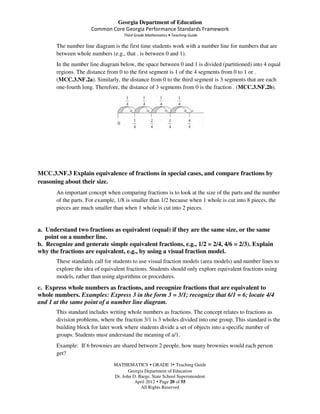
       The number line diagram is the first time students work with a number line for numbers that are
       between whole numbers (e.g., that . is between 0 and 1).
       In the number line diagram below, the space between 0 and 1 is divided (partitioned) into 4 equal
       regions. The distance from 0 to the first segment is 1 of the 4 segments from 0 to 1 or .
       (MCC.3.NF.2a). Similarly, the distance from 0 to the third segment is 3 segments that are each
       one-fourth long. Therefore, the distance of 3 segments from 0 is the fraction . (MCC.3.NF.2b).


MCC.3.NF.3 Explain equivalence of fractions in special cases, and compare fractions by
reasoning about their size.
       An important concept when comparing fractions is to look at the size of the parts and the number
       of the parts. For example, 1/8 is smaller than 1/2 because when 1 whole is cut into 8 pieces, the
       pieces are much smaller than when 1 whole is cut into 2 pieces.


a. Understand two fractions as equivalent (equal) if they are the same size, or the same
   point on a number line.
b. Recognize and generate simple equivalent fractions, e.g., 1/2 = 2/4, 4/6 = 2/3). Explain
why the fractions are equivalent, e.g., by using a visual fraction model.
       These standards call for students to use visual fraction models (area models) and number lines to
       explore the idea of equivalent fractions. Students should only explore equivalent fractions using
       models, rather than using algorithms or procedures.
c. Express whole numbers as fractions, and recognize fractions that are equivalent to
whole numbers. Examples: Express 3 in the form 3 = 3/1; recognize that 6/1 = 6; locate 4/4
and 1 at the same point of a number line diagram.
       This standard includes writing whole numbers as fractions. The concept relates to fractions as
       division problems, where the fraction 3/1 is 3 wholes divided into one group. This standard is the
       building block for later work where students divide a set of objects into a specific number of
       groups. Students must understand the meaning of a/1.
       Example: If 6 brownies are shared between 2 people, how many brownies would each person
       get?
                                MATHEMATICS GRADE 3 Teaching Guide
                                       Georgia Department of Education
                                Dr. John D. Barge, State School Superintendent
                                          April 2012 Page 20 of 55
                                             All Rights Reserved
Georgia Department of Education
                      Common Core Georgia Performance Standards Framework
                                     Third Grade Mathematics • Teaching Guide

d. Compare two fractions with the same numerator or the same denominator by reasoning
about their size. Recognize that comparisons are valid only when the two fractions refer to
the same whole. Record the results of comparisons with the symbols >, =, or <, and justify
the conclusions, e.g., by using a visual fraction model.
       This standard involves comparing fractions with or without visual fraction models including
       number lines. Experiences should encourage students to reason about the size of pieces, the fact
       that 1/3 of a cake is larger than 1/4 of the same cake. Since the same cake (the whole) is split into
       equal pieces, thirds are larger than fourths.
       In this standard, students should also reason that comparisons are only valid if the wholes are
       identical. For example, 1/2 of a large pizza is a different amount than 1/2 of a small pizza.
       Students should be given opportunities to discuss and reason about which 1/2 is larger.

Common Misconceptions

The idea that the smaller the denominator, the smaller the piece or part of the set, or the larger
the denominator, the larger the piece or part of the set, is based on the comparison that in whole
numbers, the smaller a number, the less it is, or the larger a number, the more it is. The use of
different models, such as fraction bars and number lines, allows students to compare unit
fractions to reason about their sizes.
Students think all shapes can be divided the same way. Present shapes other than circles, squares
or rectangles to prevent students from overgeneralizing that all shapes can be divided the same
way. For example, have students fold a triangle into eighths. Provide oral directions for folding
the triangle:
1. Fold the triangle into half by folding the left vertex (at the base of the triangle) over to meet
the right vertex.
2. Fold in this manner two more times.
3. Have students label each eighth using fractional notation. Then, have students count the
fractional parts in the triangle (one-eighth, two-eighths, three-eighths, and so on).


MEASUREMENT AND DATA (MD)

MCC CLUSTER #1: SOLVE PROBLEMS INVOLVING MEASUREMENT AND
ESTIMATION OF INTERVALS OF TIME, LIQUID VOLUMES, AND MASSES OF
OBJECTS.
Mathematically proficient students communicate precisely by engaging in discussion about their
reasoning using appropriate mathematical language. The terms students should learn to use with
increasing precision with this cluster are: estimate, time, time intervals, minute, hour, elapsed
time, measure, liquid volume, mass, standard units, metric, gram (g), kilogram (kg), liter (L).


                                MATHEMATICS GRADE 3 Teaching Guide
                                       Georgia Department of Education
                                Dr. John D. Barge, State School Superintendent
                                          April 2012 Page 21 of 55
                                             All Rights Reserved
Georgia Department of Education
                        Common Core Georgia Performance Standards Framework
                                       Third Grade Mathematics • Teaching Guide

MCC. 3.MD.1 Tell and write time to the nearest minute and measure time intervals in
minutes. Solve word problems involving addition and subtraction of time intervals in
minutes, e.g., by representing the problem on a number line diagram.
        This standard calls for students to solve elapsed time, including word problems. Students
        could use clock models or number lines to solve. On the number line, students should be
        given the opportunities to determine the intervals and size of jumps on their number line.
        Students could use pre-determined number lines (intervals every 5 or 15 minutes) or open
        number lines (intervals determined by students).
        Example:
              Tonya wakes up at 6:45 a.m. It takes her 5 minutes to shower, 15 minutes to
              get dressed, and 15 minutes to eat breakfast. What time will she be ready for
              school?


MCC.3.MD.2 Measure and estimate liquid volumes and masses of objects using
standardunits of grams (g), kilograms (kg), and liters (l).1 Add, subtract, multiply, or divide
to solve one-step word problems involving masses or volumes that are given in the same
units, e.g., by using drawings (such as a beaker with a measurement scale) to represent the
problem.2
        This standard asks for students to reason about the units of mass and volume. Students
        need multiple opportunities weighing classroom objects and filling containers to help
        them develop a basic understanding of the size and weight of a liter, a gram, and a
        kilogram. Milliliters may also be used to show amounts that are less than a liter. Word
        problems should only be one-step and include the same units.
        Example:

        Students identify 5 things that weigh about one gram. They record their findings
        with words and pictures. (Students can repeat this for 5 grams and 10 grams.) This
        activity helps develop gram benchmarks. One large paperclip weighs about one
        gram. A box of large paperclips (100 clips) weighs about 100 grams so 10 boxes
        would weigh one kilogram.

1
 Excludes compound units such as cm3 and finding the geometric volume of a container.
2
 Excludes multiplicative comparison problems (problems involving notions of “times as much”). See Table 2 at the
end of this document.
                                  MATHEMATICS GRADE 3 Teaching Guide
                                         Georgia Department of Education
                                  Dr. John D. Barge, State School Superintendent
                                            April 2012 Page 22 of 55
                                               All Rights Reserved
Georgia Department of Education
                       Common Core Georgia Performance Standards Framework
                                      Third Grade Mathematics • Teaching Guide

         Example:

         A paper clip weighs about a) a gram, b) 10 grams, c) 100 grams?

  Foundational understandings to help with measure concepts:

     •     Understand that larger units can be subdivided into equivalent units (partition).
     •     Understand that the same unit can be repeated to determine the measure (iteration).
           Understand the relationship between the size of a unit and the number of units needed
           (compensatory principle).

Common Misconceptions
Students may read the mark on a scale that is below a designated number on the scale as if it was
the next number. For example, a mark that is one mark below 80 grams may be read as 81 grams.
Students realize it is one away from 80, but do not think of it as 79 grams.

MCC CLUSTER #2: REPRESENT AND INTERPRET DATA.
Mathematically proficient students communicate precisely by engaging in discussion about their
reasoning using appropriate mathematical language. The terms students should learn to use with
increasing precision with this cluster are: scale, scaled picture graph, scaled bar graph, line
plot, data.

MCC.3.MD.3 Draw a scaled picture graph and a scaled bar graph to represent a data set
with several categories. Solve one- and two-step “how many more” and “how many less”
problems using information presented in scaled bar graphs. For example, draw a bar graph
in which each square in the bar graph might represent 5 pets.
         Students should have opportunities reading and solving problems using scaled graphs
         before being asked to draw one. The following graphs all use five as the scale interval,
         but students should experience different intervals to further develop their understanding
         of scale graphs and number facts. While exploring data concepts, students should Pose a
         question, Collect data, Analyze data, and Interpret data (PCAI). Students should be
         graphing data that is relevant to their lives
         Example:
         Pose a question: Student should come up with a question. What is the typical genre read
         in our class?
         Collect and organize data: student survey
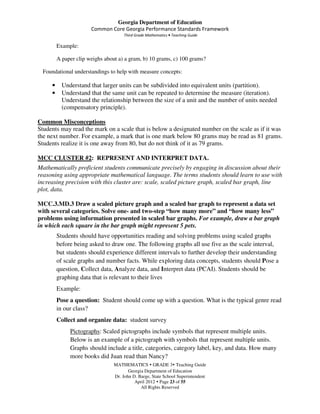
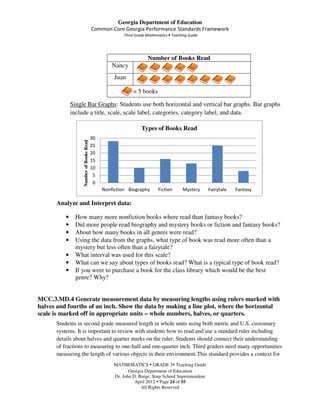
              Pictographs: Scaled pictographs include symbols that represent multiple units.
              Below is an example of a pictograph with symbols that represent multiple units.
              Graphs should include a title, categories, category label, key, and data. How many
              more books did Juan read than Nancy?
                                 MATHEMATICS GRADE 3 Teaching Guide
                                        Georgia Department of Education
                                 Dr. John D. Barge, State School Superintendent
                                           April 2012 Page 23 of 55
                                              All Rights Reserved
Georgia Department of Education
                                          Common Core Georgia Performance Standards Framework
                                                        Third Grade Mathematics • Teaching Guide


                                                                    Number of Books Read
                                                   Nancy
                                                    Juan

                                                            = 5 books

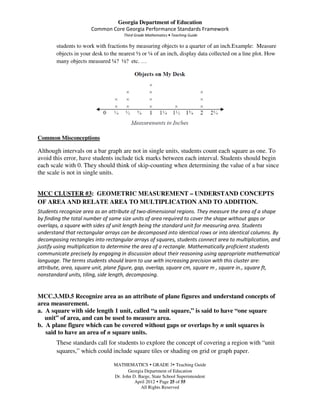
              Single Bar Graphs: Students use both horizontal and vertical bar graphs. Bar graphs
                                   :
              include a title, scale, scale label, categories, category label, and data.

                                                                 Types of Books Read
                                          30
                   Number of Books Read


                                          25
                                          20
                                          15
                                          10
                                           5
                                           0
                                               Nonfiction Biography       Fiction      Mystery      Fairytale   Fantasy

      Analyze and Interpret data:

          •     How many more nonfiction books where read than fantasy books?
          •     Did more people read biography and mystery books or fiction and fantasy books?
          •     About how many books in all genres were read?
          •     Using the data from the graphs, what type of book was read more often than a
                mystery but less often than a fairytale?
          •     What interval was used for this scale?
          •     What can we say about types of books read? What is a typical type of book read?
          •     If you were to purchase a book for the class library which would be the best
                genre? Why?


MCC.3.MD.4 Generate measurement data by measuring lengths using rulers marked with
halves and fourths of an inch. Show the data by making a line plot, where the horizontal
scale is marked off in appropriate units – whole numbers, halves, or quarters.
      Students in second grade measured length in whole units using both metric and U.S. customary
      systems. It is important to review with students how to read and use a standard ruler including
      details about halves and quarter marks on the ruler. Students should connect their understanding
      of fractions to measuring to one
                                    one-half and one-quarter inch. Third graders need many opportunities
      measuring the length of various objects in their environment.This standard provides a context for
                                                   MATHEMATICS GRADE 3 Teaching Guide
                                                          Georgia Department of Education
                                                   Dr. John D. Barge, State School Superintendent
                                                             April 2012 Page 24 of 55
                                                                All Rights Reserved
Georgia Department of Education
                       Common Core Georgia Performance Standards Framework
                                      Third Grade Mathematics • Teaching Guide

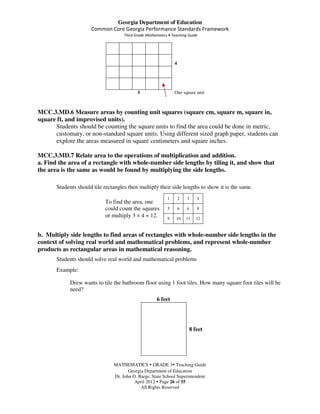
        students to work with fractions by measuring objects to a quarter of an inch.Example: Measure
        objects in your desk to the nearest ½ or ¼ of an inch, display data collected on a line plot. How
        many objects measured ¼? ½? etc. …


Common Misconceptions

Although intervals on a bar graph are not in single units, students count each square as one. To
avoid this error, have students include tick marks between each interval. Students should begin
each scale with 0. They should think of skip-counting when determining the value of a bar since
the scale is not in single units.


MCC CLUSTER #3: GEOMETRIC MEASUREMENT – UNDERSTAND CONCEPTS
OF AREA AND RELATE AREA TO MULTIPLICATION AND TO ADDITION.
Students recognize area as an attribute of two-dimensional regions. They measure the area of a shape
by finding the total number of same size units of area required to cover the shape without gaps or
overlaps, a square with sides of unit length being the standard unit for measuring area. Students
understand that rectangular arrays can be decomposed into identical rows or into identical columns. By
decomposing rectangles into rectangular arrays of squares, students connect area to multiplication, and
justify using multiplication to determine the area of a rectangle. Mathematically proficient students
communicate precisely by engaging in discussion about their reasoning using appropriate mathematical
language. The terms students should learn to use with increasing precision with this cluster are:
attribute, area, square unit, plane figure, gap, overlap, square cm, square m , square in., square ft,
nonstandard units, tiling, side length, decomposing.


MCC.3.MD.5 Recognize area as an attribute of plane figures and understand concepts of
area measurement.
a. A square with side length 1 unit, called “a unit square,” is said to have “one square
   unit” of area, and can be used to measure area.
b. A plane figure which can be covered without gaps or overlaps by n unit squares is
   said to have an area of n square units.
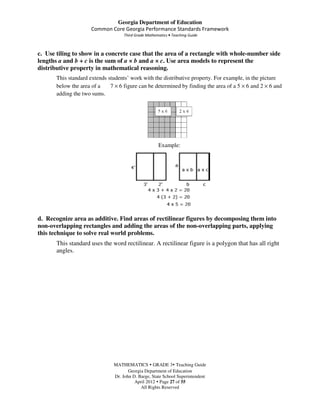
        These standards call for students to explore the concept of covering a region with “unit
        squares,” which could include square tiles or shading on grid or graph paper.

                                 MATHEMATICS GRADE 3 Teaching Guide
                                        Georgia Department of Education
                                 Dr. John D. Barge, State School Superintendent
                                           April 2012 Page 25 of 55
                                              All Rights Reserved
Georgia Department of Education
                      Common Core Georgia Performance Standards Framework
                                     Third Grade Mathematics • Teaching Guide


                                                                4


                                            5                   One square unit


MCC.3.MD.6 Measure areas by counting unit squares (square cm, square m, square in,
square ft, and improvised units).
      Students should be counting the square units to find the area could be done in metric,
      customary, or non-standard square units. Using different sized graph paper, students can
      explore the areas measured in square centimeters and square inches.

MCC.3.MD.7 Relate area to the operations of multiplication and addition.
a. Find the area of a rectangle with whole-number side lengths by tiling it, and show that
the area is the same as would be found by multiplying the side lengths.

       Students should tile rectangles then multiply their side lengths to show it is the same.
                                                            1       2   3    4
                            To find the area, one
                            could count the squares         5       6   6    8
                            or multiply 3 × 4 = 12.         9    10     11   12


b. Multiply side lengths to find areas of rectangles with whole-number side lengths in the
context of solving real world and mathematical problems, and represent whole-number
products as rectangular areas in mathematical reasoning.
       Students should solve real world and mathematical problems
       Example:

             Drew wants to tile the bathroom floor using 1 foot tiles. How many square foot tiles will he
             need?
                                                      6 feet


                                                                         8 feet


                                MATHEMATICS GRADE 3 Teaching Guide
                                       Georgia Department of Education
                                Dr. John D. Barge, State School Superintendent
                                          April 2012 Page 26 of 55
                                             All Rights Reserved
Georgia Department of Education
                      Common Core Georgia Performance Standards Framework
                                    Third Grade Mathematics • Teaching Guide


c. Use tiling to show in a concrete case that the area of a rectangle with whole-number side
lengths a and b + c is the sum of a × b and a × c. Use area models to represent the
distributive property in mathematical reasoning.
       This standard extends students’ work with the distributive property. For example, in the picture
       below the area of a    7 × 6 figure can be determined by finding the area of a 5 × 6 and 2 × 6 and
       adding the two sums.


                                                      Example:


d. Recognize area as additive. Find areas of rectilinear figures by decomposing them into
non-overlapping rectangles and adding the areas of the non-overlapping parts, applying
this technique to solve real world problems.
       This standard uses the word rectilinear. A rectilinear figure is a polygon that has all right
       angles.


                               MATHEMATICS GRADE 3 Teaching Guide
                                      Georgia Department of Education
                               Dr. John D. Barge, State School Superintendent
                                         April 2012 Page 27 of 55
                                            All Rights Reserved
Georgia Department of Education
                 Common Core Georgia Performance Standards Framework
                               Third Grade Mathematics • Teaching Guide


  Example:
      A storage shed is pictured below. What is the total area? How could the figure
      be decomposed to help find the area?


Example:
    Students can decompose a rectilinear figure into different rectangles. They find the area
    of the figure by adding the areas of each of the rectangles together.


                          MATHEMATICS GRADE 3 Teaching Guide
                                 Georgia Department of Education
                          Dr. John D. Barge, State School Superintendent
                                    April 2012 Page 28 of 55
                                       All Rights Reserved
Georgia Department of Education
                     Common Core Georgia Performance Standards Framework
                                   Third Grade Mathematics • Teaching Guide

Common Misconceptions
Students may confuse perimeter and area when they measure the sides of a rectangle and then
multiply. They think the attribute they find is length, which is perimeter. Pose problems
situations that require students to explain whether they are to find the perimeter or area.

MCC CLUSTER #4: GEOMETRIC MEASUREMENT – RECOGNIZE PERIMETER AS
AN ATTRIBUTE OF PLANE FIGURES AND DISTINGUISH BETWEEN LINEAR AND
AREA MEASURES.
Mathematically proficient students communicate precisely by engaging in discussion about their
reasoning using appropriate mathematical language. The terms students should learn to use with
increasing precision with this cluster are: attribute, perimeter, plane figure, linear, area,
polygon, side length.

MCC.3.MD.8 Solve real world and mathematical problems involving perimeters of
polygons, including finding the perimeter given the side lengths, finding an unknown side
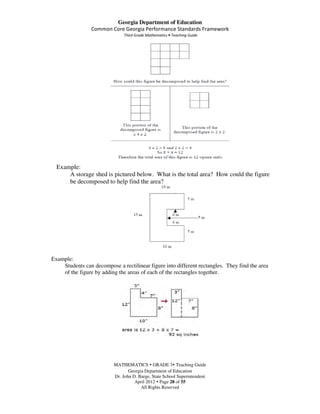
length, and exhibiting rectangles with the same perimeter and different areas or with the
same area and different perimeters.
       Students develop an understanding of the concept of perimeter by walking around the
       perimeter of a room, using rubber bands to represent the perimeter of a plane figure on a
       geoboard, or tracing around a shape on an interactive whiteboard. They find the perimeter
       of objects; use addition to find perimeters; and recognize the patterns that exist when
       finding the sum of the lengths and widths of rectangles.
       Students use geoboards, tiles, and graph paper to find all the possible rectangles that have
       a given perimeter (e.g., find the rectangles with a perimeter of 14 cm.) They record all the
       possibilities using dot or graph paper, compile the possibilities into an organized list or a
       table, and determine whether they have all the possible rectangles. Given a perimeter and
       a length or width, students use objects or pictures to find the missing length or width.
       They justify and communicate their solutions using words, diagrams, pictures, numbers,
       and an interactive whiteboard.
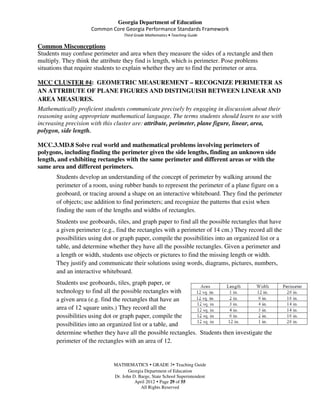
       Students use geoboards, tiles, graph paper, or
       technology to find all the possible rectangles with
       a given area (e.g. find the rectangles that have an
       area of 12 square units.) They record all the
       possibilities using dot or graph paper, compile the
       possibilities into an organized list or a table, and
       determine whether they have all the possible rectangles. Students then investigate the
       perimeter of the rectangles with an area of 12.


                              MATHEMATICS GRADE 3 Teaching Guide
                                     Georgia Department of Education
                              Dr. John D. Barge, State School Superintendent
                                        April 2012 Page 29 of 55
                                           All Rights Reserved
Georgia Department of Education
                     Common Core Georgia Performance Standards Framework
                                   Third Grade Mathematics • Teaching Guide

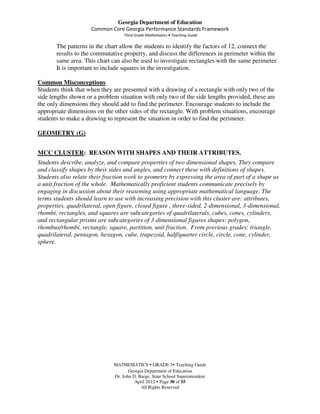
       The patterns in the chart allow the students to identify the factors of 12, connect the
       results to the commutative property, and discuss the differences in perimeter within the
       same area. This chart can also be used to investigate rectangles with the same perimeter.
       It is important to include squares in the investigation.

Common Misconceptions
Students think that when they are presented with a drawing of a rectangle with only two of the
side lengths shown or a problem situation with only two of the side lengths provided, these are
the only dimensions they should add to find the perimeter. Encourage students to include the
appropriate dimensions on the other sides of the rectangle. With problem situations, encourage
students to make a drawing to represent the situation in order to find the perimeter.

GEOMETRY (G)


MCC CLUSTER: REASON WITH SHAPES AND THEIR ATTRIBUTES.
Students describe, analyze, and compare properties of two dimensional shapes. They compare
and classify shapes by their sides and angles, and connect these with definitions of shapes.
Students also relate their fraction work to geometry by expressing the area of part of a shape as
a unit fraction of the whole. Mathematically proficient students communicate precisely by
engaging in discussion about their reasoning using appropriate mathematical language. The
terms students should learn to use with increasing precision with this cluster are: attributes,
properties, quadrilateral, open figure, closed figure , three-sided, 2-dimensional, 3-dimensional,
rhombi, rectangles, and squares are subcategories of quadrilaterals, cubes, cones, cylinders,
and rectangular prisms are subcategories of 3-dimensional figures shapes: polygon,
rhombus/rhombi, rectangle, square, partition, unit fraction. From previous grades: triangle,
quadrilateral, pentagon, hexagon, cube, trapezoid, half/quarter circle, circle, cone, cylinder,
sphere.


                              MATHEMATICS GRADE 3 Teaching Guide
                                     Georgia Department of Education
                              Dr. John D. Barge, State School Superintendent
                                        April 2012 Page 30 of 55
                                           All Rights Reserved
Georgia Department of Education
                    Common Core Georgia Performance Standards Framework
                                   Third Grade Mathematics • Teaching Guide

MCC.3.G.1 Understand that shapes in different categories (e.g., rhombuses, rectangles, and
others) may share attributes (e.g., having four sides), and that the shared attributes can
define a larger category (e.g., quadrilaterals). Recognize rhombuses, rectangles, and
squares as examples of quadrilaterals, and draw examples of quadrilaterals that do not
belong to any of these subcategories.
       In second grade, students identify and draw triangles, quadrilaterals, pentagons, and
       hexagons. Third graders build on this experience and further investigate quadrilaterals
       (technology may be used during this exploration). Students recognize shapes that are and
       are not quadrilaterals by examining the properties of the geometric figures. They
       conceptualize that a quadrilateral must be a closed figure with four straight sides and
       begin to notice characteristics of the angles and the relationship between opposite sides.
       Students should be encouraged to provide details and use proper vocabulary when
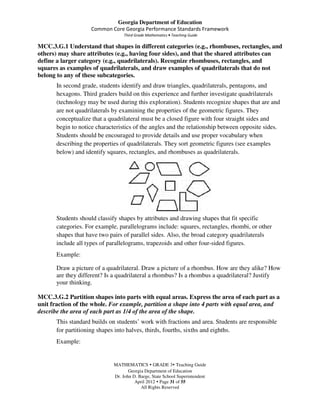
       describing the properties of quadrilaterals. They sort geometric figures (see examples
       below) and identify squares, rectangles, and rhombuses as quadrilaterals.


       Students should classify shapes by attributes and drawing shapes that fit specific
       categories. For example, parallelograms include: squares, rectangles, rhombi, or other
       shapes that have two pairs of parallel sides. Also, the broad category quadrilaterals
       include all types of parallelograms, trapezoids and other four-sided figures.
       Example:

       Draw a picture of a quadrilateral. Draw a picture of a rhombus. How are they alike? How
       are they different? Is a quadrilateral a rhombus? Is a rhombus a quadrilateral? Justify
       your thinking.

MCC.3.G.2 Partition shapes into parts with equal areas. Express the area of each part as a
unit fraction of the whole. For example, partition a shape into 4 parts with equal area, and
describe the area of each part as 1/4 of the area of the shape.
       This standard builds on students’ work with fractions and area. Students are responsible
       for partitioning shapes into halves, thirds, fourths, sixths and eighths.
       Example:


                              MATHEMATICS GRADE 3 Teaching Guide
                                     Georgia Department of Education
                              Dr. John D. Barge, State School Superintendent
                                        April 2012 Page 31 of 55
                                           All Rights Reserved
Georgia Department of Education
                      Common Core Georgia Performance Standards Framework
                                    Third Grade Mathematics • Teaching Guide

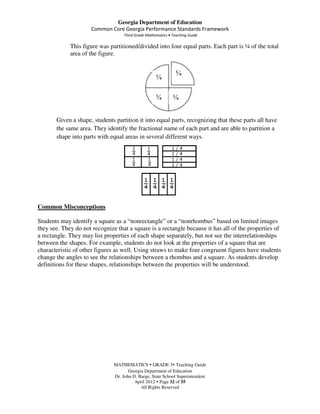
             This figure was partitioned/divided into four equal parts. Each part is ¼ of the total
             area of the figure.


       Given a shape, students partition it into equal parts, recognizing that these parts all have
       the same area. They identify the fractional name of each part and are able to partition a
       shape into parts with equal areas in several different ways.


Common Misconceptions

Students may identify a square as a “nonrectangle” or a “nonrhombus” based on limited images
they see. They do not recognize that a square is a rectangle because it has all of the properties of
a rectangle. They may list properties of each shape separately, but not see the interrelationships
between the shapes. For example, students do not look at the properties of a square that are
characteristic of other figures as well. Using straws to make four congruent figures have students
change the angles to see the relationships between a rhombus and a square. As students develop
definitions for these shapes, relationships between the properties will be understood.


                               MATHEMATICS GRADE 3 Teaching Guide
                                      Georgia Department of Education
                               Dr. John D. Barge, State School Superintendent
                                         April 2012 Page 32 of 55
                                            All Rights Reserved
Georgia Department of Education
                              Common Core Georgia Performance Standards Framework
                                                  Third Grade Mathematics • Teaching Guide

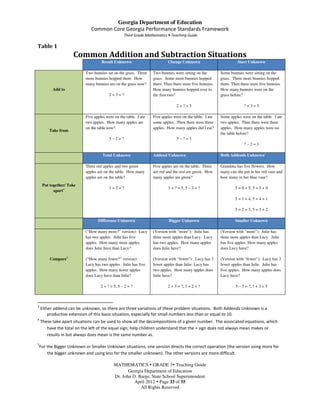
Table 1
                    Common Addition and Subtraction Situations
                                    Result Unknown                        Change Unknown                           Start Unknown

                           Two bunnies sat on the grass. Three    Two bunnies were sitting on the        Some bunnies were sitting on the
                           more bunnies hopped there. How         grass. Some more bunnies hopped        grass. Three more bunnies hopped
                           many bunnies are on the grass now?     there. Then there were five bunnies.   there. Then there were five bunnies.
          Add to                                                  How many bunnies hopped over to        How many bunnies were on the
                                         2+3=?                    the first two?                         grass before?

                                                                               2+?=5                                  ?+3=5

                           Five apples were on the table. I ate   Five apples were on the table. I ate   Some apples were on the table. I ate
                           two apples. How many apples are        some apples. Then there were three     two apples. Then there were three
                           on the table now?                      apples. How many apples did I eat?     apples. How many apples were on
        Take from
                                                                                                         the table before?
                                         5–2=?                                  5–?=3
                                                                                                                       ?–2=3

                                     Total Unknown                Addend Unknown                         Both Addends Unknown3

                           Three red apples and two green         Five apples are on the table. Three    Grandma has five flowers. How
                           apples are on the table. How many      are red and the rest are green. How    many can she put in her red vase and
                           apples are on the table?               many apples are green?                 how many in her blue vase?
    Put together/ Take
                                         3+2=?                            3 + ? = 5, 5 – 3 = ?                   5 = 0 + 5, 5 = 5 + 0
          apart4
                                                                                                                 5 = 1 + 4, 5 = 4 + 1

                                                                                                                 5 = 2 + 3, 5 = 3 + 2

                                  Difference Unknown                       Bigger Unknown                        Smaller Unknown

                           (“How many more?” version): Lucy       (Version with “more”): Julie has       (Version with “more”): Julie has
                           has two apples. Julie has five         three more apples than Lucy. Lucy      three more apples than Lucy. Julie
                           apples. How many more apples           has two apples. How many apples        has five apples. How many apples
                           does Julie have than Lucy?             does Julie have?                       does Lucy have?

        Compare5           (“How many fewer?” version):           (Version with “fewer”): Lucy has 3     (Version with “fewer”): Lucy has 3
                           Lucy has two apples. Julie has five    fewer apples than Julie. Lucy has      fewer apples than Julie. Julie has
                           apples. How many fewer apples          two apples. How many apples does       five apples. How many apples does
                           does Lucy have than Julie?             Julie have?                            Lucy have?

                                    2 + ? = 5, 5 – 2 = ?                  2 + 3 = ?, 3 + 2 = ?                   5 – 3 = ?, ? + 3 = 5


3
    Either addend can be unknown, so there are three variations of these problem situations. Both Addends Unknown is a
        productive extension of this basic situation, especially for small numbers less than or equal to 10.
4
    These take apart situations can be used to show all the decompositions of a given number. The associated equations, which
       have the total on the left of the equal sign, help children understand that the = sign does not always mean makes or
       results in but always does mean is the same number as.

5
For the Bigger Unknown or Smaller Unknown situations, one version directs the correct operation (the version using more for
    the bigger unknown and using less for the smaller unknown). The other versions are more difficult.

                                            MATHEMATICS GRADE 3 Teaching Guide
                                                   Georgia Department of Education
                                            Dr. John D. Barge, State School Superintendent
                                                      April 2012 Page 33 of 55
                                                         All Rights Reserved
Georgia Department of Education
                                   Common Core Georgia Performance Standards Framework
                                                        Third Grade Mathematics • Teaching Guide

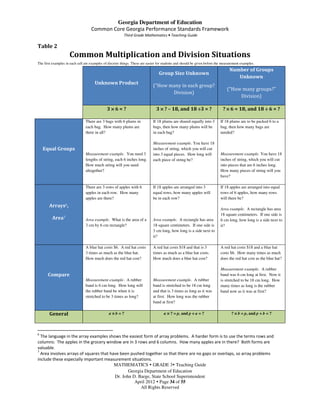
Table 2
                    Common Multiplication and Division Situations
The first examples in each cell are examples of discrete things. These are easier for students and should be given before the measurement examples.Start Unkno
                                                                                                                             Number of Groups
                                                                               Group Size Unknown
                                                                                                                                Unknown
                                     Unknown Product
                                                                           (“How many in each group?
                                                                                                                            (“How many groups?”
                                                                                  Division)
                                                                                                                                 Division)

                                             3×6=?                           3 × ? – 18, and 18 ÷3 = ?                   ? × 6 = 18, and 18 ÷ 6 = ?

                               There are 3 bags with 6 plums in            If 18 plums are shared equally into 3       If 18 plums are to be packed 6 to a
                               each bag. How many plums are                bags, then how many plums will be           bag, then how many bags are
                               there in all?                               in each bag?                                needed?

                                                                           Measurement example. You have 18
    Equal Groups                                                           inches of string, which you will cut
                               Measurement example. You need 3             into 3 equal pieces. How long will          Measurement example. You have 18
                               lengths of string, each 6 inches long.      each piece of string be?                    inches of string, which you will cut
                               How much string will you need                                                           into pieces that are 6 inches long.
                               altogether?                                                                             How many pieces of string will you
                                                                                                                       have?

                               There are 3 rows of apples with 6           If 18 apples are arranged into 3            If 18 apples are arranged into equal
                               apples in each row. How many                equal rows, how many apples will            rows of 6 apples, how many rows
                               apples are there?                           be in each row?                             will there be?
       Arrays6,
                                                                                                                       Area example. A rectangle has area
                                                                                                                       18 square centimeters. If one side is
         Area7                 Area example. What is the area of a         Area example. A rectangle has area          6 cm long, how long is a side next to
                               3 cm by 6 cm rectangle?                     18 square centimeters. If one side is       it?
                                                                           3 cm long, how long is a side next to
                                                                           it?

                               A blue hat costs $6. A red hat costs        A red hat costs $18 and that is 3           A red hat costs $18 and a blue hat
                               3 times as much as the blue hat.            times as much as a blue hat costs.          costs $6. How many times as much
                               How much does the red hat cost?             How much does a blue hat cost?              does the red hat cost as the blue hat?

                                                                                                                       Measurement example. A rubber
      Compare                                                                                                          band was 6 cm long at first. Now it
                               Measurement example. A rubber               Measurement example. A rubber               is stretched to be 18 cm long. How
                               band is 6 cm long. How long will            band is stretched to be 18 cm long          many times as long is the rubber
                               the rubber band be when it is               and that is 3 times as long as it was       band now as it was at first?
                               stretched to be 3 times as long?            at first. How long was the rubber
                                                                           band at first?

       General                                a×b=?                               a × ? = p, and p ÷ a = ?                     ? × b = p, and p ÷ b = ?


6
  The language in the array examples shows the easiest form of array problems. A harder form is to use the terms rows and
columns: The apples in the grocery window are in 3 rows and 6 columns. How many apples are in there? Both forms are
valuable.
7
  Area involves arrays of squares that have been pushed together so that there are no gaps or overlaps, so array problems
include these especially important measurement situations.
                                         MATHEMATICS GRADE 3 Teaching Guide
                                                Georgia Department of Education
                                         Dr. John D. Barge, State School Superintendent
                                                   April 2012 Page 34 of 55
                                                      All Rights Reserved
Georgia Department of Education
                     Common Core Georgia Performance Standards Framework
                                    Third Grade Mathematics • Teaching Guide

ARC OF LESSON (OPENING, WORK SESSION, CLOSING)

“When classrooms are workshops-when learners are inquiring, investigating, and constructing-
there is already a feeling of community. In workshops learners talk to one another, ask one
another questions, collaborate, prove, and communicate their thinking to one another. The heart
of math workshop is this: investigations and inquiries are ongoing, and teachers try to find
situations and structure contexts that will enable children to mathematize their lives- that will
move the community toward the horizon. Children have the opportunity to explore, to pursue
inquiries, and to model and solve problems on their own creative ways. Searching for patterns,
raising questions, and constructing one’s own models, ideas, and strategies are the primary
activities of math workshop. The classroom becomes a community of learners engaged in
activity, discourse, and reflection.” Young Mathematicians at Work- Constructing Addition and
Subtraction by Catherine Twomey Fosnot and Maarten Dolk.

“Students must believe that the teacher does not have a predetermined method for solving the
problem. If they suspect otherwise, there is no reason for them to take risks with their own ideas
and methods.” Teaching Student-Centered Mathematics, K-3 by John Van de Walle and Lou
Ann Lovin.

Opening: Set the stage
Get students mentally ready to work on the task
Clarify expectations for products/behavior
How?
   • Begin with a simpler version of the task to be presented
   • Solve problem strings related to the mathematical idea/s being investigated
   • Leap headlong into the task and begin by brainstorming strategies for approaching the
        task
   • Estimate the size of the solution and reason about the estimate
Make sure everyone understands the task before beginning. Have students restate the task in their
own words. Every task should require more of the students than just the answer.

Work session: Give ‘em a chance
Students- grapple with the mathematics through sense-making, discussion, concretizing their
mathematical ideas and the situation, record thinking in journals
Teacher- Let go. Listen. Respect student thinking. Encourage testing of ideas. Ask questions to
clarify or provoke thinking. Provide gentle hints. Observe and assess.

Closing: Best Learning Happens Here
Students- share answers, justify thinking, clarify understanding, explain thinking, question each
other
Teacher- Listen attentively to all ideas, ask for explanations, offer comments such as, “Please tell
me how you figured that out.” “I wonder what would happen if you tried…”
Anchor charts
Read Van de Walle K-3, Chapter 1
                               MATHEMATICS GRADE 3 Teaching Guide
                                      Georgia Department of Education
                               Dr. John D. Barge, State School Superintendent
                                         April 2012 Page 35 of 55
                                            All Rights Reserved
Georgia Department of Education
                     Common Core Georgia Performance Standards Framework
                                   Third Grade Mathematics • Teaching Guide

BREAKDOWN OF A TASK (UNPACKING TASKS)

How do I go about tackling a task or a unit?

   1. Read the unit in its entirety. Discuss it with your grade level colleagues. Which parts do
      you feel comfortable with? Which make you wonder? Brainstorm ways to implement the
      tasks. Collaboratively complete the culminating task with your grade level colleagues.
      As students work through the tasks, you will be able to facilitate their learning with this
      end in mind. The structure of the units/tasks is similar task to task and grade to grade.
      This structure allows you to converse in a vertical manner with your colleagues, school-
      wide. The structure of the units/tasks is similar task to task and grade to grade. There is a
      great deal of mathematical knowledge and teaching support within each grade level
      guide, unit, and task.

   2. Read the first task your students will be engaged in. Discuss it with your grade level
      colleagues. Which parts do you feel comfortable with? Which make you wonder?
      Brainstorm ways to implement the tasks.

   3. If not already established, use the first few weeks of school to establish routines and
      rituals, and to assess student mathematical understanding. You might use some of the
      tasks found in the unit, or in some of the following resources as beginning
      tasks/centers/math tubs which serve the dual purpose of allowing you to observe and
      assess.

       Additional Resources:
       Math Their Way: http://www.center.edu/MathTheirWay.shtml
       NZMaths- http://www.nzmaths.co.nz/numeracy-development-projects-
       books?parent_node=
       K-5 Math Teaching Resources- http://www.k-5mathteachingresources.com/index.html
       (this is a for-profit site with several free resources)
       Winnepeg resources- http://www.wsd1.org/iwb/math.htm
       Math Solutions- http://www.mathsolutions.com/index.cfm?page=wp9&crid=56

   4. Points to remember:
         • Each task begins with a list of the standards specifically addressed in that task,
              however, that does not mean that these are the only standards addressed in the
              task. Remember, standards build on one another, and mathematical ideas are
              connected.
         • Tasks are made to be modified to match your learner’s needs. If the names need
              changing, change them. If the materials are not available, use what is available. If
              a task doesn’t go where the students need to go, modify the task or use a different
              resource.
         • The units are not intended to be all encompassing. Each teacher and team will
              make the units their own, and add to them to meet the needs of the learners.
                              MATHEMATICS GRADE 3 Teaching Guide
                                     Georgia Department of Education
                              Dr. John D. Barge, State School Superintendent
                                        April 2012 Page 36 of 55
                                           All Rights Reserved
Georgia Department of Education
                     Common Core Georgia Performance Standards Framework
                                    Third Grade Mathematics • Teaching Guide

ROUTINES AND RITUALS

Teaching Math in Context and Through Problems
“By the time they begin school; most children have already developed a sophisticated, informal
understanding of basic mathematical concepts and problem solving strategies. Too often,
however, the mathematics instruction we impose upon them in the classroom fails to connect
with this informal knowledge” (Carpenter et al., 1999). The 8 Standards of Mathematical
Practices (SMP) should be at the forefront of every mathematics lessons and be the driving factor
of HOW students learn.

One way to help ensure that students are engaged in the 8 SMPs is to construct lessons built on
context or through story problems. It is important for you to understand the difference between
story problems and context problems. “Fosnot and Dolk (2001) point out that in story problems
children tend to focus on getting the answer, probably in a way that the teacher wants. “Context
problems, on the other hand, are connected as closely as possible to children’s lives, rather than
to ‘school mathematics’. They are designed to anticipate and develop children’s mathematical
modeling of the real world.”

Traditionally, mathematics instruction has been centered around many problems in a single math
lesson, focusing on rote procedures and algorithms which do not promote conceptual
understanding. Teaching through word problems and in context is difficult however; there are
excellent reasons for making the effort.
    • Problem solving focuses students’ attention on ideas and sense making
    • Problem solving develops the belief in students that they are capable of doing the
        mathematics and that mathematics makes sense
    • Problem solving provides on going assessment data
    • Problem solving is an excellent method for attending to a breadth of abilities
    • Problem solving engages students so that there are few discipline problems
    • Problem solving develops “mathematical power”
        (Van de Walle 3-5 pg. 15 and 16)

A problem is defined as any task or activity for which the students have no prescribed or
memorized rules or methods, nor is there a perception by students that there is a specific correct
solution method. A problem for learning mathematics also has these features:

   •   The problem must begin where the students are, which makes it accessible to all learners.
   •   The problematic or engaging aspect of the problem must be due to the mathematics that
       the students are to learn.
   •   The problem must require justifications and explanations for answers and methods.

It is important to understand that mathematics is to be taught through problem solving. That is,
problem-based tasks or activities are the vehicle through which the standards are taught. Student
learning is an outcome of the problem-solving process and the result of teaching within context
                               MATHEMATICS GRADE 3 Teaching Guide
                                      Georgia Department of Education
                               Dr. John D. Barge, State School Superintendent
                                         April 2012 Page 37 of 55
                                            All Rights Reserved
Georgia Department of Education
                      Common Core Georgia Performance Standards Framework
                                    Third Grade Mathematics • Teaching Guide

and through the Standards for Mathematical Practice. (Van de Walle and Lovin, Teaching
Student-Centered Mathematics: 3-5 pg. 11 and 12


Use of Manipulatives
Used correctly manipulatives can be a positive factor in children’s learning. It is important that
you have a good perspective on how manipulatives can help or fail to help children construct
ideas.” (Van de Walle and Lovin, Teaching Student-Centered Mathematics: 3-5 pg. 6

When a new model of new use of a familiar model is introduced into the classroom, it is
generally a good idea to explain how the model is used and perhaps conduct a simple activity
that illustrates this use.

Once you are comfortable that the models have been explained, you should not force their use on
students. Rather, students should feel free to select and use models that make sense to them. In
most instances, not using a model at all should also be an option. The choice a student makes can
provide you with valuable information about the level of sophistication of the student’s
reasoning.

Whereas the free choice of models should generally be the norm in the classroom, you can often
ask students to model to show their thinking. This will help you find out about a child’s
understanding of the idea and also his or her understanding of the models that have been used in
the classroom.

The following are simple rules of thumb for using models:
   • Introduce new models by showing how they can represent the ideas for which they are
       intended.
   • Allow students (in most instances) to select freely from available models to use in solving
       problems.
   • Encourage the use of a model when you believe it would be helpful to a student having
       difficulty. (Van de Walle and Lovin, Teaching Student-Centered Mathematics3-5 pg. 9

Use of Strategies and Effective Questioning
Teachers ask questions all the time. They serve a wide variety of purposes: to keep learners
engaged during an explanation; to assess their understanding; to deepen their thinking or focus
their attention on something. This process is often semi-automatic. Unfortunately, there are many
common pitfalls. These include:
    • asking questions with no apparent purpose;
    • asking too many closed questions;
    • asking several questions all at once;
    • poor sequencing of questions;
    • asking rhetorical questions;
    • asking ‘Guess what is in my head’ questions;
                               MATHEMATICS GRADE 3 Teaching Guide
                                      Georgia Department of Education
                               Dr. John D. Barge, State School Superintendent
                                         April 2012 Page 38 of 55
                                            All Rights Reserved
Georgia Department of Education
                     Common Core Georgia Performance Standards Framework
                                   Third Grade Mathematics • Teaching Guide

   •   focusing on just a small number of learners;
   •   ignoring incorrect answers;
   •   not taking answers seriously.

In contrast, the research shows that effective questioning has the following characteristics:
    • Questions are planned, well ramped in difficulty.
    • Open questions predominate.
    • A climate is created where learners feel safe.
    • A ‘no hands’ approach is used, for example when all learners answer at once using mini-
        whiteboards, or when the teacher chooses who answers.
    • Probing follow-up questions are prepared.
    • There is a sufficient ‘wait time’ between asking and answering a question.
    • Learners are encouraged to collaborate before answering.
    • Learners are encouraged to ask their own questions.

Mathematize the World through Daily Routines
The importance of continuing the established classroom routines cannot be overstated. Daily
routines must include such obvious activities such as taking attendance, doing a lunch count,
determining how many items are needed for snack, lining up in a variety of ways (by height, age,
type of shoe, hair color, eye color, etc.), and daily questions. They should also include less
obvious routines, such as how to select materials, how to use materials in a productive manner,
how to put materials away, and have productive discourse about the mathematics in which
students are engaged. An additional routine is to allow plenty of time for children to explore new
materials before attempting any directed activity with these new materials. The regular use of
the routines are important to the development of students’ number sense, flexibility, and fluency,
which will support students’ performances on the tasks in this unit.

Number Talks

Though the current understanding of mathematics may have been appropriate years ago, it is no
longer sufficient to succeed in today’s society. “Our students must have the ability to reason
about quantitative information, possess number sense, and check for the reasonableness of
solutions and answers (Parrish, 2010 – Number Talks: Helping Children Build Mental Math and
Computation Strategies K-5, p. 4-5).” Students need to be encouraged and given plenty of
opportunities to mentally compute and explain their strategy.

For example, if you are focusing on friendly numbers, you may include a computation problem
such as 50-28. Students may look in a number of ways and given the opportunity to share.


                              MATHEMATICS GRADE 3 Teaching Guide
                                     Georgia Department of Education
                              Dr. John D. Barge, State School Superintendent
                                        April 2012 Page 39 of 55
                                           All Rights Reserved
Georgia Department of Education
                      Common Core Georgia Performance Standards Framework
                                    Third Grade Mathematics • Teaching Guide

Student 1 Strategy:       Student 2 Strategy:              Student 3 Strategy:         Student 4 Strategy:

I see that 28 is two      I pretended that 28              I jumped back 2 from        I know that 28 + 30
away from 30. Then, I     was 25 and I know                50 to 48 and jumped         is 58 and that is too
can just add 20 more      that 25 + 25 = 50. But           back another 20 to 28       much so I know I
to get to 50, so my       if I added 28 + 25 that          to find the difference. I   need to remove 8
answer is 22.             would be 53 so took 3            know that 2 and 20          from 30 and that is
                          away from 25 and that            more is 22.                 22.
                          equals 22.


When providing a solution, students should always be required to justify, even if it is not correct.
Designating as little as 10-15 minutes a day for mental computation and talking about numbers
will help students look and think about numbers flexibly.

In a classroom number talk, students begin to share the authority of determining whether answers
are accurate, and are expected to think through all solutions and strategies carefully (Parrish,
2010). During the number talk, the teacher is not the definitive authority. The teacher maintains
the role of the facilitator, and is listening and learning for and from the students’ natural
mathematical thinking. The discussions should maintain a focus, assist students in learning
appropriate ways to structure comments and misunderstandings, and the conversation should
flow in a meaningful and natural way (Parrish, 2010).

Workstations and Learning Centers

When thinking about developing work stations and learning centers you want to base them on
student readiness, interest, or learning profile such as learning style or multiple intelligence.
This will allow different students to work on different tasks. Students should be able to complete
the tasks within the stations or centers independently, with a partner or in a group.

It is important for students to be engaged in purposeful activities within the stations and centers.
Therefore, you must careful consider the activities selected to be a part of the stations and
centers. When selecting an activity, you may want to consider the following questions:
     • Will the activity reinforce or extend a concept that’s already been introduced?
     • Are the directions clear and easy to follow?
     • Are materials easy to locate and accessible?
     • Can students complete this activity independently or with minimal help from the teacher?
     • How will students keep a record of what they’ve completed?
     • How will students be held accountable for their work?
(Laura Candler, Teaching Resources)


                               MATHEMATICS GRADE 3 Teaching Guide
                                      Georgia Department of Education
                               Dr. John D. Barge, State School Superintendent
                                         April 2012 Page 40 of 55
                                            All Rights Reserved
Georgia Department of Education
                      Common Core Georgia Performance Standards Framework
                                    Third Grade Mathematics • Teaching Guide

When implementing work stations and learning centers within your classroom, it is important to
consider when the stations and centers will be used. Will you assign students to specific stations
or centers to complete each week or will they be able to select a station or center of their choice?
Will this opportunity be presented to all students during particular times of your math block or to
students who finish their work early?

Just as with any task, some form of recording or writing should be included with stations
whenever possible. Students solving a problem on a computer can write up what they did and
explain what they learned.

Games
“A game or other repeatable activity may not look like a problem, but it can nonetheless be
problem based. The determining factor is this: Does the activity cause students to be reflective
about new or developing relationships? If the activity merely has students repeating procedure
without wrestling with an emerging idea, then it is not a problem-based experience.

Students playing a game can keep records and then tell about how they played the game- what
thinking or strategies they used.” (Van de Walle and Lovin, Teaching Student-Centered
Mathematics: 3-5 pg. 28

Journaling

"Students should be writing and talking about math topics every day. Putting thoughts into words
helps to clarify and solidify thinking. By sharing their mathematical understandings in written
and oral form with their classmates, teachers, and parents, students develop confidence in
themselves as mathematical learners; this practice also enables teachers to better monitor student
progress." NJ DOE

"Language, whether used to express ideas or to receive them, is a very powerful tool and should
be used to foster the learning of mathematics. Communicating about mathematical ideas is a way
for students to articulate, clarify, organize, and consolidate their thinking. Students, like adults,
exchange thoughts and ideas in many ways—orally; with gestures; and with pictures, objects,
and symbols. By listening carefully to others, students can become aware of alternative
perspectives and strategies. By writing and talking with others, they learn to use more-precise
mathematical language and, gradually, conventional symbols to express their mathematical
ideas. Communication makes mathematical thinking observable and therefore facilitates further
development of that thought. It encourages students to reflect on their own knowledge and their
own ways of solving problems. Throughout the early years, students should have daily
opportunities to talk and write about mathematics." NCTM

 When beginning math journals, the teacher should model the process initially, showing
 students how to find the front of the journal, the top and bottom of the composition book, how
 to open to the next page in sequence (special bookmarks or ribbons), and how to date the

                               MATHEMATICS GRADE 3 Teaching Guide
                                      Georgia Department of Education
                               Dr. John D. Barge, State School Superintendent
                                         April 2012 Page 41 of 55
                                            All Rights Reserved
Georgia Department of Education
                    Common Core Georgia Performance Standards Framework
                                   Third Grade Mathematics • Teaching Guide

page. Discuss the usefulness of the book, and the way in which it will help students retrieve
their math thinking whenever they need it.
When beginning a task, you can ask, "What do we need to find out?" and then, "How do we
figure it out?" Then figure it out, usually by drawing representations, and eventually adding
words, numbers, and symbols. During the closing of a task, have students show their journals
with a document camera or overhead when they share their thinking. This is an excellent
opportunity to discuss different ways to organize thinking and clarity of explanations.

Use a composition notebook ( the ones with graph paper are terrific for math) for recording or
drawing answers to problems. The journal entries can be from Frameworks tasks, but should
also include all mathematical thinking. Journal entries should be simple to begin with and
become more detailed as the children's problem-solving skills improve. Children should
always be allowed to discuss their representations with classmates if they desire feedback.
The children's journal entries demonstrate their thinking processes. Each entry could first be
shared with a "buddy" to encourage discussion and explanation; then one or two children
could share their entries with the entire class. Don't forget to praise children for their thinking
skills and their journal entries! These journals are perfect for assessment and for parent
conferencing. The student’s thinking is made visible!


                              MATHEMATICS GRADE 3 Teaching Guide
                                     Georgia Department of Education
                              Dr. John D. Barge, State School Superintendent
                                        April 2012 Page 42 of 55
                                           All Rights Reserved
Georgia Department of Education
                    Common Core Georgia Performance Standards Framework
                                  Third Grade Mathematics • Teaching Guide

GENERAL QUESTIONS FOR TEACHER USE
Adapted from Growing Success and materials from Math GAINS and TIPS4RM
Reasoning and Proving
   • How can we show that this is true for all cases?
   • In what cases might our conclusion not hold true?
   • How can we verify this answer?
   • Explain the reasoning behind your prediction.
   • Why does this work?
   • What do you think will happen if this pattern continues?
   • Show how you know that this statement is true.
   • Give an example of when this statement is false.
   • Explain why you do not accept the argument as proof.
   • How could we check that solution?
   • What other situations need to be considered?

Reflecting
   • Have you thought about…?
   • What do you notice about…?
   • What patterns do you see?
   • Does this problem/answer make sense to you?
   • How does this compare to…?
   • What could you start with to help you explore the possibilities?
   • How can you verify this answer?
   • What evidence of your thinking can you share?
   • Is this a reasonable answer, given that…?

Selecting Tools and Computational Strategies
   • How did the learning tool you chose contribute to your understanding/solving of the
       problem? assist in your communication?
    • In what ways would [name a tool] assist in your investigation/solving of this problem?
    • What other tools did you consider using? Explain why you chose not to use them.
    • Think of a different way to do the calculation that may be more efficient.
    • What estimation strategy did you use?

Connections
  • What other math have you studied that has some of the same principles, properties, or
     procedures as this?
   • How do these different representations connect to one another?
   • When could this mathematical concept or procedure be used in daily life?
   • What connection do you see between a problem you did previously and today’s problem?


                             MATHEMATICS GRADE 3 Teaching Guide
                                    Georgia Department of Education
                             Dr. John D. Barge, State School Superintendent
                                       April 2012 Page 43 of 55
                                          All Rights Reserved
Georgia Department of Education
                    Common Core Georgia Performance Standards Framework
                                  Third Grade Mathematics • Teaching Guide

Representing
   • What would other representations of this problem demonstrate?
   • Explain why you chose this representation.
   • How could you represent this idea algebraically? graphically?
   • Does this graphical representation of the data bias the viewer? Explain.
   • What properties would you have to use to construct a dynamic representation of this
      situation?
   • In what way would a scale model help you solve this problem?


QUESTIONS FOR TEACHER REFLECTION

   •   How did I assess for student understanding?
   •   How did my students engage in the 8 mathematical practices today?
   •   How effective was I in creating an environment where meaningful learning could take
       place?
   •   How effective was my questioning today? Did I question too little or say too much?
   •   Were manipulatives made accessible for students to work through the task?
   •   Name at least one positive thing about today’s lesson and one thing you will change.
   •   How will today’s learning impact tomorrow’s instruction?


                             MATHEMATICS GRADE 3 Teaching Guide
                                    Georgia Department of Education
                             Dr. John D. Barge, State School Superintendent
                                       April 2012 Page 44 of 55
                                          All Rights Reserved
Georgia Department of Education
                      Common Core Georgia Performance Standards Framework
                                    Third Grade Mathematics • Teaching Guide

MATHEMATICS DEPTH-OF-KNOWLEDGE LEVELS
Level 1 (Recall) includes the recall of information such as a fact, definition, term, or a simple
procedure, as well as performing a simple algorithm or applying a formula. That is, in
mathematics a one-step, well-defined, and straight algorithmic procedure should be included at
this lowest level. Other key words that signify a Level 1 include “identify,” “recall,” “recognize,”
“use,” and “measure.” Verbs such as “describe” and “explain” could be classified at different
levels depending on what is to be described and explained.

Level 2 (Skill/Concept) includes the engagement of some mental processing beyond a habitual
response. A Level 2 assessment item requires students to make some decisions as to how to
approach the problem or activity, whereas Level 1 requires students to demonstrate a rote
response, perform a well-known algorithm, follow a set procedure (like a recipe), or perform a
clearly defined series of steps. Keywords that generally distinguish a Level 2 item include
“classify,” “organize,” ”estimate,” “make observations,” “collect and display data,” and
“compare data.” These actions imply more than one step. For example, to compare data requires
first identifying characteristics of the objects or phenomenon and then grouping or ordering the
objects. Some action verbs, such as “explain,” “describe,” or “interpret” could be classified at
different levels depending on the object of the action. For example, if an item required students
to explain how light affects mass by indicating there is a relationship between light and heat, this
is considered a Level 2. Interpreting information from a simple graph, requiring reading
information from the graph, also is a Level 2. Interpreting information from a complex graph that
requires some decisions on what features of the graph need to be considered and how
information from the graph can be aggregated is a Level 3. Caution is warranted in interpreting
Level 2 as only skills because some reviewers will interpret skills very narrowly, as primarily
numerical skills, and such interpretation excludes from this level other skills such as
visualization skills and probability skills, which may be more complex simply because they are
less common. Other Level 2 activities include explaining the purpose and use of experimental
procedures; carrying out experimental procedures; making observations and collecting data;
classifying, organizing, and comparing data; and organizing and displaying data in tables,
graphs, and charts.

Level 3 (Strategic Thinking) requires reasoning, planning, using evidence, and a higher level of
thinking than the previous two levels. In most instances, requiring students to explain their
thinking is a Level 3. Activities that require students to make conjectures are also at this level.
The cognitive demands at Level 3 are complex and abstract. The complexity does not result from
the fact that there are multiple answers, a possibility for both Levels 1 and 2, but because the task
requires more demanding reasoning. An activity, however, that has more than one possible
answer and requires students to justify the response they give would most likely be a Level 3.
Other Level 3 activities include drawing conclusions from observations; citing evidence and
developing a logical argument for concepts; explaining phenomena in terms of concepts; and
using concepts to solve problems.


                               MATHEMATICS GRADE 3 Teaching Guide
                                      Georgia Department of Education
                               Dr. John D. Barge, State School Superintendent
                                         April 2012 Page 45 of 55
                                            All Rights Reserved
Georgia Department of Education
                     Common Core Georgia Performance Standards Framework
                                    Third Grade Mathematics • Teaching Guide

DOK cont’d…

Level 4 (Extended Thinking) requires complex reasoning, planning, developing, and thinking
most likely over an extended period of time. The extended time period is not a distinguishing
factor if the required work is only repetitive and does not require applying significant conceptual
understanding and higher-order thinking. For example, if a student has to take the water
temperature from a river each day for a month and then construct a graph, this would be
classified as a Level 2. However, if the student is to conduct a river study that requires taking
into consideration a number of variables, this would be a Level 4. At Level 4, the cognitive
demands of the task should be high and the work should be very complex. Students should be
required to make several connections—relate ideas within the content area or among content
areas—and have to select one approach among many alternatives on how the situation should be
solved, in order to be at this highest level. Level 4 activities include designing and conducting
experiments; making connections between a finding and related concepts and phenomena;
combining and synthesizing ideas into new concepts; and critiquing experimental designs.


                               MATHEMATICS GRADE 3 Teaching Guide
                                      Georgia Department of Education
                               Dr. John D. Barge, State School Superintendent
                                         April 2012 Page 46 of 55
                                            All Rights Reserved
Georgia Department of Education
                      Common Core Georgia Performance Standards Framework
                                    Third Grade Mathematics • Teaching Guide

DEPTH AND RIGOR STATEMENT


By changing the way we teach, we are not asking children to learn less, we are asking them to
learn more. We are asking them to mathematize, to think like mathematicians, to look at numbers
before they calculate, to think rather than to perform rote procedures. Children can and do
construct their own strategies, and when they are allowed to make sense of calculations in their
own ways, they understand better. In the words of Blaise Pascal, “We are usually convinced
more easily by reasons we have found ourselves than by those which have occurred to others.”

By changing the way we teach, we are asking teachers to think mathematically, too. We are
asking them to develop their own mental math strategies in order to develop them in their
students.                      Catherine Twomey Fosnot and Maarten Dolk, Young Mathematicians at Work.


While you may be tempted to explain and show students how to do a task, much of the learning
comes as a result of making sense of the task at hand. Allow for the productive struggle, the
grappling with the unfamiliar, the contentious discourse, for on the other side of frustration lies
understanding and the confidence that comes from “doing it myself!”


                               MATHEMATICS GRADE 3 Teaching Guide
                                      Georgia Department of Education
                               Dr. John D. Barge, State School Superintendent
                                         April 2012 Page 47 of 55
                                            All Rights Reserved
Georgia Department of Education
                                                      Common Core Georgia Performance Standards Framework
                                                                       Third Grade Mathematics • Teaching Guide


                                                           Problem Solving Rubric (3-5)
    SMP                  1-Emergent                           2-Progressing                             3- Meets/Proficient                         4-Exceeds

                The student was unable to          The student explained the problem            The student explained the problem       The student explained the problem
Make sense      explain the problem and            and showed some perseverance in              and showed perseverance when            and showed perseverance by
of problems     showed minimal perseverance        identifying the purpose of the               identifying the purpose of the          identifying the purpose of the
and persevere   when identifying the purpose of    problem, and selected and applied an         problem, and selected an applied        problem and selected and applied an
in solving      the problem.                       appropriate problem solving strategy         and appropriate problem solving         appropriate problem solving strategy
them.                                              that lead to a partially complete and/or     strategy that lead to a generally       that lead to a thorough and accurate
                                                   partially accurate solution.                 complete and accurate solution.         solution. In addition, student will
                                                                                                                                        check answer using another method.
                The student was unclear in their   The student was precise by clearly           The student was precise by clearly
                thinking and was unable to         describing their actions and strategies,     describing their actions and
Attends to      communicate mathematically.        while showing understanding and              strategies, while showing
precision                                          using appropriate vocabulary in their        understanding and using grade-level
                                                   process of finding solutions.                appropriate vocabulary in their
                                                                                                process of finding solutions.
                The student was unable to          The student expressed or justified           The student expressed and justified     The student expressed and justified
Reasoning       express or justify their opinion   their opinion either quantitatively OR       their opinion both quantitatively and   their opinion both quantitatively and
and             quantitatively or abstractly       abstractly using numbers, pictures,          abstractly using numbers, pictures,     abstractly using a variety of
explaining      using numbers, pictures, charts    charts OR words.                             charts and/or words. Student is able    numbers, pictures, charts and words.
                or words.                                                                       to make connections between             The student connects quantities to
                                                                                                models and equations.                   written symbols and create a logical
                                                                                                                                        representation with precision.
                The student was unable to          The student selected an appropriate          The student selected an efficient       The student selected multiple
Models and      select an appropriate tool, draw   tools or drew a correct representation       tool and/or drew a correct              efficient tools and correctly
use of tools    a representation to reason or      of the tools used to reason and justify      representation of the efficient tool    represented the tools to reason and
                justify their thinking.            their response.                              used to reason and justify their        justify their response. In addition
                                                                                                response.                               this students was able to explain
                                                                                                                                        why their tool/ model was efficient
Seeing          The student was unable to          The student identified a pattern or          The student identified patterns or      The student identified various
structure and   identify patterns, structures or   structure in the number system and           structures in the number system and     patterns and structures in the number
generalizing    connect to other areas of          noticed connections to other areas of        noticed connections to other areas of   system and noticed connections to
                mathematics and/or real-life.      mathematics or real-life.                    mathematics and real-life.              multiple areas of mathematics and
                                                                                                                                        real-life.
                                                                  MATHEMATICS GRADE 3 Teaching Guide
                                                                         Georgia Department of Education
                                                                  Dr. John D. Barge, State School Superintendent
                                                                            April 2012 Page 48 of 55
                                                                               All Rights Reserved
Georgia Department of Education
                      Common Core Georgia Performance Standards Framework
                                    Third Grade Mathematics • Teaching Guide

SUGGESTED LITERATURE

   •
   •     Amanda Bean's Amazing Dream (A mathematical story) by Cindy Neuschwander
   •     Bigger, Better, Best! by Stuart J. Murphy
   •     Divide and Ride by Stuart J. Murphy
   •     Give Me Half! By Stuart J. Murphy
   •     Grandfather Tang’s Story by Ann Tompert
   •     Grapes of Math by Greg Tang
   •     How Many Seeds in a Pumpkin? by Margaret McNamara
   •     Lemonade for Sale by Stuart J. Murphy
   •     One Hundred Hungry Ants, by Elinor J. Pinczes
   •     Picture Pie 2: A Drawing Book and Stencil by Ed Emberely
   •     Picture Pie: A Circle Drawing Book by Ed Emberely
   •     Racing Around by Stuart J. Murphy
   •     Spaghetti and Meatballs For All by Marilyn Burns
   •     The Best of Times by Greg Tang
   •     The Great Graph Contest by Loreen Leedy
   •     The Greedy Triangle by Marilyn Burns
   •     The Long Wait by Annie Cobb
   •     The Mathemagician's Apprentice by Brian Boyd


TECHNOLOGY LINKS

Unit 1

   •     http://www.shodor.org/interactivate/activities/EstimatorFour/?version=1.6.0_02&browse
         r=MSIE&vendor=Sun_Microsystems_Inc. A “Four in a Row” game where players get
         checkers when they quickly and efficiently estimate a sum to two numbers.
   •     http://www.oswego.org/ocsd-web/games/Estimate/estimate.html Students estimate the
         number indicated on a number line.
   •     http://olc.spsd.sk.ca/de/math1-3/p-mentalmath.html Teacher background information as
         well as student practice materials on the topic of elementary mental math strategies
   •     http://www.curriculumsupport.education.nsw.gov.au/primary/mathematics/numeracy/me
         ntal/index.htm Mental computation strategies with some fun graphics to demonstrate the
         strategies.
   •     http://www.oswego.org/ocsd-web/games/SpeedGrid/Addition/urikaadd2res.html A fun
         race against time using mental addition skills.
   •     http://letsplaymath.wordpress.com/tag/mental-math/ Offers ideas for other games and
         links to additional math sites.
                               MATHEMATICS GRADE 3 Teaching Guide
                                      Georgia Department of Education
                               Dr. John D. Barge, State School Superintendent
                                         April 2012 Page 49 of 55
                                            All Rights Reserved
Georgia Department of Education
                       Common Core Georgia Performance Standards Framework
                                      Third Grade Mathematics • Teaching Guide

   •     http://www.aaamath.com/pro.html Students practice identification and application of
         arithmetic properties
   •     http://www.cdli.ca/CITE/math_problems.htm A source for teachers to get ideas for
         additional word problems for students
   •     Graphs can be created using templates such as the pictograph template below:
         http://www.beaconlearningcenter.com/documents/2351_5255.pdf
   •     Pictographs can be created using excel following the directions below:
         http://faculty.kutztown.edu/schaeffe/Excel/Vallone/Vallone_Excel.pdf
   •     Pictographs can be created using a website such as:
         http://gwydir.demon.co.uk/jo/numbers/pictogram/pictogram.htm
   •     Bar graphs can be created using a website such as:
              - http://nces.ed.gov/nceskids/createagraph/ or
   •     http://illuminations.nctm.org/ActivityDetail.aspx?ID=63
   •     If students are having difficulty thinking of a question, these websites have many ideas:
              - http://www.canteach.ca/elementary/numbers13.html
              - http://www.uen.org/lessonplan/upload/10867-2-14587-graphing_ideas.pdf
   •     http://www.shodor.org/interactivate/activities/BarGraphSorter/ Create bar graphs based
         on random sets of shapes.

Unit 2

   •     http://mason.gmu.edu/~mmankus/whole/base10/asmdb10.htm#div A site for teachers and parents
         provides information on using base 10 blocks to solve division problems with an area model.

   •     http://mcq.wrdsb.on.ca/Admin/Documents/WORC/PDFs/LESSON%20PrimaryMath.pdf
   •     http://www.lessonplanspage.com/MathLAMultiplicationDivisionUsingTheDoorbellRang
         23.htm provide teacher resources for the book The Doorbell Rang by Pat Hutchins.
   •     http://www.stuartjmurphy.com/activities/activity_ideas.php Stuart Murphy website with
         activity suggestions for Divide and Ride. (Click on level 3 and then click on the title of
         the book.)
   •     http://www.softschools.com/math/games/division_practice.jsp Division practice; the student
         or teacher can determine the parameters for the divisor, dividend, and number of problems
   •     Directions for origami frog http://www.ljhs.sandi.net/faculty/mteachworth/avid-
         information/origami-frog-lab-avid.pdf
   •     http://www.frogtown.org/ This is a YouTube video of a frog jumping contest
   •     http://www.youtube.com/watch?v=luG7_nzBHjI&feature=fvo&ad=21937675894 This is a
         YouTube video that provides instructions for making an origami frog.


Unit 3


                                 MATHEMATICS GRADE 3 Teaching Guide
                                        Georgia Department of Education
                                 Dr. John D. Barge, State School Superintendent
                                           April 2012 Page 50 of 55
                                              All Rights Reserved
Georgia Department of Education
                        Common Core Georgia Performance Standards Framework
                                      Third Grade Mathematics • Teaching Guide

   •     http://www.multiplication.com/ Practice games for multiplication facts as well as teacher resource
         pages with instructional ideas on how to introduce multiplication. NOTE: this site contains
         advertising

   •     http://illuminations.nctm.org/LessonDetail.aspx?id=U109 Numerous ideas for
         introducing multiplication, including the array model.
   •     http://www.eduplace.com/math/mw/background/3/08/te_3_08_overview.html Provides
         background information on the relationship between multiplication and division.
   •     http://www.arcytech.org/java/patterns/patterns_d.shtml Allows students to work with
         pattern blocks in an interactive applet and easily print their work.


Unit 4

   •     http://www.brainpopjr.com/math/measurement/area/grownups.weml
   •     http://illuminations.nctm.org/ActivityDetail.aspx?ID=204
   •     http://illuminations.nctm.org/ActivityDetail.aspx?ID=204
   •     http://www.youtube.com/watch?v=G6eTMRXHhmE
   •     http://www.youtube.com/watch?v=G6eTMRXHhmE
   •     http://mrsrenz.net/mathsites.htm#area-perim


Unit 5

   •     http://www.harcourtschool.com/activity/buzz/buzz.html
   •     http://www.ablongman.com/vandewalleseries/Vol_2_BLM_PDFs/BLM20-26.pdf
   •     http://nlvm.usu.edu/en/nav/frames_asid_172_g_2_t_3.html?open=activities&from=categ
         ory_g_2_t_3.html Interactive geoboard from the National Library of Virtual
         Manipulatives
   •     http://nlvm.usu.edu/
   •     http://www.mathcats.com/explore/polygons.html - Explore Polygons
   •     http://www.math-play.com/Polygon-Game.html - Name the Shape
   •     http://nlvm.usu.edu/en/nav/frames_asid_170_g_2_t_3.html?open=activities&from=categ
         ory_g_2_t_3.html – Compose Shapes
   •     http://www.learner.org/courses/learningmath/video/geometry/wmp/geo_10_k5_ch1.html
         - Video of teacher using Venn Diagram to sort polygons with whole class
   •     http://www.regentsprep.org/regents/math/geometry/GP9/LQuad.htm
   •     http://www.mathsisfun.com/geometry/quadrilaterals-interactive.html - allows students to
         move corners to make sizes.
   •     http://www.interactivestuff.org/match/maker.phtml?featured=1&id=24 – matching game
   •     http://www.mathplayground.com/matching_shapes.html - matching games - has kite

                                 MATHEMATICS GRADE 3 Teaching Guide
                                        Georgia Department of Education
                                 Dr. John D. Barge, State School Superintendent
                                           April 2012 Page 51 of 55
                                              All Rights Reserved
Georgia Department of Education
                      Common Core Georgia Performance Standards Framework
                                    Third Grade Mathematics • Teaching Guide

   •     http://wps.ablongman.com/wps/media/objects/3464/3547873/blackline_masters/BLM_40
         .pdf

   •     http://nlvm.usu.edu/en/nav/frames_asid_172_g_2_t_3.html?open=activities This site
         offers an easy to use virtual geoboard.
   •     http://nlvm.usu.edu/en/nav/frames_asid_271_g_2_t_3.html?open=instructions&from=cat
         egory_g_2_t_3.html Students follow a pattern to create attribute trains based on color,
         shape, or the number on the shape (e.g. triangle, square pattern; red, red, blue pattern;
         triangle, square, square pattern; 2,3,1 pattern).
   •     http://www.regentsprep.org/regents/math/geometry/GP9/LQuad.htm A summary of the
         properties of several quadrilaterals.
   •     http://teams.lacoe.edu/documentation/classrooms/amy/geometry/6-
         8/activities/new_quads/quads.html A virtual “Quest” where students match properties
         with quadrilaterals.
   •     http://www.shodor.org/interactivate/lessons/IntroQuadrilaterals/ An introduction to
         Quadrilaterals
   •     http://www.mathsisfun.com/quadrilaterals.html - Use after completing the Quadrilateral
         Challenge; does allow for students to move the corners of the quadrilaterals
   •     http://illuminations.nctm.org/LessonDetail.aspx?id=L350 – Complete lesson on
         rectangles and parallelograms
   •     http://illuminations.nctm.org/LessonDetail.aspx?id=L813 – Shape Up Lesson from
         Illumination
   •     http://illuminations.nctm.org/LessonDetail.aspx?ID=L346
   •     http://ejad.best.vwh.net/java/patterns/patterns_j.shtml - Pattern Blocks
   •     http://nlvm.usu.edu/en/nav/frames_asid_170_g_2_t_3.html?open=activities&from=categ
         ory_g_2_t_3.html – National Library of Virtual Manipulatives
   •     http://wps.ablongman.com/wps/media/objects/3464/3547873/blackline_masters/BLM_38
         .pdf
   •     http://etc.usf.edu/clipart/sitemap/fractions.php
   •     http://wps.ablongman.com/ab_vandewalle_math_6/0,12312,3547876-,00.html
   •     http://www.edemberley.com/pages/main.aspx?section=db&subSection=capPages,
         http://www.edemberley.com/pages/main.aspx?section=db
   •     http://www.edemberley.com/pages/main.aspx?section=legal
   •     http://www.kellyskindergarten.com/math/math_activities.htm
   •     http://nces.ed.gov/nceskids/createagraph/ - Create a bar graph online.
   •     http://www.softschools.com/math/data_analysis/pictograph/make_your_own_pictograph/
         Create a Picture Graph
   •     http://www.eduplace.com/math/mthexp/g3/visual/pdf/vs_g3_144.pdf

Unit 6

   •     http://www.kidsnumbers.com/turkey-terminator-math-game.php
                               MATHEMATICS GRADE 3 Teaching Guide
                                      Georgia Department of Education
                               Dr. John D. Barge, State School Superintendent
                                         April 2012 Page 52 of 55
                                            All Rights Reserved
Georgia Department of Education
                       Common Core Georgia Performance Standards Framework
                                     Third Grade Mathematics • Teaching Guide


   •     http://www.visualfractions.com/
   •     http://nlvm.usu.edu/en/nav/frames_asid_103_g_1_t_1.html?from=topic_t_1.html
   •     http://nlvm.usu.edu/en/nav/frames_asid_274_g_2_t_1.html?open=activities&from=topic
         _t_1.html
   •     http://nlvm.usu.edu/en/nav/frames_asid_104_g_2_t_1.html?from=topic_t_1.html
   •     http://www.mathplayground.com/Scale_Fractions.html
   •     http://nlvm.usu.edu/en/nav/frames_asid_105_g_2_t_1.html?from=topic_t_1.html
   •     http://illuminations.nctm.org/ActivityDetail.aspx?ID=80
   •     http://www.gamequarium.com/fractions.html
   •     http://www.learningplanet.com/sam/ff/index.asp
   •     http://www.mathsisfun.com/numbers/fraction-number-line.html
   •     http://mrnussbaum.com/pizza_game/index.html
   •     http://www.bgfl.org/bgfl/custom/resources_ftp/client_ftp/ks2/maths/fractions/index.htm
   •     http://www.primarygames.com/fractions/2a.htm
   •     http://www.mathsisfun.com/numbers/fractions-match-words-pizza.html

Unit 7

   •     http://nlvm.usu.edu/en/nav/frames_asid_318_g_2_t_4.html Elapsed time problems using
         two clocks, both analog and digital
   •     http://www.shodor.org/interactivate/activities/ElapsedTime/?version=disabled&browser=
         MSIE&vendor=na&flash=10.0.32 Several activities surrounding elapsed time using
         analog or digital clocks.
   •     http://donnayoung.org/math/clock.htm Printable blank clock faces.

   •     http://illuminations.nctm.org/ActivityDetail.aspx?ID=63 – Students can use this website
         to enter their data and create a bar graph.
   •     http://www.shodor.org/interactivate/activities/BarGraph/ – different link to the same
         program as above.
   •     http://nlvm.usu.edu/en/nav/frames_asid_114_g_2_t_3.html?open=activities
   •     http://people.rit.edu/mecsma/Professional/Puzzles/Pentominoes/P-A.html

   •     http://nlvm.usu.edu/en/nav/frames_asid_114_g_2_t_3.html?open=activities Interactive
         pentomino tasks
   •     http://people.rit.edu/mecsma/Professional/Puzzles/Pentominoes/P-A.html Provides
         several beginner problems with solutions for pentominos.
   •     http://puzzler.sourceforge.net/docs/pentominoes.html Solutions to several pentominos
         puzzles such as the one below.
   •     http://nlvm.usu.edu/en/nav/frames_asid_172_g_2_t_3.html?open=activities Geoboard
         with area/perimeter activity (Look for the activity titled, “Shapes with Perimeter 16.”)


                                MATHEMATICS GRADE 3 Teaching Guide
                                       Georgia Department of Education
                                Dr. John D. Barge, State School Superintendent
                                          April 2012 Page 53 of 55
                                             All Rights Reserved
Georgia Department of Education
                  Common Core Georgia Performance Standards Framework
                                Third Grade Mathematics • Teaching Guide

•   http://highered.mcgraw-
    hill.com/sites/0072532947/student_view0/grid_and_dot_paper.html Printable dot and
    graph paper
•   http://www.shodor.org/interactivate/activities/ShapeExplorer/?version=1.6.0_07&browse
    r=MSIE&vendor=Sun_Microsystems_Inc.&flash=10.0.32 Randomly generated
    rectangles for which the perimeter and the area can be found

•   http://www.bgfl.org/bgfl/custom/resources_ftp/client_ftp/ks2/maths/perimeter_and_area/i
    ndex.html Instruction on finding area and perimeter of shapes with practice. Levels 2 and
    3 for area require finding the area of several rectangles and adding the areas together.
•   http://nlvm.usu.edu/en/nav/frames_asid_169_g_1_t_3.html?open=activities&from=categ
    ory_g_1_t_3.html The squares from this virtual pattern blocks web site can be used.
    Students can use six squares from the pattern blocks and find different arrangements of
    the squares that meet the required conditions.
•   http://www.learner.org/courses/learningmath/measurement/session9/part_a/index.html
    An interactive task for teachers to explore area and perimeter.
•
•   http://public.doe.k12.ga.us/DMGetDocument.aspx/Grade%204%20Unit%203%20Creati
    ng%20Scales.pdf?p=6CC6799F8C1371F6CA1D4816B288AA4D386F6BD621BEA7BF
    4B4B9C6CFBBB4292&amp;Type=D Link to directions on how to make a balance scale
    and a spring scale using common materials.
•   http://www.mathsisfun.com/measure/metric-mass.html Provides some background on
    metric measures and lists items that weigh about one kilogram.
•   http://gadoe.georgiastandards.org/mathframework.aspx?PageReq=MathHunt Is a link to a
    classroom video of this task. Teachers may want to view this video to see how one
    teacher implemented this task in his classroom.
•   http://nces.ed.gov/nceskids/createagraph/default.aspx?ID=3525a186ca2b4d3e8589a61cb
    efa47ac.
•   http://nces.ed.gov/nceskids/createagraph/default.aspx “Create A Graph” by the National
    Center for Education Statistics is a web-based program which allows students to create a
    bar graph.
•   http://www.amblesideprimary.com/ambleweb/mentalmaths/grapher.html Limited in its
    use but very simple to use – most labels can be renamed.
•   http://ellerbruch.nmu.edu/classes/cs255w03/cs255students/nsovey/P5/P5.html Provides
    instructions to create a line plot graph as well as features to look for in a line plot graph.
•   http://www.thefutureschannel.com/dockets/realworld/teaching_zoo/ This FUTURES
    video is a great introduction to this task. Students see how important accurate
    measurements using both metric and standard weights are important in a zoo.


                           MATHEMATICS GRADE 3 Teaching Guide
                                  Georgia Department of Education
                           Dr. John D. Barge, State School Superintendent
                                     April 2012 Page 54 of 55
                                        All Rights Reserved
Georgia Department of Education
                    Common Core Georgia Performance Standards Framework
                                 Third Grade Mathematics • Teaching Guide

RESOURCES CONSULTED

Content:
Ohio DOE
http://www.ode.state.oh.us/GD/Templates/Pages/ODE/ODEPrimary.aspx?page=2&TopicRelatio
nID=1704
Arizona DOE
http://www.azed.gov/standards-practices/mathematics-standards/
Nzmaths
http://nzmaths.co.nz/

Teacher/Student Sense-making:
http://www.youtube.com/user/mitcccnyorg?feature=watch
http://www.insidemathematics.org/index.php/video-tours-of-inside-mathematics/classroom-
teachers/157-teachers-reflect-mathematics-teaching-practices
https://www.georgiastandards.org/Common-Core/Pages/Math.aspx or
http://secc.sedl.org/common_core_videos/

Journaling:
http://www.mathsolutions.com/index.cfm?page=wp10&crid=3

Community of Learners:
http://www.edutopia.org/math-social-activity-cooperative-learning-video
http://www.edutopia.org/math-social-activity-sel
http://www.youtube.com/user/responsiveclassroom/videos
http://www.responsiveclassroom.org/category/category/first-weeks-school


                            MATHEMATICS GRADE 3 Teaching Guide
                                   Georgia Department of Education
                            Dr. John D. Barge, State School Superintendent
                                      April 2012 Page 55 of 55
                                         All Rights Reserved

Grade Level Overview

  • 1.
    CCGPS Frameworks Teacher Edition Mathematics Third Grade Grade Level Overview
  • 2.
    Georgia Department ofEducation Common Core Georgia Performance Standards Framework Third Grade Mathematics • Teaching Guide Grade Level Overview TABLE OF CONTENTS Curriculum Map and pacing Guide………………………………………………………………… Unpacking the Standards • Standards of Mathematical Practice………………………..……………...…………..…… • Content Standards………………………………………….………………………….…… Arc of Lesson/Math Instructional Framework………………………………………………..…… Unpacking a Task………………………………………………………………………………..… Routines and Rituals……………………………………………………………………………….. General Questions for Teacher Use………………………………………………………………... Questions for Teacher Reflection……………………………………………………….…………. Depth of Knowledge……………………………………………………………………….…….… Depth and Rigor Statement………………………………………………………………………… Additional Resources Available • K-2 Problem Solving Rubric………………………………………………………………. • Literature Resources……………………………………………………………….………. • Technology Links………………………………………………………………………….. Resources Consulted MATHEMATICS GRADE 3 Teaching Guide Georgia Department of Education Dr. John D. Barge, State School Superintendent April 2012 Page 2 of 55 All Rights Reserved
  • 3.
    Georgia Department ofEducation Common Core Georgia Performance Standards Framework Third Grade Mathematics • Teaching Guide Common Core Georgia Performance Standards Elementary School Mathematics Third Grade Common Core Georgia Performance Standards: Curriculum Map Unit 1 Unit 2 Unit 3 Unit 4 Unit 5 Unit 6 Unit 7 Unit 8 Numbers and Operations and Operations and Operations Geometry Representing Measurement Show What Operations in Algebraic Algebraic and Algebraic and We Know Base Ten Thinking: the Thinking: the Thinking: Comparing Relationship Properties of Patterns in Fractions Between Multiplication and Addition and Multiplication and Division Multiplication Division MCC3.NBT.1 MCC3.OA.1 MCC3.OA.5 MCC3.OA.8 MCC3.G.1 MCC3.NF.1 MCC3.MD.1 ALL MCC3.NBT.2 MCC3.OA.2 MCC3.OA.6 MCC3.OA.9 MCC3.G.2 MCC3.NF.2 MCC3.MD.2 MCC3.NBT.3 MCC3.OA.3 MCC3.OA.7 MCC3.MD.3 MCC3.MD.3 MCC3.NF.3 MCC3.MD.3 MCC3.MD.3 MCC3.OA.4 MCC3.MD.3 MCC3.MD.4 MCC3.MD.4 MCC3.MD.3 MCC3.MD.4 MCC3.MD.4 MCC3.MD.3 MCC3.MD.4 MCC3.MD.5 MCC3.MD.4 MCC3.MD.7 MCC3.MD.4 MCC3.MD.6 MCC3.MD.8 MCC3.MD.7 These units were written to build upon concepts from prior units, so later units contain tasks that depend upon the concepts addressed in earlier units. All units will include the Mathematical Practices and indicate skills to maintain. MATHEMATICS GRADE 3 Teaching Guide Georgia Department of Education Dr. John D. Barge, State School Superintendent April 2012 Page 3 of 55 All Rights Reserved
  • 4.
    Georgia Department ofEducation Common Core Georgia Performance Standards Framework Third Grade Mathematics • Teaching Guide STANDARDS FOR MATHEMATICAL PRACTICE Mathematical Practices are listed with each grade’s mathematical content standards to reflect the need to connect the mathematical practices to mathematical content in instruction. The Standards for Mathematical Practice describe varieties of expertise that mathematics educators at all levels should seek to develop in their students. These practices rest on important “processes and proficiencies” with longstanding importance in mathematics education. The first of these are the NCTM process standards of problem solving, reasoning and proof, communication, representation, and connections. The second are the strands of mathematical proficiency specified in the National Research Council’s report Adding It Up: adaptive reasoning, strategic competence, conceptual understanding (comprehension of mathematical concepts, operations and relations), procedural fluency (skill in carrying out procedures flexibly, accurately, efficiently and appropriately), and productive disposition (habitual inclination to see mathematics as sensible, useful, and worthwhile, coupled with a belief in diligence and one’s own efficacy). Students are expected to: 1. Make sense of problems and persevere in solving them. In third grade, students know that doing mathematics involves solving problems and discussing how they solved them. Students explain to themselves the meaning of a problem and look for ways to solve it. Third graders may use concrete objects or pictures to help them conceptualize and solve problems. They may check their thinking by asking themselves, “Does this make sense?” They listen to the strategies of others and will try different approaches. They often will use another method to check their answers. 2. Reason abstractly and quantitatively. Third graders should recognize that a number represents a specific quantity. They connect the quantity to written symbols and create a logical representation of the problem at hand, considering both the appropriate units involved and the meaning of quantities. 3. Construct viable arguments and critique the reasoning of others. In third grade, students may construct arguments using concrete referents, such as objects, pictures, and drawings. They refine their mathematical communication skills as they participate in mathematical discussions involving questions like “How did you get that?” and “Why is that true?” They explain their thinking to others and respond to others’ thinking. 4. Model with mathematics. Students experiment with representing problem situations in multiple ways including numbers, words (mathematical language), drawing pictures, using objects, acting out, making a chart, list, or graph, creating equations, etc. Students need opportunities to connect the different representations and explain the connections. They should be able to use all of these MATHEMATICS GRADE 3 Teaching Guide Georgia Department of Education Dr. John D. Barge, State School Superintendent April 2012 Page 4 of 55 All Rights Reserved
  • 5.
    Georgia Department ofEducation Common Core Georgia Performance Standards Framework Third Grade Mathematics • Teaching Guide representations as needed. Third graders should evaluate their results in the context of the situation and reflect on whether the results make sense. 5. Use appropriate tools strategically. Third graders consider the available tools (including estimation) when solving a mathematical problem and decide when certain tools might be helpful. For instance, they may use graph paper to find all the possible rectangles that have a given perimeter. They compile the possibilities into an organized list or a table, and determine whether they have all the possible rectangles 6. Attend to precision. As third graders develop their mathematical communication skills, they try to use clear and precise language in their discussions with others and in their own reasoning. They are careful about specifying units of measure and state the meaning of the symbols they choose. For instance, when figuring out the area of a rectangle they record their answers in square units. 7. Look for and make use of structure. In third grade, students look closely to discover a pattern or structure. For instance, students use properties of operations as strategies to multiply and divide (commutative and distributive properties). 8. Look for and express regularity in repeated reasoning. Students in third grade should notice repetitive actions in computation and look for more shortcut methods. For example, students may use the distributive property as a strategy for using products they know to solve products that they don’t know. For example, if students are asked to find the product of 7 x 8, they might decompose 7 into 5 and 2 and then multiply 5 x 8 and 2 x 8 to arrive at 40 + 16 or 56. In addition, third graders continually evaluate their work by asking themselves, “Does this make sense?” ***Mathematical Practices 1 and 6 should be evident in EVERY lesson*** MATHEMATICS GRADE 3 Teaching Guide Georgia Department of Education Dr. John D. Barge, State School Superintendent April 2012 Page 5 of 55 All Rights Reserved
  • 6.
    Georgia Department ofEducation Common Core Georgia Performance Standards Framework Third Grade Mathematics • Teaching Guide CONTENT STANDARDS OPERATIONS AND ALGEBRAIC THINKING (OA) CLUSTER #1: REPRESENT AND SOLVE PROBLEMS INVOLVING MULTIPLICATION AND DIVISION. Students develop an understanding of the meanings of multiplication and division of whole numbers through activities and problems involving equal-sized groups, arrays, and area models; multiplication is finding an unknown product, and division is finding an unknown factor in these situations. For equal-sized group situations, division can require finding the unknown number of groups or the unknown group size. The terms students should learn to use with increasing precision with this cluster are: products, groups of, quotients, partitioned equally, multiplication, division, equal groups, arrays, equations, unknown. MCC.3.OA.1 Interpret products of whole numbers, e.g., interpret 5 × 7 as the total number of objects in 5 groups of 7 objects each. For example, describe a context in which a total number of objects can be expressed as 5 × 7. This standard interprets products of whole numbers. Students recognize multiplication as a means to determine the total number of objects when there are a specific number of groups with the same number of objects in each group. Multiplication requires students to think in terms of groups of things rather than individual things. Students learn that the multiplication symbol ‘×’ means “groups of” and problems such as 5 × 7 refer to 5 groups of 7. Example: Jim purchased 5 packages of muffins. Each package contained 3 muffins. How many muffins did Jim purchase? (5 groups of 3, 5 × 3 = 15) Describe another situation where there would be 5 groups of 3 or 5 × 3. MCC.3.OA.2 Interpret whole-number quotients of whole numbers, e.g., interpret 56 ÷ 8 as the number of objects in each share when 56 objects are partitioned equally into 8 shares, or as a number of shares when 56 objects are partitioned into equal shares of 8 objects each. For example, describe a context in which a number of shares or a number of groups can be expressed as 56 ÷ 8. MATHEMATICS GRADE 3 Teaching Guide Georgia Department of Education Dr. John D. Barge, State School Superintendent April 2012 Page 6 of 55 All Rights Reserved
  • 7.
    Georgia Department ofEducation Common Core Georgia Performance Standards Framework Third Grade Mathematics • Teaching Guide This standard focuses on two distinct models of division: partition models and measurement (repeated subtraction) models. Partition models focus on the question, “How many in each group?” A context for partition models would be: There are 12 cookies on the counter. If you are sharing the cookies equally among three bags, how many cookies will go in each bag? Measurement (repeated subtraction) models focus on the question, “How many groups can you make?” A context for measurement models would be: There are 12 cookies on the counter. If you put 3 cookies in each bag, how many bags will you fill? MCC.3.OA.3 Use multiplication and division within 100 to solve word problems in situations involving equal groups, arrays, and measurement quantities, e.g., by using drawings and equations with a symbol for the unknown number to represent the problem. This standard references various strategies that can be used to solve word problems involving multiplication and division. Students should apply their skills to solve word problems. Students should use a variety of representations for creating and solving one- step word problems, such as: If you divide 4 packs of 9 brownies among 6 people, how many cookies does each person receive? (4 × 9 = 36, 36 ÷ 6 = 6). Table 2, located at the end of this document, gives examples of a variety of problem solving contexts, in which students need to find the product, the group size, or the number of groups. Students should be given ample experiences to explore all of the different problem structures. Examples of multiplication: There are 24 desks in the classroom. If the teacher puts 6 desks in each row, how many rows are there? This task can be solved by drawing an array by putting 6 desks in each row. This is an array model: MATHEMATICS GRADE 3 Teaching Guide Georgia Department of Education Dr. John D. Barge, State School Superintendent April 2012 Page 7 of 55 All Rights Reserved
  • 8.
    Georgia Department ofEducation Common Core Georgia Performance Standards Framework Third Grade Mathematics • Teaching Guide This task can also be solved by drawing pictures of equal groups. 4 groups of 6 equals 24 objects A student could also reason through the problem mentally or verbally, “I know 6 and 6 are 12. 12 and 12 are 24. Therefore, there are 4 groups of 6 giving a total of 24 desks in the classroom.” A number line could also be used to show equal jumps. Third grade students should use a variety of pictures, such as stars, boxes, flowers to represent unknown numbers (variables).. Letters are also introduced to represent unknowns in third grade. Examples of division: There are some students at recess. The teacher divides the class into 4 lines with 6 students in each line. Write a division equation for this story and determine how many students are in the class. ( ÷ 4 = 6. There are 24 students in the class). Determining the number of objects in each share (partitive division, where the size of the groups is unknown): Example: The bag has 92 hair clips, and Laura and her three friends want to share them equally. How many hair clips will each person receive? Determining the number of shares (measurement division, where the number of groups is unknown): Example: Max the monkey loves bananas. Molly, his trainer, has 24 bananas. If she gives Max 4 bananas each day, how many days will the bananas last? MATHEMATICS GRADE 3 Teaching Guide Georgia Department of Education Dr. John D. Barge, State School Superintendent April 2012 Page 8 of 55 All Rights Reserved
  • 9.
    Georgia Department ofEducation Common Core Georgia Performance Standards Framework Third Grade Mathematics • Teaching Guide Starting Day 1 Day 2 Day 3 Day 4 Day 5 Day 6 24 24 – 4 = 20 – 4 = 16 – 4 = 12 – 4 = 8–4= 4–4= 20 16 12 8 4 0 Solution: The bananas will last for 6 days. MCC. 3.OA.4 Determine the unknown whole number in a multiplication or division equation relating three whole numbers. For example, determine the unknown number that makes the equation true in each of the equations 8 × ? = 48, 5 = _ ÷ 3, 6 × 6 = ? This standard refers Table 2, included at the end of this document for your convenience, and equations for the different types of multiplication and division problem structures. The easiest problem structure includes Unknown Product (3 × 6 = ? or 18 ÷ 3 = 6). The more difficult problem structures include Group Size Unknown (3 × ? = 18 or 18 ÷ 3 = 6) or Number of Groups Unknown (? × 6 = 18, 18 ÷ 6 = 3). The focus of MCC.3.OA.4 goes beyond the traditional notion of fact families, by having students explore the inverse relationship of multiplication and division. Students apply their understanding of the meaning of the equal sign as ”the same as” to interpret an equation with an unknown. When given 4 × ? = 40, they might think: • 4 groups of some number is the same as 40 • 4 times some number is the same as 40 • I know that 4 groups of 10 is 40 so the unknown number is 10 • The missing factor is 10 because 4 times 10 equals 40. Equations in the form of a x b = c and c = a x b should be used interchangeably, with the unknown in different positions. Example: Solve the equations below: • 24 = ? × 6 • 72 ÷ ∆ = 9 • Rachel has 3 bags. There are 4 marbles in each bag. How many marbles does Rachel have altogether? 3×4=m MATHEMATICS GRADE 3 Teaching Guide Georgia Department of Education Dr. John D. Barge, State School Superintendent April 2012 Page 9 of 55 All Rights Reserved
  • 10.
    Georgia Department ofEducation Common Core Georgia Performance Standards Framework Third Grade Mathematics • Teaching Guide CLUSTER #2: MCC CLUSTER: UNDERSTAND PROPERTIES OF MULTIPLICATION AND THE RELATIONSHIP BETWEEN MULTIPLICATION AND DIVISION. Students use properties of operations to calculate products of whole numbers, using increasingly sophisticated strategies based on these properties to solve multiplication and division problems involving single-digit factors. By comparing a variety of solution strategies, students learn the relationship between multiplication and division. Mathematically proficient students communicate precisely by engaging in discussion about their reasoning using appropriate mathematical language. The terms students should learn to use with increasing precision with this cluster are: operation, multiply, divide, factor, product, quotient, strategies, (properties)- rules about how numbers work. MCC.3.OA.5 Apply properties of operations as strategies to multiply and divide. Examples: If 6 × 4 = 24 is known, then 4 × 6 = 24 is also known. (Commutative property of multiplication.) 3 × 5 × 2 can be found by 3 × 5 = 15, then 15 × 2 = 30, or by 5 × 2 = 10, then 3 × 10 = 30. (Associative property of multiplication.) Knowing that 8 × 5 = 40 and 8 × 2 = 16, one can find 8 × 7 as 8 × (5 + 2) = (8 × 5) + (8 × 2) = 40 + 16 = 56. (Distributive property.) This standard references properties (rules about how numbers work) of multiplication. While students DO NOT need to use the formal terms of these properties, students should understand that properties are rules about how numbers work, they need to be flexibly and fluently applying each of them. Students represent expressions using various objects, pictures, words and symbols in order to develop their understanding of properties. They multiply by 1 and 0 and divide by 1. They change the order of numbers to determine that the order of numbers does not make a difference in multiplication (but does make a difference in division). Given three factors, they investigate changing the order of how they multiply the numbers to determine that changing the order does not change the product. They also decompose numbers to build fluency with multiplication. The associative property states that the sum or product stays the same when the grouping of addends or factors is changed. For example, when a student multiplies 7 × 5 × 2, a student could rearrange the numbers to first multiply 5 × 2 = 10 and then multiply 10 × 7 = 70. The commutative property (order property) states that the order of numbers does not matter when you are adding or multiplying numbers. For example, if a student knows that 5 × 4 = 20, then they also know that 4 × 5 = 20. The array below could be described as a 5 × 4 array for 5 columns MATHEMATICS GRADE 3 Teaching Guide Georgia Department of Education Dr. John D. Barge, State School Superintendent April 2012 Page 10 of 55 All Rights Reserved
  • 11.
    Georgia Department ofEducation Common Core Georgia Performance Standards Framework Third Grade Mathematics • Teaching Guide and 4 rows, or a 4 × 5 array for 4 rows and 5 columns. There is no “fixed” way to write the dimensions of an array as rows × columns or columns × rows. Students should have flexibility in being able to describe both dimensions of an array. Example: 4×5 4×5 or or 5×4 5×4 Students are introduced to the distributive property of multiplication over addition as a strategy for using products they know to solve products they don’t know. Students would be using mental math to determine a product. Here are ways that students could use the distributive property to determine the product of 7 × 6. Again, students should use the distributive property, but can refer to this in informal language such as “breaking numbers apart”. Student 1 Student 2 Student 3 7×6 7×6 7×6 7 × 5 = 35 7 × 3 = 21 5 × 6 = 30 7×1=7 7 × 3 = 21 2 × 6 = 12 35 + 7 = 42 21 + 21 = 42 30 + 12 = 42 Another example if the distributive property helps students determine the products and factors of problems by breaking numbers apart. For example, for the problem 7 × 8 = ?, students can decompose the 7 into a 5 and 2, and reach the answer by multiplying 5 × 8 = 40 and 2 × 8 =16 and adding the two products (40 +16 = 56). 5×8 2×8 To further develop understanding of properties related to MATHEMATICS GRADE 3 Teaching Guide Georgia Department of Education Dr. John D. Barge, State School Superintendent April 2012 Page 11 of 55 All Rights Reserved
  • 12.
    Georgia Department ofEducation Common Core Georgia Performance Standards Framework Third Grade Mathematics • Teaching Guide multiplication and division, students use different representations and their understanding of the relationship between multiplication and division to determine if the following types of equations are true or false. • 0 × 7 = 7 × 0 = 0 (Zero Property of Multiplication) • 1 × 9 = 9 × 1 = 9 (Multiplicative Identity Property of 1) • 3 × 6 = 6 × 3 (Commutative Property) • 8 ÷ 2 = 2 ÷ 8 (Students are only to determine that these are not equal) • 2×3×5=6×5 • 10 × 2 < 5 × 2 × 2 • 2 × 3 × 5 = 10 × 3 • 0×6>3×0×2 MCC.3.OA.6 Understand division as an unknown-factor problem. For example, find 32 ÷ 8 by finding the number that makes 32 when multiplied by 8. This standard refers to Table 2, included at the end of this document for your convenience, and the various problem structures. Since multiplication and division are inverse operations, students are expected to solve problems and explain their processes of solving division problems that can also be represented as unknown factor multiplication problems. Example: A student knows that 2 x 9 = 18. How can they use that fact to determine the answer to the following question: 18 people are divided into pairs in P.E. class. How many pairs are there? Write a division equation and explain your reasoning. Multiplication and division are inverse operations and that understanding can be used to find the unknown. Fact family triangles demonstrate the inverse operations of multiplication and division by showing the two factors and how those factors relate to the product and/or quotient. Examples: • 3 × 5 = 15 5 × 3 = 15 • 15 ÷ 3 = 5 15 ÷ 5 = 3 MCC CLUSTER # 3: MULTIPLY AND DIVIDE WITHIN 100. Mathematically proficient students communicate precisely by engaging in discussion about their reasoning using appropriate mathematical language. The terms students should learn to use with increasing precision with this cluster are: operation, multiply, divide, factor, product, quotient, unknown, strategies, reasonableness, mental computation, property. MCC.3.OA.7 Fluently multiply and divide within 100, using strategies such as the relationship between multiplication and division (e.g., knowing that 8 × 5 = 40, one knows MATHEMATICS GRADE 3 Teaching Guide Georgia Department of Education Dr. John D. Barge, State School Superintendent April 2012 Page 12 of 55 All Rights Reserved
  • 13.
    Georgia Department ofEducation Common Core Georgia Performance Standards Framework Third Grade Mathematics • Teaching Guide 40 ÷ 5 = 8) or properties of operations. By the end of Grade 3, know from memory all products of two one-digit numbers. This standard uses the word fluently, which means accuracy, efficiency (using a reasonable amount of steps and time), and flexibility (using strategies such as the distributive property). “Know from memory” should not focus only on timed tests and repetitive practice, but ample experiences working with manipulatives, pictures, arrays, word problems, and numbers to internalize the basic facts (up to 9 × 9). By studying patterns and relationships in multiplication facts and relating multiplication and division, students build a foundation for fluency with multiplication and division facts. Students demonstrate fluency with multiplication facts through 10 and the related division facts. Multiplying and dividing fluently refers to knowledge of procedures, knowledge of when and how to use them appropriately, and skill in performing them flexibly, accurately, and efficiently. Strategies students may use to attain fluency include: • Multiplication by zeros and ones • Doubles (2s facts), Doubling twice (4s), Doubling three times (8s) • Tens facts (relating to place value, 5 × 10 is 5 tens or 50) • Five facts (half of tens) • Skip counting (counting groups of __ and knowing how many groups have been counted) • Square numbers (ex: 3 × 3) • Nines (10 groups less one group, e.g., 9 × 3 is 10 groups of 3 minus one group of 3) • Decomposing into known facts (6 × 7 is 6 x 6 plus one more group of 6) • Turn-around facts (Commutative Property) • Fact families (Ex: 6 × 4 = 24; 24 ÷ 6 = 4; 24 ÷ 4 = 6; 4 × 6 = 24) • Missing factors General Note: Students should have exposure to multiplication and division problems presented in both vertical and horizontal forms. MCC CLUSTER #4: SOLVE PROBLEMS INVOLVING THE FOUR OPERATIONS, AND IDENTIFY AND EXPLAIN PATTERNS IN ARITHMETIC. Mathematically proficient students communicate precisely by engaging in discussion about their reasoning using appropriate mathematical language. The terms students should learn to use with increasing precision with this cluster are: operation, multiply, divide, factor, product, quotient, subtract, add, addend, sum, difference, equation, unknown, strategies, reasonableness, mental computation, estimation, rounding, patterns, (properties) – rules about how numbers work. MATHEMATICS GRADE 3 Teaching Guide Georgia Department of Education Dr. John D. Barge, State School Superintendent April 2012 Page 13 of 55 All Rights Reserved
  • 14.
    Georgia Department ofEducation Common Core Georgia Performance Standards Framework Third Grade Mathematics • Teaching Guide MCC.3.OA.8 Solve two-step word problems using the four operations. Represent these problems using equations with a letter standing for the unknown quantity. Assess the reasonableness of answers using mental computation and estimation strategies including rounding. This standard refers to two-step word problems using the four operations. The size of the numbers should be limited to related 3rd grade standards (e.g., 3.OA.7 and 3.NBT.2). Adding and subtracting numbers should include numbers within 1,000, and multiplying and dividing numbers should include single-digit factors and products less than 100. This standard calls for students to represent problems using equations with a letter to represent unknown quantities. Example: Mike runs 2 miles a day. His goal is to run 25 miles. After 5 days, how many miles does Mike have left to run in order to meet his goal? Write an equation and find the solution (2 × 5 + m = 25). This standard refers to estimation strategies, including using compatible numbers (numbers that sum to 10, 50, or 100) or rounding. The focus in this standard is to have students use and discuss various strategies. Students should estimate during problem solving, and then revisit their estimate to check for reasonableness. Example: Here are some typical estimation strategies for the problem: On a vacation, your family travels 267 miles on the first day, 194 miles on the second day and 34 miles on the third day. How many total miles did they travel? Student 1 Student 2 Student 3 I first thought about 267 and I first thought about 194. It I rounded 267 to 300. I 34. I noticed that their sum is really close to 200. I also rounded 194 to 200. I is about 300. Then I knew have 2 hundreds in 267. rounded 34 to 30. When I that 194 is close to 200. That gives me a total of 4 added 300, 200, and 30, I When I put 300 and 200 hundreds. Then I have 67 in know my answer will be together, I get 500. 267 and the 34. When I put about 530. 67 and 34 together that is really close to 100. When I add that hundred to the 4 hundreds that I already had, I end up with 500. The assessment of estimation strategies should only have one reasonable answer (500 or 530), or a range (between 500 and 550). Problems should be structured so that all acceptable estimation strategies will arrive at a reasonable answer. MATHEMATICS GRADE 3 Teaching Guide Georgia Department of Education Dr. John D. Barge, State School Superintendent April 2012 Page 14 of 55 All Rights Reserved
  • 15.
    Georgia Department ofEducation Common Core Georgia Performance Standards Framework Third Grade Mathematics • Teaching Guide MCC.3.OA.9 Identify arithmetic patterns (including patterns in the addition table or multiplication table), and explain them using properties of operations. For example, observe that 4 times a number is always even, and explain why 4 times a number can be decomposed into two equal addends. This standard calls for students to examine arithmetic patterns involving both addition and multiplication. Arithmetic patterns are patterns that change by the same rate, such as adding the same number. For example, the series 2, 4, 6, 8, 10 is an arithmetic pattern that increases by 2 between each term. This standard also mentions identifying patterns related to the properties of operations. Examples: • Even numbers are always divisible by 2. Even numbers can always be decomposed into 2 equal addends (14 = 7 + 7). • Multiples of even numbers (2, 4, 6, and 8) are always even numbers. • On a multiplication chart, the products in each row and column increase by the same amount (skip counting). • On an addition chart, the sums in each row and column increase by the same amount. What do you notice about the numbers highlighted in pink in the multiplication table? Explain a pattern using properties of operations. When one changes the order of the factors (commutative property), they will still gets the same product; example 6 x 5 = 30 and 5 x 6 = 30. Teacher: What pattern do you notice when 2, 4, 6, 8, or 10 are multiplied by any number (even or odd)? Student: The product will always be an even number. Teacher: Why? MATHEMATICS GRADE 3 Teaching Guide Georgia Department of Education Dr. John D. Barge, State School Superintendent April 2012 Page 15 of 55 All Rights Reserved
  • 16.
    Georgia Department ofEducation Common Core Georgia Performance Standards Framework Third Grade Mathematics • Teaching Guide What patterns do you notice in this addition table? Explain why the pattern works this way? Students need ample opportunities to observe and identify important numerical patterns related to operations. They should build on their previous experiences with properties related to addition and subtraction. Students investigate addition and multiplication tables in search of patterns and explain why these patterns make sense mathematically. Example: • Any sum of two even numbers is even. • Any sum of two odd numbers is even. • Any sum of an even number and an odd number is odd. • The multiples of 4, 6, 8, and 10 are all even because they can all be decomposed into two equal groups. • The doubles (2 addends the same) in an addition table fall on a diagonal while the doubles (multiples of 2) in a multiplication table fall on horizontal and vertical lines. • The multiples of any number fall on a horizontal and a vertical line due to the commutative property. • All the multiples of 5 end in a 0 or 5 while all the multiples of 10 end with 0. Every other multiple of 5 is a multiple of 10. Students also investigate a hundreds chart in search of addition and subtraction patterns. They record and organize all the different possible sums of a number and explain why the pattern makes sense. NUMBERS AND OPERATIONS IN BASE TEN (NBT) MCC CLUSTER: USE PLACE VALUE UNDERSTANDING AND PROPERTIES OF OPERATIONS TO PERFORM MULTI-DIGIT ARITHMETIC. Mathematically proficient students communicate precisely by engaging in discussion about their reasoning using appropriate mathematical language. The terms students should learn to use with increasing precision with this cluster are: place value, round, addition, add, addend, sum, subtraction, subtract, difference, strategies, (properties)-rules about how numbers work. MCC.3.NBT.1 Use place value understanding to round whole numbers to the nearest 10 or 100. MATHEMATICS GRADE 3 Teaching Guide Georgia Department of Education Dr. John D. Barge, State School Superintendent April 2012 Page 16 of 55 All Rights Reserved
  • 17.
    Georgia Department ofEducation Common Core Georgia Performance Standards Framework Third Grade Mathematics • Teaching Guide This standard refers to place value understanding, which extends beyond an algorithm or procedure for rounding. The expectation is that students have a deep understanding of place value and number sense and can explain and reason about the answers they get when they round. Students should have numerous experiences using a number line and a hundreds chart as tools to support their work with rounding. MCC.3.NBT.2 Fluently add and subtract within 1000 using strategies and algorithms based on place value, properties of operations, and/or the relationship between addition and subtraction. This standard refers to fluently, which means accuracy, efficiency (using a reasonable amount of steps and time), and flexibility (using strategies such as the distributive property). The word algorithm refers to a procedure or a series of steps. There are other algorithms other than the standard algorithm. Third grade students should have experiences beyond the standard algorithm. A variety of algorithms will be assessed. Problems should include both vertical and horizontal forms, including opportunities for students to apply the commutative and associative properties. Students explain their thinking and show their work by using strategies and algorithms, and verify that their answer is reasonable. Example: There are 178 fourth graders and 225 fifth graders on the playground. What is the total number of students on the playground? Student 1 Student 2 Student 3 100 + 200 = 300 I added 2 to 178 to get 180. I I know the 75 plus 25 equals added 220 to get 400. I 100. Then I added 1 hundred 70 + 20 = 90 added the 3 left over to get from 178 and 2 hundreds 8 + 5 = 13 403. from 275. I had a total of 4 hundreds and I had 3 more 300+90+13 = 403 students left to add. So I have 4 hundreds plus 3 more which is 403. Student 4 178 + 225 = ? 178 + 200 = 378 378 + 20 = 398 398 + 5 = 403 MATHEMATICS GRADE 3 Teaching Guide Georgia Department of Education Dr. John D. Barge, State School Superintendent April 2012 Page 17 of 55 All Rights Reserved
  • 18.
    Georgia Department ofEducation Common Core Georgia Performance Standards Framework Third Grade Mathematics • Teaching Guide MCC.3.NBT.3 Multiply one-digit whole numbers by multiples of 10 in the range 10–90 (e.g., 9 × 80, 5 × 60) using strategies based on place value and properties of operations. This standard extends students’ work in multiplication by having them apply their understanding of place value. This standard expects that students go beyond tricks that hinder understanding such as “just adding zeros” and explain and reason about their products. For example, for the problem 50 x 4, students should think of this as 4 groups of 5 tens or 20 tens. Twenty tens equals 200. Common Misconceptions The use of terms like “round up” and “round down” confuses many students. For example, the number 37 would round to 40 or they say it “rounds up”. The digit in the tens place is changed from 3 to 4 (rounds up). This misconception is what causes the problem when applied to rounding down. The number 32 should be rounded (down) to 30, but using the logic mentioned for rounding up, some students may look at the digit in the tens place and take it to the previous number, resulting in the incorrect value of 20. To remedy this misconception, students need to use a number line to visualize the placement of the number and/or ask questions such as: “What tens are 32 between and which one is it closer to?” Developing the understanding of what the answer choices are before rounding can alleviate much of the misconception and confusion related to rounding. NUMBER AND OPERATIONS IN FRACTIONS (NF) MCC CLUSTER : DEVELOP UNDERSTANDING OF FRACTIONS AS NUMBERS. Students develop an understanding of fractions, beginning with unit fractions. Students view fractions in general as being built out of unit fractions, and they use fractions along with visual fraction models to represent parts of a whole. Students understand that the size of a fractional part is relative to the size of the whole. For example, 1/2 of the paint in a small bucket could be less paint than 1/3 of the paint in a larger bucket, but 1/3 of a ribbon is longer than 1/5 of the same ribbon because when the ribbon is divided into 3 equal parts, the parts are longer than when the ribbon is divided into 5 equal parts. Students are able to use fractions to represent numbers equal to, less than, and greater than one. They solve problems that involve comparing fractions by using visual fraction models and strategies based on noticing equal numerators or denominators. MCC.3.NF.1 Understand a fraction 1/b as the quantity formed by 1 part when a whole is partitioned into b equal parts; understand a fraction a/b as the quantity formed by a parts of size 1/b. This standard refers to the sharing of a whole being partitioned or split. Fraction models in third grade include area (parts of a whole) models (circles, rectangles, squares) and number lines. Set MATHEMATICS GRADE 3 Teaching Guide Georgia Department of Education Dr. John D. Barge, State School Superintendent April 2012 Page 18 of 55 All Rights Reserved
  • 19.
    Georgia Department ofEducation Common Core Georgia Performance Standards Framework Third Grade Mathematics • Teaching Guide models (parts of a group) are not introduced in Third Grade. In 3.NF.1 students should focus on the concept that a fraction is made up (composed) of many pieces of a unit fraction, which has a numerator of 1. For example, the fraction 3/5 is composed of 3 pieces that each have a size of 1/5. Some important concepts related to developing understanding of fractions include: • Understand fractional parts must be equal-sized. Example Non-Example These are thirds. These are NOT thirds. • The number of equal parts tells how many make a whole. • As the number of equal pieces in the whole increases, the size of the fractional pieces decreases. • The size of the fractional part is relative to the whole. • The number of children in one-half of a classroom is different than the number of children in one-half of a school. (The whole in each set is different; therefore, the half in each set will be different.) • When a whole is cut into equal parts, the denominator represents the number of equal parts. • The numerator of a fraction is the count of the number of equal parts. o ¾ means that there are 3 one-fourths. o Students can count one fourth, two fourths, three fourths. Students express fractions as fair sharing, parts of a whole, and parts of a set. They use various contexts (candy bars, fruit, and cakes) and a variety of models (circles, squares, rectangles, fraction bars, and number lines) to develop understanding of fractions and represent fractions. Students need many opportunities to solve word problems that require fair sharing. MCC.3.NF.2 Understand a fraction as a number on the number line; represent fractions on a number line diagram. a. Represent a fraction 1/b on a number line diagram by defining the interval from 0 to 1 as the whole and partitioning it into b equal parts. Recognize that each part has size 1/b and that the endpoint of the part based at 0 locates the number 1/b on the number line. b. Represent a fraction a/b on a number line diagram by marking off a lengths 1/b from 0. Recognize that the resulting interval has size a/b and that its endpoint locates the number a/b on the number line. MATHEMATICS GRADE 3 Teaching Guide Georgia Department of Education Dr. John D. Barge, State School Superintendent April 2012 Page 19 of 55 All Rights Reserved
  • 20.
    Georgia Department ofEducation Common Core Georgia Performance Standards Framework Third Grade Mathematics • Teaching Guide The number line diagram is the first time students work with a number line for numbers that are between whole numbers (e.g., that . is between 0 and 1). In the number line diagram below, the space between 0 and 1 is divided (partitioned) into 4 equal regions. The distance from 0 to the first segment is 1 of the 4 segments from 0 to 1 or . (MCC.3.NF.2a). Similarly, the distance from 0 to the third segment is 3 segments that are each one-fourth long. Therefore, the distance of 3 segments from 0 is the fraction . (MCC.3.NF.2b). MCC.3.NF.3 Explain equivalence of fractions in special cases, and compare fractions by reasoning about their size. An important concept when comparing fractions is to look at the size of the parts and the number of the parts. For example, 1/8 is smaller than 1/2 because when 1 whole is cut into 8 pieces, the pieces are much smaller than when 1 whole is cut into 2 pieces. a. Understand two fractions as equivalent (equal) if they are the same size, or the same point on a number line. b. Recognize and generate simple equivalent fractions, e.g., 1/2 = 2/4, 4/6 = 2/3). Explain why the fractions are equivalent, e.g., by using a visual fraction model. These standards call for students to use visual fraction models (area models) and number lines to explore the idea of equivalent fractions. Students should only explore equivalent fractions using models, rather than using algorithms or procedures. c. Express whole numbers as fractions, and recognize fractions that are equivalent to whole numbers. Examples: Express 3 in the form 3 = 3/1; recognize that 6/1 = 6; locate 4/4 and 1 at the same point of a number line diagram. This standard includes writing whole numbers as fractions. The concept relates to fractions as division problems, where the fraction 3/1 is 3 wholes divided into one group. This standard is the building block for later work where students divide a set of objects into a specific number of groups. Students must understand the meaning of a/1. Example: If 6 brownies are shared between 2 people, how many brownies would each person get? MATHEMATICS GRADE 3 Teaching Guide Georgia Department of Education Dr. John D. Barge, State School Superintendent April 2012 Page 20 of 55 All Rights Reserved
  • 21.
    Georgia Department ofEducation Common Core Georgia Performance Standards Framework Third Grade Mathematics • Teaching Guide d. Compare two fractions with the same numerator or the same denominator by reasoning about their size. Recognize that comparisons are valid only when the two fractions refer to the same whole. Record the results of comparisons with the symbols >, =, or <, and justify the conclusions, e.g., by using a visual fraction model. This standard involves comparing fractions with or without visual fraction models including number lines. Experiences should encourage students to reason about the size of pieces, the fact that 1/3 of a cake is larger than 1/4 of the same cake. Since the same cake (the whole) is split into equal pieces, thirds are larger than fourths. In this standard, students should also reason that comparisons are only valid if the wholes are identical. For example, 1/2 of a large pizza is a different amount than 1/2 of a small pizza. Students should be given opportunities to discuss and reason about which 1/2 is larger. Common Misconceptions The idea that the smaller the denominator, the smaller the piece or part of the set, or the larger the denominator, the larger the piece or part of the set, is based on the comparison that in whole numbers, the smaller a number, the less it is, or the larger a number, the more it is. The use of different models, such as fraction bars and number lines, allows students to compare unit fractions to reason about their sizes. Students think all shapes can be divided the same way. Present shapes other than circles, squares or rectangles to prevent students from overgeneralizing that all shapes can be divided the same way. For example, have students fold a triangle into eighths. Provide oral directions for folding the triangle: 1. Fold the triangle into half by folding the left vertex (at the base of the triangle) over to meet the right vertex. 2. Fold in this manner two more times. 3. Have students label each eighth using fractional notation. Then, have students count the fractional parts in the triangle (one-eighth, two-eighths, three-eighths, and so on). MEASUREMENT AND DATA (MD) MCC CLUSTER #1: SOLVE PROBLEMS INVOLVING MEASUREMENT AND ESTIMATION OF INTERVALS OF TIME, LIQUID VOLUMES, AND MASSES OF OBJECTS. Mathematically proficient students communicate precisely by engaging in discussion about their reasoning using appropriate mathematical language. The terms students should learn to use with increasing precision with this cluster are: estimate, time, time intervals, minute, hour, elapsed time, measure, liquid volume, mass, standard units, metric, gram (g), kilogram (kg), liter (L). MATHEMATICS GRADE 3 Teaching Guide Georgia Department of Education Dr. John D. Barge, State School Superintendent April 2012 Page 21 of 55 All Rights Reserved
  • 22.
    Georgia Department ofEducation Common Core Georgia Performance Standards Framework Third Grade Mathematics • Teaching Guide MCC. 3.MD.1 Tell and write time to the nearest minute and measure time intervals in minutes. Solve word problems involving addition and subtraction of time intervals in minutes, e.g., by representing the problem on a number line diagram. This standard calls for students to solve elapsed time, including word problems. Students could use clock models or number lines to solve. On the number line, students should be given the opportunities to determine the intervals and size of jumps on their number line. Students could use pre-determined number lines (intervals every 5 or 15 minutes) or open number lines (intervals determined by students). Example: Tonya wakes up at 6:45 a.m. It takes her 5 minutes to shower, 15 minutes to get dressed, and 15 minutes to eat breakfast. What time will she be ready for school? MCC.3.MD.2 Measure and estimate liquid volumes and masses of objects using standardunits of grams (g), kilograms (kg), and liters (l).1 Add, subtract, multiply, or divide to solve one-step word problems involving masses or volumes that are given in the same units, e.g., by using drawings (such as a beaker with a measurement scale) to represent the problem.2 This standard asks for students to reason about the units of mass and volume. Students need multiple opportunities weighing classroom objects and filling containers to help them develop a basic understanding of the size and weight of a liter, a gram, and a kilogram. Milliliters may also be used to show amounts that are less than a liter. Word problems should only be one-step and include the same units. Example: Students identify 5 things that weigh about one gram. They record their findings with words and pictures. (Students can repeat this for 5 grams and 10 grams.) This activity helps develop gram benchmarks. One large paperclip weighs about one gram. A box of large paperclips (100 clips) weighs about 100 grams so 10 boxes would weigh one kilogram. 1 Excludes compound units such as cm3 and finding the geometric volume of a container. 2 Excludes multiplicative comparison problems (problems involving notions of “times as much”). See Table 2 at the end of this document. MATHEMATICS GRADE 3 Teaching Guide Georgia Department of Education Dr. John D. Barge, State School Superintendent April 2012 Page 22 of 55 All Rights Reserved
  • 23.
    Georgia Department ofEducation Common Core Georgia Performance Standards Framework Third Grade Mathematics • Teaching Guide Example: A paper clip weighs about a) a gram, b) 10 grams, c) 100 grams? Foundational understandings to help with measure concepts: • Understand that larger units can be subdivided into equivalent units (partition). • Understand that the same unit can be repeated to determine the measure (iteration). Understand the relationship between the size of a unit and the number of units needed (compensatory principle). Common Misconceptions Students may read the mark on a scale that is below a designated number on the scale as if it was the next number. For example, a mark that is one mark below 80 grams may be read as 81 grams. Students realize it is one away from 80, but do not think of it as 79 grams. MCC CLUSTER #2: REPRESENT AND INTERPRET DATA. Mathematically proficient students communicate precisely by engaging in discussion about their reasoning using appropriate mathematical language. The terms students should learn to use with increasing precision with this cluster are: scale, scaled picture graph, scaled bar graph, line plot, data. MCC.3.MD.3 Draw a scaled picture graph and a scaled bar graph to represent a data set with several categories. Solve one- and two-step “how many more” and “how many less” problems using information presented in scaled bar graphs. For example, draw a bar graph in which each square in the bar graph might represent 5 pets. Students should have opportunities reading and solving problems using scaled graphs before being asked to draw one. The following graphs all use five as the scale interval, but students should experience different intervals to further develop their understanding of scale graphs and number facts. While exploring data concepts, students should Pose a question, Collect data, Analyze data, and Interpret data (PCAI). Students should be graphing data that is relevant to their lives Example: Pose a question: Student should come up with a question. What is the typical genre read in our class? Collect and organize data: student survey Pictographs: Scaled pictographs include symbols that represent multiple units. Below is an example of a pictograph with symbols that represent multiple units. Graphs should include a title, categories, category label, key, and data. How many more books did Juan read than Nancy? MATHEMATICS GRADE 3 Teaching Guide Georgia Department of Education Dr. John D. Barge, State School Superintendent April 2012 Page 23 of 55 All Rights Reserved
  • 24.
    Georgia Department ofEducation Common Core Georgia Performance Standards Framework Third Grade Mathematics • Teaching Guide Number of Books Read Nancy Juan = 5 books Single Bar Graphs: Students use both horizontal and vertical bar graphs. Bar graphs : include a title, scale, scale label, categories, category label, and data. Types of Books Read 30 Number of Books Read 25 20 15 10 5 0 Nonfiction Biography Fiction Mystery Fairytale Fantasy Analyze and Interpret data: • How many more nonfiction books where read than fantasy books? • Did more people read biography and mystery books or fiction and fantasy books? • About how many books in all genres were read? • Using the data from the graphs, what type of book was read more often than a mystery but less often than a fairytale? • What interval was used for this scale? • What can we say about types of books read? What is a typical type of book read? • If you were to purchase a book for the class library which would be the best genre? Why? MCC.3.MD.4 Generate measurement data by measuring lengths using rulers marked with halves and fourths of an inch. Show the data by making a line plot, where the horizontal scale is marked off in appropriate units – whole numbers, halves, or quarters. Students in second grade measured length in whole units using both metric and U.S. customary systems. It is important to review with students how to read and use a standard ruler including details about halves and quarter marks on the ruler. Students should connect their understanding of fractions to measuring to one one-half and one-quarter inch. Third graders need many opportunities measuring the length of various objects in their environment.This standard provides a context for MATHEMATICS GRADE 3 Teaching Guide Georgia Department of Education Dr. John D. Barge, State School Superintendent April 2012 Page 24 of 55 All Rights Reserved
  • 25.
    Georgia Department ofEducation Common Core Georgia Performance Standards Framework Third Grade Mathematics • Teaching Guide students to work with fractions by measuring objects to a quarter of an inch.Example: Measure objects in your desk to the nearest ½ or ¼ of an inch, display data collected on a line plot. How many objects measured ¼? ½? etc. … Common Misconceptions Although intervals on a bar graph are not in single units, students count each square as one. To avoid this error, have students include tick marks between each interval. Students should begin each scale with 0. They should think of skip-counting when determining the value of a bar since the scale is not in single units. MCC CLUSTER #3: GEOMETRIC MEASUREMENT – UNDERSTAND CONCEPTS OF AREA AND RELATE AREA TO MULTIPLICATION AND TO ADDITION. Students recognize area as an attribute of two-dimensional regions. They measure the area of a shape by finding the total number of same size units of area required to cover the shape without gaps or overlaps, a square with sides of unit length being the standard unit for measuring area. Students understand that rectangular arrays can be decomposed into identical rows or into identical columns. By decomposing rectangles into rectangular arrays of squares, students connect area to multiplication, and justify using multiplication to determine the area of a rectangle. Mathematically proficient students communicate precisely by engaging in discussion about their reasoning using appropriate mathematical language. The terms students should learn to use with increasing precision with this cluster are: attribute, area, square unit, plane figure, gap, overlap, square cm, square m , square in., square ft, nonstandard units, tiling, side length, decomposing. MCC.3.MD.5 Recognize area as an attribute of plane figures and understand concepts of area measurement. a. A square with side length 1 unit, called “a unit square,” is said to have “one square unit” of area, and can be used to measure area. b. A plane figure which can be covered without gaps or overlaps by n unit squares is said to have an area of n square units. These standards call for students to explore the concept of covering a region with “unit squares,” which could include square tiles or shading on grid or graph paper. MATHEMATICS GRADE 3 Teaching Guide Georgia Department of Education Dr. John D. Barge, State School Superintendent April 2012 Page 25 of 55 All Rights Reserved
  • 26.
    Georgia Department ofEducation Common Core Georgia Performance Standards Framework Third Grade Mathematics • Teaching Guide 4 5 One square unit MCC.3.MD.6 Measure areas by counting unit squares (square cm, square m, square in, square ft, and improvised units). Students should be counting the square units to find the area could be done in metric, customary, or non-standard square units. Using different sized graph paper, students can explore the areas measured in square centimeters and square inches. MCC.3.MD.7 Relate area to the operations of multiplication and addition. a. Find the area of a rectangle with whole-number side lengths by tiling it, and show that the area is the same as would be found by multiplying the side lengths. Students should tile rectangles then multiply their side lengths to show it is the same. 1 2 3 4 To find the area, one could count the squares 5 6 6 8 or multiply 3 × 4 = 12. 9 10 11 12 b. Multiply side lengths to find areas of rectangles with whole-number side lengths in the context of solving real world and mathematical problems, and represent whole-number products as rectangular areas in mathematical reasoning. Students should solve real world and mathematical problems Example: Drew wants to tile the bathroom floor using 1 foot tiles. How many square foot tiles will he need? 6 feet 8 feet MATHEMATICS GRADE 3 Teaching Guide Georgia Department of Education Dr. John D. Barge, State School Superintendent April 2012 Page 26 of 55 All Rights Reserved
  • 27.
    Georgia Department ofEducation Common Core Georgia Performance Standards Framework Third Grade Mathematics • Teaching Guide c. Use tiling to show in a concrete case that the area of a rectangle with whole-number side lengths a and b + c is the sum of a × b and a × c. Use area models to represent the distributive property in mathematical reasoning. This standard extends students’ work with the distributive property. For example, in the picture below the area of a 7 × 6 figure can be determined by finding the area of a 5 × 6 and 2 × 6 and adding the two sums. Example: d. Recognize area as additive. Find areas of rectilinear figures by decomposing them into non-overlapping rectangles and adding the areas of the non-overlapping parts, applying this technique to solve real world problems. This standard uses the word rectilinear. A rectilinear figure is a polygon that has all right angles. MATHEMATICS GRADE 3 Teaching Guide Georgia Department of Education Dr. John D. Barge, State School Superintendent April 2012 Page 27 of 55 All Rights Reserved
  • 28.
    Georgia Department ofEducation Common Core Georgia Performance Standards Framework Third Grade Mathematics • Teaching Guide Example: A storage shed is pictured below. What is the total area? How could the figure be decomposed to help find the area? Example: Students can decompose a rectilinear figure into different rectangles. They find the area of the figure by adding the areas of each of the rectangles together. MATHEMATICS GRADE 3 Teaching Guide Georgia Department of Education Dr. John D. Barge, State School Superintendent April 2012 Page 28 of 55 All Rights Reserved
  • 29.
    Georgia Department ofEducation Common Core Georgia Performance Standards Framework Third Grade Mathematics • Teaching Guide Common Misconceptions Students may confuse perimeter and area when they measure the sides of a rectangle and then multiply. They think the attribute they find is length, which is perimeter. Pose problems situations that require students to explain whether they are to find the perimeter or area. MCC CLUSTER #4: GEOMETRIC MEASUREMENT – RECOGNIZE PERIMETER AS AN ATTRIBUTE OF PLANE FIGURES AND DISTINGUISH BETWEEN LINEAR AND AREA MEASURES. Mathematically proficient students communicate precisely by engaging in discussion about their reasoning using appropriate mathematical language. The terms students should learn to use with increasing precision with this cluster are: attribute, perimeter, plane figure, linear, area, polygon, side length. MCC.3.MD.8 Solve real world and mathematical problems involving perimeters of polygons, including finding the perimeter given the side lengths, finding an unknown side length, and exhibiting rectangles with the same perimeter and different areas or with the same area and different perimeters. Students develop an understanding of the concept of perimeter by walking around the perimeter of a room, using rubber bands to represent the perimeter of a plane figure on a geoboard, or tracing around a shape on an interactive whiteboard. They find the perimeter of objects; use addition to find perimeters; and recognize the patterns that exist when finding the sum of the lengths and widths of rectangles. Students use geoboards, tiles, and graph paper to find all the possible rectangles that have a given perimeter (e.g., find the rectangles with a perimeter of 14 cm.) They record all the possibilities using dot or graph paper, compile the possibilities into an organized list or a table, and determine whether they have all the possible rectangles. Given a perimeter and a length or width, students use objects or pictures to find the missing length or width. They justify and communicate their solutions using words, diagrams, pictures, numbers, and an interactive whiteboard. Students use geoboards, tiles, graph paper, or technology to find all the possible rectangles with a given area (e.g. find the rectangles that have an area of 12 square units.) They record all the possibilities using dot or graph paper, compile the possibilities into an organized list or a table, and determine whether they have all the possible rectangles. Students then investigate the perimeter of the rectangles with an area of 12. MATHEMATICS GRADE 3 Teaching Guide Georgia Department of Education Dr. John D. Barge, State School Superintendent April 2012 Page 29 of 55 All Rights Reserved
  • 30.
    Georgia Department ofEducation Common Core Georgia Performance Standards Framework Third Grade Mathematics • Teaching Guide The patterns in the chart allow the students to identify the factors of 12, connect the results to the commutative property, and discuss the differences in perimeter within the same area. This chart can also be used to investigate rectangles with the same perimeter. It is important to include squares in the investigation. Common Misconceptions Students think that when they are presented with a drawing of a rectangle with only two of the side lengths shown or a problem situation with only two of the side lengths provided, these are the only dimensions they should add to find the perimeter. Encourage students to include the appropriate dimensions on the other sides of the rectangle. With problem situations, encourage students to make a drawing to represent the situation in order to find the perimeter. GEOMETRY (G) MCC CLUSTER: REASON WITH SHAPES AND THEIR ATTRIBUTES. Students describe, analyze, and compare properties of two dimensional shapes. They compare and classify shapes by their sides and angles, and connect these with definitions of shapes. Students also relate their fraction work to geometry by expressing the area of part of a shape as a unit fraction of the whole. Mathematically proficient students communicate precisely by engaging in discussion about their reasoning using appropriate mathematical language. The terms students should learn to use with increasing precision with this cluster are: attributes, properties, quadrilateral, open figure, closed figure , three-sided, 2-dimensional, 3-dimensional, rhombi, rectangles, and squares are subcategories of quadrilaterals, cubes, cones, cylinders, and rectangular prisms are subcategories of 3-dimensional figures shapes: polygon, rhombus/rhombi, rectangle, square, partition, unit fraction. From previous grades: triangle, quadrilateral, pentagon, hexagon, cube, trapezoid, half/quarter circle, circle, cone, cylinder, sphere. MATHEMATICS GRADE 3 Teaching Guide Georgia Department of Education Dr. John D. Barge, State School Superintendent April 2012 Page 30 of 55 All Rights Reserved
  • 31.
    Georgia Department ofEducation Common Core Georgia Performance Standards Framework Third Grade Mathematics • Teaching Guide MCC.3.G.1 Understand that shapes in different categories (e.g., rhombuses, rectangles, and others) may share attributes (e.g., having four sides), and that the shared attributes can define a larger category (e.g., quadrilaterals). Recognize rhombuses, rectangles, and squares as examples of quadrilaterals, and draw examples of quadrilaterals that do not belong to any of these subcategories. In second grade, students identify and draw triangles, quadrilaterals, pentagons, and hexagons. Third graders build on this experience and further investigate quadrilaterals (technology may be used during this exploration). Students recognize shapes that are and are not quadrilaterals by examining the properties of the geometric figures. They conceptualize that a quadrilateral must be a closed figure with four straight sides and begin to notice characteristics of the angles and the relationship between opposite sides. Students should be encouraged to provide details and use proper vocabulary when describing the properties of quadrilaterals. They sort geometric figures (see examples below) and identify squares, rectangles, and rhombuses as quadrilaterals. Students should classify shapes by attributes and drawing shapes that fit specific categories. For example, parallelograms include: squares, rectangles, rhombi, or other shapes that have two pairs of parallel sides. Also, the broad category quadrilaterals include all types of parallelograms, trapezoids and other four-sided figures. Example: Draw a picture of a quadrilateral. Draw a picture of a rhombus. How are they alike? How are they different? Is a quadrilateral a rhombus? Is a rhombus a quadrilateral? Justify your thinking. MCC.3.G.2 Partition shapes into parts with equal areas. Express the area of each part as a unit fraction of the whole. For example, partition a shape into 4 parts with equal area, and describe the area of each part as 1/4 of the area of the shape. This standard builds on students’ work with fractions and area. Students are responsible for partitioning shapes into halves, thirds, fourths, sixths and eighths. Example: MATHEMATICS GRADE 3 Teaching Guide Georgia Department of Education Dr. John D. Barge, State School Superintendent April 2012 Page 31 of 55 All Rights Reserved
  • 32.
    Georgia Department ofEducation Common Core Georgia Performance Standards Framework Third Grade Mathematics • Teaching Guide This figure was partitioned/divided into four equal parts. Each part is ¼ of the total area of the figure. Given a shape, students partition it into equal parts, recognizing that these parts all have the same area. They identify the fractional name of each part and are able to partition a shape into parts with equal areas in several different ways. Common Misconceptions Students may identify a square as a “nonrectangle” or a “nonrhombus” based on limited images they see. They do not recognize that a square is a rectangle because it has all of the properties of a rectangle. They may list properties of each shape separately, but not see the interrelationships between the shapes. For example, students do not look at the properties of a square that are characteristic of other figures as well. Using straws to make four congruent figures have students change the angles to see the relationships between a rhombus and a square. As students develop definitions for these shapes, relationships between the properties will be understood. MATHEMATICS GRADE 3 Teaching Guide Georgia Department of Education Dr. John D. Barge, State School Superintendent April 2012 Page 32 of 55 All Rights Reserved
  • 33.
    Georgia Department ofEducation Common Core Georgia Performance Standards Framework Third Grade Mathematics • Teaching Guide Table 1 Common Addition and Subtraction Situations Result Unknown Change Unknown Start Unknown Two bunnies sat on the grass. Three Two bunnies were sitting on the Some bunnies were sitting on the more bunnies hopped there. How grass. Some more bunnies hopped grass. Three more bunnies hopped many bunnies are on the grass now? there. Then there were five bunnies. there. Then there were five bunnies. Add to How many bunnies hopped over to How many bunnies were on the 2+3=? the first two? grass before? 2+?=5 ?+3=5 Five apples were on the table. I ate Five apples were on the table. I ate Some apples were on the table. I ate two apples. How many apples are some apples. Then there were three two apples. Then there were three on the table now? apples. How many apples did I eat? apples. How many apples were on Take from the table before? 5–2=? 5–?=3 ?–2=3 Total Unknown Addend Unknown Both Addends Unknown3 Three red apples and two green Five apples are on the table. Three Grandma has five flowers. How apples are on the table. How many are red and the rest are green. How many can she put in her red vase and apples are on the table? many apples are green? how many in her blue vase? Put together/ Take 3+2=? 3 + ? = 5, 5 – 3 = ? 5 = 0 + 5, 5 = 5 + 0 apart4 5 = 1 + 4, 5 = 4 + 1 5 = 2 + 3, 5 = 3 + 2 Difference Unknown Bigger Unknown Smaller Unknown (“How many more?” version): Lucy (Version with “more”): Julie has (Version with “more”): Julie has has two apples. Julie has five three more apples than Lucy. Lucy three more apples than Lucy. Julie apples. How many more apples has two apples. How many apples has five apples. How many apples does Julie have than Lucy? does Julie have? does Lucy have? Compare5 (“How many fewer?” version): (Version with “fewer”): Lucy has 3 (Version with “fewer”): Lucy has 3 Lucy has two apples. Julie has five fewer apples than Julie. Lucy has fewer apples than Julie. Julie has apples. How many fewer apples two apples. How many apples does five apples. How many apples does does Lucy have than Julie? Julie have? Lucy have? 2 + ? = 5, 5 – 2 = ? 2 + 3 = ?, 3 + 2 = ? 5 – 3 = ?, ? + 3 = 5 3 Either addend can be unknown, so there are three variations of these problem situations. Both Addends Unknown is a productive extension of this basic situation, especially for small numbers less than or equal to 10. 4 These take apart situations can be used to show all the decompositions of a given number. The associated equations, which have the total on the left of the equal sign, help children understand that the = sign does not always mean makes or results in but always does mean is the same number as. 5 For the Bigger Unknown or Smaller Unknown situations, one version directs the correct operation (the version using more for the bigger unknown and using less for the smaller unknown). The other versions are more difficult. MATHEMATICS GRADE 3 Teaching Guide Georgia Department of Education Dr. John D. Barge, State School Superintendent April 2012 Page 33 of 55 All Rights Reserved
  • 34.
    Georgia Department ofEducation Common Core Georgia Performance Standards Framework Third Grade Mathematics • Teaching Guide Table 2 Common Multiplication and Division Situations The first examples in each cell are examples of discrete things. These are easier for students and should be given before the measurement examples.Start Unkno Number of Groups Group Size Unknown Unknown Unknown Product (“How many in each group? (“How many groups?” Division) Division) 3×6=? 3 × ? – 18, and 18 ÷3 = ? ? × 6 = 18, and 18 ÷ 6 = ? There are 3 bags with 6 plums in If 18 plums are shared equally into 3 If 18 plums are to be packed 6 to a each bag. How many plums are bags, then how many plums will be bag, then how many bags are there in all? in each bag? needed? Measurement example. You have 18 Equal Groups inches of string, which you will cut Measurement example. You need 3 into 3 equal pieces. How long will Measurement example. You have 18 lengths of string, each 6 inches long. each piece of string be? inches of string, which you will cut How much string will you need into pieces that are 6 inches long. altogether? How many pieces of string will you have? There are 3 rows of apples with 6 If 18 apples are arranged into 3 If 18 apples are arranged into equal apples in each row. How many equal rows, how many apples will rows of 6 apples, how many rows apples are there? be in each row? will there be? Arrays6, Area example. A rectangle has area 18 square centimeters. If one side is Area7 Area example. What is the area of a Area example. A rectangle has area 6 cm long, how long is a side next to 3 cm by 6 cm rectangle? 18 square centimeters. If one side is it? 3 cm long, how long is a side next to it? A blue hat costs $6. A red hat costs A red hat costs $18 and that is 3 A red hat costs $18 and a blue hat 3 times as much as the blue hat. times as much as a blue hat costs. costs $6. How many times as much How much does the red hat cost? How much does a blue hat cost? does the red hat cost as the blue hat? Measurement example. A rubber Compare band was 6 cm long at first. Now it Measurement example. A rubber Measurement example. A rubber is stretched to be 18 cm long. How band is 6 cm long. How long will band is stretched to be 18 cm long many times as long is the rubber the rubber band be when it is and that is 3 times as long as it was band now as it was at first? stretched to be 3 times as long? at first. How long was the rubber band at first? General a×b=? a × ? = p, and p ÷ a = ? ? × b = p, and p ÷ b = ? 6 The language in the array examples shows the easiest form of array problems. A harder form is to use the terms rows and columns: The apples in the grocery window are in 3 rows and 6 columns. How many apples are in there? Both forms are valuable. 7 Area involves arrays of squares that have been pushed together so that there are no gaps or overlaps, so array problems include these especially important measurement situations. MATHEMATICS GRADE 3 Teaching Guide Georgia Department of Education Dr. John D. Barge, State School Superintendent April 2012 Page 34 of 55 All Rights Reserved
  • 35.
    Georgia Department ofEducation Common Core Georgia Performance Standards Framework Third Grade Mathematics • Teaching Guide ARC OF LESSON (OPENING, WORK SESSION, CLOSING) “When classrooms are workshops-when learners are inquiring, investigating, and constructing- there is already a feeling of community. In workshops learners talk to one another, ask one another questions, collaborate, prove, and communicate their thinking to one another. The heart of math workshop is this: investigations and inquiries are ongoing, and teachers try to find situations and structure contexts that will enable children to mathematize their lives- that will move the community toward the horizon. Children have the opportunity to explore, to pursue inquiries, and to model and solve problems on their own creative ways. Searching for patterns, raising questions, and constructing one’s own models, ideas, and strategies are the primary activities of math workshop. The classroom becomes a community of learners engaged in activity, discourse, and reflection.” Young Mathematicians at Work- Constructing Addition and Subtraction by Catherine Twomey Fosnot and Maarten Dolk. “Students must believe that the teacher does not have a predetermined method for solving the problem. If they suspect otherwise, there is no reason for them to take risks with their own ideas and methods.” Teaching Student-Centered Mathematics, K-3 by John Van de Walle and Lou Ann Lovin. Opening: Set the stage Get students mentally ready to work on the task Clarify expectations for products/behavior How? • Begin with a simpler version of the task to be presented • Solve problem strings related to the mathematical idea/s being investigated • Leap headlong into the task and begin by brainstorming strategies for approaching the task • Estimate the size of the solution and reason about the estimate Make sure everyone understands the task before beginning. Have students restate the task in their own words. Every task should require more of the students than just the answer. Work session: Give ‘em a chance Students- grapple with the mathematics through sense-making, discussion, concretizing their mathematical ideas and the situation, record thinking in journals Teacher- Let go. Listen. Respect student thinking. Encourage testing of ideas. Ask questions to clarify or provoke thinking. Provide gentle hints. Observe and assess. Closing: Best Learning Happens Here Students- share answers, justify thinking, clarify understanding, explain thinking, question each other Teacher- Listen attentively to all ideas, ask for explanations, offer comments such as, “Please tell me how you figured that out.” “I wonder what would happen if you tried…” Anchor charts Read Van de Walle K-3, Chapter 1 MATHEMATICS GRADE 3 Teaching Guide Georgia Department of Education Dr. John D. Barge, State School Superintendent April 2012 Page 35 of 55 All Rights Reserved
  • 36.
    Georgia Department ofEducation Common Core Georgia Performance Standards Framework Third Grade Mathematics • Teaching Guide BREAKDOWN OF A TASK (UNPACKING TASKS) How do I go about tackling a task or a unit? 1. Read the unit in its entirety. Discuss it with your grade level colleagues. Which parts do you feel comfortable with? Which make you wonder? Brainstorm ways to implement the tasks. Collaboratively complete the culminating task with your grade level colleagues. As students work through the tasks, you will be able to facilitate their learning with this end in mind. The structure of the units/tasks is similar task to task and grade to grade. This structure allows you to converse in a vertical manner with your colleagues, school- wide. The structure of the units/tasks is similar task to task and grade to grade. There is a great deal of mathematical knowledge and teaching support within each grade level guide, unit, and task. 2. Read the first task your students will be engaged in. Discuss it with your grade level colleagues. Which parts do you feel comfortable with? Which make you wonder? Brainstorm ways to implement the tasks. 3. If not already established, use the first few weeks of school to establish routines and rituals, and to assess student mathematical understanding. You might use some of the tasks found in the unit, or in some of the following resources as beginning tasks/centers/math tubs which serve the dual purpose of allowing you to observe and assess. Additional Resources: Math Their Way: http://www.center.edu/MathTheirWay.shtml NZMaths- http://www.nzmaths.co.nz/numeracy-development-projects- books?parent_node= K-5 Math Teaching Resources- http://www.k-5mathteachingresources.com/index.html (this is a for-profit site with several free resources) Winnepeg resources- http://www.wsd1.org/iwb/math.htm Math Solutions- http://www.mathsolutions.com/index.cfm?page=wp9&crid=56 4. Points to remember: • Each task begins with a list of the standards specifically addressed in that task, however, that does not mean that these are the only standards addressed in the task. Remember, standards build on one another, and mathematical ideas are connected. • Tasks are made to be modified to match your learner’s needs. If the names need changing, change them. If the materials are not available, use what is available. If a task doesn’t go where the students need to go, modify the task or use a different resource. • The units are not intended to be all encompassing. Each teacher and team will make the units their own, and add to them to meet the needs of the learners. MATHEMATICS GRADE 3 Teaching Guide Georgia Department of Education Dr. John D. Barge, State School Superintendent April 2012 Page 36 of 55 All Rights Reserved
  • 37.
    Georgia Department ofEducation Common Core Georgia Performance Standards Framework Third Grade Mathematics • Teaching Guide ROUTINES AND RITUALS Teaching Math in Context and Through Problems “By the time they begin school; most children have already developed a sophisticated, informal understanding of basic mathematical concepts and problem solving strategies. Too often, however, the mathematics instruction we impose upon them in the classroom fails to connect with this informal knowledge” (Carpenter et al., 1999). The 8 Standards of Mathematical Practices (SMP) should be at the forefront of every mathematics lessons and be the driving factor of HOW students learn. One way to help ensure that students are engaged in the 8 SMPs is to construct lessons built on context or through story problems. It is important for you to understand the difference between story problems and context problems. “Fosnot and Dolk (2001) point out that in story problems children tend to focus on getting the answer, probably in a way that the teacher wants. “Context problems, on the other hand, are connected as closely as possible to children’s lives, rather than to ‘school mathematics’. They are designed to anticipate and develop children’s mathematical modeling of the real world.” Traditionally, mathematics instruction has been centered around many problems in a single math lesson, focusing on rote procedures and algorithms which do not promote conceptual understanding. Teaching through word problems and in context is difficult however; there are excellent reasons for making the effort. • Problem solving focuses students’ attention on ideas and sense making • Problem solving develops the belief in students that they are capable of doing the mathematics and that mathematics makes sense • Problem solving provides on going assessment data • Problem solving is an excellent method for attending to a breadth of abilities • Problem solving engages students so that there are few discipline problems • Problem solving develops “mathematical power” (Van de Walle 3-5 pg. 15 and 16) A problem is defined as any task or activity for which the students have no prescribed or memorized rules or methods, nor is there a perception by students that there is a specific correct solution method. A problem for learning mathematics also has these features: • The problem must begin where the students are, which makes it accessible to all learners. • The problematic or engaging aspect of the problem must be due to the mathematics that the students are to learn. • The problem must require justifications and explanations for answers and methods. It is important to understand that mathematics is to be taught through problem solving. That is, problem-based tasks or activities are the vehicle through which the standards are taught. Student learning is an outcome of the problem-solving process and the result of teaching within context MATHEMATICS GRADE 3 Teaching Guide Georgia Department of Education Dr. John D. Barge, State School Superintendent April 2012 Page 37 of 55 All Rights Reserved
  • 38.
    Georgia Department ofEducation Common Core Georgia Performance Standards Framework Third Grade Mathematics • Teaching Guide and through the Standards for Mathematical Practice. (Van de Walle and Lovin, Teaching Student-Centered Mathematics: 3-5 pg. 11 and 12 Use of Manipulatives Used correctly manipulatives can be a positive factor in children’s learning. It is important that you have a good perspective on how manipulatives can help or fail to help children construct ideas.” (Van de Walle and Lovin, Teaching Student-Centered Mathematics: 3-5 pg. 6 When a new model of new use of a familiar model is introduced into the classroom, it is generally a good idea to explain how the model is used and perhaps conduct a simple activity that illustrates this use. Once you are comfortable that the models have been explained, you should not force their use on students. Rather, students should feel free to select and use models that make sense to them. In most instances, not using a model at all should also be an option. The choice a student makes can provide you with valuable information about the level of sophistication of the student’s reasoning. Whereas the free choice of models should generally be the norm in the classroom, you can often ask students to model to show their thinking. This will help you find out about a child’s understanding of the idea and also his or her understanding of the models that have been used in the classroom. The following are simple rules of thumb for using models: • Introduce new models by showing how they can represent the ideas for which they are intended. • Allow students (in most instances) to select freely from available models to use in solving problems. • Encourage the use of a model when you believe it would be helpful to a student having difficulty. (Van de Walle and Lovin, Teaching Student-Centered Mathematics3-5 pg. 9 Use of Strategies and Effective Questioning Teachers ask questions all the time. They serve a wide variety of purposes: to keep learners engaged during an explanation; to assess their understanding; to deepen their thinking or focus their attention on something. This process is often semi-automatic. Unfortunately, there are many common pitfalls. These include: • asking questions with no apparent purpose; • asking too many closed questions; • asking several questions all at once; • poor sequencing of questions; • asking rhetorical questions; • asking ‘Guess what is in my head’ questions; MATHEMATICS GRADE 3 Teaching Guide Georgia Department of Education Dr. John D. Barge, State School Superintendent April 2012 Page 38 of 55 All Rights Reserved
  • 39.
    Georgia Department ofEducation Common Core Georgia Performance Standards Framework Third Grade Mathematics • Teaching Guide • focusing on just a small number of learners; • ignoring incorrect answers; • not taking answers seriously. In contrast, the research shows that effective questioning has the following characteristics: • Questions are planned, well ramped in difficulty. • Open questions predominate. • A climate is created where learners feel safe. • A ‘no hands’ approach is used, for example when all learners answer at once using mini- whiteboards, or when the teacher chooses who answers. • Probing follow-up questions are prepared. • There is a sufficient ‘wait time’ between asking and answering a question. • Learners are encouraged to collaborate before answering. • Learners are encouraged to ask their own questions. Mathematize the World through Daily Routines The importance of continuing the established classroom routines cannot be overstated. Daily routines must include such obvious activities such as taking attendance, doing a lunch count, determining how many items are needed for snack, lining up in a variety of ways (by height, age, type of shoe, hair color, eye color, etc.), and daily questions. They should also include less obvious routines, such as how to select materials, how to use materials in a productive manner, how to put materials away, and have productive discourse about the mathematics in which students are engaged. An additional routine is to allow plenty of time for children to explore new materials before attempting any directed activity with these new materials. The regular use of the routines are important to the development of students’ number sense, flexibility, and fluency, which will support students’ performances on the tasks in this unit. Number Talks Though the current understanding of mathematics may have been appropriate years ago, it is no longer sufficient to succeed in today’s society. “Our students must have the ability to reason about quantitative information, possess number sense, and check for the reasonableness of solutions and answers (Parrish, 2010 – Number Talks: Helping Children Build Mental Math and Computation Strategies K-5, p. 4-5).” Students need to be encouraged and given plenty of opportunities to mentally compute and explain their strategy. For example, if you are focusing on friendly numbers, you may include a computation problem such as 50-28. Students may look in a number of ways and given the opportunity to share. MATHEMATICS GRADE 3 Teaching Guide Georgia Department of Education Dr. John D. Barge, State School Superintendent April 2012 Page 39 of 55 All Rights Reserved
  • 40.
    Georgia Department ofEducation Common Core Georgia Performance Standards Framework Third Grade Mathematics • Teaching Guide Student 1 Strategy: Student 2 Strategy: Student 3 Strategy: Student 4 Strategy: I see that 28 is two I pretended that 28 I jumped back 2 from I know that 28 + 30 away from 30. Then, I was 25 and I know 50 to 48 and jumped is 58 and that is too can just add 20 more that 25 + 25 = 50. But back another 20 to 28 much so I know I to get to 50, so my if I added 28 + 25 that to find the difference. I need to remove 8 answer is 22. would be 53 so took 3 know that 2 and 20 from 30 and that is away from 25 and that more is 22. 22. equals 22. When providing a solution, students should always be required to justify, even if it is not correct. Designating as little as 10-15 minutes a day for mental computation and talking about numbers will help students look and think about numbers flexibly. In a classroom number talk, students begin to share the authority of determining whether answers are accurate, and are expected to think through all solutions and strategies carefully (Parrish, 2010). During the number talk, the teacher is not the definitive authority. The teacher maintains the role of the facilitator, and is listening and learning for and from the students’ natural mathematical thinking. The discussions should maintain a focus, assist students in learning appropriate ways to structure comments and misunderstandings, and the conversation should flow in a meaningful and natural way (Parrish, 2010). Workstations and Learning Centers When thinking about developing work stations and learning centers you want to base them on student readiness, interest, or learning profile such as learning style or multiple intelligence. This will allow different students to work on different tasks. Students should be able to complete the tasks within the stations or centers independently, with a partner or in a group. It is important for students to be engaged in purposeful activities within the stations and centers. Therefore, you must careful consider the activities selected to be a part of the stations and centers. When selecting an activity, you may want to consider the following questions: • Will the activity reinforce or extend a concept that’s already been introduced? • Are the directions clear and easy to follow? • Are materials easy to locate and accessible? • Can students complete this activity independently or with minimal help from the teacher? • How will students keep a record of what they’ve completed? • How will students be held accountable for their work? (Laura Candler, Teaching Resources) MATHEMATICS GRADE 3 Teaching Guide Georgia Department of Education Dr. John D. Barge, State School Superintendent April 2012 Page 40 of 55 All Rights Reserved
  • 41.
    Georgia Department ofEducation Common Core Georgia Performance Standards Framework Third Grade Mathematics • Teaching Guide When implementing work stations and learning centers within your classroom, it is important to consider when the stations and centers will be used. Will you assign students to specific stations or centers to complete each week or will they be able to select a station or center of their choice? Will this opportunity be presented to all students during particular times of your math block or to students who finish their work early? Just as with any task, some form of recording or writing should be included with stations whenever possible. Students solving a problem on a computer can write up what they did and explain what they learned. Games “A game or other repeatable activity may not look like a problem, but it can nonetheless be problem based. The determining factor is this: Does the activity cause students to be reflective about new or developing relationships? If the activity merely has students repeating procedure without wrestling with an emerging idea, then it is not a problem-based experience. Students playing a game can keep records and then tell about how they played the game- what thinking or strategies they used.” (Van de Walle and Lovin, Teaching Student-Centered Mathematics: 3-5 pg. 28 Journaling "Students should be writing and talking about math topics every day. Putting thoughts into words helps to clarify and solidify thinking. By sharing their mathematical understandings in written and oral form with their classmates, teachers, and parents, students develop confidence in themselves as mathematical learners; this practice also enables teachers to better monitor student progress." NJ DOE "Language, whether used to express ideas or to receive them, is a very powerful tool and should be used to foster the learning of mathematics. Communicating about mathematical ideas is a way for students to articulate, clarify, organize, and consolidate their thinking. Students, like adults, exchange thoughts and ideas in many ways—orally; with gestures; and with pictures, objects, and symbols. By listening carefully to others, students can become aware of alternative perspectives and strategies. By writing and talking with others, they learn to use more-precise mathematical language and, gradually, conventional symbols to express their mathematical ideas. Communication makes mathematical thinking observable and therefore facilitates further development of that thought. It encourages students to reflect on their own knowledge and their own ways of solving problems. Throughout the early years, students should have daily opportunities to talk and write about mathematics." NCTM When beginning math journals, the teacher should model the process initially, showing students how to find the front of the journal, the top and bottom of the composition book, how to open to the next page in sequence (special bookmarks or ribbons), and how to date the MATHEMATICS GRADE 3 Teaching Guide Georgia Department of Education Dr. John D. Barge, State School Superintendent April 2012 Page 41 of 55 All Rights Reserved
  • 42.
    Georgia Department ofEducation Common Core Georgia Performance Standards Framework Third Grade Mathematics • Teaching Guide page. Discuss the usefulness of the book, and the way in which it will help students retrieve their math thinking whenever they need it. When beginning a task, you can ask, "What do we need to find out?" and then, "How do we figure it out?" Then figure it out, usually by drawing representations, and eventually adding words, numbers, and symbols. During the closing of a task, have students show their journals with a document camera or overhead when they share their thinking. This is an excellent opportunity to discuss different ways to organize thinking and clarity of explanations. Use a composition notebook ( the ones with graph paper are terrific for math) for recording or drawing answers to problems. The journal entries can be from Frameworks tasks, but should also include all mathematical thinking. Journal entries should be simple to begin with and become more detailed as the children's problem-solving skills improve. Children should always be allowed to discuss their representations with classmates if they desire feedback. The children's journal entries demonstrate their thinking processes. Each entry could first be shared with a "buddy" to encourage discussion and explanation; then one or two children could share their entries with the entire class. Don't forget to praise children for their thinking skills and their journal entries! These journals are perfect for assessment and for parent conferencing. The student’s thinking is made visible! MATHEMATICS GRADE 3 Teaching Guide Georgia Department of Education Dr. John D. Barge, State School Superintendent April 2012 Page 42 of 55 All Rights Reserved
  • 43.
    Georgia Department ofEducation Common Core Georgia Performance Standards Framework Third Grade Mathematics • Teaching Guide GENERAL QUESTIONS FOR TEACHER USE Adapted from Growing Success and materials from Math GAINS and TIPS4RM Reasoning and Proving • How can we show that this is true for all cases? • In what cases might our conclusion not hold true? • How can we verify this answer? • Explain the reasoning behind your prediction. • Why does this work? • What do you think will happen if this pattern continues? • Show how you know that this statement is true. • Give an example of when this statement is false. • Explain why you do not accept the argument as proof. • How could we check that solution? • What other situations need to be considered? Reflecting • Have you thought about…? • What do you notice about…? • What patterns do you see? • Does this problem/answer make sense to you? • How does this compare to…? • What could you start with to help you explore the possibilities? • How can you verify this answer? • What evidence of your thinking can you share? • Is this a reasonable answer, given that…? Selecting Tools and Computational Strategies • How did the learning tool you chose contribute to your understanding/solving of the problem? assist in your communication? • In what ways would [name a tool] assist in your investigation/solving of this problem? • What other tools did you consider using? Explain why you chose not to use them. • Think of a different way to do the calculation that may be more efficient. • What estimation strategy did you use? Connections • What other math have you studied that has some of the same principles, properties, or procedures as this? • How do these different representations connect to one another? • When could this mathematical concept or procedure be used in daily life? • What connection do you see between a problem you did previously and today’s problem? MATHEMATICS GRADE 3 Teaching Guide Georgia Department of Education Dr. John D. Barge, State School Superintendent April 2012 Page 43 of 55 All Rights Reserved
  • 44.
    Georgia Department ofEducation Common Core Georgia Performance Standards Framework Third Grade Mathematics • Teaching Guide Representing • What would other representations of this problem demonstrate? • Explain why you chose this representation. • How could you represent this idea algebraically? graphically? • Does this graphical representation of the data bias the viewer? Explain. • What properties would you have to use to construct a dynamic representation of this situation? • In what way would a scale model help you solve this problem? QUESTIONS FOR TEACHER REFLECTION • How did I assess for student understanding? • How did my students engage in the 8 mathematical practices today? • How effective was I in creating an environment where meaningful learning could take place? • How effective was my questioning today? Did I question too little or say too much? • Were manipulatives made accessible for students to work through the task? • Name at least one positive thing about today’s lesson and one thing you will change. • How will today’s learning impact tomorrow’s instruction? MATHEMATICS GRADE 3 Teaching Guide Georgia Department of Education Dr. John D. Barge, State School Superintendent April 2012 Page 44 of 55 All Rights Reserved
  • 45.
    Georgia Department ofEducation Common Core Georgia Performance Standards Framework Third Grade Mathematics • Teaching Guide MATHEMATICS DEPTH-OF-KNOWLEDGE LEVELS Level 1 (Recall) includes the recall of information such as a fact, definition, term, or a simple procedure, as well as performing a simple algorithm or applying a formula. That is, in mathematics a one-step, well-defined, and straight algorithmic procedure should be included at this lowest level. Other key words that signify a Level 1 include “identify,” “recall,” “recognize,” “use,” and “measure.” Verbs such as “describe” and “explain” could be classified at different levels depending on what is to be described and explained. Level 2 (Skill/Concept) includes the engagement of some mental processing beyond a habitual response. A Level 2 assessment item requires students to make some decisions as to how to approach the problem or activity, whereas Level 1 requires students to demonstrate a rote response, perform a well-known algorithm, follow a set procedure (like a recipe), or perform a clearly defined series of steps. Keywords that generally distinguish a Level 2 item include “classify,” “organize,” ”estimate,” “make observations,” “collect and display data,” and “compare data.” These actions imply more than one step. For example, to compare data requires first identifying characteristics of the objects or phenomenon and then grouping or ordering the objects. Some action verbs, such as “explain,” “describe,” or “interpret” could be classified at different levels depending on the object of the action. For example, if an item required students to explain how light affects mass by indicating there is a relationship between light and heat, this is considered a Level 2. Interpreting information from a simple graph, requiring reading information from the graph, also is a Level 2. Interpreting information from a complex graph that requires some decisions on what features of the graph need to be considered and how information from the graph can be aggregated is a Level 3. Caution is warranted in interpreting Level 2 as only skills because some reviewers will interpret skills very narrowly, as primarily numerical skills, and such interpretation excludes from this level other skills such as visualization skills and probability skills, which may be more complex simply because they are less common. Other Level 2 activities include explaining the purpose and use of experimental procedures; carrying out experimental procedures; making observations and collecting data; classifying, organizing, and comparing data; and organizing and displaying data in tables, graphs, and charts. Level 3 (Strategic Thinking) requires reasoning, planning, using evidence, and a higher level of thinking than the previous two levels. In most instances, requiring students to explain their thinking is a Level 3. Activities that require students to make conjectures are also at this level. The cognitive demands at Level 3 are complex and abstract. The complexity does not result from the fact that there are multiple answers, a possibility for both Levels 1 and 2, but because the task requires more demanding reasoning. An activity, however, that has more than one possible answer and requires students to justify the response they give would most likely be a Level 3. Other Level 3 activities include drawing conclusions from observations; citing evidence and developing a logical argument for concepts; explaining phenomena in terms of concepts; and using concepts to solve problems. MATHEMATICS GRADE 3 Teaching Guide Georgia Department of Education Dr. John D. Barge, State School Superintendent April 2012 Page 45 of 55 All Rights Reserved
  • 46.
    Georgia Department ofEducation Common Core Georgia Performance Standards Framework Third Grade Mathematics • Teaching Guide DOK cont’d… Level 4 (Extended Thinking) requires complex reasoning, planning, developing, and thinking most likely over an extended period of time. The extended time period is not a distinguishing factor if the required work is only repetitive and does not require applying significant conceptual understanding and higher-order thinking. For example, if a student has to take the water temperature from a river each day for a month and then construct a graph, this would be classified as a Level 2. However, if the student is to conduct a river study that requires taking into consideration a number of variables, this would be a Level 4. At Level 4, the cognitive demands of the task should be high and the work should be very complex. Students should be required to make several connections—relate ideas within the content area or among content areas—and have to select one approach among many alternatives on how the situation should be solved, in order to be at this highest level. Level 4 activities include designing and conducting experiments; making connections between a finding and related concepts and phenomena; combining and synthesizing ideas into new concepts; and critiquing experimental designs. MATHEMATICS GRADE 3 Teaching Guide Georgia Department of Education Dr. John D. Barge, State School Superintendent April 2012 Page 46 of 55 All Rights Reserved
  • 47.
    Georgia Department ofEducation Common Core Georgia Performance Standards Framework Third Grade Mathematics • Teaching Guide DEPTH AND RIGOR STATEMENT By changing the way we teach, we are not asking children to learn less, we are asking them to learn more. We are asking them to mathematize, to think like mathematicians, to look at numbers before they calculate, to think rather than to perform rote procedures. Children can and do construct their own strategies, and when they are allowed to make sense of calculations in their own ways, they understand better. In the words of Blaise Pascal, “We are usually convinced more easily by reasons we have found ourselves than by those which have occurred to others.” By changing the way we teach, we are asking teachers to think mathematically, too. We are asking them to develop their own mental math strategies in order to develop them in their students. Catherine Twomey Fosnot and Maarten Dolk, Young Mathematicians at Work. While you may be tempted to explain and show students how to do a task, much of the learning comes as a result of making sense of the task at hand. Allow for the productive struggle, the grappling with the unfamiliar, the contentious discourse, for on the other side of frustration lies understanding and the confidence that comes from “doing it myself!” MATHEMATICS GRADE 3 Teaching Guide Georgia Department of Education Dr. John D. Barge, State School Superintendent April 2012 Page 47 of 55 All Rights Reserved
  • 48.
    Georgia Department ofEducation Common Core Georgia Performance Standards Framework Third Grade Mathematics • Teaching Guide Problem Solving Rubric (3-5) SMP 1-Emergent 2-Progressing 3- Meets/Proficient 4-Exceeds The student was unable to The student explained the problem The student explained the problem The student explained the problem Make sense explain the problem and and showed some perseverance in and showed perseverance when and showed perseverance by of problems showed minimal perseverance identifying the purpose of the identifying the purpose of the identifying the purpose of the and persevere when identifying the purpose of problem, and selected and applied an problem, and selected an applied problem and selected and applied an in solving the problem. appropriate problem solving strategy and appropriate problem solving appropriate problem solving strategy them. that lead to a partially complete and/or strategy that lead to a generally that lead to a thorough and accurate partially accurate solution. complete and accurate solution. solution. In addition, student will check answer using another method. The student was unclear in their The student was precise by clearly The student was precise by clearly thinking and was unable to describing their actions and strategies, describing their actions and Attends to communicate mathematically. while showing understanding and strategies, while showing precision using appropriate vocabulary in their understanding and using grade-level process of finding solutions. appropriate vocabulary in their process of finding solutions. The student was unable to The student expressed or justified The student expressed and justified The student expressed and justified Reasoning express or justify their opinion their opinion either quantitatively OR their opinion both quantitatively and their opinion both quantitatively and and quantitatively or abstractly abstractly using numbers, pictures, abstractly using numbers, pictures, abstractly using a variety of explaining using numbers, pictures, charts charts OR words. charts and/or words. Student is able numbers, pictures, charts and words. or words. to make connections between The student connects quantities to models and equations. written symbols and create a logical representation with precision. The student was unable to The student selected an appropriate The student selected an efficient The student selected multiple Models and select an appropriate tool, draw tools or drew a correct representation tool and/or drew a correct efficient tools and correctly use of tools a representation to reason or of the tools used to reason and justify representation of the efficient tool represented the tools to reason and justify their thinking. their response. used to reason and justify their justify their response. In addition response. this students was able to explain why their tool/ model was efficient Seeing The student was unable to The student identified a pattern or The student identified patterns or The student identified various structure and identify patterns, structures or structure in the number system and structures in the number system and patterns and structures in the number generalizing connect to other areas of noticed connections to other areas of noticed connections to other areas of system and noticed connections to mathematics and/or real-life. mathematics or real-life. mathematics and real-life. multiple areas of mathematics and real-life. MATHEMATICS GRADE 3 Teaching Guide Georgia Department of Education Dr. John D. Barge, State School Superintendent April 2012 Page 48 of 55 All Rights Reserved
  • 49.
    Georgia Department ofEducation Common Core Georgia Performance Standards Framework Third Grade Mathematics • Teaching Guide SUGGESTED LITERATURE • • Amanda Bean's Amazing Dream (A mathematical story) by Cindy Neuschwander • Bigger, Better, Best! by Stuart J. Murphy • Divide and Ride by Stuart J. Murphy • Give Me Half! By Stuart J. Murphy • Grandfather Tang’s Story by Ann Tompert • Grapes of Math by Greg Tang • How Many Seeds in a Pumpkin? by Margaret McNamara • Lemonade for Sale by Stuart J. Murphy • One Hundred Hungry Ants, by Elinor J. Pinczes • Picture Pie 2: A Drawing Book and Stencil by Ed Emberely • Picture Pie: A Circle Drawing Book by Ed Emberely • Racing Around by Stuart J. Murphy • Spaghetti and Meatballs For All by Marilyn Burns • The Best of Times by Greg Tang • The Great Graph Contest by Loreen Leedy • The Greedy Triangle by Marilyn Burns • The Long Wait by Annie Cobb • The Mathemagician's Apprentice by Brian Boyd TECHNOLOGY LINKS Unit 1 • http://www.shodor.org/interactivate/activities/EstimatorFour/?version=1.6.0_02&browse r=MSIE&vendor=Sun_Microsystems_Inc. A “Four in a Row” game where players get checkers when they quickly and efficiently estimate a sum to two numbers. • http://www.oswego.org/ocsd-web/games/Estimate/estimate.html Students estimate the number indicated on a number line. • http://olc.spsd.sk.ca/de/math1-3/p-mentalmath.html Teacher background information as well as student practice materials on the topic of elementary mental math strategies • http://www.curriculumsupport.education.nsw.gov.au/primary/mathematics/numeracy/me ntal/index.htm Mental computation strategies with some fun graphics to demonstrate the strategies. • http://www.oswego.org/ocsd-web/games/SpeedGrid/Addition/urikaadd2res.html A fun race against time using mental addition skills. • http://letsplaymath.wordpress.com/tag/mental-math/ Offers ideas for other games and links to additional math sites. MATHEMATICS GRADE 3 Teaching Guide Georgia Department of Education Dr. John D. Barge, State School Superintendent April 2012 Page 49 of 55 All Rights Reserved
  • 50.
    Georgia Department ofEducation Common Core Georgia Performance Standards Framework Third Grade Mathematics • Teaching Guide • http://www.aaamath.com/pro.html Students practice identification and application of arithmetic properties • http://www.cdli.ca/CITE/math_problems.htm A source for teachers to get ideas for additional word problems for students • Graphs can be created using templates such as the pictograph template below: http://www.beaconlearningcenter.com/documents/2351_5255.pdf • Pictographs can be created using excel following the directions below: http://faculty.kutztown.edu/schaeffe/Excel/Vallone/Vallone_Excel.pdf • Pictographs can be created using a website such as: http://gwydir.demon.co.uk/jo/numbers/pictogram/pictogram.htm • Bar graphs can be created using a website such as: - http://nces.ed.gov/nceskids/createagraph/ or • http://illuminations.nctm.org/ActivityDetail.aspx?ID=63 • If students are having difficulty thinking of a question, these websites have many ideas: - http://www.canteach.ca/elementary/numbers13.html - http://www.uen.org/lessonplan/upload/10867-2-14587-graphing_ideas.pdf • http://www.shodor.org/interactivate/activities/BarGraphSorter/ Create bar graphs based on random sets of shapes. Unit 2 • http://mason.gmu.edu/~mmankus/whole/base10/asmdb10.htm#div A site for teachers and parents provides information on using base 10 blocks to solve division problems with an area model. • http://mcq.wrdsb.on.ca/Admin/Documents/WORC/PDFs/LESSON%20PrimaryMath.pdf • http://www.lessonplanspage.com/MathLAMultiplicationDivisionUsingTheDoorbellRang 23.htm provide teacher resources for the book The Doorbell Rang by Pat Hutchins. • http://www.stuartjmurphy.com/activities/activity_ideas.php Stuart Murphy website with activity suggestions for Divide and Ride. (Click on level 3 and then click on the title of the book.) • http://www.softschools.com/math/games/division_practice.jsp Division practice; the student or teacher can determine the parameters for the divisor, dividend, and number of problems • Directions for origami frog http://www.ljhs.sandi.net/faculty/mteachworth/avid- information/origami-frog-lab-avid.pdf • http://www.frogtown.org/ This is a YouTube video of a frog jumping contest • http://www.youtube.com/watch?v=luG7_nzBHjI&feature=fvo&ad=21937675894 This is a YouTube video that provides instructions for making an origami frog. Unit 3 MATHEMATICS GRADE 3 Teaching Guide Georgia Department of Education Dr. John D. Barge, State School Superintendent April 2012 Page 50 of 55 All Rights Reserved
  • 51.
    Georgia Department ofEducation Common Core Georgia Performance Standards Framework Third Grade Mathematics • Teaching Guide • http://www.multiplication.com/ Practice games for multiplication facts as well as teacher resource pages with instructional ideas on how to introduce multiplication. NOTE: this site contains advertising • http://illuminations.nctm.org/LessonDetail.aspx?id=U109 Numerous ideas for introducing multiplication, including the array model. • http://www.eduplace.com/math/mw/background/3/08/te_3_08_overview.html Provides background information on the relationship between multiplication and division. • http://www.arcytech.org/java/patterns/patterns_d.shtml Allows students to work with pattern blocks in an interactive applet and easily print their work. Unit 4 • http://www.brainpopjr.com/math/measurement/area/grownups.weml • http://illuminations.nctm.org/ActivityDetail.aspx?ID=204 • http://illuminations.nctm.org/ActivityDetail.aspx?ID=204 • http://www.youtube.com/watch?v=G6eTMRXHhmE • http://www.youtube.com/watch?v=G6eTMRXHhmE • http://mrsrenz.net/mathsites.htm#area-perim Unit 5 • http://www.harcourtschool.com/activity/buzz/buzz.html • http://www.ablongman.com/vandewalleseries/Vol_2_BLM_PDFs/BLM20-26.pdf • http://nlvm.usu.edu/en/nav/frames_asid_172_g_2_t_3.html?open=activities&from=categ ory_g_2_t_3.html Interactive geoboard from the National Library of Virtual Manipulatives • http://nlvm.usu.edu/ • http://www.mathcats.com/explore/polygons.html - Explore Polygons • http://www.math-play.com/Polygon-Game.html - Name the Shape • http://nlvm.usu.edu/en/nav/frames_asid_170_g_2_t_3.html?open=activities&from=categ ory_g_2_t_3.html – Compose Shapes • http://www.learner.org/courses/learningmath/video/geometry/wmp/geo_10_k5_ch1.html - Video of teacher using Venn Diagram to sort polygons with whole class • http://www.regentsprep.org/regents/math/geometry/GP9/LQuad.htm • http://www.mathsisfun.com/geometry/quadrilaterals-interactive.html - allows students to move corners to make sizes. • http://www.interactivestuff.org/match/maker.phtml?featured=1&id=24 – matching game • http://www.mathplayground.com/matching_shapes.html - matching games - has kite MATHEMATICS GRADE 3 Teaching Guide Georgia Department of Education Dr. John D. Barge, State School Superintendent April 2012 Page 51 of 55 All Rights Reserved
  • 52.
    Georgia Department ofEducation Common Core Georgia Performance Standards Framework Third Grade Mathematics • Teaching Guide • http://wps.ablongman.com/wps/media/objects/3464/3547873/blackline_masters/BLM_40 .pdf • http://nlvm.usu.edu/en/nav/frames_asid_172_g_2_t_3.html?open=activities This site offers an easy to use virtual geoboard. • http://nlvm.usu.edu/en/nav/frames_asid_271_g_2_t_3.html?open=instructions&from=cat egory_g_2_t_3.html Students follow a pattern to create attribute trains based on color, shape, or the number on the shape (e.g. triangle, square pattern; red, red, blue pattern; triangle, square, square pattern; 2,3,1 pattern). • http://www.regentsprep.org/regents/math/geometry/GP9/LQuad.htm A summary of the properties of several quadrilaterals. • http://teams.lacoe.edu/documentation/classrooms/amy/geometry/6- 8/activities/new_quads/quads.html A virtual “Quest” where students match properties with quadrilaterals. • http://www.shodor.org/interactivate/lessons/IntroQuadrilaterals/ An introduction to Quadrilaterals • http://www.mathsisfun.com/quadrilaterals.html - Use after completing the Quadrilateral Challenge; does allow for students to move the corners of the quadrilaterals • http://illuminations.nctm.org/LessonDetail.aspx?id=L350 – Complete lesson on rectangles and parallelograms • http://illuminations.nctm.org/LessonDetail.aspx?id=L813 – Shape Up Lesson from Illumination • http://illuminations.nctm.org/LessonDetail.aspx?ID=L346 • http://ejad.best.vwh.net/java/patterns/patterns_j.shtml - Pattern Blocks • http://nlvm.usu.edu/en/nav/frames_asid_170_g_2_t_3.html?open=activities&from=categ ory_g_2_t_3.html – National Library of Virtual Manipulatives • http://wps.ablongman.com/wps/media/objects/3464/3547873/blackline_masters/BLM_38 .pdf • http://etc.usf.edu/clipart/sitemap/fractions.php • http://wps.ablongman.com/ab_vandewalle_math_6/0,12312,3547876-,00.html • http://www.edemberley.com/pages/main.aspx?section=db&subSection=capPages, http://www.edemberley.com/pages/main.aspx?section=db • http://www.edemberley.com/pages/main.aspx?section=legal • http://www.kellyskindergarten.com/math/math_activities.htm • http://nces.ed.gov/nceskids/createagraph/ - Create a bar graph online. • http://www.softschools.com/math/data_analysis/pictograph/make_your_own_pictograph/ Create a Picture Graph • http://www.eduplace.com/math/mthexp/g3/visual/pdf/vs_g3_144.pdf Unit 6 • http://www.kidsnumbers.com/turkey-terminator-math-game.php MATHEMATICS GRADE 3 Teaching Guide Georgia Department of Education Dr. John D. Barge, State School Superintendent April 2012 Page 52 of 55 All Rights Reserved
  • 53.
    Georgia Department ofEducation Common Core Georgia Performance Standards Framework Third Grade Mathematics • Teaching Guide • http://www.visualfractions.com/ • http://nlvm.usu.edu/en/nav/frames_asid_103_g_1_t_1.html?from=topic_t_1.html • http://nlvm.usu.edu/en/nav/frames_asid_274_g_2_t_1.html?open=activities&from=topic _t_1.html • http://nlvm.usu.edu/en/nav/frames_asid_104_g_2_t_1.html?from=topic_t_1.html • http://www.mathplayground.com/Scale_Fractions.html • http://nlvm.usu.edu/en/nav/frames_asid_105_g_2_t_1.html?from=topic_t_1.html • http://illuminations.nctm.org/ActivityDetail.aspx?ID=80 • http://www.gamequarium.com/fractions.html • http://www.learningplanet.com/sam/ff/index.asp • http://www.mathsisfun.com/numbers/fraction-number-line.html • http://mrnussbaum.com/pizza_game/index.html • http://www.bgfl.org/bgfl/custom/resources_ftp/client_ftp/ks2/maths/fractions/index.htm • http://www.primarygames.com/fractions/2a.htm • http://www.mathsisfun.com/numbers/fractions-match-words-pizza.html Unit 7 • http://nlvm.usu.edu/en/nav/frames_asid_318_g_2_t_4.html Elapsed time problems using two clocks, both analog and digital • http://www.shodor.org/interactivate/activities/ElapsedTime/?version=disabled&browser= MSIE&vendor=na&flash=10.0.32 Several activities surrounding elapsed time using analog or digital clocks. • http://donnayoung.org/math/clock.htm Printable blank clock faces. • http://illuminations.nctm.org/ActivityDetail.aspx?ID=63 – Students can use this website to enter their data and create a bar graph. • http://www.shodor.org/interactivate/activities/BarGraph/ – different link to the same program as above. • http://nlvm.usu.edu/en/nav/frames_asid_114_g_2_t_3.html?open=activities • http://people.rit.edu/mecsma/Professional/Puzzles/Pentominoes/P-A.html • http://nlvm.usu.edu/en/nav/frames_asid_114_g_2_t_3.html?open=activities Interactive pentomino tasks • http://people.rit.edu/mecsma/Professional/Puzzles/Pentominoes/P-A.html Provides several beginner problems with solutions for pentominos. • http://puzzler.sourceforge.net/docs/pentominoes.html Solutions to several pentominos puzzles such as the one below. • http://nlvm.usu.edu/en/nav/frames_asid_172_g_2_t_3.html?open=activities Geoboard with area/perimeter activity (Look for the activity titled, “Shapes with Perimeter 16.”) MATHEMATICS GRADE 3 Teaching Guide Georgia Department of Education Dr. John D. Barge, State School Superintendent April 2012 Page 53 of 55 All Rights Reserved
  • 54.
    Georgia Department ofEducation Common Core Georgia Performance Standards Framework Third Grade Mathematics • Teaching Guide • http://highered.mcgraw- hill.com/sites/0072532947/student_view0/grid_and_dot_paper.html Printable dot and graph paper • http://www.shodor.org/interactivate/activities/ShapeExplorer/?version=1.6.0_07&browse r=MSIE&vendor=Sun_Microsystems_Inc.&flash=10.0.32 Randomly generated rectangles for which the perimeter and the area can be found • http://www.bgfl.org/bgfl/custom/resources_ftp/client_ftp/ks2/maths/perimeter_and_area/i ndex.html Instruction on finding area and perimeter of shapes with practice. Levels 2 and 3 for area require finding the area of several rectangles and adding the areas together. • http://nlvm.usu.edu/en/nav/frames_asid_169_g_1_t_3.html?open=activities&from=categ ory_g_1_t_3.html The squares from this virtual pattern blocks web site can be used. Students can use six squares from the pattern blocks and find different arrangements of the squares that meet the required conditions. • http://www.learner.org/courses/learningmath/measurement/session9/part_a/index.html An interactive task for teachers to explore area and perimeter. • • http://public.doe.k12.ga.us/DMGetDocument.aspx/Grade%204%20Unit%203%20Creati ng%20Scales.pdf?p=6CC6799F8C1371F6CA1D4816B288AA4D386F6BD621BEA7BF 4B4B9C6CFBBB4292&amp;Type=D Link to directions on how to make a balance scale and a spring scale using common materials. • http://www.mathsisfun.com/measure/metric-mass.html Provides some background on metric measures and lists items that weigh about one kilogram. • http://gadoe.georgiastandards.org/mathframework.aspx?PageReq=MathHunt Is a link to a classroom video of this task. Teachers may want to view this video to see how one teacher implemented this task in his classroom. • http://nces.ed.gov/nceskids/createagraph/default.aspx?ID=3525a186ca2b4d3e8589a61cb efa47ac. • http://nces.ed.gov/nceskids/createagraph/default.aspx “Create A Graph” by the National Center for Education Statistics is a web-based program which allows students to create a bar graph. • http://www.amblesideprimary.com/ambleweb/mentalmaths/grapher.html Limited in its use but very simple to use – most labels can be renamed. • http://ellerbruch.nmu.edu/classes/cs255w03/cs255students/nsovey/P5/P5.html Provides instructions to create a line plot graph as well as features to look for in a line plot graph. • http://www.thefutureschannel.com/dockets/realworld/teaching_zoo/ This FUTURES video is a great introduction to this task. Students see how important accurate measurements using both metric and standard weights are important in a zoo. MATHEMATICS GRADE 3 Teaching Guide Georgia Department of Education Dr. John D. Barge, State School Superintendent April 2012 Page 54 of 55 All Rights Reserved
  • 55.
    Georgia Department ofEducation Common Core Georgia Performance Standards Framework Third Grade Mathematics • Teaching Guide RESOURCES CONSULTED Content: Ohio DOE http://www.ode.state.oh.us/GD/Templates/Pages/ODE/ODEPrimary.aspx?page=2&TopicRelatio nID=1704 Arizona DOE http://www.azed.gov/standards-practices/mathematics-standards/ Nzmaths http://nzmaths.co.nz/ Teacher/Student Sense-making: http://www.youtube.com/user/mitcccnyorg?feature=watch http://www.insidemathematics.org/index.php/video-tours-of-inside-mathematics/classroom- teachers/157-teachers-reflect-mathematics-teaching-practices https://www.georgiastandards.org/Common-Core/Pages/Math.aspx or http://secc.sedl.org/common_core_videos/ Journaling: http://www.mathsolutions.com/index.cfm?page=wp10&crid=3 Community of Learners: http://www.edutopia.org/math-social-activity-cooperative-learning-video http://www.edutopia.org/math-social-activity-sel http://www.youtube.com/user/responsiveclassroom/videos http://www.responsiveclassroom.org/category/category/first-weeks-school MATHEMATICS GRADE 3 Teaching Guide Georgia Department of Education Dr. John D. Barge, State School Superintendent April 2012 Page 55 of 55 All Rights Reserved