5thGrade Mathematics  Unpacked Content
For the new Common Core State Standards that will be effective in all North Carolina schools in the 2012-13 school year.
This document is designed to help North Carolina educators teach the Common Core (Standard Course of Study). NCDPI staff are continually
updating and improving these tools to better serve teachers.

  What is the purpose of this document?
  To increase student achievement by ensuring educators understand specifically what the new standards mean a student must know,
  understand and be able to do. This document may also be used to facilitate discussion among teachers and curriculum staff and to encourage
  coherence in the sequence, pacing, and units of study for grade-level curricula. This document, along with on-going professional
  development, is one of many resources used to understand and teach the CCSS.

  What is in the document?
  Descriptions of what each standard means a student will know, understand and be able to do. The “unpacking” of the standards done in this
  document is an effort to answer a simple question “What does this standard mean that a student must know and be able to do?” and to
  ensure the description is helpful, specific and comprehensive for educators.

  How do I send Feedback?
  We intend the explanations and examples in this document to be helpful and specific. That said, we believe that as this document is used,
  teachers and educators will find ways in which the unpacking can be improved and made ever more useful. Please send feedback to us at
  feedback@dpi.state.nc.us and we will use your input to refine our unpacking of the standards. Thank You!

  Just want the standards alone?
  You can find the standards alone at http://corestandards.org/the-standards


      5th Grade Mathematics        Unpacked Content                                                           August, 2011	
  
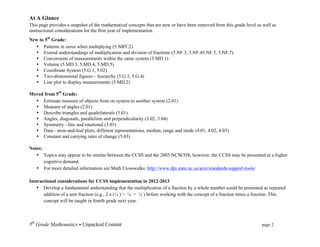
At A Glance
This page provides a snapshot of the mathematical concepts that are new or have been removed from this grade level as well as
instructional considerations for the first year of implementation.
New to 5th Grade:
  • Patterns in zeros when multiplying (5.NBT.2)
  • Extend understandings of multiplication and division of fractions (5.NF.3, 5.NF.45.NF.5, 5.NF.7)
  • Conversions of measurements within the same system (5.MD.1)
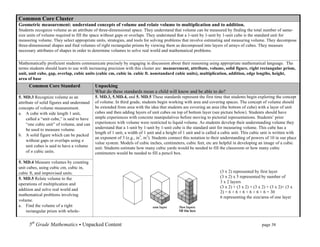
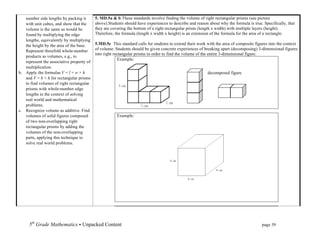
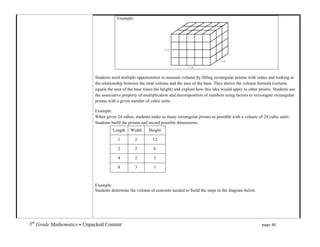
  • Volume (5.MD.3, 5.MD.4, 5.MD.5)
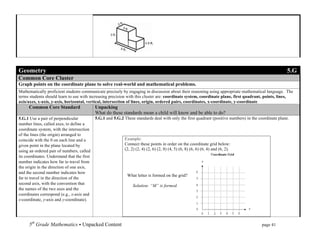
  • Coordinate System (5.G.1, 5.02)
  • Two-dimensional figures – hierarchy (5.G.3, 5.G.4)
  • Line plot to display measurements (5.MD.2)

Moved from 5th Grade:
  • Estimate measure of objects from on system to another system (2.01)
  • Measure of angles (2.01)
  • Describe triangles and quadrilaterals (3.01)
  • Angles, diagonals, parallelism and perpendicularity (3.02, 3.04)
  • Symmetry - line and rotational (3.03)
  • Data - stem-and-leaf plots, different representations, median, range and mode (4.01, 4.02, 4.03)
  • Constant and carrying rates of change (5.03)

Notes:
   • Topics may appear to be similar between the CCSS and the 2003 NCSCOS; however, the CCSS may be presented at a higher
       cognitive demand.
   • For more detailed information see Math Crosswalks: http://www.dpi.state.nc.us/acre/standards/support-tools/

Instructional considerations for CCSS implementation in 2012-2013
   • Develop a fundamental understanding that the multiplication of a fraction by a whole number could be presented as repeated
       addition of a unit fraction (e.g., 2 x (¼ ) = ¼ + ¼ ) before working with the concept of a fraction times a fraction. This
       concept will be taught in fourth grade next year.


5th Grade Mathematics • Unpacked Content	


     page 2	


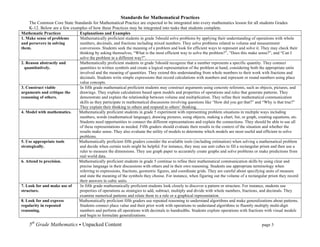
Standards for Mathematical Practices
     The Common Core State Standards for Mathematical Practice are expected to be integrated into every mathematics lesson for all students Grades
     K-12. Below are a few examples of how these Practices may be integrated into tasks that students complete.
Mathematic Practices           Explanations and Examples
1. Make sense of problems      Mathematically proficient students in grade 5should solve problems by applying their understanding of operations with whole
and persevere in solving       numbers, decimals, and fractions including mixed numbers. They solve problems related to volume and measurement
them.                          conversions. Students seek the meaning of a problem and look for efficient ways to represent and solve it. They may check their
                               thinking by asking themselves, “What is the most efficient way to solve the problem?”, “Does this make sense?”, and “Can I
                               solve the problem in a different way?”.
2. Reason abstractly and       Mathematically proficient students in grade 5should recognize that a number represents a specific quantity. They connect
  quantitatively.              quantities to written symbols and create a logical representation of the problem at hand, considering both the appropriate units
                               involved and the meaning of quantities. They extend this understanding from whole numbers to their work with fractions and
                               decimals. Students write simple expressions that record calculations with numbers and represent or round numbers using place
                               value concepts.
3. Construct viable            In fifth grade mathematical proficient students may construct arguments using concrete referents, such as objects, pictures, and
arguments and critique the     drawings. They explain calculations based upon models and properties of operations and rules that generate patterns. They
reasoning of others.           demonstrate and explain the relationship between volume and multiplication. They refine their mathematical communication
                               skills as they participate in mathematical discussions involving questions like “How did you get that?” and “Why is that true?”
                               They explain their thinking to others and respond to others’ thinking.
4. Model with mathematics.     Mathematically proficient students in grade 5 experiment with representing problem situations in multiple ways including
                               numbers, words (mathematical language), drawing pictures, using objects, making a chart, list, or graph, creating equations, etc.
                               Students need opportunities to connect the different representations and explain the connections. They should be able to use all
                               of these representations as needed. Fifth graders should evaluate their results in the context of the situation and whether the
                               results make sense. They also evaluate the utility of models to determine which models are most useful and efficient to solve
                               problems.
5. Use appropriate tools       Mathematically proficient fifth graders consider the available tools (including estimation) when solving a mathematical problem
strategically.                 and decide when certain tools might be helpful. For instance, they may use unit cubes to fill a rectangular prism and then use a
                               ruler to measure the dimensions. They use graph paper to accurately create graphs and solve problems or make predictions from
                               real world data.
6. Attend to precision.        Mathematically proficient students in grade 5 continue to refine their mathematical communication skills by using clear and
                               precise language in their discussions with others and in their own reasoning. Students use appropriate terminology when
                               referring to expressions, fractions, geometric figures, and coordinate grids. They are careful about specifying units of measure
                               and state the meaning of the symbols they choose. For instance, when figuring out the volume of a rectangular prism they record
                               their answers in cubic units.
7. Look for and make use of    In fifth grade mathematically proficient students look closely to discover a pattern or structure. For instance, students use
structure.                     properties of operations as strategies to add, subtract, multiply and divide with whole numbers, fractions, and decimals. They
                               examine numerical patterns and relate them to a rule or a graphical representation.
8. Look for and express        Mathematically proficient fifth graders use repeated reasoning to understand algorithms and make generalizations about patterns.
regularity in repeated         Students connect place value and their prior work with operations to understand algorithms to fluently multiply multi-digit
reasoning.                     numbers and perform all operations with decimals to hundredths. Students explore operations with fractions with visual models
                               and begin to formulate generalizations.

    5th Grade Mathematics • Unpacked Content	


      page 3	


Grade 5 Critical Areas
The Critical Areas are designed to bring focus to the standards at each grade by describing the big ideas that educators can use to build
their curriculum and to guide instruction. The Critical Areas for fifth grade can be found on page 33 in the Common Core State Standards for
Mathematics.	
  

       1. Developing fluency with addition and subtraction of fractions, and developing understanding of the multiplication of
          fractions and of division of fractions in limited cases (unit fractions divided by whole numbers and whole numbers
          divided by unit fractions).
          Students apply their understanding of fractions and fraction models to represent the addition and subtraction of fractions with
          unlike denominators as equivalent calculations with like denominators. They develop fluency in calculating sums and
          differences of fractions, and make reasonable estimates of them. Students also use the meaning of fractions, of multiplication
          and division, and the relationship between multiplication and division to understand and explain why the procedures for
          multiplying and dividing fractions make sense. (Note: this is limited to the case of dividing unit fractions by whole numbers
          and whole numbers by unit fractions.)

       2. Extending division to 2-digit divisors, integrating decimal fractions into the place value system and developing
          understanding of operations with decimals to hundredths, and developing fluency with whole number and decimal
          operations.
          Students develop understanding of why division procedures work based on the meaning of base-ten numerals and properties of
          operations. They finalize fluency with multi-digit addition, subtraction, multiplication, and division. They apply their
          understandings of models for decimals, decimal notation, and properties of operations to add and subtract decimals to
          hundredths. They develop fluency in these computations, and make reasonable estimates of their results. Students use the
          relationship between decimals and fractions, as well as the relationship between finite decimals and whole numbers (i.e., a
          finite decimal multiplied by an appropriate power of 10 is a whole number), to understand and explain why the procedures for
          multiplying and dividing finite decimals make sense. They compute products and quotients of decimals to hundredths
          efficiently and accurately.

       3. Developing understanding of volume.
          Students recognize volume as an attribute of three-dimensional space. They understand that volume can be measured by
          finding the total number of same-size units of volume required to fill the space without gaps or overlaps. They understand that
          a 1-unit by 1-unit by 1-unit cube is the standard unit for measuring volume. They select appropriate units, strategies, and tools
          for solving problems that involve estimating and measuring volume. They decompose three-dimensional shapes and find
          volumes of right rectangular prisms by viewing them as decomposed into layers of arrays of cubes. They measure necessary
          attributes of shapes in order to determine volumes to solve real world and mathematical problems.

5th Grade Mathematics • Unpacked Content	


     page 4	


Operations and Algebraic Thinking                                                                                                                     5.0A
Common Core Cluster
Write and interpret numerical expressions.
Mathematically proficient students communicate precisely by engaging in discussion about their reasoning using appropriate mathematical language. The
terms students should learn to use with increasing precision with this cluster are: parentheses, brackets, braces, numerical expressions
     Common Core Standard                Unpacking
                                         What do these standards mean a child will know and be able to do?
5.OA.1 Use parentheses, brackets, or     The standard calls for students to evaluate expressions with parentheses ( ), brackets [ ] and braces { }. In upper
braces in numerical expressions, and     levels of mathematics, evaluate means to substitute for a variable and simplify the expression. However at this
evaluate expressions with these          level students are to only simplify the expressions because there are no variables.
symbols.                                 Example:
                                         Evaluate the expression 2{ 5[12 + 5(500 - 100) + 399]}
                                         Students should have experiences working with the order of first evaluating terms in parentheses, then brackets,
                                         and then braces.
                                         The first step would be to subtract 500 – 100 = 400.
                                         Then multiply 400 by 5 = 2,000.
                                         Inside the bracket, there is now [12 + 2,000 + 399]. That equals 2,411.
                                         Next multiply by the 5 outside of the bracket. 2,411 x 5 = 12,055.
                                         Next multiply by the 2 outside of the braces. 12,055 x 2= 24,110.

                                         Mathematically, there cannot be brackets or braces in a problem that does not have parentheses. Likewise, there
                                         cannot be braces in a problem that does not have both parentheses and brackets.

                                         This standard builds on the expectations of third grade where students are expected to start learning the
                                         conventional order. Students need experiences with multiple expressions that use grouping symbols throughout
                                         the year to develop understanding of when and how to use parentheses, brackets, and braces. First, students use
                                         these symbols with whole numbers. Then the symbols can be used as students add, subtract, multiply and divide
                                         decimals and fractions.
                                         Example:
                                                 • (26 + 18) 4                                    Solution: 11
                                                 • {[2 x (3+5)] – 9} + [5 x (23-18)]              Solution: 32
                                                 • 12 – (0.4 x 2)                                 Solution: 11.2
                                                 • (2 + 3) x (1.5 – 0.5)                          Solution: 5
                                                         ⎛ 1 1 ⎞
                                                     6 − ⎜ + ⎟
                                                 •       ⎝ 2 3 ⎠                                 Solution: 5 1/6
                                                 •   { 80 ÷ [ 2 x (3 ½ + 1 ½ ) ] }+ 100            Solution: 108

     5th Grade Mathematics • Unpacked Content	


      page 5	


To further develop students’ understanding of grouping symbols and facility with operations, students place
                                          grouping symbols in equations to make the equations true or they compare expressions that are grouped
                                          differently.
                                          Example:
                                              • 15 - 7 – 2 = 10 → 15 - (7 – 2) = 10
                                              • 3 x 125 ÷ 25 + 7 = 22 → [3 x (125 ÷ 25)] + 7 = 22
                                              • 24 ÷ 12 ÷ 6 ÷ 2 = 2 x 9 + 3 ÷ ½ → 24 ÷ [(12 ÷ 6) ÷ 2] = (2 x 9) + (3 ÷ ½)
                                              • Compare 3 x 2 + 5 and 3 x (2 + 5)
                                              • Compare 15 – 6 + 7 and 15 – (6 + 7)
5.OA.2 Write simple expressions that      This standard refers to expressions. Expressions are a series of numbers and symbols (+, -, x, ÷) without an equals
record calculations with numbers, and     sign. Equations result when two expressions are set equal to each other (2 + 3 = 4 + 1).
interpret numerical expressions without   Example:
evaluating them.                          4(5 + 3) is an expression.
For example, express the calculation      When we compute 4(5 + 3) we are evaluating the expression. The expression equals 32.
“add 8 and 7, then multiply by 2” as 2    4(5 + 3) = 32 is an equation.
× (8 + 7). Recognize that 3 × (18932 +
921) is three times as large as 18932 +   This standard calls for students to verbally describe the relationship between expressions without actually
921, without having to calculate the      calculating them. This standard calls for students to apply their reasoning of the four operations as well as place
indicated sum or product.                 value while describing the relationship between numbers. The standard does not include the use of variables, only
                                          numbers and signs for operations.
                                          Example:
                                          Write an expression for the steps “double five and then add 26.”
                                                 Student
                                                 (2 x 5) + 26

                                          Describe how the expression 5(10 x 10) relates to 10 x 10.
                                                Student
                                                The expression 5(10 x 10) is 5 times larger than the expression 10 x 10 since I know that I that 5(10
                                                x 10) means that I have 5 groups of (10 x 10).


     5th Grade Mathematics • Unpacked Content	


      page 6	


Common Core Cluster
Analyze patterns and relationships.
Mathematically proficient students communicate precisely by engaging in discussion about their reasoning using appropriate mathematical language. The
terms students should learn to use with increasing precision with this cluster are: numerical patterns, rules, ordered pairs, coordinate plane
     Common Core Standard                  Unpacking
                                           What do these standards mean a child will know and be able to do?
5.OA.3 Generate two numerical              This standard extends the work from Fourth Grade, where students generate numerical patterns when they are
patterns using two given rules. Identify   given one rule. In Fifth Grade, students are given two rules and generate two numerical patterns. The graphs that
apparent relationships between             are created should be line graphs to represent the pattern. This is a linear function which is why we get the
corresponding terms. Form ordered          straight lines. The Days are the independent variable, Fish are the dependent variables, and the constant rate is
pairs consisting of corresponding terms    what the rule identifies in the table.
from the two patterns, and graph the       Example:
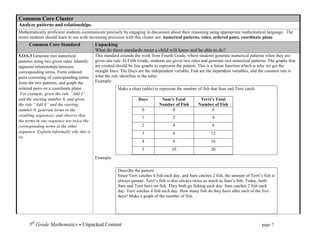
ordered pairs on a coordinate plane.                   Make a chart (table) to represent the number of fish that Sam and Terri catch.
 For example, given the rule “Add 3”
and the starting number 0, and given                               Days         Sam’s Total           Terri’s Total
the rule “Add 6” and the starting                                              Number of Fish        Number of Fish
number 0, generate terms in the                                      0              0                       0
resulting sequences, and observe that                                1                2                      4
the terms in one sequence are twice the
corresponding terms in the other                                     2                4                      8
sequence. Explain informally why this is                             3                6                     12
so.
                                                                     4                8                     16
                                                                     5                10                    20
                                           Example:
                                           	
  
                                                       Describe the pattern:
                                                       Since Terri catches 4 fish each day, and Sam catches 2 fish, the amount of Terri’s fish is
                                                       always greater. Terri’s fish is also always twice as much as Sam’s fish. Today, both
                                                       Sam and Terri have no fish. They both go fishing each day. Sam catches 2 fish each
                                                       day. Terri catches 4 fish each day. How many fish do they have after each of the five
                                                       days? Make a graph of the number of fish.


     5th Grade Mathematics • Unpacked Content	


      page 7	


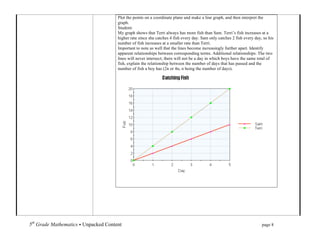
Plot the points on a coordinate plane and make a line graph, and then interpret the
                                                graph.
                                                Student:
                                                My graph shows that Terri always has more fish than Sam. Terri’s fish increases at a
                                                higher rate since she catches 4 fish every day. Sam only catches 2 fish every day, so his
                                                number of fish increases at a smaller rate than Terri.
                                                Important to note as well that the lines become increasingly further apart. Identify
                                                apparent relationships between corresponding terms. Additional relationships: The two
                                                lines will never intersect; there will not be a day in which boys have the same total of
                                                fish, explain the relationship between the number of days that has passed and the
                                                number of fish a boy has (2n or 4n, n being the number of days).


5th Grade Mathematics • Unpacked Content	


      page 8	


Example:

                                   Use the rule “add 3” to write a sequence of numbers. Starting with a 0, students write 0, 3, 6, 9, 12, . . .

                                   Use the rule “add 6” to write a sequence of numbers. Starting with 0, students write 0, 6, 12, 18, 24, . . .

                                   After comparing these two sequences, the students notice that each term in the second sequence is twice the
                                   corresponding terms of the first sequence. One way they justify this is by describing the patterns of the terms.
                                   Their justification may include some mathematical notation (See example below). A student may explain that
                                   both sequences start with zero and to generate each term of the second sequence he/she added 6, which is twice as
                                   much as was added to produce the terms in the first sequence. Students may also use the distributive property to
                                   describe the relationship between the two numerical patterns by reasoning that 6 + 6 + 6 = 2 (3 + 3 + 3).
                                          +3         +3         +3          +3
                                   0,           3,        6,         9,          12, . . .
                                           +6        +6          +6         +6
                                   0,           6,        12,         18,        24, . . .

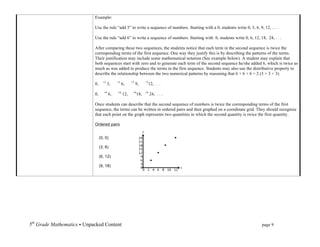
                                   Once students can describe that the second sequence of numbers is twice the corresponding terms of the first
                                   sequence, the terms can be written in ordered pairs and then graphed on a coordinate grid. They should recognize
                                   that each point on the graph represents two quantities in which the second quantity is twice the first quantity.

                                   Ordered pairs


                                        (0, 0)

                                        (3, 6)

                                        (6, 12)

                                        (9, 18)

                                        (12, 24)


5th Grade Mathematics • Unpacked Content	


      page 9	


Number and Operations in Base Ten                                                                                                                          5.NBT
Common Core Cluster
Understand the place value system.
Mathematically proficient students communicate precisely by engaging in discussion about their reasoning using appropriate mathematical language. The
terms students should learn to use with increasing precision with this cluster are: place value, decimal, decimal point, patterns, multiply, divide, tenths,
thousands, greater than, less than, equal to, ‹, ›, =, compare/comparison, round	
  
     Common Core Standard                  Unpacking
                                           What do these standards mean a child will know and be able to do?
5.NBT.1 Recognize that in a multi-digit    This standard calls for students to reason about the magnitude of numbers. Students should work with the idea
number, a digit in one place represents    that the tens place is ten times as much as the ones place, and the ones place is 1/10th the size of the tens place.
10 times as much as it represents in the   In fourth grade, students examined the relationships of the digits in numbers for whole numbers only. This
place to its right and 1/10 of what it     standard extends this understanding to the relationship of decimal fractions. Students use base ten blocks, pictures
represents in the place to its left.       of base ten blocks, and interactive images of base ten blocks to manipulate and investigate the place value
                                           relationships. They use their understanding of unit fractions to compare decimal places and fractional language to
                                           describe those comparisons.

                                           Before considering the relationship of decimal fractions, students express their understanding that in multi-digit
                                           whole numbers, a digit in one place represents 10 times what it represents in the place to its right and 1/10 of
                                           what it represents in the place to its left.

                                           Example:
                                           The 2 in the number 542 is different from the value of the 2 in 324. The 2 in 542 represents 2 ones or 2, while the
                                           2 in 324 represents 2 tens or 20. Since the 2 in 324 is one place to the left of the 2 in 542 the value of the 2 is 10
                                           times greater. Meanwhile, the 4 in 542 represents 4 tens or 40 and the 4 in 324 represents 4 ones or 4. Since the 4
                                           in 324 is one place to the right of the 4 in 542 the value of the 4 in the number 324 is 1/10th of its value in the
                                           number 542.
                                           Example:
                                           A student thinks, “I know that in the number 5555, the 5 in the tens place (5555) represents 50 and the 5 in the
                                           hundreds place (5555) represents 500. So a 5 in the hundreds place is ten times as much as a 5 in the tens place or
                                           a 5 in the tens place is 1/10 of the value of a 5 in the hundreds place.


                                           Base on the base-10 number system digits to the left are times as great as digits to the right; likewise, digits to the
                                           right are 1/10th of digits to the left. For example, the 8 in 845 has a value of 800 which is ten times as much as
                                           the 8 in the number 782. In the same spirit, the 8 in 782 is 1/10th the value of the 8 in 845.


     5th Grade Mathematics • Unpacked Content	


       page 10	


To extend this understanding of place value to their work with decimals, students use a model of one unit; they
                                           cut it into 10 equal pieces, shade in, or describe 1/10 of that model using fractional language (“This is 1 out of 10
                                           equal parts. So it is 1/10”. I can write this using 1/10 or 0.1”). They repeat the process by finding 1/10 of a 1/10
                                           (e.g., dividing 1/10 into 10 equal parts to arrive at 1/100 or 0.01) and can explain their reasoning, “0.01 is 1/10 of
                                           1/10 thus is 1/100 of the whole unit.”

                                           In the number 55.55, each digit is 5, but the value of the digits is different because of the placement.

                                                     5       5       .       5       5


                                           The 5 that the arrow points to is 1/10 of the 5 to the left and 10 times the 5 to the right. The 5 in the ones place is
                                           1/10 of 50 and 10 times five tenths.

                                                 5       5       .       5       5


                                           The 5 that the arrow points to is 1/10 of the 5 to the left and 10 times the 5 to the right. The 5 in the tenths place is
                                           10 times five hundredths.


5.NBT.2 Explain patterns in the number     This standard includes multiplying by multiples of 10 and powers of 10, including 102 which is 10 x 10=100, and
of zeros of the product when               103 which is 10 x 10 x 10=1,000. Students should have experiences working with connecting the pattern of the
multiplying a number by powers of 10,      number of zeros in the product when you multiply by powers of 10.
and explain patterns in the placement of
                                           Example:
the decimal point when a decimal is        2.5 x 103 = 2.5 x (10 x 10 x 10) = 2.5 x 1,000 = 2,500 Students should reason that the exponent above the 10
multiplied or divided by a power of 10.    indicates how many places the decimal point is moving (not just that the decimal point is moving but that you are
Use whole-number exponents to denote       multiplying or making the number 10 times greater three times) when you multiply by a power of 10. Since we
powers of 10.                              are multiplying by a power of 10 the decimal point moves to the right.

                                           350 ÷ 103 = 350 ÷ 1,000 = 0.350 = 0.35        350/10 = 35, 35 /10 = 3.5          3.5 /10 =.0.35, or 350 x 1/10, 35 x 1/10,

     5th Grade Mathematics • Unpacked Content	


      page 11	


3.5 x 1/10 this will relate well to subsequent work with operating with fractions. This example shows that when
                                          we divide by powers of 10, the exponent above the 10 indicates how many places the decimal point is moving
                                          (how many times we are dividing by 10 , the number becomes ten times smaller). Since we are dividing by
                                          powers of 10, the decimal point moves to the left.

                                          Students need to be provided with opportunities to explore this concept and come to this understanding; this
                                          should not just be taught procedurally.

                                          Example:
                                          Students might write:
                                              • 36 x 10 = 36 x 101 = 360
                                              • 36 x 10 x 10 = 36 x 102 = 3600
                                              • 36 x 10 x 10 x 10 = 36 x 103 = 36,000
                                              • 36 x 10 x 10 x 10 x 10 = 36 x 104 = 360,000

                                          Students might think and/or say:
                                              • I noticed that every time, I multiplied by 10 I added a zero to the end of the number. That makes sense
                                                  because each digit’s value became 10 times larger. To make a digit 10 times larger, I have to move it one
                                                  place value to the left.
                                              • When I multiplied 36 by 10, the 30 became 300. The 6 became 60 or the 36 became 360. So I had to add
                                                  a zero at the end to have the 3 represent 3 one-hundreds (instead of 3 tens) and the 6 represents 6 tens
                                                  (instead of 6 ones).

                                          Students should be able to use the same type of reasoning as above to explain why the following multiplication
                                          and division problem by powers of 10 make sense.
                                              • 523 x 103 = 523,000 The place value of 523 is increased by 3 places.
                                              • 5.223 x 102 = 522.3       The place value of 5.223 is increased by 2 places.
                                              • 52.3 ÷ 101 = 5.23         The place value of 52.3 is decreased by one place.

5.NBT.3 Read, write, and compare          This standard references expanded form of decimals with fractions included. Students should build on their work
decimals to thousandths.                  from Fourth Grade, where they worked with both decimals and fractions interchangeably. Expanded form is
a. Read and write decimals to             included to build upon work in 5.NBT.2 and deepen students’ understanding of place value.
    thousandths using base-ten            Students build on the understanding they developed in fourth grade to read, write, and compare decimals to
    numerals, number names, and           thousandths. They connect their prior experiences with using decimal notation for fractions and addition of
    expanded form, e.g., 347.392 = 3 ×    fractions with denominators of 10 and 100. They use concrete models and number lines to extend this
    100 + 4 × 10 + 7 × 1 + 3 × (1/10) +   understanding to decimals to the thousandths. Models may include base ten blocks, place value charts, grids,
                                          pictures, drawings, manipulatives, technology-based, etc. They read decimals using fractional language and write
    9 x (1/100) + 2 x (1/1000)
                                          decimals in fractional form, as well as in expanded notation. This investigation leads them to understanding
                                          equivalence of decimals (0.8 = 0.80 = 0.800).

     5th Grade Mathematics • Unpacked Content	


      page 12	


b. Compare two decimals to                 Comparing decimals builds on work from fourth grade.
   thousandths based on meanings of
   the digits in each place, using >, =,   Example:
   and < symbols to record the results     Some equivalent forms of 0.72 are:
   of comparisons.                          72/100                            70/100 + 2/100
                                            7/10 + 2/100                      0.720
                                            7 x (1/10) + 2 x (1/100)          7 x (1/10) + 2 x (1/100) + 0 x (1/1000)
                                            0.70 + 0.02                       720/1000
                                           Students need to understand the size of decimal numbers and relate them to common benchmarks such as 0, 0.5
                                           (0.50 and 0.500), and 1. Comparing tenths to tenths, hundredths to hundredths, and thousandths to thousandths is
                                           simplified if students use their understanding of fractions to compare decimals.

                                           Example:
                                           Comparing 0.25 and 0.17, a student might think, “25 hundredths is more than 17 hundredths”. They may also
                                           think that it is 8 hundredths more. They may write this comparison as 0.25 > 0.17 and recognize that 0.17 < 0.25
                                           is another way to express this comparison.

                                           Comparing 0.207 to 0.26, a student might think, “Both numbers have 2 tenths, so I need to compare the
                                           hundredths. The second number has 6 hundredths and the first number has no hundredths so the second number
                                           must be larger. Another student might think while writing fractions, “I know that 0.207 is 207 thousandths (and
                                           may write 207/1000). 0.26 is 26 hundredths (and may write 26/100) but I can also think of it as 260 thousandths
                                           (260/1000). So, 260 thousandths is more than 207 thousandths.
5.NBT.4 Use place value understanding      This standard refers to rounding. Students should go beyond simply applying an algorithm or procedure for
to round decimals to any place.            rounding. The expectation is that students have a deep understanding of place value and number sense and can
                                           explain and reason about the answers they get when they round. Students should have numerous experiences
                                           using a number line to support their work with rounding.

                                           Example:
                                           Round 14.235 to the nearest tenth.
                                           Students recognize that the possible answer must be in tenths thus, it is either 14.2 or 14.3. They then identify that
                                           14.235 is closer to 14.2 (14.20) than to 14.3 (14.30).


                                           Students should use benchmark numbers to support this work. Benchmarks are convenient numbers for
                                           comparing and rounding numbers. 0., 0.5, 1, 1.5 are examples of benchmark numbers.

      5th Grade Mathematics • Unpacked Content	


       page 13	


Example:
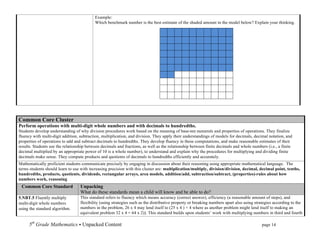
                                           Which benchmark number is the best estimate of the shaded amount in the model below? Explain your thinking.


Common Core Cluster
Perform operations with multi-digit whole numbers and with decimals to hundredths.
Students develop understanding of why division procedures work based on the meaning of base-ten numerals and properties of operations. They finalize
fluency with multi-digit addition, subtraction, multiplication, and division. They apply their understandings of models for decimals, decimal notation, and
properties of operations to add and subtract decimals to hundredths. They develop fluency in these computations, and make reasonable estimates of their
results. Students use the relationship between decimals and fractions, as well as the relationship between finite decimals and whole numbers (i.e., a finite
decimal multiplied by an appropriate power of 10 is a whole number), to understand and explain why the procedures for multiplying and dividing finite
decimals make sense. They compute products and quotients of decimals to hundredths efficiently and accurately.
Mathematically proficient students communicate precisely by engaging in discussion about their reasoning using appropriate mathematical language. The
terms students should learn to use with increasing precision with this cluster are: multiplication/multiply, division/division, decimal, decimal point, tenths,
hundredths, products, quotients, dividends, rectangular arrays, area models, addition/add, subtraction/subtract, (properties)-rules about how
numbers work, reasoning
 Common Core Standard              Unpacking
                                   What do these standards mean a child will know and be able to do?
5.NBT.5 Fluently multiply          This standard refers to fluency which means accuracy (correct answer), efficiency (a reasonable amount of steps), and
multi-digit whole numbers          flexibility (using strategies such as the distributive property or breaking numbers apart also using strategies according to the
using the standard algorithm.      numbers in the problem, 26 x 4 may lend itself to (25 x 4 ) + 4 where as another problem might lend itself to making an
                                   equivalent problem 32 x 4 = 64 x 2)). This standard builds upon students’ work with multiplying numbers in third and fourth

      5th Grade Mathematics • Unpacked Content	


      page 14	


grade. In fourth grade, students developed understanding of multiplication through using various strategies. While the
                                  standard algorithm is mentioned, alternative strategies are also appropriate to help students develop conceptual
                                  understanding. The size of the numbers should NOT exceed a three-digit factor by a two-digit factor.

                                  Examples of alternative strategies:
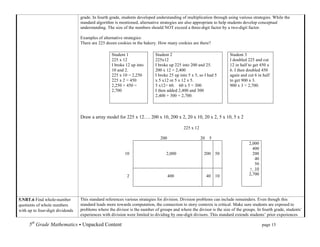
                                  There are 225 dozen cookies in the bakery. How many cookies are there?

                                                   Student 1                Student 2                                     Student 3
                                                   225 x 12                 225x12                                        I doubled 225 and cut
                                                   I broke 12 up into       I broke up 225 into 200 and 25.               12 in half to get 450 x
                                                   10 and 2.                200 x 12 = 2,400                              6. I then doubled 450
                                                   225 x 10 = 2,250         I broke 25 up into 5 x 5, so I had 5          again and cut 6 in half
                                                   225 x 2 = 450            x 5 x12 or 5 x 12 x 5.                        to get 900 x 3.
                                                   2,250 + 450 =            5 x12= 60. 60 x 5 = 300                       900 x 3 = 2,700.
                                                   2,700                    I then added 2,400 and 300
                                                                            2,400 + 300 = 2,700.


                                  Draw a array model for 225 x 12…. 200 x 10, 200 x 2, 20 x 10, 20 x 2, 5 x 10, 5 x 2

                                                                                            225 x 12

                                                                               200                     20    5
                                                                                                                                           2,000
                                                                                                                                             400
                                                             10                   2,000                 200      50                          200
                                                                                                                                              40
                                                                                                                                              50
                                                                                                                                           + 10
                                                              2                      400                    40   10                        2,700


5.NBT.6 Find whole-number         This standard references various strategies for division. Division problems can include remainders. Even though this
quotients of whole numbers        standard leads more towards computation, the connection to story contexts is critical. Make sure students are exposed to
with up to four-digit dividends   problems where the divisor is the number of groups and where the divisor is the size of the groups. In fourth grade, students’
                                  experiences with division were limited to dividing by one-digit divisors. This standard extends students’ prior experiences

      5th Grade Mathematics • Unpacked Content	


             page 15	


and two-digit divisors, using      with strategies, illustrations, and explanations. When the two-digit divisor is a “familiar” number, a student might
strategies based on place value,   decompose the dividend using place value.
the properties of operations,
and/or the relationship between    Example:
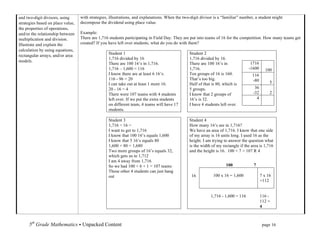
multiplication and division.       There are 1,716 students participating in Field Day. They are put into teams of 16 for the competition. How many teams get
Illustrate and explain the         created? If you have left over students, what do you do with them?
calculation by using equations,
                                                   Student 1                                     Student 2
rectangular arrays, and/or area
                                                   1,716 divided by 16                           1,716 divided by 16.
models.
                                                   There are 100 16’s in 1,716.                  There are 100 16’s in                        1716
                                                   1,716 – 1,600 = 116                           1,716.                                      -1600      100
                                                   I know there are at least 6 16’s.             Ten groups of 16 is 160.                     116
                                                   116 - 96 = 20                                 That’s too big.                              -80
                                                   I can take out at least 1 more 16.            Half of that is 80, which is                              5
                                                   20 - 16 = 4                                   5 groups.                                      36
                                                   There were 107 teams with 4 students          I know that 2 groups of                       -32         2
                                                   left over. If we put the extra students       16’s is 32.                                     4
                                                   on different team, 4 teams will have 17       I have 4 students left over.
                                                   students.

                                                   Student 3                                     Student 4
                                                   1,716 ÷ 16 =                                  How many 16’s are in 1,716?
                                                   I want to get to 1,716                        We have an area of 1,716. I know that one side
                                                   I know that 100 16’s equals 1,600             of my array is 16 units long. I used 16 as the
                                                   I know that 5 16’s equals 80                  height. I am trying to answer the question what
                                                   1,600 + 80 = 1,680                            is the width of my rectangle if the area is 1,716
                                                   Two more groups of 16’s equals 32,            and the height is 16. 100 + 7 = 107 R 4
                                                   which gets us to 1,712                         	
  
                                                   I am 4 away from 1,716
                                                   So we had 100 + 6 + 1 = 107 teams                                     100                   7
                                                   Those other 4 students can just hang           	
  
                                                   out                                            16           100 x 16 = 1,600                      7 x 16
                                                                                                  	
                                                 =112


                                                                                                             1,716 - 1,600 = 116                     116 -
                                                                                                                                                     112 =
                                                                                                                                                     4


      5th Grade Mathematics • Unpacked Content	


              page 16	


Example:
                           Using expanded notation 2682 ÷ 25 = (2000 + 600 + 80 + 2) ÷ 25
                           Using understanding of the relationship between 100 and 25, a student might think ~
                               • I know that 100 divided by 25 is 4 so 200 divided by 25 is 8 and 2000 divided by 25 is 80.
                               • 600 divided by 25 has to be 24.
                               • Since 3 x 25 is 75, I know that 80 divided by 25 is 3 with a reminder of 5.
                                    (Note that a student might divide into 82 and not 80)
                               • I can’t divide 2 by 25 so 2 plus the 5 leaves a remainder of 7.
                               • 80 + 24 + 3 = 107. So, the answer is 107 with a remainder of 7.
                           Using an equation that relates division to multiplication, 25 x n = 2682, a student might estimate the answer to be slightly
                           larger than 100 because s/he recognizes that 25 x 100 = 2500.

                           Example: 968 ÷ 21
                           Using base ten models, a student can represent 962 and use the models to make an array with one dimension of 21. The
                           student continues to make the array until no more groups of 21 can be made. Remainders are not part of the array.


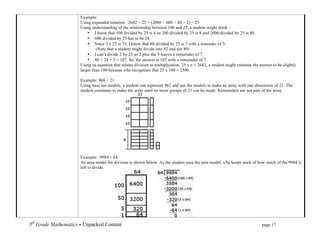
                           Example: 9984 ÷ 64
                           An area model for division is shown below. As the student uses the area model, s/he keeps track of how much of the 9984 is
                           left to divide.


5th Grade Mathematics • Unpacked Content	


       page 17	


5.NBT.7 Add, subtract,             This standard builds on the work from fourth grade where students are introduced to decimals and compare them. In fifth
multiply, and divide decimals      grade, students begin adding, subtracting, multiplying and dividing decimals. This work should focus on concrete models
to hundredths, using concrete      and pictorial representations, rather than relying solely on the algorithm. The use of symbolic notations involves having
models or drawings and             students record the answers to computations (2.25 x 3= 6.75), but this work should not be done without models or pictures.
strategies based on place value,   This standard includes students’ reasoning and explanations of how they use models, pictures, and strategies.
properties of operations, and/or
the relationship between
addition and subtraction; relate   This standard requires students to extend the models and strategies they developed for whole numbers in grades 1-4 to
the strategy to a written method   decimal values. Before students are asked to give exact answers, they should estimate answers based on their understanding
and explain the reasoning used.    of operations and the value of the numbers.

                                   Examples:
                                       • 3.6 + 1.7
                                   A student might estimate the sum to be larger than 5 because 3.6 is more than 3 ½ and 1.7 is more than 1 ½.
                                       • 5.4 – 0.8
                                   A student might estimate the answer to be a little more than 4.4 because a number less than 1 is being subtracted.
                                       • 6 x 2.4
                                   A student might estimate an answer between 12 and 18 since 6 x 2 is 12 and 6 x 3 is 18. Another student might give an
                                   estimate of a little less than 15 because s/he figures the answer to be very close, but smaller than 6 x 2 ½ and think of 2 ½
                                   groups of 6 as 12 (2 groups of 6) + 3 (½ of a group of 6).


                                   Students should be able to express that when they add decimals they add tenths to tenths and hundredths to hundredths. So,
                                   when they are adding in a vertical format (numbers beneath each other), it is important that they write numbers with the
                                   same place value beneath each other. This understanding can be reinforced by connecting addition of decimals to their
                                   understanding of addition of fractions. Adding fractions with denominators of 10 and 100 is a standard in fourth grade.

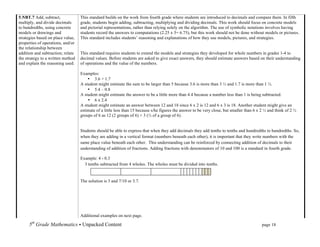
                                   Example: 4 - 0.3
                                     3 tenths subtracted from 4 wholes. The wholes must be divided into tenths.


                                   The solution is 3 and 7/10 or 3.7.


                                   Additional examples on next page.

      5th Grade Mathematics • Unpacked Content	


       page 18	


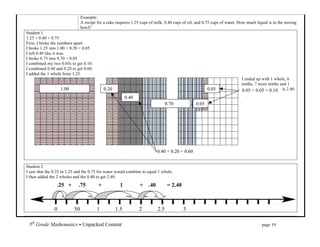
Example:
                               A recipe for a cake requires 1.25 cups of milk, 0.40 cups of oil, and 0.75 cups of water. How much liquid is in the mixing
                               bowl?
Student 1
1.25 + 0.40 + 0.75
First, I broke the numbers apart:
I broke 1.25 into 1.00 + 0.20 + 0.05
I left 0.40 like it was.
I broke 0.75 into 0.70 + 0.05
I combined my two 0.05s to get 0.10.
I combined 0.40 and 0.20 to get 0.60.
I added the 1 whole from 1.25.
                                                                                                                            I ended up with 1 whole, 6
                                                                                                                            tenths, 7 more tenths and 1
                   1.00                      0.20                                                      0.05                 more + 0.05 = 0.10
                                                                                                                            0.05 tenth which equals 2.40
                                                                                                                            cups.
                                                          0.40
                                             .00                                                       .00
                                                                                 0.70           0.05
                                                          .00
                                                                                                .00


                                                                           0.40 + 0.20 = 0.60


Student 2
I saw that the 0.25 in 1.25 and the 0.75 for water would combine to equal 1 whole.
I then added the 2 wholes and the 0.40 to get 2.40.
                 .25 +       .75         +            1          +   .40          = 2.40


               0          50            1           1.5          2         2.5             3

 5th Grade Mathematics • Unpacked Content	


     page 19	


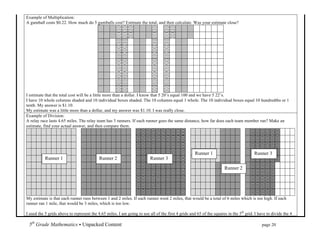
Example of Multiplication:
A gumball costs $0.22. How much do 5 gumballs cost? Estimate the total, and then calculate. Was your estimate close?


I estimate that the total cost will be a little more than a dollar. I know that 5 20’s equal 100 and we have 5 22’s.
I have 10 whole columns shaded and 10 individual boxes shaded. The 10 columns equal 1 whole. The 10 individual boxes equal 10 hundredths or 1
tenth. My answer is $1.10.
My estimate was a little more than a dollar, and my answer was $1.10. I was really close.
Example of Division:
A relay race lasts 4.65 miles. The relay team has 3 runners. If each runner goes the same distance, how far does each team member run? Make an
estimate, find your actual answer, and then compare them.


                                                                                                    Runner 1                               Runner 3
           Runner 1                        Runner 2                      Runner 3

                                                                                                                         Runner 2


My estimate is that each runner runs between 1 and 2 miles. If each runner went 2 miles, that would be a total of 6 miles which is too high. If each
runner ran 1 mile, that would be 3 miles, which is too low.

I used the 5 grids above to represent the 4.65 miles. I am going to use all of the first 4 grids and 65 of the squares in the 5th grid. I have to divide the 4

 5th Grade Mathematics • Unpacked Content	


        page 20	


whole grids and the 65 squares into 3 equal groups. I labeled each of the first 3 grids for each runner, so I know that each team member ran at least 1
mile. I then have 1 whole grid and 65 squares to divide up. Each column represents one-tenth. If I give 5 columns to each runner, that means that each
runner has run 1 whole mile and 5 tenths of a mile. Now, I have 15 squares left to divide up. Each runner gets 5 of those squares. So each runner ran 1
mile, 5 tenths and 5 hundredths of a mile. I can write that as 1.55 miles.

My answer is 1.55 and my estimate was between 1 and 2 miles. I was pretty close.

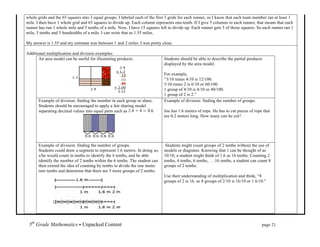
Additional multiplication and division examples:
      An area model can be useful for illustrating products.                   Students should be able to describe the partial products
                                                                               displayed by the area model.

                                                                               For example,
                                                                               “3/10 times 4/10 is 12/100.
                                                                               3/10 times 2 is 6/10 or 60/100.
                                                                               1 group of 4/10 is 4/10 or 40/100.
                                                                               1 group of 2 is 2.”
        Example of division: finding the number in each group or share.        Example of division: finding the number of groups.
        Students should be encouraged to apply a fair sharing model
        separating decimal values into equal parts such as                     Joe has 1.6 meters of rope. He has to cut pieces of rope that
                                                                               are 0.2 meters long. How many can he cut?


        Example of division: finding the number of groups.                      Students might count groups of 2 tenths without the use of
        Students could draw a segment to represent 1.6 meters. In doing so,    models or diagrams. Knowing that 1 can be thought of as
        s/he would count in tenths to identify the 6 tenths, and be able       10/10, a student might think of 1.6 as 16 tenths. Counting 2
        identify the number of 2 tenths within the 6 tenths. The student can   tenths, 4 tenths, 6 tenths, . . .16 tenths, a student can count 8
        then extend the idea of counting by tenths to divide the one meter     groups of 2 tenths.
        into tenths and determine that there are 5 more groups of 2 tenths.
                                                                               Use their understanding of multiplication and think, “8
                                                                               groups of 2 is 16, so 8 groups of 2/10 is 16/10 or 1 6/10.”


 5th Grade Mathematics • Unpacked Content	


       page 21	


Number and Operation – Fractions                                                                                                                     5.NF
Common Core Cluster
Use equivalent fractions as a strategy to add and subtract fractions.
Students apply their understanding of fractions and fraction models to represent the addition and subtraction of fractions with unlike denominators as
equivalent calculations with like denominators. They develop fluency in calculating sums and differences of fractions, and make reasonable estimates of
them.
Mathematically proficient students communicate precisely by engaging in discussion about their reasoning using appropriate mathematical language. The
terms students should learn to use with increasing precision with this cluster are: fraction, equivalent, addition/ add, sum, subtraction/subtract,
difference, unlike denominator, numerator, benchmark fraction, estimate, reasonableness, mixed numbers
     Common Core Standard                 Unpacking
                                          What do these standards mean a child will know and be able to do?
5.NF.1 Add and subtract fractions with    5.NF.1 builds on the work in fourth grade where students add fractions with like denominators. In fifth grade, the
unlike denominators (including mixed      example provided in the standard has students find a common denominator by finding the product of both
numbers) by replacing given fractions     denominators. For 1/3 + 1/6, a common denominator is 18, which is the product of 3 and 6. This process should
with equivalent fractions in such a way   be introduced using visual fraction models (area models, number lines, etc.) to build understanding before moving
as to produce an equivalent sum or        into the standard algorithm.
difference of fractions with like
denominators.
                                          Students should apply their understanding of equivalent fractions and their ability to rewrite fractions in an
For example, 2/3 + 5/4 = 8/12 + 15/12
                                          equivalent form to find common denominators. They should know that multiplying the denominators will always
= 23/12. (In general, a/b + c/d = (ad +
                                          give a common denominator but may not result in the smallest denominator.
bc)/bd.)
                                          Examples:
                                                   2 7 16 35 51
                                                    + =  +  =
                                                   5 8 40 40 40

                                                   1 1   3 2   1
                                                  3 − =3 − =3
                                                   4 6  12 12 12


                                          Example:
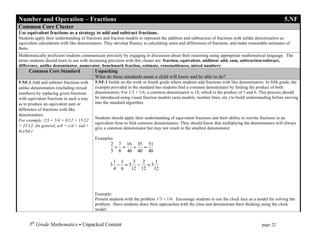
                                          Present students with the problem 1/3 + 1/6. Encourage students to use the clock face as a model for solving the
                                          problem. Have students share their approaches with the class and demonstrate their thinking using the clock
                                          model.


     5th Grade Mathematics • Unpacked Content	


      page 22	


5.NF.2 Solve word problems involving        This standard refers to number sense, which means students’ understanding of fractions as numbers that lie
addition and subtraction of fractions       between whole numbers on a number line. Number sense in fractions also includes moving between decimals and
referring to the same whole, including      fractions to find equivalents, also being able to use reasoning such as 7/8 is greater than ¾ because 7/8 is missing
cases of unlike denominators, e.g., by      only 1/8 and ¾ is missing ¼ so 7/8 is closer to a whole Also, students should use benchmark fractions to estimate
using visual fraction models or             and examine the reasonableness of their answers. Example here such as 5/8 is greater than 6/10 because 5/8 is 1/8
equations to represent the problem. Use     larger than ½(4/8) and 6/10 is only 1/10 larger than ½ (5/10)
benchmark fractions and number sense
                                            Example:
of fractions to estimate mentally and
                                            Your teacher gave you 1/7 of the bag of candy. She also gave your friend 1/3 of the bag of candy. If you and your
assess the reasonableness of answers.
                                            friend combined your candy, what fraction of the bag would you have? Estimate your answer and then calculate.
For example, recognize an incorrect         How reasonable was your estimate?
result 2/5 + 1/2 = 3/7, by observing that
3/7 < 1/2.                                          Student 1
                                                    1/7 is really close to 0. 1/3 is larger than 1/7, but still less than 1/2. If we put them together we
                                                    might get close to 1/2.
                                                    1/7 + 1/3= 3/21 + 7/21 = 10/21. The fraction does not simplify. I know that 10 is half of 20, so
                                                    10/21 is a little less than ½.
                                                    Another example: 1/7 is close to 1/6 but less than 1/6, and 1/3 is equivalent to 2/6, so I have a
                                                    little less than 3/6 or ½.


                                            Example:
                                            Jerry was making two different types of cookies. One recipe needed 3/4 cup of sugar and the other needed 2/3 cup
                                            of sugar. How much sugar did he need to make both recipes?
                                                • Mental estimation:

      5th Grade Mathematics • Unpacked Content	


       page 23	


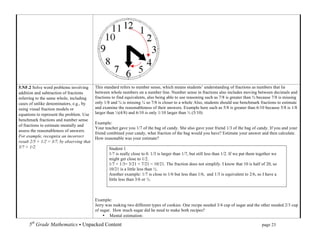
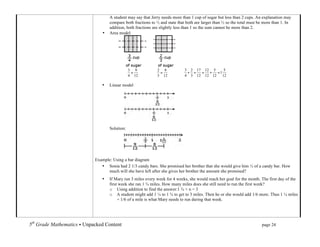
A student may say that Jerry needs more than 1 cup of sugar but less than 2 cups. An explanation may
                                           compare both fractions to ½ and state that both are larger than ½ so the total must be more than 1. In
                                           addition, both fractions are slightly less than 1 so the sum cannot be more than 2.
                                       •   Area model


                                                       3 9           2 8             3 2 17 12 5   5
                                                        =             =               + =  = + =1
                                                       4 12          3 12            4 3 12 12 12 12

                                       •   Linear model


                                           Solution:


                                   Example: Using a bar diagram
                                      • Sonia had 2 1/3 candy bars. She promised her brother that she would give him ½ of a candy bar. How
                                         much will she have left after she gives her brother the amount she promised?
                                       •   If Mary ran 3 miles every week for 4 weeks, she would reach her goal for the month. The first day of the
                                           first week she ran 1 ¾ miles. How many miles does she still need to run the first week?
                                           o Using addition to find the answer:1 ¾ + n = 3
                                           o A student might add 1 ¼ to 1 ¾ to get to 3 miles. Then he or she would add 1/6 more. Thus 1 ¼ miles
                                                + 1/6 of a mile is what Mary needs to run during that week.


5th Grade Mathematics • Unpacked Content	


      page 24	


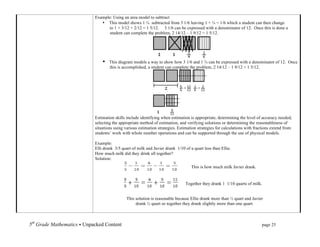
Example: Using an area model to subtract
                                      • This model shows 1 ¾ subtracted from 3 1/6 leaving 1 + ¼ = 1/6 which a student can then change
                                         to 1 + 3/12 + 2/12 = 1 5/12. 3 1/6 can be expressed with a denominator of 12. Once this is done a
                                         student can complete the problem, 2 14/12 – 1 9/12 = 1 5/12.


                                       •   This diagram models a way to show how 3 1/6 and 1 ¾ can be expressed with a denominator of 12. Once
                                           this is accomplished, a student can complete the problem, 2 14/12 – 1 9/12 = 1 5/12.


                                   Estimation skills include identifying when estimation is appropriate, determining the level of accuracy needed,
                                   selecting the appropriate method of estimation, and verifying solutions or determining the reasonableness of
                                   situations using various estimation strategies. Estimation strategies for calculations with fractions extend from
                                   students’ work with whole number operations and can be supported through the use of physical models.

                                   Example:
                                   Elli drank 3/5 quart of milk and Javier drank 1/10 of a quart less than Ellie.
                                   How much milk did they drink all together?
                                   Solution:
                                                                                           This is how much milk Javier drank.


                                                                                       Together they drank 1 1/10 quarts of milk.


                                                       This solution is reasonable because Ellie drank more than ½ quart and Javier
                                                            drank ½ quart so together they drank slightly more than one quart.


5th Grade Mathematics • Unpacked Content	


     page 25	


Common Core Cluster
Apply and extend previous understandings of multiplication and division to multiply and divide fractions.
Students also use the meaning of fractions, of multiplication and division, and the relationship between multiplication and division to understand and explain
why the procedures for multiplying and dividing fractions make sense. (Note: this is limited to the case of dividing unit fractions by whole numbers and
whole numbers by unit fractions.)
Mathematically proficient students communicate precisely by engaging in discussion about their reasoning using appropriate mathematical language. The
terms students should learn to use with increasing precision with this cluster are: fraction, numerator, denominator, operations, multiplication/multiply,
division/divide, mixed numbers, product, quotient, partition, equal parts, equivalent, factor, unit fraction, area, side lengths, fractional sides
lengths, scaling, comparing
  Common Core Standard               Unpacking
                                     What does this standards mean a child will know and be able to do?
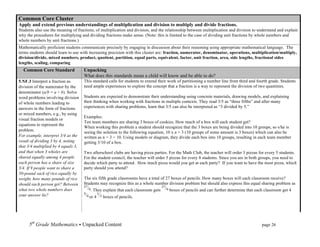
5.NF.3 Interpret a fraction as       This standard calls for students to extend their work of partitioning a number line from third and fourth grade. Students
division of the numerator by the     need ample experiences to explore the concept that a fraction is a way to represent the division of two quantities.
denominator (a/b = a ÷ b). Solve
word problems involving division     Students are expected to demonstrate their understanding using concrete materials, drawing models, and explaining
of whole numbers leading to          their thinking when working with fractions in multiple contexts. They read 3/5 as “three fifths” and after many
answers in the form of fractions     experiences with sharing problems, learn that 3/5 can also be interpreted as “3 divided by 5.”
or mixed numbers, e.g., by using
                                     Examples:
visual fraction models or
                                     Ten team members are sharing 3 boxes of cookies. How much of a box will each student get?
equations to represent the
                                     When working this problem a student should recognize that the 3 boxes are being divided into 10 groups, so s/he is
problem.                             seeing the solution to the following equation, 10 x n = 3 (10 groups of some amount is 3 boxes) which can also be
For example, interpret 3/4 as the    written as n = 3 ÷ 10. Using models or diagram, they divide each box into 10 groups, resulting in each team member
result of dividing 3 by 4, noting    getting 3/10 of a box.
that 3/4 multiplied by 4 equals 3,
and that when 3 wholes are           Two afterschool clubs are having pizza parties. For the Math Club, the teacher will order 3 pizzas for every 5 students.
shared equally among 4 people        For the student council, the teacher will order 5 pizzas for every 8 students. Since you are in both groups, you need to
each person has a share of size      decide which party to attend. How much pizza would you get at each party? If you want to have the most pizza, which
3/4. If 9 people want to share a     party should you attend?
50-pound sack of rice equally by
weight, how many pounds of rice      The six fifth grade classrooms have a total of 27 boxes of pencils. How many boxes will each classroom receive?
should each person get? Between      Students may recognize this as a whole number division problem but should also express this equal sharing problem as
what two whole numbers does             . They explain that each classroom gets      boxes of pencils and can further determine that each classroom get 4
your answer lie?                        or 4   boxes of pencils.


     5th Grade Mathematics • Unpacked Content	


      page 26	


Example:
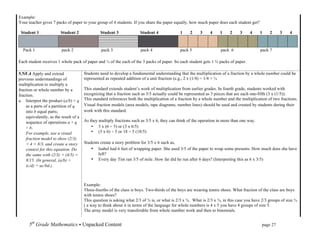
Your teacher gives 7 packs of paper to your group of 4 students. If you share the paper equally, how much paper does each student get?

 Student 1               Student 2              Student 3              Student 4             1     2     3    4           1   2          3          4   1    2        3   4


  Pack 1                 pack 2                 pack 3                 pack 4                pack 5                       pack 6                        pack 7

Each student receives 1 whole pack of paper and ¼ of the each of the 3 packs of paper. So each student gets 1 ¾ packs of paper.

5.NF.4 Apply and extend                Students need to develop a fundamental understanding that the multiplication of a fraction by a whole number could be
previous understandings of             represented as repeated addition of a unit fraction (e.g., 2 x (1/4) = 1/4 + ¼
multiplication to multiply a
fraction or whole number by a          This standard extends student’s work of multiplication from earlier grades. In fourth grade, students worked with
fraction.                              recognizing that a fraction such as 3/5 actually could be represented as 3 pieces that are each one-fifth (3 x (1/5)).
a. Interpret the product (a/b) × q     This standard references both the multiplication of a fraction by a whole number and the multiplication of two fractions.
    as a parts of a partition of q     Visual fraction models (area models, tape diagrams, number lines) should be used and created by students during their
    into b equal parts;                work with this standard.
    equivalently, as the result of a
    sequence of operations a × q       As they multiply fractions such as 3/5 x 6, they can think of the operation in more than one way.
    ÷ b.                                   • 3 x (6 ÷ 5) or (3 x 6/5)
    For example, use a visual              • (3 x 6) ÷ 5 or 18 ÷ 5 (18/5)
    fraction model to show (2/3)
    × 4 = 8/3, and create a story      Students create a story problem for 3/5 x 6 such as,
    context for this equation. Do          • Isabel had 6 feet of wrapping paper. She used 3/5 of the paper to wrap some presents. How much does she have
    the same with (2/3) × (4/5) =              left?
    8/15. (In general, (a/b) ×             • Every day Tim ran 3/5 of mile. How far did he run after 6 days? (Interpreting this as 6 x 3/5)
    (c/d) = ac/bd.)


                                       Example:
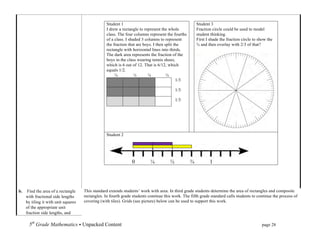
                                       Three-fourths of the class is boys. Two-thirds of the boys are wearing tennis shoes. What fraction of the class are boys
                                       with tennis shoes?
                                       This question is asking what 2/3 of ¾ is, or what is 2/3 x ¾. What is 2/3 x ¾, in this case you have 2/3 groups of size ¾
                                       ( a way to think about it in terms of the language for whole numbers is 4 x 5 you have 4 groups of size 5.
                                       The array model is very transferable from whole number work and then to binomials.


      5th Grade Mathematics • Unpacked Content	


         page 27	


Student 1                                           Student 3
                                                   I drew a rectangle to represent the whole           Fraction circle could be used to model
                                                   class. The four columns represent the fourths       student thinking.
                                                   of a class. I shaded 3 columns to represent         First I shade the fraction circle to show the
                                                   the fraction that are boys. I then split the        ¾ and then overlay with 2/3 of that?
                                                   rectangle with horizontal lines into thirds.
                                                   The dark area represents the fraction of the
                                                   boys in the class wearing tennis shoes,
                                                   which is 6 out of 12. That is 6/12, which
                                                   equals 1/2.
                                                        ¼           ¼      ¼           ¼
                                                                                             1/3

                                                                                           1/3

                                                                                           1/3


                                                   Student 2


                                                                 0          ¼          ½           ¾          1


b.    Find the area of a rectangle    This standard extends students’ work with area. In third grade students determine the area of rectangles and composite
     with fractional side lengths     rectangles. In fourth grade students continue this work. The fifth grade standard calls students to continue the process of
     by tiling it with unit squares   covering (with tiles). Grids (see picture) below can be used to support this work.
     of the appropriate unit
     fraction side lengths, and

      5th Grade Mathematics • Unpacked Content	


            page 28	


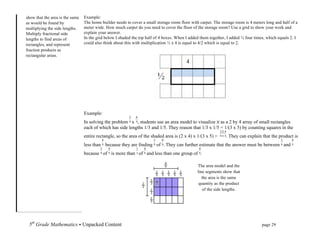
show that the area is the same   Example:
as would be found by             The home builder needs to cover a small storage room floor with carpet. The storage room is 4 meters long and half of a
multiplying the side lengths.    meter wide. How much carpet do you need to cover the floor of the storage room? Use a grid to show your work and
Multiply fractional side         explain your answer.
lengths to find areas of         In the grid below I shaded the top half of 4 boxes. When I added them together, I added ½ four times, which equals 2. I
rectangles, and represent        could also think about this with multiplication ½ x 4 is equal to 4/2 which is equal to 2.
fraction products as
rectangular areas.


                                 Example:
                                 In solving the problem x , students use an area model to visualize it as a 2 by 4 array of small rectangles
                                 each of which has side lengths 1/3 and 1/5. They reason that 1/3 x 1/5 = 1/(3 x 5) by counting squares in the
                                 entire rectangle, so the area of the shaded area is (2 x 4) x 1/(3 x 5) =          . They can explain that the product is
                                 less than because they are finding of . They can further estimate that the answer must be between and
                                 because of is more than of and less than one group of .

                                                                                                The area model and the
                                                                                                line segments show that
                                                                                                   the area is the same
                                                                                                 quantity as the product
                                                                                                   of the side lengths.


 5th Grade Mathematics • Unpacked Content	


      page 29	


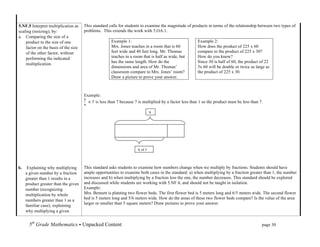
5.NF.5 Interpret multiplication as    This standard calls for students to examine the magnitude of products in terms of the relationship between two types of
scaling (resizing), by:               problems. This extends the work with 5.OA.1.
a. Comparing the size of a
    product to the size of one                       Example 1:                                        Example 2:
    factor on the basis of the size                  Mrs. Jones teaches in a room that is 60           How does the product of 225 x 60
    of the other factor, without                     feet wide and 40 feet long. Mr. Thomas            compare to the product of 225 x 30?
    performing the indicated                         teaches in a room that is half as wide, but       How do you know?
                                                     has the same length. How do the                   Since 30 is half of 60, the product of 22
    multiplication.
                                                     dimensions and area of Mr. Thomas’                5x 60 will be double or twice as large as
                                                     classroom compare to Mrs. Jones’ room?            the product of 225 x 30.
                                                     Draw a picture to prove your answer.


                                      Example:
                                           is less than 7 because 7 is multiplied by a factor less than 1 so the product must be less than 7.

                                                                                        7	


                                                                     ¾	
  of	
  7	
  
                                                                     77of	
  
                                                                     7of	
  7	
  
b.    Explaining why multiplying      This standard asks students to examine how numbers change when we multiply by fractions. Students should have
     a given number by a fraction     ample opportunities to examine both cases in the standard: a) when multiplying by a fraction greater than 1, the number
     greater than 1 results in a      increases and b) when multiplying by a fraction less the one, the number decreases. This standard should be explored
     product greater than the given   and discussed while students are working with 5.NF.4, and should not be taught in isolation.
     number (recognizing              Example:
     multiplication by whole          Mrs. Bennett is planting two flower beds. The first flower bed is 5 meters long and 6/5 meters wide. The second flower
     numbers greater than 1 as a      bed is 5 meters long and 5/6 meters wide. How do the areas of these two flower beds compare? Is the value of the area
                                      larger or smaller than 5 square meters? Draw pictures to prove your answer.
     familiar case); explaining
     why multiplying a given


       5th Grade Mathematics • Unpacked Content	


      page 30	


number by a fraction less than   Example:
   1 results in a product smaller
                                                	
  
                                        x 8 must be more than 8 because 2 groups of 8 is 16 and         is almost 3 groups of 8. So the answer must be close to,
   than the given number; and
   relating the principle of        but less than 24.
   fraction equivalence a/b = (n
                                    3   =   5 x 3 because multiplying 3 by 5 is the same as multiplying by 1.
   × a)/(n × b) to the effect of
                                    4       5x4                       4    5
   multiplying a/b by 1.
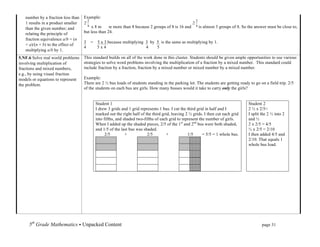
5.NF.6 Solve real world problems    This standard builds on all of the work done in this cluster. Students should be given ample opportunities to use various
involving multiplication of         strategies to solve word problems involving the multiplication of a fraction by a mixed number. This standard could
fractions and mixed numbers,        include fraction by a fraction, fraction by a mixed number or mixed number by a mixed number.
e.g., by using visual fraction
models or equations to represent    Example:
the problem.                        There are 2 ½ bus loads of students standing in the parking lot. The students are getting ready to go on a field trip. 2/5
                                    of the students on each bus are girls. How many busses would it take to carry only the girls?


                                            Student 1                                                                                     Student 2
                                            I drew 3 grids and 1 grid represents 1 bus. I cut the third grid in half and I                2 ½ x 2/5=
                                            marked out the right half of the third grid, leaving 2 ½ grids. I then cut each grid          I split the 2 ½ into 2
                                            into fifths, and shaded two-fifths of each grid to represent the number of girls.             and ½
                                            When I added up the shaded pieces, 2/5 of the 1st and 2nd bus were both shaded,               2 x 2/5 = 4/5
                                            and 1/5 of the last bus was shaded.                                                           ½ x 2/5 = 2/10
                                                  2/5         +           2/5         +           1/5      = 5/5 = 1 whole bus.           I then added 4/5 and
                                                                                                                                          2/10. That equals 1
                                                                                                                                          whole bus load.


     5th Grade Mathematics • Unpacked Content	


             page 31	


Example:

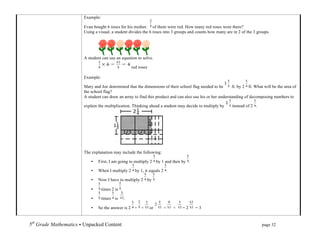
                             Evan bought 6 roses for his mother. of them were red. How many red roses were there?
                             Using a visual, a student divides the 6 roses into 3 groups and counts how many are in 2 of the 3 groups.


                             A student can use an equation to solve.

                                                           red roses

                             Example:

                             Mary and Joe determined that the dimensions of their school flag needed to be       ft. by 2 ft. What will be the area of
                             the school flag?
                             A student can draw an array to find this product and can also use his or her understanding of decomposing numbers to

                             explain the multiplication. Thinking ahead a student may decide to multiply by      instead of 2 .


                             The explanation may include the following:

                                 •   First, I am going to multiply 2 by 1 and then by .

                                 •   When I multiply 2 by 1, it equals 2 .

                                 •   Now I have to multiply 2 by .

                                 •      times 2 is .

                                 •      times is       .

                                 •   So the answer is 2 + +            or   +   +    =2     =3


5th Grade Mathematics • Unpacked Content	


      page 32	


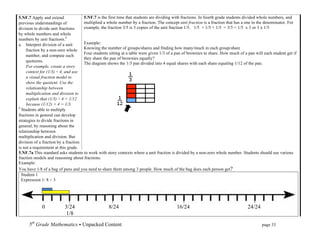
5.NF.7 Apply and extend              5.NF.7 is the first time that students are dividing with fractions. In fourth grade students divided whole numbers, and
previous understandings of           multiplied a whole number by a fraction. The concept unit fraction is a fraction that has a one in the denominator. For
division to divide unit fractions    example, the fraction 3/5 is 3 copies of the unit fraction 1/5. 1/5 + 1/5 + 1/5 = 3/5 = 1/5 x 3 or 3 x 1/5
by whole numbers and whole
numbers by unit fractions.1
a. Interpret division of a unit      Example:
     fraction by a non-zero whole    Knowing the number of groups/shares and finding how many/much in each group/share
                                     Four students sitting at a table were given 1/3 of a pan of brownies to share. How much of a pan will each student get if
     number, and compute such
                                     they share the pan of brownies equally?
     quotients.
                                     The diagram shows the 1/3 pan divided into 4 equal shares with each share equaling 1/12 of the pan.
     For example, create a story
     context for (1/3) ÷ 4, and use
     a visual fraction model to
     show the quotient. Use the
     relationship between
     multiplication and division to
     explain that (1/3) ÷ 4 = 1/12
     because (1/12) × 4 = 1/3.
1
  Students able to multiply
fractions in general can develop
strategies to divide fractions in
general, by reasoning about the
relationship between
multiplication and division. But
division of a fraction by a fraction
is not a requirement at this grade.
5.NF.7a This standard asks students to work with story contexts where a unit fraction is divided by a non-zero whole number. Students should use various
fraction models and reasoning about fractions.
Example:
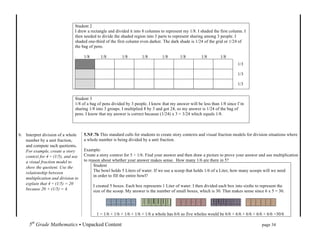
You have 1/8 of a bag of pens and you need to share them among 3 people. How much of the bag does each person get?
  Student 1
  Expression 1/ 8 ÷ 3


             0            3/24                     8/24                                  16/24                                     24/24
                          1/8
      5th Grade Mathematics • Unpacked Content	


       page 33	


                               Student 2
                               I drew a rectangle and divided it into 8 columns to represent my 1/8. I shaded the first column. I
                               then needed to divide the shaded region into 3 parts to represent sharing among 3 people. I
                               shaded one-third of the first column even darker. The dark shade is 1/24 of the grid or 1/24 of
                               the bag of pens.

                                    1/8       1/8         1/8        1/8         1/8       1/8         1/8              1/8
                                                                                                                                     1/3

                                                                                                                                     1/3

                                                                                                                                     1/3


                               Student 3
                               1/8 of a bag of pens divided by 3 people. I know that my answer will be less than 1/8 since I’m
                               sharing 1/8 into 3 groups. I multiplied 8 by 3 and got 24, so my answer is 1/24 of the bag of
                               pens. I know that my answer is correct because (1/24) x 3 = 3/24 which equals 1/8.


b. Interpret division of a whole    5.NF.7b This standard calls for students to create story contexts and visual fraction models for division situations where
   number by a unit fraction,       a whole number is being divided by a unit fraction.
   and compute such quotients.
   For example, create a story      Example:
   context for 4 ÷ (1/5), and use   Create a story context for 5 ÷ 1/6. Find your answer and then draw a picture to prove your answer and use multiplication
   a visual fraction model to       to reason about whether your answer makes sense. How many 1/6 are there in 5?
   show the quotient. Use the             Student
                                          The bowl holds 5 Liters of water. If we use a scoop that holds 1/6 of a Liter, how many scoops will we need
   relationship between
                                          in order to fill the entire bowl?
   multiplication and division to
   explain that 4 ÷ (1/5) = 20
                                          I created 5 boxes. Each box represents 1 Liter of water. I then divided each box into sixths to represent the
   because 20 × (1/5) = 4.                size of the scoop. My answer is the number of small boxes, which is 30. That makes sense since 6 x 5 = 30.


                                           1 = 1/6 + 1/6 + 1/6 + 1/6 + 1/6 a whole has 6/6 so five wholes would be 6/6 + 6/6 + 6/6 + 6/6 + 6/6 =30/6

       5th Grade Mathematics • Unpacked Content	


     page 34	


c. Solve real world problems          5.NF.7c extends students’ work from other standards in 5.NF.7. Student should continue to use visual fraction models
   involving division of unit         and reasoning to solve these real-world problems.
   fractions by non-zero whole
   numbers and division of            Example:
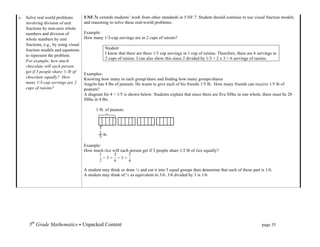
   whole numbers by unit              How many 1/3-cup servings are in 2 cups of raisins?
   fractions, e.g., by using visual
   fraction models and equations                  Student
                                                  I know that there are three 1/3 cup servings in 1 cup of raisins. Therefore, there are 6 servings in
   to represent the problem.
                                                  2 cups of raisins. I can also show this since 2 divided by 1/3 = 2 x 3 = 6 servings of raisins.
   For example, how much
   chocolate will each person
   get if 3 people share ½ lb of
                                      Examples:
   chocolate equally? How             Knowing how many in each group/share and finding how many groups/shares
   many 1/3-cup servings are 2        Angelo has 4 lbs of peanuts. He wants to give each of his friends 1/5 lb. How many friends can receive 1/5 lb of
   cups of raisins?                   peanuts?
                                      A diagram for 4 ÷ 1/5 is shown below. Students explain that since there are five fifths in one whole, there must be 20
                                      fifths in 4 lbs.

                                            1 lb. of peanuts


                                      Example:
                                      How much rice will each person get if 3 people share 1/2 lb of rice equally?


                                      A student may think or draw ½ and cut it into 3 equal groups then determine that each of those part is 1/6.
                                      A student may think of ½ as equivalent to 3/6. 3/6 divided by 3 is 1/6.


      5th Grade Mathematics • Unpacked Content	


      page 35	


Measurement and Data                                                                                                                                     5.MD
Common Core Cluster
Convert like measurement units within a given measurement system.
Mathematically proficient students communicate precisely by engaging in discussion about their reasoning using appropriate mathematical language. The
terms students should learn to use with increasing precision with this cluster are: conversion/convert, metric and customary measurement
From previous grades: relative size, liquid volume, mass, length, kilometer (km), meter (m), centimeter (cm), kilogram (kg), gram (g), liter (L),
milliliter (mL), inch (in), foot (ft), yard (yd), mile (mi), ounce (oz), pound (lb), cup (c), pint (pt), quart (qt), gallon (gal), hour, minute, second
     Common Core Standard                  Unpacking
                                           What do these standards mean a child will know and be able to do?
5.MD.1 Convert among different-sized       5.MD.1 calls for students to convert measurements within the same system of measurement in the context of
standard measurement units within a        multi-step, real-world problems. Both customary and standard measurement systems are included; students
given measurement system (e.g.,            worked with both metric and customary units of length in second grade. In third grade, students work with metric
convert 5 cm to 0.05 m), and use these     units of mass and liquid volume. In fourth grade, students work with both systems and begin conversions within
conversions in solving multi-step, real    systems in length, mass and volume.
world problems.                            Students should explore how the base-ten system supports conversions within the metric system.

                                           Example: 100 cm = 1 meter.


Common Core Cluster
Represent and interpret data.
Mathematically proficient students communicate precisely by engaging in discussion about their reasoning using appropriate mathematical language. The
terms students should learn to use with increasing precision with this cluster are: line plot, length, mass, liquid volume
     Common Core Standard                 Unpacking
                                          What do these standards mean a child will know and be able to do?
5. MD.2 Make a line plot to display a     5.MD.2 This standard provides a context for students to work with fractions by measuring objects to one-eighth of
data set of measurements in fractions     a unit. This includes length, mass, and liquid volume. Students are making a line plot of this data and then adding
of a unit (1/2, 1/4, 1/8). Use            and subtracting fractions based on data in the line plot.
operations on fractions for this grade
to solve problems involving
information presented in line plots.
For example, given different              Example:
                                          Students measured objects in their desk to the nearest ½, ¼, or 1/8 of an inch then displayed data collected on a line
measurements of liquid in identical
                                          plot. How many object measured ¼? ½? If you put all the objects together end to end what would be the total
beakers, find the amount of liquid
                                          length of all the objects?

      5th Grade Mathematics • Unpacked Content	


      page 36	


each beaker would contain if the total
amount in all the beakers were
redistributed equally.


                                         Example:
                                         Ten beakers, measured in liters, are filled with a liquid.


                                         The line plot above shows the amount of liquid in liters in 10 beakers. If the liquid is redistributed equally, how
                                         much liquid would each beaker have? (This amount is the mean.)

                                         Students apply their understanding of operations with fractions. They use either addition and/or multiplication to
                                         determine the total number of liters in the beakers. Then the sum of the liters is shared evenly among the ten
                                         beakers.


     5th Grade Mathematics • Unpacked Content	


      page 37	


Common Core Cluster
Geometric measurement: understand concepts of volume and relate volume to multiplication and to addition.
Students recognize volume as an attribute of three-dimensional space. They understand that volume can be measured by finding the total number of same-
size units of volume required to fill the space without gaps or overlaps. They understand that a 1-unit by 1-unit by 1-unit cube is the standard unit for
measuring volume. They select appropriate units, strategies, and tools for solving problems that involve estimating and measuring volume. They decompose
three-dimensional shapes and find volumes of right rectangular prisms by viewing them as decomposed into layers of arrays of cubes. They measure
necessary attributes of shapes in order to determine volumes to solve real world and mathematical problems.

Mathematically proficient students communicate precisely by engaging in discussion about their reasoning using appropriate mathematical language. The
terms students should learn to use with increasing precision with this cluster are: measurement, attribute, volume, solid figure, right rectangular prism,
unit, unit cube, gap, overlap, cubic units (cubic cm, cubic in. cubic ft. nonstandard cubic units), multiplication, addition, edge lengths, height,
area of base
      Common Core Standard                   Unpacking
                                             What do these standards mean a child will know and be able to do?
5. MD.3 Recognize volume as an               5. MD.3, 5.MD.4, and 5. MD.5 These standards represent the first time that students begin exploring the concept
attribute of solid figures and understand    of volume. In third grade, students begin working with area and covering spaces. The concept of volume should
concepts of volume measurement.              be extended from area with the idea that students are covering an area (the bottom of cube) with a layer of unit
a. A cube with side length 1 unit,           cubes and then adding layers of unit cubes on top of bottom layer (see picture below). Students should have
     called a “unit cube,” is said to have   ample experiences with concrete manipulatives before moving to pictorial representations. Students’ prior
     “one cubic unit” of volume, and can     experiences with volume were restricted to liquid volume. As students develop their understanding volume they
     be used to measure volume.              understand that a 1-unit by 1-unit by 1-unit cube is the standard unit for measuring volume. This cube has a
                                             length of 1 unit, a width of 1 unit and a height of 1 unit and is called a cubic unit. This cubic unit is written with
b. A solid figure which can be packed
                                             an exponent of 3 (e.g., in3, m3). Students connect this notation to their understanding of powers of 10 in our place
     without gaps or overlaps using n
                                             value system. Models of cubic inches, centimeters, cubic feet, etc are helpful in developing an image of a cubic
     unit cubes is said to have a volume     unit. Students estimate how many cubic yards would be needed to fill the classroom or how many cubic
     of n cubic units.                       centimeters would be needed to fill a pencil box.

5. MD.4 Measure volumes by counting
unit cubes, using cubic cm, cubic in,
cubic ft, and improvised units.                                                                                             (3 x 2) represented by first layer
5. MD.5 Relate volume to the                                                                                                (3 x 2) x 5 represented by number of
                                                                                                                            3 x 2 layers
operations of multiplication and
                                                                                                                            (3 x 2) + (3 x 2) + (3 x 2) + (3 x 2)+ (3 x
addition and solve real world and
                                                                                                                            2) = 6 + 6 + 6 + 6 + 6 + 6 = 30
mathematical problems involving
                                                                                                                            6 representing the size/area of one layer
volume.
a. Find the volume of a right
    rectangular prism with whole-                                                                                           	


      5th Grade Mathematics • Unpacked Content	


      page 38	


number side lengths by packing it       5. MD.5a & b These standards involve finding the volume of right rectangular prisms (see picture
   with unit cubes, and show that the      above).Students should have experiences to describe and reason about why the formula is true. Specifically, that
   volume is the same as would be          they are covering the bottom of a right rectangular prism (length x width) with multiple layers (height).
   found by multiplying the edge           Therefore, the formula (length x width x height) is an extension of the formula for the area of a rectangle.
   lengths, equivalently by multiplying
   the height by the area of the base.     5.MD.5c This standard calls for students to extend their work with the area of composite figures into the context
   Represent threefold whole-number        of volume. Students should be given concrete experiences of breaking apart (decomposing) 3-dimensional figures
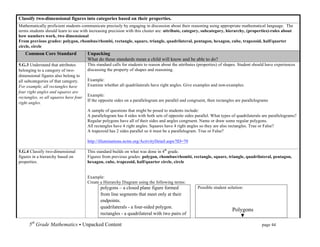
                                           into right rectangular prisms in order to find the volume of the entire 3-dimensional figure.
   products as volumes, e.g., to
                                                         Example:
   represent the associative property of
   multiplication.
b. Apply the formulas V = l × w × h                                                                       decomposed figure
   and V = b × h for rectangular prisms
   to find volumes of right rectangular
   prisms with whole-number edge
   lengths in the context of solving
   real world and mathematical
   problems.
c. Recognize volume as additive. Find
   volumes of solid figures composed                   Example:
   of two non-overlapping right
   rectangular prisms by adding the
   volumes of the non-overlapping
   parts, applying this technique to
   solve real world problems.


     5th Grade Mathematics • Unpacked Content	


      page 39	


Example:


                                   Students need multiple opportunities to measure volume by filling rectangular prisms with cubes and looking at
                                   the relationship between the total volume and the area of the base. They derive the volume formula (volume
                                   equals the area of the base times the height) and explore how this idea would apply to other prisms. Students use
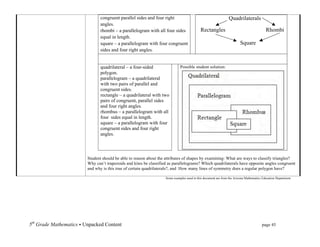
                                   the associative property of multiplication and decomposition of numbers using factors to investigate rectangular
                                   prisms with a given number of cubic units.

                                   Example:
                                   When given 24 cubes, students make as many rectangular prisms as possible with a volume of 24 cubic units.
                                   Students build the prisms and record possible dimensions.
                                                   Length            Width            Height

                                                        1                2                12

                                                        2                2                 6

                                                        4                2                 3

                                                        8                3                 1


                                   Example:
                                   Students determine the volume of concrete needed to build the steps in the diagram below.


5th Grade Mathematics • Unpacked Content	


            page 40	


Geometry                                                                                                                                                       5.G
Common Core Cluster
Graph points on the coordinate plane to solve real-world and mathematical problems.
Mathematically proficient students communicate precisely by engaging in discussion about their reasoning using appropriate mathematical language. The
terms students should learn to use with increasing precision with this cluster are: coordinate system, coordinate plane, first quadrant, points, lines,
axis/axes, x-axis, y-axis, horizontal, vertical, intersection of lines, origin, ordered pairs, coordinates, x-coordinate, y-coordinate
      Common Core Standard                   Unpacking
                                             What do these standards mean a child will know and be able to do?
5.G.1 Use a pair of perpendicular            5.G.1 and 5.G.2 These standards deal with only the first quadrant (positive numbers) in the coordinate plane.
number lines, called axes, to define a
coordinate system, with the intersection
of the lines (the origin) arranged to
coincide with the 0 on each line and a                       Example:
given point in the plane located by                          Connect these points in order on the coordinate grid below:
using an ordered pair of numbers, called                     (2, 2) (2, 4) (2, 6) (2, 8) (4, 5) (6, 8) (6, 6) (6, 4) and (6, 2).
its coordinates. Understand that the first
number indicates how far to travel from
the origin in the direction of one axis,
and the second number indicates how
                                                               What letter is formed on the grid?
far to travel in the direction of the
second axis, with the convention that
                                                                             Solution: “M” is formed.
the names of the two axes and the                              	
  
coordinates correspond (e.g., x-axis and
x-coordinate, y-axis and y-coordinate).


      5th Grade Mathematics • Unpacked Content	


     page 41	


Example:
                                                        Plot these points on a coordinate grid.
                                                                          Point A: (2,6)
                                                                          Point B: (4,6)
                                                                          Point C: (6,3)
                                                                          Point D: (2,3)
                                                        Connect the points in order. Make sure to connect Point D back to Point A.
                                                                1. What geometric figure is formed? What attributes did you use to
                                                                    identify it?
                                                                2. What line segments in this figure are parallel?
                                                                3. What line segments in this figure are perpendicular?
                                                        solutions: trapezoid, line segments AB and DC are parallel, segments AD and
                                                        DC are perpendicular

                                                        Example:
                                                        Emanuel draws a line segment from (1, 3) to (8, 10). He then draws a line
                                                        segment from (0, 2) to (7, 9). If he wants to draw another line segment that is
                                                        parallel to those two segments what points will he use?


5.G.2 Represent real world and          5.G.2 references real-world and mathematical problems, including the traveling from one point to another and
mathematical problems by graphing       identifying the coordinates of missing points in geometric figures, such as squares, rectangles, and
points in the first quadrant of the     parallelograms.
coordinate plane, and interpret
coordinate values of points in the
context of the situation.


     5th Grade Mathematics • Unpacked Content	


          page 42	


Example:
                                                      Using the coordinate grid, which
                                                      ordered pair represents the
                                                      location of the School?
                                                      Explain a possible path from the
                                                      school to the library.


                                      Example:	
  
                                      Sara has saved $20. She earns $8 for each hour she works.
                                      If Sara saves all of her money, how much will she have after working 3 hours? 5 hours? 10 hours?
                                      Create a graph that shows the relationship between the hours Sara worked and the amount of money she has
                                      saved.
                                      What other information do you know from analyzing the graph?
                                      Use the graph below to determine how much money Jack makes after working exactly 9 hours.


Common Core Cluster

   5th Grade Mathematics • Unpacked Content	


     page 43	


Classify two-dimensional figures into categories based on their properties.
Mathematically proficient students communicate precisely by engaging in discussion about their reasoning using appropriate mathematical language. The
terms students should learn to use with increasing precision with this cluster are: attribute, category, subcategory, hierarchy, (properties)-rules about
how numbers work, two dimensional
From previous grades: polygon, rhombus/rhombi, rectangle, square, triangle, quadrilateral, pentagon, hexagon, cube, trapezoid, half/quarter
circle, circle
   Common Core Standard                Unpacking
                                       What do these standards mean a child will know and be able to do?
5.G.3 Understand that attributes       This standard calls for students to reason about the attributes (properties) of shapes. Student should have experiences
belonging to a category of two-        discussing the property of shapes and reasoning.
dimensional figures also belong to
all subcategories of that category.    Example:
For example, all rectangles have       Examine whether all quadrilaterals have right angles. Give examples and non-examples.
four right angles and squares are
rectangles, so all squares have four   Example:
                                       If the opposite sides on a parallelogram are parallel and congruent, then rectangles are parallelograms
right angles.
                                       A sample of questions that might be posed to students include:
                                       A parallelogram has 4 sides with both sets of opposite sides parallel. What types of quadrilaterals are parallelograms?
                                       Regular polygons have all of their sides and angles congruent. Name or draw some regular polygons.
                                       All rectangles have 4 right angles. Squares have 4 right angles so they are also rectangles. True or False?
                                       A trapezoid has 2 sides parallel so it must be a parallelogram. True or False?

                                       http://illuminations.nctm.org/ActivityDetail.aspx?ID=70

5.G.4 Classify two-dimensional         This standard builds on what was done in 4th grade.
figures in a hierarchy based on        Figures from previous grades: polygon, rhombus/rhombi, rectangle, square, triangle, quadrilateral, pentagon,
properties.                            hexagon, cube, trapezoid, half/quarter circle, circle


                                       Example:
                                       Create a Hierarchy Diagram using the following terms:
                                              polygons – a closed plane figure formed                 Possible student solution:
                                              from line segments that meet only at their
                                              endpoints.
                                              quadrilaterals - a four-sided polygon.
                                                                                                                         Polygons
                                              rectangles - a quadrilateral with two pairs of

     5th Grade Mathematics • Unpacked Content	


     page 44	


congruent parallel sides and four right                                                                          Quadrilaterals
                                      angles.
                                      rhombi – a parallelogram with all four sides                              Rectangles                                                          Rhombi
                                      equal in length.
                                      square – a parallelogram with four congruent                                                                                       Square
                                      sides and four right angles.


                                      quadrilateral – a four-sided                  Possible student solution:	


                                      polygon.
                                      parallelogram – a quadrilateral
                                      with two pairs of parallel and
                                      congruent sides.
                                      rectangle – a quadrilateral with two
                                      pairs of congruent, parallel sides
                                      and four right angles.
                                      rhombus – a parallelogram with all
                                      four sides equal in length.
                                      square – a parallelogram with four
                                      congruent sides and four right
                                      angles.


                               Student should be able to reason about the attributes of shapes by examining: What are ways to classify triangles?
                               Why can’t trapezoids and kites be classified as parallelograms? Which quadrilaterals have opposite angles congruent
                               and why is this true of certain quadrilaterals?, and How many lines of symmetry does a regular polygon have?

                                                                          Some examples used in this document are from the Arizona Mathematics Education Department


5th Grade Mathematics • Unpacked Content	


     page 45	


Glossary
Table 1 Common addition and subtraction situations1
                                  Result Unknown                            Change Unknown                               Start Unknown
                       Two bunnies sat on the grass. Three        Two bunnies were sitting on the grass.     Some bunnies were sitting on the grass.
                       more bunnies hopped there. How many        Some more bunnies hopped there. Then       Three more bunnies hopped there. Then
          Add to       bunnies are on the grass now?              there were five bunnies. How many          there were five bunnies. How many
                       2+3=?                                      bunnies hopped over to the first two?      bunnies were on the grass before?
                                                                  2+?=5                                      ?+3=5
                       Five apples were on the table. I ate two   Five apples were on the table. I ate       Some apples were on the table. I ate two
                       apples. How many apples are on the         some apples. Then there were three         apples. Then there were three apples.
        Take from
                       table now?                                 apples. How many apples did I eat?         How many apples were on the table
                       5–2=?                                      5–?=3                                      before? ? – 2 = 3

                                    Total Unknown                            Addend Unknown                         Both Addends Unknown2
                       Three red apples and two green apples      Five apples are on the table. Three are    Grandma has five flowers. How many
                       are on the table. How many apples are      red and the rest are green. How many       can she put in her red vase and how
       Put Together/   on the table?                              apples are green?                          many in her blue vase?
        Take Apart3    3+2=?                                      3 + ? = 5, 5 – 3 = ?                       5 = 0 + 5, 5 = 5 + 0
                                                                                                             5 = 1 + 4, 5 = 4 + 1
                                                                                                             5 = 2 + 3, 5 = 3 + 2

                                Difference Unknown                            Bigger Unknown                             Smaller Unknown
                       (“How many more?” version):                (Version with “more”):                     (Version with “more”):
                       Lucy has two apples. Julie has five        Julie has three more apples than Lucy.     Julie has three more apples than Lucy.
                       apples. How many more apples does          Lucy has two apples. How many apples       Julie has five apples. How many apples
                       Julie have than Lucy?                      does Julie have?                           does Lucy have?
        Compare4     (“How many fewer?” version):                 (Version with “fewer”):                     (Version with “fewer”):
                     Lucy has two apples. Julie has five          Lucy has 3 fewer apples than Julie.         Lucy has 3 fewer apples than Julie.
                     apples. How many fewer apples does           Lucy has two apples. How many apples Julie has five apples. How many apples
                     Lucy have than Julie?                        does Julie have?                            does Lucy have?
                     2 + ? = 5, 5 – 2 = ?                         2 + 3 = ?, 3 + 2 = ?                        5 – 3 = ?, ? + 3 = 5
2
  These take apart situations can be used to show all the decompositions of a given number. The associated equations, which have the total on the left of
the equal sign, help children understand that the = sign does not always mean makes or results in but always does mean is the same number as.
3
  Either addend can be unknown, so there are three variations of these problem situations. Both Addends Unknown is a productive extension of this basic
situation, especially for small numbers less than or equal to 10.
4
  For the Bigger Unknown or Smaller Unknown situations, one version directs the correct operation (the version using more for the bigger unknown and
using less for the smaller unknown). The other versions are more difficult.
_________________
1
  Adapted from Box 2-4 of Mathematics Learning in Early Childhood, National Research Council (2009, pp. 32, 33).

5th Grade Mathematics • Unpacked Content	


       page 46	


Table 2 Common multiplication and division situations1
                          Unknown Product                           Group Size Unknown                             Number of Groups Unknown
                                                                (“How many in each group?”                       (“How many groups?” Division)
                                                                           Division)
                                3×6=?                             3 × ? = 18, and 18 ÷ 3 = ?                    ? × 6 = 18, and 18 ÷ 6 = ?
                  There are 3 bags with 6 plums in       If 18 plums are shared equally into 3 bags,     If 18 plums are to be packed 6 to a
                  each bag. How many plums are           then how many plums will be in each bag?        bag, then how many bags are needed?
                  there in all?
       Equal                                             Measurement example. You have 18 inches         Measurement example. You have 18
       Groups     Measurement example. You need 3        of string, which you will cut into 3 equal      inches of string, which you will cut
                  lengths of string, each 6 inches       pieces. How long will each piece of string      into pieces that are 6 inches long. How
                  long. How much string will you         be?                                             many pieces of string will you have?
                  need altogether?
                  There are 3 rows of apples with 6      If 18 apples are arranged into 3 equal rows,    If 18 apples are arranged into equal
                  apples in each row. How many           how many apples will be in each row?            rows of 6 apples, how many rows will
                  apples are there?                                                                      there be?
       Arrays,2
                                                         Area example. A rectangle has area 18
        Area3
                  Area example. What is the area of a    square centimeters. If one side is 3 cm long,   Area example. A rectangle has area 18
                  3 cm by 6 cm rectangle?                how long is a side next to it?                  square centimeters. If one side is 6 cm
                                                                                                         long, how long is a side next to it?
                  A blue hat costs $6. A red hat costs   A red hat costs $18 and that is 3 times as      A red hat costs $18 and a blue hat
                  3 times as much as the blue hat.       much as a blue hat costs. How much does a       costs $6. How many times as much
                  How much does the red hat cost?        blue hat cost?                                  does the red hat cost as the blue hat?

       Compare    Measurement example. A rubber          Measurement example. A rubber band is           Measurement example. A rubber band
                  band is 6 cm long. How long will       stretched to be 18 cm long and that is 3        was 6 cm long at first. Now it is
                  the rubber band be when it is          times as long as it was at first. How long      stretched to be 18 cm long. How many
                  stretched to be 3 times as long?       was the rubber band at first?                   times as long is the rubber band now as
                                                                                                         it was at first?
       General                  a×b=?                               a × ? = p, and p ÷ a = ?                     ? × b = p, and p ÷ b = ?

2
  The language in the array examples shows the easiest form of array problems. A harder form is to use the terms rows and columns: The apples in
the grocery window are in 3 rows and 6 columns. How many apples are in there? Both forms are valuable.
3
  Area involves arrays of squares that have been pushed together so that there are no gaps or overlaps, so array problems include these especially
important measurement situations.
1
  The first examples in each cell are examples of discrete things. These are easier for students and should be given before the measurement
examples.


5th Grade Mathematics • Unpacked Content	


     page 47	


Table 3 The properties of operations
Here a, b and c stand for arbitrary numbers in a given number system. The properties of operations apply to the rational number system, the real
number system, and the complex number system.


                  Associative property of addition                                           (a + b) + c = a + (b + c)


                 Commutative property of addition                                                  a+b=b+a


                    Additive identity property of 0                                              a+0=0+a=a


               Associative property of multiplication                                         (a × b) × c = a × (b × c)


              Commutative property of multiplication                                                a×b=b×a


                Multiplicative identity property of 1                                             a×1=1×a=a


       Distributive property of multiplication over addition                                 a × (b + c) = a × b + a × c


5th Grade Mathematics • Unpacked Content	


     page 48	


Instructional Support Tools

  • 1.
      5thGrade Mathematics Unpacked Content For the new Common Core State Standards that will be effective in all North Carolina schools in the 2012-13 school year. This document is designed to help North Carolina educators teach the Common Core (Standard Course of Study). NCDPI staff are continually updating and improving these tools to better serve teachers. What is the purpose of this document? To increase student achievement by ensuring educators understand specifically what the new standards mean a student must know, understand and be able to do. This document may also be used to facilitate discussion among teachers and curriculum staff and to encourage coherence in the sequence, pacing, and units of study for grade-level curricula. This document, along with on-going professional development, is one of many resources used to understand and teach the CCSS. What is in the document? Descriptions of what each standard means a student will know, understand and be able to do. The “unpacking” of the standards done in this document is an effort to answer a simple question “What does this standard mean that a student must know and be able to do?” and to ensure the description is helpful, specific and comprehensive for educators. How do I send Feedback? We intend the explanations and examples in this document to be helpful and specific. That said, we believe that as this document is used, teachers and educators will find ways in which the unpacking can be improved and made ever more useful. Please send feedback to us at feedback@dpi.state.nc.us and we will use your input to refine our unpacking of the standards. Thank You! Just want the standards alone? You can find the standards alone at http://corestandards.org/the-standards   5th Grade Mathematics Unpacked Content August, 2011  
  • 2.
    At A Glance Thispage provides a snapshot of the mathematical concepts that are new or have been removed from this grade level as well as instructional considerations for the first year of implementation. New to 5th Grade: • Patterns in zeros when multiplying (5.NBT.2) • Extend understandings of multiplication and division of fractions (5.NF.3, 5.NF.45.NF.5, 5.NF.7) • Conversions of measurements within the same system (5.MD.1) • Volume (5.MD.3, 5.MD.4, 5.MD.5) • Coordinate System (5.G.1, 5.02) • Two-dimensional figures – hierarchy (5.G.3, 5.G.4) • Line plot to display measurements (5.MD.2) Moved from 5th Grade: • Estimate measure of objects from on system to another system (2.01) • Measure of angles (2.01) • Describe triangles and quadrilaterals (3.01) • Angles, diagonals, parallelism and perpendicularity (3.02, 3.04) • Symmetry - line and rotational (3.03) • Data - stem-and-leaf plots, different representations, median, range and mode (4.01, 4.02, 4.03) • Constant and carrying rates of change (5.03) Notes: • Topics may appear to be similar between the CCSS and the 2003 NCSCOS; however, the CCSS may be presented at a higher cognitive demand. • For more detailed information see Math Crosswalks: http://www.dpi.state.nc.us/acre/standards/support-tools/ Instructional considerations for CCSS implementation in 2012-2013 • Develop a fundamental understanding that the multiplication of a fraction by a whole number could be presented as repeated addition of a unit fraction (e.g., 2 x (¼ ) = ¼ + ¼ ) before working with the concept of a fraction times a fraction. This concept will be taught in fourth grade next year. 5th Grade Mathematics • Unpacked Content             page 2    
  • 3.
    Standards for MathematicalPractices The Common Core State Standards for Mathematical Practice are expected to be integrated into every mathematics lesson for all students Grades K-12. Below are a few examples of how these Practices may be integrated into tasks that students complete. Mathematic Practices Explanations and Examples 1. Make sense of problems Mathematically proficient students in grade 5should solve problems by applying their understanding of operations with whole and persevere in solving numbers, decimals, and fractions including mixed numbers. They solve problems related to volume and measurement them. conversions. Students seek the meaning of a problem and look for efficient ways to represent and solve it. They may check their thinking by asking themselves, “What is the most efficient way to solve the problem?”, “Does this make sense?”, and “Can I solve the problem in a different way?”. 2. Reason abstractly and Mathematically proficient students in grade 5should recognize that a number represents a specific quantity. They connect quantitatively. quantities to written symbols and create a logical representation of the problem at hand, considering both the appropriate units involved and the meaning of quantities. They extend this understanding from whole numbers to their work with fractions and decimals. Students write simple expressions that record calculations with numbers and represent or round numbers using place value concepts. 3. Construct viable In fifth grade mathematical proficient students may construct arguments using concrete referents, such as objects, pictures, and arguments and critique the drawings. They explain calculations based upon models and properties of operations and rules that generate patterns. They reasoning of others. demonstrate and explain the relationship between volume and multiplication. They refine their mathematical communication skills as they participate in mathematical discussions involving questions like “How did you get that?” and “Why is that true?” They explain their thinking to others and respond to others’ thinking. 4. Model with mathematics. Mathematically proficient students in grade 5 experiment with representing problem situations in multiple ways including numbers, words (mathematical language), drawing pictures, using objects, making a chart, list, or graph, creating equations, etc. Students need opportunities to connect the different representations and explain the connections. They should be able to use all of these representations as needed. Fifth graders should evaluate their results in the context of the situation and whether the results make sense. They also evaluate the utility of models to determine which models are most useful and efficient to solve problems. 5. Use appropriate tools Mathematically proficient fifth graders consider the available tools (including estimation) when solving a mathematical problem strategically. and decide when certain tools might be helpful. For instance, they may use unit cubes to fill a rectangular prism and then use a ruler to measure the dimensions. They use graph paper to accurately create graphs and solve problems or make predictions from real world data. 6. Attend to precision. Mathematically proficient students in grade 5 continue to refine their mathematical communication skills by using clear and precise language in their discussions with others and in their own reasoning. Students use appropriate terminology when referring to expressions, fractions, geometric figures, and coordinate grids. They are careful about specifying units of measure and state the meaning of the symbols they choose. For instance, when figuring out the volume of a rectangular prism they record their answers in cubic units. 7. Look for and make use of In fifth grade mathematically proficient students look closely to discover a pattern or structure. For instance, students use structure. properties of operations as strategies to add, subtract, multiply and divide with whole numbers, fractions, and decimals. They examine numerical patterns and relate them to a rule or a graphical representation. 8. Look for and express Mathematically proficient fifth graders use repeated reasoning to understand algorithms and make generalizations about patterns. regularity in repeated Students connect place value and their prior work with operations to understand algorithms to fluently multiply multi-digit reasoning. numbers and perform all operations with decimals to hundredths. Students explore operations with fractions with visual models and begin to formulate generalizations. 5th Grade Mathematics • Unpacked Content             page 3    
  • 4.
    Grade 5 CriticalAreas The Critical Areas are designed to bring focus to the standards at each grade by describing the big ideas that educators can use to build their curriculum and to guide instruction. The Critical Areas for fifth grade can be found on page 33 in the Common Core State Standards for Mathematics.   1. Developing fluency with addition and subtraction of fractions, and developing understanding of the multiplication of fractions and of division of fractions in limited cases (unit fractions divided by whole numbers and whole numbers divided by unit fractions). Students apply their understanding of fractions and fraction models to represent the addition and subtraction of fractions with unlike denominators as equivalent calculations with like denominators. They develop fluency in calculating sums and differences of fractions, and make reasonable estimates of them. Students also use the meaning of fractions, of multiplication and division, and the relationship between multiplication and division to understand and explain why the procedures for multiplying and dividing fractions make sense. (Note: this is limited to the case of dividing unit fractions by whole numbers and whole numbers by unit fractions.) 2. Extending division to 2-digit divisors, integrating decimal fractions into the place value system and developing understanding of operations with decimals to hundredths, and developing fluency with whole number and decimal operations. Students develop understanding of why division procedures work based on the meaning of base-ten numerals and properties of operations. They finalize fluency with multi-digit addition, subtraction, multiplication, and division. They apply their understandings of models for decimals, decimal notation, and properties of operations to add and subtract decimals to hundredths. They develop fluency in these computations, and make reasonable estimates of their results. Students use the relationship between decimals and fractions, as well as the relationship between finite decimals and whole numbers (i.e., a finite decimal multiplied by an appropriate power of 10 is a whole number), to understand and explain why the procedures for multiplying and dividing finite decimals make sense. They compute products and quotients of decimals to hundredths efficiently and accurately. 3. Developing understanding of volume. Students recognize volume as an attribute of three-dimensional space. They understand that volume can be measured by finding the total number of same-size units of volume required to fill the space without gaps or overlaps. They understand that a 1-unit by 1-unit by 1-unit cube is the standard unit for measuring volume. They select appropriate units, strategies, and tools for solving problems that involve estimating and measuring volume. They decompose three-dimensional shapes and find volumes of right rectangular prisms by viewing them as decomposed into layers of arrays of cubes. They measure necessary attributes of shapes in order to determine volumes to solve real world and mathematical problems. 5th Grade Mathematics • Unpacked Content             page 4    
  • 5.
      Operations and AlgebraicThinking 5.0A Common Core Cluster Write and interpret numerical expressions. Mathematically proficient students communicate precisely by engaging in discussion about their reasoning using appropriate mathematical language. The terms students should learn to use with increasing precision with this cluster are: parentheses, brackets, braces, numerical expressions Common Core Standard Unpacking What do these standards mean a child will know and be able to do? 5.OA.1 Use parentheses, brackets, or The standard calls for students to evaluate expressions with parentheses ( ), brackets [ ] and braces { }. In upper braces in numerical expressions, and levels of mathematics, evaluate means to substitute for a variable and simplify the expression. However at this evaluate expressions with these level students are to only simplify the expressions because there are no variables. symbols. Example: Evaluate the expression 2{ 5[12 + 5(500 - 100) + 399]} Students should have experiences working with the order of first evaluating terms in parentheses, then brackets, and then braces. The first step would be to subtract 500 – 100 = 400. Then multiply 400 by 5 = 2,000. Inside the bracket, there is now [12 + 2,000 + 399]. That equals 2,411. Next multiply by the 5 outside of the bracket. 2,411 x 5 = 12,055. Next multiply by the 2 outside of the braces. 12,055 x 2= 24,110. Mathematically, there cannot be brackets or braces in a problem that does not have parentheses. Likewise, there cannot be braces in a problem that does not have both parentheses and brackets. This standard builds on the expectations of third grade where students are expected to start learning the conventional order. Students need experiences with multiple expressions that use grouping symbols throughout the year to develop understanding of when and how to use parentheses, brackets, and braces. First, students use these symbols with whole numbers. Then the symbols can be used as students add, subtract, multiply and divide decimals and fractions. Example: • (26 + 18) 4 Solution: 11 • {[2 x (3+5)] – 9} + [5 x (23-18)] Solution: 32 • 12 – (0.4 x 2) Solution: 11.2 • (2 + 3) x (1.5 – 0.5) Solution: 5 ⎛ 1 1 ⎞ 6 − ⎜ + ⎟ • ⎝ 2 3 ⎠ Solution: 5 1/6 • { 80 ÷ [ 2 x (3 ½ + 1 ½ ) ] }+ 100 Solution: 108 5th Grade Mathematics • Unpacked Content             page 5    
  • 6.
    To further developstudents’ understanding of grouping symbols and facility with operations, students place grouping symbols in equations to make the equations true or they compare expressions that are grouped differently. Example: • 15 - 7 – 2 = 10 → 15 - (7 – 2) = 10 • 3 x 125 ÷ 25 + 7 = 22 → [3 x (125 ÷ 25)] + 7 = 22 • 24 ÷ 12 ÷ 6 ÷ 2 = 2 x 9 + 3 ÷ ½ → 24 ÷ [(12 ÷ 6) ÷ 2] = (2 x 9) + (3 ÷ ½) • Compare 3 x 2 + 5 and 3 x (2 + 5) • Compare 15 – 6 + 7 and 15 – (6 + 7) 5.OA.2 Write simple expressions that This standard refers to expressions. Expressions are a series of numbers and symbols (+, -, x, ÷) without an equals record calculations with numbers, and sign. Equations result when two expressions are set equal to each other (2 + 3 = 4 + 1). interpret numerical expressions without Example: evaluating them. 4(5 + 3) is an expression. For example, express the calculation When we compute 4(5 + 3) we are evaluating the expression. The expression equals 32. “add 8 and 7, then multiply by 2” as 2 4(5 + 3) = 32 is an equation. × (8 + 7). Recognize that 3 × (18932 + 921) is three times as large as 18932 + This standard calls for students to verbally describe the relationship between expressions without actually 921, without having to calculate the calculating them. This standard calls for students to apply their reasoning of the four operations as well as place indicated sum or product. value while describing the relationship between numbers. The standard does not include the use of variables, only numbers and signs for operations. Example: Write an expression for the steps “double five and then add 26.” Student (2 x 5) + 26 Describe how the expression 5(10 x 10) relates to 10 x 10. Student The expression 5(10 x 10) is 5 times larger than the expression 10 x 10 since I know that I that 5(10 x 10) means that I have 5 groups of (10 x 10).         5th Grade Mathematics • Unpacked Content             page 6    
  • 7.
    Common Core Cluster Analyzepatterns and relationships. Mathematically proficient students communicate precisely by engaging in discussion about their reasoning using appropriate mathematical language. The terms students should learn to use with increasing precision with this cluster are: numerical patterns, rules, ordered pairs, coordinate plane Common Core Standard Unpacking What do these standards mean a child will know and be able to do? 5.OA.3 Generate two numerical This standard extends the work from Fourth Grade, where students generate numerical patterns when they are patterns using two given rules. Identify given one rule. In Fifth Grade, students are given two rules and generate two numerical patterns. The graphs that apparent relationships between are created should be line graphs to represent the pattern. This is a linear function which is why we get the corresponding terms. Form ordered straight lines. The Days are the independent variable, Fish are the dependent variables, and the constant rate is pairs consisting of corresponding terms what the rule identifies in the table. from the two patterns, and graph the Example: ordered pairs on a coordinate plane. Make a chart (table) to represent the number of fish that Sam and Terri catch. For example, given the rule “Add 3” and the starting number 0, and given Days Sam’s Total Terri’s Total the rule “Add 6” and the starting Number of Fish Number of Fish number 0, generate terms in the 0 0 0 resulting sequences, and observe that 1 2 4 the terms in one sequence are twice the corresponding terms in the other 2 4 8 sequence. Explain informally why this is 3 6 12 so. 4 8 16 5 10 20 Example:   Describe the pattern: Since Terri catches 4 fish each day, and Sam catches 2 fish, the amount of Terri’s fish is always greater. Terri’s fish is also always twice as much as Sam’s fish. Today, both Sam and Terri have no fish. They both go fishing each day. Sam catches 2 fish each day. Terri catches 4 fish each day. How many fish do they have after each of the five days? Make a graph of the number of fish. 5th Grade Mathematics • Unpacked Content             page 7    
  • 8.
    Plot the pointson a coordinate plane and make a line graph, and then interpret the graph. Student: My graph shows that Terri always has more fish than Sam. Terri’s fish increases at a higher rate since she catches 4 fish every day. Sam only catches 2 fish every day, so his number of fish increases at a smaller rate than Terri. Important to note as well that the lines become increasingly further apart. Identify apparent relationships between corresponding terms. Additional relationships: The two lines will never intersect; there will not be a day in which boys have the same total of fish, explain the relationship between the number of days that has passed and the number of fish a boy has (2n or 4n, n being the number of days). 5th Grade Mathematics • Unpacked Content             page 8    
  • 9.
    Example: Use the rule “add 3” to write a sequence of numbers. Starting with a 0, students write 0, 3, 6, 9, 12, . . . Use the rule “add 6” to write a sequence of numbers. Starting with 0, students write 0, 6, 12, 18, 24, . . . After comparing these two sequences, the students notice that each term in the second sequence is twice the corresponding terms of the first sequence. One way they justify this is by describing the patterns of the terms. Their justification may include some mathematical notation (See example below). A student may explain that both sequences start with zero and to generate each term of the second sequence he/she added 6, which is twice as much as was added to produce the terms in the first sequence. Students may also use the distributive property to describe the relationship between the two numerical patterns by reasoning that 6 + 6 + 6 = 2 (3 + 3 + 3). +3 +3 +3 +3 0, 3, 6, 9, 12, . . . +6 +6 +6 +6 0, 6, 12, 18, 24, . . . Once students can describe that the second sequence of numbers is twice the corresponding terms of the first sequence, the terms can be written in ordered pairs and then graphed on a coordinate grid. They should recognize that each point on the graph represents two quantities in which the second quantity is twice the first quantity. Ordered pairs (0, 0) (3, 6) (6, 12) (9, 18) (12, 24)           5th Grade Mathematics • Unpacked Content             page 9    
  • 10.
    Number and Operationsin Base Ten 5.NBT Common Core Cluster Understand the place value system. Mathematically proficient students communicate precisely by engaging in discussion about their reasoning using appropriate mathematical language. The terms students should learn to use with increasing precision with this cluster are: place value, decimal, decimal point, patterns, multiply, divide, tenths, thousands, greater than, less than, equal to, ‹, ›, =, compare/comparison, round   Common Core Standard Unpacking What do these standards mean a child will know and be able to do? 5.NBT.1 Recognize that in a multi-digit This standard calls for students to reason about the magnitude of numbers. Students should work with the idea number, a digit in one place represents that the tens place is ten times as much as the ones place, and the ones place is 1/10th the size of the tens place. 10 times as much as it represents in the In fourth grade, students examined the relationships of the digits in numbers for whole numbers only. This place to its right and 1/10 of what it standard extends this understanding to the relationship of decimal fractions. Students use base ten blocks, pictures represents in the place to its left. of base ten blocks, and interactive images of base ten blocks to manipulate and investigate the place value relationships. They use their understanding of unit fractions to compare decimal places and fractional language to describe those comparisons. Before considering the relationship of decimal fractions, students express their understanding that in multi-digit whole numbers, a digit in one place represents 10 times what it represents in the place to its right and 1/10 of what it represents in the place to its left. Example: The 2 in the number 542 is different from the value of the 2 in 324. The 2 in 542 represents 2 ones or 2, while the 2 in 324 represents 2 tens or 20. Since the 2 in 324 is one place to the left of the 2 in 542 the value of the 2 is 10 times greater. Meanwhile, the 4 in 542 represents 4 tens or 40 and the 4 in 324 represents 4 ones or 4. Since the 4 in 324 is one place to the right of the 4 in 542 the value of the 4 in the number 324 is 1/10th of its value in the number 542. Example: A student thinks, “I know that in the number 5555, the 5 in the tens place (5555) represents 50 and the 5 in the hundreds place (5555) represents 500. So a 5 in the hundreds place is ten times as much as a 5 in the tens place or a 5 in the tens place is 1/10 of the value of a 5 in the hundreds place. Base on the base-10 number system digits to the left are times as great as digits to the right; likewise, digits to the right are 1/10th of digits to the left. For example, the 8 in 845 has a value of 800 which is ten times as much as the 8 in the number 782. In the same spirit, the 8 in 782 is 1/10th the value of the 8 in 845. 5th Grade Mathematics • Unpacked Content             page 10    
  • 11.
    To extend thisunderstanding of place value to their work with decimals, students use a model of one unit; they cut it into 10 equal pieces, shade in, or describe 1/10 of that model using fractional language (“This is 1 out of 10 equal parts. So it is 1/10”. I can write this using 1/10 or 0.1”). They repeat the process by finding 1/10 of a 1/10 (e.g., dividing 1/10 into 10 equal parts to arrive at 1/100 or 0.01) and can explain their reasoning, “0.01 is 1/10 of 1/10 thus is 1/100 of the whole unit.” In the number 55.55, each digit is 5, but the value of the digits is different because of the placement. 5 5 . 5 5 The 5 that the arrow points to is 1/10 of the 5 to the left and 10 times the 5 to the right. The 5 in the ones place is 1/10 of 50 and 10 times five tenths. 5 5 . 5 5 The 5 that the arrow points to is 1/10 of the 5 to the left and 10 times the 5 to the right. The 5 in the tenths place is 10 times five hundredths. 5.NBT.2 Explain patterns in the number This standard includes multiplying by multiples of 10 and powers of 10, including 102 which is 10 x 10=100, and of zeros of the product when 103 which is 10 x 10 x 10=1,000. Students should have experiences working with connecting the pattern of the multiplying a number by powers of 10, number of zeros in the product when you multiply by powers of 10. and explain patterns in the placement of Example: the decimal point when a decimal is 2.5 x 103 = 2.5 x (10 x 10 x 10) = 2.5 x 1,000 = 2,500 Students should reason that the exponent above the 10 multiplied or divided by a power of 10. indicates how many places the decimal point is moving (not just that the decimal point is moving but that you are Use whole-number exponents to denote multiplying or making the number 10 times greater three times) when you multiply by a power of 10. Since we powers of 10. are multiplying by a power of 10 the decimal point moves to the right. 350 ÷ 103 = 350 ÷ 1,000 = 0.350 = 0.35 350/10 = 35, 35 /10 = 3.5 3.5 /10 =.0.35, or 350 x 1/10, 35 x 1/10, 5th Grade Mathematics • Unpacked Content             page 11    
  • 12.
    3.5 x 1/10this will relate well to subsequent work with operating with fractions. This example shows that when we divide by powers of 10, the exponent above the 10 indicates how many places the decimal point is moving (how many times we are dividing by 10 , the number becomes ten times smaller). Since we are dividing by powers of 10, the decimal point moves to the left. Students need to be provided with opportunities to explore this concept and come to this understanding; this should not just be taught procedurally. Example: Students might write: • 36 x 10 = 36 x 101 = 360 • 36 x 10 x 10 = 36 x 102 = 3600 • 36 x 10 x 10 x 10 = 36 x 103 = 36,000 • 36 x 10 x 10 x 10 x 10 = 36 x 104 = 360,000 Students might think and/or say: • I noticed that every time, I multiplied by 10 I added a zero to the end of the number. That makes sense because each digit’s value became 10 times larger. To make a digit 10 times larger, I have to move it one place value to the left. • When I multiplied 36 by 10, the 30 became 300. The 6 became 60 or the 36 became 360. So I had to add a zero at the end to have the 3 represent 3 one-hundreds (instead of 3 tens) and the 6 represents 6 tens (instead of 6 ones). Students should be able to use the same type of reasoning as above to explain why the following multiplication and division problem by powers of 10 make sense. • 523 x 103 = 523,000 The place value of 523 is increased by 3 places. • 5.223 x 102 = 522.3 The place value of 5.223 is increased by 2 places. • 52.3 ÷ 101 = 5.23 The place value of 52.3 is decreased by one place. 5.NBT.3 Read, write, and compare This standard references expanded form of decimals with fractions included. Students should build on their work decimals to thousandths. from Fourth Grade, where they worked with both decimals and fractions interchangeably. Expanded form is a. Read and write decimals to included to build upon work in 5.NBT.2 and deepen students’ understanding of place value. thousandths using base-ten Students build on the understanding they developed in fourth grade to read, write, and compare decimals to numerals, number names, and thousandths. They connect their prior experiences with using decimal notation for fractions and addition of expanded form, e.g., 347.392 = 3 × fractions with denominators of 10 and 100. They use concrete models and number lines to extend this 100 + 4 × 10 + 7 × 1 + 3 × (1/10) + understanding to decimals to the thousandths. Models may include base ten blocks, place value charts, grids, pictures, drawings, manipulatives, technology-based, etc. They read decimals using fractional language and write 9 x (1/100) + 2 x (1/1000) decimals in fractional form, as well as in expanded notation. This investigation leads them to understanding equivalence of decimals (0.8 = 0.80 = 0.800). 5th Grade Mathematics • Unpacked Content             page 12    
  • 13.
    b. Compare twodecimals to Comparing decimals builds on work from fourth grade. thousandths based on meanings of the digits in each place, using >, =, Example: and < symbols to record the results Some equivalent forms of 0.72 are: of comparisons. 72/100 70/100 + 2/100 7/10 + 2/100 0.720 7 x (1/10) + 2 x (1/100) 7 x (1/10) + 2 x (1/100) + 0 x (1/1000) 0.70 + 0.02 720/1000 Students need to understand the size of decimal numbers and relate them to common benchmarks such as 0, 0.5 (0.50 and 0.500), and 1. Comparing tenths to tenths, hundredths to hundredths, and thousandths to thousandths is simplified if students use their understanding of fractions to compare decimals. Example: Comparing 0.25 and 0.17, a student might think, “25 hundredths is more than 17 hundredths”. They may also think that it is 8 hundredths more. They may write this comparison as 0.25 > 0.17 and recognize that 0.17 < 0.25 is another way to express this comparison. Comparing 0.207 to 0.26, a student might think, “Both numbers have 2 tenths, so I need to compare the hundredths. The second number has 6 hundredths and the first number has no hundredths so the second number must be larger. Another student might think while writing fractions, “I know that 0.207 is 207 thousandths (and may write 207/1000). 0.26 is 26 hundredths (and may write 26/100) but I can also think of it as 260 thousandths (260/1000). So, 260 thousandths is more than 207 thousandths. 5.NBT.4 Use place value understanding This standard refers to rounding. Students should go beyond simply applying an algorithm or procedure for to round decimals to any place. rounding. The expectation is that students have a deep understanding of place value and number sense and can explain and reason about the answers they get when they round. Students should have numerous experiences using a number line to support their work with rounding. Example: Round 14.235 to the nearest tenth. Students recognize that the possible answer must be in tenths thus, it is either 14.2 or 14.3. They then identify that 14.235 is closer to 14.2 (14.20) than to 14.3 (14.30).                           Students should use benchmark numbers to support this work. Benchmarks are convenient numbers for comparing and rounding numbers. 0., 0.5, 1, 1.5 are examples of benchmark numbers. 5th Grade Mathematics • Unpacked Content             page 13    
  • 14.
    Example: Which benchmark number is the best estimate of the shaded amount in the model below? Explain your thinking.   Common Core Cluster Perform operations with multi-digit whole numbers and with decimals to hundredths. Students develop understanding of why division procedures work based on the meaning of base-ten numerals and properties of operations. They finalize fluency with multi-digit addition, subtraction, multiplication, and division. They apply their understandings of models for decimals, decimal notation, and properties of operations to add and subtract decimals to hundredths. They develop fluency in these computations, and make reasonable estimates of their results. Students use the relationship between decimals and fractions, as well as the relationship between finite decimals and whole numbers (i.e., a finite decimal multiplied by an appropriate power of 10 is a whole number), to understand and explain why the procedures for multiplying and dividing finite decimals make sense. They compute products and quotients of decimals to hundredths efficiently and accurately. Mathematically proficient students communicate precisely by engaging in discussion about their reasoning using appropriate mathematical language. The terms students should learn to use with increasing precision with this cluster are: multiplication/multiply, division/division, decimal, decimal point, tenths, hundredths, products, quotients, dividends, rectangular arrays, area models, addition/add, subtraction/subtract, (properties)-rules about how numbers work, reasoning Common Core Standard Unpacking What do these standards mean a child will know and be able to do? 5.NBT.5 Fluently multiply This standard refers to fluency which means accuracy (correct answer), efficiency (a reasonable amount of steps), and multi-digit whole numbers flexibility (using strategies such as the distributive property or breaking numbers apart also using strategies according to the using the standard algorithm. numbers in the problem, 26 x 4 may lend itself to (25 x 4 ) + 4 where as another problem might lend itself to making an equivalent problem 32 x 4 = 64 x 2)). This standard builds upon students’ work with multiplying numbers in third and fourth 5th Grade Mathematics • Unpacked Content             page 14    
  • 15.
    grade. In fourthgrade, students developed understanding of multiplication through using various strategies. While the standard algorithm is mentioned, alternative strategies are also appropriate to help students develop conceptual understanding. The size of the numbers should NOT exceed a three-digit factor by a two-digit factor. Examples of alternative strategies: There are 225 dozen cookies in the bakery. How many cookies are there? Student 1 Student 2 Student 3 225 x 12 225x12 I doubled 225 and cut I broke 12 up into I broke up 225 into 200 and 25. 12 in half to get 450 x 10 and 2. 200 x 12 = 2,400 6. I then doubled 450 225 x 10 = 2,250 I broke 25 up into 5 x 5, so I had 5 again and cut 6 in half 225 x 2 = 450 x 5 x12 or 5 x 12 x 5. to get 900 x 3. 2,250 + 450 = 5 x12= 60. 60 x 5 = 300 900 x 3 = 2,700. 2,700 I then added 2,400 and 300 2,400 + 300 = 2,700. Draw a array model for 225 x 12…. 200 x 10, 200 x 2, 20 x 10, 20 x 2, 5 x 10, 5 x 2 225 x 12 200 20 5 2,000 400 10 2,000 200 50 200 40 50 + 10 2 400 40 10 2,700 5.NBT.6 Find whole-number This standard references various strategies for division. Division problems can include remainders. Even though this quotients of whole numbers standard leads more towards computation, the connection to story contexts is critical. Make sure students are exposed to with up to four-digit dividends problems where the divisor is the number of groups and where the divisor is the size of the groups. In fourth grade, students’ experiences with division were limited to dividing by one-digit divisors. This standard extends students’ prior experiences 5th Grade Mathematics • Unpacked Content             page 15    
  • 16.
    and two-digit divisors,using with strategies, illustrations, and explanations. When the two-digit divisor is a “familiar” number, a student might strategies based on place value, decompose the dividend using place value. the properties of operations, and/or the relationship between Example: multiplication and division. There are 1,716 students participating in Field Day. They are put into teams of 16 for the competition. How many teams get Illustrate and explain the created? If you have left over students, what do you do with them? calculation by using equations, Student 1 Student 2 rectangular arrays, and/or area 1,716 divided by 16 1,716 divided by 16. models. There are 100 16’s in 1,716. There are 100 16’s in 1716 1,716 – 1,600 = 116 1,716. -1600 100 I know there are at least 6 16’s. Ten groups of 16 is 160. 116 116 - 96 = 20 That’s too big. -80 I can take out at least 1 more 16. Half of that is 80, which is 5 20 - 16 = 4 5 groups. 36 There were 107 teams with 4 students I know that 2 groups of -32 2 left over. If we put the extra students 16’s is 32. 4 on different team, 4 teams will have 17 I have 4 students left over. students. Student 3 Student 4 1,716 ÷ 16 = How many 16’s are in 1,716? I want to get to 1,716 We have an area of 1,716. I know that one side I know that 100 16’s equals 1,600 of my array is 16 units long. I used 16 as the I know that 5 16’s equals 80 height. I am trying to answer the question what 1,600 + 80 = 1,680 is the width of my rectangle if the area is 1,716 Two more groups of 16’s equals 32, and the height is 16. 100 + 7 = 107 R 4 which gets us to 1,712   I am 4 away from 1,716 So we had 100 + 6 + 1 = 107 teams 100 7 Those other 4 students can just hang   out 16 100 x 16 = 1,600 7 x 16   =112   1,716 - 1,600 = 116 116 - 112 = 4 5th Grade Mathematics • Unpacked Content             page 16    
  • 17.
    Example: Using expanded notation 2682 ÷ 25 = (2000 + 600 + 80 + 2) ÷ 25 Using understanding of the relationship between 100 and 25, a student might think ~ • I know that 100 divided by 25 is 4 so 200 divided by 25 is 8 and 2000 divided by 25 is 80. • 600 divided by 25 has to be 24. • Since 3 x 25 is 75, I know that 80 divided by 25 is 3 with a reminder of 5. (Note that a student might divide into 82 and not 80) • I can’t divide 2 by 25 so 2 plus the 5 leaves a remainder of 7. • 80 + 24 + 3 = 107. So, the answer is 107 with a remainder of 7. Using an equation that relates division to multiplication, 25 x n = 2682, a student might estimate the answer to be slightly larger than 100 because s/he recognizes that 25 x 100 = 2500. Example: 968 ÷ 21 Using base ten models, a student can represent 962 and use the models to make an array with one dimension of 21. The student continues to make the array until no more groups of 21 can be made. Remainders are not part of the array. Example: 9984 ÷ 64 An area model for division is shown below. As the student uses the area model, s/he keeps track of how much of the 9984 is left to divide. 5th Grade Mathematics • Unpacked Content             page 17    
  • 18.
    5.NBT.7 Add, subtract, This standard builds on the work from fourth grade where students are introduced to decimals and compare them. In fifth multiply, and divide decimals grade, students begin adding, subtracting, multiplying and dividing decimals. This work should focus on concrete models to hundredths, using concrete and pictorial representations, rather than relying solely on the algorithm. The use of symbolic notations involves having models or drawings and students record the answers to computations (2.25 x 3= 6.75), but this work should not be done without models or pictures. strategies based on place value, This standard includes students’ reasoning and explanations of how they use models, pictures, and strategies. properties of operations, and/or the relationship between addition and subtraction; relate This standard requires students to extend the models and strategies they developed for whole numbers in grades 1-4 to the strategy to a written method decimal values. Before students are asked to give exact answers, they should estimate answers based on their understanding and explain the reasoning used. of operations and the value of the numbers. Examples: • 3.6 + 1.7 A student might estimate the sum to be larger than 5 because 3.6 is more than 3 ½ and 1.7 is more than 1 ½. • 5.4 – 0.8 A student might estimate the answer to be a little more than 4.4 because a number less than 1 is being subtracted. • 6 x 2.4 A student might estimate an answer between 12 and 18 since 6 x 2 is 12 and 6 x 3 is 18. Another student might give an estimate of a little less than 15 because s/he figures the answer to be very close, but smaller than 6 x 2 ½ and think of 2 ½ groups of 6 as 12 (2 groups of 6) + 3 (½ of a group of 6). Students should be able to express that when they add decimals they add tenths to tenths and hundredths to hundredths. So, when they are adding in a vertical format (numbers beneath each other), it is important that they write numbers with the same place value beneath each other. This understanding can be reinforced by connecting addition of decimals to their understanding of addition of fractions. Adding fractions with denominators of 10 and 100 is a standard in fourth grade. Example: 4 - 0.3 3 tenths subtracted from 4 wholes. The wholes must be divided into tenths. The solution is 3 and 7/10 or 3.7. Additional examples on next page. 5th Grade Mathematics • Unpacked Content             page 18    
  • 19.
    Example: A recipe for a cake requires 1.25 cups of milk, 0.40 cups of oil, and 0.75 cups of water. How much liquid is in the mixing bowl? Student 1 1.25 + 0.40 + 0.75 First, I broke the numbers apart: I broke 1.25 into 1.00 + 0.20 + 0.05 I left 0.40 like it was. I broke 0.75 into 0.70 + 0.05 I combined my two 0.05s to get 0.10. I combined 0.40 and 0.20 to get 0.60. I added the 1 whole from 1.25. I ended up with 1 whole, 6 tenths, 7 more tenths and 1 1.00 0.20 0.05 more + 0.05 = 0.10 0.05 tenth which equals 2.40 cups. 0.40 .00 .00 0.70 0.05 .00 .00 0.40 + 0.20 = 0.60 Student 2 I saw that the 0.25 in 1.25 and the 0.75 for water would combine to equal 1 whole. I then added the 2 wholes and the 0.40 to get 2.40. .25 + .75 + 1 + .40 = 2.40 0 50 1 1.5 2 2.5 3 5th Grade Mathematics • Unpacked Content             page 19    
  • 20.
    Example of Multiplication: Agumball costs $0.22. How much do 5 gumballs cost? Estimate the total, and then calculate. Was your estimate close? I estimate that the total cost will be a little more than a dollar. I know that 5 20’s equal 100 and we have 5 22’s. I have 10 whole columns shaded and 10 individual boxes shaded. The 10 columns equal 1 whole. The 10 individual boxes equal 10 hundredths or 1 tenth. My answer is $1.10. My estimate was a little more than a dollar, and my answer was $1.10. I was really close. Example of Division: A relay race lasts 4.65 miles. The relay team has 3 runners. If each runner goes the same distance, how far does each team member run? Make an estimate, find your actual answer, and then compare them. Runner 1 Runner 3 Runner 1 Runner 2 Runner 3 Runner 2 My estimate is that each runner runs between 1 and 2 miles. If each runner went 2 miles, that would be a total of 6 miles which is too high. If each runner ran 1 mile, that would be 3 miles, which is too low. I used the 5 grids above to represent the 4.65 miles. I am going to use all of the first 4 grids and 65 of the squares in the 5th grid. I have to divide the 4 5th Grade Mathematics • Unpacked Content             page 20    
  • 21.
    whole grids andthe 65 squares into 3 equal groups. I labeled each of the first 3 grids for each runner, so I know that each team member ran at least 1 mile. I then have 1 whole grid and 65 squares to divide up. Each column represents one-tenth. If I give 5 columns to each runner, that means that each runner has run 1 whole mile and 5 tenths of a mile. Now, I have 15 squares left to divide up. Each runner gets 5 of those squares. So each runner ran 1 mile, 5 tenths and 5 hundredths of a mile. I can write that as 1.55 miles. My answer is 1.55 and my estimate was between 1 and 2 miles. I was pretty close. Additional multiplication and division examples: An area model can be useful for illustrating products. Students should be able to describe the partial products displayed by the area model. For example, “3/10 times 4/10 is 12/100. 3/10 times 2 is 6/10 or 60/100. 1 group of 4/10 is 4/10 or 40/100. 1 group of 2 is 2.” Example of division: finding the number in each group or share. Example of division: finding the number of groups. Students should be encouraged to apply a fair sharing model separating decimal values into equal parts such as Joe has 1.6 meters of rope. He has to cut pieces of rope that are 0.2 meters long. How many can he cut? Example of division: finding the number of groups. Students might count groups of 2 tenths without the use of Students could draw a segment to represent 1.6 meters. In doing so, models or diagrams. Knowing that 1 can be thought of as s/he would count in tenths to identify the 6 tenths, and be able 10/10, a student might think of 1.6 as 16 tenths. Counting 2 identify the number of 2 tenths within the 6 tenths. The student can tenths, 4 tenths, 6 tenths, . . .16 tenths, a student can count 8 then extend the idea of counting by tenths to divide the one meter groups of 2 tenths. into tenths and determine that there are 5 more groups of 2 tenths. Use their understanding of multiplication and think, “8 groups of 2 is 16, so 8 groups of 2/10 is 16/10 or 1 6/10.” 5th Grade Mathematics • Unpacked Content             page 21    
  • 22.
    Number and Operation– Fractions 5.NF Common Core Cluster Use equivalent fractions as a strategy to add and subtract fractions. Students apply their understanding of fractions and fraction models to represent the addition and subtraction of fractions with unlike denominators as equivalent calculations with like denominators. They develop fluency in calculating sums and differences of fractions, and make reasonable estimates of them. Mathematically proficient students communicate precisely by engaging in discussion about their reasoning using appropriate mathematical language. The terms students should learn to use with increasing precision with this cluster are: fraction, equivalent, addition/ add, sum, subtraction/subtract, difference, unlike denominator, numerator, benchmark fraction, estimate, reasonableness, mixed numbers Common Core Standard Unpacking What do these standards mean a child will know and be able to do? 5.NF.1 Add and subtract fractions with 5.NF.1 builds on the work in fourth grade where students add fractions with like denominators. In fifth grade, the unlike denominators (including mixed example provided in the standard has students find a common denominator by finding the product of both numbers) by replacing given fractions denominators. For 1/3 + 1/6, a common denominator is 18, which is the product of 3 and 6. This process should with equivalent fractions in such a way be introduced using visual fraction models (area models, number lines, etc.) to build understanding before moving as to produce an equivalent sum or into the standard algorithm. difference of fractions with like denominators. Students should apply their understanding of equivalent fractions and their ability to rewrite fractions in an For example, 2/3 + 5/4 = 8/12 + 15/12 equivalent form to find common denominators. They should know that multiplying the denominators will always = 23/12. (In general, a/b + c/d = (ad + give a common denominator but may not result in the smallest denominator. bc)/bd.) Examples: 2 7 16 35 51 + = + = 5 8 40 40 40 1 1 3 2 1 3 − =3 − =3 4 6 12 12 12 Example: Present students with the problem 1/3 + 1/6. Encourage students to use the clock face as a model for solving the problem. Have students share their approaches with the class and demonstrate their thinking using the clock model. 5th Grade Mathematics • Unpacked Content             page 22    
  • 23.
    5.NF.2 Solve wordproblems involving This standard refers to number sense, which means students’ understanding of fractions as numbers that lie addition and subtraction of fractions between whole numbers on a number line. Number sense in fractions also includes moving between decimals and referring to the same whole, including fractions to find equivalents, also being able to use reasoning such as 7/8 is greater than ¾ because 7/8 is missing cases of unlike denominators, e.g., by only 1/8 and ¾ is missing ¼ so 7/8 is closer to a whole Also, students should use benchmark fractions to estimate using visual fraction models or and examine the reasonableness of their answers. Example here such as 5/8 is greater than 6/10 because 5/8 is 1/8 equations to represent the problem. Use larger than ½(4/8) and 6/10 is only 1/10 larger than ½ (5/10) benchmark fractions and number sense Example: of fractions to estimate mentally and Your teacher gave you 1/7 of the bag of candy. She also gave your friend 1/3 of the bag of candy. If you and your assess the reasonableness of answers. friend combined your candy, what fraction of the bag would you have? Estimate your answer and then calculate. For example, recognize an incorrect How reasonable was your estimate? result 2/5 + 1/2 = 3/7, by observing that 3/7 < 1/2. Student 1 1/7 is really close to 0. 1/3 is larger than 1/7, but still less than 1/2. If we put them together we might get close to 1/2. 1/7 + 1/3= 3/21 + 7/21 = 10/21. The fraction does not simplify. I know that 10 is half of 20, so 10/21 is a little less than ½. Another example: 1/7 is close to 1/6 but less than 1/6, and 1/3 is equivalent to 2/6, so I have a little less than 3/6 or ½. Example: Jerry was making two different types of cookies. One recipe needed 3/4 cup of sugar and the other needed 2/3 cup of sugar. How much sugar did he need to make both recipes? • Mental estimation: 5th Grade Mathematics • Unpacked Content             page 23    
  • 24.
    A student maysay that Jerry needs more than 1 cup of sugar but less than 2 cups. An explanation may compare both fractions to ½ and state that both are larger than ½ so the total must be more than 1. In addition, both fractions are slightly less than 1 so the sum cannot be more than 2. • Area model 3 9 2 8 3 2 17 12 5 5 = = + = = + =1 4 12 3 12 4 3 12 12 12 12 • Linear model Solution: Example: Using a bar diagram • Sonia had 2 1/3 candy bars. She promised her brother that she would give him ½ of a candy bar. How much will she have left after she gives her brother the amount she promised? • If Mary ran 3 miles every week for 4 weeks, she would reach her goal for the month. The first day of the first week she ran 1 ¾ miles. How many miles does she still need to run the first week? o Using addition to find the answer:1 ¾ + n = 3 o A student might add 1 ¼ to 1 ¾ to get to 3 miles. Then he or she would add 1/6 more. Thus 1 ¼ miles + 1/6 of a mile is what Mary needs to run during that week. 5th Grade Mathematics • Unpacked Content             page 24    
  • 25.
    Example: Using anarea model to subtract • This model shows 1 ¾ subtracted from 3 1/6 leaving 1 + ¼ = 1/6 which a student can then change to 1 + 3/12 + 2/12 = 1 5/12. 3 1/6 can be expressed with a denominator of 12. Once this is done a student can complete the problem, 2 14/12 – 1 9/12 = 1 5/12. • This diagram models a way to show how 3 1/6 and 1 ¾ can be expressed with a denominator of 12. Once this is accomplished, a student can complete the problem, 2 14/12 – 1 9/12 = 1 5/12. Estimation skills include identifying when estimation is appropriate, determining the level of accuracy needed, selecting the appropriate method of estimation, and verifying solutions or determining the reasonableness of situations using various estimation strategies. Estimation strategies for calculations with fractions extend from students’ work with whole number operations and can be supported through the use of physical models. Example: Elli drank 3/5 quart of milk and Javier drank 1/10 of a quart less than Ellie. How much milk did they drink all together? Solution: This is how much milk Javier drank. Together they drank 1 1/10 quarts of milk. This solution is reasonable because Ellie drank more than ½ quart and Javier drank ½ quart so together they drank slightly more than one quart.   5th Grade Mathematics • Unpacked Content             page 25    
  • 26.
    Common Core Cluster Applyand extend previous understandings of multiplication and division to multiply and divide fractions. Students also use the meaning of fractions, of multiplication and division, and the relationship between multiplication and division to understand and explain why the procedures for multiplying and dividing fractions make sense. (Note: this is limited to the case of dividing unit fractions by whole numbers and whole numbers by unit fractions.) Mathematically proficient students communicate precisely by engaging in discussion about their reasoning using appropriate mathematical language. The terms students should learn to use with increasing precision with this cluster are: fraction, numerator, denominator, operations, multiplication/multiply, division/divide, mixed numbers, product, quotient, partition, equal parts, equivalent, factor, unit fraction, area, side lengths, fractional sides lengths, scaling, comparing Common Core Standard Unpacking What does this standards mean a child will know and be able to do? 5.NF.3 Interpret a fraction as This standard calls for students to extend their work of partitioning a number line from third and fourth grade. Students division of the numerator by the need ample experiences to explore the concept that a fraction is a way to represent the division of two quantities. denominator (a/b = a ÷ b). Solve word problems involving division Students are expected to demonstrate their understanding using concrete materials, drawing models, and explaining of whole numbers leading to their thinking when working with fractions in multiple contexts. They read 3/5 as “three fifths” and after many answers in the form of fractions experiences with sharing problems, learn that 3/5 can also be interpreted as “3 divided by 5.” or mixed numbers, e.g., by using Examples: visual fraction models or Ten team members are sharing 3 boxes of cookies. How much of a box will each student get? equations to represent the When working this problem a student should recognize that the 3 boxes are being divided into 10 groups, so s/he is problem. seeing the solution to the following equation, 10 x n = 3 (10 groups of some amount is 3 boxes) which can also be For example, interpret 3/4 as the written as n = 3 ÷ 10. Using models or diagram, they divide each box into 10 groups, resulting in each team member result of dividing 3 by 4, noting getting 3/10 of a box. that 3/4 multiplied by 4 equals 3, and that when 3 wholes are Two afterschool clubs are having pizza parties. For the Math Club, the teacher will order 3 pizzas for every 5 students. shared equally among 4 people For the student council, the teacher will order 5 pizzas for every 8 students. Since you are in both groups, you need to each person has a share of size decide which party to attend. How much pizza would you get at each party? If you want to have the most pizza, which 3/4. If 9 people want to share a party should you attend? 50-pound sack of rice equally by weight, how many pounds of rice The six fifth grade classrooms have a total of 27 boxes of pencils. How many boxes will each classroom receive? should each person get? Between Students may recognize this as a whole number division problem but should also express this equal sharing problem as what two whole numbers does . They explain that each classroom gets boxes of pencils and can further determine that each classroom get 4 your answer lie? or 4 boxes of pencils. 5th Grade Mathematics • Unpacked Content             page 26    
  • 27.
    Example: Your teacher gives7 packs of paper to your group of 4 students. If you share the paper equally, how much paper does each student get? Student 1 Student 2 Student 3 Student 4 1 2 3 4 1 2 3 4 1 2 3 4 Pack 1 pack 2 pack 3 pack 4 pack 5 pack 6 pack 7 Each student receives 1 whole pack of paper and ¼ of the each of the 3 packs of paper. So each student gets 1 ¾ packs of paper. 5.NF.4 Apply and extend Students need to develop a fundamental understanding that the multiplication of a fraction by a whole number could be previous understandings of represented as repeated addition of a unit fraction (e.g., 2 x (1/4) = 1/4 + ¼ multiplication to multiply a fraction or whole number by a This standard extends student’s work of multiplication from earlier grades. In fourth grade, students worked with fraction. recognizing that a fraction such as 3/5 actually could be represented as 3 pieces that are each one-fifth (3 x (1/5)). a. Interpret the product (a/b) × q This standard references both the multiplication of a fraction by a whole number and the multiplication of two fractions. as a parts of a partition of q Visual fraction models (area models, tape diagrams, number lines) should be used and created by students during their into b equal parts; work with this standard. equivalently, as the result of a sequence of operations a × q As they multiply fractions such as 3/5 x 6, they can think of the operation in more than one way. ÷ b. • 3 x (6 ÷ 5) or (3 x 6/5) For example, use a visual • (3 x 6) ÷ 5 or 18 ÷ 5 (18/5) fraction model to show (2/3) × 4 = 8/3, and create a story Students create a story problem for 3/5 x 6 such as, context for this equation. Do • Isabel had 6 feet of wrapping paper. She used 3/5 of the paper to wrap some presents. How much does she have the same with (2/3) × (4/5) = left? 8/15. (In general, (a/b) × • Every day Tim ran 3/5 of mile. How far did he run after 6 days? (Interpreting this as 6 x 3/5) (c/d) = ac/bd.) Example: Three-fourths of the class is boys. Two-thirds of the boys are wearing tennis shoes. What fraction of the class are boys with tennis shoes? This question is asking what 2/3 of ¾ is, or what is 2/3 x ¾. What is 2/3 x ¾, in this case you have 2/3 groups of size ¾ ( a way to think about it in terms of the language for whole numbers is 4 x 5 you have 4 groups of size 5. The array model is very transferable from whole number work and then to binomials. 5th Grade Mathematics • Unpacked Content             page 27    
  • 28.
    Student 1 Student 3 I drew a rectangle to represent the whole Fraction circle could be used to model class. The four columns represent the fourths student thinking. of a class. I shaded 3 columns to represent First I shade the fraction circle to show the the fraction that are boys. I then split the ¾ and then overlay with 2/3 of that? rectangle with horizontal lines into thirds. The dark area represents the fraction of the boys in the class wearing tennis shoes, which is 6 out of 12. That is 6/12, which equals 1/2. ¼ ¼ ¼ ¼ 1/3 1/3 1/3 Student 2       0 ¼ ½ ¾ 1 b. Find the area of a rectangle This standard extends students’ work with area. In third grade students determine the area of rectangles and composite with fractional side lengths rectangles. In fourth grade students continue this work. The fifth grade standard calls students to continue the process of by tiling it with unit squares covering (with tiles). Grids (see picture) below can be used to support this work. of the appropriate unit fraction side lengths, and 5th Grade Mathematics • Unpacked Content             page 28    
  • 29.
    show that thearea is the same Example: as would be found by The home builder needs to cover a small storage room floor with carpet. The storage room is 4 meters long and half of a multiplying the side lengths. meter wide. How much carpet do you need to cover the floor of the storage room? Use a grid to show your work and Multiply fractional side explain your answer. lengths to find areas of In the grid below I shaded the top half of 4 boxes. When I added them together, I added ½ four times, which equals 2. I rectangles, and represent could also think about this with multiplication ½ x 4 is equal to 4/2 which is equal to 2. fraction products as rectangular areas. Example: In solving the problem x , students use an area model to visualize it as a 2 by 4 array of small rectangles each of which has side lengths 1/3 and 1/5. They reason that 1/3 x 1/5 = 1/(3 x 5) by counting squares in the entire rectangle, so the area of the shaded area is (2 x 4) x 1/(3 x 5) = . They can explain that the product is less than because they are finding of . They can further estimate that the answer must be between and because of is more than of and less than one group of . The area model and the line segments show that the area is the same quantity as the product of the side lengths. 5th Grade Mathematics • Unpacked Content             page 29    
  • 30.
    5.NF.5 Interpret multiplicationas This standard calls for students to examine the magnitude of products in terms of the relationship between two types of scaling (resizing), by: problems. This extends the work with 5.OA.1. a. Comparing the size of a product to the size of one Example 1: Example 2: factor on the basis of the size Mrs. Jones teaches in a room that is 60 How does the product of 225 x 60 of the other factor, without feet wide and 40 feet long. Mr. Thomas compare to the product of 225 x 30? performing the indicated teaches in a room that is half as wide, but How do you know? has the same length. How do the Since 30 is half of 60, the product of 22 multiplication. dimensions and area of Mr. Thomas’ 5x 60 will be double or twice as large as classroom compare to Mrs. Jones’ room? the product of 225 x 30. Draw a picture to prove your answer. Example: is less than 7 because 7 is multiplied by a factor less than 1 so the product must be less than 7. 7   ¾  of  7   77of   7of  7   b. Explaining why multiplying This standard asks students to examine how numbers change when we multiply by fractions. Students should have a given number by a fraction ample opportunities to examine both cases in the standard: a) when multiplying by a fraction greater than 1, the number greater than 1 results in a increases and b) when multiplying by a fraction less the one, the number decreases. This standard should be explored product greater than the given and discussed while students are working with 5.NF.4, and should not be taught in isolation. number (recognizing Example: multiplication by whole Mrs. Bennett is planting two flower beds. The first flower bed is 5 meters long and 6/5 meters wide. The second flower numbers greater than 1 as a bed is 5 meters long and 5/6 meters wide. How do the areas of these two flower beds compare? Is the value of the area larger or smaller than 5 square meters? Draw pictures to prove your answer. familiar case); explaining why multiplying a given 5th Grade Mathematics • Unpacked Content             page 30    
  • 31.
    number by afraction less than Example: 1 results in a product smaller   x 8 must be more than 8 because 2 groups of 8 is 16 and is almost 3 groups of 8. So the answer must be close to, than the given number; and relating the principle of but less than 24. fraction equivalence a/b = (n 3 = 5 x 3 because multiplying 3 by 5 is the same as multiplying by 1. × a)/(n × b) to the effect of 4 5x4 4 5 multiplying a/b by 1. 5.NF.6 Solve real world problems This standard builds on all of the work done in this cluster. Students should be given ample opportunities to use various involving multiplication of strategies to solve word problems involving the multiplication of a fraction by a mixed number. This standard could fractions and mixed numbers, include fraction by a fraction, fraction by a mixed number or mixed number by a mixed number. e.g., by using visual fraction models or equations to represent Example: the problem. There are 2 ½ bus loads of students standing in the parking lot. The students are getting ready to go on a field trip. 2/5 of the students on each bus are girls. How many busses would it take to carry only the girls? Student 1 Student 2 I drew 3 grids and 1 grid represents 1 bus. I cut the third grid in half and I 2 ½ x 2/5= marked out the right half of the third grid, leaving 2 ½ grids. I then cut each grid I split the 2 ½ into 2 into fifths, and shaded two-fifths of each grid to represent the number of girls. and ½ When I added up the shaded pieces, 2/5 of the 1st and 2nd bus were both shaded, 2 x 2/5 = 4/5 and 1/5 of the last bus was shaded. ½ x 2/5 = 2/10 2/5 + 2/5 + 1/5 = 5/5 = 1 whole bus. I then added 4/5 and 2/10. That equals 1 whole bus load. 5th Grade Mathematics • Unpacked Content             page 31    
  • 32.
    Example: Evan bought 6 roses for his mother. of them were red. How many red roses were there? Using a visual, a student divides the 6 roses into 3 groups and counts how many are in 2 of the 3 groups. A student can use an equation to solve. red roses Example: Mary and Joe determined that the dimensions of their school flag needed to be ft. by 2 ft. What will be the area of the school flag? A student can draw an array to find this product and can also use his or her understanding of decomposing numbers to explain the multiplication. Thinking ahead a student may decide to multiply by instead of 2 . The explanation may include the following: • First, I am going to multiply 2 by 1 and then by . • When I multiply 2 by 1, it equals 2 . • Now I have to multiply 2 by . • times 2 is . • times is . • So the answer is 2 + + or + + =2 =3 5th Grade Mathematics • Unpacked Content             page 32    
  • 33.
    5.NF.7 Apply andextend 5.NF.7 is the first time that students are dividing with fractions. In fourth grade students divided whole numbers, and previous understandings of multiplied a whole number by a fraction. The concept unit fraction is a fraction that has a one in the denominator. For division to divide unit fractions example, the fraction 3/5 is 3 copies of the unit fraction 1/5. 1/5 + 1/5 + 1/5 = 3/5 = 1/5 x 3 or 3 x 1/5 by whole numbers and whole numbers by unit fractions.1 a. Interpret division of a unit Example: fraction by a non-zero whole Knowing the number of groups/shares and finding how many/much in each group/share Four students sitting at a table were given 1/3 of a pan of brownies to share. How much of a pan will each student get if number, and compute such they share the pan of brownies equally? quotients. The diagram shows the 1/3 pan divided into 4 equal shares with each share equaling 1/12 of the pan. For example, create a story context for (1/3) ÷ 4, and use a visual fraction model to show the quotient. Use the relationship between multiplication and division to explain that (1/3) ÷ 4 = 1/12 because (1/12) × 4 = 1/3. 1 Students able to multiply fractions in general can develop strategies to divide fractions in general, by reasoning about the relationship between multiplication and division. But division of a fraction by a fraction is not a requirement at this grade. 5.NF.7a This standard asks students to work with story contexts where a unit fraction is divided by a non-zero whole number. Students should use various fraction models and reasoning about fractions. Example: You have 1/8 of a bag of pens and you need to share them among 3 people. How much of the bag does each person get? Student 1 Expression 1/ 8 ÷ 3     0 3/24 8/24 16/24 24/24 1/8 5th Grade Mathematics • Unpacked Content             page 33    
  • 34.
      Student 2 I drew a rectangle and divided it into 8 columns to represent my 1/8. I shaded the first column. I then needed to divide the shaded region into 3 parts to represent sharing among 3 people. I shaded one-third of the first column even darker. The dark shade is 1/24 of the grid or 1/24 of the bag of pens. 1/8 1/8 1/8 1/8 1/8 1/8 1/8 1/8 1/3 1/3 1/3 Student 3 1/8 of a bag of pens divided by 3 people. I know that my answer will be less than 1/8 since I’m sharing 1/8 into 3 groups. I multiplied 8 by 3 and got 24, so my answer is 1/24 of the bag of pens. I know that my answer is correct because (1/24) x 3 = 3/24 which equals 1/8. b. Interpret division of a whole 5.NF.7b This standard calls for students to create story contexts and visual fraction models for division situations where number by a unit fraction, a whole number is being divided by a unit fraction. and compute such quotients. For example, create a story Example: context for 4 ÷ (1/5), and use Create a story context for 5 ÷ 1/6. Find your answer and then draw a picture to prove your answer and use multiplication a visual fraction model to to reason about whether your answer makes sense. How many 1/6 are there in 5? show the quotient. Use the Student The bowl holds 5 Liters of water. If we use a scoop that holds 1/6 of a Liter, how many scoops will we need relationship between in order to fill the entire bowl? multiplication and division to explain that 4 ÷ (1/5) = 20 I created 5 boxes. Each box represents 1 Liter of water. I then divided each box into sixths to represent the because 20 × (1/5) = 4. size of the scoop. My answer is the number of small boxes, which is 30. That makes sense since 6 x 5 = 30. 1 = 1/6 + 1/6 + 1/6 + 1/6 + 1/6 a whole has 6/6 so five wholes would be 6/6 + 6/6 + 6/6 + 6/6 + 6/6 =30/6 5th Grade Mathematics • Unpacked Content             page 34    
  • 35.
    c. Solve realworld problems 5.NF.7c extends students’ work from other standards in 5.NF.7. Student should continue to use visual fraction models involving division of unit and reasoning to solve these real-world problems. fractions by non-zero whole numbers and division of Example: whole numbers by unit How many 1/3-cup servings are in 2 cups of raisins? fractions, e.g., by using visual fraction models and equations Student I know that there are three 1/3 cup servings in 1 cup of raisins. Therefore, there are 6 servings in to represent the problem. 2 cups of raisins. I can also show this since 2 divided by 1/3 = 2 x 3 = 6 servings of raisins. For example, how much chocolate will each person get if 3 people share ½ lb of Examples: chocolate equally? How Knowing how many in each group/share and finding how many groups/shares many 1/3-cup servings are 2 Angelo has 4 lbs of peanuts. He wants to give each of his friends 1/5 lb. How many friends can receive 1/5 lb of cups of raisins? peanuts? A diagram for 4 ÷ 1/5 is shown below. Students explain that since there are five fifths in one whole, there must be 20 fifths in 4 lbs. 1 lb. of peanuts Example: How much rice will each person get if 3 people share 1/2 lb of rice equally? A student may think or draw ½ and cut it into 3 equal groups then determine that each of those part is 1/6. A student may think of ½ as equivalent to 3/6. 3/6 divided by 3 is 1/6. 5th Grade Mathematics • Unpacked Content             page 35    
  • 36.
    Measurement and Data 5.MD Common Core Cluster Convert like measurement units within a given measurement system. Mathematically proficient students communicate precisely by engaging in discussion about their reasoning using appropriate mathematical language. The terms students should learn to use with increasing precision with this cluster are: conversion/convert, metric and customary measurement From previous grades: relative size, liquid volume, mass, length, kilometer (km), meter (m), centimeter (cm), kilogram (kg), gram (g), liter (L), milliliter (mL), inch (in), foot (ft), yard (yd), mile (mi), ounce (oz), pound (lb), cup (c), pint (pt), quart (qt), gallon (gal), hour, minute, second Common Core Standard Unpacking What do these standards mean a child will know and be able to do? 5.MD.1 Convert among different-sized 5.MD.1 calls for students to convert measurements within the same system of measurement in the context of standard measurement units within a multi-step, real-world problems. Both customary and standard measurement systems are included; students given measurement system (e.g., worked with both metric and customary units of length in second grade. In third grade, students work with metric convert 5 cm to 0.05 m), and use these units of mass and liquid volume. In fourth grade, students work with both systems and begin conversions within conversions in solving multi-step, real systems in length, mass and volume. world problems. Students should explore how the base-ten system supports conversions within the metric system. Example: 100 cm = 1 meter.   Common Core Cluster Represent and interpret data. Mathematically proficient students communicate precisely by engaging in discussion about their reasoning using appropriate mathematical language. The terms students should learn to use with increasing precision with this cluster are: line plot, length, mass, liquid volume Common Core Standard Unpacking What do these standards mean a child will know and be able to do? 5. MD.2 Make a line plot to display a 5.MD.2 This standard provides a context for students to work with fractions by measuring objects to one-eighth of data set of measurements in fractions a unit. This includes length, mass, and liquid volume. Students are making a line plot of this data and then adding of a unit (1/2, 1/4, 1/8). Use and subtracting fractions based on data in the line plot. operations on fractions for this grade to solve problems involving information presented in line plots. For example, given different Example: Students measured objects in their desk to the nearest ½, ¼, or 1/8 of an inch then displayed data collected on a line measurements of liquid in identical plot. How many object measured ¼? ½? If you put all the objects together end to end what would be the total beakers, find the amount of liquid length of all the objects? 5th Grade Mathematics • Unpacked Content             page 36    
  • 37.
    each beaker wouldcontain if the total amount in all the beakers were redistributed equally. Example: Ten beakers, measured in liters, are filled with a liquid. The line plot above shows the amount of liquid in liters in 10 beakers. If the liquid is redistributed equally, how much liquid would each beaker have? (This amount is the mean.) Students apply their understanding of operations with fractions. They use either addition and/or multiplication to determine the total number of liters in the beakers. Then the sum of the liters is shared evenly among the ten beakers. 5th Grade Mathematics • Unpacked Content             page 37    
  • 38.
    Common Core Cluster Geometricmeasurement: understand concepts of volume and relate volume to multiplication and to addition. Students recognize volume as an attribute of three-dimensional space. They understand that volume can be measured by finding the total number of same- size units of volume required to fill the space without gaps or overlaps. They understand that a 1-unit by 1-unit by 1-unit cube is the standard unit for measuring volume. They select appropriate units, strategies, and tools for solving problems that involve estimating and measuring volume. They decompose three-dimensional shapes and find volumes of right rectangular prisms by viewing them as decomposed into layers of arrays of cubes. They measure necessary attributes of shapes in order to determine volumes to solve real world and mathematical problems. Mathematically proficient students communicate precisely by engaging in discussion about their reasoning using appropriate mathematical language. The terms students should learn to use with increasing precision with this cluster are: measurement, attribute, volume, solid figure, right rectangular prism, unit, unit cube, gap, overlap, cubic units (cubic cm, cubic in. cubic ft. nonstandard cubic units), multiplication, addition, edge lengths, height, area of base Common Core Standard Unpacking What do these standards mean a child will know and be able to do? 5. MD.3 Recognize volume as an 5. MD.3, 5.MD.4, and 5. MD.5 These standards represent the first time that students begin exploring the concept attribute of solid figures and understand of volume. In third grade, students begin working with area and covering spaces. The concept of volume should concepts of volume measurement. be extended from area with the idea that students are covering an area (the bottom of cube) with a layer of unit a. A cube with side length 1 unit, cubes and then adding layers of unit cubes on top of bottom layer (see picture below). Students should have called a “unit cube,” is said to have ample experiences with concrete manipulatives before moving to pictorial representations. Students’ prior “one cubic unit” of volume, and can experiences with volume were restricted to liquid volume. As students develop their understanding volume they be used to measure volume. understand that a 1-unit by 1-unit by 1-unit cube is the standard unit for measuring volume. This cube has a length of 1 unit, a width of 1 unit and a height of 1 unit and is called a cubic unit. This cubic unit is written with b. A solid figure which can be packed an exponent of 3 (e.g., in3, m3). Students connect this notation to their understanding of powers of 10 in our place without gaps or overlaps using n value system. Models of cubic inches, centimeters, cubic feet, etc are helpful in developing an image of a cubic unit cubes is said to have a volume unit. Students estimate how many cubic yards would be needed to fill the classroom or how many cubic of n cubic units. centimeters would be needed to fill a pencil box. 5. MD.4 Measure volumes by counting unit cubes, using cubic cm, cubic in, cubic ft, and improvised units. (3 x 2) represented by first layer 5. MD.5 Relate volume to the (3 x 2) x 5 represented by number of 3 x 2 layers operations of multiplication and (3 x 2) + (3 x 2) + (3 x 2) + (3 x 2)+ (3 x addition and solve real world and 2) = 6 + 6 + 6 + 6 + 6 + 6 = 30 mathematical problems involving 6 representing the size/area of one layer volume. a. Find the volume of a right rectangular prism with whole-   5th Grade Mathematics • Unpacked Content             page 38    
  • 39.
    number side lengthsby packing it 5. MD.5a & b These standards involve finding the volume of right rectangular prisms (see picture with unit cubes, and show that the above).Students should have experiences to describe and reason about why the formula is true. Specifically, that volume is the same as would be they are covering the bottom of a right rectangular prism (length x width) with multiple layers (height). found by multiplying the edge Therefore, the formula (length x width x height) is an extension of the formula for the area of a rectangle. lengths, equivalently by multiplying the height by the area of the base. 5.MD.5c This standard calls for students to extend their work with the area of composite figures into the context Represent threefold whole-number of volume. Students should be given concrete experiences of breaking apart (decomposing) 3-dimensional figures into right rectangular prisms in order to find the volume of the entire 3-dimensional figure. products as volumes, e.g., to Example: represent the associative property of multiplication. b. Apply the formulas V = l × w × h decomposed figure and V = b × h for rectangular prisms to find volumes of right rectangular prisms with whole-number edge lengths in the context of solving real world and mathematical problems. c. Recognize volume as additive. Find volumes of solid figures composed Example: of two non-overlapping right rectangular prisms by adding the volumes of the non-overlapping parts, applying this technique to solve real world problems. 5th Grade Mathematics • Unpacked Content             page 39    
  • 40.
    Example:                                                                                                 Students need multiple opportunities to measure volume by filling rectangular prisms with cubes and looking at the relationship between the total volume and the area of the base. They derive the volume formula (volume equals the area of the base times the height) and explore how this idea would apply to other prisms. Students use the associative property of multiplication and decomposition of numbers using factors to investigate rectangular prisms with a given number of cubic units. Example: When given 24 cubes, students make as many rectangular prisms as possible with a volume of 24 cubic units. Students build the prisms and record possible dimensions. Length Width Height 1 2 12 2 2 6 4 2 3 8 3 1 Example: Students determine the volume of concrete needed to build the steps in the diagram below. 5th Grade Mathematics • Unpacked Content             page 40    
  • 41.
        Geometry 5.G Common Core Cluster Graph points on the coordinate plane to solve real-world and mathematical problems. Mathematically proficient students communicate precisely by engaging in discussion about their reasoning using appropriate mathematical language. The terms students should learn to use with increasing precision with this cluster are: coordinate system, coordinate plane, first quadrant, points, lines, axis/axes, x-axis, y-axis, horizontal, vertical, intersection of lines, origin, ordered pairs, coordinates, x-coordinate, y-coordinate Common Core Standard Unpacking What do these standards mean a child will know and be able to do? 5.G.1 Use a pair of perpendicular 5.G.1 and 5.G.2 These standards deal with only the first quadrant (positive numbers) in the coordinate plane. number lines, called axes, to define a coordinate system, with the intersection of the lines (the origin) arranged to coincide with the 0 on each line and a Example: given point in the plane located by Connect these points in order on the coordinate grid below: using an ordered pair of numbers, called (2, 2) (2, 4) (2, 6) (2, 8) (4, 5) (6, 8) (6, 6) (6, 4) and (6, 2). its coordinates. Understand that the first number indicates how far to travel from the origin in the direction of one axis, and the second number indicates how What letter is formed on the grid? far to travel in the direction of the second axis, with the convention that Solution: “M” is formed. the names of the two axes and the   coordinates correspond (e.g., x-axis and x-coordinate, y-axis and y-coordinate). 5th Grade Mathematics • Unpacked Content             page 41    
  • 42.
    Example: Plot these points on a coordinate grid. Point A: (2,6) Point B: (4,6) Point C: (6,3) Point D: (2,3) Connect the points in order. Make sure to connect Point D back to Point A. 1. What geometric figure is formed? What attributes did you use to identify it? 2. What line segments in this figure are parallel? 3. What line segments in this figure are perpendicular? solutions: trapezoid, line segments AB and DC are parallel, segments AD and DC are perpendicular Example: Emanuel draws a line segment from (1, 3) to (8, 10). He then draws a line segment from (0, 2) to (7, 9). If he wants to draw another line segment that is parallel to those two segments what points will he use? 5.G.2 Represent real world and 5.G.2 references real-world and mathematical problems, including the traveling from one point to another and mathematical problems by graphing identifying the coordinates of missing points in geometric figures, such as squares, rectangles, and points in the first quadrant of the parallelograms. coordinate plane, and interpret coordinate values of points in the context of the situation. 5th Grade Mathematics • Unpacked Content             page 42    
  • 43.
    Example: Using the coordinate grid, which ordered pair represents the location of the School? Explain a possible path from the school to the library.   Example:   Sara has saved $20. She earns $8 for each hour she works. If Sara saves all of her money, how much will she have after working 3 hours? 5 hours? 10 hours? Create a graph that shows the relationship between the hours Sara worked and the amount of money she has saved. What other information do you know from analyzing the graph? Use the graph below to determine how much money Jack makes after working exactly 9 hours.                                                               Common Core Cluster 5th Grade Mathematics • Unpacked Content             page 43    
  • 44.
    Classify two-dimensional figuresinto categories based on their properties. Mathematically proficient students communicate precisely by engaging in discussion about their reasoning using appropriate mathematical language. The terms students should learn to use with increasing precision with this cluster are: attribute, category, subcategory, hierarchy, (properties)-rules about how numbers work, two dimensional From previous grades: polygon, rhombus/rhombi, rectangle, square, triangle, quadrilateral, pentagon, hexagon, cube, trapezoid, half/quarter circle, circle Common Core Standard Unpacking What do these standards mean a child will know and be able to do? 5.G.3 Understand that attributes This standard calls for students to reason about the attributes (properties) of shapes. Student should have experiences belonging to a category of two- discussing the property of shapes and reasoning. dimensional figures also belong to all subcategories of that category. Example: For example, all rectangles have Examine whether all quadrilaterals have right angles. Give examples and non-examples. four right angles and squares are rectangles, so all squares have four Example: If the opposite sides on a parallelogram are parallel and congruent, then rectangles are parallelograms right angles. A sample of questions that might be posed to students include: A parallelogram has 4 sides with both sets of opposite sides parallel. What types of quadrilaterals are parallelograms? Regular polygons have all of their sides and angles congruent. Name or draw some regular polygons. All rectangles have 4 right angles. Squares have 4 right angles so they are also rectangles. True or False? A trapezoid has 2 sides parallel so it must be a parallelogram. True or False? http://illuminations.nctm.org/ActivityDetail.aspx?ID=70 5.G.4 Classify two-dimensional This standard builds on what was done in 4th grade. figures in a hierarchy based on Figures from previous grades: polygon, rhombus/rhombi, rectangle, square, triangle, quadrilateral, pentagon, properties. hexagon, cube, trapezoid, half/quarter circle, circle Example: Create a Hierarchy Diagram using the following terms: polygons – a closed plane figure formed Possible student solution: from line segments that meet only at their endpoints. quadrilaterals - a four-sided polygon. Polygons rectangles - a quadrilateral with two pairs of 5th Grade Mathematics • Unpacked Content             page 44    
  • 45.
    congruent parallel sidesand four right Quadrilaterals angles. rhombi – a parallelogram with all four sides Rectangles Rhombi equal in length. square – a parallelogram with four congruent Square sides and four right angles. quadrilateral – a four-sided Possible student solution:                             polygon. parallelogram – a quadrilateral with two pairs of parallel and congruent sides. rectangle – a quadrilateral with two pairs of congruent, parallel sides and four right angles. rhombus – a parallelogram with all four sides equal in length. square – a parallelogram with four congruent sides and four right angles. Student should be able to reason about the attributes of shapes by examining: What are ways to classify triangles? Why can’t trapezoids and kites be classified as parallelograms? Which quadrilaterals have opposite angles congruent and why is this true of certain quadrilaterals?, and How many lines of symmetry does a regular polygon have? Some examples used in this document are from the Arizona Mathematics Education Department 5th Grade Mathematics • Unpacked Content             page 45    
  • 46.
    Glossary Table 1 Commonaddition and subtraction situations1 Result Unknown Change Unknown Start Unknown Two bunnies sat on the grass. Three Two bunnies were sitting on the grass. Some bunnies were sitting on the grass. more bunnies hopped there. How many Some more bunnies hopped there. Then Three more bunnies hopped there. Then Add to bunnies are on the grass now? there were five bunnies. How many there were five bunnies. How many 2+3=? bunnies hopped over to the first two? bunnies were on the grass before? 2+?=5 ?+3=5 Five apples were on the table. I ate two Five apples were on the table. I ate Some apples were on the table. I ate two apples. How many apples are on the some apples. Then there were three apples. Then there were three apples. Take from table now? apples. How many apples did I eat? How many apples were on the table 5–2=? 5–?=3 before? ? – 2 = 3 Total Unknown Addend Unknown Both Addends Unknown2 Three red apples and two green apples Five apples are on the table. Three are Grandma has five flowers. How many are on the table. How many apples are red and the rest are green. How many can she put in her red vase and how Put Together/ on the table? apples are green? many in her blue vase? Take Apart3 3+2=? 3 + ? = 5, 5 – 3 = ? 5 = 0 + 5, 5 = 5 + 0 5 = 1 + 4, 5 = 4 + 1 5 = 2 + 3, 5 = 3 + 2 Difference Unknown Bigger Unknown Smaller Unknown (“How many more?” version): (Version with “more”): (Version with “more”): Lucy has two apples. Julie has five Julie has three more apples than Lucy. Julie has three more apples than Lucy. apples. How many more apples does Lucy has two apples. How many apples Julie has five apples. How many apples Julie have than Lucy? does Julie have? does Lucy have? Compare4 (“How many fewer?” version): (Version with “fewer”): (Version with “fewer”): Lucy has two apples. Julie has five Lucy has 3 fewer apples than Julie. Lucy has 3 fewer apples than Julie. apples. How many fewer apples does Lucy has two apples. How many apples Julie has five apples. How many apples Lucy have than Julie? does Julie have? does Lucy have? 2 + ? = 5, 5 – 2 = ? 2 + 3 = ?, 3 + 2 = ? 5 – 3 = ?, ? + 3 = 5 2 These take apart situations can be used to show all the decompositions of a given number. The associated equations, which have the total on the left of the equal sign, help children understand that the = sign does not always mean makes or results in but always does mean is the same number as. 3 Either addend can be unknown, so there are three variations of these problem situations. Both Addends Unknown is a productive extension of this basic situation, especially for small numbers less than or equal to 10. 4 For the Bigger Unknown or Smaller Unknown situations, one version directs the correct operation (the version using more for the bigger unknown and using less for the smaller unknown). The other versions are more difficult. _________________ 1 Adapted from Box 2-4 of Mathematics Learning in Early Childhood, National Research Council (2009, pp. 32, 33). 5th Grade Mathematics • Unpacked Content             page 46    
  • 47.
    Table 2 Commonmultiplication and division situations1 Unknown Product Group Size Unknown Number of Groups Unknown (“How many in each group?” (“How many groups?” Division) Division) 3×6=? 3 × ? = 18, and 18 ÷ 3 = ? ? × 6 = 18, and 18 ÷ 6 = ? There are 3 bags with 6 plums in If 18 plums are shared equally into 3 bags, If 18 plums are to be packed 6 to a each bag. How many plums are then how many plums will be in each bag? bag, then how many bags are needed? there in all? Equal Measurement example. You have 18 inches Measurement example. You have 18 Groups Measurement example. You need 3 of string, which you will cut into 3 equal inches of string, which you will cut lengths of string, each 6 inches pieces. How long will each piece of string into pieces that are 6 inches long. How long. How much string will you be? many pieces of string will you have? need altogether? There are 3 rows of apples with 6 If 18 apples are arranged into 3 equal rows, If 18 apples are arranged into equal apples in each row. How many how many apples will be in each row? rows of 6 apples, how many rows will apples are there? there be? Arrays,2 Area example. A rectangle has area 18 Area3 Area example. What is the area of a square centimeters. If one side is 3 cm long, Area example. A rectangle has area 18 3 cm by 6 cm rectangle? how long is a side next to it? square centimeters. If one side is 6 cm long, how long is a side next to it? A blue hat costs $6. A red hat costs A red hat costs $18 and that is 3 times as A red hat costs $18 and a blue hat 3 times as much as the blue hat. much as a blue hat costs. How much does a costs $6. How many times as much How much does the red hat cost? blue hat cost? does the red hat cost as the blue hat? Compare Measurement example. A rubber Measurement example. A rubber band is Measurement example. A rubber band band is 6 cm long. How long will stretched to be 18 cm long and that is 3 was 6 cm long at first. Now it is the rubber band be when it is times as long as it was at first. How long stretched to be 18 cm long. How many stretched to be 3 times as long? was the rubber band at first? times as long is the rubber band now as it was at first? General a×b=? a × ? = p, and p ÷ a = ? ? × b = p, and p ÷ b = ? 2 The language in the array examples shows the easiest form of array problems. A harder form is to use the terms rows and columns: The apples in the grocery window are in 3 rows and 6 columns. How many apples are in there? Both forms are valuable. 3 Area involves arrays of squares that have been pushed together so that there are no gaps or overlaps, so array problems include these especially important measurement situations. 1 The first examples in each cell are examples of discrete things. These are easier for students and should be given before the measurement examples. 5th Grade Mathematics • Unpacked Content             page 47    
  • 48.
    Table 3 Theproperties of operations Here a, b and c stand for arbitrary numbers in a given number system. The properties of operations apply to the rational number system, the real number system, and the complex number system. Associative property of addition (a + b) + c = a + (b + c) Commutative property of addition a+b=b+a Additive identity property of 0 a+0=0+a=a Associative property of multiplication (a × b) × c = a × (b × c) Commutative property of multiplication a×b=b×a Multiplicative identity property of 1 a×1=1×a=a Distributive property of multiplication over addition a × (b + c) = a × b + a × c 5th Grade Mathematics • Unpacked Content             page 48