Basic Mechanical Engineering
UNIT-II Design Fundamentals
UNIT NO 02
Design Fundamentals
5 March 2019
 Design: Steps in design process, mechanical
properties (Strength, Toughness, Hardness,
Ductility, Malleability, Brittleness, Elasticity,
Plasticity, Resilience, Fatigue, Creep) and
selection of engineering materials, Applications of
following materials in engineering- Aluminium,
Plastic, Steel , Brass, Cast iron, Rubber, Copper.
 Mechanism (Descriptive treatment only):
Definition, and comparison of mechanism and
machine, four bar mechanism, Slider crank
mechanism.Classification of Pairs.
DESIGN
5 March 2019
 Design refers to the plan of construction of an
object.
 The persons who performs the design is
called as a designer and the sequence of
activities performed by the designer is called
as a design process.
 Machine design refers to a systematic
process of designing a machine which
converts mechanical energy into some useful
form of task by using mechanisms.
 Machine design may lead to entirely design a
new machine or develop an existing machine.
NEED OF MACHINE DESIGN
5 March 2019
 Functional requirement
 User comfort
 Safety
 Modification
 Appearance
 Cost reduction
GENERAL CONSIDERATIONS IN DESIGN
5 March 2019
 Type of load
 Selection of material
 Shape and size
 Friction and lubrication
 Operational safety
 Machine availability
 Use of standard parts
 Motion of elements
 Production quantity
 Maintenance of element
GENERAL CONSIDERATIONS IN DESIGN
5 March 2019
 Life of element
 Capacity of element
 Weight of element
 Cost of element
STEPS IN A DESIGN PROCESS
5 March 2019
1. Define the need
2. Synthesis
3. Analysis of forces
4. Selection of material
5. Design of elements( Shape, size and stresses)
6. Modification
7. Detailed drawing
8. Production
MECHANICAL PROPERTIES OF MATERIAL
5 March 2019
The various properties of a material are mainly
classifies as follows:
1. Mechanical Properties
2. Thermal Properties
3. Electrical Properties
Here we are supposed to study only the
mechanical properties of a material as follows.
MECHANICAL PROPERTIES
5 March 2019
 Mechanical properties include those characteristics of
a material that describes its behavior under the action
of external forces.
 The knowledge of mechanical properties of a material
is very essential to construct a mechanically fool-proof
structure.
 Some of the important mechanical properties are as
follows:
Elasticity, Plasticity, Toughness, Resilience, Strength,
Stiffness,
Ductility, Malleability, Brittleness, Hardness, Fatigue,
Creep.
ELASTICITY
• It is the property of a material to regain its original shape
after deformation when the external forces are removed.
• This property is required for materials used in tools and
machines.
PLASTICITY
• It is the property of a material which retains the deformation
produced under the load permanently.
• This property is essential in stamping, press work, forgings,
ornamental work etc.
TOUGHNESS
• It is the total amount of energy absorbed by a material
before its failure.
• It is the complete area under the stress strain curve.
• This property is essential in parts those are subjected to
impact and shock loads. 5 March 2019
RESILIENCE
• It is defined as the total amount of energy absorbed by a material
during its elastic deformation.
• This property is essential for springs, shock absorbers etc.
• The area under the stress-strain curve in the elastic region
indicates resilience.
STRENGTH
• It is the ability of a material to resist externally applied forces,
without failure.
• It is measured in N/mm2.
STIFFNESS
• It is the ability of a material to resist deformation under stress.
• It is also defined as the force per unit deflection and is measured
in N/mm.
DUCTILITY
• It is defined as the ability of a material to undergo plastic
deformation under tensile loading, before its fracture.
• It is also defined as the ability of a material to be drawn into wires.5 March 2019
MALLEABILITY
• It is the ability of a material to be formed by hammering or rolling into
sheets.
• It is the capacity of material to withstand deformation under compression
without failure.
• The main difference between ductility and malleability is that, the
ductility is considered as a tensile property whereas malleability is
considered as a compressive property.
HARDNESS
• It the resistance of a metal to plastic deformation usually by indentation.
• It is also defined as the property of a material by virtue of which it resists
scratching, abrasion, and cutting.
BRITTLENESS
• It is the property of a material with little permanent distortion.
• It is a property just opposite to ductility.
5 March 2019
FATIGUE
• When a material is subjected to repeated stresses or loading, it fails
at stresses below the yield point stress. Such type of failure is
called as fatigue failure.
• Fatigue failure is caused by means of a progressive crack formation
which are generally microscopic in size.
CREEP
• When a material is subjected to constant stresses at high
temperature for a long time, it will undergo a slow and permanent
deformation which is called as creep.
• Creep is considered while designing boilers, I.C engines, Steam
turbines, etc.
5 March 2019
SELECTION CRITERIA FOR MATERIALS
5 March 2019
1. Availability of materials
2. Properties of materials
3. Working environmental conditions
4. Physical attributes
5. Performance requirements
6. Reliability of materials
7. Disposability and recyclability
8. Safety factor
9. Manufacturing considerations
10.Cost of materials
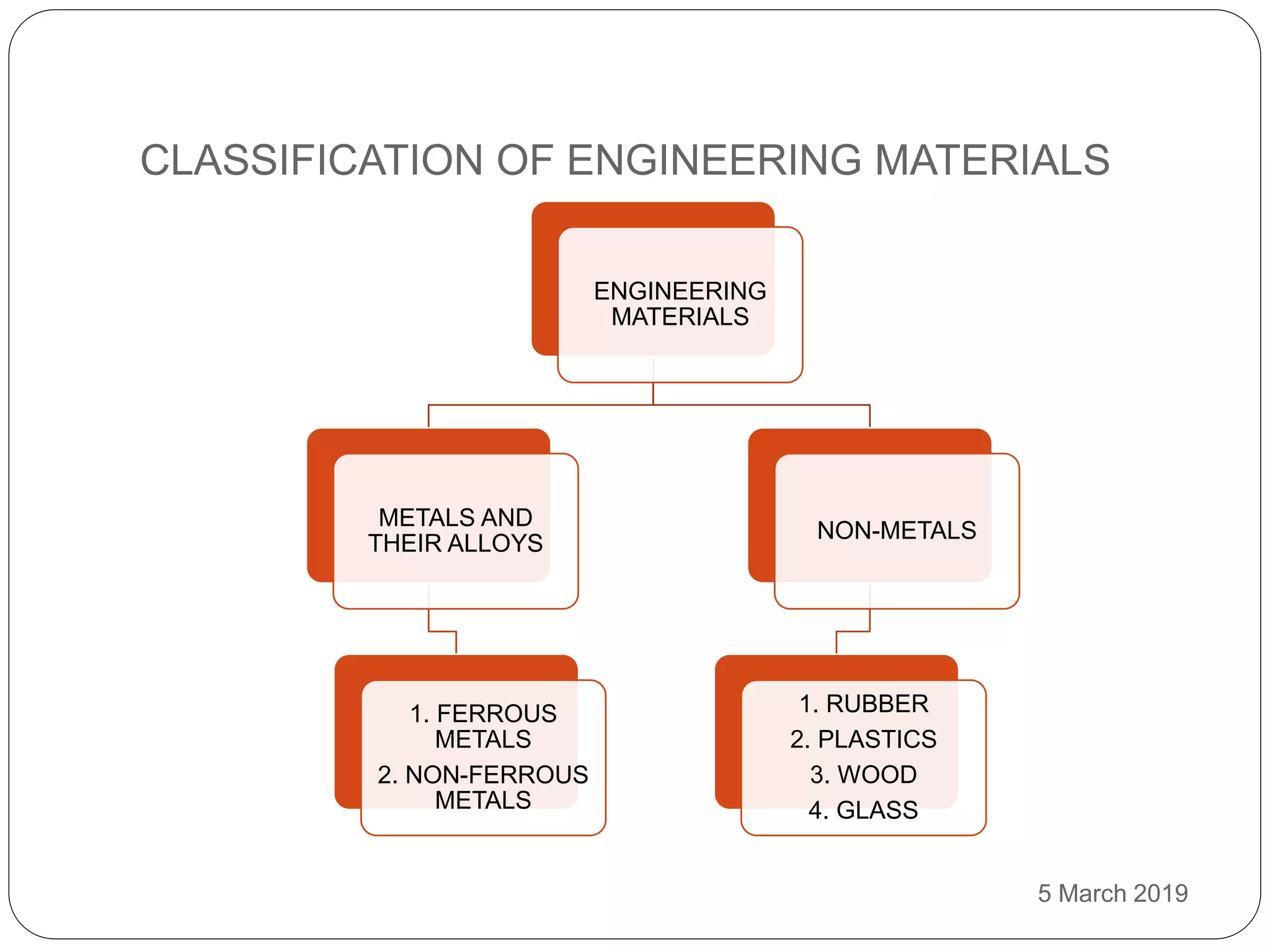
CLASSIFICATION OF ENGINEERING MATERIALS
5 March 2019
ENGINEERING
MATERIALS
METALS AND
THEIR ALLOYS
1. FERROUS
METALS
2. NON-FERROUS
METALS
NON-METALS
1. RUBBER
2. PLASTICS
3. WOOD
4. GLASS
FERROUS METALS:
• The ferrous metals are those which have the iron as their main
constituent.
• These are important metals in the metallurgical and
mechanical industries because of their extensive use.
• These are commonly classified as :
• 1. Cast iron 2. Alloy cast iron 3. Steel 4. Alloy steel
• CAST IRON:
• Cast iron are the alloys of iron and carbon.
• Cast iron are formed by melting a metal and casting with or
without machining to the desired final shape and size, hence
called as cast iron.
CHARACTERISTICS OF CAST IRON:
• While manufacturing of cast iron, raw materials like pig iron,
scrap limestone, coke etc are used. All these elements are
relatively cheap, hence cast iron is the cheapest among all
alloys. Commercial C.I are complex in composition and their
carbon content is in the range of 2.3 to 3.7% with other
elements such as sulphur, manganese, phosphorous and
silicon. 5 March 2019
• The melting point of cast iron is low lying between 1140 to 1240 degC.
• Due to high fluidity of metal, cast iron has excellent machinability.
• By altering the chemical composition , cast iron can provide a wide
range of metallic properties.
Advantages of Cast Iron:
• It is a low cost material
• It can provide good damping capacity and high compressive strength
• It has good resistance to wear and abrasion.
• It has high hardness
• Corrosion resistance of cast iron is fairly good.
• It has excellent machinability.
Limitations of cast iron:
• It is brittle in nature
• Its mechanical properties such as toughness, stiffness, resilience etc.
are poor
• Due to brittleness, it is poor against fatigue and impact loading.
Applications of cast iron : Machine beds, columns, road rollers, pipe
fittings, valves, farm equipments, automotive parts, motor cover, pump
bodies, engine blocks,bearing blocks etc.
5 March 2019
Types of Cast Iron :
Cast iron are classified as follows:
1. White Cast iron 2. Gray cast iron 3. Malleable cast iron
4. Nodular cast iron
Alloy cast iron:
• As cast iron has low impact resistance, corrosion resistance and
temperature resistance, hence to increase these properties certain
alloys or alloying elements are added to cast iron in suitable amount.
• Usually, nickel, cobalt , chromium, molybdenum, vanadium, silicon
are used as alloying elements for cast iron.
Properties of alloy cast iron:
• It has high strength, , high wear resistance and corrosion resistance.
Applications of alloy cast iron:
Alloy cast iron find use in the manufacturing of following parts such as
Gears, automobile parts like piston, piston rings, camshaft, crankshaft,
cylinders, brake drums, pulleys, grinding machinery parts etc.
5 March 2019
Plain Carbon Steel:
 Steel is an alloy of iron and carbon with carbon percent upto 1.6%.
 Carbon content increases the strength and hardness of steel
 Plain carbon steel is defined as a steel which has its properties mainly
due to its carbon content and does not contain more than 0.5 %
silicon and 1.5% manganese.
Properties of plain carbon steel:
 They are ductile in nature
 They have high fatigue and impact strength
 Their mechanical properties like toughness, stiffness, resilience etc.
are high.
Advantages of plain carbon steel:
 They have high tensile strength
 They have high resilience and toughness
 They can sustain fatigue and impact load.
Limitations of plain carbon steel:
 Vibration damping capacity of steel is poor
 They cannot be cast into complicated shapes
 They have low wear resistance and costlier than cast iron. 5 March 2019
Applications of plain carbon steel:
 Stampings, fan blades, rivets, nuts, bolts, wires, structural steel, grill,
shaft etc.
 Gears, valves, crankshaft, camshaft, axles, screws, springs.
 Cutting tools, milling cutters, blades, drill bits, musical instruments,
agricultural applications etc.
Alloy Steel:
To obtain specific properties in steel, various alloying elements such as
carbon, sulphur, manganese, phosphorous, nickel, cobalt, silicon,
tungsten, chromium, molybdenum, vanadium, titanium etc are added to
steel in small proportion of composition.
By adding the above alloying elements, properties like ductility,
corrosion, impact resistance, fatigue strength etc. can be improved.
Limitations: They cannot be casted into complicated shapes. Their
vibration damping capacity is poor and they are costlier than iron and
steel.
Application: Aircraft engine parts, heat exchangers, wrist watches,
sanitary fittings, furnace parts, turbine blades, missile components etc.
5 March 2019
NON FERROUS METALS :
 Non-ferrous metals are those which contain a metal other than iron as
their main constituent or element.
 Non ferrous metals find applications in a wide variety of industrial
sectors because of following advantages:
 Low density, light weight, high electrical conductivity, ease of fabrication
and high corrosion resistance.
The commonly used non-ferrous alloys are as follows:
1. Copper and its alloys such as brass and bronze
2. Aluminium and its alloys
COPPER AND ITS ALLOYS:
 Copper is one of the most widely used non-ferrous metals.
 Various alloying elements are added to copper to improve and add
some mechanical properties.
 Major alloying elements are zinc, silicon, aluminum, lead manganese,
nickel, tin, phosphorous, magnesium etc.
5 March 2019
Properties of copper:
 High ductility and malleability
 High electrical and thermal conductivity
 Non-magnetic in nature
 It can be easily alloyed with other metals
 It has high corrosion resistance.
Applications of Copper:
 Electrical parts
 Heat exchanger tubes
 Household utensils, etc.
BRASS:
 Brass is an alloy of copper and zinc with small amount of other
alloying elements.
 It has high corrosion resistance, high ductility and malleability, high
strength and high machinability.
Limitations : It has low thermal and electrical conductivity and also it
is costlier.
Applications: Coins, needles, jewellery, condenser tubes, cartridge
cases, headlight reflectors, springs, welding rods, shafts, machine
parts etc. 5 March 2019
ALUMINIUM AND ITS ALLOYS:
 Aluminium is another widely used non ferrous metal.
 It can be easily alloyed with elements like silicon, copper, nickel,
zinc, manganese, titanium, magnesium etc.
Advantages of Aluminium alloys:
 It has high thermal and electrical conductivity
 It has high corrosion resistance
 It has high toughness
 They are malleable and ductile
 They can be easily casted
Applications of aluminum alloys:
 Aircraft industry for manufacturing aircraft parts
 Motor housing, pump castings, pistons, cylinders of automotives
 In food industry, food preparation equipments, refrigeration,
storage containers, bakery equipments etc.
5 March 2019
NON METALS:
The use of non metals is increasing in most of the industries because
of the following properties:
 They have low density
 They are light in weight
 They provide flexibility in design
 They have high resistance to heat and electricity
 They have a low cost as compared to metals
Commonly used non-metals are as follows:
1. Rubber 2. Plastic 3. Wood 4. Glass
RUBBER:
o Rubbers or Elastomers are hydrocarbon and polymeric materials
o Rubber is defined as a polymeric material which at room
temperature can be stretched to atleast twice its original length
and after immediate release will return quickly to its original length
without any permanent deformation.
5 March 2019
Properties of Rubber:
 They are non crystalline in structure
 They are non conductors of electricity and low heat conductors
 Their chemical and corrosive resistance is also high
 They are ductile in nature
 They have high resilience and elasticity
Rubbers are either natural rubbers or synthetic rubbers
Applications of rubbers:
 Vehicle tires, gaskets, erasers, pipes, tubes
 Belt conveyers, adhesives, tapes, seals, gloves, aprons, floor tiles, etc.
 Brake liners, containers, wires and cables, engine mountings etc.
5 March 2019
PLASTICS:
 A large group of engg materials which have increasing importance in
industrial applications are composed of natural synthetic organic
polymers(plastics).
 Now-a-days in some of the applications, metals and wood parts are
replaced by plastics, which have satisfactory properties and may be
produced at lower cost
 Plastic are moulded into any required shapes by the application of
pressure and heat. For example, toys, chairs, radiator fans,
refrigerator equipments etc.
 The plastics can be cast, rolled, laminated and machined easily
Characteristics of plastics:
They have low density and weight, high corrosion resistance, low
thermal and electrical properties, low coefficient of friction, produced in
different colors, good moldability and more economical than other
metals.
Limitations of Plastics:
 They have low strength and rigidity, poor tensile strength, poor
temperature resistance, short life and poor dimensional stability.
Applications: telephone receivers, electric plugs, radio and T.V cabinets,
camera and mobile phones, automobile parts, switch panels, etc.5 March 2019
MECHANISMS
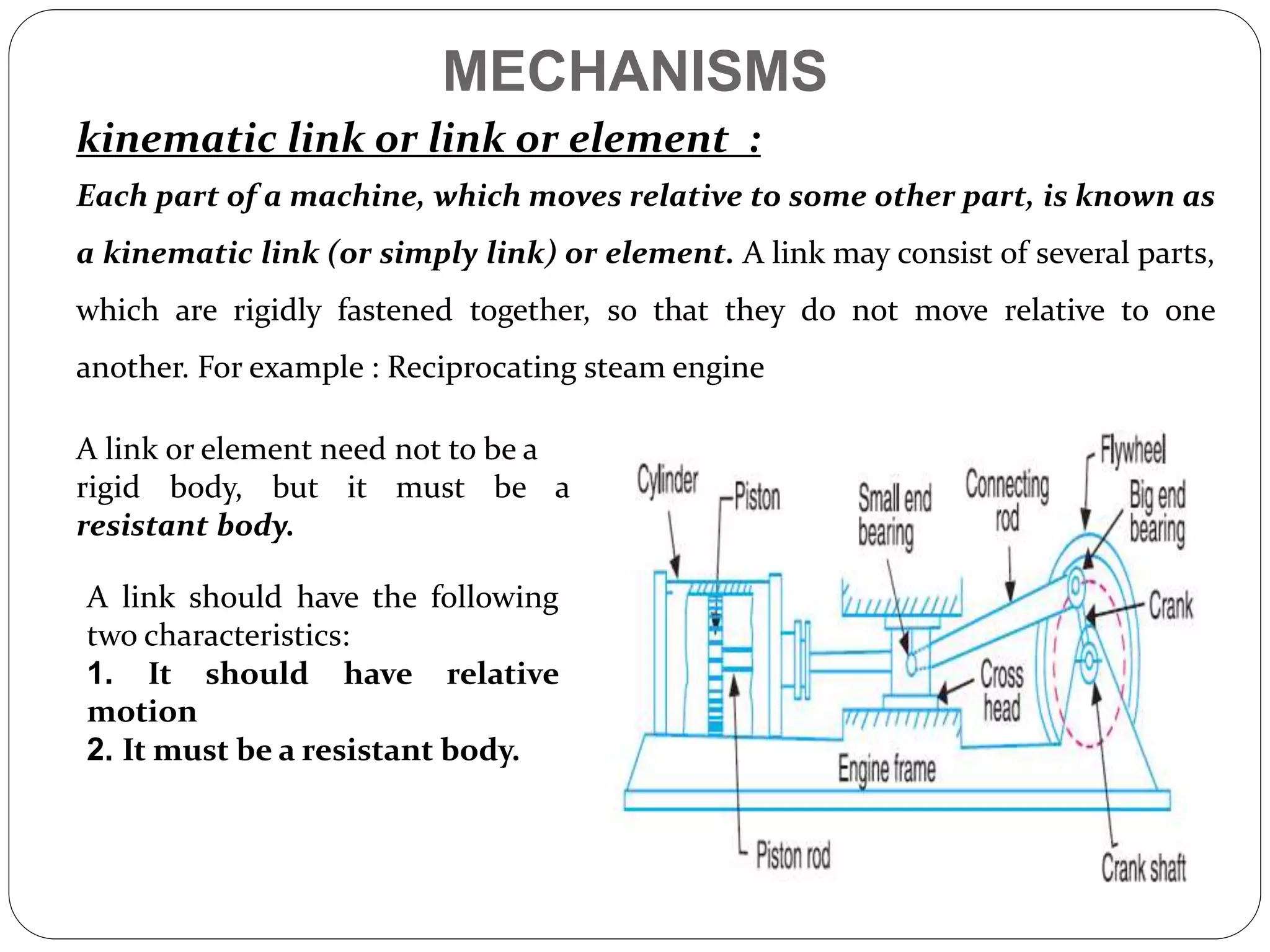
kinematic link or link or element :
Each part of a machine, which moves relative to some other part, is known as
a kinematic link (or simply link) or element. A link may consist of several parts,
which are rigidly fastened together, so that they do not move relative to one
another. For example : Reciprocating steam engine
A link or element need not to be a
rigid body, but it must be a
resistant body.
A link should have the following
two characteristics:
1. It should have relative
motion
2. It must be a resistant body.
Types of Links
In order to transmit motion, the driver and the follower may be connected
by the following three types of links :
1. Rigid link - A rigid link is one which does not undergo any
deformation while transmitting motion.
2. Flexible link - A flexible link is one which is partly deformed in a
manner not to affect the transmission of motion
3. Fluid link - A fluid link is one which is formed by having a fluid in a
receptacle and the motion is transmitted through the fluid by
pressure or compression only.
Structure
It is an assemblage of a number of resistant bodies (known as members)
having no relative motion between them and meant for carrying loads having
straining action.
Examples :
A railway bridge
A roof truss
Machine frames etc
Kinematic Pair
The two links or elements of a machine, when in contact with each other, are
said to form a pair. If the relative motion between them is completely or
successfully constrained (i.e. in a definite direction), the pair is known as
kinematic pair.
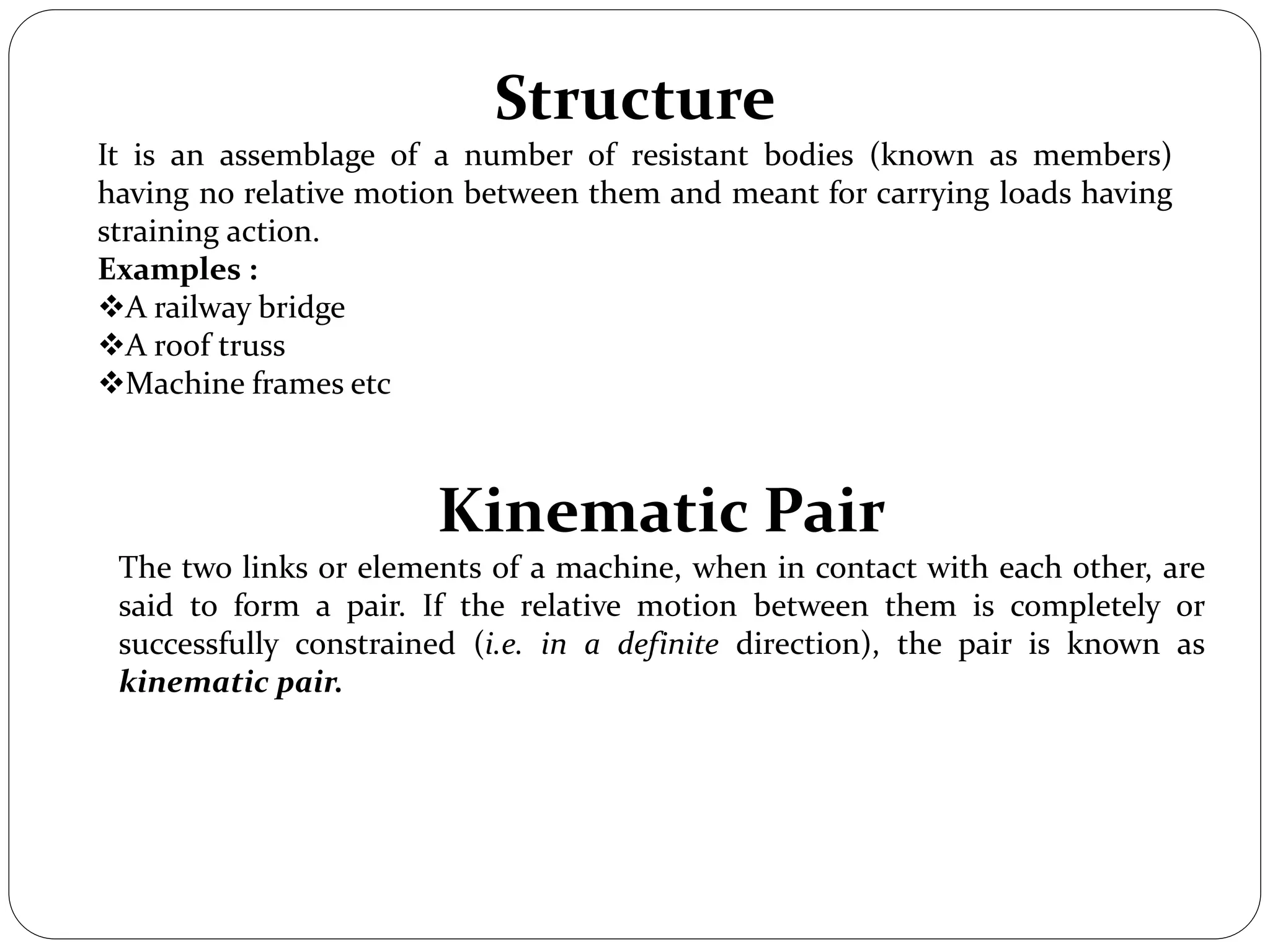
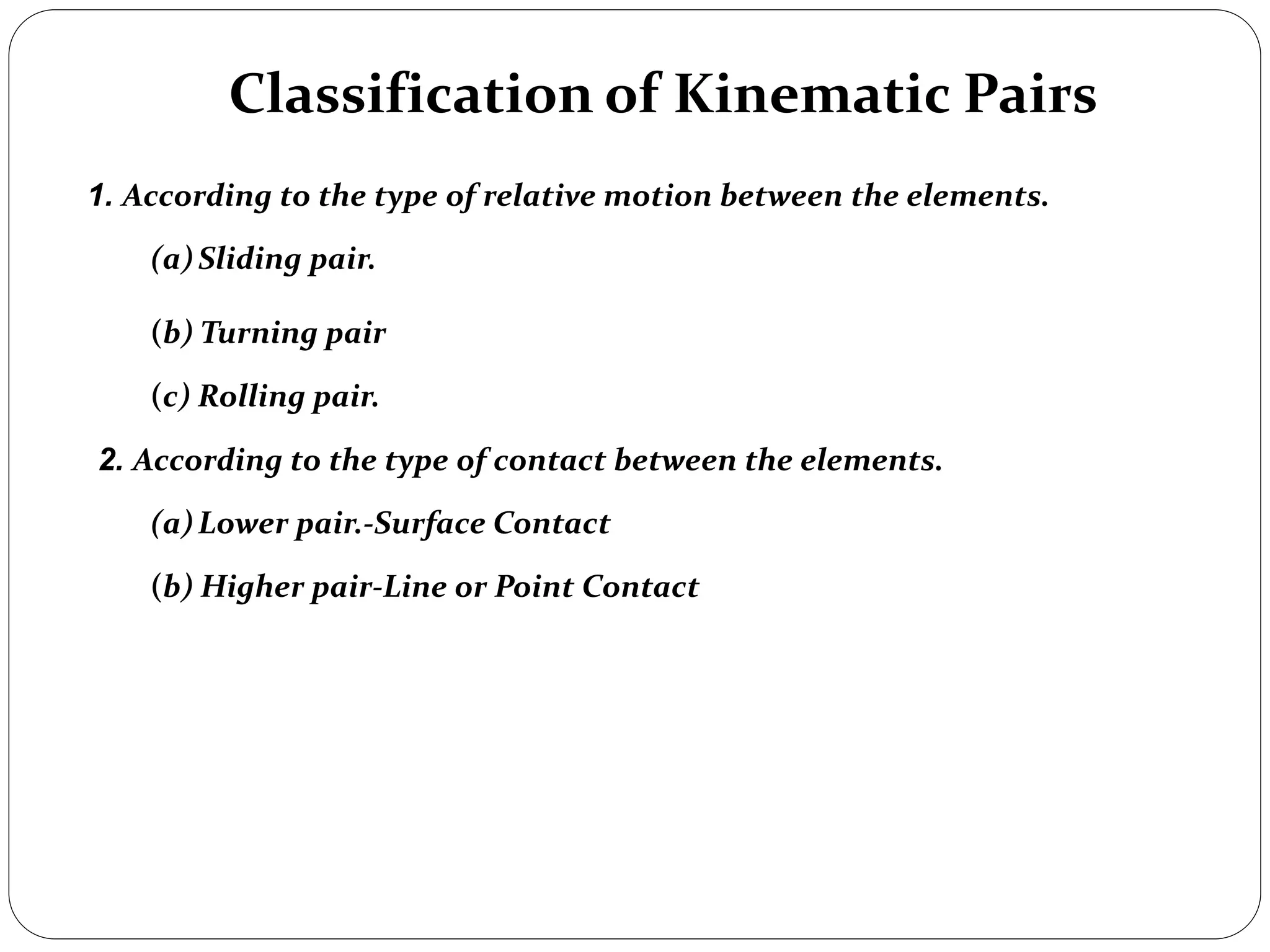
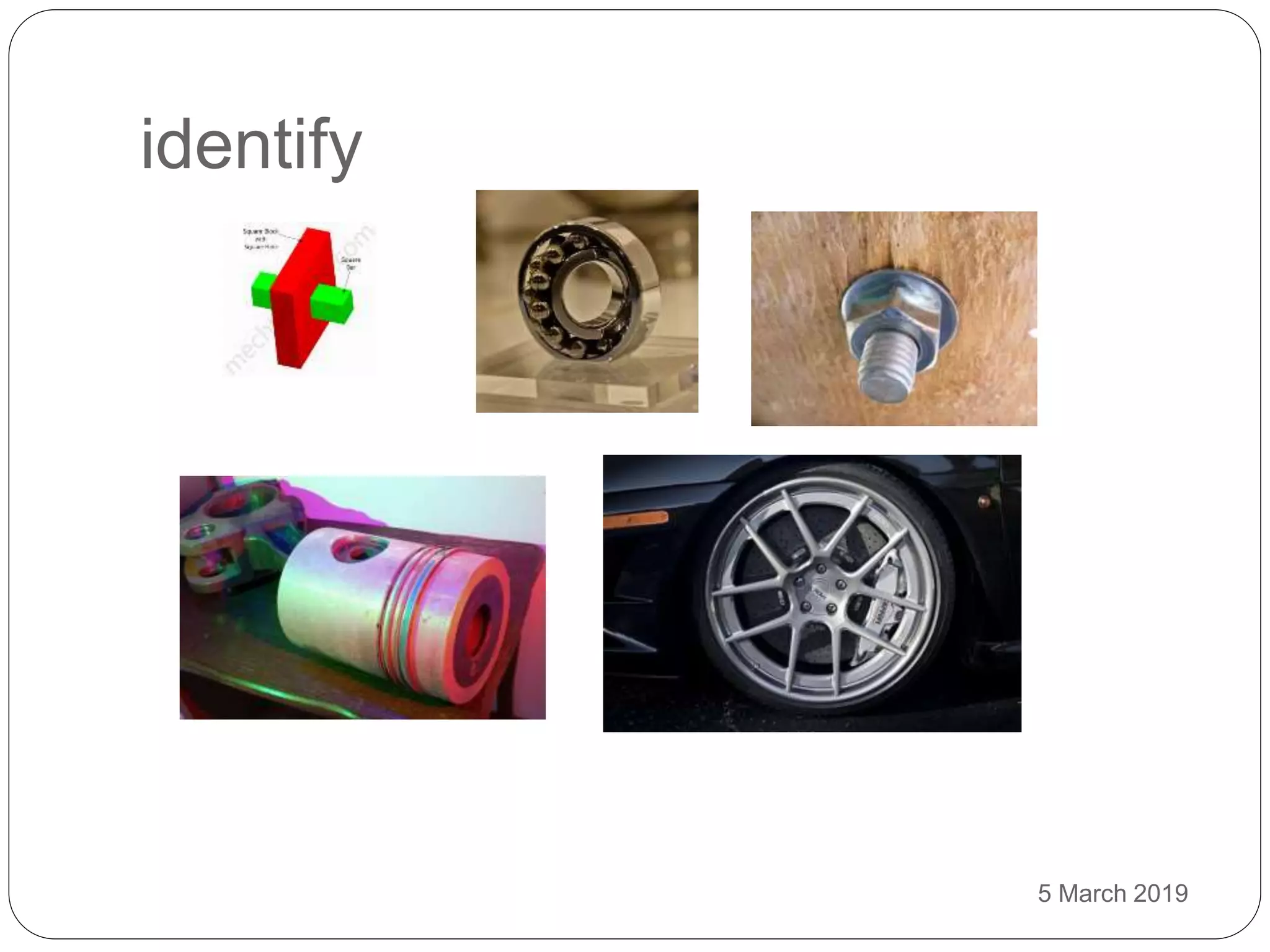
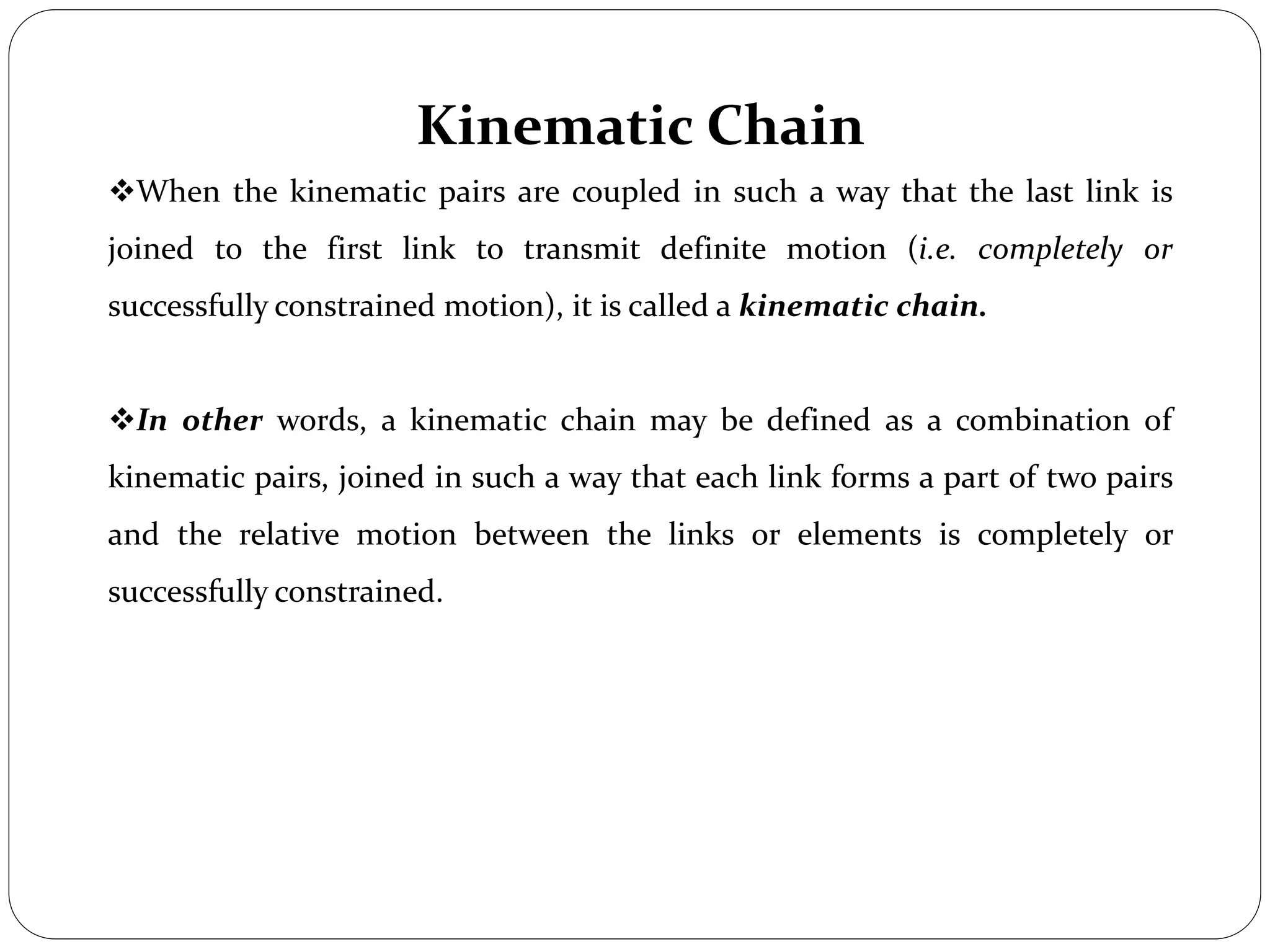
Classification of Kinematic Pairs
1. According to the type of relative motion between the elements.
(a)Sliding pair.
(b) Turning pair
(c) Rolling pair.
2. According to the type of contact between the elements.
(a)Lower pair.-Surface Contact
(b) Higher pair-Line or Point Contact
identify
5 March 2019
Kinematic Chain
When the kinematic pairs are coupled in such a way that the last link is
joined to the first link to transmit definite motion (i.e. completely or
successfully constrained motion), it is called a kinematic chain.
In other words, a kinematic chain may be defined as a combination of
kinematic pairs, joined in such a way that each link forms a part of two pairs
and the relative motion between the links or elements is completely or
successfully constrained.
MECHANISMS
5 March 2019
 Mechanism is a part of a machine which has moving
parts that performs some function.
 Ex: Threading mechanism in a lathe machine,
steering gear mechanism in a car, etc.
The study of mechanism involves its analysis as well
as synthesis.
Analysis includes the study of motion and forces
concerning different parts of the existing mechanism,
while Synthesis includes the design of different
components of the mechanism.
TERMINOLOGIES RELATED TO STUDY OF MECHANISMS:
Machine and mechanisms:
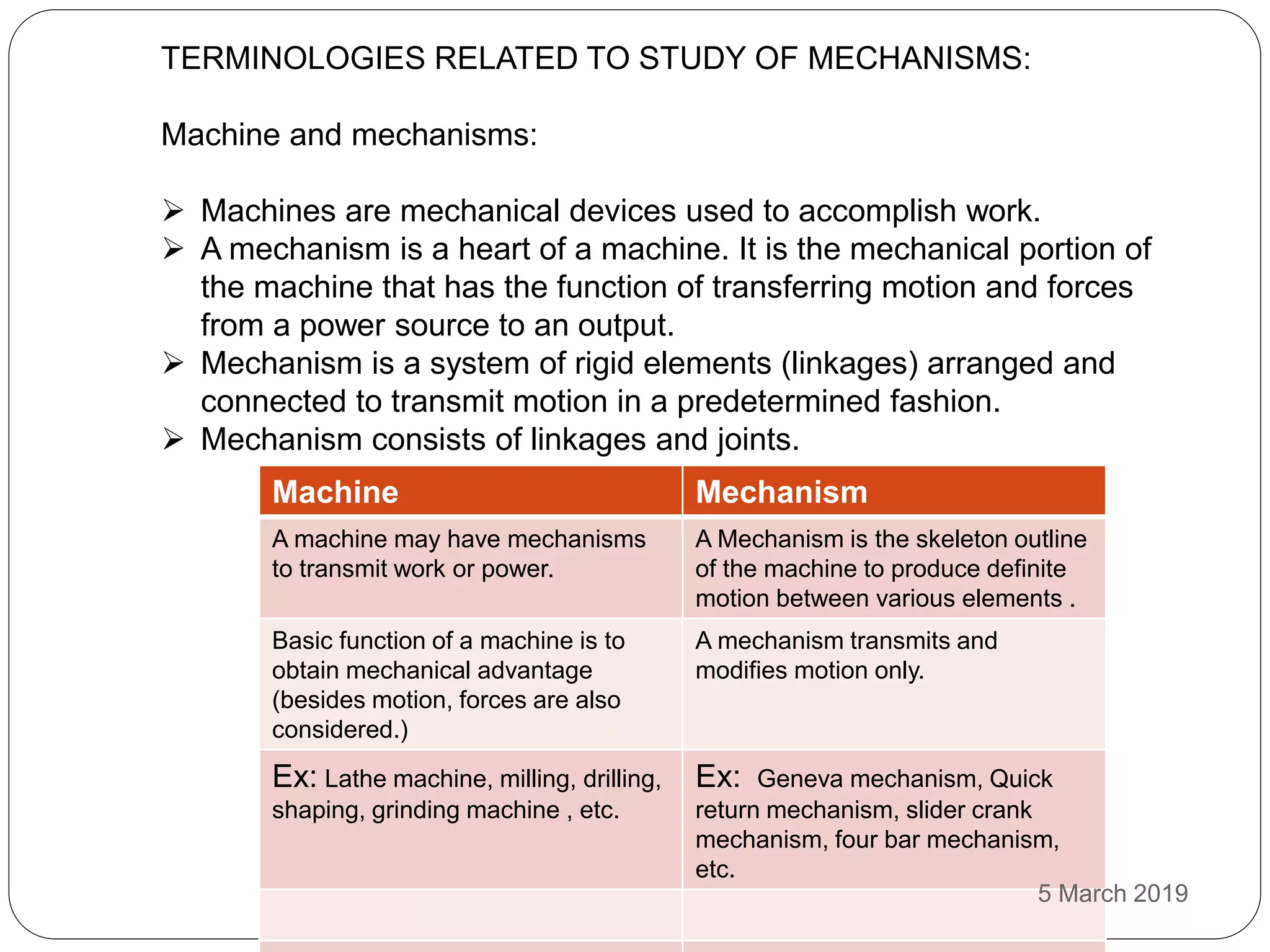
 Machines are mechanical devices used to accomplish work.
 A mechanism is a heart of a machine. It is the mechanical portion of
the machine that has the function of transferring motion and forces
from a power source to an output.
 Mechanism is a system of rigid elements (linkages) arranged and
connected to transmit motion in a predetermined fashion.
 Mechanism consists of linkages and joints.
Machine Mechanism
A machine may have mechanisms
to transmit work or power.
A Mechanism is the skeleton outline
of the machine to produce definite
motion between various elements .
Basic function of a machine is to
obtain mechanical advantage
(besides motion, forces are also
considered.)
A mechanism transmits and
modifies motion only.
Ex: Lathe machine, milling, drilling,
shaping, grinding machine , etc.
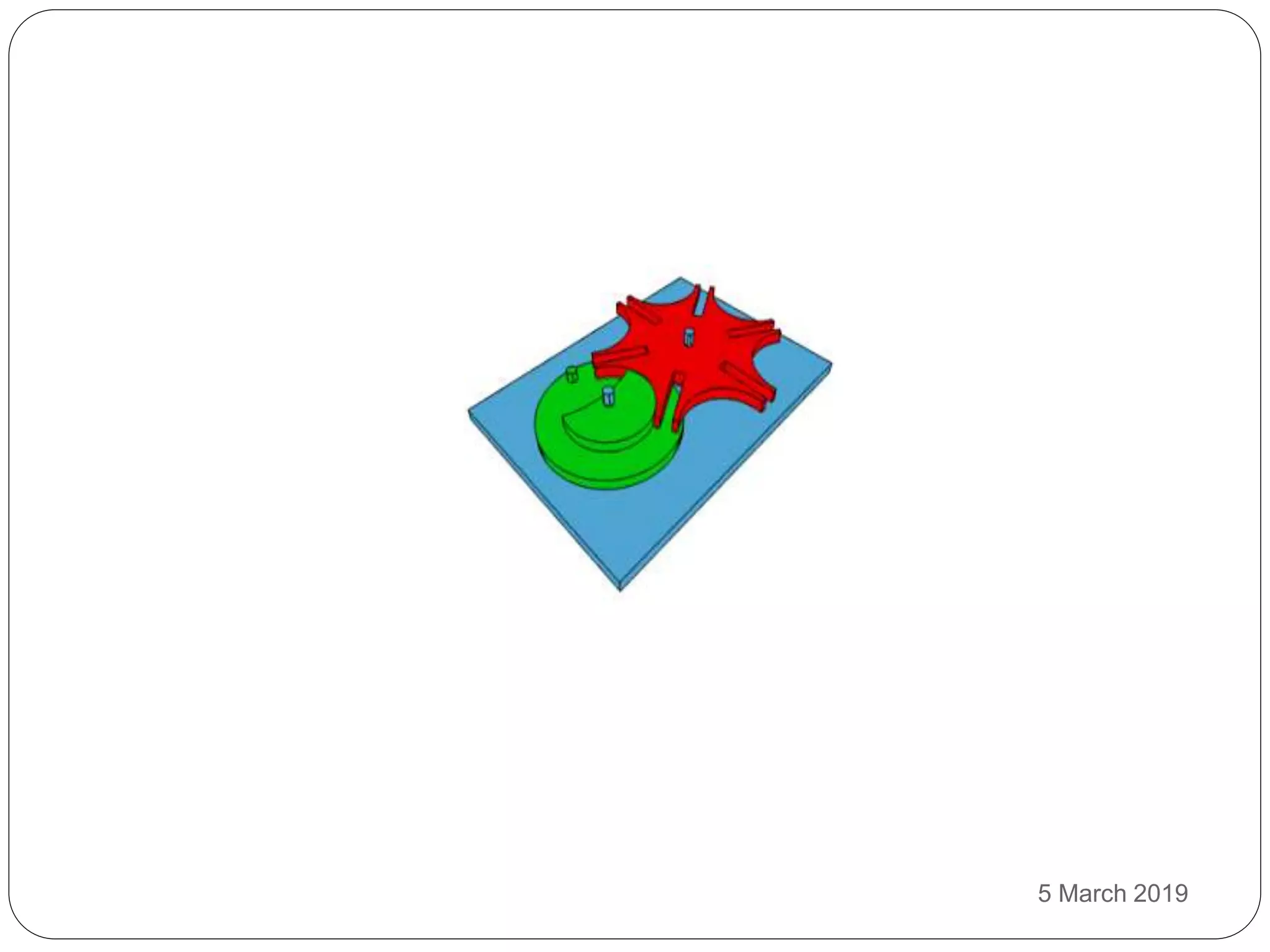
Ex: Geneva mechanism, Quick
return mechanism, slider crank
mechanism, four bar mechanism,
etc.
5 March 2019
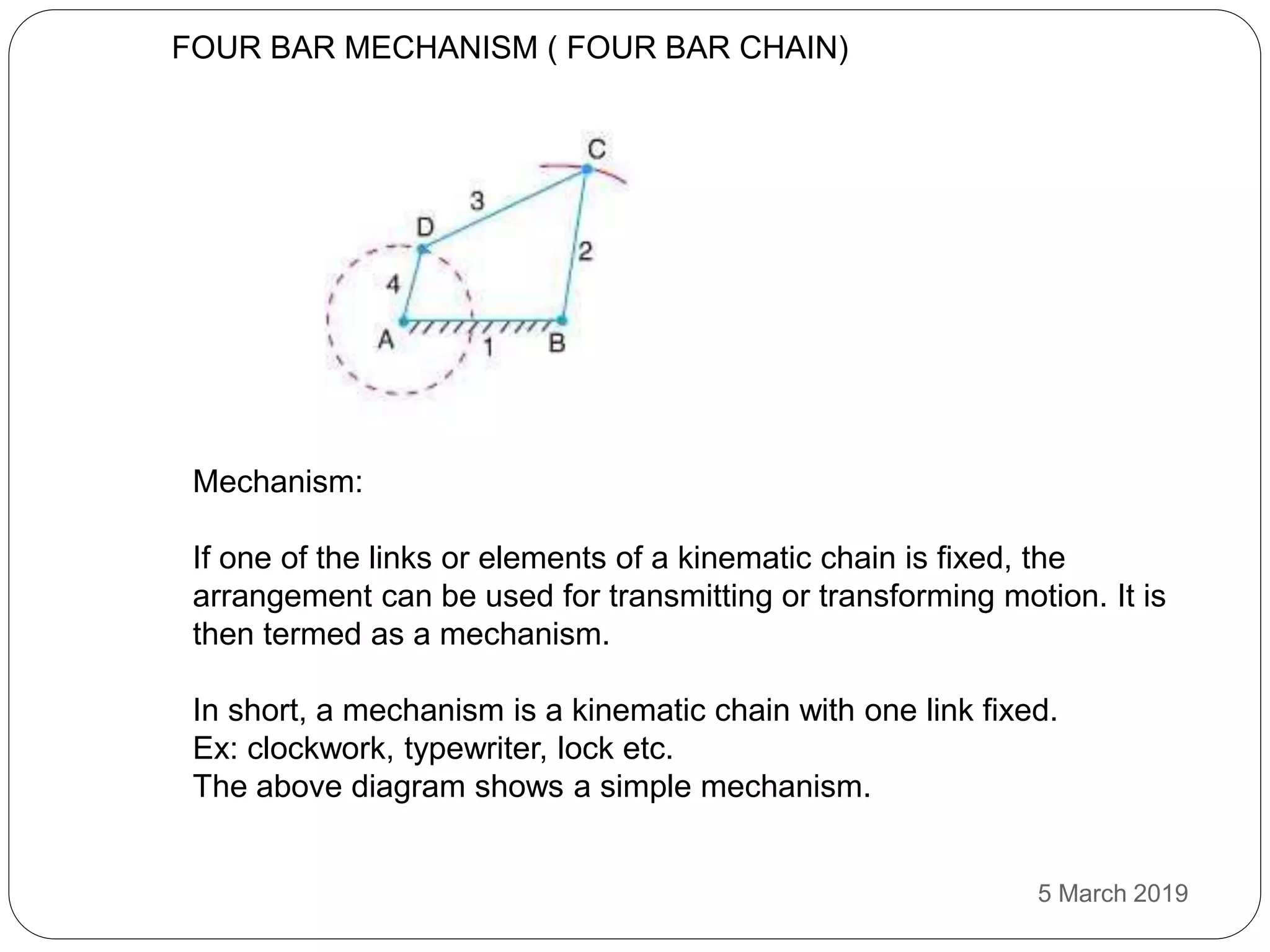
FOUR BAR MECHANISM ( FOUR BAR CHAIN)
Mechanism:
If one of the links or elements of a kinematic chain is fixed, the
arrangement can be used for transmitting or transforming motion. It is
then termed as a mechanism.
In short, a mechanism is a kinematic chain with one link fixed.
Ex: clockwork, typewriter, lock etc.
The above diagram shows a simple mechanism.
5 March 2019
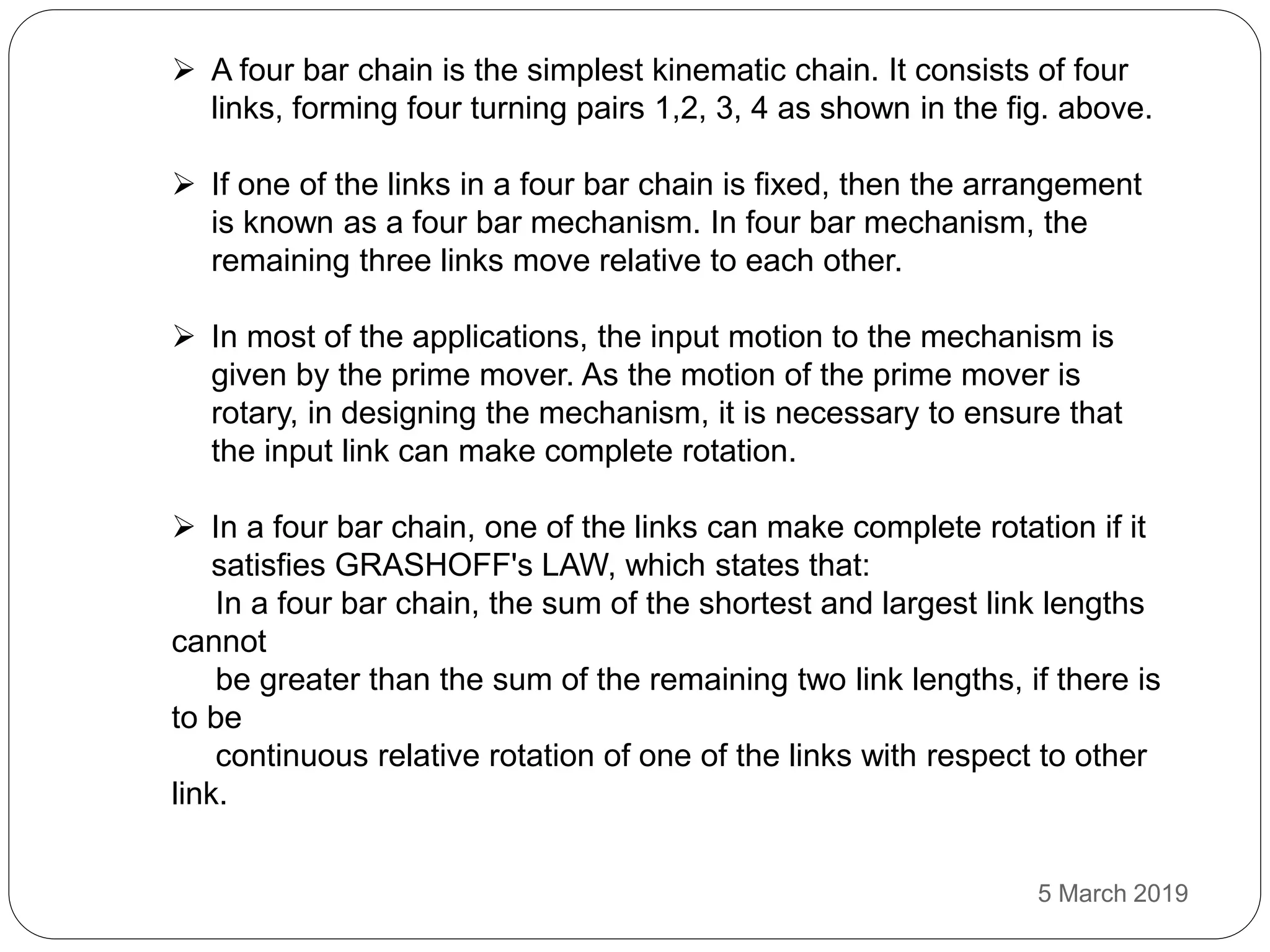
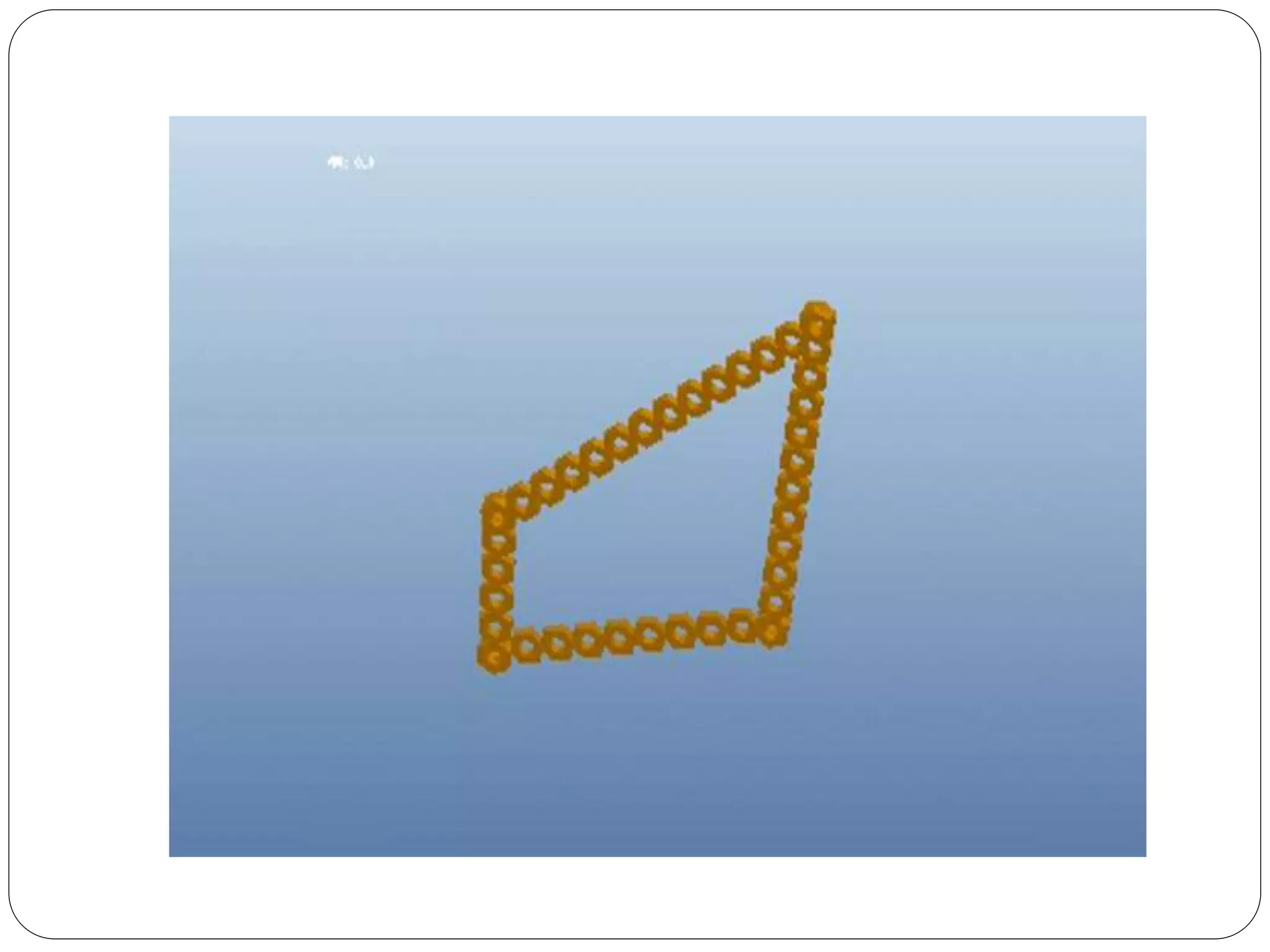
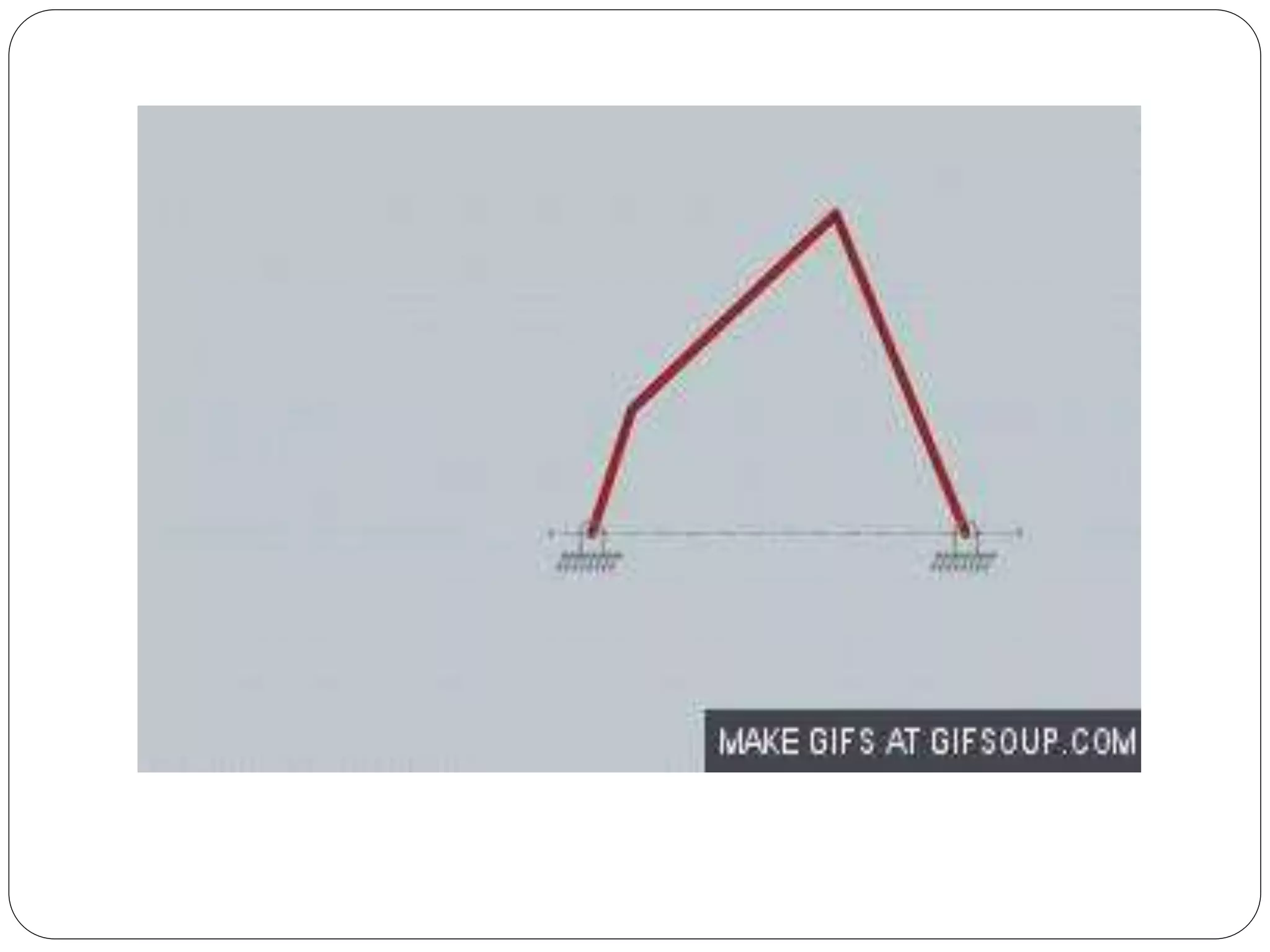
 A four bar chain is the simplest kinematic chain. It consists of four
links, forming four turning pairs 1,2, 3, 4 as shown in the fig. above.
 If one of the links in a four bar chain is fixed, then the arrangement
is known as a four bar mechanism. In four bar mechanism, the
remaining three links move relative to each other.
 In most of the applications, the input motion to the mechanism is
given by the prime mover. As the motion of the prime mover is
rotary, in designing the mechanism, it is necessary to ensure that
the input link can make complete rotation.
 In a four bar chain, one of the links can make complete rotation if it
satisfies GRASHOFF's LAW, which states that:
In a four bar chain, the sum of the shortest and largest link lengths
cannot
be greater than the sum of the remaining two link lengths, if there is
to be
continuous relative rotation of one of the links with respect to other
link.
5 March 2019
5 March 2019
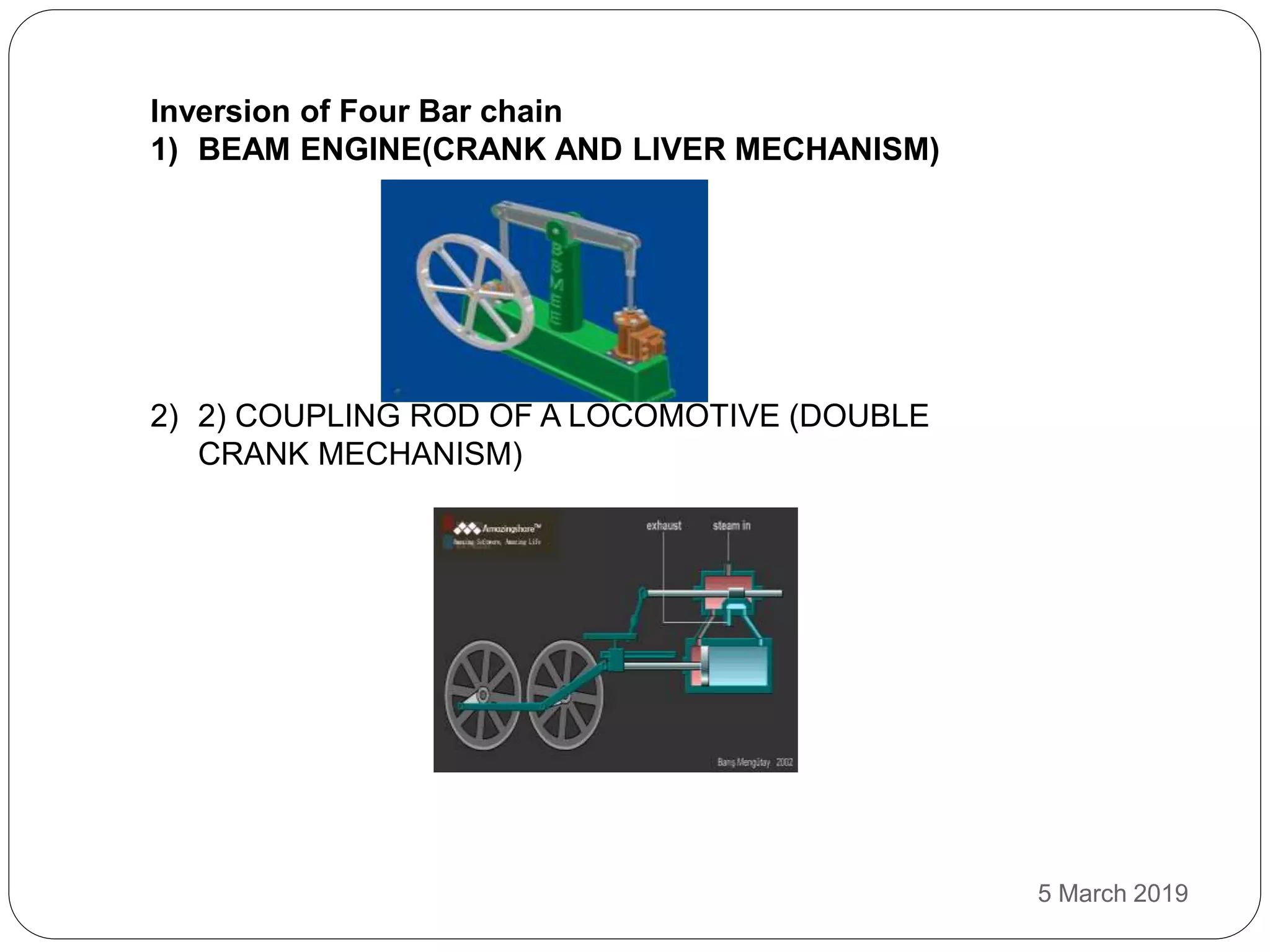
Inversion of Four Bar chain
1) BEAM ENGINE(CRANK AND LIVER MECHANISM)
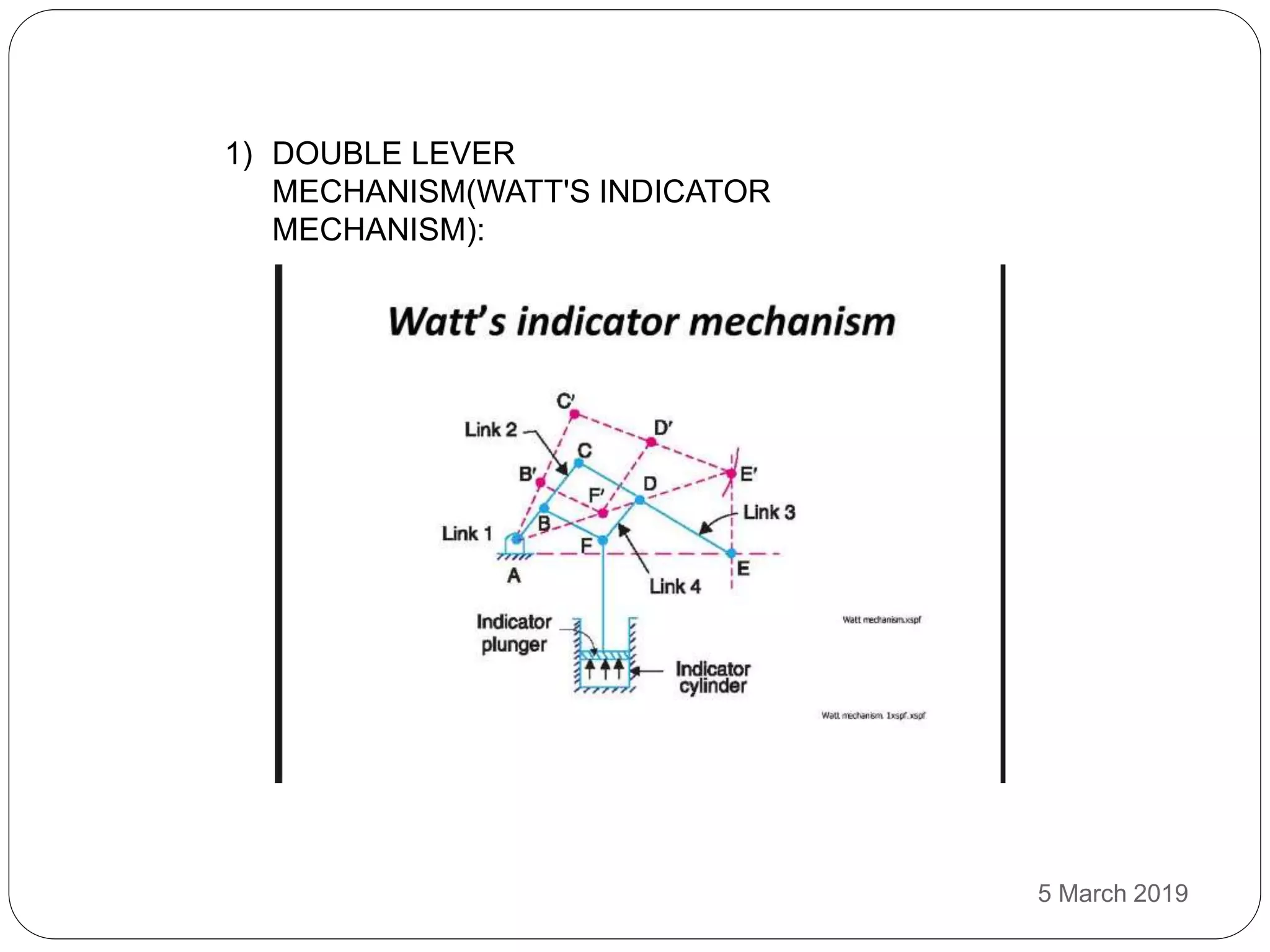
2) 2) COUPLING ROD OF A LOCOMOTIVE (DOUBLE
CRANK MECHANISM)
5 March 2019
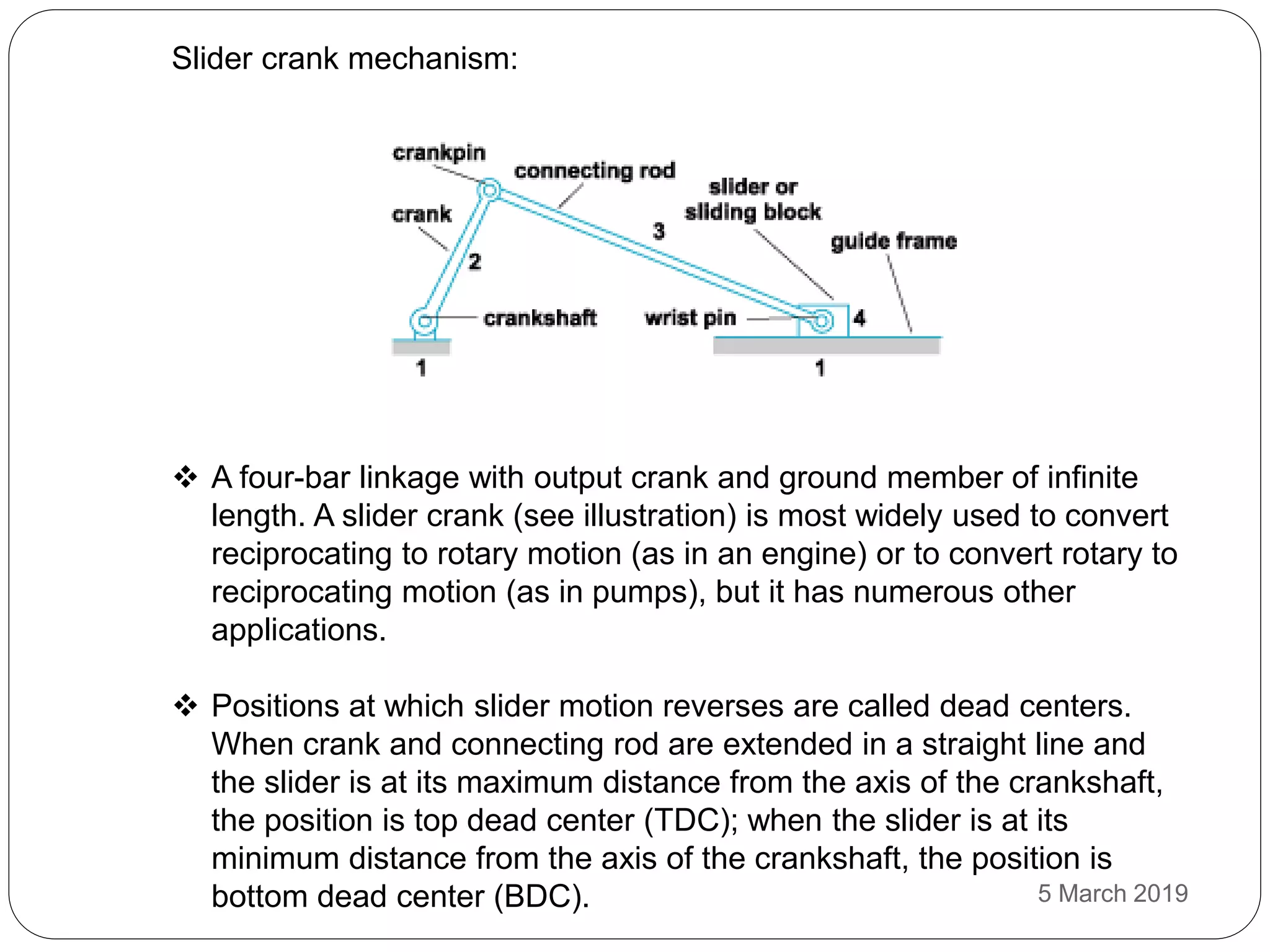
1) DOUBLE LEVER
MECHANISM(WATT'S INDICATOR
MECHANISM):
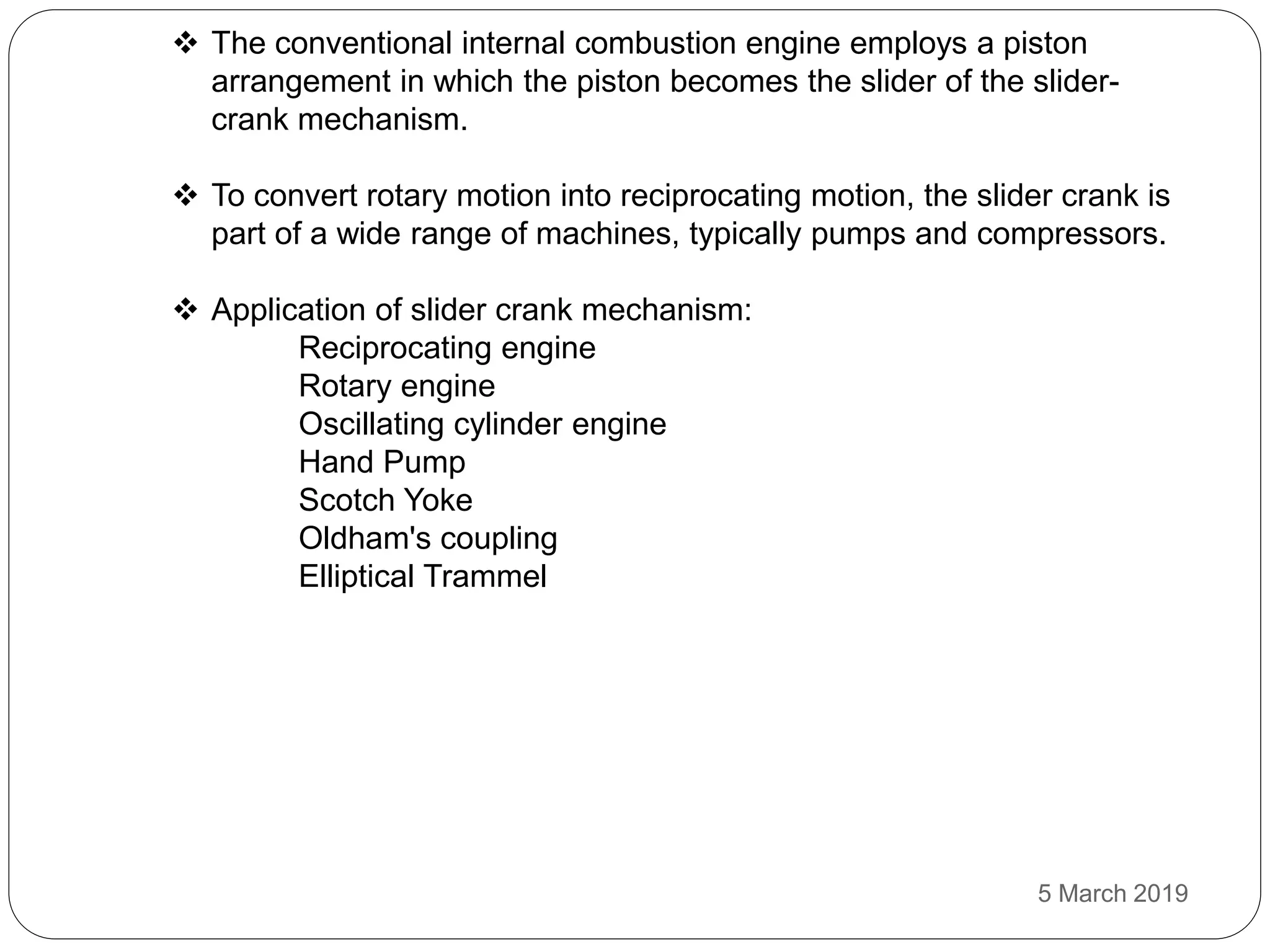
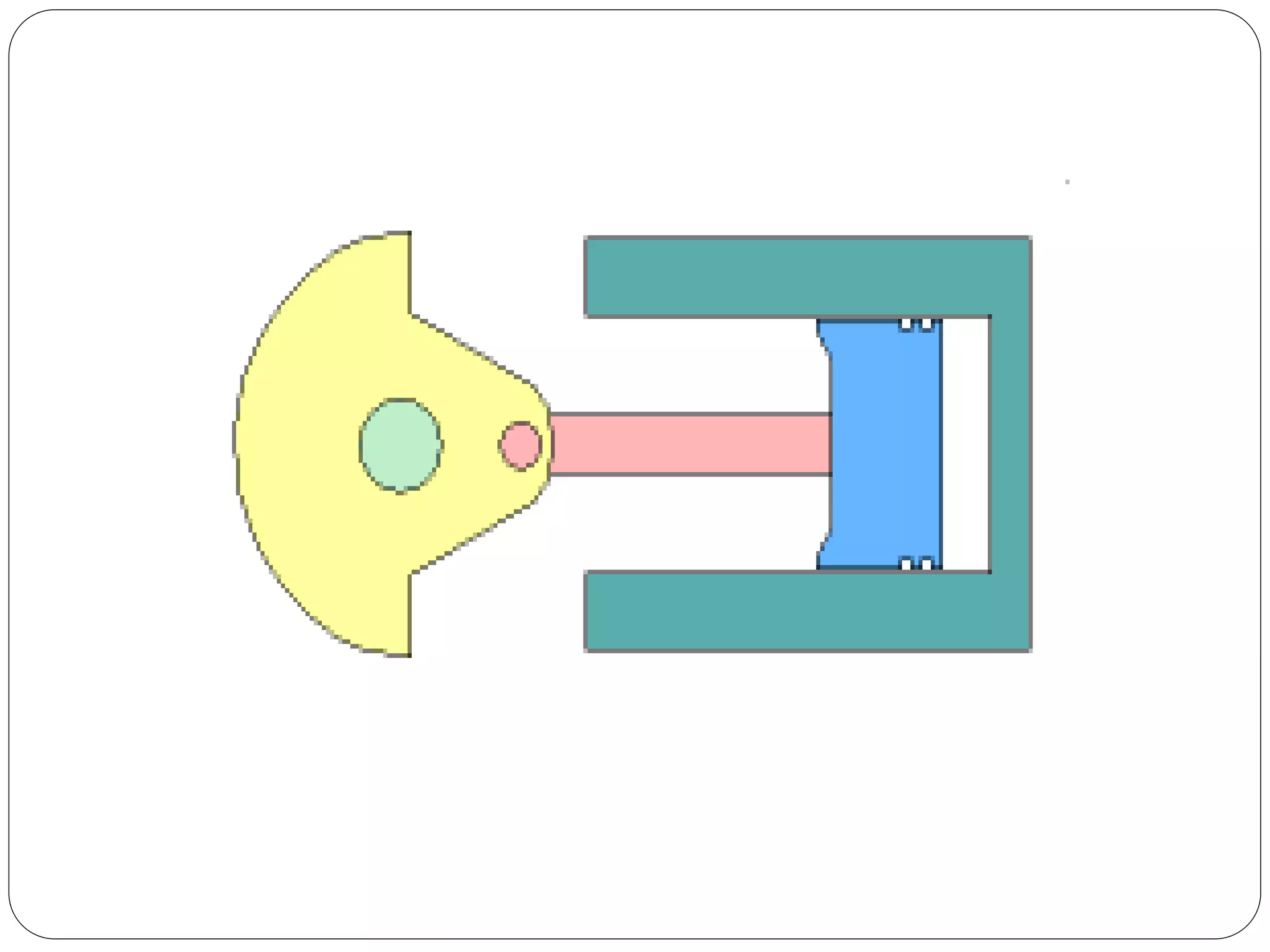
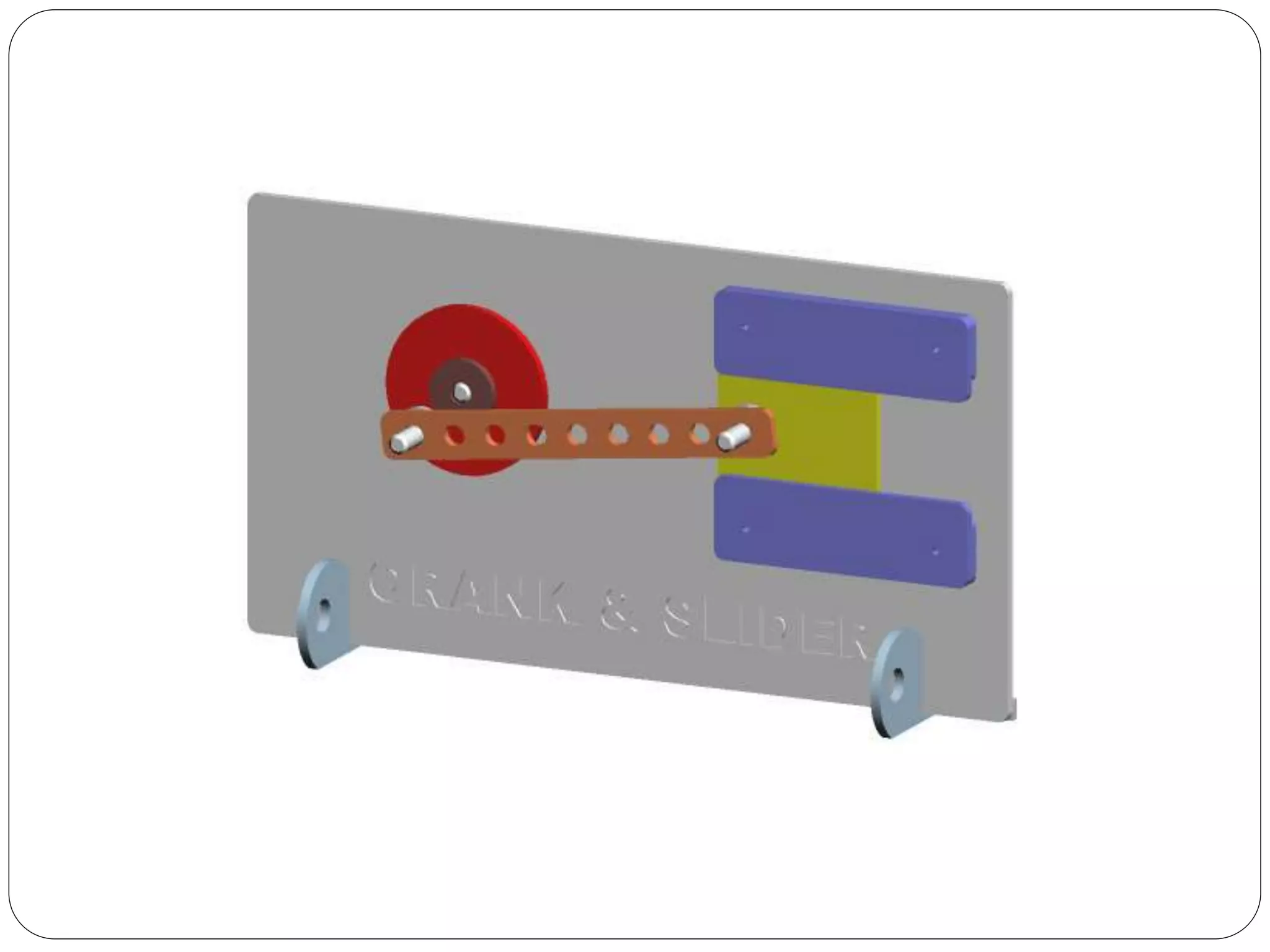
Slider crank mechanism:
 A four-bar linkage with output crank and ground member of infinite
length. A slider crank (see illustration) is most widely used to convert
reciprocating to rotary motion (as in an engine) or to convert rotary to
reciprocating motion (as in pumps), but it has numerous other
applications.
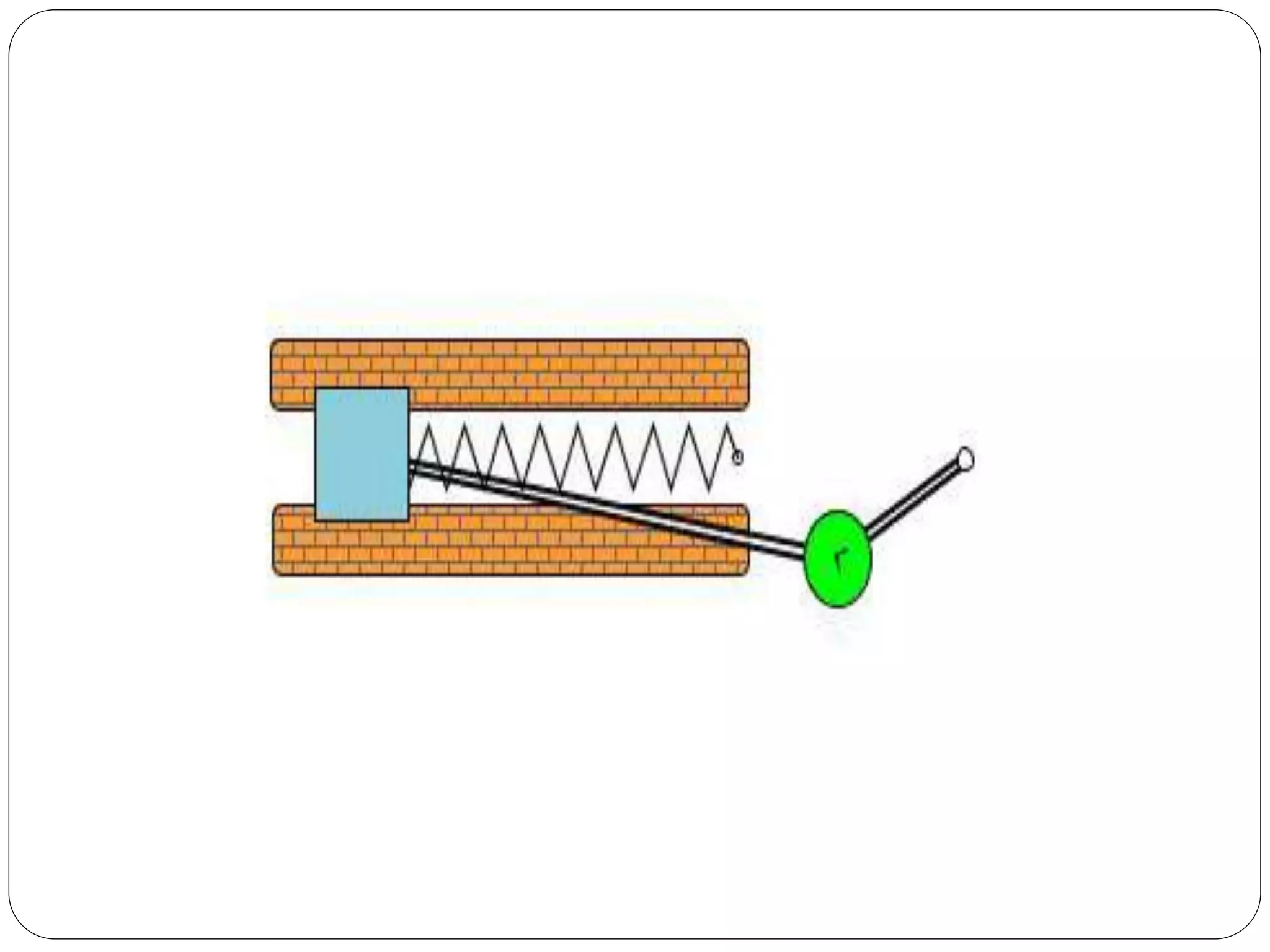
 Positions at which slider motion reverses are called dead centers.
When crank and connecting rod are extended in a straight line and
the slider is at its maximum distance from the axis of the crankshaft,
the position is top dead center (TDC); when the slider is at its
minimum distance from the axis of the crankshaft, the position is
bottom dead center (BDC). 5 March 2019
 The conventional internal combustion engine employs a piston
arrangement in which the piston becomes the slider of the slider-
crank mechanism.
 To convert rotary motion into reciprocating motion, the slider crank is
part of a wide range of machines, typically pumps and compressors.
 Application of slider crank mechanism:
Reciprocating engine
Rotary engine
Oscillating cylinder engine
Hand Pump
Scotch Yoke
Oldham's coupling
Elliptical Trammel
5 March 2019
5 March 2019
5 March 2019

Unit ii design and mechanism

  • 1.
  • 2.
    UNIT NO 02 DesignFundamentals 5 March 2019  Design: Steps in design process, mechanical properties (Strength, Toughness, Hardness, Ductility, Malleability, Brittleness, Elasticity, Plasticity, Resilience, Fatigue, Creep) and selection of engineering materials, Applications of following materials in engineering- Aluminium, Plastic, Steel , Brass, Cast iron, Rubber, Copper.  Mechanism (Descriptive treatment only): Definition, and comparison of mechanism and machine, four bar mechanism, Slider crank mechanism.Classification of Pairs.
  • 3.
    DESIGN 5 March 2019 Design refers to the plan of construction of an object.  The persons who performs the design is called as a designer and the sequence of activities performed by the designer is called as a design process.  Machine design refers to a systematic process of designing a machine which converts mechanical energy into some useful form of task by using mechanisms.  Machine design may lead to entirely design a new machine or develop an existing machine.
  • 4.
    NEED OF MACHINEDESIGN 5 March 2019  Functional requirement  User comfort  Safety  Modification  Appearance  Cost reduction
  • 5.
    GENERAL CONSIDERATIONS INDESIGN 5 March 2019  Type of load  Selection of material  Shape and size  Friction and lubrication  Operational safety  Machine availability  Use of standard parts  Motion of elements  Production quantity  Maintenance of element
  • 6.
    GENERAL CONSIDERATIONS INDESIGN 5 March 2019  Life of element  Capacity of element  Weight of element  Cost of element
  • 7.
    STEPS IN ADESIGN PROCESS 5 March 2019 1. Define the need 2. Synthesis 3. Analysis of forces 4. Selection of material 5. Design of elements( Shape, size and stresses) 6. Modification 7. Detailed drawing 8. Production
  • 8.
    MECHANICAL PROPERTIES OFMATERIAL 5 March 2019 The various properties of a material are mainly classifies as follows: 1. Mechanical Properties 2. Thermal Properties 3. Electrical Properties Here we are supposed to study only the mechanical properties of a material as follows.
  • 9.
    MECHANICAL PROPERTIES 5 March2019  Mechanical properties include those characteristics of a material that describes its behavior under the action of external forces.  The knowledge of mechanical properties of a material is very essential to construct a mechanically fool-proof structure.  Some of the important mechanical properties are as follows: Elasticity, Plasticity, Toughness, Resilience, Strength, Stiffness, Ductility, Malleability, Brittleness, Hardness, Fatigue, Creep.
  • 10.
    ELASTICITY • It isthe property of a material to regain its original shape after deformation when the external forces are removed. • This property is required for materials used in tools and machines. PLASTICITY • It is the property of a material which retains the deformation produced under the load permanently. • This property is essential in stamping, press work, forgings, ornamental work etc. TOUGHNESS • It is the total amount of energy absorbed by a material before its failure. • It is the complete area under the stress strain curve. • This property is essential in parts those are subjected to impact and shock loads. 5 March 2019
  • 11.
    RESILIENCE • It isdefined as the total amount of energy absorbed by a material during its elastic deformation. • This property is essential for springs, shock absorbers etc. • The area under the stress-strain curve in the elastic region indicates resilience. STRENGTH • It is the ability of a material to resist externally applied forces, without failure. • It is measured in N/mm2. STIFFNESS • It is the ability of a material to resist deformation under stress. • It is also defined as the force per unit deflection and is measured in N/mm. DUCTILITY • It is defined as the ability of a material to undergo plastic deformation under tensile loading, before its fracture. • It is also defined as the ability of a material to be drawn into wires.5 March 2019
  • 12.
    MALLEABILITY • It isthe ability of a material to be formed by hammering or rolling into sheets. • It is the capacity of material to withstand deformation under compression without failure. • The main difference between ductility and malleability is that, the ductility is considered as a tensile property whereas malleability is considered as a compressive property. HARDNESS • It the resistance of a metal to plastic deformation usually by indentation. • It is also defined as the property of a material by virtue of which it resists scratching, abrasion, and cutting. BRITTLENESS • It is the property of a material with little permanent distortion. • It is a property just opposite to ductility. 5 March 2019
  • 13.
    FATIGUE • When amaterial is subjected to repeated stresses or loading, it fails at stresses below the yield point stress. Such type of failure is called as fatigue failure. • Fatigue failure is caused by means of a progressive crack formation which are generally microscopic in size. CREEP • When a material is subjected to constant stresses at high temperature for a long time, it will undergo a slow and permanent deformation which is called as creep. • Creep is considered while designing boilers, I.C engines, Steam turbines, etc. 5 March 2019
  • 14.
    SELECTION CRITERIA FORMATERIALS 5 March 2019 1. Availability of materials 2. Properties of materials 3. Working environmental conditions 4. Physical attributes 5. Performance requirements 6. Reliability of materials 7. Disposability and recyclability 8. Safety factor 9. Manufacturing considerations 10.Cost of materials
  • 15.
    CLASSIFICATION OF ENGINEERINGMATERIALS 5 March 2019 ENGINEERING MATERIALS METALS AND THEIR ALLOYS 1. FERROUS METALS 2. NON-FERROUS METALS NON-METALS 1. RUBBER 2. PLASTICS 3. WOOD 4. GLASS
  • 16.
    FERROUS METALS: • Theferrous metals are those which have the iron as their main constituent. • These are important metals in the metallurgical and mechanical industries because of their extensive use. • These are commonly classified as : • 1. Cast iron 2. Alloy cast iron 3. Steel 4. Alloy steel • CAST IRON: • Cast iron are the alloys of iron and carbon. • Cast iron are formed by melting a metal and casting with or without machining to the desired final shape and size, hence called as cast iron. CHARACTERISTICS OF CAST IRON: • While manufacturing of cast iron, raw materials like pig iron, scrap limestone, coke etc are used. All these elements are relatively cheap, hence cast iron is the cheapest among all alloys. Commercial C.I are complex in composition and their carbon content is in the range of 2.3 to 3.7% with other elements such as sulphur, manganese, phosphorous and silicon. 5 March 2019
  • 17.
    • The meltingpoint of cast iron is low lying between 1140 to 1240 degC. • Due to high fluidity of metal, cast iron has excellent machinability. • By altering the chemical composition , cast iron can provide a wide range of metallic properties. Advantages of Cast Iron: • It is a low cost material • It can provide good damping capacity and high compressive strength • It has good resistance to wear and abrasion. • It has high hardness • Corrosion resistance of cast iron is fairly good. • It has excellent machinability. Limitations of cast iron: • It is brittle in nature • Its mechanical properties such as toughness, stiffness, resilience etc. are poor • Due to brittleness, it is poor against fatigue and impact loading. Applications of cast iron : Machine beds, columns, road rollers, pipe fittings, valves, farm equipments, automotive parts, motor cover, pump bodies, engine blocks,bearing blocks etc. 5 March 2019
  • 18.
    Types of CastIron : Cast iron are classified as follows: 1. White Cast iron 2. Gray cast iron 3. Malleable cast iron 4. Nodular cast iron Alloy cast iron: • As cast iron has low impact resistance, corrosion resistance and temperature resistance, hence to increase these properties certain alloys or alloying elements are added to cast iron in suitable amount. • Usually, nickel, cobalt , chromium, molybdenum, vanadium, silicon are used as alloying elements for cast iron. Properties of alloy cast iron: • It has high strength, , high wear resistance and corrosion resistance. Applications of alloy cast iron: Alloy cast iron find use in the manufacturing of following parts such as Gears, automobile parts like piston, piston rings, camshaft, crankshaft, cylinders, brake drums, pulleys, grinding machinery parts etc. 5 March 2019
  • 19.
    Plain Carbon Steel: Steel is an alloy of iron and carbon with carbon percent upto 1.6%.  Carbon content increases the strength and hardness of steel  Plain carbon steel is defined as a steel which has its properties mainly due to its carbon content and does not contain more than 0.5 % silicon and 1.5% manganese. Properties of plain carbon steel:  They are ductile in nature  They have high fatigue and impact strength  Their mechanical properties like toughness, stiffness, resilience etc. are high. Advantages of plain carbon steel:  They have high tensile strength  They have high resilience and toughness  They can sustain fatigue and impact load. Limitations of plain carbon steel:  Vibration damping capacity of steel is poor  They cannot be cast into complicated shapes  They have low wear resistance and costlier than cast iron. 5 March 2019
  • 20.
    Applications of plaincarbon steel:  Stampings, fan blades, rivets, nuts, bolts, wires, structural steel, grill, shaft etc.  Gears, valves, crankshaft, camshaft, axles, screws, springs.  Cutting tools, milling cutters, blades, drill bits, musical instruments, agricultural applications etc. Alloy Steel: To obtain specific properties in steel, various alloying elements such as carbon, sulphur, manganese, phosphorous, nickel, cobalt, silicon, tungsten, chromium, molybdenum, vanadium, titanium etc are added to steel in small proportion of composition. By adding the above alloying elements, properties like ductility, corrosion, impact resistance, fatigue strength etc. can be improved. Limitations: They cannot be casted into complicated shapes. Their vibration damping capacity is poor and they are costlier than iron and steel. Application: Aircraft engine parts, heat exchangers, wrist watches, sanitary fittings, furnace parts, turbine blades, missile components etc. 5 March 2019
  • 21.
    NON FERROUS METALS:  Non-ferrous metals are those which contain a metal other than iron as their main constituent or element.  Non ferrous metals find applications in a wide variety of industrial sectors because of following advantages:  Low density, light weight, high electrical conductivity, ease of fabrication and high corrosion resistance. The commonly used non-ferrous alloys are as follows: 1. Copper and its alloys such as brass and bronze 2. Aluminium and its alloys COPPER AND ITS ALLOYS:  Copper is one of the most widely used non-ferrous metals.  Various alloying elements are added to copper to improve and add some mechanical properties.  Major alloying elements are zinc, silicon, aluminum, lead manganese, nickel, tin, phosphorous, magnesium etc. 5 March 2019
  • 22.
    Properties of copper: High ductility and malleability  High electrical and thermal conductivity  Non-magnetic in nature  It can be easily alloyed with other metals  It has high corrosion resistance. Applications of Copper:  Electrical parts  Heat exchanger tubes  Household utensils, etc. BRASS:  Brass is an alloy of copper and zinc with small amount of other alloying elements.  It has high corrosion resistance, high ductility and malleability, high strength and high machinability. Limitations : It has low thermal and electrical conductivity and also it is costlier. Applications: Coins, needles, jewellery, condenser tubes, cartridge cases, headlight reflectors, springs, welding rods, shafts, machine parts etc. 5 March 2019
  • 23.
    ALUMINIUM AND ITSALLOYS:  Aluminium is another widely used non ferrous metal.  It can be easily alloyed with elements like silicon, copper, nickel, zinc, manganese, titanium, magnesium etc. Advantages of Aluminium alloys:  It has high thermal and electrical conductivity  It has high corrosion resistance  It has high toughness  They are malleable and ductile  They can be easily casted Applications of aluminum alloys:  Aircraft industry for manufacturing aircraft parts  Motor housing, pump castings, pistons, cylinders of automotives  In food industry, food preparation equipments, refrigeration, storage containers, bakery equipments etc. 5 March 2019
  • 24.
    NON METALS: The useof non metals is increasing in most of the industries because of the following properties:  They have low density  They are light in weight  They provide flexibility in design  They have high resistance to heat and electricity  They have a low cost as compared to metals Commonly used non-metals are as follows: 1. Rubber 2. Plastic 3. Wood 4. Glass RUBBER: o Rubbers or Elastomers are hydrocarbon and polymeric materials o Rubber is defined as a polymeric material which at room temperature can be stretched to atleast twice its original length and after immediate release will return quickly to its original length without any permanent deformation. 5 March 2019
  • 25.
    Properties of Rubber: They are non crystalline in structure  They are non conductors of electricity and low heat conductors  Their chemical and corrosive resistance is also high  They are ductile in nature  They have high resilience and elasticity Rubbers are either natural rubbers or synthetic rubbers Applications of rubbers:  Vehicle tires, gaskets, erasers, pipes, tubes  Belt conveyers, adhesives, tapes, seals, gloves, aprons, floor tiles, etc.  Brake liners, containers, wires and cables, engine mountings etc. 5 March 2019
  • 26.
    PLASTICS:  A largegroup of engg materials which have increasing importance in industrial applications are composed of natural synthetic organic polymers(plastics).  Now-a-days in some of the applications, metals and wood parts are replaced by plastics, which have satisfactory properties and may be produced at lower cost  Plastic are moulded into any required shapes by the application of pressure and heat. For example, toys, chairs, radiator fans, refrigerator equipments etc.  The plastics can be cast, rolled, laminated and machined easily Characteristics of plastics: They have low density and weight, high corrosion resistance, low thermal and electrical properties, low coefficient of friction, produced in different colors, good moldability and more economical than other metals. Limitations of Plastics:  They have low strength and rigidity, poor tensile strength, poor temperature resistance, short life and poor dimensional stability. Applications: telephone receivers, electric plugs, radio and T.V cabinets, camera and mobile phones, automobile parts, switch panels, etc.5 March 2019
  • 27.
    MECHANISMS kinematic link orlink or element : Each part of a machine, which moves relative to some other part, is known as a kinematic link (or simply link) or element. A link may consist of several parts, which are rigidly fastened together, so that they do not move relative to one another. For example : Reciprocating steam engine A link or element need not to be a rigid body, but it must be a resistant body. A link should have the following two characteristics: 1. It should have relative motion 2. It must be a resistant body.
  • 28.
    Types of Links Inorder to transmit motion, the driver and the follower may be connected by the following three types of links : 1. Rigid link - A rigid link is one which does not undergo any deformation while transmitting motion. 2. Flexible link - A flexible link is one which is partly deformed in a manner not to affect the transmission of motion 3. Fluid link - A fluid link is one which is formed by having a fluid in a receptacle and the motion is transmitted through the fluid by pressure or compression only.
  • 29.
    Structure It is anassemblage of a number of resistant bodies (known as members) having no relative motion between them and meant for carrying loads having straining action. Examples : A railway bridge A roof truss Machine frames etc Kinematic Pair The two links or elements of a machine, when in contact with each other, are said to form a pair. If the relative motion between them is completely or successfully constrained (i.e. in a definite direction), the pair is known as kinematic pair.
  • 30.
    Classification of KinematicPairs 1. According to the type of relative motion between the elements. (a)Sliding pair. (b) Turning pair (c) Rolling pair. 2. According to the type of contact between the elements. (a)Lower pair.-Surface Contact (b) Higher pair-Line or Point Contact
  • 31.
  • 32.
    Kinematic Chain When thekinematic pairs are coupled in such a way that the last link is joined to the first link to transmit definite motion (i.e. completely or successfully constrained motion), it is called a kinematic chain. In other words, a kinematic chain may be defined as a combination of kinematic pairs, joined in such a way that each link forms a part of two pairs and the relative motion between the links or elements is completely or successfully constrained.
  • 33.
    MECHANISMS 5 March 2019 Mechanism is a part of a machine which has moving parts that performs some function.  Ex: Threading mechanism in a lathe machine, steering gear mechanism in a car, etc. The study of mechanism involves its analysis as well as synthesis. Analysis includes the study of motion and forces concerning different parts of the existing mechanism, while Synthesis includes the design of different components of the mechanism.
  • 34.
    TERMINOLOGIES RELATED TOSTUDY OF MECHANISMS: Machine and mechanisms:  Machines are mechanical devices used to accomplish work.  A mechanism is a heart of a machine. It is the mechanical portion of the machine that has the function of transferring motion and forces from a power source to an output.  Mechanism is a system of rigid elements (linkages) arranged and connected to transmit motion in a predetermined fashion.  Mechanism consists of linkages and joints. Machine Mechanism A machine may have mechanisms to transmit work or power. A Mechanism is the skeleton outline of the machine to produce definite motion between various elements . Basic function of a machine is to obtain mechanical advantage (besides motion, forces are also considered.) A mechanism transmits and modifies motion only. Ex: Lathe machine, milling, drilling, shaping, grinding machine , etc. Ex: Geneva mechanism, Quick return mechanism, slider crank mechanism, four bar mechanism, etc. 5 March 2019
  • 35.
    FOUR BAR MECHANISM( FOUR BAR CHAIN) Mechanism: If one of the links or elements of a kinematic chain is fixed, the arrangement can be used for transmitting or transforming motion. It is then termed as a mechanism. In short, a mechanism is a kinematic chain with one link fixed. Ex: clockwork, typewriter, lock etc. The above diagram shows a simple mechanism. 5 March 2019
  • 36.
     A fourbar chain is the simplest kinematic chain. It consists of four links, forming four turning pairs 1,2, 3, 4 as shown in the fig. above.  If one of the links in a four bar chain is fixed, then the arrangement is known as a four bar mechanism. In four bar mechanism, the remaining three links move relative to each other.  In most of the applications, the input motion to the mechanism is given by the prime mover. As the motion of the prime mover is rotary, in designing the mechanism, it is necessary to ensure that the input link can make complete rotation.  In a four bar chain, one of the links can make complete rotation if it satisfies GRASHOFF's LAW, which states that: In a four bar chain, the sum of the shortest and largest link lengths cannot be greater than the sum of the remaining two link lengths, if there is to be continuous relative rotation of one of the links with respect to other link. 5 March 2019
  • 37.
    5 March 2019 Inversionof Four Bar chain 1) BEAM ENGINE(CRANK AND LIVER MECHANISM) 2) 2) COUPLING ROD OF A LOCOMOTIVE (DOUBLE CRANK MECHANISM)
  • 38.
    5 March 2019 1)DOUBLE LEVER MECHANISM(WATT'S INDICATOR MECHANISM):
  • 39.
    Slider crank mechanism: A four-bar linkage with output crank and ground member of infinite length. A slider crank (see illustration) is most widely used to convert reciprocating to rotary motion (as in an engine) or to convert rotary to reciprocating motion (as in pumps), but it has numerous other applications.  Positions at which slider motion reverses are called dead centers. When crank and connecting rod are extended in a straight line and the slider is at its maximum distance from the axis of the crankshaft, the position is top dead center (TDC); when the slider is at its minimum distance from the axis of the crankshaft, the position is bottom dead center (BDC). 5 March 2019
  • 40.
     The conventionalinternal combustion engine employs a piston arrangement in which the piston becomes the slider of the slider- crank mechanism.  To convert rotary motion into reciprocating motion, the slider crank is part of a wide range of machines, typically pumps and compressors.  Application of slider crank mechanism: Reciprocating engine Rotary engine Oscillating cylinder engine Hand Pump Scotch Yoke Oldham's coupling Elliptical Trammel 5 March 2019
  • 46.
  • 47.