 SURFACE COATINGS
POLYESTER RESINS
MATERIALS FOR REPAIR
BY: MOHIT
PANCHAL
15001515006
CONTENTS
 MATERIALS FOR REPAIR
 Types
 Applications
 SURFACE COATING
 What is surface coating?
 Essential parameters for coatings
 Types of surface coatings
 Various types of coatings & their performance
characteristics
 POLYESTER RESINS
 What is polyester resins ?
 Properties of polyester resins
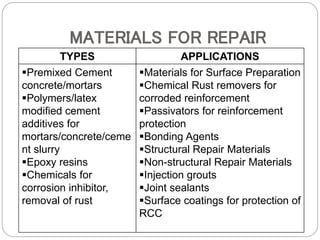
MATERIALS FOR REPAIR
TYPES APPLICATIONS
Premixed Cement
concrete/mortars
Polymers/latex
modified cement
additives for
mortars/concrete/ceme
nt slurry
Epoxy resins
Chemicals for
corrosion inhibitor,
removal of rust
Materials for Surface Preparation
Chemical Rust removers for
corroded reinforcement
Passivators for reinforcement
protection
Bonding Agents
Structural Repair Materials
Non-structural Repair Materials
Injection grouts
Joint sealants
Surface coatings for protection of
RCC
WHAT IS SURFACE COATING?
 Surface coating are referred as resurfacing
materials and toppings. Protective coatings
can greatly reduce the effect of deteriorate
conditions, and significantly improve the
durability characteristics of the concrete. A
variety of coatings are available and some are
tailored for greater chemical resistance, while
others are to resist wear and erosion.
ESSENTIAL PARAMETERS FOR
COATINGS
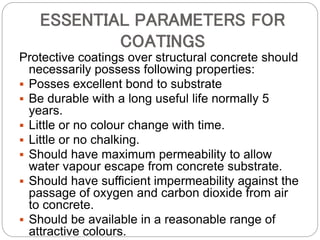
Protective coatings over structural concrete should
necessarily possess following properties:
 Posses excellent bond to substrate
 Be durable with a long useful life normally 5
years.
 Little or no colour change with time.
 Little or no chalking.
 Should have maximum permeability to allow
water vapour escape from concrete substrate.
 Should have sufficient impermeability against the
passage of oxygen and carbon dioxide from air
to concrete.
 Should be available in a reasonable range of
attractive colours.
TYPES OF SURFACE COATINGS
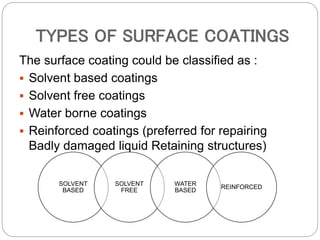
The surface coating could be classified as :
 Solvent based coatings
 Solvent free coatings
 Water borne coatings
 Reinforced coatings (preferred for repairing
Badly damaged liquid Retaining structures)
SOLVENT
BASED
SOLVENT
FREE
WATER
BASED
REINFORCED
VARIOUS TYPES OF COATINGS & THEIR
PERFORMANCE CHARACTERISTICS
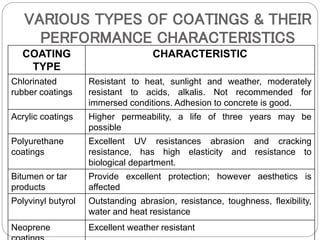
COATING
TYPE
CHARACTERISTIC
Chlorinated
rubber coatings
Resistant to heat, sunlight and weather, moderately
resistant to acids, alkalis. Not recommended for
immersed conditions. Adhesion to concrete is good.
Acrylic coatings Higher permeability, a life of three years may be
possible
Polyurethane
coatings
Excellent UV resistances abrasion and cracking
resistance, has high elasticity and resistance to
biological department.
Bitumen or tar
products
Provide excellent protection; however aesthetics is
affected
Polyvinyl butyrol Outstanding abrasion, resistance, toughness, flexibility,
water and heat resistance
Neoprene Excellent weather resistant
POLYESTER RESINS
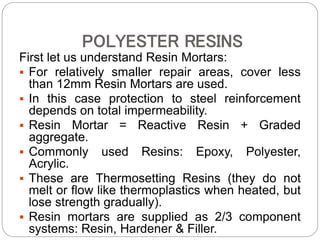
First let us understand Resin Mortars:
 For relatively smaller repair areas, cover less
than 12mm Resin Mortars are used.
 In this case protection to steel reinforcement
depends on total impermeability.
 Resin Mortar = Reactive Resin + Graded
aggregate.
 Commonly used Resins: Epoxy, Polyester,
Acrylic.
 These are Thermosetting Resins (they do not
melt or flow like thermoplastics when heated, but
lose strength gradually).
 Resin mortars are supplied as 2/3 component
systems: Resin, Hardener & Filler.
WHAT IS POLYESTER RESINS ?
 Polyester resins are unsaturated synthetic resins
formed by the reaction of dibasic organic acids
and polyhydric alcohols.
 Unsaturated polyester resin is a thermoset,
capable of being cured from a liquid or solid state
when subject to the right conditions.
 There are two principle types of polyester resin
used as standard laminating systems in the
composites industry.
 Orthophthalic polyester resin is the standard
economic resin used by many people.
 Isophthalic polyester resin is now becoming the
preferred material in industries such as marine where
its superior water resistance is desirable.
PROPERTIES OF POLYESTER
RESINS
 Most polyester resins are viscous, pale coloured
liquids consisting of a solution of a polyester in a
monomer which is usually styrene.
 Polyester resins can be moulded without the use
of pressure and are called 'contact' or 'low
pressure' resins.
 Polyester resins have a limited storage life as
they will set or 'gel' on their own over a long
period of time.
 Polyester resin requires the addition of several
ancillary products like Catalyst, Accelerator &
Additives .
PROPERTIES OF POLYESTER
RESINS
 Polyesters offer ease of handling, low cost,
dimensional stability, as well as good
mechanical, chemical-resistance and electrical
properties.
 Polyester resins are the least expensive of the
resin options, providing the most economical way
to incorporate resin, filler and reinforcement.

MATERIALS FOR REPAIR

  • 1.
     SURFACE COATINGS POLYESTERRESINS MATERIALS FOR REPAIR BY: MOHIT PANCHAL 15001515006
  • 2.
    CONTENTS  MATERIALS FORREPAIR  Types  Applications  SURFACE COATING  What is surface coating?  Essential parameters for coatings  Types of surface coatings  Various types of coatings & their performance characteristics  POLYESTER RESINS  What is polyester resins ?  Properties of polyester resins
  • 3.
    MATERIALS FOR REPAIR TYPESAPPLICATIONS Premixed Cement concrete/mortars Polymers/latex modified cement additives for mortars/concrete/ceme nt slurry Epoxy resins Chemicals for corrosion inhibitor, removal of rust Materials for Surface Preparation Chemical Rust removers for corroded reinforcement Passivators for reinforcement protection Bonding Agents Structural Repair Materials Non-structural Repair Materials Injection grouts Joint sealants Surface coatings for protection of RCC
  • 4.
    WHAT IS SURFACECOATING?  Surface coating are referred as resurfacing materials and toppings. Protective coatings can greatly reduce the effect of deteriorate conditions, and significantly improve the durability characteristics of the concrete. A variety of coatings are available and some are tailored for greater chemical resistance, while others are to resist wear and erosion.
  • 5.
    ESSENTIAL PARAMETERS FOR COATINGS Protectivecoatings over structural concrete should necessarily possess following properties:  Posses excellent bond to substrate  Be durable with a long useful life normally 5 years.  Little or no colour change with time.  Little or no chalking.  Should have maximum permeability to allow water vapour escape from concrete substrate.  Should have sufficient impermeability against the passage of oxygen and carbon dioxide from air to concrete.  Should be available in a reasonable range of attractive colours.
  • 6.
    TYPES OF SURFACECOATINGS The surface coating could be classified as :  Solvent based coatings  Solvent free coatings  Water borne coatings  Reinforced coatings (preferred for repairing Badly damaged liquid Retaining structures) SOLVENT BASED SOLVENT FREE WATER BASED REINFORCED
  • 7.
    VARIOUS TYPES OFCOATINGS & THEIR PERFORMANCE CHARACTERISTICS COATING TYPE CHARACTERISTIC Chlorinated rubber coatings Resistant to heat, sunlight and weather, moderately resistant to acids, alkalis. Not recommended for immersed conditions. Adhesion to concrete is good. Acrylic coatings Higher permeability, a life of three years may be possible Polyurethane coatings Excellent UV resistances abrasion and cracking resistance, has high elasticity and resistance to biological department. Bitumen or tar products Provide excellent protection; however aesthetics is affected Polyvinyl butyrol Outstanding abrasion, resistance, toughness, flexibility, water and heat resistance Neoprene Excellent weather resistant
  • 8.
    POLYESTER RESINS First letus understand Resin Mortars:  For relatively smaller repair areas, cover less than 12mm Resin Mortars are used.  In this case protection to steel reinforcement depends on total impermeability.  Resin Mortar = Reactive Resin + Graded aggregate.  Commonly used Resins: Epoxy, Polyester, Acrylic.  These are Thermosetting Resins (they do not melt or flow like thermoplastics when heated, but lose strength gradually).  Resin mortars are supplied as 2/3 component systems: Resin, Hardener & Filler.
  • 9.
    WHAT IS POLYESTERRESINS ?  Polyester resins are unsaturated synthetic resins formed by the reaction of dibasic organic acids and polyhydric alcohols.  Unsaturated polyester resin is a thermoset, capable of being cured from a liquid or solid state when subject to the right conditions.  There are two principle types of polyester resin used as standard laminating systems in the composites industry.  Orthophthalic polyester resin is the standard economic resin used by many people.  Isophthalic polyester resin is now becoming the preferred material in industries such as marine where its superior water resistance is desirable.
  • 10.
    PROPERTIES OF POLYESTER RESINS Most polyester resins are viscous, pale coloured liquids consisting of a solution of a polyester in a monomer which is usually styrene.  Polyester resins can be moulded without the use of pressure and are called 'contact' or 'low pressure' resins.  Polyester resins have a limited storage life as they will set or 'gel' on their own over a long period of time.  Polyester resin requires the addition of several ancillary products like Catalyst, Accelerator & Additives .
  • 11.
    PROPERTIES OF POLYESTER RESINS Polyesters offer ease of handling, low cost, dimensional stability, as well as good mechanical, chemical-resistance and electrical properties.  Polyester resins are the least expensive of the resin options, providing the most economical way to incorporate resin, filler and reinforcement.