Polymer Coating Material
(PCM)
Prepared & Presented By: Abdallah Sayed Ahmed El-gharbawy
What Is Polymer ….?
• Monomer: Low molecular weight compound
that can be connected together to give a
polymer such as Ethylene , Propylene.
• Polymer: High molecular weight molecule
made up of a small repeat unit (monomer) such
as Polyethylene.
A-A-A-A-A-A-A-A-A-A-A-A-A-A-A-
Polymer Classifications
Thermoplastic Meltable plastic such as PE, PVC , PP
Thermoset Cross-linked polymer that cannot be melted (Epoxides,
Polyester)
Elastomers Polymers that stretch and then return to their original form:
often thermoset polymers (Tires, Rubber).
Thermoplastic
elastomers
Elastic polymers that can be melted (soles of tennis shoes).
Polymer Characteristics
• Corrosion resistance: Polymers are resistant to corrosion.
• Lightweight
• Electrical properties: Polymers are nonconductive
• Low maintenance cost: Polymer is easy to maintain because it does not rust,
is easily cleaned, and requires minimal protection from the environment.
• Less Energy & Cost to fabricate
• Low Heat transfer
Metal Corrosion
What Is Polymer Coating….?
Polymeric coatings are coatings or paint made with polymers that provide
superior adherence and protection from corrosion.
Examples of polymeric coatings include:
Natural and synthetic rubber
Urethane
Polyvinyl chloride
Acrylic
Phenolic resins
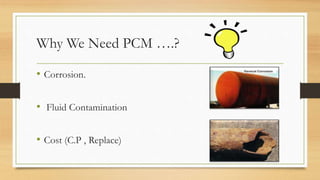
Why We Need PCM ….?
• Corrosion.
• Fluid Contamination
• Cost (C.P , Replace)
Properties of Polymer Coating
• Temperature-resistant up to approx. 535°F (280°C).
• Heat/moisture/salt/ UV and chemicals Stability.
• High Toughness.
• Passive fire protection
• Waterproof fabric (hydrophobic)
• Antimicrobial surface
• Wear resistance
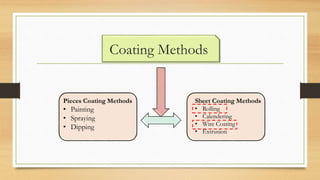
Coating Methods
Pieces Coating Methods
• Painting
• Spraying
• Dipping
Sheet Coating Methods
• Rolling
• Calendering
• Wire Coating
• Extrusion
Spraying Methods
•This process occurs when paint is applied to an
object through the use of an air-pressurized
(compressed gas)spray gun.
•The air gun has a nozzle, paint basin, and air
compressor. When the trigger is pressed the paint
mixes with the compressed air stream and is
released in a fine spray.
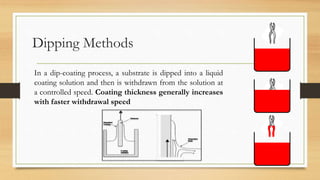
In a dip-coating process, a substrate is dipped into a liquid
coating solution and then is withdrawn from the solution at
a controlled speed. Coating thickness generally increases
with faster withdrawal speed
Dipping Methods
In this process polymer solution is rolled onto
the fabric/film/sheet by a roller suspended in
the coating solution.
Rolling Methods
•Steel cable can be
jacketed with a number
of plastics, and a variety
of wall thicknesses.
•Commonly used
plastics includes PVC,
Nylon,PE or PP.
Wire Coating Methods
Insulating material is used as a
protective coating on electrical wire
Electrocoating or E-coat
•Electrocoating is an immersion painting
process in which charged paint particles are
attracted to an oppositely charged metallic
surface.
• As the paint is deposited, it forms a finish
which begins to insulate the metal from the
surrounding charged solution. Deposition
continues until the coating thickness becomes
sufficient to form a barrier against further
paint attraction.
Application Of PCM
Types of Polymer Coatings
Acrylics and alkyds :
• Acrylics are esters of acrylic acid.
• Alkyds are synthetic resins made by reacting
alcohols and fatty acids
• Alkyd resins benefits are: good weathering
characteristics and ease of application with low-
cost, low-toxicity, Abrasion resistance, Good
adhesion.
Acrylic
Alkyds
Types of Polymer Coatings
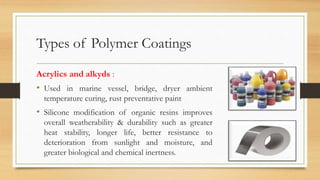
Acrylics and alkyds :
• Used in marine vessel, bridge, dryer ambient
temperature curing, rust preventative paint
• Silicone modification of organic resins improves
overall weatherability & durability such as greater
heat stability, longer life, better resistance to
deterioration from sunlight and moisture, and
greater biological and chemical inertness.
Types of Polymer Coatings
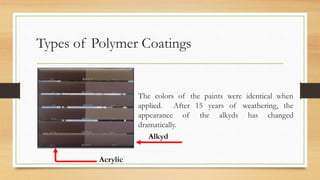
The colors of the paints were identical when
applied. After 15 years of weathering, the
appearance of the alkyds has changed
dramatically.
Alkyd
Acrylic
Types of Polymer Coatings
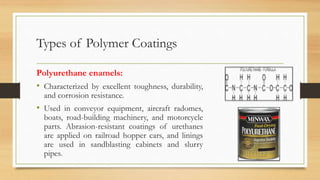
Polyurethane enamels:
• Characterized by excellent toughness, durability,
and corrosion resistance.
• Used in conveyor equipment, aircraft radomes,
boats, road-building machinery, and motorcycle
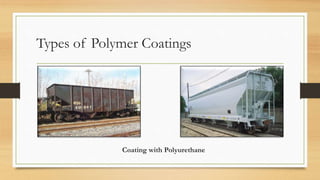
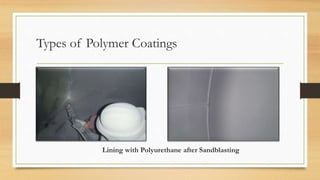
parts. Abrasion-resistant coatings of urethanes
are applied on railroad hopper cars, and linings
are used in sandblasting cabinets and slurry
pipes.
Types of Polymer Coatings
Air plane Coating with Polyurethane
Coating with Polyurethane
Types of Polymer Coatings
Lining with Polyurethane after Sandblasting
Types of Polymer Coatings
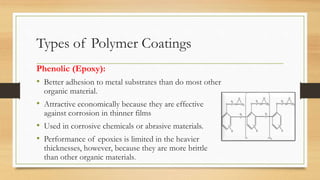
Phenolic (Epoxy):
• Better adhesion to metal substrates than do most other
organic material.
• Attractive economically because they are effective
against corrosion in thinner films
• Used in corrosive chemicals or abrasive materials.
• Performance of epoxies is limited in the heavier
thicknesses, however, because they are more brittle
than other organic materials.
Pump Impeller Pipe Painting with Epoxy Coupling
Types of Polymer Coatings
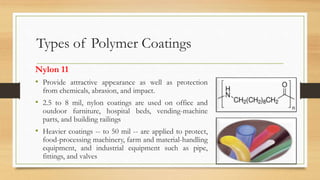
Nylon 11
• Provide attractive appearance as well as protection
from chemicals, abrasion, and impact.
• 2.5 to 8 mil, nylon coatings are used on office and
outdoor furniture, hospital beds, vending-machine
parts, and building railings
• Heavier coatings -- to 50 mil -- are applied to protect,
food-processing machinery, farm and material-handling
equipment, and industrial equipment such as pipe,
fittings, and valves
Types of Polymer Coatings
Coating with Nylon
Types of Polymer Coatings
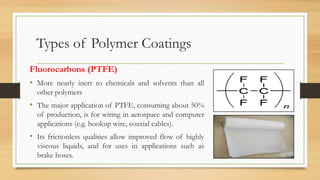
Fluorocarbons (PTFE)
• More nearly inert to chemicals and solvents than all
other polymers
• The major application of PTFE, consuming about 50%
of production, is for wiring in aerospace and computer
applications (e.g. hookup wire, coaxial cables).
• Its frictionless qualities allow improved flow of highly
viscous liquids, and for uses in applications such as
brake hoses.
Polymer_Coating_Material_pptx.pptx

Polymer_Coating_Material_pptx.pptx

  • 1.
    Polymer Coating Material (PCM) Prepared& Presented By: Abdallah Sayed Ahmed El-gharbawy
  • 2.
    What Is Polymer….? • Monomer: Low molecular weight compound that can be connected together to give a polymer such as Ethylene , Propylene. • Polymer: High molecular weight molecule made up of a small repeat unit (monomer) such as Polyethylene. A-A-A-A-A-A-A-A-A-A-A-A-A-A-A-
  • 3.
    Polymer Classifications Thermoplastic Meltableplastic such as PE, PVC , PP Thermoset Cross-linked polymer that cannot be melted (Epoxides, Polyester) Elastomers Polymers that stretch and then return to their original form: often thermoset polymers (Tires, Rubber). Thermoplastic elastomers Elastic polymers that can be melted (soles of tennis shoes).
  • 4.
    Polymer Characteristics • Corrosionresistance: Polymers are resistant to corrosion. • Lightweight • Electrical properties: Polymers are nonconductive • Low maintenance cost: Polymer is easy to maintain because it does not rust, is easily cleaned, and requires minimal protection from the environment. • Less Energy & Cost to fabricate • Low Heat transfer
  • 5.
  • 6.
    What Is PolymerCoating….? Polymeric coatings are coatings or paint made with polymers that provide superior adherence and protection from corrosion. Examples of polymeric coatings include: Natural and synthetic rubber Urethane Polyvinyl chloride Acrylic Phenolic resins
  • 7.
    Why We NeedPCM ….? • Corrosion. • Fluid Contamination • Cost (C.P , Replace)
  • 8.
    Properties of PolymerCoating • Temperature-resistant up to approx. 535°F (280°C). • Heat/moisture/salt/ UV and chemicals Stability. • High Toughness. • Passive fire protection • Waterproof fabric (hydrophobic) • Antimicrobial surface • Wear resistance
  • 9.
    Coating Methods Pieces CoatingMethods • Painting • Spraying • Dipping Sheet Coating Methods • Rolling • Calendering • Wire Coating • Extrusion
  • 10.
    Spraying Methods •This processoccurs when paint is applied to an object through the use of an air-pressurized (compressed gas)spray gun. •The air gun has a nozzle, paint basin, and air compressor. When the trigger is pressed the paint mixes with the compressed air stream and is released in a fine spray.
  • 11.
    In a dip-coatingprocess, a substrate is dipped into a liquid coating solution and then is withdrawn from the solution at a controlled speed. Coating thickness generally increases with faster withdrawal speed Dipping Methods
  • 12.
    In this processpolymer solution is rolled onto the fabric/film/sheet by a roller suspended in the coating solution. Rolling Methods
  • 13.
    •Steel cable canbe jacketed with a number of plastics, and a variety of wall thicknesses. •Commonly used plastics includes PVC, Nylon,PE or PP. Wire Coating Methods Insulating material is used as a protective coating on electrical wire
  • 15.
    Electrocoating or E-coat •Electrocoatingis an immersion painting process in which charged paint particles are attracted to an oppositely charged metallic surface. • As the paint is deposited, it forms a finish which begins to insulate the metal from the surrounding charged solution. Deposition continues until the coating thickness becomes sufficient to form a barrier against further paint attraction.
  • 18.
  • 19.
    Types of PolymerCoatings Acrylics and alkyds : • Acrylics are esters of acrylic acid. • Alkyds are synthetic resins made by reacting alcohols and fatty acids • Alkyd resins benefits are: good weathering characteristics and ease of application with low- cost, low-toxicity, Abrasion resistance, Good adhesion. Acrylic Alkyds
  • 20.
    Types of PolymerCoatings Acrylics and alkyds : • Used in marine vessel, bridge, dryer ambient temperature curing, rust preventative paint • Silicone modification of organic resins improves overall weatherability & durability such as greater heat stability, longer life, better resistance to deterioration from sunlight and moisture, and greater biological and chemical inertness.
  • 21.
    Types of PolymerCoatings The colors of the paints were identical when applied. After 15 years of weathering, the appearance of the alkyds has changed dramatically. Alkyd Acrylic
  • 22.
    Types of PolymerCoatings Polyurethane enamels: • Characterized by excellent toughness, durability, and corrosion resistance. • Used in conveyor equipment, aircraft radomes, boats, road-building machinery, and motorcycle parts. Abrasion-resistant coatings of urethanes are applied on railroad hopper cars, and linings are used in sandblasting cabinets and slurry pipes.
  • 23.
    Types of PolymerCoatings Air plane Coating with Polyurethane
  • 24.
  • 25.
    Lining with Polyurethaneafter Sandblasting Types of Polymer Coatings
  • 26.
    Types of PolymerCoatings Phenolic (Epoxy): • Better adhesion to metal substrates than do most other organic material. • Attractive economically because they are effective against corrosion in thinner films • Used in corrosive chemicals or abrasive materials. • Performance of epoxies is limited in the heavier thicknesses, however, because they are more brittle than other organic materials.
  • 27.
    Pump Impeller PipePainting with Epoxy Coupling Types of Polymer Coatings
  • 28.
    Types of PolymerCoatings Nylon 11 • Provide attractive appearance as well as protection from chemicals, abrasion, and impact. • 2.5 to 8 mil, nylon coatings are used on office and outdoor furniture, hospital beds, vending-machine parts, and building railings • Heavier coatings -- to 50 mil -- are applied to protect, food-processing machinery, farm and material-handling equipment, and industrial equipment such as pipe, fittings, and valves
  • 29.
    Types of PolymerCoatings Coating with Nylon
  • 30.
    Types of PolymerCoatings Fluorocarbons (PTFE) • More nearly inert to chemicals and solvents than all other polymers • The major application of PTFE, consuming about 50% of production, is for wiring in aerospace and computer applications (e.g. hookup wire, coaxial cables). • Its frictionless qualities allow improved flow of highly viscous liquids, and for uses in applications such as brake hoses.