Materials And Techniques
For Repair
Prepared By:
Assistant Professor Ankit Patel
General
Though concrete is relatively durable construction material it may
suffer damage or distress during its life period due to number of
reasons. Deterioration of concrete structure is the natural
phenomenon of the gradual degradation of constituent material
brought about physical chemical and mechanical processes. A basic
understanding of underlying causes of concrete deficiencies is
essential to performing meaningful evaluations and successful repair.
If the cause is understood it is much more likely that an appropriate
repair system will be selected and the repair will be successful and
max life of repair will be obtained.
BITS Edu
Campus
Prof. Ankit Patel
2
General
Selection of repair material is one of the most important tasks for
ensuring durable and trust worthy repair. Though, the pre-requisite
for a sound repair system is the detailed investigation and
determining the exact cause of distress, yet an understanding of the
process of deterioration of the repair materials under service
conditions is vital. Of course, availability of materials of relevance,
equipment and skilled labour have to be explored before deciding
upon the repair material. Since, cementitious products have a
tendency to shrink and hardening with age, it is essential that the
repair material for repairing concrete or plaster should be of non
shrink type and compatible with parent material.
BITS Edu
Campus
Prof. Ankit Patel
3
Essential Parameters for Repair
Materials
Besides being of compatible properties, repair materials for cement
concrete/mortar shall also be easy to apply and require no attention
after the repair has been applied. Final selection of materials is made
based on the relationship between cost, performance, and risk. The
essential parameters for deciding upon a repair material for concrete
are:
 Low shrinkage properties
 Requisite setting/hardening properties
 Workability
 Good bond strength with existing sub-strata
 Compatible coefficient of thermal expansion
 Compatible mechanical properties and strength to that of the sub-
strata
 Minimal or no curing requirement
BITS Edu
Campus
Prof. Ankit Patel
4
Essential Parameters for Repair
Materials
 Alkaline character
 Low air and water permeability
 Aesthetics to match with surroundings
 Cost
 Durable, non degradable or non-biodegradable
 Non-hazardous/non-polluting
BITS Edu
Campus
Prof. Ankit Patel
5
Essential Parameters for Repair
Materials
Low Shrinkage: It is well known that the cementitious repair materials
shrink with passage of time. Most of the shrinkage generally takes place in
the initial period from the time of casting to 21 days. Therefore,
cementitious repair material in its original form, if used for repair to
concrete/ mortar, is likely to get either delaminated due to de-bonding or
develop shrinkage cracks on its surface due to shrinkage strains and
stresses. Shrinkage cracks so developed in the repair patch would allow the
easy access of atmospheric air and water, which could be harmful for
concrete and reinforcement.
It is, therefore, essential that the low shrinkage property of repair material
shall be looked for while selecting a material for concrete repair.
Cementitious materials need additional no shrink compounds so as to be
effective in achieving the desired property. Using low cement content and
low water cement ratio will also reduce the drying shrinkage.
BITS Edu
Campus
Prof. Ankit Patel
6
Essential Parameters for Repair
Materials
Requisite setting/hardening Properties : It is desirable that the repaired
structure shall be put to use at the earliest possible to reduce the down time
of plant, machinery, building or road. It is, therefore, essential that repaired
patch shall harden in the minimum possible time. However, in exceptional
cases, it could also be essential to have the slow setting property as a
desirable property for repair material. Such situation could be where more
working time is required to work on repair materials or the repair process is
intricate that more working time is required.
BITS Edu
Campus
Prof. Ankit Patel
7
Essential Parameters for Repair
Materials
Workability:
The property desired by the field workers is good workability. Optimum
workability is to be achieved without sacrificing the other desirable
properties by use of suitable additives/admixtures.
Bond with the Substrate:
The bond strength of repair patch with the substrate is essential to have a
successful repair system. If it is felt that the bond strength of the repair
material with the base material is inadequate or less than the strength of the
base material, then some other suitable means could be explored to improve
bond strength between repair material and substrate. These could be use of:
 Adhesive,
 Surface interlocking system, and/or
 Mechanical bonding
BITS Edu
Campus
Prof. Ankit Patel
8
Essential Parameters for Repair
MaterialsCompatible Coefficient of thermal Expansion:
The difference in volume change because of temperature variation can
cause failure either at the bond line or within the section of lower
strength material. Therefore, in the areas exposed to temperature
variations, the patches of repair should have same coefficient of thermal
expansion to ensure that no undue stresses are transferred to bonding
interface or the substrate.
Compatible Mechanical Properties & Strength:
The hardened material shall have compatible mechanical properties or
rather slightly better strength than that of base material. This property is
desirable to ensure uniform flow of stresses and strains in loaded
structures. It is well known that the elastic modulus of two concretes
would be different for different crushing strength so if repair concrete is
having strength much different than the base, it could lead to non-
uniform flow of stresses and may result in an early failure of the repair
patch.
BITS Edu
Campus
Prof. Ankit Patel
9
Essential Parameters for Repair
Materials
Minimal or no curing Requirement:
It is desirable that the repair material shall not have any curing
requirement after the repair has been applied or even if it is required; it
should be minimal to ensure that the repair patch hardens and attains the
desired strength without much post-repair-care.
Alkalinity:
In case of RCC, it is important to maintain the alkalinity of concrete
around reinforcement with its pH above 11.5 from corrosion protection
point of view. In this context, it is necessary for the repair material to
have chemical characteristics such that it does not adversely affect the
alkalinity of the base concrete at a later date.
BITS Edu
Campus
Prof. Ankit Patel
10
Essential Parameters for Repair
Materials
Low air & water permeability:
Permeable material allows easy permeation of environmental chemicals
including carbon dioxide, water, oxygen, industrial gases/vapours etc. It
is essential that repair materials should have a very low air/water
permeability to provide protection to the reinforced concrete against
ingress of harmful environmental chemicals.
Aesthetics:
It is desirable that colour and texture of the repair material should match
with the structure and give aesthetically pleasant appearance. If need be,
this could be achieved through appropriate finishes.
Cost:
Economics is important while considering various options for repair
materials but cheaper repair material should not be selected at the cost of
performance characteristics. BITS Edu
Campus
Prof. Ankit Patel
11
Essential Parameters for Repair
Materials
Durability & Bio non-degradability:
The repair material selected should be durable under its exposure
conditions during the service life against chemical attack, resistant to
any form of energy like ultra violet rays, infra red rays, heat etc and
should be bio non-degradable.
Non-Hazardous / Non –Polluting:
The repair materials should not be hazardous to field workers. However
adequate Safety measures are required to be taken for repair Materials,
which are hazardous to workers involved with their application, etc.
These should also be environment friendly.
BITS Edu
Campus
Prof. Ankit Patel
12
Classification of Repair Materials
Wide range of materials for repair of concrete is available differing
in cost and their performance into the following categories:
1. Patch repair materials:
Cementious Mortar/ concrete
Polymer modified cementitious mortar/concrete
Polymer mortar
Quick seating compounds ie high alumina cement calcium sulphate
based
2. Injection grout:
Cementitious grout
Polymer grout
Sulpho aluminate grout
3. Bonding materials:
Polymer emulsion type
Polymer resin type
BITS Edu
Campus
Prof. Ankit Patel
13
Classification of Repair Materials
4. Resurfacing materials:
Protective coating and membrane
Gunite shotcrete
Overlays
5. Sealing materials
6. Water proofing materials
7. Other repair materials:
Corrosion inhibitors
Cathodic protection
Realkalization
BITS Edu
Campus
Prof. Ankit Patel
14
Premixed Cement Concrete
Conventional concrete is composed of Portland cement, aggregates
and water. Admixtures are frequently used to entrain air, accelerate or
retard hydration, improve workability, increase strength, or alter the
properties of concrete. Pozzolonic materials such as fly ash or silica
fume may be use in Portland cement to provide reduced early heat of
hydration, improve later stage strength, and increase the resistance to
alkali-aggregate reactions and sulphate attack. Cement paste, being a
binder in concrete or mortar holds fine aggregates, coarse aggregates
and other constituents together in a hardened matrix. Cement forms
one of the most basic materials used for not only in new construction
but also as repair material. Therefore, selection of the appropriate
type of cement for new construction as well as repair work is
important and determines the final efficacy and durability of the
structure.
BITS Edu
Campus
Prof. Ankit Patel
15
Premixed Cement Concrete
Ordinary Portland cement (OPC): IS: 456-2000 allows to use 33, 43,
53 grade of OPC. Grade 33 and 43 may be use for most of the repair
works. Whereas 53 grade cement is more suited for injection grouting of
cracks or honey combed concrete.
Portland Pozzolana Cement and Portland Slag cement: PPC is
obtained by intergrinding of OPC clinkers with 15 to 35 % of
Pozzolonic materials like fly ash and calcined clay. Pozzolana
themselves do not possess any cementitious properties, but in finely
divided state and in presence of water chemically react with free lime
available in the OPC cement paste to form compound possessing
cementitious properties. Pozzolonic materials convert soluble calcium
hydroxide into insoluble formed hence the permeability and durability
gets improve.
Portland slag cement is made by intergrinding Portland cement clinker ,
gypsum and granulated blast furnace slag. The quantity of blast furnace
slag mixed with OPC will range from 25 to 65%
BITS Edu
Campus
Prof. Ankit Patel
16
Premixed Cement Concrete
Blast furnace slag is a waste produce consisting of a mixture of lime,
silica , and alumina obtained in manufacture of pig iron.
Portland slag cement has low heat of hydration , better resistance to
chlorides sulphates and alkalies , low permeability and good resistance
to acidic water.
Rapid Hardening Cement (RHC): RHC develops strength more rapidly at
early ages but as its ultimate strength comparable to OPC. It is used
where early strength is required for eg. For road repair works, wall
sealing etc.
Expansive cement: Concrete shrinks while setting due to loss of free
water. The important property of expansive cement is that it suffers no
overall change in volume on drying. This type of cement is made by
mixing 8-20 parts of sulphoaluminate clinker with 100 parts of OPC and
15 parts of stabilizer. Shrinkage compensating expansive cement are use
to minimize cracking caused by drying shrinkage in repair concrete. It
restrain expansion, induces compressive stresses.
BITS Edu
Campus
Prof. Ankit Patel
17
Premixed Cement Concrete
Pr-Mixed Cement Mortar: it is a mixture of Portland cement, fine
aggregate and water. Water reducing admixtures, expansive agents and
other modifiers are often used with conventional mortar to minimize
shrinkage. Conventional mortar is readily available , well understood ,
economically and easy to produce , pace and finish. They are suitable
for small cracks.
Mortar generally exhibit increased drying shrinkage compared to
concrete because of their higher water volume, high cement content
and higher paste aggregate ratio.
BITS Edu
Campus
Prof. Ankit Patel
18
INTRODUCTION
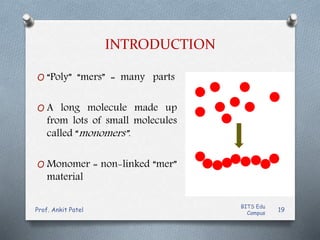
O “Poly” “mers” = many parts
O A long molecule made up
from lots of small molecules
called “monomers”.
O Monomer = non-linked “mer”
material
19
BITS Edu
Campus
Prof. Ankit Patel
BITS Edu
Campus
Prof. Ankit Patel
20
ACADEMIC PURPOSE
“Polymer in concrete – a new construction
achievements on the horizon”
Introduction:
O Through continued research it has been
established that addition of polymer in concrete
brings about marked improvement in its
compressive strength, fatigue resistance ,impact
resistance, toughness and durability.
O Polymer concrete is highly impermeable and
resistance to attack by acids alkalis and other
chemicals. BITS Edu
Campus
Prof. Ankit Patel 21
Types of polymer concrete:
 Polymer concrete may be classified into the
following three categories:
O Polymer impregnated concrete (PIC).
O Polymer Portland cement concrete (PPPC).
O Polymer concrete(PC).
BITS Edu
Campus
Prof. Ankit Patel 22
POLYMER IMPREGNATED CONCRETE (PIC)
O PIC is a hardened Portland cement concrete that has
been impregnated with a monomer(low viscosity
liquid organic material)and subsequently
polymerized in situ.
O In this case , the cement concrete is cast and cured
in the conversational manner.
O After the concrete product gets hardened and dried,
air from its voids is removed under partial vacuum
and viscosity monomer(vinyl chloride etc.)is
diffused through the pores of concrete. The concrete
product is then finally subjected to polymerization
by radiation by heat treatment thereby converting
the monomer filled in the voids into solid plastic.BITS Edu
Campus
Prof. Ankit Patel 23
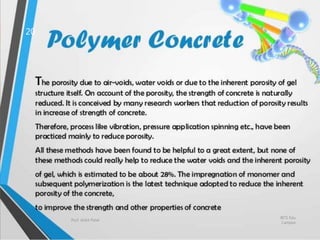
The concept underlying PIC is that if voids are responsible for low
strength as well as poor durability of concrete in severe
environments, then eliminating them by filling with a polymer should
improve the characteristics of the material.
It is difficult for a liquid to penetrate it if the viscosity of the liquid is
high and the voids in concrete are not empty (they contain water and
air). Therefore, for producing PIC, it is essential not only to select a
low-viscosity liquid for penetration but also to dry and evacuate the
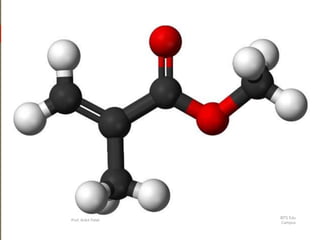
concrete before subjecting it to the penetration process. Monomers
such as methyl methacrylate (MMA) and styrene are commonly used
for penetration because of relatively low viscosity, high boiling point
(less loss due to volatilization), and low cost.
BITS Edu
Campus
Prof. Ankit Patel
24
After penetration, the monomer has to be polymerized in situ.
This can be accomplished in one of three ways.
 A combination of promoter chemical and catalysts can be used for
room-temperature polymerization; but it is not favored because
the process is slow and less controllable.
 Gamma radiation can also induce polymerization at room
temperature, but the health hazard associated with it discourages
the wide acceptance of this process in filed practice.
 The third method, which is generally employed, consists of using
a monomer-catalyst mixture for penetration, and subsequently
polymerizing the monomer by heating the concrete to 70 C with
steam, hot water, or infrared heaters.
BITS Edu
Campus
Prof. Ankit Patel
25
BITS Edu
Campus
Prof. Ankit Patel
26
APPLICATION:
PIC (short form) product on account of their high
resistance to wear and tear, impact etc. are used as
/in:
O Precast slabs for bridge decks;
O Roads;
O Marine structures;
BITS Edu
Campus
Prof. Ankit Patel 27
POLYMER PORTLAND CEMENT CONCRETE (PPCC)
O PPCC is produced by incorporating an emulsion of a polymer or a
monomer in ordinary Portland cement concrete.
O The ingredients comprising cement invented by john, aggregates
and monomer are mixing with water and monomer in the
concrete mix is polymerized after placing concrete in position.
O The resultant concrete has improved:
• Strength;
• Adhesion;
• Chemical resistance;
• Impact resistance;
• Abrasion resistance;
• Increased impermeability;
• Reduced absorption;
O Application: marine works.
BITS Edu
Campus
Prof. Ankit Patel 28
POLYMER CONCRETE(PC)
 Polymer concrete is a mixture of aggregates with polymer as the
sole binder. There is no bonding material present. Portland cement
is not used. It is manufactured in a manner similar to that of cement
concrete. Monomers or pre polymers are added to the graded
aggregate and the mixture is thoroughly mixed by hand or machine.
The thoroughly mixed polymer concrete material is cast in moulds
of steel or aluminum. The polymer concrete material cast in moulds
are then polymerized either at room temp or at an elevated temp.
 In PC polymer/monomer is employed to act as binder in place of
cement.
 The monomer and aggregate are mixed together and the monomer is
polymerized after placement of concrete in position.
 Application: industrial structures, dams, as it possess good electrical
properties it can be use to manufacturing electric poles.
BITS Edu
Campus
Prof. Ankit Patel
29
Precautions while placing PMM/PMC
General Guidelines & Precautions for use of polymer modified
cement Mortar/concrete
 The speed and time of mixing should be properly selected to avoid
unnecessary entrapment of air.
 The PMM/PMC has excellent adhesion even to metal and hence all
equipment should be washed immediately after use.
 For resurfacing, flooring and patching, all loose and non-durable
materials must be removed either by sandblasting, wire brushing and
blowing with compressed air. The cleaned surface should be
thoroughly wetted well before placement of PMM/PMC.
 Before application, surface should be in saturated dry (wet but no
standing water) condition.
 PMM/PMC should never be placed below 5° C and above 30° C.
 The surface of newly placed material should be protected from rainfall
or other source of water. The surface should be immediately covered
with plastic sheet.
BITS Edu
Campus
Prof. Ankit Patel
30
Precautions while placing PMM/PMC
 In large area of application, it is advisable to provide joints of 15 mm
width at intervals of 3-4 meter.
 Polymers should be stored in a cool dry room & should not be kept in
exposed areas.
 Polymers should be mixed with cement slurry or mortar in the
proportions recommended by the manufacturers for various uses.
BITS Edu
Campus
Prof. Ankit Patel
31
EPOXIES AND EPOXY SYSTEMS
.
 Epoxies also come in the category of polymers but in the case of
epoxies, the polymerisation process takes place when two
materials called the epoxy resin and hardener come in contact by
thoroughly mixing in specified proportion. The epoxy resin
materials have good mechanical strength, chemical resistance and
ease of working. These are being used in civil engineering for
high performance coatings, adhesives, injection grouting, high
performance systems, industrial flooring or grouting etc.
 The term ‘epoxy resin’ is a generic name of compounds that
describe a broad class of thermosetting polymers in which the
primary cross linking occurs through the reaction of an epoxide
group. In general, an epoxy resin can be thought of as a molecule
containing a three-membered ring, consisting of one oxygen atom
and two carbon atoms.
BITS Edu
Campus
Prof. Ankit Patel
32
EPOXIES AND EPOXY SYSTEMS
 Epoxies Resin: It have very good mechanical strength, chemical
resistance and ease of working. They are excellent binding agents
with high tensile strength. The product is of low viscosity and can
be injected into small cracks too. The higher viscosity epoxy resin
can be use for surface coating or filling large cracks or holes.
 Epoxy Hardener (Curing Agent): it combines with the epoxy
resin and changes it from liquid to a solid state. The most
common used curing agents are aliphatic and aromatic amines
and polyamides and their products. The aromatic polyamine
curing agents react faster than the aliphatic polyamines
BITS Edu
Campus
Prof. Ankit Patel
33
EPOXY MODIFIERS
 The modifiers are used to provide specific physical and
mechanical performance in both the uncured and cured resin.
 Rubber Additives: These are used to increase flexibility, fatigue
resistance, crack resistance, and energy absorption (toughness) in
epoxy resins.
 Diluents: These are used for lowering the viscosity and
improving handling characteristics of epoxy resin
BITS Edu
Campus
Prof. Ankit Patel
34
EPOXY MODIFIERS
 Coal Tar Epoxy System: Coal Tar epoxy resin combinations
with polyamine hardener have been widely used as water resistant
protective coatings. Coal Tar plays an important part in the
improvement of corrosion resistance of epoxy resin system.
 Epoxy Mortar and Concrete: Epoxy resins are used with
aggregate (silica sand) to produce epoxy mortar or epoxy
concrete, which is used for structural repairs of concrete, RCC
besides its use in new construction in industrial flooring,
foundation grouting, roads etc. They are normally used where
volume of materials is not large and where rapid curing can be
obtained
BITS Edu
Campus
Prof. Ankit Patel
35
What are the advantages of Epoxies?
Bonds strongly to most materials including metals,
concrete, glass, ceramics, stone, wood, leather.
Exceptions are plastics materials like polyethylene,
polypropylene, Teflon, etc.
Excellent resistance to chemicals and solvents.
Very good electrical insulating properties.
Outstanding mechanical strength including tensile,
compressive, flexural and modulus.
Very little shrinkage on curing, thus providing good
dimensional stability.
BITS Edu Campus Prof. Ankit Patel 36
Precautions While Using Epoxies
 Epoxies are generally toxic in nature and these require lot of care
in their handling. The special care required to be taken during
their mixing and applications
 They should not come in contact with the skin. Workers should be
provided with rubber gloves.
 The utensils/ equipment's used for the mixing resin and hardener
should be cleaned immediately after their use.
 The epoxies are generally used as an adhesive to act as bond coat
between the old concrete and repaired concrete.
 Epoxies have much higher bond strength than other polymers, but
at the same time, these are costlier.
BITS Edu
Campus
Prof. Ankit Patel
37
Field of Applications:
Anti Corrosive and Water Proofing Protective Coatings:
Bond Coats (Structural Adhesives) and Grouts:
Structural repairs to concrete
BITS Edu
Campus
Prof. Ankit Patel
38
BITS Edu
Campus
Prof. Ankit Patel
39
Surface Coatings
 Surface coating are also referred as resurfacing materials and
toppings. Protective coatings can greatly reduce the effect of
deteriorate conditions, and significantly improve the durability
characteristics of the concrete. A variety of coatings are available
and some are tailored for greater chemical resistance, while others
are to resist wear and erosion.
 Essential Parameters for coatings:
 Posses excellent bond to substrate
 Be durable with a long useful life normally 5 years.
 Little or no colour change with time.
 Should have sufficient impermeability against the passage of
oxygen and carbon dioxide from air to concrete.
 Should be available in a reasonable range of attractive colours.
BITS Edu
Campus
Prof. Ankit Patel
40
Surface Coatings
Factors Considered on application of coatings:
 Climatic Conditions
 Temperature of concrete
 Moisture content of surface
 The thickness and number of coats
Types of Coating:
1. Epoxy coatings:
 Excellent chemical resistance to most chemicals
 Excellent adhesion to concrete
 Good abrasion and impact resistance
 Excellent resistant to corrosion of steel reinforcement
2. Acrylic coatings:
 Solvent Free acrylic coatings have excellent wetting
characteristics , a fair degree of chemical resistance and good
color retention characteristics
BITS Edu
Campus
Prof. Ankit Patel
41
Surface Coatings
 Because of their low viscosity, these materials are ideally suited
for sealing cracks
3. Polyvinyl chloride coatings:
 Very poor adhesion to concrete
 Excellent acid resistance
 Not suitable on moist surface
4. Polyvinyl Alcohol coatings:
 Good adhesion to concrete
 Moderately resistant to acids and alkalies
 Good flexibility, hardness and abrasion resistance
5. Chlorinated Rubber coatings:
 Resistance to heat, sunlight and weather
 Moderately resistant to acids and alkalies
 Good adhesion to concrete BITS Edu
Campus
Prof. Ankit Patel
42
Surface Hardness And Overlays
The surface hardener and overlays are use for repair and upgrading
of industrial floors, where loaded vehicles traverse the floor.
 This improves the wear resistance chemical resistance, reduce
dusting and improve appearance of concrete floors
 Overlays (Toppings): it is provided as a second stage of
construction on a new floor or deck, or in a rehabilitation of
existing deteriorated floor slab or deck.
 General requirement of overlays it gives adequate skid resistance,
low permeability to water, higher abrasion resistance, sufficient
flexibility to avoid cracking
 Material used for overlays are thin polymer overlays and thin
epoxy overlays
BITS Edu
Campus
Prof. Ankit Patel
43
Surface Hardness And Overlays
 Thin Polymer overlays: this are use to improve the abrasion
resistance and for creating waterproofing barriers on the surface
and act as a protective coatings . These are applied in less than
10mm thickness and it is applied for 2 to 3 coats.
 Thin epoxy overlays: this are also used to improve the abrasion
resistance and for creating waterproofing barriers on the surface
and act as a protective coatings . These are applied in 2 to 3mm
thickness. It is generally comprises of resin and hardener. The
strength gain is much faster than polymer overlays.
BITS Edu
Campus
Prof. Ankit Patel
44
Sealing Materials
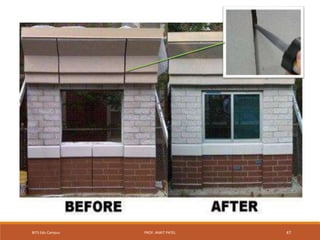
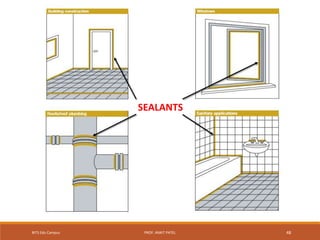
Definition for ‘SEALANT’ is “any material placed in a joint
opening generally for the purpose of weather proofing a building, so
designed to prevent the passage of moisture, air, dust, and heat
through all joints and seams in the structure.”
OR
Definition for ‘SEALANT’ is “in building construction, a material
that has the necessary adhesive and cohesive properties to form a
seal.”
BITS Edu
Campus
Prof. Ankit Patel
45
Sealing Materials
Functions:
 Sealants, despite not having great strength, convey a number of
properties. They seal top structures to the substrate, and are
particularly effective in waterproofing processes by keeping
moisture out (or in) the components in which they are used.
 They can provide thermal insulation, and may serve as fire
barriers.
 They may have electrical properties, as well. Sealants can also be
used for simple smoothing or filling.
 To prevent ingress of water into the structure
 To accommodate joint movement
BITS Edu
Campus
Prof. Ankit Patel
46
BITS Edu Campus PROF. ANKIT PATEL 47
SEALANTS
BITS Edu Campus PROF. ANKIT PATEL 48
 Types of Construction Sealants
• Silicone Sealants
• Epoxy
• Hybrid Polyurethanes Sealants
• Polyurethanes Sealants
• Elastic Sealants
• Varnish
• Acrylic Latex Sealants
• Bituminous Sealants
• Synthetic Rubber Sealants
• Thermoplastics Sealants
• Butyl Sealants
• Hot Wax
• Proof Sealants
• Polysulfide Sealants
BITS Edu Campus PROF. ANKIT PATEL 49
 Advantages
• Improves Product Durability and Reliability.
• Increases Product Performance.
•Increases Product Quality.
• Enhances Product Aesthetics.
•Increases weathering characteristics.
BITS Edu Campus PROF. ANKIT PATEL 50
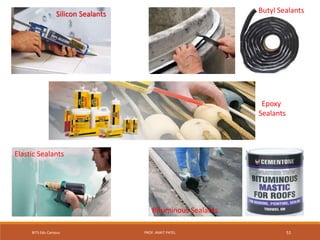
Silicon Sealants Butyl Sealants
Epoxy
Sealants
Bituminous Sealants
Elastic Sealants
BITS Edu Campus PROF. ANKIT PATEL 51
Bonding Materials
Bonding materials are natural, synthetic or compounded materials
used to join two structural members without mechanical fasteners.
These materials are often used in various repair applications, such as
bonding of new concrete to old concrete.
The bonding between new concrete and old concrete depends upon:
i. The cleanliness of the old surface.
ii. The strength and integrity of the old surface
Two types of bonding agents are frequently used:
(a) Cement - based slurries
(b) Epoxies
BITS Edu
Campus
Prof. Ankit Patel
52
Water Proofing Materials
Waterproofing materials are applied on concrete surfaces to form
impervious coatings that prevents the ingress of water into the
concrete.
Various waterproofing materials marketed are :
1. Cement based coatings:
A bedding layer of mortar 1 : 3 (cement : sand) of thickness not less
than 5 mm may be applied.
BITS Edu
Campus
Prof. Ankit Patel
53
Water Proofing Materials
2. Polymer resin based coatings:
Solvent based coatings are available as single or two component
coatings. The coatings on drying produce a smooth dense continuous
film that provides a barrier to moisture and mild chemical attack;
these are preferred for location of high humidity.
BITS Edu
Campus
Prof. Ankit Patel
54
Chemical Admixtures
These are the materials in the form of powder or fluids that are
added to the concrete to give it certain characteristics not obtainable
with plain concrete mixes. In normal use, admixture dosages are less
than 5% by mass of cement.
Various Chemical admixtures are:
1. Accelerators
2. Retarders
3. Plasticizers
4. Super plasticizers
BITS Edu
Campus
Prof. Ankit Patel
55
Chemical Admixtures
Accelerating Admixtures :
An accelerating admixture is used to accelerate the rate of hydration
(setting) and strength development of concrete at an early age.
Advantages
1. Early removal of formwork
2. Reducing curing period requirement
3. Advance the time that a structure can be placed in the service
4. In the emergency repair works
Calcium chloride (CaCl2) is the chemical most commonly used in
accelerating admixtures, especially for non-reinforced concrete. The
widespread use of calcium chloride as an accelerating admixtures
has provided much data and experience on the effect of this chemical
on the properties of concrete. Besides accelerating strength gain,
calcium chloride causes an increase in drying shrinkage, potential
reinforcement corrosion, discoloration (a darkening of concrete), and
an increase in the potential for scaling.
BITS Edu
Campus
Prof. Ankit Patel
56
Chemical Admixtures
Retarding Admixtures:
Retarding admixtures are used to delay the rate of setting of
concrete. High temperatures of fresh concrete (30°C [86°F]) are
often the cause of an increased rate of hardening that make placing
and finishing difficult. One of the most practical methods of
counteracting this effect is to reduce the temperature of the concrete
by cooling the mixing water and/or the aggregates. Retarders do not
decrease the initial temperature of concrete. The bleeding rate and
bleeding capacity of concrete is increased with retarders. Retarding
admixtures are useful in extending the setting time of concrete, but
they are often also used in attempts to decrease slump loss and
extend workability, especially prior to placement at elevated
temperatures.
Some of the materials used as retarders are:
1. Gypsum, Lignin , Borax ,Sugars ,Tartaric acid and salts
BITS Edu
Campus
Prof. Ankit Patel
57
Chemical Admixtures
Water-Reducing Admixtures (Plasticizers)
Plasticizers or water reducers are chemical admixtures that can be
added to concrete mixtures to improve workability. Water-reducing
admixtures are used to reduce the quantity of mixing water required
to produce concrete of a certain slump.
Advantages
1. Increase workability significantly
2. Reduce water-cement ratio
3. Reduce cement content
4. Increase strength and Durability
5. Increase slump significantly. Adding a water-reducing admixture
to concrete without reducing the water content can produce a
mixture with a higher slump.
6. Reduce water content. Typical water reducers reduce the water
content by approximately 5% to 10%
BITS Edu
Campus
Prof. Ankit Patel
58
Chemical Admixtures
High-Range Water Reducing Admixtures (Super Plasticizers)
High-range water reducers, can be used to impart properties induced
by regular water reducers, only much more efficiently. They can
greatly reduce water demand and cement contents and make low
water-cement ratio, high-strength concrete with normal or enhanced
workability. A water reduction of 12% to 30% can be obtained
through the use of these admixtures
The reduced water content and water-cement ratio can produce
concretes with
(1) Ultimate compressive strengths in excess of 70 MPa (10,000
psi),
(2) Increased early strength gain,
(3) Reduced chloride-ion penetration, and
(4) Other beneficial properties associated with low water-cement
ratio concrete
BITS Edu
Campus
Prof. Ankit Patel
59
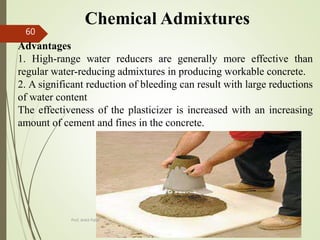
Chemical Admixtures
Advantages
1. High-range water reducers are generally more effective than
regular water-reducing admixtures in producing workable concrete.
2. A significant reduction of bleeding can result with large reductions
of water content
The effectiveness of the plasticizer is increased with an increasing
amount of cement and fines in the concrete.
BITS Edu
Campus
Prof. Ankit Patel
60
Mineral Admixtures
Mineral admixture are finely divided siliceous materials, which can
be added to concrete in relatively large amounts, it is in the range of
15 to 60 % by weight of cement. They may be Pozzolonic ore
cementitious or both. Benefits of using mineral admixtures in
concrete are improvements in impermeability, resistance to thermal
cracking and chemicals, high ultimate strength, better durability and
economy.
The most commonly used mineral admixtures are:
1. Fly Ash
2. Silica Fume
3. Blast Furnace Slag
BITS Edu
Campus
Prof. Ankit Patel
61
Mineral Admixtures
 Fly ash is a fused residue of clay minerals present in coal. The
high temperature generated when coal burns in thermal power
plants, transforms the clay minerals in coal powder into a variety
of fused fine particles of mainly aluminium silicate composition.
 In addition to electricity, these plants produce a material that is
fast becoming a vital ingredient for improving the performance of
a wide range of concrete products That material is fly ash
PRESENT SCENARIO IN INDIA
 Over 75% of the total installed power generation is coal-
based 230 – 250 million tonne coal is being used every year.
 High ash contents varying from 30 to 50%. More than 110
million tonne of ash generated every year.
 Presently as per the Ministry Of Environment & Forest Figures,
30% of Ash is being used in Fillings, embankments,
construction, block & tiles, etc
BITS Edu
Campus
Prof. Ankit Patel
62
Mineral Admixtures
[B] CLASSIFICATION AS PER CATEGORY OF FLY ASH:
I. BOTTOM ASH: - Ash collected at the bottom of boiler furnace
characterized by better geo- technical properties is termed as
bottom ash. It is a good material for fill, road and embankment
construction.
II. DRY ASH: - Ash collected from different rows of Electro-static
precipitators in dry form is termed as dry ash. It is used in the
manufacture of PPC, Concrete & Cement mortar, Lime fly ash
bricks, Building blocks, Aerated concrete blocks etc.
III. POND ASH: - Fly ash and bottom ash are mixed together with
water to form slurry, which is pumped to the ash pond area. In
ash pond area, ash gets settled and excess water is decanted.
This deposited ash is called pond ash. This is used as filling
materials including in the construction of roads & embankments.BITS Edu
Campus
Prof. Ankit Patel
63
 Better compaction characteristics.
 Cost effective.
 Good compaction.
 It is used as a replacement material.
 Low heat of hydration.
 Gain strength more than that of the ordinary cement.
ADVANTAGES OF USING FLY ASH
B I T S E D U C A M P U S
P R O F . A N K I T P A T E L
64
Mineral Admixtures
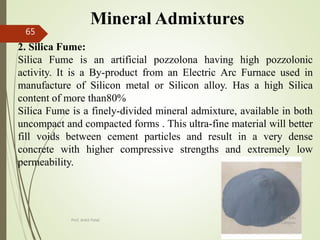
2. Silica Fume:
Silica Fume is an artificial pozzolona having high pozzolonic
activity. It is a By-product from an Electric Arc Furnace used in
manufacture of Silicon metal or Silicon alloy. Has a high Silica
content of more than80%
Silica Fume is a finely-divided mineral admixture, available in both
uncompact and compacted forms . This ultra-fine material will better
fill voids between cement particles and result in a very dense
concrete with higher compressive strengths and extremely low
permeability.
BITS Edu
Campus
Prof. Ankit Patel
65
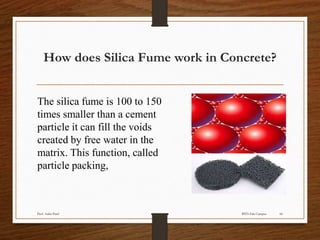
How does Silica Fume work in Concrete?
The silica fume is 100 to 150
times smaller than a cement
particle it can fill the voids
created by free water in the
matrix. This function, called
particle packing,
BITS Edu CampusProf. Ankit Patel 66
Mineral Admixtures
Properties of Fresh Concrete
 Too much silica fumes cause the concrete to become sticky and
thus reduces the workability
 Silica fume addition up to 15% by weight of cement does not
result in any loss of workability
 Silica fume concrete, due to larger surface area of fine particle
requires higher water content for same workability than ordinary
concrete
PROBLEMS WITH THE USE OF SILICA FUME
 Availability
 Cost
APPLICATIONS
 Silica Fume is now widely used for high strength structures
BITS Edu
Campus
Prof. Ankit Patel
67
Advantages of Silica Fume
• Lowers concrete permeability.
• Significantly increases concrete durability.
• Increases ultimate strength gain.
• Beneficial in all types of high strength concrete
applications.
• Improves bond strength to steel.
• Significantly reduces alkali-silica reactivity.
• Provides excellent resistance to sulphate or seawater
attack.
• Reduces steel corrosion.
• Improves freeze/thaw durability of concrete.
BITS Edu CampusProf. Ankit Patel 68
Uses of Silica Fume
For production of high strength concrete, corrosion-
resistant concrete, abrasion-resistant concrete, and low
permeability concrete. Used to make sewer and manhole
repair products.
BITS Edu CampusProf. Ankit Patel 69
Mineral Admixtures
Portland Slag cement: This type of cement is made by
intergrinding Portland cement clinker, gypsum and granulated blast
furnace slag. The quantity of blast furnace slag mixed with clinker
will range from 25 to 65 %.Blast furnace slag is the waste produce
consisting of mixture of lime, silica and alumina obtained in the
manufacture of pig iron. The Portland slag cement should not be
used in cold weather as the low heat of hydration coupled with low
rate of strength development.
Advantages of PSC:
Low heat of hydration, better resistance to chlorides sulphate,
alkalies, low permeability, good resistance to acidic waters.
Generally it is use in mass concrete works and marine works.
BITS Edu
Campus
Prof. Ankit Patel
70
FERROCEMENT
Introduction:
Ferro-cement is a relatively new construction material consists of
wire meshes and cement mortar. It was developed by P.L.Nervi, an
Italian architect in 1940.
WHAT IS FERRO CEMENT ?
“Ferro cement is a type of thin wall reinforced concrete,
commonly constructed of hydraulic cement mortar, reinforced with
closely spaced layers of continuous and relatively small size wire
mesh. The mesh may be made of metallic or other suitable
materials.”
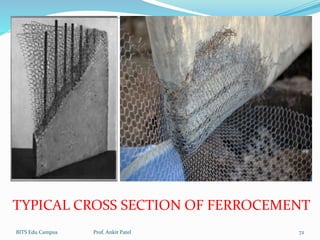
Ferro cement= wire meshes + cement mortar
It consists of closely spaced wire meshes which are impregnated
with rich cement mortar mix.
Mortar provides the mass & wire mesh imparts tensile strength and
ductility to the material.
It has high resistance against cracking, high fatigue resistance , high
BITS Edu
Campus
Prof. Ankit Patel
71
TYPICAL CROSS SECTION OF FERROCEMENT
BITS Edu Campus Prof. Ankit Patel 72
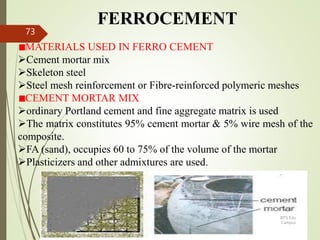
FERROCEMENT
MATERIALS USED IN FERRO CEMENT
Cement mortar mix
Skeleton steel
Steel mesh reinforcement or Fibre-reinforced polymeric meshes
CEMENT MORTAR MIX
ordinary Portland cement and fine aggregate matrix is used
The matrix constitutes 95% cement mortar & 5% wire mesh of the
composite.
FA (sand), occupies 60 to 75% of the volume of the mortar
Plasticizers and other admixtures are used.
BITS Edu
Campus
Prof. Ankit Patel
73
FERROCEMENT
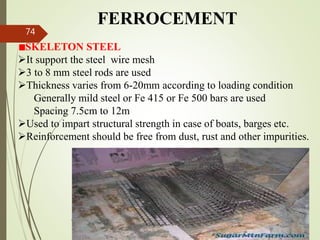
SKELETON STEEL
It support the steel wire mesh
3 to 8 mm steel rods are used
Thickness varies from 6-20mm according to loading condition
Generally mild steel or Fe 415 or Fe 500 bars are used
Spacing 7.5cm to 12m
Used to impart structural strength in case of boats, barges etc.
Reinforcement should be free from dust, rust and other impurities.
BITS Edu
Campus
Prof. Ankit Patel
74
FERROCEMENT
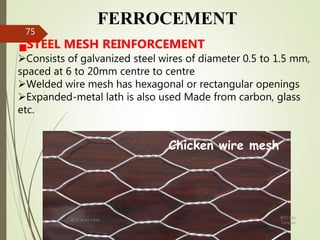
STEEL MESH REINFORCEMENT
Consists of galvanized steel wires of diameter 0.5 to 1.5 mm,
spaced at 6 to 20mm centre to centre
Welded wire mesh has hexagonal or rectangular openings
Expanded-metal lath is also used Made from carbon, glass
etc.
Chicken wire mesh
BITS Edu
Campus
Prof. Ankit Patel
75
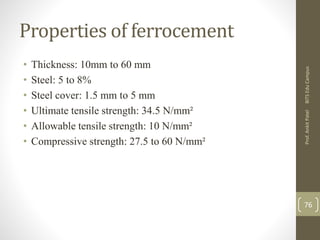
Properties of ferrocement
• Thickness: 10mm to 60 mm
• Steel: 5 to 8%
• Steel cover: 1.5 mm to 5 mm
• Ultimate tensile strength: 34.5 N/mm²
• Allowable tensile strength: 10 N/mm²
• Compressive strength: 27.5 to 60 N/mm²
BITSEduCampusProf.AnkitPatel
76
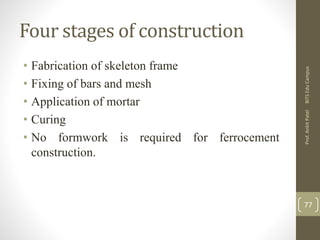
Four stages of construction
• Fabrication of skeleton frame
• Fixing of bars and mesh
• Application of mortar
• Curing
• No formwork is required for ferrocement
construction.
BITSEduCampusProf.AnkitPatel
77
ADVANTAGES OF FERRO-CEMENT
It is highly versatile and can be formed into almost
any shape for a wide range of uses
20% savings on materials and cost
Suitability for pre-casting
Flexibility in cutting, drilling and jointing
Good fire resistance
Good impermeability
Low maintenance costs
BITS Edu Campus Prof. Ankit Patel 78
 Thin elements and light structures, reduction in self
weight & Its simple techniques require a minimum of
skilled labor
 Reduction in expensive form work so economy & speed can
be achieved
 Only a few simple hand tools are needed to build any
structures
 Structures are highly waterproof & Higher strength to
weight ratio than R.C.C
 It is very easy to repair the damaged ferrocement work.
BITS Edu Campus Prof. Ankit Patel 79
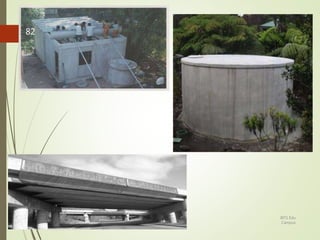
APPLICATIONS OF FERRO CEMENT
1. Marine Applications
 Boats, fishing vessels, barges, cargo tugs, flotation buoys
Key criteria for marine applications: light weight,
impact resistance, thickness and water tightness
2. Water supply and sanitation
 Water tanks, sedimentation tanks, swimming pool linings,
well casings, septic tanks etc.
3. Agricultural
 Grain storage bins, silos, canal linings, pipes, shells for fish
and poultry farms
BITS Edu Campus Prof. Ankit Patel 80
4. Residential Buildings
 Houses, community centers, precast housing
elements, corrugated roofing sheets, wall panels
etc.
5. Miscellaneous uses
Mobile homes
Wind tunnel
Silos and bins
BITS Edu Campus Prof. Ankit Patel 81
BITS Edu
Campus
Prof. Ankit Patel
82
FERROCEMENT
Conclusion
In India, Ferro-cement is used often because the
constructions made from it are more resistant to
earthquakes. It has a wide range of other uses including
sculpture and prefabricated building components.
BITS Edu
Campus
Prof. Ankit Patel
83
FERROCEMENT
Conclusion
In India, Ferro-cement is used often because the
constructions made from it are more resistant to
earthquakes. It has a wide range of other uses including
sculpture and prefabricated building components.
BITS Edu
Campus
Prof. Ankit Patel
84
Background of Fibre Reinforced Concrete
 Portland cement concrete is considered to be a relatively brittle
material. When subjected to tensile stresses, non-reinforced
concrete will crack and Since mid 1800's Steel reinforcing has
been used to overcome this problem. As a composite system, the
reinforcing steel is assumed to carry all tensile loads .
 The problem with employing steel in concrete is that over time
steel corrodes due to the ingress of chloride ions.
 In the northeast, where sodium chloride de-icing salts are
commonly used and a large amount of coastal area exists,
chlorides are readily available for penetration into concrete to
promote corrosion, which favors the formation of rust. Rust has
a volume between four to ten times the iron, which dissolves to
form it.
BITS Edu Campus
Prof. Ankit Patel
85
 The volume expansion produces large tensile stresses in the
concrete, which initiates cracks and results in concrete spalling
from the surface. Although some measures are available to
reduce corrosion of steel in concrete such as corrosion
inhibitive admixtures and coatings, a better and permanent
solution may be replace the steel with a reinforcement that is
less environmentally sensitive.
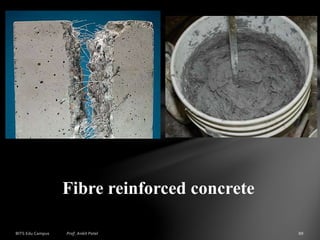
 FRC is Portland cement concrete reinforced with more or less
randomly distributed fibres. In FRC, thousands of small fibres
are dispersed and distributed randomly in the concrete during
mixing, and thus improve concrete properties in all directions.
fibres help to improve the post peak ductility performance, pre-
crack tensile strength, fatigue strength, impact strength and
eliminate temperature and shrinkage cracks.
BITS Edu Campus
Prof. Ankit Patel
86
FIBRE REINFORCED CONCRETE
Fibre Reinforced Concrete can be defined as a composite material
consisting of mixtures of cement, mortar or concrete and
discontinuous, discrete, uniformly dispersed suitable fibres.
Fibre is a small piece of reinforcing material possessing certain
characteristics properties. They can be circular or flat. The fibre is
often described by a convenient parameter called “aspect ratio”. The
aspect ratio of the fibre is the ratio of its length to its diameter.fibre
reinforced concrete (FRC) is concrete containing fibrous material
which increases its structural integrity. It contains short discrete
fibres that are uniformly distributed and randomly oriented. fibres
include steel fibres, glass fibres, synthetic fibres and natural fibres.
Within these different fibres that character of fibre reinforced
concrete changes with varying concretes, fibre materials.
BITS Edu
Campus
Prof. Ankit Patel
87
Fibre reinforced concrete
Factors Affecting Characteristic of FRC
 Volume of fibres
 Aspect ratio of fibres
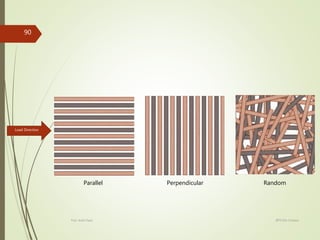
 Orientation of fibres
 Size of coarse aggregate
 Workability and compaction of concrete
 Mixing
BITS Edu Campus
Prof. Ankit Patel
89
Load directionLoad Direction
Parallel Perpendicular Random
BITS Edu CampusProf. Ankit Patel
90
FIBRE REINFORCED CONCRETE
DIFFERENT TYPE OF FIBRE:
1. Steel fibre Reinforced Concrete
2. Polypropylene fibre Reinforced (PFR) cement mortar & concrete
3. Glass-fibre Reinforced Concrete
4. Asbestos fibres
5. Carbon fibres
 Steel fibre reinforced concrete
 This type of concrete is formed by adding steel fibres in the
ingredients of concrete. A number of steel fibres are available as
reinforcement such as round steel fibres ,straight ,deformed
variable cross section and glued bundles of steel fibres.
BITS Edu
Campus
Prof. Ankit Patel
91
FIBRE REINFORCED CONCRETE
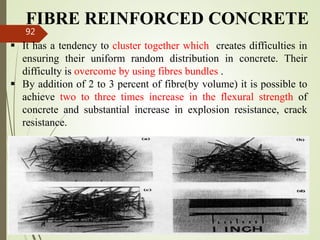
 It has a tendency to cluster together which creates difficulties in
ensuring their uniform random distribution in concrete. Their
difficulty is overcome by using fibres bundles .
 By addition of 2 to 3 percent of fibre(by volume) it is possible to
achieve two to three times increase in the flexural strength of
concrete and substantial increase in explosion resistance, crack
resistance.
BITS Edu
Campus
Prof. Ankit Patel
92
FIBRE REINFORCED CONCRETE
 Applications:
 Construction of pavements
 Bridge decks
 Tunnels lining
2 Polypropylene fibre Reinforced (PFR) cement mortar &
concrete
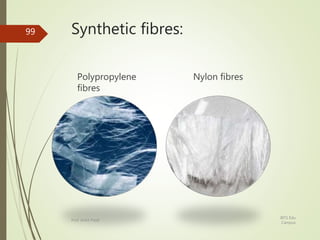
Polypropylene is one of the cheapest & abundantly available
polymers polypropylene fibres are resistant to most chemical. Their
addition to concrete has shown better distribute cracking and reduced
crack size The amount of plastic fibres added to concrete is about
0.25 to 1 % by volume.
BITS Edu
Campus
Prof. Ankit Patel
93
FIBRE REINFORCED CONCRETE
3. Glass-Fibre Reinforced Concrete
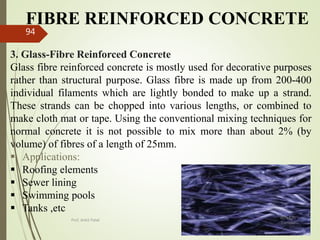
Glass fibre reinforced concrete is mostly used for decorative purposes
rather than structural purpose. Glass fibre is made up from 200-400
individual filaments which are lightly bonded to make up a strand.
These strands can be chopped into various lengths, or combined to
make cloth mat or tape. Using the conventional mixing techniques for
normal concrete it is not possible to mix more than about 2% (by
volume) of fibres of a length of 25mm.
 Applications:
 Roofing elements
 Sewer lining
 Swimming pools
 Tanks ,etc
BITS Edu
Campus
Prof. Ankit Patel
94
FIBRE REINFORCED CONCRETE
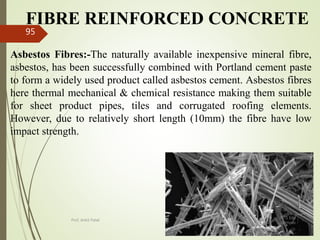
Asbestos Fibres:-The naturally available inexpensive mineral fibre,
asbestos, has been successfully combined with Portland cement paste
to form a widely used product called asbestos cement. Asbestos fibres
here thermal mechanical & chemical resistance making them suitable
for sheet product pipes, tiles and corrugated roofing elements.
However, due to relatively short length (10mm) the fibre have low
impact strength.
BITS Edu
Campus
Prof. Ankit Patel
95
FIBRE REINFORCED CONCRETE
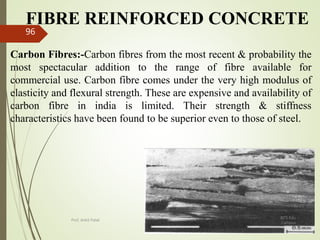
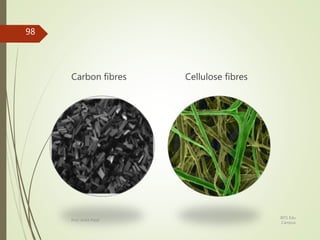
Carbon Fibres:-Carbon fibres from the most recent & probability the
most spectacular addition to the range of fibre available for
commercial use. Carbon fibre comes under the very high modulus of
elasticity and flexural strength. These are expensive and availability of
carbon fibre in india is limited. Their strength & stiffness
characteristics have been found to be superior even to those of steel.
BITS Edu
Campus
Prof. Ankit Patel
96
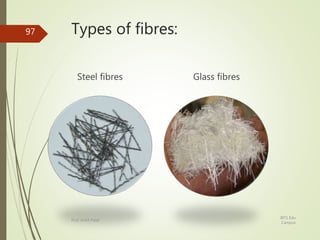
Types of fibres:
Steel fibres Glass fibres
BITS Edu
Campus
Prof. Ankit Patel
97
Carbon fibres Cellulose fibres
BITS Edu
Campus
Prof. Ankit Patel
98
Synthetic fibres:
Nylon fibresPolypropylene
fibres
BITS Edu
Campus
Prof. Ankit Patel
99
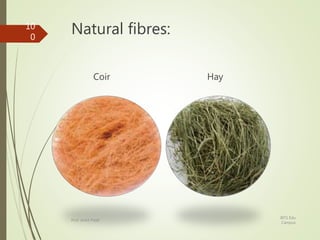
Natural fibres:
Coir Hay
BITS Edu
Campus
Prof. Ankit Patel
10
0
FIBRE REINFORCED CONCRETE
Advantages of FRC:
 Reduction in shrinkage and cracking
 Improvement in bond strength
 Better toughness
 Lower permeability of concrete
Applications:
 Hydraulic structure
 Highway pavements
 Bridge decks
 Tunnel linings
 Repair and Rehabilitation
BITS Edu
Campus
Prof. Ankit Patel
10
1
VACUUM CONCRETE
The concrete from which water is extracted by a vacuum process
before the hardening takes place is known as vacuum concrete. All the
water used in mixing concrete is not required for hydration. Therefore,
removal of excess water before hardening take place
improves concrete strength.
Vacuum concrete is the type of concrete in which the excess water is
removed for improving concrete strength
The type of concrete having relatively high slump in order to achieve
consolidation is usually useful in case of thin slabs and walls. In this
technique, the excess water after placement and compaction of concrete
is sucked out with the help of vacuum pumps. This technique
is effectively used in industrial floors, parking lots and deck slabs of
bridges etc. The magnitude of applied vacuum is usually about 0.08
MPa and the water content is reduced by upto 20-25%. The reduction is
effective upto a depth of about 100 to 150 mm only BITS Edu
Campus
Prof. Ankit Patel
10
2
VACUUM CONCRETE
Procedure:
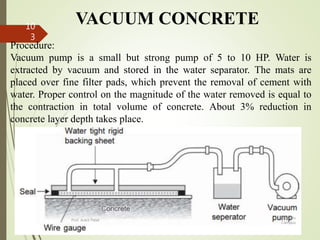
Vacuum pump is a small but strong pump of 5 to 10 HP. Water is
extracted by vacuum and stored in the water separator. The mats are
placed over fine filter pads, which prevent the removal of cement with
water. Proper control on the magnitude of the water removed is equal to
the contraction in total volume of concrete. About 3% reduction in
concrete layer depth takes place.
BITS Edu
Campus
Prof. Ankit Patel
10
3
VACUUM CONCRETE
Advantages of vacuum concreting:
 Due to dewatering through vacuum, both workability and high
strength are achieved simultaneously.
 Reduction in water-cement ratio may increase the compressive
strength by 10 to 50% and lowers the permeability.
 It enhances the wear resistance of concrete surface.
 The surface obtained after vacuum dewatering is plain and smooth
due to reduced shrinkage.
 The formwork can be removed early and surface can be put to use
early.
Applications of vacuum Concrete:
 Construction of thin concrete walls, partition walls and slabs
 Resurfacing and repair of road pavements.
BITS Edu
Campus
Prof. Ankit Patel
10
4
SULPHUR INFILTRATED CONCRETE
Sulphur, sand and coarse aggregate are the ingredients of this
concrete. Molten sulphur is added to the preheated aggregates in a
mixture. The hot mix is immediately transferred into the moulds to fill
them completely. The products manufactured with sulphur concrete
need no curing and the moulds can be stripped immediately as the
sulphur solidifies rapidly under normal temperatures. One of the
major advantages of these products is that they can be remoulded and
concrete can be reused with minimum or no wastage. These products
have very low absorption and less permeability.
Strength upto 44 MPa have been reported when 30 % of sulphur, 50%
of sand and 20% of coarse aggregate are mixed. These are therefore
versatile for use as precast slab elements of canal and tunnel linings.
Recent studies shows that the sulphur impregnation into lean porous
concrete improves its strength and other properties. BITS Edu
Campus
Prof. Ankit Patel
10
5
SULPHUR INFILTRATED CONCRETE
Applications:
 Precast roofing elements, facing posts, sewer pipes
 Railway sleepers
 For industrial applications, where high corrosion resistance is
required.
BITS Edu
Campus
Prof. Ankit Patel
10
6
FOAMED CONCRETE (AERATED CONCRETE)
Foam concrete is a type of porous concrete. According to its features
and uses it is similar to aerated concrete. The synonyms are:
1) Aerated concrete
2) Lightweight concrete
3) Porous concrete
It is made by introducing air or gas bubbles into the plastic cement
mortar mix to produce a material with a cellular structure somewhat
similar to sponge rubber.
Foamed Concrete can be placed easily, by pumping if necessary, and
does not require compaction, vibrating or levelling.
It has excellent resistance to water and frost, and provides a high level
of both sound and thermal insulation.
BITS Edu
Campus
Prof. Ankit Patel
10
7
FOAMED CONCRETE (AERATED CONCRETE)
MAKING OF FOAMED CONCRETE
The components of foam concrete mix should be set by their
functional role in order as follows:
1. Foaming agent
2. Binding agent
3. Water
4. Aggregate
5. Admixtures.
Making the Slurry
 The cement used for the slurry is usually Type 1 Portland Cement
although other cements can be used. If sand is specified in the mix
design ideally it should be fine with 2mm maximum size and 60 to
90% passing through a 600 micron sieve.
 The water:cement ratio of the slurry is usually between 0.5 and 0.6.
If necessary more water can be added to increased the workability.
BITS Edu
Campus
Prof. Ankit Patel
10
8
FOAMED CONCRETE (AERATED CONCRETE)
 The slurry can be made using a ready mix truck mixer. Firstly, the
cement mortar slurry is made at the batching plant, according to the
mix design, by either the DRY or WET method.
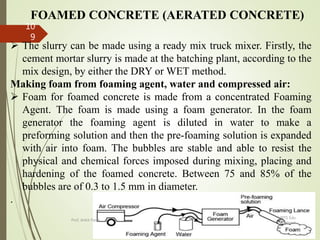
Making foam from foaming agent, water and compressed air:
 Foam for foamed concrete is made from a concentrated Foaming
Agent. The foam is made using a foam generator. In the foam
generator the foaming agent is diluted in water to make a
preforming solution and then the pre-foaming solution is expanded
with air into foam. The bubbles are stable and able to resist the
physical and chemical forces imposed during mixing, placing and
hardening of the foamed concrete. Between 75 and 85% of the
bubbles are of 0.3 to 1.5 mm in diameter.
.
BITS Edu
Campus
Prof. Ankit Patel
10
9
FOAMED CONCRETE (AERATED CONCRETE)
Advantages of Foamed Concrete:
 Does not settle, hence requires no compaction.
 Lightweight - does not impose large loadings.
 Excellent load spreading characteristics.
 Once placed requires no maintenance.
 Resistant to freeze-thaw cycle
 Low water absorption over time.
 Non-hazardous either during application or in service.
 Highly cost effective compared with other methods.
BITS Edu
Campus
Prof. Ankit Patel
11
0
FOAMED CONCRETE (AERATED CONCRETE)
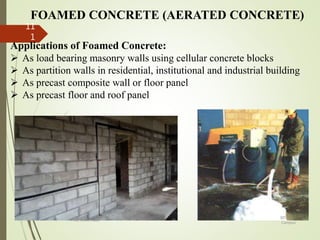
Applications of Foamed Concrete:
 As load bearing masonry walls using cellular concrete blocks
 As partition walls in residential, institutional and industrial building
 As precast composite wall or floor panel
 As precast floor and roof panel
BITS Edu
Campus
Prof. Ankit Patel
11
1
PRE-PLACED AGGREGATE CONCRETE (PAC)
Pre-placed concrete is a special technique of placing concrete under
water. When tremine method is not found feasible, this method is
adopted. This technique also called grouted concrete consists of
placing the coarse aggregate only in the form and thoroughly
compacting it to form a prepacked mass. This mass is then grouted
with the cement mortar of the required proportions. PAC is used
where placing conventional concrete is extremely difficult, such as
where massive reinforcement steel and embedded items are present, in
underwater repairs, concrete and masonry repairs, or where shrinkage
of concrete must be kept to a minimum.
BITS Edu
Campus
Prof. Ankit Patel
11
2
PRE-PLACED AGGREGATE CONCRETE (PAC)
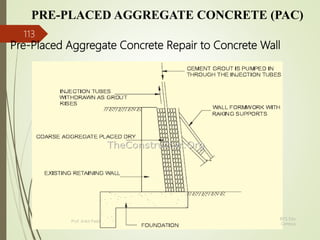
Pre-Placed Aggregate Concrete Repair to Concrete Wall
BITS Edu
Campus
Prof. Ankit Patel
113
PRE-PLACED AGGREGATE CONCRETE (PAC)
The PAC process is described below:
 Formwork and structural steel are installed.
 Washed aggregate is slurred into place.
 Grout is pumped into the formwork, starting at the bottom and
finishing at the top.
 Forms are pulled after cure time is complete, leaving a strong,
aesthetically pleasing finish.
BITS Edu
Campus
Prof. Ankit Patel
11
4
PRE-PLACED AGGREGATE CONCRETE (PAC)
The grouting of preplaced aggregate done by three methods:
 The grout mixture is poured on the top surface of aggregate and
allowed to penetrate downwards. This method is particularly useful
for grouting thin concrete members, such as road pavements and floor
slab.
 The mould is partially filled up with grout and the coarse aggregate
can be deposited in the grout.
 The grout is pumped into the preplaced aggregate mass from bottom
of the mould. The position of injection pipe is raised from bottom to
cover full depth of mould.
Advantages of preplaced aggregate concrete:
 There are several advantages with this process, including high
bondability, low shrinkage, reduced cracking, and increased strength.
 PAC can also lead to cost savings because it reduces the need for
heavy equipment.
 This technique is employed in mass concreting, in bridge abutments
BITS Edu
Campus
Prof. Ankit Patel
11
5
SHOTCRETE
OR
GUNITING
BITS Edu
Campus
Prof. Ankit Patel
11
6
SHOTCRETE OR GUNITING
.
BITS Edu
Campus
Prof. Ankit Patel
11
7
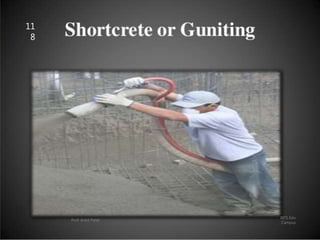
SHOTCRETE OR GUNITING
.
BITS Edu
Campus
Prof. Ankit Patel
11
8
conventional concrete is first placed and then
compacted in the second operation.
shotcrete undergoes placement and compaction at
the same time.
Shotcrete is more dense, homogeneous, strong, and
waterproof .
It can be impacted onto any type or shape of
surface, including vertical or overhead areas
BITSEduCampusProf.AnkitPatel
119
1. Dry process 2. Wet process
Dry process:
Step1: Pre blended, dry or semi-dampened
materials are placed into shotcrete equipment and
metered into a hose.
Step2: Compressed air conveys materials at high
velocity to the nozzle where the water is added.
Step3: Then the material is consolidated on
receiving surface by high impact velocity.
BITSEduCampusProf.AnkitPatel
120
Advantages of Dry process:
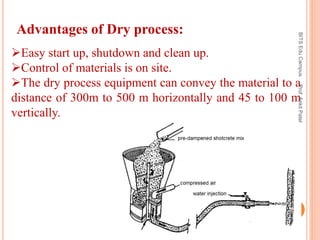
Easy start up, shutdown and clean up.
Control of materials is on site.
The dry process equipment can convey the material to a
distance of 300m to 500 m horizontally and 45 to 100 m
vertically.
BITSEduCampusProf.AnkitPatel
121
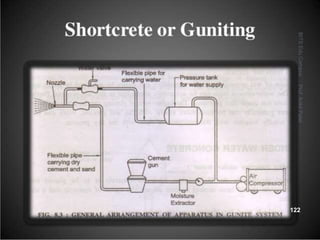
SHOTCRETE OR GUNITING
.
BITSEduCampusProf.AnkitPatel
122
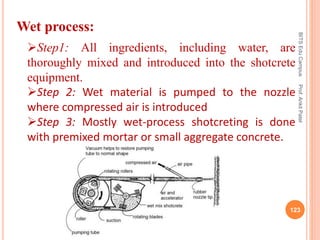
Wet process:
Step1: All ingredients, including water, are
thoroughly mixed and introduced into the shotcrete
equipment.
Step 2: Wet material is pumped to the nozzle
where compressed air is introduced
Step 3: Mostly wet-process shotcreting is done
with premixed mortar or small aggregate concrete.
BITSEduCampusProf.AnkitPatel
123
Advantages of Wet process:
Little or no formwork is required.
Cost effective method for placing concrete.
Ideal for irregular surface applications
Allows for easier material handling in areas with
difficult access
BITSEduCampusProf.AnkitPatel
124
SHOTCRETE OR GUNITING
.
BITSEduCampusProf.AnkitPatel
125
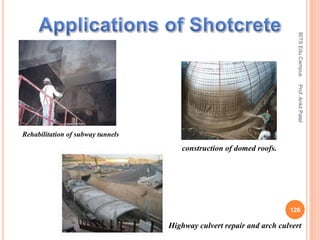
Rehabilitation of subway tunnels
construction of domed roofs.
Highway culvert repair and arch culvert
BITSEduCampusProf.AnkitPatel
126
MICROCONCRETE
Micro concrete is a dry ready mix Cementetious based composition
formulated for use in repairs of areas where the concrete is damaged
& the area is restricted in movement making the placement of
conventional concrete difficult., It is supplied as a ready to use dry
powder which requires only addition of clean water at site to produce
a free flowing non shrink repair micro concrete. This is a cementitious
material, with additives, which impart controlled expansion
characteristics in the plastic state with reduced water demand.
Purpose: For the repair of damaged reinforced concrete elements like
beams, columns, wall etc., where access is restricted and compaction
is not possible.
Advantages:
Designed as a Ready mix factory packed & premixed product so
consistent performance is guaranteed, Shrinkage compensated, Offers
high initial strength & sustained long term strength & performance
Self flow able.
BITS Edu
Campus
Prof. Ankit Patel
12
7
SHORING
Shoring is the construction of a temporary structure to support
temporarily an unsafe structure. These support walls laterally. They
can be used under the following circumstances:
1.When walls bulge out
2.When walls crack due to unequal settlement of foundation and
repairs are to be carried out to the cracked wall.
3.When an adjacent structure needs pulling down.
4.When openings are to be newly made or enlarged in a wall.
Types of shoring
Raking shores
Flying shores
Dead shores
BITS Edu
Campus
Prof. Ankit Patel
12
8
SHORING
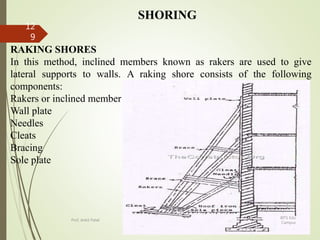
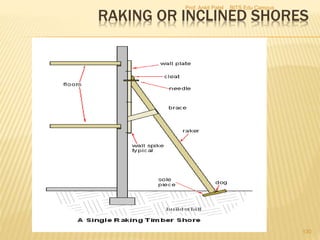
RAKING SHORES
In this method, inclined members known as rakers are used to give
lateral supports to walls. A raking shore consists of the following
components:
Rakers or inclined member
Wall plate
Needles
Cleats
Bracing
Sole plate
BITS Edu
Campus
Prof. Ankit Patel
12
9
RAKING OR INCLINED SHORES
BITS Edu CampusProf. Ankit Patel
130
SHORING
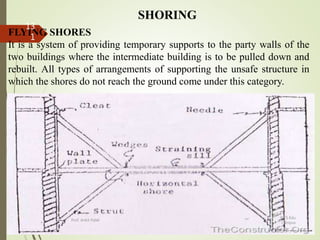
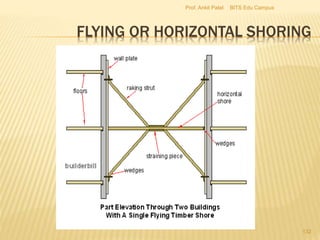
FLYING SHORES
It is a system of providing temporary supports to the party walls of the
two buildings where the intermediate building is to be pulled down and
rebuilt. All types of arrangements of supporting the unsafe structure in
which the shores do not reach the ground come under this category.
BITS Edu
Campus
Prof. Ankit Patel
13
1
FLYING OR HORIZONTAL SHORING
BITS Edu CampusProf. Ankit Patel
132
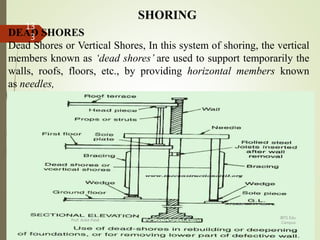
SHORING
DEAD SHORES
Dead Shores or Vertical Shores, In this system of shoring, the vertical
members known as ‘dead shores’ are used to support temporarily the
walls, roofs, floors, etc., by providing horizontal members known
as needles,
BITS Edu
Campus
Prof. Ankit Patel
13
3
UNDERPINNING
 It is the method of supporting the structures while providing new
foundations or carrying out repairs and alterations without
disturbing the stability of existing structures. It is carried under
following conditions:
1. When a building with deep foundation is to be constructed
adjoining a building which is built on shallow footings. Here the
shallow footings should be strengthened first.
2. In order to protect an existing structure from the danger of
excessive or differential settlement of foundation.
3. In order to improve the bearing capacity of foundation so as to
sustain heavier loads for which deepening or widening of
foundation is done.
4. In order to provide a basement for an existing structure.
BITS Edu CampusProf. Ankit Patel
134
PRECAUTIONARY MEASURES
Before implementing appropriate underpinning measures
the following important points should be carefully
attended:
 The existing structure should be fully examined carefully
and appropriate underpinning method should be adopted.
 All poor masonry work, such as joints, cracks, plastering
should be rectified before.
 Necessary shoring and struting should be done such that
existing structure is safe.
 Urgent repair like grouting of cracks, insertion of rod
between walls , etc. should be carried out before
commencing underpinning.
BITS Edu CampusProf. Ankit Patel
135
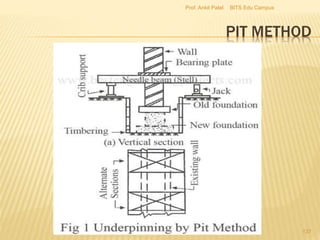
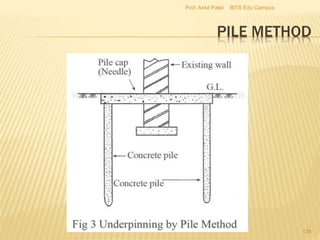
METHODS OF UNDERPINNING
 Pit method
 Pile method
BITS Edu CampusProf. Ankit Patel
136
PIT METHOD
BITS Edu CampusProf. Ankit Patel
137
PILE METHOD
BITS Edu CampusProf. Ankit Patel
138
THANK YOU
BITS Edu
Campus
Prof. Ankit Patel
13
9

Chapter 3 materials & techniques for repairs

  • 1.
    Materials And Techniques ForRepair Prepared By: Assistant Professor Ankit Patel
  • 2.
    General Though concrete isrelatively durable construction material it may suffer damage or distress during its life period due to number of reasons. Deterioration of concrete structure is the natural phenomenon of the gradual degradation of constituent material brought about physical chemical and mechanical processes. A basic understanding of underlying causes of concrete deficiencies is essential to performing meaningful evaluations and successful repair. If the cause is understood it is much more likely that an appropriate repair system will be selected and the repair will be successful and max life of repair will be obtained. BITS Edu Campus Prof. Ankit Patel 2
  • 3.
    General Selection of repairmaterial is one of the most important tasks for ensuring durable and trust worthy repair. Though, the pre-requisite for a sound repair system is the detailed investigation and determining the exact cause of distress, yet an understanding of the process of deterioration of the repair materials under service conditions is vital. Of course, availability of materials of relevance, equipment and skilled labour have to be explored before deciding upon the repair material. Since, cementitious products have a tendency to shrink and hardening with age, it is essential that the repair material for repairing concrete or plaster should be of non shrink type and compatible with parent material. BITS Edu Campus Prof. Ankit Patel 3
  • 4.
    Essential Parameters forRepair Materials Besides being of compatible properties, repair materials for cement concrete/mortar shall also be easy to apply and require no attention after the repair has been applied. Final selection of materials is made based on the relationship between cost, performance, and risk. The essential parameters for deciding upon a repair material for concrete are:  Low shrinkage properties  Requisite setting/hardening properties  Workability  Good bond strength with existing sub-strata  Compatible coefficient of thermal expansion  Compatible mechanical properties and strength to that of the sub- strata  Minimal or no curing requirement BITS Edu Campus Prof. Ankit Patel 4
  • 5.
    Essential Parameters forRepair Materials  Alkaline character  Low air and water permeability  Aesthetics to match with surroundings  Cost  Durable, non degradable or non-biodegradable  Non-hazardous/non-polluting BITS Edu Campus Prof. Ankit Patel 5
  • 6.
    Essential Parameters forRepair Materials Low Shrinkage: It is well known that the cementitious repair materials shrink with passage of time. Most of the shrinkage generally takes place in the initial period from the time of casting to 21 days. Therefore, cementitious repair material in its original form, if used for repair to concrete/ mortar, is likely to get either delaminated due to de-bonding or develop shrinkage cracks on its surface due to shrinkage strains and stresses. Shrinkage cracks so developed in the repair patch would allow the easy access of atmospheric air and water, which could be harmful for concrete and reinforcement. It is, therefore, essential that the low shrinkage property of repair material shall be looked for while selecting a material for concrete repair. Cementitious materials need additional no shrink compounds so as to be effective in achieving the desired property. Using low cement content and low water cement ratio will also reduce the drying shrinkage. BITS Edu Campus Prof. Ankit Patel 6
  • 7.
    Essential Parameters forRepair Materials Requisite setting/hardening Properties : It is desirable that the repaired structure shall be put to use at the earliest possible to reduce the down time of plant, machinery, building or road. It is, therefore, essential that repaired patch shall harden in the minimum possible time. However, in exceptional cases, it could also be essential to have the slow setting property as a desirable property for repair material. Such situation could be where more working time is required to work on repair materials or the repair process is intricate that more working time is required. BITS Edu Campus Prof. Ankit Patel 7
  • 8.
    Essential Parameters forRepair Materials Workability: The property desired by the field workers is good workability. Optimum workability is to be achieved without sacrificing the other desirable properties by use of suitable additives/admixtures. Bond with the Substrate: The bond strength of repair patch with the substrate is essential to have a successful repair system. If it is felt that the bond strength of the repair material with the base material is inadequate or less than the strength of the base material, then some other suitable means could be explored to improve bond strength between repair material and substrate. These could be use of:  Adhesive,  Surface interlocking system, and/or  Mechanical bonding BITS Edu Campus Prof. Ankit Patel 8
  • 9.
    Essential Parameters forRepair MaterialsCompatible Coefficient of thermal Expansion: The difference in volume change because of temperature variation can cause failure either at the bond line or within the section of lower strength material. Therefore, in the areas exposed to temperature variations, the patches of repair should have same coefficient of thermal expansion to ensure that no undue stresses are transferred to bonding interface or the substrate. Compatible Mechanical Properties & Strength: The hardened material shall have compatible mechanical properties or rather slightly better strength than that of base material. This property is desirable to ensure uniform flow of stresses and strains in loaded structures. It is well known that the elastic modulus of two concretes would be different for different crushing strength so if repair concrete is having strength much different than the base, it could lead to non- uniform flow of stresses and may result in an early failure of the repair patch. BITS Edu Campus Prof. Ankit Patel 9
  • 10.
    Essential Parameters forRepair Materials Minimal or no curing Requirement: It is desirable that the repair material shall not have any curing requirement after the repair has been applied or even if it is required; it should be minimal to ensure that the repair patch hardens and attains the desired strength without much post-repair-care. Alkalinity: In case of RCC, it is important to maintain the alkalinity of concrete around reinforcement with its pH above 11.5 from corrosion protection point of view. In this context, it is necessary for the repair material to have chemical characteristics such that it does not adversely affect the alkalinity of the base concrete at a later date. BITS Edu Campus Prof. Ankit Patel 10
  • 11.
    Essential Parameters forRepair Materials Low air & water permeability: Permeable material allows easy permeation of environmental chemicals including carbon dioxide, water, oxygen, industrial gases/vapours etc. It is essential that repair materials should have a very low air/water permeability to provide protection to the reinforced concrete against ingress of harmful environmental chemicals. Aesthetics: It is desirable that colour and texture of the repair material should match with the structure and give aesthetically pleasant appearance. If need be, this could be achieved through appropriate finishes. Cost: Economics is important while considering various options for repair materials but cheaper repair material should not be selected at the cost of performance characteristics. BITS Edu Campus Prof. Ankit Patel 11
  • 12.
    Essential Parameters forRepair Materials Durability & Bio non-degradability: The repair material selected should be durable under its exposure conditions during the service life against chemical attack, resistant to any form of energy like ultra violet rays, infra red rays, heat etc and should be bio non-degradable. Non-Hazardous / Non –Polluting: The repair materials should not be hazardous to field workers. However adequate Safety measures are required to be taken for repair Materials, which are hazardous to workers involved with their application, etc. These should also be environment friendly. BITS Edu Campus Prof. Ankit Patel 12
  • 13.
    Classification of RepairMaterials Wide range of materials for repair of concrete is available differing in cost and their performance into the following categories: 1. Patch repair materials: Cementious Mortar/ concrete Polymer modified cementitious mortar/concrete Polymer mortar Quick seating compounds ie high alumina cement calcium sulphate based 2. Injection grout: Cementitious grout Polymer grout Sulpho aluminate grout 3. Bonding materials: Polymer emulsion type Polymer resin type BITS Edu Campus Prof. Ankit Patel 13
  • 14.
    Classification of RepairMaterials 4. Resurfacing materials: Protective coating and membrane Gunite shotcrete Overlays 5. Sealing materials 6. Water proofing materials 7. Other repair materials: Corrosion inhibitors Cathodic protection Realkalization BITS Edu Campus Prof. Ankit Patel 14
  • 15.
    Premixed Cement Concrete Conventionalconcrete is composed of Portland cement, aggregates and water. Admixtures are frequently used to entrain air, accelerate or retard hydration, improve workability, increase strength, or alter the properties of concrete. Pozzolonic materials such as fly ash or silica fume may be use in Portland cement to provide reduced early heat of hydration, improve later stage strength, and increase the resistance to alkali-aggregate reactions and sulphate attack. Cement paste, being a binder in concrete or mortar holds fine aggregates, coarse aggregates and other constituents together in a hardened matrix. Cement forms one of the most basic materials used for not only in new construction but also as repair material. Therefore, selection of the appropriate type of cement for new construction as well as repair work is important and determines the final efficacy and durability of the structure. BITS Edu Campus Prof. Ankit Patel 15
  • 16.
    Premixed Cement Concrete OrdinaryPortland cement (OPC): IS: 456-2000 allows to use 33, 43, 53 grade of OPC. Grade 33 and 43 may be use for most of the repair works. Whereas 53 grade cement is more suited for injection grouting of cracks or honey combed concrete. Portland Pozzolana Cement and Portland Slag cement: PPC is obtained by intergrinding of OPC clinkers with 15 to 35 % of Pozzolonic materials like fly ash and calcined clay. Pozzolana themselves do not possess any cementitious properties, but in finely divided state and in presence of water chemically react with free lime available in the OPC cement paste to form compound possessing cementitious properties. Pozzolonic materials convert soluble calcium hydroxide into insoluble formed hence the permeability and durability gets improve. Portland slag cement is made by intergrinding Portland cement clinker , gypsum and granulated blast furnace slag. The quantity of blast furnace slag mixed with OPC will range from 25 to 65% BITS Edu Campus Prof. Ankit Patel 16
  • 17.
    Premixed Cement Concrete Blastfurnace slag is a waste produce consisting of a mixture of lime, silica , and alumina obtained in manufacture of pig iron. Portland slag cement has low heat of hydration , better resistance to chlorides sulphates and alkalies , low permeability and good resistance to acidic water. Rapid Hardening Cement (RHC): RHC develops strength more rapidly at early ages but as its ultimate strength comparable to OPC. It is used where early strength is required for eg. For road repair works, wall sealing etc. Expansive cement: Concrete shrinks while setting due to loss of free water. The important property of expansive cement is that it suffers no overall change in volume on drying. This type of cement is made by mixing 8-20 parts of sulphoaluminate clinker with 100 parts of OPC and 15 parts of stabilizer. Shrinkage compensating expansive cement are use to minimize cracking caused by drying shrinkage in repair concrete. It restrain expansion, induces compressive stresses. BITS Edu Campus Prof. Ankit Patel 17
  • 18.
    Premixed Cement Concrete Pr-MixedCement Mortar: it is a mixture of Portland cement, fine aggregate and water. Water reducing admixtures, expansive agents and other modifiers are often used with conventional mortar to minimize shrinkage. Conventional mortar is readily available , well understood , economically and easy to produce , pace and finish. They are suitable for small cracks. Mortar generally exhibit increased drying shrinkage compared to concrete because of their higher water volume, high cement content and higher paste aggregate ratio. BITS Edu Campus Prof. Ankit Patel 18
  • 19.
    INTRODUCTION O “Poly” “mers”= many parts O A long molecule made up from lots of small molecules called “monomers”. O Monomer = non-linked “mer” material 19 BITS Edu Campus Prof. Ankit Patel
  • 20.
  • 21.
    ACADEMIC PURPOSE “Polymer inconcrete – a new construction achievements on the horizon” Introduction: O Through continued research it has been established that addition of polymer in concrete brings about marked improvement in its compressive strength, fatigue resistance ,impact resistance, toughness and durability. O Polymer concrete is highly impermeable and resistance to attack by acids alkalis and other chemicals. BITS Edu Campus Prof. Ankit Patel 21
  • 22.
    Types of polymerconcrete:  Polymer concrete may be classified into the following three categories: O Polymer impregnated concrete (PIC). O Polymer Portland cement concrete (PPPC). O Polymer concrete(PC). BITS Edu Campus Prof. Ankit Patel 22
  • 23.
    POLYMER IMPREGNATED CONCRETE(PIC) O PIC is a hardened Portland cement concrete that has been impregnated with a monomer(low viscosity liquid organic material)and subsequently polymerized in situ. O In this case , the cement concrete is cast and cured in the conversational manner. O After the concrete product gets hardened and dried, air from its voids is removed under partial vacuum and viscosity monomer(vinyl chloride etc.)is diffused through the pores of concrete. The concrete product is then finally subjected to polymerization by radiation by heat treatment thereby converting the monomer filled in the voids into solid plastic.BITS Edu Campus Prof. Ankit Patel 23
  • 24.
    The concept underlyingPIC is that if voids are responsible for low strength as well as poor durability of concrete in severe environments, then eliminating them by filling with a polymer should improve the characteristics of the material. It is difficult for a liquid to penetrate it if the viscosity of the liquid is high and the voids in concrete are not empty (they contain water and air). Therefore, for producing PIC, it is essential not only to select a low-viscosity liquid for penetration but also to dry and evacuate the concrete before subjecting it to the penetration process. Monomers such as methyl methacrylate (MMA) and styrene are commonly used for penetration because of relatively low viscosity, high boiling point (less loss due to volatilization), and low cost. BITS Edu Campus Prof. Ankit Patel 24
  • 25.
    After penetration, themonomer has to be polymerized in situ. This can be accomplished in one of three ways.  A combination of promoter chemical and catalysts can be used for room-temperature polymerization; but it is not favored because the process is slow and less controllable.  Gamma radiation can also induce polymerization at room temperature, but the health hazard associated with it discourages the wide acceptance of this process in filed practice.  The third method, which is generally employed, consists of using a monomer-catalyst mixture for penetration, and subsequently polymerizing the monomer by heating the concrete to 70 C with steam, hot water, or infrared heaters. BITS Edu Campus Prof. Ankit Patel 25
  • 26.
  • 27.
    APPLICATION: PIC (short form)product on account of their high resistance to wear and tear, impact etc. are used as /in: O Precast slabs for bridge decks; O Roads; O Marine structures; BITS Edu Campus Prof. Ankit Patel 27
  • 28.
    POLYMER PORTLAND CEMENTCONCRETE (PPCC) O PPCC is produced by incorporating an emulsion of a polymer or a monomer in ordinary Portland cement concrete. O The ingredients comprising cement invented by john, aggregates and monomer are mixing with water and monomer in the concrete mix is polymerized after placing concrete in position. O The resultant concrete has improved: • Strength; • Adhesion; • Chemical resistance; • Impact resistance; • Abrasion resistance; • Increased impermeability; • Reduced absorption; O Application: marine works. BITS Edu Campus Prof. Ankit Patel 28
  • 29.
    POLYMER CONCRETE(PC)  Polymerconcrete is a mixture of aggregates with polymer as the sole binder. There is no bonding material present. Portland cement is not used. It is manufactured in a manner similar to that of cement concrete. Monomers or pre polymers are added to the graded aggregate and the mixture is thoroughly mixed by hand or machine. The thoroughly mixed polymer concrete material is cast in moulds of steel or aluminum. The polymer concrete material cast in moulds are then polymerized either at room temp or at an elevated temp.  In PC polymer/monomer is employed to act as binder in place of cement.  The monomer and aggregate are mixed together and the monomer is polymerized after placement of concrete in position.  Application: industrial structures, dams, as it possess good electrical properties it can be use to manufacturing electric poles. BITS Edu Campus Prof. Ankit Patel 29
  • 30.
    Precautions while placingPMM/PMC General Guidelines & Precautions for use of polymer modified cement Mortar/concrete  The speed and time of mixing should be properly selected to avoid unnecessary entrapment of air.  The PMM/PMC has excellent adhesion even to metal and hence all equipment should be washed immediately after use.  For resurfacing, flooring and patching, all loose and non-durable materials must be removed either by sandblasting, wire brushing and blowing with compressed air. The cleaned surface should be thoroughly wetted well before placement of PMM/PMC.  Before application, surface should be in saturated dry (wet but no standing water) condition.  PMM/PMC should never be placed below 5° C and above 30° C.  The surface of newly placed material should be protected from rainfall or other source of water. The surface should be immediately covered with plastic sheet. BITS Edu Campus Prof. Ankit Patel 30
  • 31.
    Precautions while placingPMM/PMC  In large area of application, it is advisable to provide joints of 15 mm width at intervals of 3-4 meter.  Polymers should be stored in a cool dry room & should not be kept in exposed areas.  Polymers should be mixed with cement slurry or mortar in the proportions recommended by the manufacturers for various uses. BITS Edu Campus Prof. Ankit Patel 31
  • 32.
    EPOXIES AND EPOXYSYSTEMS .  Epoxies also come in the category of polymers but in the case of epoxies, the polymerisation process takes place when two materials called the epoxy resin and hardener come in contact by thoroughly mixing in specified proportion. The epoxy resin materials have good mechanical strength, chemical resistance and ease of working. These are being used in civil engineering for high performance coatings, adhesives, injection grouting, high performance systems, industrial flooring or grouting etc.  The term ‘epoxy resin’ is a generic name of compounds that describe a broad class of thermosetting polymers in which the primary cross linking occurs through the reaction of an epoxide group. In general, an epoxy resin can be thought of as a molecule containing a three-membered ring, consisting of one oxygen atom and two carbon atoms. BITS Edu Campus Prof. Ankit Patel 32
  • 33.
    EPOXIES AND EPOXYSYSTEMS  Epoxies Resin: It have very good mechanical strength, chemical resistance and ease of working. They are excellent binding agents with high tensile strength. The product is of low viscosity and can be injected into small cracks too. The higher viscosity epoxy resin can be use for surface coating or filling large cracks or holes.  Epoxy Hardener (Curing Agent): it combines with the epoxy resin and changes it from liquid to a solid state. The most common used curing agents are aliphatic and aromatic amines and polyamides and their products. The aromatic polyamine curing agents react faster than the aliphatic polyamines BITS Edu Campus Prof. Ankit Patel 33
  • 34.
    EPOXY MODIFIERS  Themodifiers are used to provide specific physical and mechanical performance in both the uncured and cured resin.  Rubber Additives: These are used to increase flexibility, fatigue resistance, crack resistance, and energy absorption (toughness) in epoxy resins.  Diluents: These are used for lowering the viscosity and improving handling characteristics of epoxy resin BITS Edu Campus Prof. Ankit Patel 34
  • 35.
    EPOXY MODIFIERS  CoalTar Epoxy System: Coal Tar epoxy resin combinations with polyamine hardener have been widely used as water resistant protective coatings. Coal Tar plays an important part in the improvement of corrosion resistance of epoxy resin system.  Epoxy Mortar and Concrete: Epoxy resins are used with aggregate (silica sand) to produce epoxy mortar or epoxy concrete, which is used for structural repairs of concrete, RCC besides its use in new construction in industrial flooring, foundation grouting, roads etc. They are normally used where volume of materials is not large and where rapid curing can be obtained BITS Edu Campus Prof. Ankit Patel 35
  • 36.
    What are theadvantages of Epoxies? Bonds strongly to most materials including metals, concrete, glass, ceramics, stone, wood, leather. Exceptions are plastics materials like polyethylene, polypropylene, Teflon, etc. Excellent resistance to chemicals and solvents. Very good electrical insulating properties. Outstanding mechanical strength including tensile, compressive, flexural and modulus. Very little shrinkage on curing, thus providing good dimensional stability. BITS Edu Campus Prof. Ankit Patel 36
  • 37.
    Precautions While UsingEpoxies  Epoxies are generally toxic in nature and these require lot of care in their handling. The special care required to be taken during their mixing and applications  They should not come in contact with the skin. Workers should be provided with rubber gloves.  The utensils/ equipment's used for the mixing resin and hardener should be cleaned immediately after their use.  The epoxies are generally used as an adhesive to act as bond coat between the old concrete and repaired concrete.  Epoxies have much higher bond strength than other polymers, but at the same time, these are costlier. BITS Edu Campus Prof. Ankit Patel 37
  • 38.
    Field of Applications: AntiCorrosive and Water Proofing Protective Coatings: Bond Coats (Structural Adhesives) and Grouts: Structural repairs to concrete BITS Edu Campus Prof. Ankit Patel 38
  • 39.
  • 40.
    Surface Coatings  Surfacecoating are also referred as resurfacing materials and toppings. Protective coatings can greatly reduce the effect of deteriorate conditions, and significantly improve the durability characteristics of the concrete. A variety of coatings are available and some are tailored for greater chemical resistance, while others are to resist wear and erosion.  Essential Parameters for coatings:  Posses excellent bond to substrate  Be durable with a long useful life normally 5 years.  Little or no colour change with time.  Should have sufficient impermeability against the passage of oxygen and carbon dioxide from air to concrete.  Should be available in a reasonable range of attractive colours. BITS Edu Campus Prof. Ankit Patel 40
  • 41.
    Surface Coatings Factors Consideredon application of coatings:  Climatic Conditions  Temperature of concrete  Moisture content of surface  The thickness and number of coats Types of Coating: 1. Epoxy coatings:  Excellent chemical resistance to most chemicals  Excellent adhesion to concrete  Good abrasion and impact resistance  Excellent resistant to corrosion of steel reinforcement 2. Acrylic coatings:  Solvent Free acrylic coatings have excellent wetting characteristics , a fair degree of chemical resistance and good color retention characteristics BITS Edu Campus Prof. Ankit Patel 41
  • 42.
    Surface Coatings  Becauseof their low viscosity, these materials are ideally suited for sealing cracks 3. Polyvinyl chloride coatings:  Very poor adhesion to concrete  Excellent acid resistance  Not suitable on moist surface 4. Polyvinyl Alcohol coatings:  Good adhesion to concrete  Moderately resistant to acids and alkalies  Good flexibility, hardness and abrasion resistance 5. Chlorinated Rubber coatings:  Resistance to heat, sunlight and weather  Moderately resistant to acids and alkalies  Good adhesion to concrete BITS Edu Campus Prof. Ankit Patel 42
  • 43.
    Surface Hardness AndOverlays The surface hardener and overlays are use for repair and upgrading of industrial floors, where loaded vehicles traverse the floor.  This improves the wear resistance chemical resistance, reduce dusting and improve appearance of concrete floors  Overlays (Toppings): it is provided as a second stage of construction on a new floor or deck, or in a rehabilitation of existing deteriorated floor slab or deck.  General requirement of overlays it gives adequate skid resistance, low permeability to water, higher abrasion resistance, sufficient flexibility to avoid cracking  Material used for overlays are thin polymer overlays and thin epoxy overlays BITS Edu Campus Prof. Ankit Patel 43
  • 44.
    Surface Hardness AndOverlays  Thin Polymer overlays: this are use to improve the abrasion resistance and for creating waterproofing barriers on the surface and act as a protective coatings . These are applied in less than 10mm thickness and it is applied for 2 to 3 coats.  Thin epoxy overlays: this are also used to improve the abrasion resistance and for creating waterproofing barriers on the surface and act as a protective coatings . These are applied in 2 to 3mm thickness. It is generally comprises of resin and hardener. The strength gain is much faster than polymer overlays. BITS Edu Campus Prof. Ankit Patel 44
  • 45.
    Sealing Materials Definition for‘SEALANT’ is “any material placed in a joint opening generally for the purpose of weather proofing a building, so designed to prevent the passage of moisture, air, dust, and heat through all joints and seams in the structure.” OR Definition for ‘SEALANT’ is “in building construction, a material that has the necessary adhesive and cohesive properties to form a seal.” BITS Edu Campus Prof. Ankit Patel 45
  • 46.
    Sealing Materials Functions:  Sealants,despite not having great strength, convey a number of properties. They seal top structures to the substrate, and are particularly effective in waterproofing processes by keeping moisture out (or in) the components in which they are used.  They can provide thermal insulation, and may serve as fire barriers.  They may have electrical properties, as well. Sealants can also be used for simple smoothing or filling.  To prevent ingress of water into the structure  To accommodate joint movement BITS Edu Campus Prof. Ankit Patel 46
  • 47.
    BITS Edu CampusPROF. ANKIT PATEL 47
  • 48.
    SEALANTS BITS Edu CampusPROF. ANKIT PATEL 48
  • 49.
     Types ofConstruction Sealants • Silicone Sealants • Epoxy • Hybrid Polyurethanes Sealants • Polyurethanes Sealants • Elastic Sealants • Varnish • Acrylic Latex Sealants • Bituminous Sealants • Synthetic Rubber Sealants • Thermoplastics Sealants • Butyl Sealants • Hot Wax • Proof Sealants • Polysulfide Sealants BITS Edu Campus PROF. ANKIT PATEL 49
  • 50.
     Advantages • ImprovesProduct Durability and Reliability. • Increases Product Performance. •Increases Product Quality. • Enhances Product Aesthetics. •Increases weathering characteristics. BITS Edu Campus PROF. ANKIT PATEL 50
  • 51.
    Silicon Sealants ButylSealants Epoxy Sealants Bituminous Sealants Elastic Sealants BITS Edu Campus PROF. ANKIT PATEL 51
  • 52.
    Bonding Materials Bonding materialsare natural, synthetic or compounded materials used to join two structural members without mechanical fasteners. These materials are often used in various repair applications, such as bonding of new concrete to old concrete. The bonding between new concrete and old concrete depends upon: i. The cleanliness of the old surface. ii. The strength and integrity of the old surface Two types of bonding agents are frequently used: (a) Cement - based slurries (b) Epoxies BITS Edu Campus Prof. Ankit Patel 52
  • 53.
    Water Proofing Materials Waterproofingmaterials are applied on concrete surfaces to form impervious coatings that prevents the ingress of water into the concrete. Various waterproofing materials marketed are : 1. Cement based coatings: A bedding layer of mortar 1 : 3 (cement : sand) of thickness not less than 5 mm may be applied. BITS Edu Campus Prof. Ankit Patel 53
  • 54.
    Water Proofing Materials 2.Polymer resin based coatings: Solvent based coatings are available as single or two component coatings. The coatings on drying produce a smooth dense continuous film that provides a barrier to moisture and mild chemical attack; these are preferred for location of high humidity. BITS Edu Campus Prof. Ankit Patel 54
  • 55.
    Chemical Admixtures These arethe materials in the form of powder or fluids that are added to the concrete to give it certain characteristics not obtainable with plain concrete mixes. In normal use, admixture dosages are less than 5% by mass of cement. Various Chemical admixtures are: 1. Accelerators 2. Retarders 3. Plasticizers 4. Super plasticizers BITS Edu Campus Prof. Ankit Patel 55
  • 56.
    Chemical Admixtures Accelerating Admixtures: An accelerating admixture is used to accelerate the rate of hydration (setting) and strength development of concrete at an early age. Advantages 1. Early removal of formwork 2. Reducing curing period requirement 3. Advance the time that a structure can be placed in the service 4. In the emergency repair works Calcium chloride (CaCl2) is the chemical most commonly used in accelerating admixtures, especially for non-reinforced concrete. The widespread use of calcium chloride as an accelerating admixtures has provided much data and experience on the effect of this chemical on the properties of concrete. Besides accelerating strength gain, calcium chloride causes an increase in drying shrinkage, potential reinforcement corrosion, discoloration (a darkening of concrete), and an increase in the potential for scaling. BITS Edu Campus Prof. Ankit Patel 56
  • 57.
    Chemical Admixtures Retarding Admixtures: Retardingadmixtures are used to delay the rate of setting of concrete. High temperatures of fresh concrete (30°C [86°F]) are often the cause of an increased rate of hardening that make placing and finishing difficult. One of the most practical methods of counteracting this effect is to reduce the temperature of the concrete by cooling the mixing water and/or the aggregates. Retarders do not decrease the initial temperature of concrete. The bleeding rate and bleeding capacity of concrete is increased with retarders. Retarding admixtures are useful in extending the setting time of concrete, but they are often also used in attempts to decrease slump loss and extend workability, especially prior to placement at elevated temperatures. Some of the materials used as retarders are: 1. Gypsum, Lignin , Borax ,Sugars ,Tartaric acid and salts BITS Edu Campus Prof. Ankit Patel 57
  • 58.
    Chemical Admixtures Water-Reducing Admixtures(Plasticizers) Plasticizers or water reducers are chemical admixtures that can be added to concrete mixtures to improve workability. Water-reducing admixtures are used to reduce the quantity of mixing water required to produce concrete of a certain slump. Advantages 1. Increase workability significantly 2. Reduce water-cement ratio 3. Reduce cement content 4. Increase strength and Durability 5. Increase slump significantly. Adding a water-reducing admixture to concrete without reducing the water content can produce a mixture with a higher slump. 6. Reduce water content. Typical water reducers reduce the water content by approximately 5% to 10% BITS Edu Campus Prof. Ankit Patel 58
  • 59.
    Chemical Admixtures High-Range WaterReducing Admixtures (Super Plasticizers) High-range water reducers, can be used to impart properties induced by regular water reducers, only much more efficiently. They can greatly reduce water demand and cement contents and make low water-cement ratio, high-strength concrete with normal or enhanced workability. A water reduction of 12% to 30% can be obtained through the use of these admixtures The reduced water content and water-cement ratio can produce concretes with (1) Ultimate compressive strengths in excess of 70 MPa (10,000 psi), (2) Increased early strength gain, (3) Reduced chloride-ion penetration, and (4) Other beneficial properties associated with low water-cement ratio concrete BITS Edu Campus Prof. Ankit Patel 59
  • 60.
    Chemical Admixtures Advantages 1. High-rangewater reducers are generally more effective than regular water-reducing admixtures in producing workable concrete. 2. A significant reduction of bleeding can result with large reductions of water content The effectiveness of the plasticizer is increased with an increasing amount of cement and fines in the concrete. BITS Edu Campus Prof. Ankit Patel 60
  • 61.
    Mineral Admixtures Mineral admixtureare finely divided siliceous materials, which can be added to concrete in relatively large amounts, it is in the range of 15 to 60 % by weight of cement. They may be Pozzolonic ore cementitious or both. Benefits of using mineral admixtures in concrete are improvements in impermeability, resistance to thermal cracking and chemicals, high ultimate strength, better durability and economy. The most commonly used mineral admixtures are: 1. Fly Ash 2. Silica Fume 3. Blast Furnace Slag BITS Edu Campus Prof. Ankit Patel 61
  • 62.
    Mineral Admixtures  Flyash is a fused residue of clay minerals present in coal. The high temperature generated when coal burns in thermal power plants, transforms the clay minerals in coal powder into a variety of fused fine particles of mainly aluminium silicate composition.  In addition to electricity, these plants produce a material that is fast becoming a vital ingredient for improving the performance of a wide range of concrete products That material is fly ash PRESENT SCENARIO IN INDIA  Over 75% of the total installed power generation is coal- based 230 – 250 million tonne coal is being used every year.  High ash contents varying from 30 to 50%. More than 110 million tonne of ash generated every year.  Presently as per the Ministry Of Environment & Forest Figures, 30% of Ash is being used in Fillings, embankments, construction, block & tiles, etc BITS Edu Campus Prof. Ankit Patel 62
  • 63.
    Mineral Admixtures [B] CLASSIFICATIONAS PER CATEGORY OF FLY ASH: I. BOTTOM ASH: - Ash collected at the bottom of boiler furnace characterized by better geo- technical properties is termed as bottom ash. It is a good material for fill, road and embankment construction. II. DRY ASH: - Ash collected from different rows of Electro-static precipitators in dry form is termed as dry ash. It is used in the manufacture of PPC, Concrete & Cement mortar, Lime fly ash bricks, Building blocks, Aerated concrete blocks etc. III. POND ASH: - Fly ash and bottom ash are mixed together with water to form slurry, which is pumped to the ash pond area. In ash pond area, ash gets settled and excess water is decanted. This deposited ash is called pond ash. This is used as filling materials including in the construction of roads & embankments.BITS Edu Campus Prof. Ankit Patel 63
  • 64.
     Better compactioncharacteristics.  Cost effective.  Good compaction.  It is used as a replacement material.  Low heat of hydration.  Gain strength more than that of the ordinary cement. ADVANTAGES OF USING FLY ASH B I T S E D U C A M P U S P R O F . A N K I T P A T E L 64
  • 65.
    Mineral Admixtures 2. SilicaFume: Silica Fume is an artificial pozzolona having high pozzolonic activity. It is a By-product from an Electric Arc Furnace used in manufacture of Silicon metal or Silicon alloy. Has a high Silica content of more than80% Silica Fume is a finely-divided mineral admixture, available in both uncompact and compacted forms . This ultra-fine material will better fill voids between cement particles and result in a very dense concrete with higher compressive strengths and extremely low permeability. BITS Edu Campus Prof. Ankit Patel 65
  • 66.
    How does SilicaFume work in Concrete? The silica fume is 100 to 150 times smaller than a cement particle it can fill the voids created by free water in the matrix. This function, called particle packing, BITS Edu CampusProf. Ankit Patel 66
  • 67.
    Mineral Admixtures Properties ofFresh Concrete  Too much silica fumes cause the concrete to become sticky and thus reduces the workability  Silica fume addition up to 15% by weight of cement does not result in any loss of workability  Silica fume concrete, due to larger surface area of fine particle requires higher water content for same workability than ordinary concrete PROBLEMS WITH THE USE OF SILICA FUME  Availability  Cost APPLICATIONS  Silica Fume is now widely used for high strength structures BITS Edu Campus Prof. Ankit Patel 67
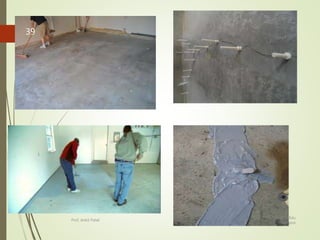
  • 68.
    Advantages of SilicaFume • Lowers concrete permeability. • Significantly increases concrete durability. • Increases ultimate strength gain. • Beneficial in all types of high strength concrete applications. • Improves bond strength to steel. • Significantly reduces alkali-silica reactivity. • Provides excellent resistance to sulphate or seawater attack. • Reduces steel corrosion. • Improves freeze/thaw durability of concrete. BITS Edu CampusProf. Ankit Patel 68
  • 69.
    Uses of SilicaFume For production of high strength concrete, corrosion- resistant concrete, abrasion-resistant concrete, and low permeability concrete. Used to make sewer and manhole repair products. BITS Edu CampusProf. Ankit Patel 69
  • 70.
    Mineral Admixtures Portland Slagcement: This type of cement is made by intergrinding Portland cement clinker, gypsum and granulated blast furnace slag. The quantity of blast furnace slag mixed with clinker will range from 25 to 65 %.Blast furnace slag is the waste produce consisting of mixture of lime, silica and alumina obtained in the manufacture of pig iron. The Portland slag cement should not be used in cold weather as the low heat of hydration coupled with low rate of strength development. Advantages of PSC: Low heat of hydration, better resistance to chlorides sulphate, alkalies, low permeability, good resistance to acidic waters. Generally it is use in mass concrete works and marine works. BITS Edu Campus Prof. Ankit Patel 70
  • 71.
    FERROCEMENT Introduction: Ferro-cement is arelatively new construction material consists of wire meshes and cement mortar. It was developed by P.L.Nervi, an Italian architect in 1940. WHAT IS FERRO CEMENT ? “Ferro cement is a type of thin wall reinforced concrete, commonly constructed of hydraulic cement mortar, reinforced with closely spaced layers of continuous and relatively small size wire mesh. The mesh may be made of metallic or other suitable materials.” Ferro cement= wire meshes + cement mortar It consists of closely spaced wire meshes which are impregnated with rich cement mortar mix. Mortar provides the mass & wire mesh imparts tensile strength and ductility to the material. It has high resistance against cracking, high fatigue resistance , high BITS Edu Campus Prof. Ankit Patel 71
  • 72.
    TYPICAL CROSS SECTIONOF FERROCEMENT BITS Edu Campus Prof. Ankit Patel 72
  • 73.
    FERROCEMENT MATERIALS USED INFERRO CEMENT Cement mortar mix Skeleton steel Steel mesh reinforcement or Fibre-reinforced polymeric meshes CEMENT MORTAR MIX ordinary Portland cement and fine aggregate matrix is used The matrix constitutes 95% cement mortar & 5% wire mesh of the composite. FA (sand), occupies 60 to 75% of the volume of the mortar Plasticizers and other admixtures are used. BITS Edu Campus Prof. Ankit Patel 73
  • 74.
    FERROCEMENT SKELETON STEEL It supportthe steel wire mesh 3 to 8 mm steel rods are used Thickness varies from 6-20mm according to loading condition Generally mild steel or Fe 415 or Fe 500 bars are used Spacing 7.5cm to 12m Used to impart structural strength in case of boats, barges etc. Reinforcement should be free from dust, rust and other impurities. BITS Edu Campus Prof. Ankit Patel 74
  • 75.
    FERROCEMENT STEEL MESH REINFORCEMENT Consistsof galvanized steel wires of diameter 0.5 to 1.5 mm, spaced at 6 to 20mm centre to centre Welded wire mesh has hexagonal or rectangular openings Expanded-metal lath is also used Made from carbon, glass etc. Chicken wire mesh BITS Edu Campus Prof. Ankit Patel 75
  • 76.
    Properties of ferrocement •Thickness: 10mm to 60 mm • Steel: 5 to 8% • Steel cover: 1.5 mm to 5 mm • Ultimate tensile strength: 34.5 N/mm² • Allowable tensile strength: 10 N/mm² • Compressive strength: 27.5 to 60 N/mm² BITSEduCampusProf.AnkitPatel 76
  • 77.
    Four stages ofconstruction • Fabrication of skeleton frame • Fixing of bars and mesh • Application of mortar • Curing • No formwork is required for ferrocement construction. BITSEduCampusProf.AnkitPatel 77
  • 78.
    ADVANTAGES OF FERRO-CEMENT Itis highly versatile and can be formed into almost any shape for a wide range of uses 20% savings on materials and cost Suitability for pre-casting Flexibility in cutting, drilling and jointing Good fire resistance Good impermeability Low maintenance costs BITS Edu Campus Prof. Ankit Patel 78
  • 79.
     Thin elementsand light structures, reduction in self weight & Its simple techniques require a minimum of skilled labor  Reduction in expensive form work so economy & speed can be achieved  Only a few simple hand tools are needed to build any structures  Structures are highly waterproof & Higher strength to weight ratio than R.C.C  It is very easy to repair the damaged ferrocement work. BITS Edu Campus Prof. Ankit Patel 79
  • 80.
    APPLICATIONS OF FERROCEMENT 1. Marine Applications  Boats, fishing vessels, barges, cargo tugs, flotation buoys Key criteria for marine applications: light weight, impact resistance, thickness and water tightness 2. Water supply and sanitation  Water tanks, sedimentation tanks, swimming pool linings, well casings, septic tanks etc. 3. Agricultural  Grain storage bins, silos, canal linings, pipes, shells for fish and poultry farms BITS Edu Campus Prof. Ankit Patel 80
  • 81.
    4. Residential Buildings Houses, community centers, precast housing elements, corrugated roofing sheets, wall panels etc. 5. Miscellaneous uses Mobile homes Wind tunnel Silos and bins BITS Edu Campus Prof. Ankit Patel 81
  • 82.
  • 83.
    FERROCEMENT Conclusion In India, Ferro-cementis used often because the constructions made from it are more resistant to earthquakes. It has a wide range of other uses including sculpture and prefabricated building components. BITS Edu Campus Prof. Ankit Patel 83
  • 84.
    FERROCEMENT Conclusion In India, Ferro-cementis used often because the constructions made from it are more resistant to earthquakes. It has a wide range of other uses including sculpture and prefabricated building components. BITS Edu Campus Prof. Ankit Patel 84
  • 85.
    Background of FibreReinforced Concrete  Portland cement concrete is considered to be a relatively brittle material. When subjected to tensile stresses, non-reinforced concrete will crack and Since mid 1800's Steel reinforcing has been used to overcome this problem. As a composite system, the reinforcing steel is assumed to carry all tensile loads .  The problem with employing steel in concrete is that over time steel corrodes due to the ingress of chloride ions.  In the northeast, where sodium chloride de-icing salts are commonly used and a large amount of coastal area exists, chlorides are readily available for penetration into concrete to promote corrosion, which favors the formation of rust. Rust has a volume between four to ten times the iron, which dissolves to form it. BITS Edu Campus Prof. Ankit Patel 85
  • 86.
     The volumeexpansion produces large tensile stresses in the concrete, which initiates cracks and results in concrete spalling from the surface. Although some measures are available to reduce corrosion of steel in concrete such as corrosion inhibitive admixtures and coatings, a better and permanent solution may be replace the steel with a reinforcement that is less environmentally sensitive.  FRC is Portland cement concrete reinforced with more or less randomly distributed fibres. In FRC, thousands of small fibres are dispersed and distributed randomly in the concrete during mixing, and thus improve concrete properties in all directions. fibres help to improve the post peak ductility performance, pre- crack tensile strength, fatigue strength, impact strength and eliminate temperature and shrinkage cracks. BITS Edu Campus Prof. Ankit Patel 86
  • 87.
    FIBRE REINFORCED CONCRETE FibreReinforced Concrete can be defined as a composite material consisting of mixtures of cement, mortar or concrete and discontinuous, discrete, uniformly dispersed suitable fibres. Fibre is a small piece of reinforcing material possessing certain characteristics properties. They can be circular or flat. The fibre is often described by a convenient parameter called “aspect ratio”. The aspect ratio of the fibre is the ratio of its length to its diameter.fibre reinforced concrete (FRC) is concrete containing fibrous material which increases its structural integrity. It contains short discrete fibres that are uniformly distributed and randomly oriented. fibres include steel fibres, glass fibres, synthetic fibres and natural fibres. Within these different fibres that character of fibre reinforced concrete changes with varying concretes, fibre materials. BITS Edu Campus Prof. Ankit Patel 87
  • 88.
  • 89.
    Factors Affecting Characteristicof FRC  Volume of fibres  Aspect ratio of fibres  Orientation of fibres  Size of coarse aggregate  Workability and compaction of concrete  Mixing BITS Edu Campus Prof. Ankit Patel 89
  • 90.
    Load directionLoad Direction ParallelPerpendicular Random BITS Edu CampusProf. Ankit Patel 90
  • 91.
    FIBRE REINFORCED CONCRETE DIFFERENTTYPE OF FIBRE: 1. Steel fibre Reinforced Concrete 2. Polypropylene fibre Reinforced (PFR) cement mortar & concrete 3. Glass-fibre Reinforced Concrete 4. Asbestos fibres 5. Carbon fibres  Steel fibre reinforced concrete  This type of concrete is formed by adding steel fibres in the ingredients of concrete. A number of steel fibres are available as reinforcement such as round steel fibres ,straight ,deformed variable cross section and glued bundles of steel fibres. BITS Edu Campus Prof. Ankit Patel 91
  • 92.
    FIBRE REINFORCED CONCRETE It has a tendency to cluster together which creates difficulties in ensuring their uniform random distribution in concrete. Their difficulty is overcome by using fibres bundles .  By addition of 2 to 3 percent of fibre(by volume) it is possible to achieve two to three times increase in the flexural strength of concrete and substantial increase in explosion resistance, crack resistance. BITS Edu Campus Prof. Ankit Patel 92
  • 93.
    FIBRE REINFORCED CONCRETE Applications:  Construction of pavements  Bridge decks  Tunnels lining 2 Polypropylene fibre Reinforced (PFR) cement mortar & concrete Polypropylene is one of the cheapest & abundantly available polymers polypropylene fibres are resistant to most chemical. Their addition to concrete has shown better distribute cracking and reduced crack size The amount of plastic fibres added to concrete is about 0.25 to 1 % by volume. BITS Edu Campus Prof. Ankit Patel 93
  • 94.
    FIBRE REINFORCED CONCRETE 3.Glass-Fibre Reinforced Concrete Glass fibre reinforced concrete is mostly used for decorative purposes rather than structural purpose. Glass fibre is made up from 200-400 individual filaments which are lightly bonded to make up a strand. These strands can be chopped into various lengths, or combined to make cloth mat or tape. Using the conventional mixing techniques for normal concrete it is not possible to mix more than about 2% (by volume) of fibres of a length of 25mm.  Applications:  Roofing elements  Sewer lining  Swimming pools  Tanks ,etc BITS Edu Campus Prof. Ankit Patel 94
  • 95.
    FIBRE REINFORCED CONCRETE AsbestosFibres:-The naturally available inexpensive mineral fibre, asbestos, has been successfully combined with Portland cement paste to form a widely used product called asbestos cement. Asbestos fibres here thermal mechanical & chemical resistance making them suitable for sheet product pipes, tiles and corrugated roofing elements. However, due to relatively short length (10mm) the fibre have low impact strength. BITS Edu Campus Prof. Ankit Patel 95
  • 96.
    FIBRE REINFORCED CONCRETE CarbonFibres:-Carbon fibres from the most recent & probability the most spectacular addition to the range of fibre available for commercial use. Carbon fibre comes under the very high modulus of elasticity and flexural strength. These are expensive and availability of carbon fibre in india is limited. Their strength & stiffness characteristics have been found to be superior even to those of steel. BITS Edu Campus Prof. Ankit Patel 96
  • 97.
    Types of fibres: Steelfibres Glass fibres BITS Edu Campus Prof. Ankit Patel 97
  • 98.
    Carbon fibres Cellulosefibres BITS Edu Campus Prof. Ankit Patel 98
  • 99.
  • 100.
    Natural fibres: Coir Hay BITSEdu Campus Prof. Ankit Patel 10 0
  • 101.
    FIBRE REINFORCED CONCRETE Advantagesof FRC:  Reduction in shrinkage and cracking  Improvement in bond strength  Better toughness  Lower permeability of concrete Applications:  Hydraulic structure  Highway pavements  Bridge decks  Tunnel linings  Repair and Rehabilitation BITS Edu Campus Prof. Ankit Patel 10 1
  • 102.
    VACUUM CONCRETE The concretefrom which water is extracted by a vacuum process before the hardening takes place is known as vacuum concrete. All the water used in mixing concrete is not required for hydration. Therefore, removal of excess water before hardening take place improves concrete strength. Vacuum concrete is the type of concrete in which the excess water is removed for improving concrete strength The type of concrete having relatively high slump in order to achieve consolidation is usually useful in case of thin slabs and walls. In this technique, the excess water after placement and compaction of concrete is sucked out with the help of vacuum pumps. This technique is effectively used in industrial floors, parking lots and deck slabs of bridges etc. The magnitude of applied vacuum is usually about 0.08 MPa and the water content is reduced by upto 20-25%. The reduction is effective upto a depth of about 100 to 150 mm only BITS Edu Campus Prof. Ankit Patel 10 2
  • 103.
    VACUUM CONCRETE Procedure: Vacuum pumpis a small but strong pump of 5 to 10 HP. Water is extracted by vacuum and stored in the water separator. The mats are placed over fine filter pads, which prevent the removal of cement with water. Proper control on the magnitude of the water removed is equal to the contraction in total volume of concrete. About 3% reduction in concrete layer depth takes place. BITS Edu Campus Prof. Ankit Patel 10 3
  • 104.
    VACUUM CONCRETE Advantages ofvacuum concreting:  Due to dewatering through vacuum, both workability and high strength are achieved simultaneously.  Reduction in water-cement ratio may increase the compressive strength by 10 to 50% and lowers the permeability.  It enhances the wear resistance of concrete surface.  The surface obtained after vacuum dewatering is plain and smooth due to reduced shrinkage.  The formwork can be removed early and surface can be put to use early. Applications of vacuum Concrete:  Construction of thin concrete walls, partition walls and slabs  Resurfacing and repair of road pavements. BITS Edu Campus Prof. Ankit Patel 10 4
  • 105.
    SULPHUR INFILTRATED CONCRETE Sulphur,sand and coarse aggregate are the ingredients of this concrete. Molten sulphur is added to the preheated aggregates in a mixture. The hot mix is immediately transferred into the moulds to fill them completely. The products manufactured with sulphur concrete need no curing and the moulds can be stripped immediately as the sulphur solidifies rapidly under normal temperatures. One of the major advantages of these products is that they can be remoulded and concrete can be reused with minimum or no wastage. These products have very low absorption and less permeability. Strength upto 44 MPa have been reported when 30 % of sulphur, 50% of sand and 20% of coarse aggregate are mixed. These are therefore versatile for use as precast slab elements of canal and tunnel linings. Recent studies shows that the sulphur impregnation into lean porous concrete improves its strength and other properties. BITS Edu Campus Prof. Ankit Patel 10 5
  • 106.
    SULPHUR INFILTRATED CONCRETE Applications: Precast roofing elements, facing posts, sewer pipes  Railway sleepers  For industrial applications, where high corrosion resistance is required. BITS Edu Campus Prof. Ankit Patel 10 6
  • 107.
    FOAMED CONCRETE (AERATEDCONCRETE) Foam concrete is a type of porous concrete. According to its features and uses it is similar to aerated concrete. The synonyms are: 1) Aerated concrete 2) Lightweight concrete 3) Porous concrete It is made by introducing air or gas bubbles into the plastic cement mortar mix to produce a material with a cellular structure somewhat similar to sponge rubber. Foamed Concrete can be placed easily, by pumping if necessary, and does not require compaction, vibrating or levelling. It has excellent resistance to water and frost, and provides a high level of both sound and thermal insulation. BITS Edu Campus Prof. Ankit Patel 10 7
  • 108.
    FOAMED CONCRETE (AERATEDCONCRETE) MAKING OF FOAMED CONCRETE The components of foam concrete mix should be set by their functional role in order as follows: 1. Foaming agent 2. Binding agent 3. Water 4. Aggregate 5. Admixtures. Making the Slurry  The cement used for the slurry is usually Type 1 Portland Cement although other cements can be used. If sand is specified in the mix design ideally it should be fine with 2mm maximum size and 60 to 90% passing through a 600 micron sieve.  The water:cement ratio of the slurry is usually between 0.5 and 0.6. If necessary more water can be added to increased the workability. BITS Edu Campus Prof. Ankit Patel 10 8
  • 109.
    FOAMED CONCRETE (AERATEDCONCRETE)  The slurry can be made using a ready mix truck mixer. Firstly, the cement mortar slurry is made at the batching plant, according to the mix design, by either the DRY or WET method. Making foam from foaming agent, water and compressed air:  Foam for foamed concrete is made from a concentrated Foaming Agent. The foam is made using a foam generator. In the foam generator the foaming agent is diluted in water to make a preforming solution and then the pre-foaming solution is expanded with air into foam. The bubbles are stable and able to resist the physical and chemical forces imposed during mixing, placing and hardening of the foamed concrete. Between 75 and 85% of the bubbles are of 0.3 to 1.5 mm in diameter. . BITS Edu Campus Prof. Ankit Patel 10 9
  • 110.
    FOAMED CONCRETE (AERATEDCONCRETE) Advantages of Foamed Concrete:  Does not settle, hence requires no compaction.  Lightweight - does not impose large loadings.  Excellent load spreading characteristics.  Once placed requires no maintenance.  Resistant to freeze-thaw cycle  Low water absorption over time.  Non-hazardous either during application or in service.  Highly cost effective compared with other methods. BITS Edu Campus Prof. Ankit Patel 11 0
  • 111.
    FOAMED CONCRETE (AERATEDCONCRETE) Applications of Foamed Concrete:  As load bearing masonry walls using cellular concrete blocks  As partition walls in residential, institutional and industrial building  As precast composite wall or floor panel  As precast floor and roof panel BITS Edu Campus Prof. Ankit Patel 11 1
  • 112.
    PRE-PLACED AGGREGATE CONCRETE(PAC) Pre-placed concrete is a special technique of placing concrete under water. When tremine method is not found feasible, this method is adopted. This technique also called grouted concrete consists of placing the coarse aggregate only in the form and thoroughly compacting it to form a prepacked mass. This mass is then grouted with the cement mortar of the required proportions. PAC is used where placing conventional concrete is extremely difficult, such as where massive reinforcement steel and embedded items are present, in underwater repairs, concrete and masonry repairs, or where shrinkage of concrete must be kept to a minimum. BITS Edu Campus Prof. Ankit Patel 11 2
  • 113.
    PRE-PLACED AGGREGATE CONCRETE(PAC) Pre-Placed Aggregate Concrete Repair to Concrete Wall BITS Edu Campus Prof. Ankit Patel 113
  • 114.
    PRE-PLACED AGGREGATE CONCRETE(PAC) The PAC process is described below:  Formwork and structural steel are installed.  Washed aggregate is slurred into place.  Grout is pumped into the formwork, starting at the bottom and finishing at the top.  Forms are pulled after cure time is complete, leaving a strong, aesthetically pleasing finish. BITS Edu Campus Prof. Ankit Patel 11 4
  • 115.
    PRE-PLACED AGGREGATE CONCRETE(PAC) The grouting of preplaced aggregate done by three methods:  The grout mixture is poured on the top surface of aggregate and allowed to penetrate downwards. This method is particularly useful for grouting thin concrete members, such as road pavements and floor slab.  The mould is partially filled up with grout and the coarse aggregate can be deposited in the grout.  The grout is pumped into the preplaced aggregate mass from bottom of the mould. The position of injection pipe is raised from bottom to cover full depth of mould. Advantages of preplaced aggregate concrete:  There are several advantages with this process, including high bondability, low shrinkage, reduced cracking, and increased strength.  PAC can also lead to cost savings because it reduces the need for heavy equipment.  This technique is employed in mass concreting, in bridge abutments BITS Edu Campus Prof. Ankit Patel 11 5
  • 116.
  • 117.
    SHOTCRETE OR GUNITING . BITSEdu Campus Prof. Ankit Patel 11 7
  • 118.
    SHOTCRETE OR GUNITING . BITSEdu Campus Prof. Ankit Patel 11 8
  • 119.
    conventional concrete isfirst placed and then compacted in the second operation. shotcrete undergoes placement and compaction at the same time. Shotcrete is more dense, homogeneous, strong, and waterproof . It can be impacted onto any type or shape of surface, including vertical or overhead areas BITSEduCampusProf.AnkitPatel 119
  • 120.
    1. Dry process2. Wet process Dry process: Step1: Pre blended, dry or semi-dampened materials are placed into shotcrete equipment and metered into a hose. Step2: Compressed air conveys materials at high velocity to the nozzle where the water is added. Step3: Then the material is consolidated on receiving surface by high impact velocity. BITSEduCampusProf.AnkitPatel 120
  • 121.
    Advantages of Dryprocess: Easy start up, shutdown and clean up. Control of materials is on site. The dry process equipment can convey the material to a distance of 300m to 500 m horizontally and 45 to 100 m vertically. BITSEduCampusProf.AnkitPatel 121
  • 122.
  • 123.
    Wet process: Step1: Allingredients, including water, are thoroughly mixed and introduced into the shotcrete equipment. Step 2: Wet material is pumped to the nozzle where compressed air is introduced Step 3: Mostly wet-process shotcreting is done with premixed mortar or small aggregate concrete. BITSEduCampusProf.AnkitPatel 123
  • 124.
    Advantages of Wetprocess: Little or no formwork is required. Cost effective method for placing concrete. Ideal for irregular surface applications Allows for easier material handling in areas with difficult access BITSEduCampusProf.AnkitPatel 124
  • 125.
  • 126.
    Rehabilitation of subwaytunnels construction of domed roofs. Highway culvert repair and arch culvert BITSEduCampusProf.AnkitPatel 126
  • 127.
    MICROCONCRETE Micro concrete isa dry ready mix Cementetious based composition formulated for use in repairs of areas where the concrete is damaged & the area is restricted in movement making the placement of conventional concrete difficult., It is supplied as a ready to use dry powder which requires only addition of clean water at site to produce a free flowing non shrink repair micro concrete. This is a cementitious material, with additives, which impart controlled expansion characteristics in the plastic state with reduced water demand. Purpose: For the repair of damaged reinforced concrete elements like beams, columns, wall etc., where access is restricted and compaction is not possible. Advantages: Designed as a Ready mix factory packed & premixed product so consistent performance is guaranteed, Shrinkage compensated, Offers high initial strength & sustained long term strength & performance Self flow able. BITS Edu Campus Prof. Ankit Patel 12 7
  • 128.
    SHORING Shoring is theconstruction of a temporary structure to support temporarily an unsafe structure. These support walls laterally. They can be used under the following circumstances: 1.When walls bulge out 2.When walls crack due to unequal settlement of foundation and repairs are to be carried out to the cracked wall. 3.When an adjacent structure needs pulling down. 4.When openings are to be newly made or enlarged in a wall. Types of shoring Raking shores Flying shores Dead shores BITS Edu Campus Prof. Ankit Patel 12 8
  • 129.
    SHORING RAKING SHORES In thismethod, inclined members known as rakers are used to give lateral supports to walls. A raking shore consists of the following components: Rakers or inclined member Wall plate Needles Cleats Bracing Sole plate BITS Edu Campus Prof. Ankit Patel 12 9
  • 130.
    RAKING OR INCLINEDSHORES BITS Edu CampusProf. Ankit Patel 130
  • 131.
    SHORING FLYING SHORES It isa system of providing temporary supports to the party walls of the two buildings where the intermediate building is to be pulled down and rebuilt. All types of arrangements of supporting the unsafe structure in which the shores do not reach the ground come under this category. BITS Edu Campus Prof. Ankit Patel 13 1
  • 132.
    FLYING OR HORIZONTALSHORING BITS Edu CampusProf. Ankit Patel 132
  • 133.
    SHORING DEAD SHORES Dead Shoresor Vertical Shores, In this system of shoring, the vertical members known as ‘dead shores’ are used to support temporarily the walls, roofs, floors, etc., by providing horizontal members known as needles, BITS Edu Campus Prof. Ankit Patel 13 3
  • 134.
    UNDERPINNING  It isthe method of supporting the structures while providing new foundations or carrying out repairs and alterations without disturbing the stability of existing structures. It is carried under following conditions: 1. When a building with deep foundation is to be constructed adjoining a building which is built on shallow footings. Here the shallow footings should be strengthened first. 2. In order to protect an existing structure from the danger of excessive or differential settlement of foundation. 3. In order to improve the bearing capacity of foundation so as to sustain heavier loads for which deepening or widening of foundation is done. 4. In order to provide a basement for an existing structure. BITS Edu CampusProf. Ankit Patel 134
  • 135.
    PRECAUTIONARY MEASURES Before implementingappropriate underpinning measures the following important points should be carefully attended:  The existing structure should be fully examined carefully and appropriate underpinning method should be adopted.  All poor masonry work, such as joints, cracks, plastering should be rectified before.  Necessary shoring and struting should be done such that existing structure is safe.  Urgent repair like grouting of cracks, insertion of rod between walls , etc. should be carried out before commencing underpinning. BITS Edu CampusProf. Ankit Patel 135
  • 136.
    METHODS OF UNDERPINNING Pit method  Pile method BITS Edu CampusProf. Ankit Patel 136
  • 137.
    PIT METHOD BITS EduCampusProf. Ankit Patel 137
  • 138.
    PILE METHOD BITS EduCampusProf. Ankit Patel 138
  • 139.