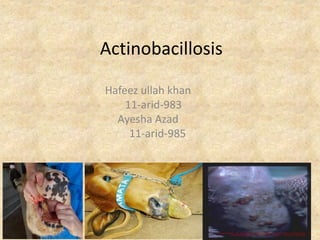
Actinobacillosis
Hafeez ullah khan
11-arid-983
Ayesha Azad
11-arid-985
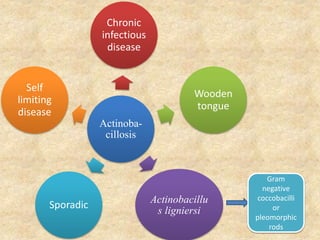
Actinoba-
cillosis
Chronic
infectious
disease
Wooden
tongue
Actinobacillu
s ligniersi
Sporadic
Self
limiting
disease
Gram
negative
coccobacilli
or
pleomorphic
rods
Epidemiology
• Distribution: The disease in cattle is worldwide in
distribution and usually of sporadic occurrence
on individual farms and reported in Egypt.
• Areas with copper deficiency
• Animal susceptibility: Cattle, buffaloes (mature
and of dairy breed are more susceptible), sheep
and goats.
• Predisposing factors : Oral mucosa injuries by
fibrous feed materials or by foreign bodies and
during oral manipulation by hand of owner or
veterinarian
Mode of infection
Source of infection: Pus or infected discharges are the
main source of infection.
Mode of transmission: The disease is transmitted by
ingestion of contaminated food and water with the
presence of oral mucosa injury (wounds or abrasions).
 A. lignieresii normal rumen inhabitant of sheep
and cattle.
 It survives 4 to 5 days in forage
Cattle
Acute inflammatory reaction in
the tongue and the subsequent
development of granulomatous
lesions in which necrosis and
suppuration occur, often with
the discharge of pus to the
exterior. Spread to regional
lymph nodes is usual.
Lingual involvement causes
interference with prehension and
mastication
Sheep
Suppurative infection
around head, neck, skin,
rumen, lung, mammary
gland and tongue
involvement is not
typical.
Pathogenesis
Clinical signs
• Glossal actinobacillosis
• The characteristic lesion is a granuloma of the tongue,
with discharge of pus.
• Inability to eat or drink for several days
• Drooling saliva
• Painful and swollen tongue
• Nodules and ulcers on the tongue
• In later stages when the acute inflammation is replaced
by fibrous tissue, the tongue becomes shrunken and
immobile and there is considerable interference with
prehension.
Conti….
• Cutaneous actinobacillosis is also recorded with
actinobacillosis granulomas occurring on atypical
but visible areas such as the external nares,
cheeks, skin or eyelid, and hind limbs.
• In sheep, Tongue is not usually involved. lesion up
to 8 cm in diameter present on lower jaw, face,
nose, in the skin folds from lower jaw to sternum,
these lesions are superficial or deep, usually
extended to cranial or cervical lymph nodes, it
discharge viscid yellow green pus containing
granules through number of openings.
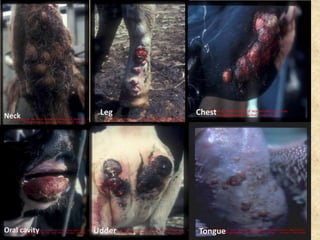
Neck
Oral cavity
Leg
Udder
Chest
Tongue
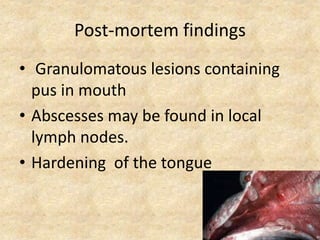
Post-mortem findings
• Granulomatous lesions containing
pus in mouth
• Abscesses may be found in local
lymph nodes.
• Hardening of the tongue
Diagnosis
• Field diagnosis: It depends on clinical signs of disease
as fever, tongue protrusion, salivation and history of
feeding on hard food objects beside the epidemiology
of the disease.
• Laboratory diagnosis:
• Samples: Pus, smear or biopsy from the lesion, parts of
lesion on ice or formalin, blood and serum.
• Laboratory procedures:
– Direct examination of stained smears after staining with
Gram stain.
– Culture of the suspected material on blood agar.
– Histopathological findings.
– Serotests.
Differential diagnosis
• The disease may be confused with:
Actinomycosis: It involves hard tissue and rarely
soft one.
TB, especially with atypical form, differentiates on
basis of tuberculin test.
Abscess of throat region, contain single cavity and
discharge thin pus and readily heal after drainage
Treatment
Flushing with iodine.
Administration of potassium iodide orally (6 to
10 g a day for 10 days)
Intravenous injection of sodium iodide at 10 %
(8 g for 100kg)
Streptomycin (5 g/day for 3 days) treatment of
choice, Tetracylcines and tilmicosin also
effective.
Control
• Restriction of the spread of disease is best
implemented by quick treatment of affected
animals and the prevention of contamination of
pasture and feed troughs.
• Isolation or disposal of animals with discharging
lesions is essential, although the disease does not
spread readily unless predisposing environmental
factors cause a high incidence of oral or skin
lacerations.
Actinobacillosis
Actinobacillosis

Actinobacillosis

  • 1.
  • 2.
  • 3.
    Epidemiology • Distribution: Thedisease in cattle is worldwide in distribution and usually of sporadic occurrence on individual farms and reported in Egypt. • Areas with copper deficiency • Animal susceptibility: Cattle, buffaloes (mature and of dairy breed are more susceptible), sheep and goats. • Predisposing factors : Oral mucosa injuries by fibrous feed materials or by foreign bodies and during oral manipulation by hand of owner or veterinarian
  • 4.
    Mode of infection Sourceof infection: Pus or infected discharges are the main source of infection. Mode of transmission: The disease is transmitted by ingestion of contaminated food and water with the presence of oral mucosa injury (wounds or abrasions).  A. lignieresii normal rumen inhabitant of sheep and cattle.  It survives 4 to 5 days in forage
  • 5.
    Cattle Acute inflammatory reactionin the tongue and the subsequent development of granulomatous lesions in which necrosis and suppuration occur, often with the discharge of pus to the exterior. Spread to regional lymph nodes is usual. Lingual involvement causes interference with prehension and mastication Sheep Suppurative infection around head, neck, skin, rumen, lung, mammary gland and tongue involvement is not typical. Pathogenesis
  • 6.
    Clinical signs • Glossalactinobacillosis • The characteristic lesion is a granuloma of the tongue, with discharge of pus. • Inability to eat or drink for several days • Drooling saliva • Painful and swollen tongue • Nodules and ulcers on the tongue • In later stages when the acute inflammation is replaced by fibrous tissue, the tongue becomes shrunken and immobile and there is considerable interference with prehension.
  • 7.
    Conti…. • Cutaneous actinobacillosisis also recorded with actinobacillosis granulomas occurring on atypical but visible areas such as the external nares, cheeks, skin or eyelid, and hind limbs. • In sheep, Tongue is not usually involved. lesion up to 8 cm in diameter present on lower jaw, face, nose, in the skin folds from lower jaw to sternum, these lesions are superficial or deep, usually extended to cranial or cervical lymph nodes, it discharge viscid yellow green pus containing granules through number of openings.
  • 9.
  • 10.
    Post-mortem findings • Granulomatouslesions containing pus in mouth • Abscesses may be found in local lymph nodes. • Hardening of the tongue
  • 11.
    Diagnosis • Field diagnosis:It depends on clinical signs of disease as fever, tongue protrusion, salivation and history of feeding on hard food objects beside the epidemiology of the disease. • Laboratory diagnosis: • Samples: Pus, smear or biopsy from the lesion, parts of lesion on ice or formalin, blood and serum. • Laboratory procedures: – Direct examination of stained smears after staining with Gram stain. – Culture of the suspected material on blood agar. – Histopathological findings. – Serotests.
  • 12.
    Differential diagnosis • Thedisease may be confused with: Actinomycosis: It involves hard tissue and rarely soft one. TB, especially with atypical form, differentiates on basis of tuberculin test. Abscess of throat region, contain single cavity and discharge thin pus and readily heal after drainage
  • 13.
    Treatment Flushing with iodine. Administrationof potassium iodide orally (6 to 10 g a day for 10 days) Intravenous injection of sodium iodide at 10 % (8 g for 100kg) Streptomycin (5 g/day for 3 days) treatment of choice, Tetracylcines and tilmicosin also effective.
  • 14.
    Control • Restriction ofthe spread of disease is best implemented by quick treatment of affected animals and the prevention of contamination of pasture and feed troughs. • Isolation or disposal of animals with discharging lesions is essential, although the disease does not spread readily unless predisposing environmental factors cause a high incidence of oral or skin lacerations.