AssignmentAssignment
Subject : Breeding Designer Crops (GPB822)Subject : Breeding Designer Crops (GPB822)
Presented by: Mr.Presented by: Mr. IndranilIndranil BhattacharjeeBhattacharjee
Student I.D. No.: 17PHGPB102Student I.D. No.: 17PHGPB102
Presented to : Prof. (Dr.)Presented to : Prof. (Dr.) B.G.SureshB.G.Suresh
SamSam HigginbottomHigginbottom University of Agriculture, Technology &University of Agriculture, Technology &
SciencesSciences
AllahabadAllahabad--211007211007
Lecture Outline
• What is biopharming?
• Why use plants?
• Current and evolving regulation
• What are the risks and concerns?
The use of agricultural plants for the production of
useful molecules for non food, feed or fiber
applications. (also called molecular farming,
pharming, or biopharming)
What is biopharming?
The use of agricultural plants for the production of
useful molecules for non food, feed or fiber
applications. (also called molecular farming,
pharming, or biopharming)
Plants are already grown to produce valuable
molecules, including many drugs.
Biopharming is different because the plants are
genetically engineered (GE) to produce the
molecules we want them to.
What is biopharming?
Plant Products
• Over 120 pharmaceutical products currently in
use are derived from plants. Mainly from tropical
forest species (e.g. Taxol from Yew trees)
1. Plant derived pharmaceuticals (non-GE)
Industrial products
• proteins
• enzymes
• modified starches
• fats
• oils
• waxes
• plastics
Pharmaceuticals
• recombinant human
proteins
• therapeutic proteins and
pharmaceutical
intermediates
• antibodies (plantibodies)
• vaccines
2. Plant-made pharmaceuticals (PMPs) and
industrial products (PMIP) (GE)
1.Plant-derived pharmaceuticals (non-GE)
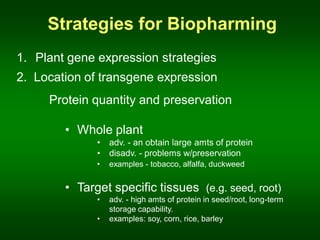
Plant Products
Strategies for Biopharming
1.Plant gene expression strategies
• Transient transformation
• adv. – quick and easy production
• disadv. – small amount of product, processing pblms
• Stable transformation
• adv. – use for producing large quantities of protein, stability
and storage
• disadv – gene flow - outcrossing w/native species
• Chloroplast transformation
• adv. – reduce gene flow through pollen
• disadv. – protein not stable for long periods of time
therefore complications w/extraction/processing times
1. Plant gene expression strategies
Protein quantity and preservation
• Whole plant
• adv. - an obtain large amts of protein
• disadv. - problems w/preservation
• examples - tobacco, alfalfa, duckweed
• Target specific tissues (e.g. seed, root)
• adv. - high amts of protein in seed/root, long-term
storage capability.
• examples: soy, corn, rice, barley
2. Location of transgene expression
Strategies for Biopharming
1. Plant gene expression system
2. Location of trans-gene expression
3. Selection of plant species and characteristics
• Mode of reproduction – self/outcrossing
• Yield, harvest, production, processing
Strategies for Biopharming
Advantages
Cost reduction
- scalability (e.g. Enbrel® )
- low/no inputs
- low capital cost
Stability
- storage
Safety
- eukaroytic production system
- free of animal viruses (e.g.
BSE)
Why use plants?
Disadvantages
Environment
contamination
- gene flow
- wildlife exposure
Food supply
contamination
- mistaken/intentional mixing
w/human food
Health safety
concerns
- Variable, case-specific
Avidin by Sigma
• transgenic corn
• traditionally isolated from chicken egg whites
• used in medical diagnostics
GUS (b-glycuronidase) by Sigma
• transgenic corn
• traditionally isolated from bacterial
sources (E.Coli)
• used as visual marker in research labs
Trypsin by Sigma
• transgenic corn
• traditionally isolated from bovine pancreas
• variety of applications, including biopharmaceutical
processing
• first large scale transgenic plant product
• Worldwide market = US$120 million in 2004
Industrial products on the market
Industrial products close to market
• Plant- made vaccines (edible vaccines)
• Plant-made antibodies (plantibodies)
• Plant-made therapeutic proteins and
intermediates
Unlike PMIPs, no PMPS are currently available
on the market
Plant-made Pharmaceuticals (PMPs)
Edible vaccines
Advantages:
Administered directly
• no purification required
• no hazards assoc. w/injections
Production
• may be grown locally, where needed most
• no transportation costs
Naturally stored
• no need for refrigeration or special storage
Plant-made Vaccines
Examples of edible vaccines under development:
• pig vaccine in corn
• HIV-suppressing protein in spinach
• human vaccine for hepatitis B in potato
Plant-made Vaccines
• Plantibodies - monoclonal antibodies produced
in plants
• Plants used include tobacco, corn, potatoes,
soy, alfalfa, and rice
• Free from potential contamination of
mammalian viruses
• Examples: cancer, dental caries, herpes
simplex virus, respiratory syncytial virus
Plantibodies
Plantibodies
**GE Corn can produce up to 1 kg antibody/acre
and can be stored at RT for up to 5 years.
Humphreys DP et al. Curr Opin Drug Discover Dev 2001; 4:172-85.
Dental Caries MAb– expected to reach the market
soon
MAb directed against genital herpes – estimated to
reach market within 5 years
(Horn et al, 2004)
Therapeutic proteins and intermediates
• Blood substitutes – human hemoglobin
• Proteins to treat diseases such as CF, HIV,
Hypertension, Hepatitis B…..many others
Plant made Pharmaceuticals
**To date, there are no plant-produced
pharmaceuticals commercially available
Plant made Pharmaceuticals
Patient advocacy groups:
American Autoimmune Related Diseases Association
Arthritis Foundation
Cystic Fibrosis Foundation
Current ‘Pharm’ Companies
•LEX System™
•Lemna (duckweed)
•trangenic tobacco
•PMPs and non-protein substances
(flavors and fragrances, medicinals,
and natural insecticides)
Kentucky Tobacco Research and
Development Center
Controlled Pharming Ventures
•collaboration w/Purdue
•transgenic corn
•converted limestone mine facility
Rhizosecretion
• Monoclonal antibodies
(Drake et al., 2003)
• Recombinant proteins
(Gaume et al, 2003)•biomass biorefinery
•based on switchgrass.
•used to produce PHAs
in green tissue plants
for fuel generation.
Current ‘Pharm’ Companies
• Genetically engineered Arabidopsis plants can
sequester arsenic from the soil. (Dhankher et al. 2002
Nature Biotechnology)
• Immunogenicity in human of an edible vaccine for
hepatitis B (Thanavala et al., 2005. PNAS)
Examples of Current Research
• Expression of single-chain antibodies in transgenic
plants. (Galeffi et al., 2005 Vaccine)
• Plant based HIV-1 vaccine candidate: Tat
protein produced in spinach. (Karasev et al. 2005
Vaccine)
• Plant-derived vaccines against diarrheal diseases.
(Tacket. 2005 Vaccine)
Environment contamination
• Gene flow via pollen
• Non-target species near field sites
e.g. butterflies, bees, etc
Food supply contamination
• Accident, intentional, gene flow
Health safety concerns
• Non-target organ responses
• Side-effects
• Allergenicity
Risks and Concerns
U.S. Regulatory System
(existing regulations)
Field Testing
-permits
-notifications
Determination of
non-regulated
status
Food safety
Feed safety
Pesticide and
herbicide
registration
USDA FDA EPA
Breakdown of Regulatory
System: Prodigene Incident 2002
2001 : Field trails of GE corn producing
pig vaccine were planted in IA and NE.
2002: USDA discovered “volunteer”
corn plants in fields in both IA and NE.
Soy was already planted in NE site.
$500,000 fine + $3 million to buy/destroy contaminated
soy
USDA Response to Incident
Revised regulations so that they were distinct from
commodity crops:
• Designated equipment must be used
• At least 5 inspections/yr
• Pharm crops must be grown at least 1 mile away
from any other fields and planted 28 days
before/after surrounding crops
FDA/USDA Guidance for Industry on Plant-Made
Pharmaceuticals Regulations
November 2004: Draft Document
Other challenges:
•Industrial hygiene and safety programs – these will
depend on the activity of the protein, route of exposure.
•Difficulty in obtaining relevant data because of high
species-specificity.
(Goldstein, 2005)
Current Evolving Regulations
www.ucsusa.org
Biopharming field trials in the US
Since 1995 ~ 300 biopharming plantings
The USDA receives/reviews applications for permits
for biopharm trials.
www.ucsusa.org
Biopharming field trials in the US
http://go.ucsusa.org/food_and_environment/pharm/index.php?s_keyword=XX
US Pharma Crop Database
Biopharming in Colorado
Biopharming in N.Carolina
The 2005 Oregon Biopharm Bill
Main concern is containment.
Opponents want:
• a guarantee of 0% contamination
of the food supply.
• full disclosure of field trials, crop,
gene, location, etc.
• an extensive regulatory framework
Biopharm opposition
1. Physical differences
• e.g. “purple” maize, GFP
2. Sterility
• male sterile plants
• terminator technology
3. Easily detectable by addition of 'reporter
genes‘
• e.g. PCR markers
Suggested Safeguards for
biopharm operations
4.Use chloroplast expression system
• will help increase yield
• will eliminate potential gene flow via pollen
• disadv. = technically difficult (Chlorogen
Company)
5. Complete disclosure of DNA sequences
6. Legislate for administration
Suggested Safeguards for
biopharm operations
Use only traditional drug production systems
•microbial, yeast and fungi
•mammalian cell culture
Use only fully contained production systems:
•plant cell cultures
•hydroponics (rhizosecretion)
•greenhouses
Use non-food crops
•tobacco
•hemp/cannabis
Alternatives to biopharming?
The expectation is for lower production costs
however there is no evidence that pharming
will produce cheaper, safe drugs.
Moreover, there are unknown costs associated
with containment, litigation and liability,
production…..others?
Economics
Future directions for
agricultural biotechnology?
Public perception
of risk
Regulation
Science has developed genetically enhanced crops and
has/can develop plant-made industrial and
pharmaceuticals crops.
The extent to which these crops will be further developed
for commercial and/or humanitarian use will ultimately
depend on…..
12 biopharming

12 biopharming

  • 1.
    AssignmentAssignment Subject : BreedingDesigner Crops (GPB822)Subject : Breeding Designer Crops (GPB822) Presented by: Mr.Presented by: Mr. IndranilIndranil BhattacharjeeBhattacharjee Student I.D. No.: 17PHGPB102Student I.D. No.: 17PHGPB102 Presented to : Prof. (Dr.)Presented to : Prof. (Dr.) B.G.SureshB.G.Suresh SamSam HigginbottomHigginbottom University of Agriculture, Technology &University of Agriculture, Technology & SciencesSciences AllahabadAllahabad--211007211007
  • 2.
    Lecture Outline • Whatis biopharming? • Why use plants? • Current and evolving regulation • What are the risks and concerns?
  • 5.
    The use ofagricultural plants for the production of useful molecules for non food, feed or fiber applications. (also called molecular farming, pharming, or biopharming) What is biopharming?
  • 6.
    The use ofagricultural plants for the production of useful molecules for non food, feed or fiber applications. (also called molecular farming, pharming, or biopharming) Plants are already grown to produce valuable molecules, including many drugs. Biopharming is different because the plants are genetically engineered (GE) to produce the molecules we want them to. What is biopharming?
  • 7.
    Plant Products • Over120 pharmaceutical products currently in use are derived from plants. Mainly from tropical forest species (e.g. Taxol from Yew trees) 1. Plant derived pharmaceuticals (non-GE)
  • 8.
    Industrial products • proteins •enzymes • modified starches • fats • oils • waxes • plastics Pharmaceuticals • recombinant human proteins • therapeutic proteins and pharmaceutical intermediates • antibodies (plantibodies) • vaccines 2. Plant-made pharmaceuticals (PMPs) and industrial products (PMIP) (GE) 1.Plant-derived pharmaceuticals (non-GE) Plant Products
  • 9.
    Strategies for Biopharming 1.Plantgene expression strategies • Transient transformation • adv. – quick and easy production • disadv. – small amount of product, processing pblms • Stable transformation • adv. – use for producing large quantities of protein, stability and storage • disadv – gene flow - outcrossing w/native species • Chloroplast transformation • adv. – reduce gene flow through pollen • disadv. – protein not stable for long periods of time therefore complications w/extraction/processing times
  • 10.
    1. Plant geneexpression strategies Protein quantity and preservation • Whole plant • adv. - an obtain large amts of protein • disadv. - problems w/preservation • examples - tobacco, alfalfa, duckweed • Target specific tissues (e.g. seed, root) • adv. - high amts of protein in seed/root, long-term storage capability. • examples: soy, corn, rice, barley 2. Location of transgene expression Strategies for Biopharming
  • 11.
    1. Plant geneexpression system 2. Location of trans-gene expression 3. Selection of plant species and characteristics • Mode of reproduction – self/outcrossing • Yield, harvest, production, processing Strategies for Biopharming
  • 13.
    Advantages Cost reduction - scalability(e.g. Enbrel® ) - low/no inputs - low capital cost Stability - storage Safety - eukaroytic production system - free of animal viruses (e.g. BSE) Why use plants? Disadvantages Environment contamination - gene flow - wildlife exposure Food supply contamination - mistaken/intentional mixing w/human food Health safety concerns - Variable, case-specific
  • 14.
    Avidin by Sigma •transgenic corn • traditionally isolated from chicken egg whites • used in medical diagnostics GUS (b-glycuronidase) by Sigma • transgenic corn • traditionally isolated from bacterial sources (E.Coli) • used as visual marker in research labs Trypsin by Sigma • transgenic corn • traditionally isolated from bovine pancreas • variety of applications, including biopharmaceutical processing • first large scale transgenic plant product • Worldwide market = US$120 million in 2004 Industrial products on the market
  • 15.
  • 16.
    • Plant- madevaccines (edible vaccines) • Plant-made antibodies (plantibodies) • Plant-made therapeutic proteins and intermediates Unlike PMIPs, no PMPS are currently available on the market Plant-made Pharmaceuticals (PMPs)
  • 17.
    Edible vaccines Advantages: Administered directly •no purification required • no hazards assoc. w/injections Production • may be grown locally, where needed most • no transportation costs Naturally stored • no need for refrigeration or special storage Plant-made Vaccines
  • 18.
    Examples of ediblevaccines under development: • pig vaccine in corn • HIV-suppressing protein in spinach • human vaccine for hepatitis B in potato Plant-made Vaccines
  • 19.
    • Plantibodies -monoclonal antibodies produced in plants • Plants used include tobacco, corn, potatoes, soy, alfalfa, and rice • Free from potential contamination of mammalian viruses • Examples: cancer, dental caries, herpes simplex virus, respiratory syncytial virus Plantibodies
  • 20.
    Plantibodies **GE Corn canproduce up to 1 kg antibody/acre and can be stored at RT for up to 5 years. Humphreys DP et al. Curr Opin Drug Discover Dev 2001; 4:172-85. Dental Caries MAb– expected to reach the market soon MAb directed against genital herpes – estimated to reach market within 5 years (Horn et al, 2004)
  • 21.
    Therapeutic proteins andintermediates • Blood substitutes – human hemoglobin • Proteins to treat diseases such as CF, HIV, Hypertension, Hepatitis B…..many others Plant made Pharmaceuticals
  • 22.
    **To date, thereare no plant-produced pharmaceuticals commercially available Plant made Pharmaceuticals Patient advocacy groups: American Autoimmune Related Diseases Association Arthritis Foundation Cystic Fibrosis Foundation
  • 23.
  • 25.
    Current ‘Pharm’ Companies •LEXSystem™ •Lemna (duckweed) •trangenic tobacco •PMPs and non-protein substances (flavors and fragrances, medicinals, and natural insecticides) Kentucky Tobacco Research and Development Center Controlled Pharming Ventures •collaboration w/Purdue •transgenic corn •converted limestone mine facility
  • 26.
    Rhizosecretion • Monoclonal antibodies (Drakeet al., 2003) • Recombinant proteins (Gaume et al, 2003)•biomass biorefinery •based on switchgrass. •used to produce PHAs in green tissue plants for fuel generation. Current ‘Pharm’ Companies
  • 27.
    • Genetically engineeredArabidopsis plants can sequester arsenic from the soil. (Dhankher et al. 2002 Nature Biotechnology) • Immunogenicity in human of an edible vaccine for hepatitis B (Thanavala et al., 2005. PNAS) Examples of Current Research • Expression of single-chain antibodies in transgenic plants. (Galeffi et al., 2005 Vaccine) • Plant based HIV-1 vaccine candidate: Tat protein produced in spinach. (Karasev et al. 2005 Vaccine) • Plant-derived vaccines against diarrheal diseases. (Tacket. 2005 Vaccine)
  • 29.
    Environment contamination • Geneflow via pollen • Non-target species near field sites e.g. butterflies, bees, etc Food supply contamination • Accident, intentional, gene flow Health safety concerns • Non-target organ responses • Side-effects • Allergenicity Risks and Concerns
  • 30.
    U.S. Regulatory System (existingregulations) Field Testing -permits -notifications Determination of non-regulated status Food safety Feed safety Pesticide and herbicide registration USDA FDA EPA
  • 31.
    Breakdown of Regulatory System:Prodigene Incident 2002 2001 : Field trails of GE corn producing pig vaccine were planted in IA and NE. 2002: USDA discovered “volunteer” corn plants in fields in both IA and NE. Soy was already planted in NE site. $500,000 fine + $3 million to buy/destroy contaminated soy
  • 32.
    USDA Response toIncident Revised regulations so that they were distinct from commodity crops: • Designated equipment must be used • At least 5 inspections/yr • Pharm crops must be grown at least 1 mile away from any other fields and planted 28 days before/after surrounding crops
  • 33.
    FDA/USDA Guidance forIndustry on Plant-Made Pharmaceuticals Regulations November 2004: Draft Document Other challenges: •Industrial hygiene and safety programs – these will depend on the activity of the protein, route of exposure. •Difficulty in obtaining relevant data because of high species-specificity. (Goldstein, 2005) Current Evolving Regulations
  • 34.
    www.ucsusa.org Biopharming field trialsin the US Since 1995 ~ 300 biopharming plantings The USDA receives/reviews applications for permits for biopharm trials.
  • 35.
    www.ucsusa.org Biopharming field trialsin the US http://go.ucsusa.org/food_and_environment/pharm/index.php?s_keyword=XX US Pharma Crop Database
  • 36.
  • 37.
  • 38.
    The 2005 OregonBiopharm Bill
  • 39.
    Main concern iscontainment. Opponents want: • a guarantee of 0% contamination of the food supply. • full disclosure of field trials, crop, gene, location, etc. • an extensive regulatory framework Biopharm opposition
  • 40.
    1. Physical differences •e.g. “purple” maize, GFP 2. Sterility • male sterile plants • terminator technology 3. Easily detectable by addition of 'reporter genes‘ • e.g. PCR markers Suggested Safeguards for biopharm operations
  • 41.
    4.Use chloroplast expressionsystem • will help increase yield • will eliminate potential gene flow via pollen • disadv. = technically difficult (Chlorogen Company) 5. Complete disclosure of DNA sequences 6. Legislate for administration Suggested Safeguards for biopharm operations
  • 42.
    Use only traditionaldrug production systems •microbial, yeast and fungi •mammalian cell culture Use only fully contained production systems: •plant cell cultures •hydroponics (rhizosecretion) •greenhouses Use non-food crops •tobacco •hemp/cannabis Alternatives to biopharming?
  • 43.
    The expectation isfor lower production costs however there is no evidence that pharming will produce cheaper, safe drugs. Moreover, there are unknown costs associated with containment, litigation and liability, production…..others? Economics
  • 44.
    Future directions for agriculturalbiotechnology? Public perception of risk Regulation Science has developed genetically enhanced crops and has/can develop plant-made industrial and pharmaceuticals crops. The extent to which these crops will be further developed for commercial and/or humanitarian use will ultimately depend on…..