Amity School of Architecture & Planning
MASTER PLAN AND
LAND USE PLANNING
B. Arch IV Semester
Course Code: BAR 408
Amity School of Architecture & Planning
A Master plan is a comprehensive long term
perspective plan intended for guiding the sustainable
planned development of city.
MASTER PLAN - Introduction
• It creates a vision that is supported by policies, guidelines
and priorities.
• It is a policy based document, it does not, nor can
regulate land use.
Amity School of Architecture & Planning
• lays down the planning guidelines, policies, development code
and space requirements for various socio-economic activities
supporting city population during plan period.
• It is based on
• public input,
• surveys,
• planning initiatives,
• existing development,
• physical characteristics, &
• socio-economic conditions.
MASTER PLAN - Introduction
Amity School of Architecture & Planning
• It includes analysis, recommendations, and proposals for :
• population,
• economy,
• housing,
• transportation,
• community facilities, &
• land use.
• It is the basis for all infrastructure requirements.
MASTER PLAN - Introduction
Amity School of Architecture & Planning
• To guide development of a city is an orderly manner
so as to improve the quality of life of the people
• Organize and coordinate the complex relationships
between urban land uses
• Chart a course for growth and change, be responsive
to change and maintain its validity over time and
space, and be subject to continual review
THE MASTER PLAN - FUNCTIONS
Amity School of Architecture & Planning
• Direct the physical development of the city in relation
to its social and economic characteristics based on
comprehensive surveys and studies on the present
status and the future growth prospects; and
• Provide a resource mobilization plan for the proposed
development works.
THE MASTER PLAN - FUNCTIONS
Amity School of Architecture & Planning
•Delhi Master plan -2021
•JDA Master plan - 2025
Amity School of Architecture & Planning
LAND USE
Land use refers to the
manner of utilization
of land, including its
allocation,
development and
management.
Amity School of Architecture & Planning
It is the human use of land.
Land Use - Introduction
It involves the management and modification of natural
environment or wilderness into built environment such as
fields, pastures, and settlements.
Municipal governments divide the land into various land
uses In order for an urban area to function effectively and
to meet all the needs of citizen .
Amity School of Architecture & Planning
• To promote efficient utilization, acquisition & disposition of
land and ensure the highest and best use of land.
• To direct, harmonize and influence discussions and activities
of the private and public sectors relative to the use and
management of lands
• To reconcile land use conflicts and proposals between and
among individuals, private and government entities relative
to the present and future need for the land.
Land Use - OBJECTIVES
Amity School of Architecture & Planning
To promote desirable patterns of land uses to prevent
wasteful development and minimize the cost of public
infrastructure and utilities and other social services
to preserve areas of ecological, aesthetic, historical
and cultural significance
Land Use - OBJECTIVES
Amity School of Architecture & Planning
URBAN LAND USE -
CLASSIFICATION
• Residential
• Commercial
• Institutional
• Industrial
• Transportation
• Utilities/Facilities
• Open spaces/greens
Amity School of Architecture & Planning
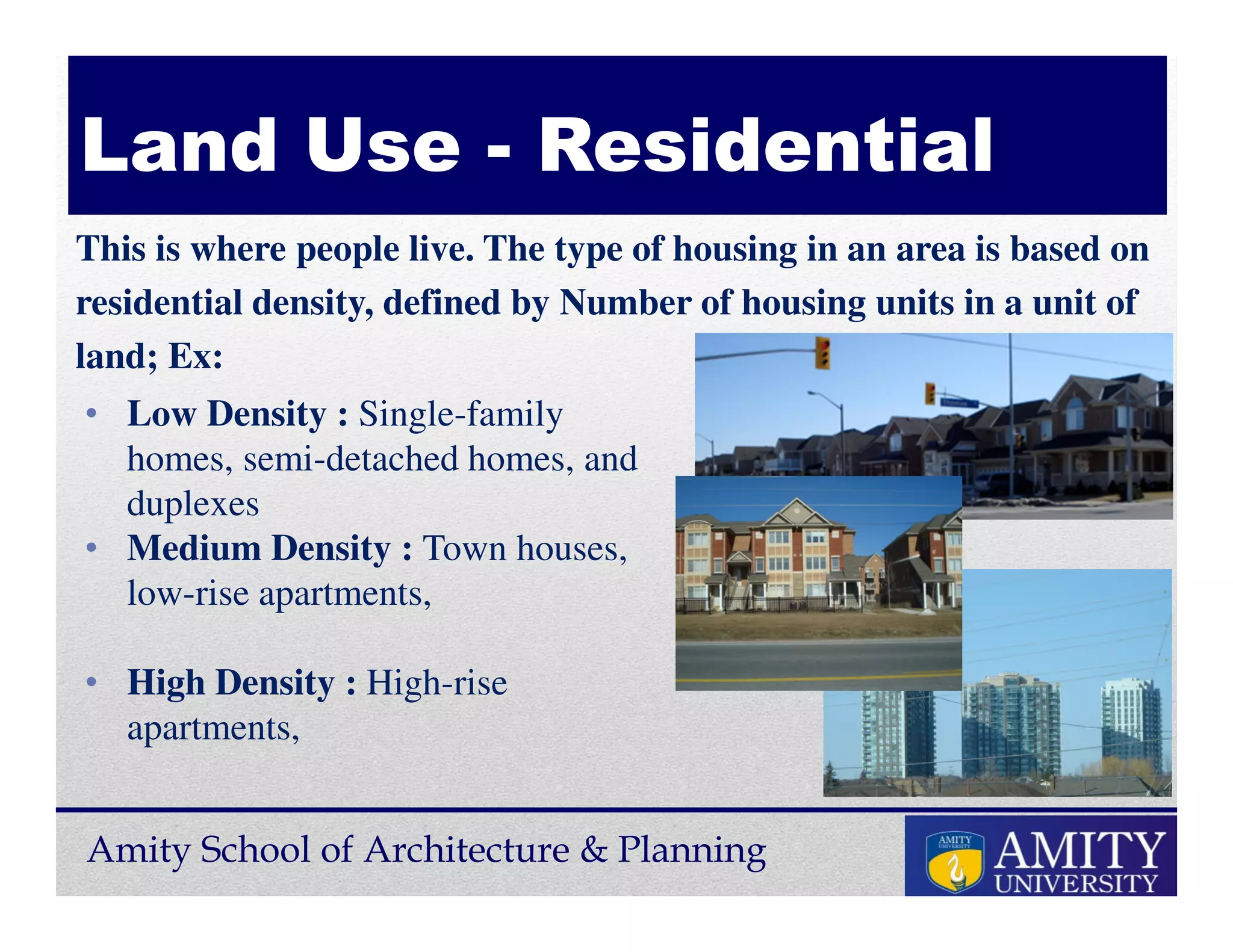
This is where people live. The type of housing in an area is based on
residential density, defined by Number of housing units in a unit of
land; Ex:
Land Use - Residential
• Low Density : Single-family
homes, semi-detached homes, and
duplexes
• Medium Density : Town houses,
low-rise apartments,
• High Density : High-rise
apartments,
Amity School of Architecture & Planning
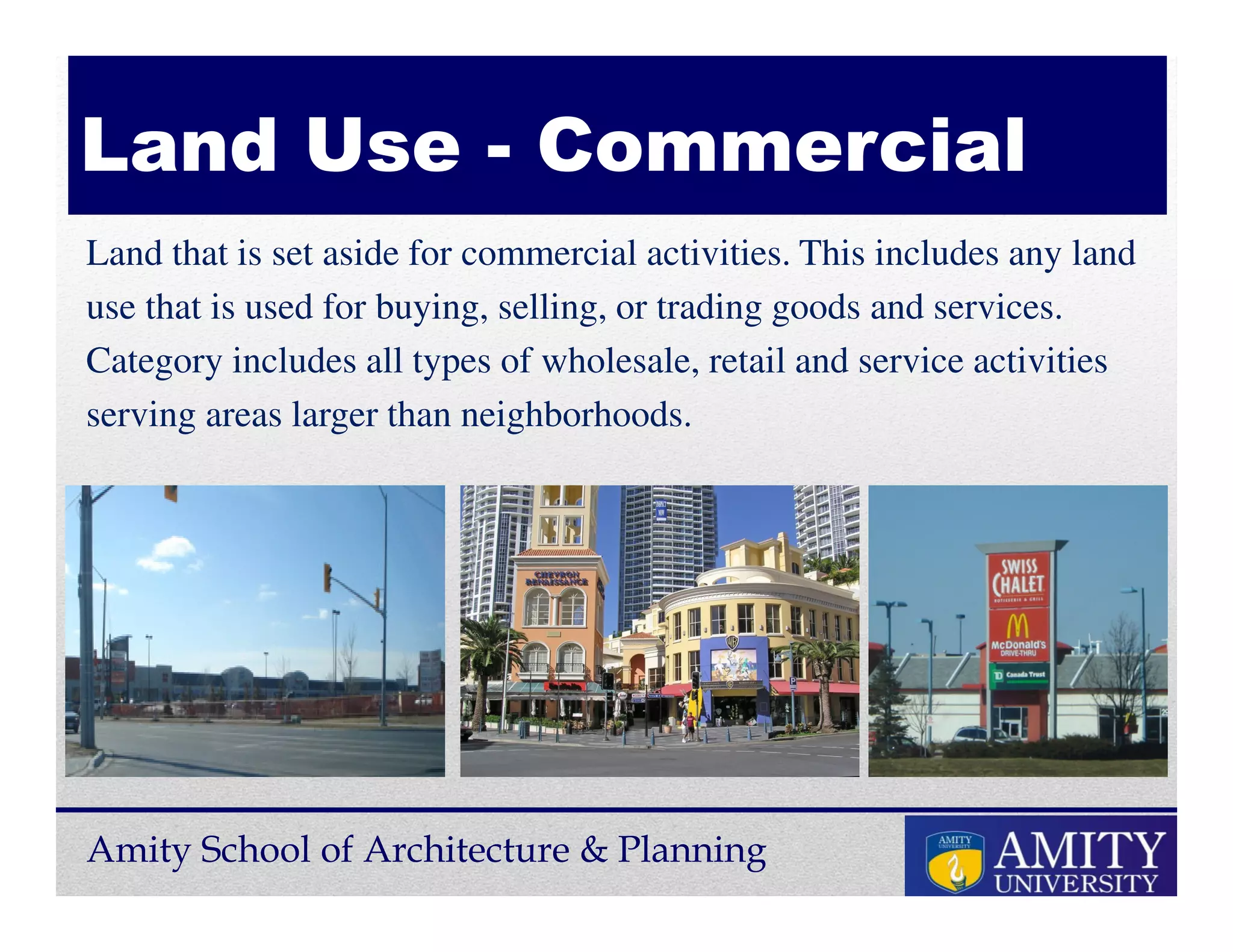
Land that is set aside for commercial activities. This includes any land
use that is used for buying, selling, or trading goods and services.
Category includes all types of wholesale, retail and service activities
serving areas larger than neighborhoods.
Land Use - Commercial
Amity School of Architecture & Planning
Category includes all types of wholesale, retail and service activities serving
areas larger than neighborhoods. These are :
• Major Central Business Districts in urbanized areas - shopping, service
area with largest dept. and variety stores, specialty, shops, business and
professional services, hotels, theaters, etc.
• Minor Central Business District in less urbanized areas - market as main
feature (types: wholesale market, wet and dry market); mixed use
development.
• Highway Service Centers or Commercial Strips such as highway gas
stations, motel and restaurants-extension of CBD
• Neighborhood Center – local sources of staple and convenience goods and
services; built around supermarket with convenience stores.
Land Use - Commercial
Amity School of Architecture & Planning
Land that covers the major public and semipublic uses like educational,
cultural, religious, health, protective and government services. It is
occupied by schools, hospitals, government offices, and places of worship.
Land Use - Institutional
Amity School of Architecture & Planning
Land that is used for industry viz ; Factories, warehouses, power plants,
or places of resource extraction (like mines).
It includes manufacturing, refining, fabricating, assembly, storage, parking
and other incidental uses including food processing, cottage industry,
sawmills, rice mills, steel mills, chemical processing plants, etc. Also
included are the proposed industrial estates/subdivision
Land Use - Industrial
Amity School of Architecture & Planning
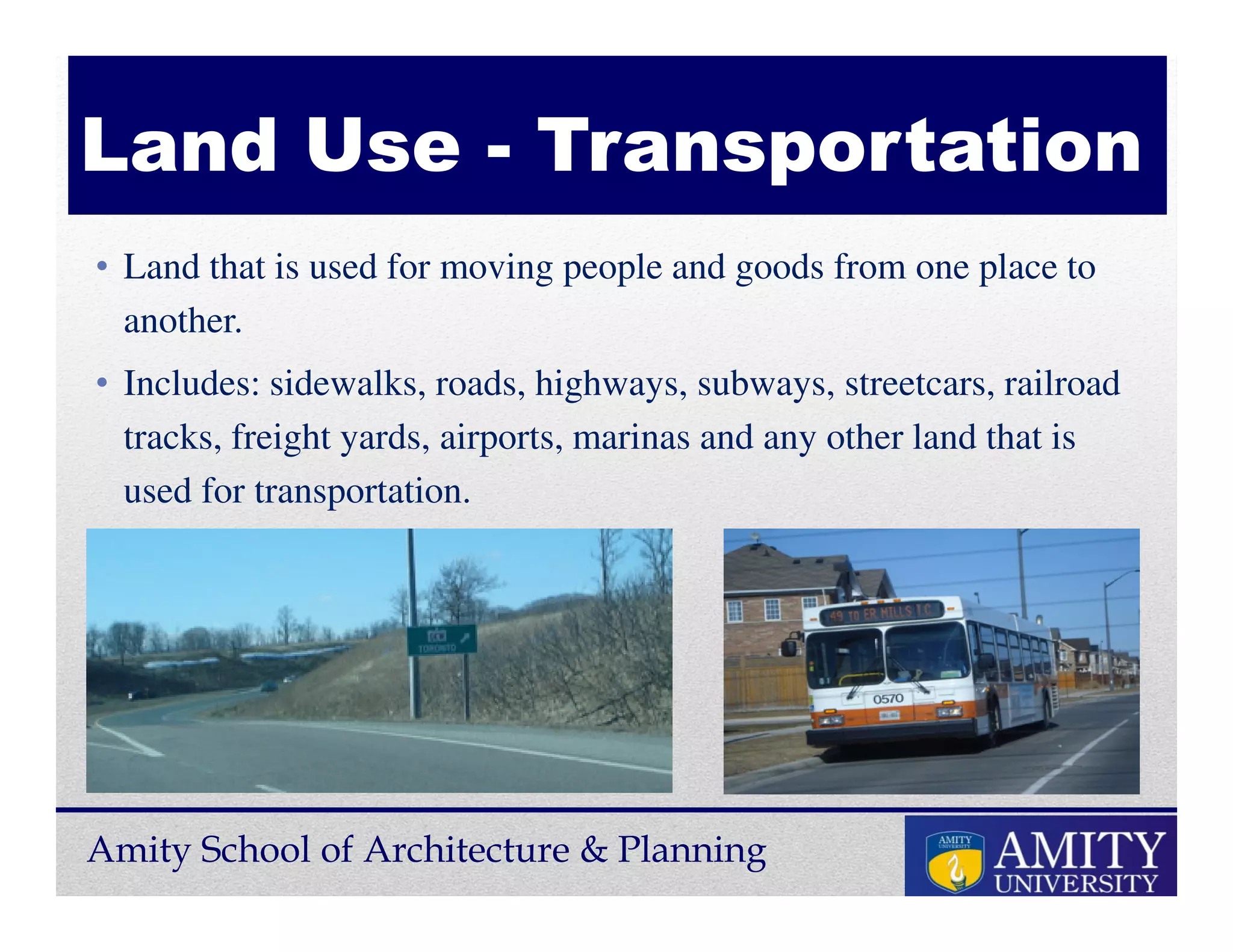
• Land that is used for moving people and goods from one place to
another.
• Includes: sidewalks, roads, highways, subways, streetcars, railroad
tracks, freight yards, airports, marinas and any other land that is
used for transportation.
Land Use - Transportation
Amity School of Architecture & Planning
• Land that is now vacant, or left in a natural state (like a woodlot), or
land that is for recreational use (parks, playgrounds, community
centres)
• Parks/Playgrounds and other Recreational Areas the space
requirement may be computed with the use of space standards based
on population or area of the municipality or city
• so called “non-functional open spaces” and includes lands reserved
for greenbelts and buffer zones; and other vacant lands reserved for
specific or functional purposes.
Land Use - Open Space
Amity School of Architecture & Planning
Land Use - Open Space
Amity School of Architecture & Planning
LAND USE PLANNING
• Refers to the rational and judicious approach of allocating
available land resources to different land using activities
and for different functions consistent with the overall
development vision/goal of a particular city
• refers to a document embodying a set of policies
accompanied by maps and similar illustrations which
represent the community desired pattern of population
distribution and a proposal for the future allocation of land
to the various land-using activities.
Amity School of Architecture & Planning
23
Land-Use Planning Principles
• Evaluate and record unique features.
• Preserve unique cultural or historical features.
• Conserve open space and environmental features.
• Calculate additional charges for altering land.
• Plan for mixed uses in close proximity.
• Plan variety of transportation options.
• Set limits and managed growth patterns.
• Encourage development in areas of existing infrastructure.
Amity School of Architecture & Planning
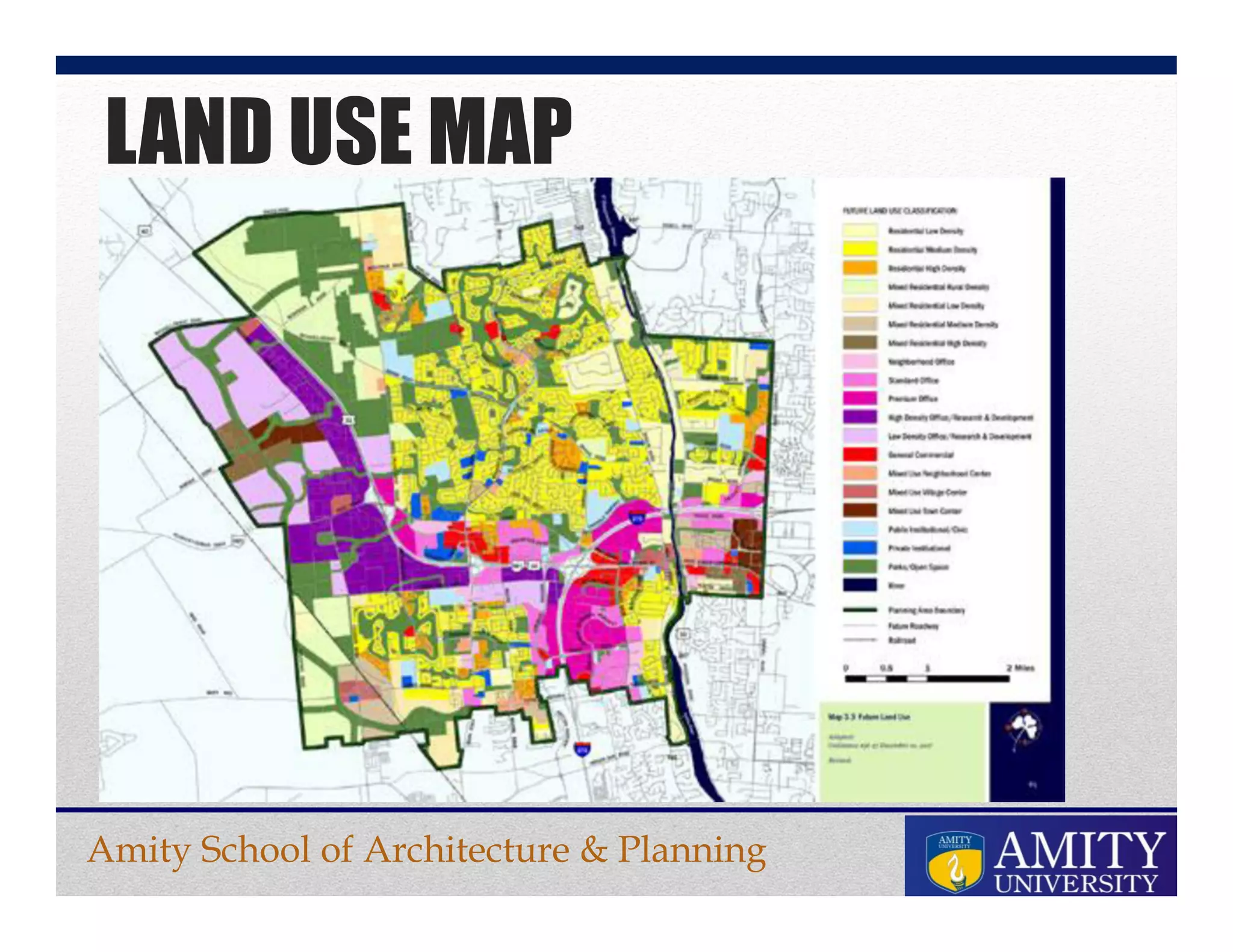
LAND USE MAPS/MAPPING
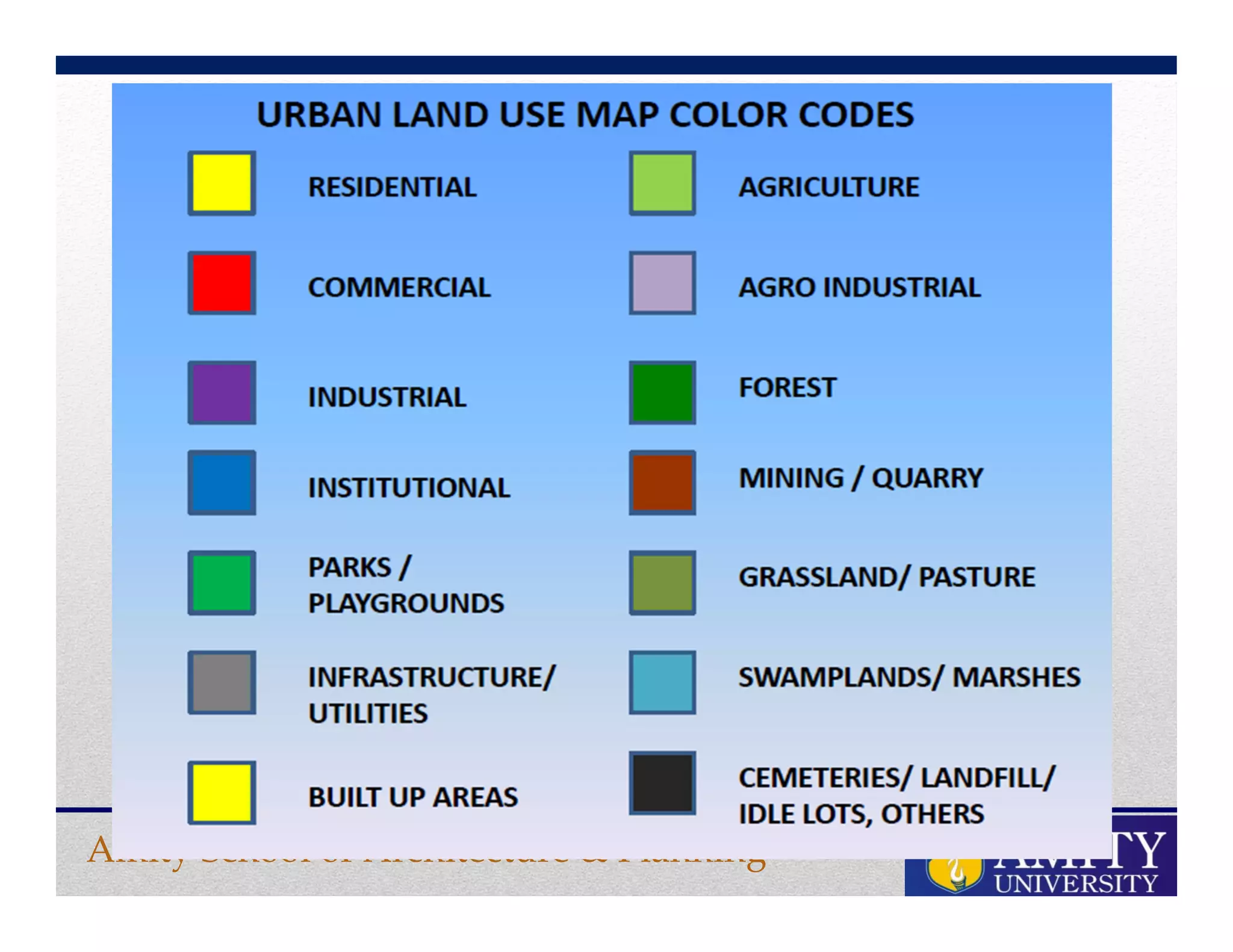
• Land use map is the graphical representation of Land use for
a place or particular in an area.
• It is a convenient visual form of spatial data, their distribution
and relationships
• This is a reduced and simplified model of reality containing
geographic information.
• It is a graphic depiction of all or part of a geographic realm
where the real-world features have been replaced with
symbols in their correct spatial location at a reduced scale
Amity School of Architecture & Planning
ELEMENTS OF MAP
• Map Title – defines the information and purpose of a map.
• Legend – key to the codes and symbols used in a map.
• Date and Author – name of map maker and date of survey or period covered by it.
• North Arrow – usually, maps are oriented towards the geographic (true) north.
• Geographic Coordinates – geographic grid known as latitudes and longitudes.
• Latitude (parallels) – distance measured north and south of the equator.
• Longitude (meridians) – distance measured east and west with the imaginary prime
meridian (Greenwich Laboratory in London) as reference line.
• Scale – ratio distance on the map itself and the corresponding distance on the ground.
• Graphic Scale – line or bar marked off in graduated distances representing actual
distances on the ground.
• Numerical/Functional- compares map distance with ground distance by proportional
numbers and expressed as a representative fraction or ratio. Example: 1:1,000 means
1 meter on the map is equivalent to 1,000 meters or 1 kilometer on the ground.
Amity School of Architecture & Planning
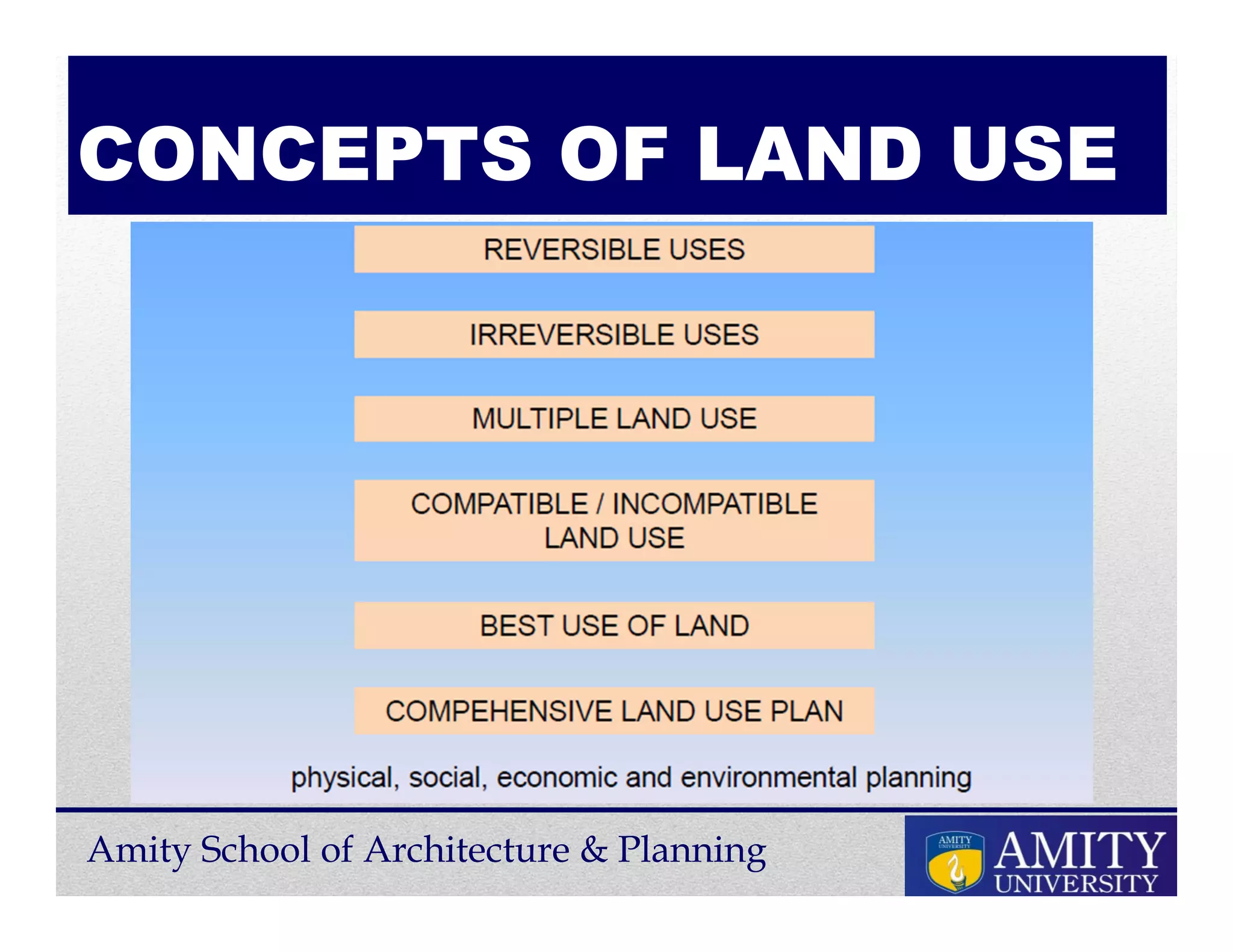
CONCEPTS OF LAND USE
Amity School of Architecture & Planning
CONCEPTS OF LAND USE
when the inherent features and characteristics of the
land have not been considerably altered or modified
such that the soil horizon, landform, and structure
remain intact so that the land can be reverted to its
former use or original condition.
REVERSIBLE USES
Amity School of Architecture & Planning
CONCEPTS OF LAND USE
when land is subject to applications which brought about
changes, alteration or modifications so much so that it
prevents the original use or it is physically impossible to
restore the land to its previous state or condition.
IRREVERSIBLE USES
Amity School of Architecture & Planning
CONCEPTS OF LAND USE
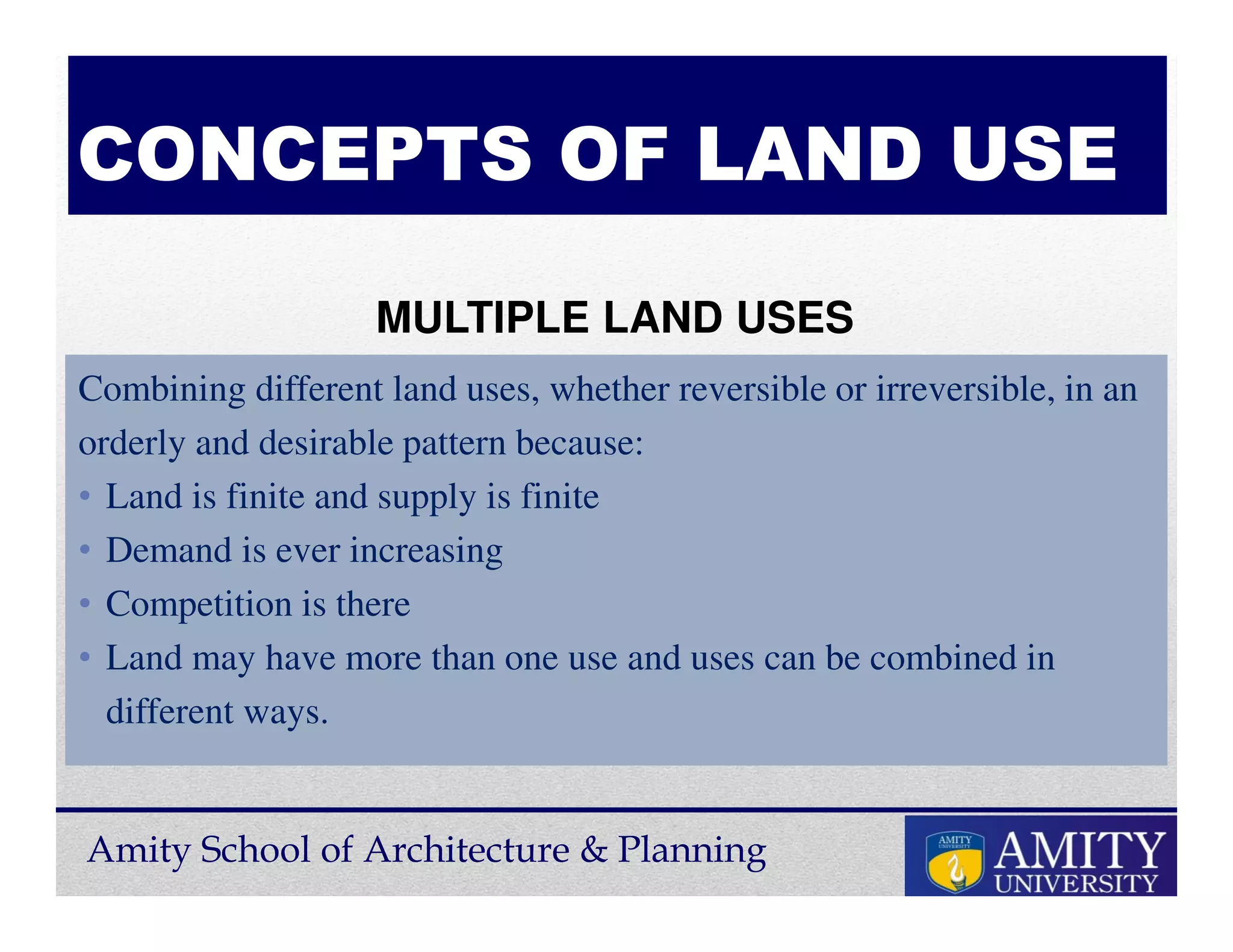
Combining different land uses, whether reversible or irreversible, in an
orderly and desirable pattern because:
• Land is finite and supply is finite
• Demand is ever increasing
• Competition is there
• Land may have more than one use and uses can be combined in
different ways.
MULTIPLE LAND USES
Amity School of Architecture & Planning
CONCEPTS OF LAND USE
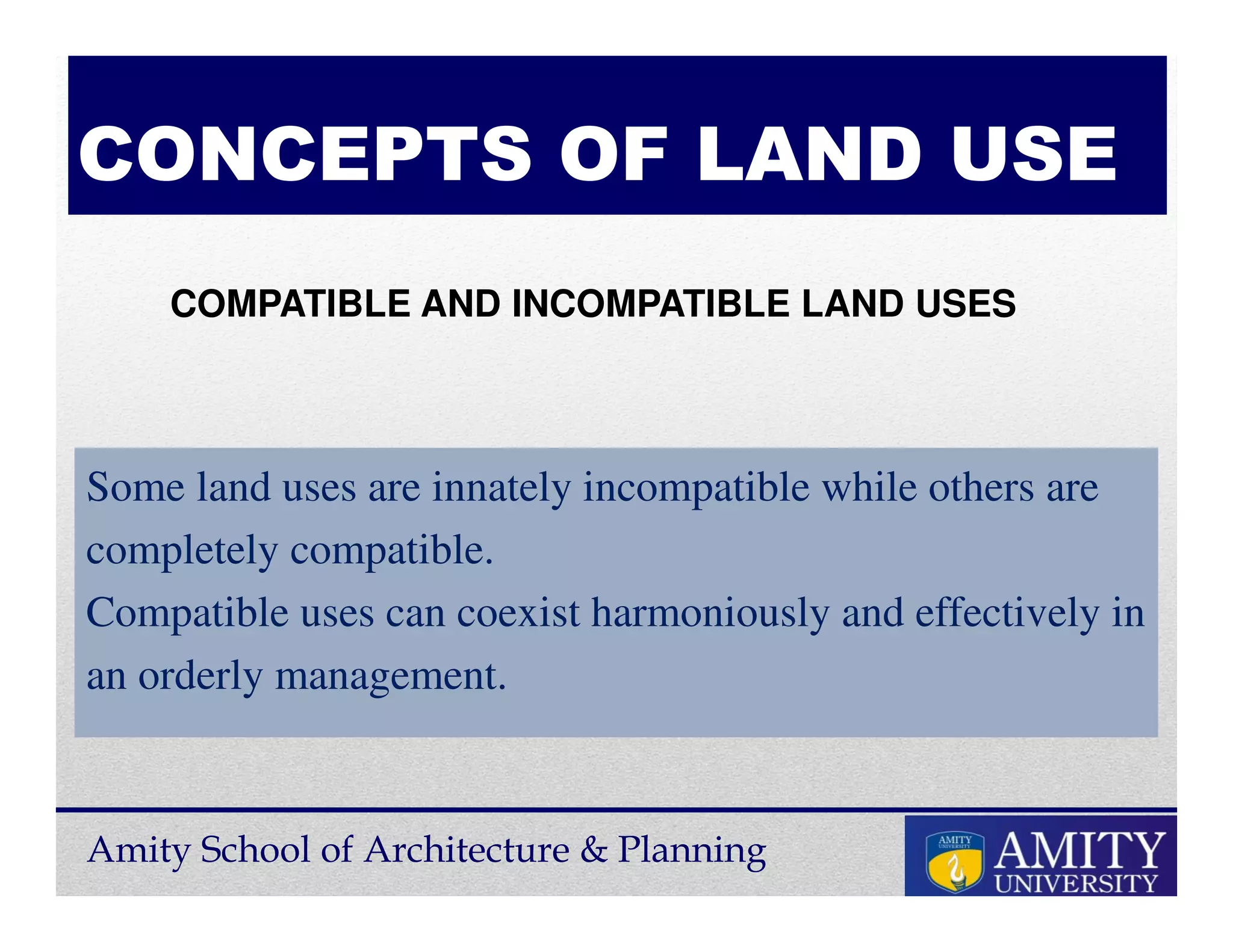
Some land uses are innately incompatible while others are
completely compatible.
Compatible uses can coexist harmoniously and effectively in
an orderly management.
COMPATIBLE AND INCOMPATIBLE LAND USES
Amity School of Architecture & Planning
CONCEPTS OF LAND USE
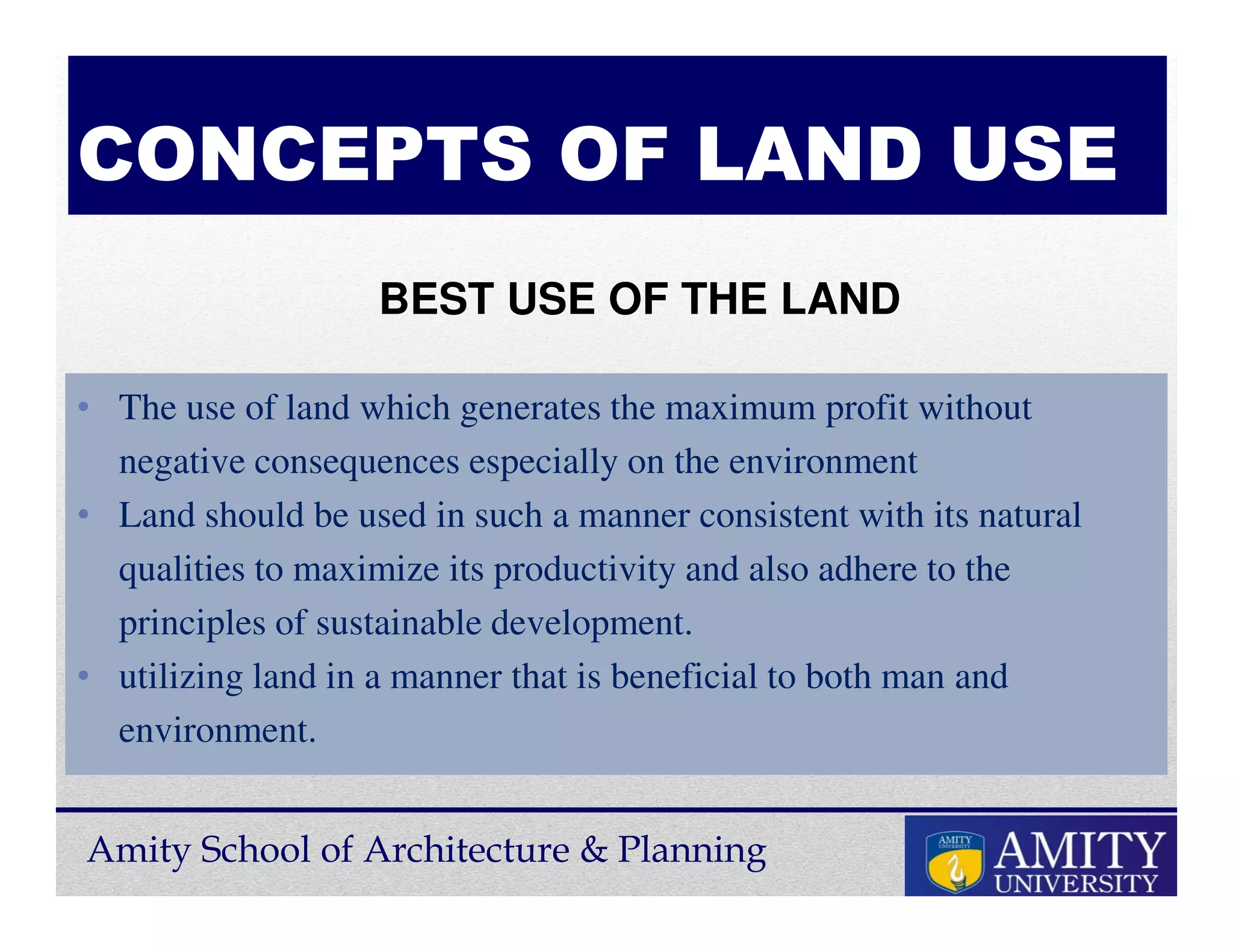
• The use of land which generates the maximum profit without
negative consequences especially on the environment
• Land should be used in such a manner consistent with its natural
qualities to maximize its productivity and also adhere to the
principles of sustainable development.
• utilizing land in a manner that is beneficial to both man and
environment.
BEST USE OF THE LAND
Amity School of Architecture & Planning
CONCEPTS OF LAND USE
A document embodying specific proposals for
guiding, regulating growth and development of a
city or municipality.
COMPREHENSIVE LAND USE PLANNING
Amity School of Architecture & Planning
LAND USE MAP
Amity School of Architecture & Planning
Exercise
1. Define Master Plan. What are the main objectives and functions of
master plan
2. What do you understand by land uses? How we represent the land
use in map?
3. Explain the major land uses in detail. What are the main objective
of land use plan?
4. Describe the main elements of land use plan
5. Write short notes on
a) Land use planning Principles
b) Reversible land use
c) Irreversible land use
d) Multiple land uses

Master plan and land use

  • 1.
    Amity School ofArchitecture & Planning MASTER PLAN AND LAND USE PLANNING B. Arch IV Semester Course Code: BAR 408
  • 2.
    Amity School ofArchitecture & Planning A Master plan is a comprehensive long term perspective plan intended for guiding the sustainable planned development of city. MASTER PLAN - Introduction • It creates a vision that is supported by policies, guidelines and priorities. • It is a policy based document, it does not, nor can regulate land use.
  • 3.
    Amity School ofArchitecture & Planning • lays down the planning guidelines, policies, development code and space requirements for various socio-economic activities supporting city population during plan period. • It is based on • public input, • surveys, • planning initiatives, • existing development, • physical characteristics, & • socio-economic conditions. MASTER PLAN - Introduction
  • 4.
    Amity School ofArchitecture & Planning • It includes analysis, recommendations, and proposals for : • population, • economy, • housing, • transportation, • community facilities, & • land use. • It is the basis for all infrastructure requirements. MASTER PLAN - Introduction
  • 5.
    Amity School ofArchitecture & Planning • To guide development of a city is an orderly manner so as to improve the quality of life of the people • Organize and coordinate the complex relationships between urban land uses • Chart a course for growth and change, be responsive to change and maintain its validity over time and space, and be subject to continual review THE MASTER PLAN - FUNCTIONS
  • 6.
    Amity School ofArchitecture & Planning • Direct the physical development of the city in relation to its social and economic characteristics based on comprehensive surveys and studies on the present status and the future growth prospects; and • Provide a resource mobilization plan for the proposed development works. THE MASTER PLAN - FUNCTIONS
  • 7.
    Amity School ofArchitecture & Planning •Delhi Master plan -2021 •JDA Master plan - 2025
  • 8.
    Amity School ofArchitecture & Planning
  • 9.
    Amity School ofArchitecture & Planning LAND USE Land use refers to the manner of utilization of land, including its allocation, development and management.
  • 10.
    Amity School ofArchitecture & Planning It is the human use of land. Land Use - Introduction It involves the management and modification of natural environment or wilderness into built environment such as fields, pastures, and settlements. Municipal governments divide the land into various land uses In order for an urban area to function effectively and to meet all the needs of citizen .
  • 11.
    Amity School ofArchitecture & Planning • To promote efficient utilization, acquisition & disposition of land and ensure the highest and best use of land. • To direct, harmonize and influence discussions and activities of the private and public sectors relative to the use and management of lands • To reconcile land use conflicts and proposals between and among individuals, private and government entities relative to the present and future need for the land. Land Use - OBJECTIVES
  • 12.
    Amity School ofArchitecture & Planning To promote desirable patterns of land uses to prevent wasteful development and minimize the cost of public infrastructure and utilities and other social services to preserve areas of ecological, aesthetic, historical and cultural significance Land Use - OBJECTIVES
  • 13.
    Amity School ofArchitecture & Planning URBAN LAND USE - CLASSIFICATION • Residential • Commercial • Institutional • Industrial • Transportation • Utilities/Facilities • Open spaces/greens
  • 14.
    Amity School ofArchitecture & Planning This is where people live. The type of housing in an area is based on residential density, defined by Number of housing units in a unit of land; Ex: Land Use - Residential • Low Density : Single-family homes, semi-detached homes, and duplexes • Medium Density : Town houses, low-rise apartments, • High Density : High-rise apartments,
  • 15.
    Amity School ofArchitecture & Planning Land that is set aside for commercial activities. This includes any land use that is used for buying, selling, or trading goods and services. Category includes all types of wholesale, retail and service activities serving areas larger than neighborhoods. Land Use - Commercial
  • 16.
    Amity School ofArchitecture & Planning Category includes all types of wholesale, retail and service activities serving areas larger than neighborhoods. These are : • Major Central Business Districts in urbanized areas - shopping, service area with largest dept. and variety stores, specialty, shops, business and professional services, hotels, theaters, etc. • Minor Central Business District in less urbanized areas - market as main feature (types: wholesale market, wet and dry market); mixed use development. • Highway Service Centers or Commercial Strips such as highway gas stations, motel and restaurants-extension of CBD • Neighborhood Center – local sources of staple and convenience goods and services; built around supermarket with convenience stores. Land Use - Commercial
  • 17.
    Amity School ofArchitecture & Planning Land that covers the major public and semipublic uses like educational, cultural, religious, health, protective and government services. It is occupied by schools, hospitals, government offices, and places of worship. Land Use - Institutional
  • 18.
    Amity School ofArchitecture & Planning Land that is used for industry viz ; Factories, warehouses, power plants, or places of resource extraction (like mines). It includes manufacturing, refining, fabricating, assembly, storage, parking and other incidental uses including food processing, cottage industry, sawmills, rice mills, steel mills, chemical processing plants, etc. Also included are the proposed industrial estates/subdivision Land Use - Industrial
  • 19.
    Amity School ofArchitecture & Planning • Land that is used for moving people and goods from one place to another. • Includes: sidewalks, roads, highways, subways, streetcars, railroad tracks, freight yards, airports, marinas and any other land that is used for transportation. Land Use - Transportation
  • 20.
    Amity School ofArchitecture & Planning • Land that is now vacant, or left in a natural state (like a woodlot), or land that is for recreational use (parks, playgrounds, community centres) • Parks/Playgrounds and other Recreational Areas the space requirement may be computed with the use of space standards based on population or area of the municipality or city • so called “non-functional open spaces” and includes lands reserved for greenbelts and buffer zones; and other vacant lands reserved for specific or functional purposes. Land Use - Open Space
  • 21.
    Amity School ofArchitecture & Planning Land Use - Open Space
  • 22.
    Amity School ofArchitecture & Planning LAND USE PLANNING • Refers to the rational and judicious approach of allocating available land resources to different land using activities and for different functions consistent with the overall development vision/goal of a particular city • refers to a document embodying a set of policies accompanied by maps and similar illustrations which represent the community desired pattern of population distribution and a proposal for the future allocation of land to the various land-using activities.
  • 23.
    Amity School ofArchitecture & Planning 23 Land-Use Planning Principles • Evaluate and record unique features. • Preserve unique cultural or historical features. • Conserve open space and environmental features. • Calculate additional charges for altering land. • Plan for mixed uses in close proximity. • Plan variety of transportation options. • Set limits and managed growth patterns. • Encourage development in areas of existing infrastructure.
  • 24.
    Amity School ofArchitecture & Planning LAND USE MAPS/MAPPING • Land use map is the graphical representation of Land use for a place or particular in an area. • It is a convenient visual form of spatial data, their distribution and relationships • This is a reduced and simplified model of reality containing geographic information. • It is a graphic depiction of all or part of a geographic realm where the real-world features have been replaced with symbols in their correct spatial location at a reduced scale
  • 25.
    Amity School ofArchitecture & Planning ELEMENTS OF MAP • Map Title – defines the information and purpose of a map. • Legend – key to the codes and symbols used in a map. • Date and Author – name of map maker and date of survey or period covered by it. • North Arrow – usually, maps are oriented towards the geographic (true) north. • Geographic Coordinates – geographic grid known as latitudes and longitudes. • Latitude (parallels) – distance measured north and south of the equator. • Longitude (meridians) – distance measured east and west with the imaginary prime meridian (Greenwich Laboratory in London) as reference line. • Scale – ratio distance on the map itself and the corresponding distance on the ground. • Graphic Scale – line or bar marked off in graduated distances representing actual distances on the ground. • Numerical/Functional- compares map distance with ground distance by proportional numbers and expressed as a representative fraction or ratio. Example: 1:1,000 means 1 meter on the map is equivalent to 1,000 meters or 1 kilometer on the ground.
  • 26.
    Amity School ofArchitecture & Planning CONCEPTS OF LAND USE
  • 27.
    Amity School ofArchitecture & Planning CONCEPTS OF LAND USE when the inherent features and characteristics of the land have not been considerably altered or modified such that the soil horizon, landform, and structure remain intact so that the land can be reverted to its former use or original condition. REVERSIBLE USES
  • 28.
    Amity School ofArchitecture & Planning CONCEPTS OF LAND USE when land is subject to applications which brought about changes, alteration or modifications so much so that it prevents the original use or it is physically impossible to restore the land to its previous state or condition. IRREVERSIBLE USES
  • 29.
    Amity School ofArchitecture & Planning CONCEPTS OF LAND USE Combining different land uses, whether reversible or irreversible, in an orderly and desirable pattern because: • Land is finite and supply is finite • Demand is ever increasing • Competition is there • Land may have more than one use and uses can be combined in different ways. MULTIPLE LAND USES
  • 30.
    Amity School ofArchitecture & Planning CONCEPTS OF LAND USE Some land uses are innately incompatible while others are completely compatible. Compatible uses can coexist harmoniously and effectively in an orderly management. COMPATIBLE AND INCOMPATIBLE LAND USES
  • 31.
    Amity School ofArchitecture & Planning CONCEPTS OF LAND USE • The use of land which generates the maximum profit without negative consequences especially on the environment • Land should be used in such a manner consistent with its natural qualities to maximize its productivity and also adhere to the principles of sustainable development. • utilizing land in a manner that is beneficial to both man and environment. BEST USE OF THE LAND
  • 32.
    Amity School ofArchitecture & Planning CONCEPTS OF LAND USE A document embodying specific proposals for guiding, regulating growth and development of a city or municipality. COMPREHENSIVE LAND USE PLANNING
  • 33.
    Amity School ofArchitecture & Planning LAND USE MAP
  • 34.
    Amity School ofArchitecture & Planning
  • 35.
    Amity School ofArchitecture & Planning Exercise 1. Define Master Plan. What are the main objectives and functions of master plan 2. What do you understand by land uses? How we represent the land use in map? 3. Explain the major land uses in detail. What are the main objective of land use plan? 4. Describe the main elements of land use plan 5. Write short notes on a) Land use planning Principles b) Reversible land use c) Irreversible land use d) Multiple land uses