Perspective in Strategic
Planning
by: Dr. Eusebio F. Miclat, Jr.
Development Planning & Budgeting, PSU (2004)
Reporter
Lennie H. Torres
Professor:
Josefina Bitonio, DPA
DM 214 Strategic Planning/ ME 217 Strategic Planning
1st Semester 2013
3 Perspective in Strategic
Planning
1. Down-board thinking
2. Paradigm Shift
3. Planning Orientation
a) System Approach
b) Mega-level Environment
c) Outside-In Planning
Down – Board Thinking
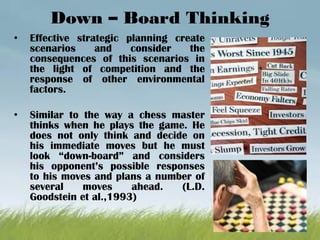
• Effective strategic planning create
scenarios and consider the
consequences of this scenarios in
the light of competition and the
response of other environmental
factors.
• Similar to the way a chess master
thinks when he plays the game. He
does not only think and decide on
his immediate moves but he must
look “down-board” and considers
his opponent’s possible responses
to his moves and plans a number of
several moves ahead. (L.D.
Goodstein et al.,1993)
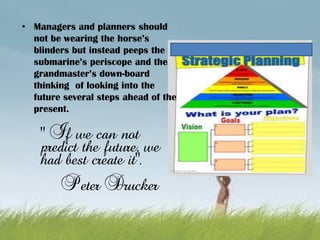
“ If we can not
predict the future, we
had best create it”.
Peter Drucker
• Managers and planners should
not be wearing the horse’s
blinders but instead peeps the
submarine’s periscope and the
grandmaster’s down-board
thinking of looking into the
future several steps ahead of the
present.
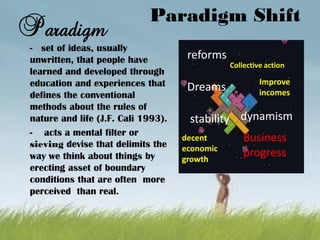
Paradigm Shift
- set of ideas, usually
unwritten, that people have
learned and developed through
education and experiences that
defines the conventional
methods about the rules of
nature and life (J.F. Cali 1993).
- acts a mental filter or
sieving devise that delimits the
way we think about things by
erecting asset of boundary
conditions that are often more
perceived than real.
Paradigm
reforms
Collective action
Dreams Improve
incomes
stability dynamism
decent
economic
growth
Business
progress
Paradigm Shift
- requires disassembling our
old and conventional ways of
seeing, doing, thinking, and
assessing a thing because they
no longer apply with reality and
the present.
The “ new paradigm” calls for
a broad, flexible, eclectic,
creative and futuristic mental
framework.
“CHANGE”
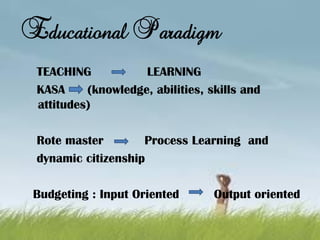
Educational Paradigm
TEACHING LEARNING
KASA (knowledge, abilities, skills and
attitudes)
Rote master Process Learning and
dynamic citizenship
Budgeting : Input Oriented Output oriented
Planning Orientation
There are three types of planning
orientation:
1. system
2. mega level
3. outside in approaches
System
- an organized unitary whole
composed of two or more
independent parts, components
or sub-systems and delineated by
identifiable boundaries from its
environmental supra system
(F. Kast and J. Rosenzweig, 1979)
Elements of a System
1. Inputs
2. Conversion process
3. Outputs
4. Outcomes
a) Effect -immediate consequences of
program output (UN, 1978)
b) Impact –change in the standard of living of
the target group or within target area
stemming from the program(UN, 1978)
`
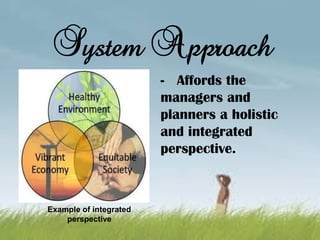
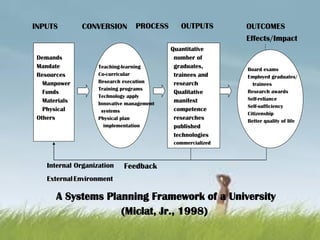
System Approach
- Affords the
managers and
planners a holistic
and integrated
perspective.
Example of integrated
perspective
Demands
Mandate
Resources
Manpower
Funds
Materials
Physical
Others
Teaching-learning
Co-curricular
Research execution
Training programs
Technology apply
Innovative management
systems
Physical plan
implementation
Quantitative
number of
graduates,
trainees and
research
Qualitative
manifest
competence
researches
published
technologies
commercialized
Board exams
Employed graduates/
trainees
Research awards
Self-reliance
Self-sufficiency
Citizenship
Better quality of life
Internal Organization
ExternalEnvironment
Feedback
INPUTS CONVERSION PROCESS OUTPUTS OUTCOMES
Effects/Impact
A Systems Planning Framework of a University
(Miclat, Jr., 1998)
Mega-Level Environment
- Looks its role in different level of
planning environments. There is no
permanent one-to-one correspondence.
Rather the levels of planning
environment vary and slide depending
on the highest level of planning
environment one adopts in planning.
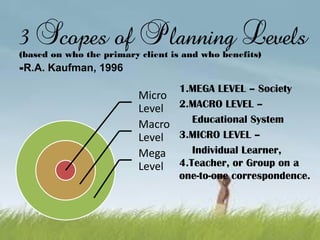
3 Scopes of Planning Levels
(based on who the primary client is and who benefits)
-R.A. Kaufman, 1996
1.MEGA LEVEL – Society
2.MACRO LEVEL –
Educational System
3.MICRO LEVEL –
Individual Learner,
4.Teacher, or Group on a
one-to-one correspondence.
Micro
Level
Macro
Level
Mega
Level
- They argue that mega level planning
views the society and the educational clients
as the basis of everything the education
system or organization uses, does, and
delivers. In the macro level, planning is
primarily looking after the organization but
without any substantial commitment to both
the client and the society. Finally, micro level,
planning is concerned only with individuals or
group jobs and tasks
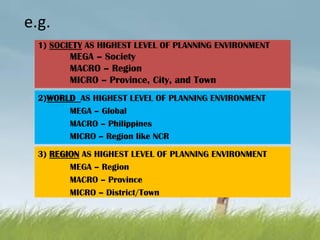
e.g.
1) SOCIETY AS HIGHEST LEVEL OF PLANNING ENVIRONMENT
MEGA – Society
MACRO – Region
MICRO – Province, City, and Town
2)WORLD AS HIGHEST LEVEL OF PLANNING ENVIRONMENT
MEGA – Global
MACRO – Philippines
MICRO – Region like NCR
3) REGION AS HIGHEST LEVEL OF PLANNING ENVIRONMENT
MEGA – Region
MACRO – Province
MICRO – District/Town
Outside-In Planning
• planning in this way is as if one were looking
into the organization from the outside – from
the vantage point of society back into the
organization and its results and efforts.
( Kaufman and associates (2002)
• proactive.
• It is a paradigm or frame of reference that
continuously challenges the status quo while
identifying possible scenarios and new
opportunities that bring about positive
change and growth to society.
According to Gene Bellinger's Theory of
systemic thinking..
Traditional Management
Perspective
VS.
Management Perspective in
a Learning Organization
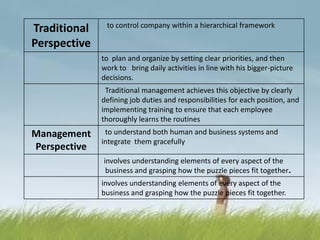
Traditional
Perspective
to control company within a hierarchical framework
to plan and organize by setting clear priorities, and then
work to bring daily activities in line with his bigger-picture
decisions.
Traditional management achieves this objective by clearly
defining job duties and responsibilities for each position, and
implementing training to ensure that each employee
thoroughly learns the routines
Management
Perspective
to understand both human and business systems and
integrate them gracefully
involves understanding elements of every aspect of the
business and grasping how the puzzle pieces fit together.
involves understanding elements of every aspect of the
business and grasping how the puzzle pieces fit together.
Management
Perspective
A leader who operates from a balanced management
perspective will know the right questions to ask.
-His big-picture orientation will enable her to zero in on
imbalances, and thoughtfully investigate areas where
change is necessary.
Management perspective involves using a firm grasp of
the company's overall direction to plan and organize day-
to-day operations.
perspective seeks to inspire a team of employees to learn
and excel.
A management perspective inspires learning by defining
on going improvement as a priority and by creating
conditions in which learning can successfully occur, such
as scheduling time specifically dedicated to training and
building employee skills.
Seeing the Big
Picture
-Whether a manager
operates as a traditional
CEO or a visionary
leader, his job is to see
the big picture and
communicate it to his
employees.
Planning and Organizing
• A leader using a holistic, systems-
oriented approach will plan and
organize by working to bring
concurrent processes into a useful
balance, with a focus on
understanding rather than
controlling.
• Whether a manager operates
traditionally or holistically, he will be
responsible for integrating the larger
perspective into recurring daily
processes.
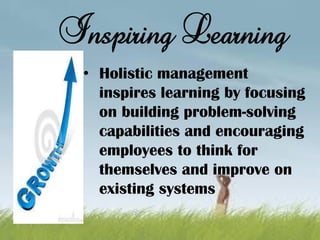
• Holistic management
inspires learning by focusing
on building problem-solving
capabilities and encouraging
employees to think for
themselves and improve on
existing systems
Inspiring Learning
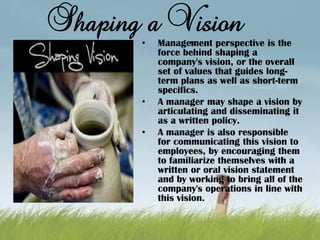
Shaping a Vision
`• Management perspective is the
force behind shaping a
company's vision, or the overall
set of values that guides long-
term plans as well as short-term
specifics.
• A manager may shape a vision by
articulating and disseminating it
as a written policy.
• A manager is also responsible
for communicating this vision to
employees, by encouraging them
to familiarize themselves with a
written or oral vision statement
and by working to bring all of the
company's operations in line with
this vision.
References:
Miclat, Jr. Eusebio F. Development Planning & Budgeting,
PSU, 2004
http://work.chron.com/management-perspective-5652.html
Reference: www.openuni-clsu.edu.ph/openfiles/.../sqm.doc

Perspective in Strategic Planning

  • 1.
    Perspective in Strategic Planning by:Dr. Eusebio F. Miclat, Jr. Development Planning & Budgeting, PSU (2004) Reporter Lennie H. Torres Professor: Josefina Bitonio, DPA DM 214 Strategic Planning/ ME 217 Strategic Planning 1st Semester 2013
  • 2.
    3 Perspective inStrategic Planning 1. Down-board thinking 2. Paradigm Shift 3. Planning Orientation a) System Approach b) Mega-level Environment c) Outside-In Planning
  • 3.
    Down – BoardThinking • Effective strategic planning create scenarios and consider the consequences of this scenarios in the light of competition and the response of other environmental factors. • Similar to the way a chess master thinks when he plays the game. He does not only think and decide on his immediate moves but he must look “down-board” and considers his opponent’s possible responses to his moves and plans a number of several moves ahead. (L.D. Goodstein et al.,1993)
  • 4.
    “ If wecan not predict the future, we had best create it”. Peter Drucker • Managers and planners should not be wearing the horse’s blinders but instead peeps the submarine’s periscope and the grandmaster’s down-board thinking of looking into the future several steps ahead of the present.
  • 5.
    Paradigm Shift - setof ideas, usually unwritten, that people have learned and developed through education and experiences that defines the conventional methods about the rules of nature and life (J.F. Cali 1993). - acts a mental filter or sieving devise that delimits the way we think about things by erecting asset of boundary conditions that are often more perceived than real. Paradigm reforms Collective action Dreams Improve incomes stability dynamism decent economic growth Business progress
  • 6.
    Paradigm Shift - requiresdisassembling our old and conventional ways of seeing, doing, thinking, and assessing a thing because they no longer apply with reality and the present. The “ new paradigm” calls for a broad, flexible, eclectic, creative and futuristic mental framework.
  • 7.
  • 10.
    Educational Paradigm TEACHING LEARNING KASA(knowledge, abilities, skills and attitudes) Rote master Process Learning and dynamic citizenship Budgeting : Input Oriented Output oriented
  • 11.
    Planning Orientation There arethree types of planning orientation: 1. system 2. mega level 3. outside in approaches
  • 12.
    System - an organizedunitary whole composed of two or more independent parts, components or sub-systems and delineated by identifiable boundaries from its environmental supra system (F. Kast and J. Rosenzweig, 1979)
  • 13.
    Elements of aSystem 1. Inputs 2. Conversion process 3. Outputs 4. Outcomes a) Effect -immediate consequences of program output (UN, 1978) b) Impact –change in the standard of living of the target group or within target area stemming from the program(UN, 1978) `
  • 14.
    System Approach - Affordsthe managers and planners a holistic and integrated perspective. Example of integrated perspective
  • 15.
    Demands Mandate Resources Manpower Funds Materials Physical Others Teaching-learning Co-curricular Research execution Training programs Technologyapply Innovative management systems Physical plan implementation Quantitative number of graduates, trainees and research Qualitative manifest competence researches published technologies commercialized Board exams Employed graduates/ trainees Research awards Self-reliance Self-sufficiency Citizenship Better quality of life Internal Organization ExternalEnvironment Feedback INPUTS CONVERSION PROCESS OUTPUTS OUTCOMES Effects/Impact A Systems Planning Framework of a University (Miclat, Jr., 1998)
  • 16.
    Mega-Level Environment - Looksits role in different level of planning environments. There is no permanent one-to-one correspondence. Rather the levels of planning environment vary and slide depending on the highest level of planning environment one adopts in planning.
  • 17.
    3 Scopes ofPlanning Levels (based on who the primary client is and who benefits) -R.A. Kaufman, 1996 1.MEGA LEVEL – Society 2.MACRO LEVEL – Educational System 3.MICRO LEVEL – Individual Learner, 4.Teacher, or Group on a one-to-one correspondence. Micro Level Macro Level Mega Level
  • 18.
    - They arguethat mega level planning views the society and the educational clients as the basis of everything the education system or organization uses, does, and delivers. In the macro level, planning is primarily looking after the organization but without any substantial commitment to both the client and the society. Finally, micro level, planning is concerned only with individuals or group jobs and tasks
  • 19.
    e.g. 1) SOCIETY ASHIGHEST LEVEL OF PLANNING ENVIRONMENT MEGA – Society MACRO – Region MICRO – Province, City, and Town 2)WORLD AS HIGHEST LEVEL OF PLANNING ENVIRONMENT MEGA – Global MACRO – Philippines MICRO – Region like NCR 3) REGION AS HIGHEST LEVEL OF PLANNING ENVIRONMENT MEGA – Region MACRO – Province MICRO – District/Town
  • 20.
    Outside-In Planning • planningin this way is as if one were looking into the organization from the outside – from the vantage point of society back into the organization and its results and efforts. ( Kaufman and associates (2002) • proactive. • It is a paradigm or frame of reference that continuously challenges the status quo while identifying possible scenarios and new opportunities that bring about positive change and growth to society.
  • 21.
    According to GeneBellinger's Theory of systemic thinking.. Traditional Management Perspective VS. Management Perspective in a Learning Organization
  • 22.
    Traditional Perspective to control companywithin a hierarchical framework to plan and organize by setting clear priorities, and then work to bring daily activities in line with his bigger-picture decisions. Traditional management achieves this objective by clearly defining job duties and responsibilities for each position, and implementing training to ensure that each employee thoroughly learns the routines Management Perspective to understand both human and business systems and integrate them gracefully involves understanding elements of every aspect of the business and grasping how the puzzle pieces fit together. involves understanding elements of every aspect of the business and grasping how the puzzle pieces fit together.
  • 23.
    Management Perspective A leader whooperates from a balanced management perspective will know the right questions to ask. -His big-picture orientation will enable her to zero in on imbalances, and thoughtfully investigate areas where change is necessary. Management perspective involves using a firm grasp of the company's overall direction to plan and organize day- to-day operations. perspective seeks to inspire a team of employees to learn and excel. A management perspective inspires learning by defining on going improvement as a priority and by creating conditions in which learning can successfully occur, such as scheduling time specifically dedicated to training and building employee skills.
  • 24.
    Seeing the Big Picture -Whethera manager operates as a traditional CEO or a visionary leader, his job is to see the big picture and communicate it to his employees.
  • 25.
    Planning and Organizing •A leader using a holistic, systems- oriented approach will plan and organize by working to bring concurrent processes into a useful balance, with a focus on understanding rather than controlling. • Whether a manager operates traditionally or holistically, he will be responsible for integrating the larger perspective into recurring daily processes.
  • 26.
    • Holistic management inspireslearning by focusing on building problem-solving capabilities and encouraging employees to think for themselves and improve on existing systems Inspiring Learning
  • 27.
    Shaping a Vision `•Management perspective is the force behind shaping a company's vision, or the overall set of values that guides long- term plans as well as short-term specifics. • A manager may shape a vision by articulating and disseminating it as a written policy. • A manager is also responsible for communicating this vision to employees, by encouraging them to familiarize themselves with a written or oral vision statement and by working to bring all of the company's operations in line with this vision.
  • 30.
    References: Miclat, Jr. EusebioF. Development Planning & Budgeting, PSU, 2004 http://work.chron.com/management-perspective-5652.html Reference: www.openuni-clsu.edu.ph/openfiles/.../sqm.doc