





Setting of Goals and Objectives



Methodology of
Urban, Regional Development Plans
Plan Implementation Techniques,



Public Participation and Plan Implementation



Techniques of Urban Renewal and area
Redevelopment



Contents of Master Plan, Regional Plan


Regional Plan



The Master/Development Plan



Zonal Development Plan,



Development Schemes,



Town Planning Schemes, etc.


Definition
A region is a sub-system within a system (the
country itself) and if sub-systems develop greater
inter-connectivity, the greater will be the efficiency
of the system.


A) Regions in Regional Economics
1. Homogeneous Regions of various hues. Formal regions.
2. Nodal, polarized, heterogeneous, or functional regions.
3. Planning and Programming Regions.



B) Regions in Multi-level planning
1.Macro region
2.State region/ Micro region
4. Micro region


C) Regions in in the ‘stages-of-development’ analysis
1. Developed Region
2. Backward and Depressed Region (Vestigial regions also)
3. Neutral and Intermediate Regions.



D) Regions as per the activity status analysis
1. Mineral regions
2. Manufacturing regions
3. Urban and or Congested regions


The hierarchy of planning region



(i) national level



(ii) macro level



(iii) state level



(iv) meso level



(v) and micro level


Establishment of Regions/Delineation

The State Government may, by notification
a) Declare any area in the State to be a region for the purposes of this
Act.
b) Define the limits of such area; and
c) Specify the name by which such region shall be known.
The State Government may, by notification alter the name of any such region and on such
alteration, any reference in any law or instrument or other document to the region
shall
be deemed to be reference to the region as renamed, unless expressly otherwise provided or the
context so required
The Regional plan shall indicate the manner in which land in
the region should be used, the phasing of development, the
net work of communications and transport, the proposals for
conservation and development of natural resources, and in
particular –
a) allocation of land to such purposes as residential,
industrial, agricultural or as forests or for mineral exploitation;
b) reservation of open spaces for recreational purposes,
gardens, tree belts and animal sanctuaries;
c) access or development of transport and communication
facilities such as roads, railways, water ways and the location
and development of airports;
d) requirements and suggestions for development of public
utilities such as water supply, drainage and electricity;
e) allocation of areas to be developed as ‘ special areas’,
wherein new towns, township, large industrial estates or
any other type of large development projects may be
established.
f) Landscaping and the preservation of areas in their
natural state;
g) Measures relating to the prevention of erosion, including
rejuvenation of forest areas;
h) Proposals relating to irrigation, water supply or flood
control works..


After preparation of the existing land use map, the
Director shall cause to be prepared a draft
regional plan and publish it by making a copy
thereof available for inspection and publishing a
notice in such form and manner as may be
prescribed inviting objections and suggestions
from any person with respect to the draft plan
before such date as may be specified in the
notice, such date not being earlier than sixty days
from the publication of the notice.


The Director shall consider all the objections and
suggestions received by him within the period
specified in the notice under sub-section (1) and
shall after giving a reasonable opportunity to all
persons affected thereby of being heard prepare
the regional plan containing such modifications,
if any, as the considers necessary and submit it
to the State Government for approval together
with all connected documents, plans, maps and
charts.
The state government may approve the draft regional
plan submitted under section 8 with or without
modification or reject or return the sameto the Director
for reconsideration.
Cities are probably the most complex things that
human beings have ever created.
 They are the wellsprings of culture, technology,
wealth and power.
 People have a love-hate relationship with cities.
 We are torn between our needs for community
and privacy and the conflicting attractions of urban
and rural life.



Urban Planning can be defined as the design and
regulation of the uses of space that focus on the
physical form, economic functions, and social
impacts of the urban environment and on the
location of different activities within it.


The need of the hour is sustainable development.
With increasing population and growing pollution, we
can’t ignore the ill effects of planning on the
environment.
Sustainable development refers to:o Utilising the present resources keeping in mind the
future needs of the society, so as not to exhaust the
resources.
o It should not disturb the ecological cycle and hence
preserve the environment.


Protect natural environment.



Conservation of areas of cultural heritage.



Optimize land use and land utilization



Provide services and infrastructure





Participatory approach for supply of land and infrastructure
development.
Urban planning is basically resource generation, resource
development and resource management exercise. The
efficiency of urban settlements largely depends upon how
well they are planned, how economically they are
developed and how efficiently they are managed
The State Government may by notification constitute planning
areas for the purposes of this Act and define the limits thereof.
The State Government may, by notification –

a) alter the limits of the planning area, so as to include
therein or exclude therefrom such area as may be
specified in the notification;
b) amalgamate two or more planning areas so as to
constitute one planning area
c) divide any planning area into two or more planning
areas
d) declare that the whole or part of the area constituting
the planning area shall cease to be a planning area or
part thereof




The Director shall carry out the survey and prepare an
existing land use map and forthwith public the same in such
manner as may be prescribed together with public notice of
the preparation of the map and of place or places where
the copies may be inspected, inviting objections and
suggestions in writing from any person with respect thereto
within thirty days from the date of publication of such notice.
After the expiry of the period specified in the notice
published under sub-section (1) the Director may, after
allowing a reasonable opportunity of being heard to all such
persons who have filed the objections or suggestions, make
such modifications therein as may be considered desirable.


on the publication of the existing land use map
under section 15 –
no person shall institute or change the use of
any land or carry out any development of land
for any purpose other than that indicated in the
existing land use map without the permission in
writing of the Director:


A development plan shall take into account any
draft five year plan and Annual Development plan
of the district, in which the planning area is
situated and shall :
◦ indicate broadly the land use proposed in the planning
area;
• Project the requirement of the planning area
of such amenities and utilities as water,
drainage, electricity and suggest their
fulfillment.
• Propose broad based regulations for zoning,
by way of guide lines, within each zone or
sector of the location, height, size of buildings
and structures, open spaces, court yards and
the use to which such buildings and structures
and land may be put;
• Lay down the broad based traffic circulation
patterns in a city’
• Suggest architectural control features;
elevation and frontages of buildings and
structures;
• Indicate measures for flood control,
prevention of air and water pollution,
disposal of garbage and general
environmental control.
Under Section 17A of T&CP act There is a Provision of
Constitution of committee comprising of Mayor/President
of ulb’s,MP,MLA,Chairman DA,President Janpad
Panchyats,
Sarpanchs and seven members nominated by govt of
specific fields to
(a) Consider and suggest modifications and
alterations in the draft development Plan.
(b) Hear the objections after Publication of the Draft
development plan and suggest modifications or
alterations if
any.






The Committee constituted under sub-section
(1), shall :Consider and suggest modifications and
alterations in the draft development plan
prepared by the Director under section 14’
Hear the objections after publication of the draft
development plan under section 18 and suggest
modifications or alterations if any, to the Director.
The Convener of the Committee shall record in
writing all the suggestions, modifications and
alterations recommended by the committee
under sub-section (2) and thereafter forward his
report to the Director.


On receipt of the report from the Convener of the
Committee under sub-section (3) of Section 17-A the
Director shall consider the report of the committee and in
consultation with the Committee constituted under subsection (1) of section 17-A publish the draft development
plan prepared under section-14 in such manner as may be
prescribed, together with a notice of the preparation of the
draft development plan and the place or places where the
copies may be inspected, inviting objections and
suggestions in writing from any person with respect
thereto, within thirty days from the date of publication of
such notice such notice shall specify in regard to the draft
development plan the following particulars, namely :-


The existing land use maps;



A narrative report, supported by maps and charts explaining
the provisions of the draft development plan;



the phasing of implementation of the draft development plan
as suggested by the Director



the provisions for enforcing the draft development plan and
stating the manner in which permission for development may
be obtained;



approximate cost of land acquisition for public purposes and
the cost of works involved in the implementation of the plan.
Local Authority to prepare Zoning Plans

The Local Authority may on its own motion at
any time after the publication of the the
development plan, or thereafter if so required by
the State Government shall, within six months of
such requisition, prepare a zoning plan.



The zoning plan shall enlarge the details of land
use as indicated in the development plan and
shall :◦ Indicate the land liable to acquisition for public purpose
for the purposes of the Union Government, the State
Government, a Town and Country Development
Authority, a Special Area Development Authority, a local
Authority, a public utility or any other authority
established by or under any enactment for the time being
in force :
◦

◦
◦



define in detail and provide for areas reserved for
agriculture, public and semi public, open spaces, parks,
playground, gardens, recreational areas, green belts and
nature reserves’
allocate in detail areas or zones for residential,
commercial, industrial, agricultural and other purposes;
define and provide for the complete road and street
pattern for the present and in the future and indicate the
traffic circulation;

lay down in detail the projected road and street
improvements;
◦
◦

◦

indicate and provide for areas reserved for public
buildings, institutions, and civic developments;
assess, make projections for and provide for the future
requirements of amenities, services and utilities such as
municipal transport, electricity, water and drainage;
prescribe in detail the zoning regulations for each zone,
with a view to facilitating an individual layout and
regulating the location, height, number of storeys and the
size of buildings and other structures, the size of the
courtyards, courts and other open spaces and the use of
the buildings, structures and land;
◦

◦


define areas which have been badly laid out or areas
which have developed so as to form slums, and
provide for their proper development and/or
relocation;
designate areas for future development and
expansion;

indicate the phasing of the programme of
development
The zoning plan may, and if possible, shall
indicate :-



◦
◦

control over architectural features, elevation and
frontage of buildings and structures; and
the details of development of specific areas for
housing, shopping centres, industrial areas,
educational and cultural institutions and civic centres.





The Director may on his own motion or if so
required by the State Government shall
undertake a review and evaluation of the
Development Plan.
The Director may if necessary propose
modification of the plan under sub-section (1).
The Director, shall if so required by the State
Government proceed to review and propose
modifications of any planning unit of a
development plan




The local Authority shall on its own motion or if so
required by the State Government or the Director
undertake review and evaluation of the zoning
plan.
The provisions of Section 18 and 19 shall so far as
may be apply to the modifications under subsection (2), review and modification under subsection (3) and review and evaluation under subsection (4) as these provisions apply to relation to
the preparation, publication and approval of a
development plan.


The Master Plan is to be followed by preparation of
Zonal Development Plan, Development Schemes,
Town Planning Schemes, etc.



Which indicates details and specific location of
various activities, facilities and services as suggested
in the Master Plan.



Such detailed plans and Town Planning Schemes
are necessary for smooth enforcement of
Implementation of Master Plan.


Primarily it is the responsibility of Development Authority
to implement the Plan through various Town Planning
Schemes under the T&CP Act 1973.



After the 73rd Constitutional amendment the state Govt
has dissolved most of the SADA’s only 6 DA and 3
SADA are remaining.
1.

MPHB

2.

Urban Local Body

3.

PWD

4.

PHE

5.

Road Dev. Corporation

6.

State Transport Deptt

7.

Real State Developers

8.

Rural road Dev Corporation


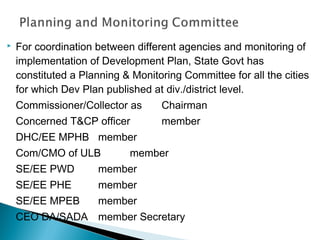
For coordination between different agencies and monitoring of
implementation of Development Plan, State Govt has
constituted a Planning & Monitoring Committee for all the cities
for which Dev Plan published at div./district level.
Commissioner/Collector as

Chairman

Concerned T&CP officer

member

DHC/EE MPHB member
Com/CMO of ULB

member

SE/EE PWD

member

SE/EE PHE

member

SE/EE MPEB

member

CEO DA/SADA member Secretary
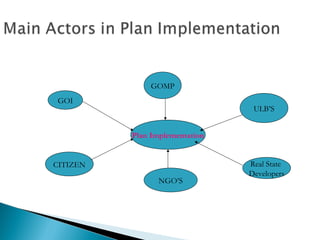
GOMP
GOI

ULB’S
Plan Implementation

CITIZEN
NGO’S

Real State
Developers
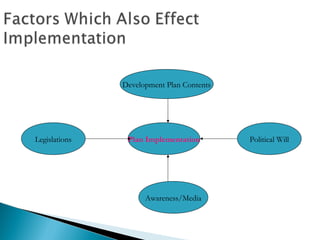
Development Plan Contents

Legislations

Plan Implementation

Awareness/Media

Political Will
Plan preparation techniques

Plan preparation techniques

  • 2.
     Setting of Goalsand Objectives  Methodology of Urban, Regional Development Plans Plan Implementation Techniques,  Public Participation and Plan Implementation  Techniques of Urban Renewal and area Redevelopment  Contents of Master Plan, Regional Plan
  • 3.
     Regional Plan  The Master/DevelopmentPlan  Zonal Development Plan,  Development Schemes,  Town Planning Schemes, etc.
  • 4.
     Definition A region isa sub-system within a system (the country itself) and if sub-systems develop greater inter-connectivity, the greater will be the efficiency of the system.
  • 5.
     A) Regions inRegional Economics 1. Homogeneous Regions of various hues. Formal regions. 2. Nodal, polarized, heterogeneous, or functional regions. 3. Planning and Programming Regions.  B) Regions in Multi-level planning 1.Macro region 2.State region/ Micro region 4. Micro region
  • 6.
     C) Regions inin the ‘stages-of-development’ analysis 1. Developed Region 2. Backward and Depressed Region (Vestigial regions also) 3. Neutral and Intermediate Regions.  D) Regions as per the activity status analysis 1. Mineral regions 2. Manufacturing regions 3. Urban and or Congested regions
  • 7.
     The hierarchy ofplanning region  (i) national level  (ii) macro level  (iii) state level  (iv) meso level  (v) and micro level
  • 8.
     Establishment of Regions/Delineation TheState Government may, by notification a) Declare any area in the State to be a region for the purposes of this Act. b) Define the limits of such area; and c) Specify the name by which such region shall be known. The State Government may, by notification alter the name of any such region and on such alteration, any reference in any law or instrument or other document to the region shall be deemed to be reference to the region as renamed, unless expressly otherwise provided or the context so required
  • 9.
    The Regional planshall indicate the manner in which land in the region should be used, the phasing of development, the net work of communications and transport, the proposals for conservation and development of natural resources, and in particular – a) allocation of land to such purposes as residential, industrial, agricultural or as forests or for mineral exploitation; b) reservation of open spaces for recreational purposes, gardens, tree belts and animal sanctuaries; c) access or development of transport and communication facilities such as roads, railways, water ways and the location and development of airports;
  • 10.
    d) requirements andsuggestions for development of public utilities such as water supply, drainage and electricity; e) allocation of areas to be developed as ‘ special areas’, wherein new towns, township, large industrial estates or any other type of large development projects may be established. f) Landscaping and the preservation of areas in their natural state; g) Measures relating to the prevention of erosion, including rejuvenation of forest areas; h) Proposals relating to irrigation, water supply or flood control works..
  • 11.
     After preparation ofthe existing land use map, the Director shall cause to be prepared a draft regional plan and publish it by making a copy thereof available for inspection and publishing a notice in such form and manner as may be prescribed inviting objections and suggestions from any person with respect to the draft plan before such date as may be specified in the notice, such date not being earlier than sixty days from the publication of the notice.
  • 12.
     The Director shallconsider all the objections and suggestions received by him within the period specified in the notice under sub-section (1) and shall after giving a reasonable opportunity to all persons affected thereby of being heard prepare the regional plan containing such modifications, if any, as the considers necessary and submit it to the State Government for approval together with all connected documents, plans, maps and charts.
  • 13.
    The state governmentmay approve the draft regional plan submitted under section 8 with or without modification or reject or return the sameto the Director for reconsideration.
  • 14.
    Cities are probablythe most complex things that human beings have ever created.  They are the wellsprings of culture, technology, wealth and power.  People have a love-hate relationship with cities.  We are torn between our needs for community and privacy and the conflicting attractions of urban and rural life. 
  • 15.
     Urban Planning canbe defined as the design and regulation of the uses of space that focus on the physical form, economic functions, and social impacts of the urban environment and on the location of different activities within it.
  • 16.
     The need ofthe hour is sustainable development. With increasing population and growing pollution, we can’t ignore the ill effects of planning on the environment. Sustainable development refers to:o Utilising the present resources keeping in mind the future needs of the society, so as not to exhaust the resources. o It should not disturb the ecological cycle and hence preserve the environment.
  • 17.
     Protect natural environment.  Conservationof areas of cultural heritage.  Optimize land use and land utilization  Provide services and infrastructure   Participatory approach for supply of land and infrastructure development. Urban planning is basically resource generation, resource development and resource management exercise. The efficiency of urban settlements largely depends upon how well they are planned, how economically they are developed and how efficiently they are managed
  • 18.
    The State Governmentmay by notification constitute planning areas for the purposes of this Act and define the limits thereof. The State Government may, by notification – a) alter the limits of the planning area, so as to include therein or exclude therefrom such area as may be specified in the notification; b) amalgamate two or more planning areas so as to constitute one planning area c) divide any planning area into two or more planning areas d) declare that the whole or part of the area constituting the planning area shall cease to be a planning area or part thereof
  • 19.
      The Director shallcarry out the survey and prepare an existing land use map and forthwith public the same in such manner as may be prescribed together with public notice of the preparation of the map and of place or places where the copies may be inspected, inviting objections and suggestions in writing from any person with respect thereto within thirty days from the date of publication of such notice. After the expiry of the period specified in the notice published under sub-section (1) the Director may, after allowing a reasonable opportunity of being heard to all such persons who have filed the objections or suggestions, make such modifications therein as may be considered desirable.
  • 20.
     on the publicationof the existing land use map under section 15 – no person shall institute or change the use of any land or carry out any development of land for any purpose other than that indicated in the existing land use map without the permission in writing of the Director:
  • 21.
     A development planshall take into account any draft five year plan and Annual Development plan of the district, in which the planning area is situated and shall : ◦ indicate broadly the land use proposed in the planning area;
  • 22.
    • Project therequirement of the planning area of such amenities and utilities as water, drainage, electricity and suggest their fulfillment. • Propose broad based regulations for zoning, by way of guide lines, within each zone or sector of the location, height, size of buildings and structures, open spaces, court yards and the use to which such buildings and structures and land may be put;
  • 23.
    • Lay downthe broad based traffic circulation patterns in a city’ • Suggest architectural control features; elevation and frontages of buildings and structures; • Indicate measures for flood control, prevention of air and water pollution, disposal of garbage and general environmental control.
  • 24.
    Under Section 17Aof T&CP act There is a Provision of Constitution of committee comprising of Mayor/President of ulb’s,MP,MLA,Chairman DA,President Janpad Panchyats, Sarpanchs and seven members nominated by govt of specific fields to (a) Consider and suggest modifications and alterations in the draft development Plan. (b) Hear the objections after Publication of the Draft development plan and suggest modifications or alterations if any.
  • 25.
       The Committee constitutedunder sub-section (1), shall :Consider and suggest modifications and alterations in the draft development plan prepared by the Director under section 14’ Hear the objections after publication of the draft development plan under section 18 and suggest modifications or alterations if any, to the Director. The Convener of the Committee shall record in writing all the suggestions, modifications and alterations recommended by the committee under sub-section (2) and thereafter forward his report to the Director.
  • 26.
     On receipt ofthe report from the Convener of the Committee under sub-section (3) of Section 17-A the Director shall consider the report of the committee and in consultation with the Committee constituted under subsection (1) of section 17-A publish the draft development plan prepared under section-14 in such manner as may be prescribed, together with a notice of the preparation of the draft development plan and the place or places where the copies may be inspected, inviting objections and suggestions in writing from any person with respect thereto, within thirty days from the date of publication of such notice such notice shall specify in regard to the draft development plan the following particulars, namely :-
  • 27.
     The existing landuse maps;  A narrative report, supported by maps and charts explaining the provisions of the draft development plan;  the phasing of implementation of the draft development plan as suggested by the Director  the provisions for enforcing the draft development plan and stating the manner in which permission for development may be obtained;  approximate cost of land acquisition for public purposes and the cost of works involved in the implementation of the plan.
  • 28.
    Local Authority toprepare Zoning Plans  The Local Authority may on its own motion at any time after the publication of the the development plan, or thereafter if so required by the State Government shall, within six months of such requisition, prepare a zoning plan. 
  • 29.
     The zoning planshall enlarge the details of land use as indicated in the development plan and shall :◦ Indicate the land liable to acquisition for public purpose for the purposes of the Union Government, the State Government, a Town and Country Development Authority, a Special Area Development Authority, a local Authority, a public utility or any other authority established by or under any enactment for the time being in force :
  • 30.
    ◦ ◦ ◦  define in detailand provide for areas reserved for agriculture, public and semi public, open spaces, parks, playground, gardens, recreational areas, green belts and nature reserves’ allocate in detail areas or zones for residential, commercial, industrial, agricultural and other purposes; define and provide for the complete road and street pattern for the present and in the future and indicate the traffic circulation; lay down in detail the projected road and street improvements;
  • 31.
    ◦ ◦ ◦ indicate and providefor areas reserved for public buildings, institutions, and civic developments; assess, make projections for and provide for the future requirements of amenities, services and utilities such as municipal transport, electricity, water and drainage; prescribe in detail the zoning regulations for each zone, with a view to facilitating an individual layout and regulating the location, height, number of storeys and the size of buildings and other structures, the size of the courtyards, courts and other open spaces and the use of the buildings, structures and land;
  • 32.
    ◦ ◦  define areas whichhave been badly laid out or areas which have developed so as to form slums, and provide for their proper development and/or relocation; designate areas for future development and expansion; indicate the phasing of the programme of development
  • 33.
    The zoning planmay, and if possible, shall indicate :-  ◦ ◦ control over architectural features, elevation and frontage of buildings and structures; and the details of development of specific areas for housing, shopping centres, industrial areas, educational and cultural institutions and civic centres.
  • 34.
       The Director mayon his own motion or if so required by the State Government shall undertake a review and evaluation of the Development Plan. The Director may if necessary propose modification of the plan under sub-section (1). The Director, shall if so required by the State Government proceed to review and propose modifications of any planning unit of a development plan
  • 35.
      The local Authorityshall on its own motion or if so required by the State Government or the Director undertake review and evaluation of the zoning plan. The provisions of Section 18 and 19 shall so far as may be apply to the modifications under subsection (2), review and modification under subsection (3) and review and evaluation under subsection (4) as these provisions apply to relation to the preparation, publication and approval of a development plan.
  • 36.
     The Master Planis to be followed by preparation of Zonal Development Plan, Development Schemes, Town Planning Schemes, etc.  Which indicates details and specific location of various activities, facilities and services as suggested in the Master Plan.  Such detailed plans and Town Planning Schemes are necessary for smooth enforcement of Implementation of Master Plan.
  • 37.
     Primarily it isthe responsibility of Development Authority to implement the Plan through various Town Planning Schemes under the T&CP Act 1973.  After the 73rd Constitutional amendment the state Govt has dissolved most of the SADA’s only 6 DA and 3 SADA are remaining.
  • 38.
    1. MPHB 2. Urban Local Body 3. PWD 4. PHE 5. RoadDev. Corporation 6. State Transport Deptt 7. Real State Developers 8. Rural road Dev Corporation
  • 39.
     For coordination betweendifferent agencies and monitoring of implementation of Development Plan, State Govt has constituted a Planning & Monitoring Committee for all the cities for which Dev Plan published at div./district level. Commissioner/Collector as Chairman Concerned T&CP officer member DHC/EE MPHB member Com/CMO of ULB member SE/EE PWD member SE/EE PHE member SE/EE MPEB member CEO DA/SADA member Secretary
  • 40.
  • 41.
    Development Plan Contents Legislations PlanImplementation Awareness/Media Political Will