Pepsico's Distribution &LogisticsPepsico's Distribution &Logistics
OperationsOperations
By (Group - 8) Sec C
Arun K.P- 12129
Gaurav Jhunjhunwala- 12138
Md.Shahbaaz Roomy Akhtar- 12149
Roshan v shetty- 12158
Vinay Prakash- 12178
Sarthak Rohatgi- 12182
Introduction
• PepsiCo is the US based world’s leading beverage
and snacks food companies.
• Headquartered in New York.
• Largest share in US beverage markets with 28% with
revenue of $25.11bn and growth of 6.8% .
`
Contd…
PepsiCo served diverse market with its six group
companies such as
1) Frito-lay North America
2) Frito-lay International
3) Pepsi-Cola North America
4) Pepsi Beverage International
5) Gatorade/ Tropicana North America
6) Quaker Foods North America
Contd…Contd…
• Success mainly due to logistics and distribution
management operations.
• Technical Capabilities to support logistics.
• Power of one program by Roger Enrico.
• Integrating and streamlining operations of various
companies.
Background
• In 1898, Caleb Bradham invented Pepsi-Cola.
• Started marketing in 1903 and developed system of
bottling franchise for the drinks.
• Went bankrupt in 1923.
• Charles, head of Loft candy company bought in
1931 and merged it with Loft candy to create Pepsi-
Cola bottling company in 1941.
• Merged with Frito lays international in 1965 to
create PepsiCo Inc.
Contd…Contd…
• Diversification into restaurant business.
• 1980s Pepsi Co acquired its franchisees to build its bottling
business.
• 1990s Overseas expansion of bottling operations.
• 1998 Formation of Pepsi Bottling Company (PBG).
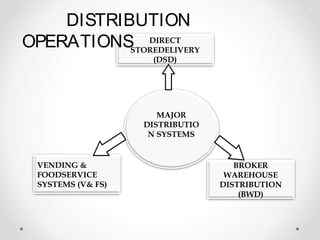
VENDING &
FOODSERVICE
SYSTEMS (V& FS)
BROKER
WAREHOUSE
DISTRIBUTION
(BWD)
DIRECT
STOREDELIVERY
(DSD)
MAJOR
DISTRIBUTIO
N SYSTEMS
DISTRIBUTION
OPERATIONS
Direct StoreDelivery (DSD)Direct StoreDelivery (DSD)
• DSD was the oldest method employed by the PepsiCo
• Employees take Direct orders and delivers the
previous orders
• Orders are taken manually .
• Timely delivery and shelf arrangement
• Ensured maximum visibility for passers by.
Contd…Contd…
• To launch new products in pretty quick time
• Market response can be determined more easily
• No labour costs -unloading the trucks , placing the
products on shelves.
Broker WarehouseDistribution(BWD)Broker WarehouseDistribution(BWD)
• Less delicate & perishable products
• “IMPULSIVE BUYING” products were not included
• Employed third party distributors
• Employees at the stores handled the products and placed
them on the selves.
• For the products which are less delicate and
perishable.eg cold drinks and juice.
ADVANTAGES:-
• No additional employees
• Economical
Vending & Food serviceVending & Food service
System(V&FS)System(V&FS)
• PepsiCo’s sales personnel distributes products
through third party V&FS and bottling companies
• Through this system, products were made available
in school, colleges, canteen, stadiums, offices,
restaurants etc
• Huge potential of distribution channel developed the
largest vending and food service sales forces in the
US, comprising 600 people
Contd…Contd…
• Revenues of over $1 billion /year
• Five retail channels –supermarkets/retail stores,
fountain/restaurant, convenience stores, vending and
others
• There were other distribution channels for beverages
including institutional buyers such as airlines.
BenefitsBenefits
• By 1990s Frito-Lay served more than 400000 retail
customers each week through more than 10000 truck
routed and 1600 distribution centers.
• Store door delivery system granted the freshness of
its product ,reduced retailer inventory and minimized
whole sale expense.
• During this period they concentrated on DTS(Down
the street), which resulted in 65% sales of salted
snacks versus 45% in supermarket.
LogisticsOperationsLogisticsOperations
• PepsiCo’s logistics two main phases were:
1.Giving syrup to the bottlers
2.Distribution of bottles/cans to retail outlets
• Product quality and uniformity standards should be
maintained.
• Timely delivery
BeverageManufacturing Unit to BottlersBeverageManufacturing Unit to Bottlers
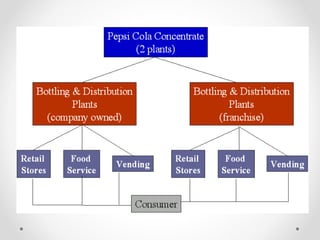
• Pepsi-Cola North America (PCNA) produced and
sold beverages& concentrate to bottling units in the
US and Canada.
• Syrup was either sold directly to the bottlers or was
combined with carbonated water for bottling
• PCNA’S objective
1.Timely delivery(99.1% accuracy).
2.Reduce transportation cost
Contd…Contd…
• PCNA -3rd
party logistics company “Penske
logistics”
• Penske offered transport solution and warehouse
management services
• Used- i2 transportation optimization system (TOS)
software
• Monitor movement of products and makes
necessary changes in routes and schedule to tackle
unexpected situations.
• Thus PCNA achieves more than 99.1% accuracy
Contd…Contd…
• PCNA has centralized transportation to single
location
• It also employs Six sigma quality process.
• TOS –
o Order optimization,
o Load configuration,
o Lowest shipping cost,
o Quick routes
BottlersTo Retail OutletsBottlersTo Retail Outlets
• Pepsi Americas (PAS) was one of the largest bottlers
of PepsiCo.
• PAS had 100 distribution centres and each centre
had 50 trucks
• PAS objectives
o Timely dispatch
o Full capacity utilization
o Quicker inventory replenishment.
PDTPDT
• Delivered according to the stocks in truck
• Labor and fuel cost
• Old system- SKU 55’s(1990) to 300(2002)
• Replaced handheld computers with PDT8000
• PDT 8000- according to customer requirement
• Connected via WLAN or Modem
ProblemsProblems
• Frito lays and beverages are delivered separately.
• Cost of Labor, Fuel and Time incurred.
• Distribution channels concentrated more on super
markets and restaurant.
• Pepsi Co group companies and its bottlers operates
independently instead of an integrated approach.
• No ERP system, so separate distribution systems of
each brand , this increase cost.
RecommendationsRecommendations
• Chilled DSD system for products that require
continuous refrigeration and Hybrid System should
be extended.
• Combination of Pepsi Cos selling operations with its
distributions and logistics function.
• Streamline operations and integrate systems
• Integrate the distribution channel of products with
same destination .
• Allocation of resources in the emerging markets like
India and China.
Pepsico distribution

Pepsico distribution

  • 1.
    Pepsico's Distribution &LogisticsPepsico'sDistribution &Logistics OperationsOperations By (Group - 8) Sec C Arun K.P- 12129 Gaurav Jhunjhunwala- 12138 Md.Shahbaaz Roomy Akhtar- 12149 Roshan v shetty- 12158 Vinay Prakash- 12178 Sarthak Rohatgi- 12182
  • 2.
    Introduction • PepsiCo isthe US based world’s leading beverage and snacks food companies. • Headquartered in New York. • Largest share in US beverage markets with 28% with revenue of $25.11bn and growth of 6.8% . `
  • 3.
    Contd… PepsiCo served diversemarket with its six group companies such as 1) Frito-lay North America 2) Frito-lay International 3) Pepsi-Cola North America 4) Pepsi Beverage International 5) Gatorade/ Tropicana North America 6) Quaker Foods North America
  • 4.
    Contd…Contd… • Success mainlydue to logistics and distribution management operations. • Technical Capabilities to support logistics. • Power of one program by Roger Enrico. • Integrating and streamlining operations of various companies.
  • 5.
    Background • In 1898,Caleb Bradham invented Pepsi-Cola. • Started marketing in 1903 and developed system of bottling franchise for the drinks. • Went bankrupt in 1923. • Charles, head of Loft candy company bought in 1931 and merged it with Loft candy to create Pepsi- Cola bottling company in 1941. • Merged with Frito lays international in 1965 to create PepsiCo Inc.
  • 6.
    Contd…Contd… • Diversification intorestaurant business. • 1980s Pepsi Co acquired its franchisees to build its bottling business. • 1990s Overseas expansion of bottling operations. • 1998 Formation of Pepsi Bottling Company (PBG).
  • 7.
    VENDING & FOODSERVICE SYSTEMS (V&FS) BROKER WAREHOUSE DISTRIBUTION (BWD) DIRECT STOREDELIVERY (DSD) MAJOR DISTRIBUTIO N SYSTEMS DISTRIBUTION OPERATIONS
  • 9.
    Direct StoreDelivery (DSD)DirectStoreDelivery (DSD) • DSD was the oldest method employed by the PepsiCo • Employees take Direct orders and delivers the previous orders • Orders are taken manually . • Timely delivery and shelf arrangement • Ensured maximum visibility for passers by.
  • 10.
    Contd…Contd… • To launchnew products in pretty quick time • Market response can be determined more easily • No labour costs -unloading the trucks , placing the products on shelves.
  • 11.
    Broker WarehouseDistribution(BWD)Broker WarehouseDistribution(BWD) •Less delicate & perishable products • “IMPULSIVE BUYING” products were not included • Employed third party distributors • Employees at the stores handled the products and placed them on the selves. • For the products which are less delicate and perishable.eg cold drinks and juice. ADVANTAGES:- • No additional employees • Economical
  • 12.
    Vending & FoodserviceVending & Food service System(V&FS)System(V&FS) • PepsiCo’s sales personnel distributes products through third party V&FS and bottling companies • Through this system, products were made available in school, colleges, canteen, stadiums, offices, restaurants etc • Huge potential of distribution channel developed the largest vending and food service sales forces in the US, comprising 600 people
  • 13.
    Contd…Contd… • Revenues ofover $1 billion /year • Five retail channels –supermarkets/retail stores, fountain/restaurant, convenience stores, vending and others • There were other distribution channels for beverages including institutional buyers such as airlines.
  • 14.
    BenefitsBenefits • By 1990sFrito-Lay served more than 400000 retail customers each week through more than 10000 truck routed and 1600 distribution centers. • Store door delivery system granted the freshness of its product ,reduced retailer inventory and minimized whole sale expense. • During this period they concentrated on DTS(Down the street), which resulted in 65% sales of salted snacks versus 45% in supermarket.
  • 15.
    LogisticsOperationsLogisticsOperations • PepsiCo’s logisticstwo main phases were: 1.Giving syrup to the bottlers 2.Distribution of bottles/cans to retail outlets • Product quality and uniformity standards should be maintained. • Timely delivery
  • 16.
    BeverageManufacturing Unit toBottlersBeverageManufacturing Unit to Bottlers • Pepsi-Cola North America (PCNA) produced and sold beverages& concentrate to bottling units in the US and Canada. • Syrup was either sold directly to the bottlers or was combined with carbonated water for bottling • PCNA’S objective 1.Timely delivery(99.1% accuracy). 2.Reduce transportation cost
  • 17.
    Contd…Contd… • PCNA -3rd partylogistics company “Penske logistics” • Penske offered transport solution and warehouse management services • Used- i2 transportation optimization system (TOS) software • Monitor movement of products and makes necessary changes in routes and schedule to tackle unexpected situations. • Thus PCNA achieves more than 99.1% accuracy
  • 18.
    Contd…Contd… • PCNA hascentralized transportation to single location • It also employs Six sigma quality process. • TOS – o Order optimization, o Load configuration, o Lowest shipping cost, o Quick routes
  • 19.
    BottlersTo Retail OutletsBottlersToRetail Outlets • Pepsi Americas (PAS) was one of the largest bottlers of PepsiCo. • PAS had 100 distribution centres and each centre had 50 trucks • PAS objectives o Timely dispatch o Full capacity utilization o Quicker inventory replenishment.
  • 20.
    PDTPDT • Delivered accordingto the stocks in truck • Labor and fuel cost • Old system- SKU 55’s(1990) to 300(2002) • Replaced handheld computers with PDT8000 • PDT 8000- according to customer requirement • Connected via WLAN or Modem
  • 21.
    ProblemsProblems • Frito laysand beverages are delivered separately. • Cost of Labor, Fuel and Time incurred. • Distribution channels concentrated more on super markets and restaurant. • Pepsi Co group companies and its bottlers operates independently instead of an integrated approach. • No ERP system, so separate distribution systems of each brand , this increase cost.
  • 22.
    RecommendationsRecommendations • Chilled DSDsystem for products that require continuous refrigeration and Hybrid System should be extended. • Combination of Pepsi Cos selling operations with its distributions and logistics function. • Streamline operations and integrate systems • Integrate the distribution channel of products with same destination . • Allocation of resources in the emerging markets like India and China.