


Amazon
Entering Indian Market
Group A4
Biswo Ranjan Bal 12012
Gaurav Kumar 12017
Shashank Shekhar Goswami 12045
Siv Sagar Saha 12048
Robin Kumar Sahu 12097
Ritesh Jaiswal 12153
Sarthak Rohatgi 12182
Introduction of Amazon
 American multinational company
 Incorporated in 1994 by Jeff Bezos
 In July 1995, sold its first book on Amazon.com
 Presence across three locations in India (Bangalore, Hyderabad, Chennai)
2
Vision & Mission Statement
 Vision
 “To be earth’s most customer centric company; to build a place where
people can come to find and discover anything they might want to buy
online.”
 Mission
 “To leverage technology and the expertise of invaluable employees and to
provide customer with the best shopping experience on the internet.”
3
Ethical issues of Amazon.com coming to
India
Stakeholders: Justified returns to them has to be ensured
Suppliers: Suppliers forms an integral part for any business operations. Amazon being an
online retail chain has to have good relationship with its partners.
Customers: These are the most important category for any organisation. Amazon has to
make sure that it provides genuine products to its customers. Since they could not have touch
feel or test facility in their type of business
4
Employees: Employees should not exploited. They should be trained properly. Moreover
since they are expanding in India, they should focus on giving Indians more employment.
As we have seen the recent issue of Infosys in U.S.A. where allegations over racial
discrimination has been raised against the company.
Competitors: They should start a healthy competition with their competitors. Price wars
will be there but they have to focus more on customer satisfaction. An environment should
be created where there is a win-win situation for all.
Society: They should not involve in any unfair means which harms the society or the legal
structure.
As in the case of Bharti Walmart where the CFO Pankaj Madan and his entire legal team has
been suspended on account of alleged bribery to the government officials for getting various
licenses and permissions. (Economic Times, 2013)
5
Strategic Issues
 Amazon is basing its strategy on three pillars:
 Vast selection
 Low price
 Fast delivery
 Gaining market share
 In India, tastes and desires change drastically in every 200kms, which was
unlikely in other countries
 Flipkart which is the market leader in India, is the biggest hurdle in their way
to success as it has gained customers’ confidence over the years
6
Strategic Shift
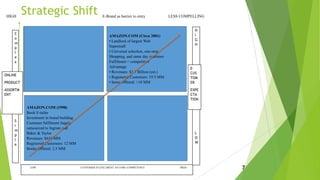
AMAZON.COM (Circa 2001)
• Landlord of largest Web
Supermall
• Universal selection, one-stop
Shopping, and same day customer
Fulfilment = competitive
Advantage
• Revenues: $2.7 Billion (est.)
• Registered Customers: 19.5 MM
• Items Offered: >18 MM
AMAZON.COM (1998)
Book E-tailer
Investment in brand building
Customer fulfilment largely
outsourced to Ingram and
Baker & Taylor
Revenues: $610 MM
Registered Customers: 12 MM
Books Offered: 2.5 MM
C
o
m
p
l
e
x
S
i
m
p
l
e
LOW CUSTOMER FULFILLMENT AS CORE-COMPETENCE HIGH
H
I
G
H
L
O
W
ONLINE
PRODUCT
ASSORTM
ENT
E-
CUS
TOM
ER
EXPE
CTA
TION
HIGH E-Brand as barrier to entry LESS COMPELLING
7
Analysis of Strategic shift
 Amazon adopted changes with time
 Added new market developments
 From just being an online book seller, it became an online shopping place
 Expansion of business created entry barrier for competitors
8
Understanding Indian Market
 Middle class in India is booming
 India is the third largest publisher of English language books in the world
 E-commerce has a huge potential in India, a country of more than 1.2 billion
people
 52 million active Internet users, of which 40 percent have shopped online
 Indian online market is expected to grow 55% to 100 billion rupees this year
9
What Amazon looks to achieve in India
 Customer satisfaction in India
 Looking for a long term business
 Considers new markets where the company could enter or additional products
that could be developed
10
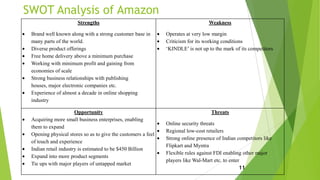
SWOT Analysis of Amazon
Strengths
Brand well known along with a strong customer base in
many parts of the world.
Diverse product offerings
Free home delivery above a minimum purchase
Working with minimum profit and gaining from
economies of scale
Strong business relationships with publishing
houses, major electronic companies etc.
Experience of almost a decade in online shopping
industry
Weakness
Operates at very low margin
Criticism for its working conditions
‘KINDLE’ is not up to the mark of its competitors
Opportunity
Acquiring more small business enterprises, enabling
them to expand
Opening physical stores so as to give the customers a feel
of touch and experience
Indian retail industry is estimated to be $450 Billion
Expand into more product segments
Tie ups with major players of untapped market
Threats
Online security threats
Regional low-cost retailers
Strong online presence of Indian competitors like
Flipkart and Myntra
Flexible rules against FDI enabling other major
players like Wal-Mart etc. to enter
11
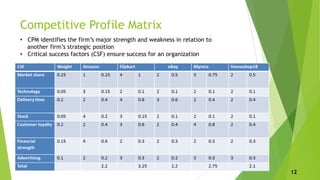
Competitive Profile Matrix
• CPM identifies the firm’s major strength and weakness in relation to
another firm’s strategic position
• Critical success factors (CSF) ensure success for an organization
12
Competitor Analysis
 The largest competitor as of now in India is Flipkart with highest score (3.25)
 Currently, product options on Amazon are limited while competitors has
expanded
(Flipkart and eBay offer a wider range of products)
 Flipkart has 80 per cent share of the online book market in India
 Flipkart now has a wide reach in the Indian market and the delivery time is
just four business days
13
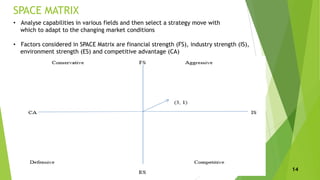
SPACE MATRIX
• Analyse capabilities in various fields and then select a strategy move with
which to adapt to the changing market conditions
• Factors considered in SPACE Matrix are financial strength (FS), industry strength (IS),
environment strength (ES) and competitive advantage (CA)
14
Analysis of SPACE matrix
 Amazon has good Financial and Industry strength
 It should aggressively enter the market
15
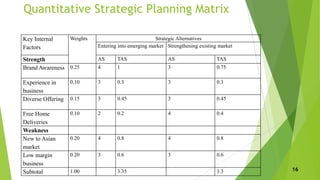
Quantitative Strategic Planning Matrix
Key Internal
Factors
Weights Strategic Alternatives
Entering into emerging market Strengthening existing market
Strength AS TAS AS TAS
Brand Awareness 0.25 4 1 3 0.75
Experience in
business
0.10 3 0.3 3 0.3
Diverse Offering 0.15 3 0.45 3 0.45
Free Home
Deliveries
0.10 2 0.2 4 0.4
Weakness
New to Asian
market
0.20 4 0.8 4 0.8
Low margin
business
0.20 3 0.6 3 0.6
Subtotal 1.00 3.35 3.3 16
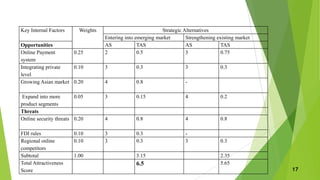
Key Internal Factors Weights Strategic Alternatives
Entering into emerging market Strengthening existing market
Opportunities AS TAS AS TAS
Online Payment
system
0.25 2 0.5 3 0.75
Integrating private
level
0.10 3 0.3 3 0.3
Growing Asian market 0.20 4 0.8 -
Expand into more
product segments
0.05 3 0.15 4 0.2
Threats
Online security threats 0.20 4 0.8 4 0.8
FDI rules 0.10 3 0.3 -
Regional online
competitors
0.10 3 0.3 3 0.3
Subtotal 1.00 3.15 2.35
Total Attractiveness
Score
6.5 5.65
17
Analysis of Quantitative Strategic
Planning Matrix
 Depending on various key internal factors:
Amazon should enter emerging market (India) rather than expanding its
existing market
18
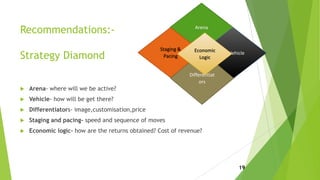
Recommendations:-
Strategy Diamond
 Arena- where will we be active?
 Vehicle- how will be get there?
 Differentiators- image,customisation,price
 Staging and pacing- speed and sequence of moves
 Economic logic- how are the returns obtained? Cost of revenue?
Arena
Vehicle
Staging &
Pacing
Differentiat
ors
Economic
Logic
19
 Logistic management
About 60% of online sales come from tier two cities. To reach the customers
quickly company needs to have an effective logistic management. Flipkart
seems to be Amazon’s only real competition. Flipkart’s quick delivery
system, along with the option of cash-on-delivery has led to large Flipkart
loyalists
 Diversification
Diversifying into other products will help the company to check the
entry of competitors which e.g. going into food, clothes etc. so that
expenses are also distributed and adverse conditions in one sector can be
borne by other one.
20
 Innovation
Only pricing cannot be taken as a differentiating factor, innovation
is also needed. The company should create a total buying
experience that has been missing in the Indian context. Promotion
should be done through Push and Pull strategies which will
include offers and advertising.
21
Amazon India business strategy

Amazon India business strategy

  • 1.
    Amazon Entering Indian Market GroupA4 Biswo Ranjan Bal 12012 Gaurav Kumar 12017 Shashank Shekhar Goswami 12045 Siv Sagar Saha 12048 Robin Kumar Sahu 12097 Ritesh Jaiswal 12153 Sarthak Rohatgi 12182
  • 2.
    Introduction of Amazon American multinational company  Incorporated in 1994 by Jeff Bezos  In July 1995, sold its first book on Amazon.com  Presence across three locations in India (Bangalore, Hyderabad, Chennai) 2
  • 3.
    Vision & MissionStatement  Vision  “To be earth’s most customer centric company; to build a place where people can come to find and discover anything they might want to buy online.”  Mission  “To leverage technology and the expertise of invaluable employees and to provide customer with the best shopping experience on the internet.” 3
  • 4.
    Ethical issues ofAmazon.com coming to India Stakeholders: Justified returns to them has to be ensured Suppliers: Suppliers forms an integral part for any business operations. Amazon being an online retail chain has to have good relationship with its partners. Customers: These are the most important category for any organisation. Amazon has to make sure that it provides genuine products to its customers. Since they could not have touch feel or test facility in their type of business 4
  • 5.
    Employees: Employees shouldnot exploited. They should be trained properly. Moreover since they are expanding in India, they should focus on giving Indians more employment. As we have seen the recent issue of Infosys in U.S.A. where allegations over racial discrimination has been raised against the company. Competitors: They should start a healthy competition with their competitors. Price wars will be there but they have to focus more on customer satisfaction. An environment should be created where there is a win-win situation for all. Society: They should not involve in any unfair means which harms the society or the legal structure. As in the case of Bharti Walmart where the CFO Pankaj Madan and his entire legal team has been suspended on account of alleged bribery to the government officials for getting various licenses and permissions. (Economic Times, 2013) 5
  • 6.
    Strategic Issues  Amazonis basing its strategy on three pillars:  Vast selection  Low price  Fast delivery  Gaining market share  In India, tastes and desires change drastically in every 200kms, which was unlikely in other countries  Flipkart which is the market leader in India, is the biggest hurdle in their way to success as it has gained customers’ confidence over the years 6
  • 7.
    Strategic Shift AMAZON.COM (Circa2001) • Landlord of largest Web Supermall • Universal selection, one-stop Shopping, and same day customer Fulfilment = competitive Advantage • Revenues: $2.7 Billion (est.) • Registered Customers: 19.5 MM • Items Offered: >18 MM AMAZON.COM (1998) Book E-tailer Investment in brand building Customer fulfilment largely outsourced to Ingram and Baker & Taylor Revenues: $610 MM Registered Customers: 12 MM Books Offered: 2.5 MM C o m p l e x S i m p l e LOW CUSTOMER FULFILLMENT AS CORE-COMPETENCE HIGH H I G H L O W ONLINE PRODUCT ASSORTM ENT E- CUS TOM ER EXPE CTA TION HIGH E-Brand as barrier to entry LESS COMPELLING 7
  • 8.
    Analysis of Strategicshift  Amazon adopted changes with time  Added new market developments  From just being an online book seller, it became an online shopping place  Expansion of business created entry barrier for competitors 8
  • 9.
    Understanding Indian Market Middle class in India is booming  India is the third largest publisher of English language books in the world  E-commerce has a huge potential in India, a country of more than 1.2 billion people  52 million active Internet users, of which 40 percent have shopped online  Indian online market is expected to grow 55% to 100 billion rupees this year 9
  • 10.
    What Amazon looksto achieve in India  Customer satisfaction in India  Looking for a long term business  Considers new markets where the company could enter or additional products that could be developed 10
  • 11.
    SWOT Analysis ofAmazon Strengths Brand well known along with a strong customer base in many parts of the world. Diverse product offerings Free home delivery above a minimum purchase Working with minimum profit and gaining from economies of scale Strong business relationships with publishing houses, major electronic companies etc. Experience of almost a decade in online shopping industry Weakness Operates at very low margin Criticism for its working conditions ‘KINDLE’ is not up to the mark of its competitors Opportunity Acquiring more small business enterprises, enabling them to expand Opening physical stores so as to give the customers a feel of touch and experience Indian retail industry is estimated to be $450 Billion Expand into more product segments Tie ups with major players of untapped market Threats Online security threats Regional low-cost retailers Strong online presence of Indian competitors like Flipkart and Myntra Flexible rules against FDI enabling other major players like Wal-Mart etc. to enter 11
  • 12.
    Competitive Profile Matrix •CPM identifies the firm’s major strength and weakness in relation to another firm’s strategic position • Critical success factors (CSF) ensure success for an organization 12
  • 13.
    Competitor Analysis  Thelargest competitor as of now in India is Flipkart with highest score (3.25)  Currently, product options on Amazon are limited while competitors has expanded (Flipkart and eBay offer a wider range of products)  Flipkart has 80 per cent share of the online book market in India  Flipkart now has a wide reach in the Indian market and the delivery time is just four business days 13
  • 14.
    SPACE MATRIX • Analysecapabilities in various fields and then select a strategy move with which to adapt to the changing market conditions • Factors considered in SPACE Matrix are financial strength (FS), industry strength (IS), environment strength (ES) and competitive advantage (CA) 14
  • 15.
    Analysis of SPACEmatrix  Amazon has good Financial and Industry strength  It should aggressively enter the market 15
  • 16.
    Quantitative Strategic PlanningMatrix Key Internal Factors Weights Strategic Alternatives Entering into emerging market Strengthening existing market Strength AS TAS AS TAS Brand Awareness 0.25 4 1 3 0.75 Experience in business 0.10 3 0.3 3 0.3 Diverse Offering 0.15 3 0.45 3 0.45 Free Home Deliveries 0.10 2 0.2 4 0.4 Weakness New to Asian market 0.20 4 0.8 4 0.8 Low margin business 0.20 3 0.6 3 0.6 Subtotal 1.00 3.35 3.3 16
  • 17.
    Key Internal FactorsWeights Strategic Alternatives Entering into emerging market Strengthening existing market Opportunities AS TAS AS TAS Online Payment system 0.25 2 0.5 3 0.75 Integrating private level 0.10 3 0.3 3 0.3 Growing Asian market 0.20 4 0.8 - Expand into more product segments 0.05 3 0.15 4 0.2 Threats Online security threats 0.20 4 0.8 4 0.8 FDI rules 0.10 3 0.3 - Regional online competitors 0.10 3 0.3 3 0.3 Subtotal 1.00 3.15 2.35 Total Attractiveness Score 6.5 5.65 17
  • 18.
    Analysis of QuantitativeStrategic Planning Matrix  Depending on various key internal factors: Amazon should enter emerging market (India) rather than expanding its existing market 18
  • 19.
    Recommendations:- Strategy Diamond  Arena-where will we be active?  Vehicle- how will be get there?  Differentiators- image,customisation,price  Staging and pacing- speed and sequence of moves  Economic logic- how are the returns obtained? Cost of revenue? Arena Vehicle Staging & Pacing Differentiat ors Economic Logic 19
  • 20.
     Logistic management About60% of online sales come from tier two cities. To reach the customers quickly company needs to have an effective logistic management. Flipkart seems to be Amazon’s only real competition. Flipkart’s quick delivery system, along with the option of cash-on-delivery has led to large Flipkart loyalists  Diversification Diversifying into other products will help the company to check the entry of competitors which e.g. going into food, clothes etc. so that expenses are also distributed and adverse conditions in one sector can be borne by other one. 20
  • 21.
     Innovation Only pricingcannot be taken as a differentiating factor, innovation is also needed. The company should create a total buying experience that has been missing in the Indian context. Promotion should be done through Push and Pull strategies which will include offers and advertising. 21