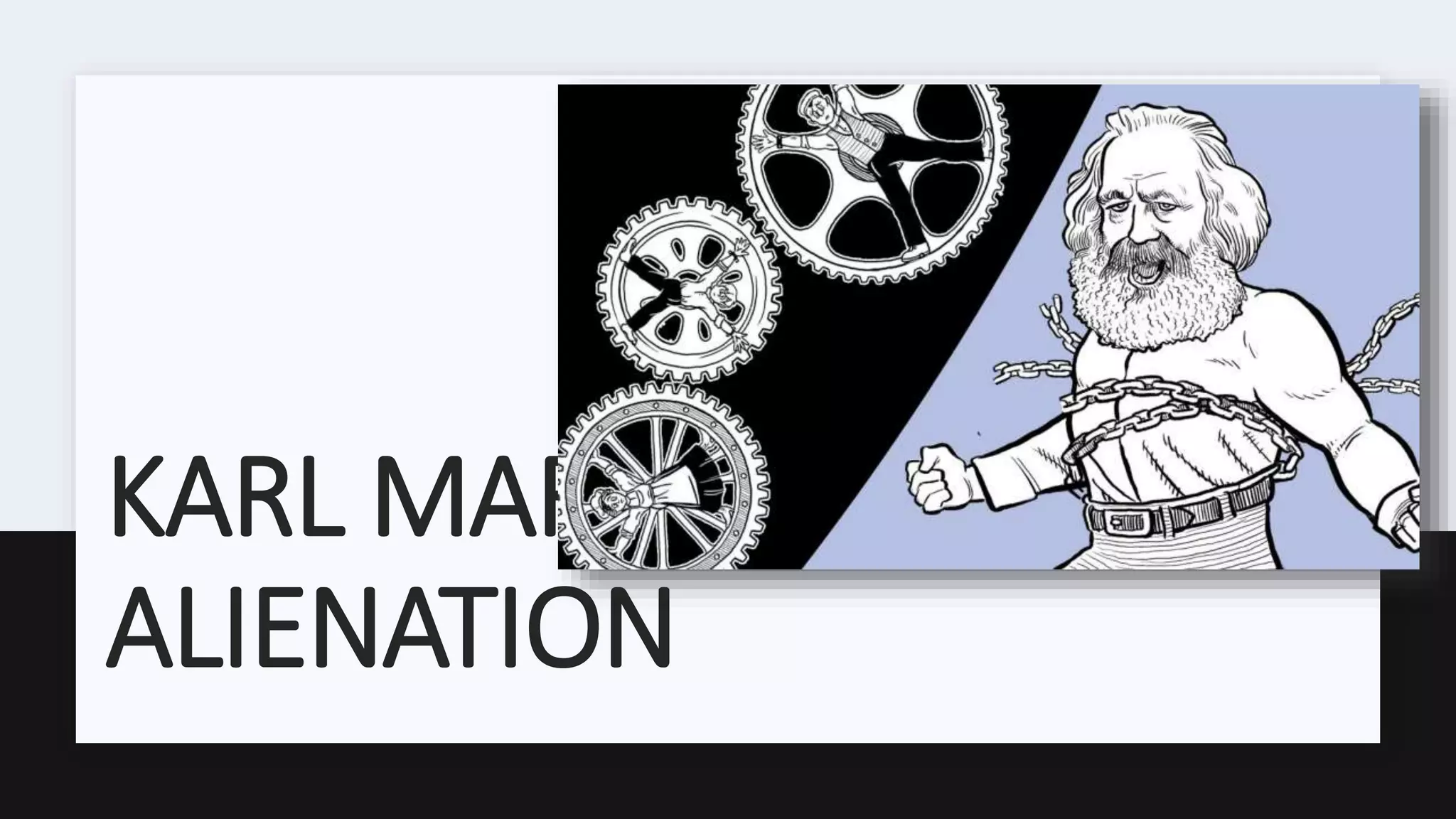
KARL MARX’S
ALIENATION
ALIENATION
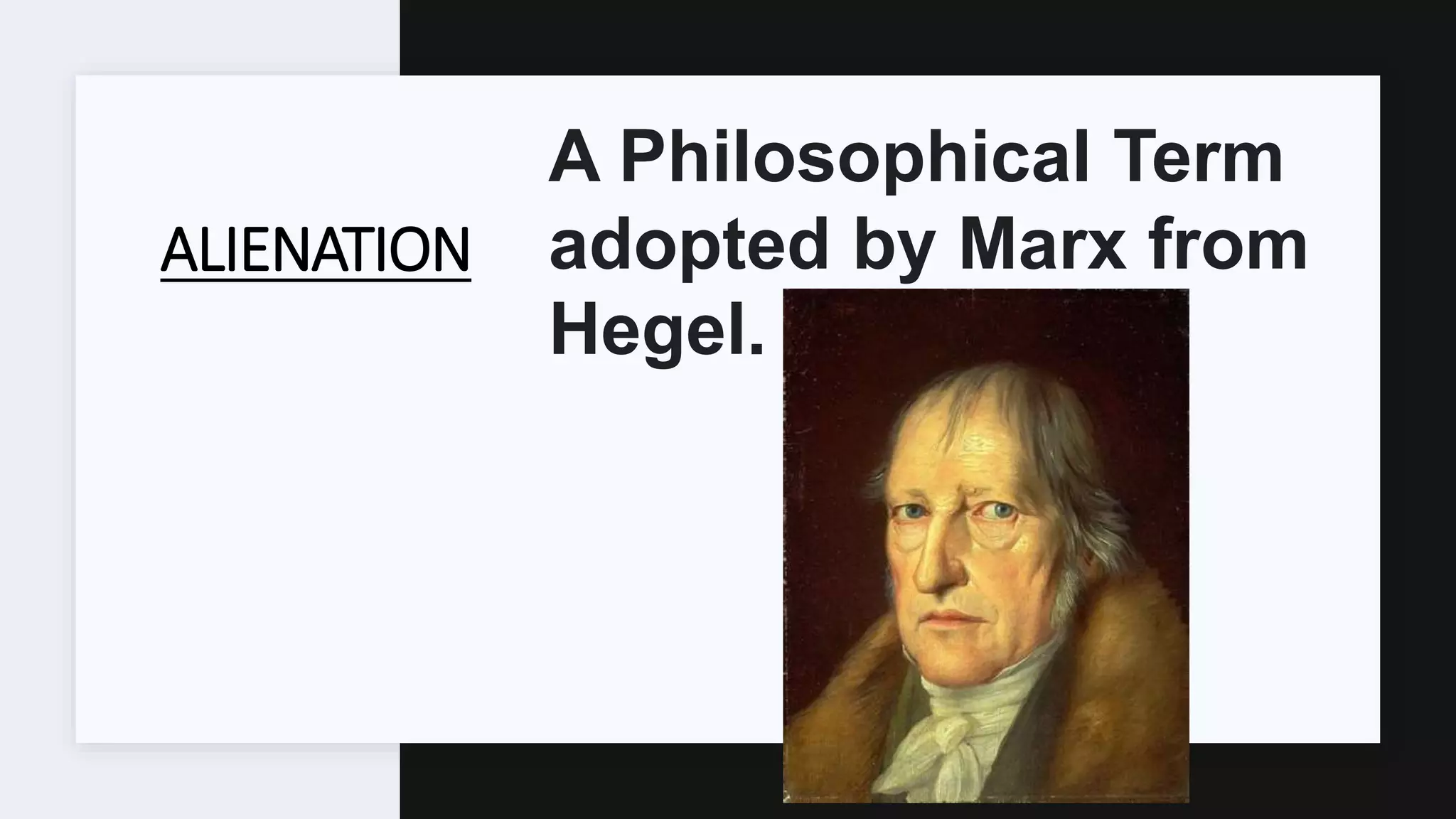
A Philosophical Term
adopted by Marx from
Hegel.
ALIENATION
In social sciences, the state of
feeling estranged or
separated from one’s milieu,
work, products of work, or
self.
ALIENATION
In social sciences, the state of
feeling estranged or
separated from one’s milieu,
work, products of work, or
self.
4 TYPES OF
ALIENATION
1) Alienation of the worker from their product
2) Alienation of the worker from the act of
production
3) Alienation of the worker from their species-
essence
4) Alienation of the worker from other workers
ALIENATION OF
THE WORKER
FROM THEIR
PRODUCT
The design and development of a
production rest not in the hands of a
worker but within the decisions of the
capitalists. A worker does not have
control over what he or she intends to
produce or the specifications of his or
her product.
ALIENATION OF
THE WORKER
FROM THE ACT OF
PRODUCTION
The production of goods and services
within a capitalist society is repetitive
and mechanical that offers little to no
psychological satisfaction to the worker.
Labor seems coerced because a worker
undertakes this as a means of survival.
ALIENATION OF
THE WORKER
FROM THEIR
SPECIES-
ESSENCE
The species-essence or “Gattungswesen” of
an individual comprises all of his or her innate
potentials. Under a capitalist mode of
production, an individual losses identity and
the opportunity for self-development as he or
she is forced to sell his or her labor-power as a
market commodity.
ALIENATION OF
THE WORKER
FROM OTHER
WORKERS
The reduction of labor to a mere market
commodity creates the so-called labor market
in which a worker competes against another
worker. Labor is traded in a competitive labor
market instead of considering it as a
constructive socioeconomic activity
characterized by collective common effort.
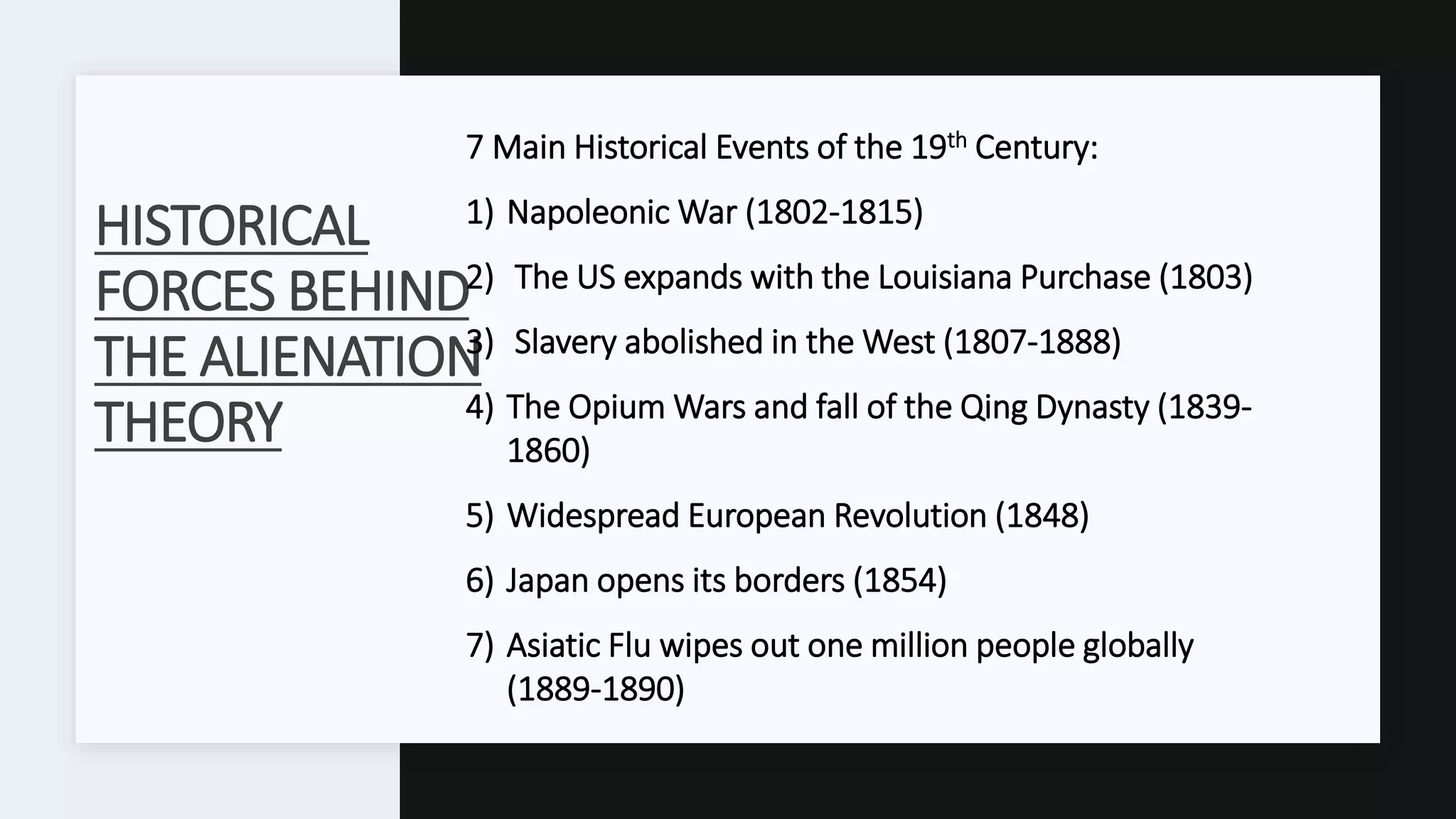
HISTORICAL
FORCES BEHIND
THE ALIENATION
THEORY
7 Main Historical Events of the 19th Century:
1) Napoleonic War (1802-1815)
2) The US expands with the Louisiana Purchase (1803)
3) Slavery abolished in the West (1807-1888)
4) The Opium Wars and fall of the Qing Dynasty (1839-
1860)
5) Widespread European Revolution (1848)
6) Japan opens its borders (1854)
7) Asiatic Flu wipes out one million people globally
(1889-1890)
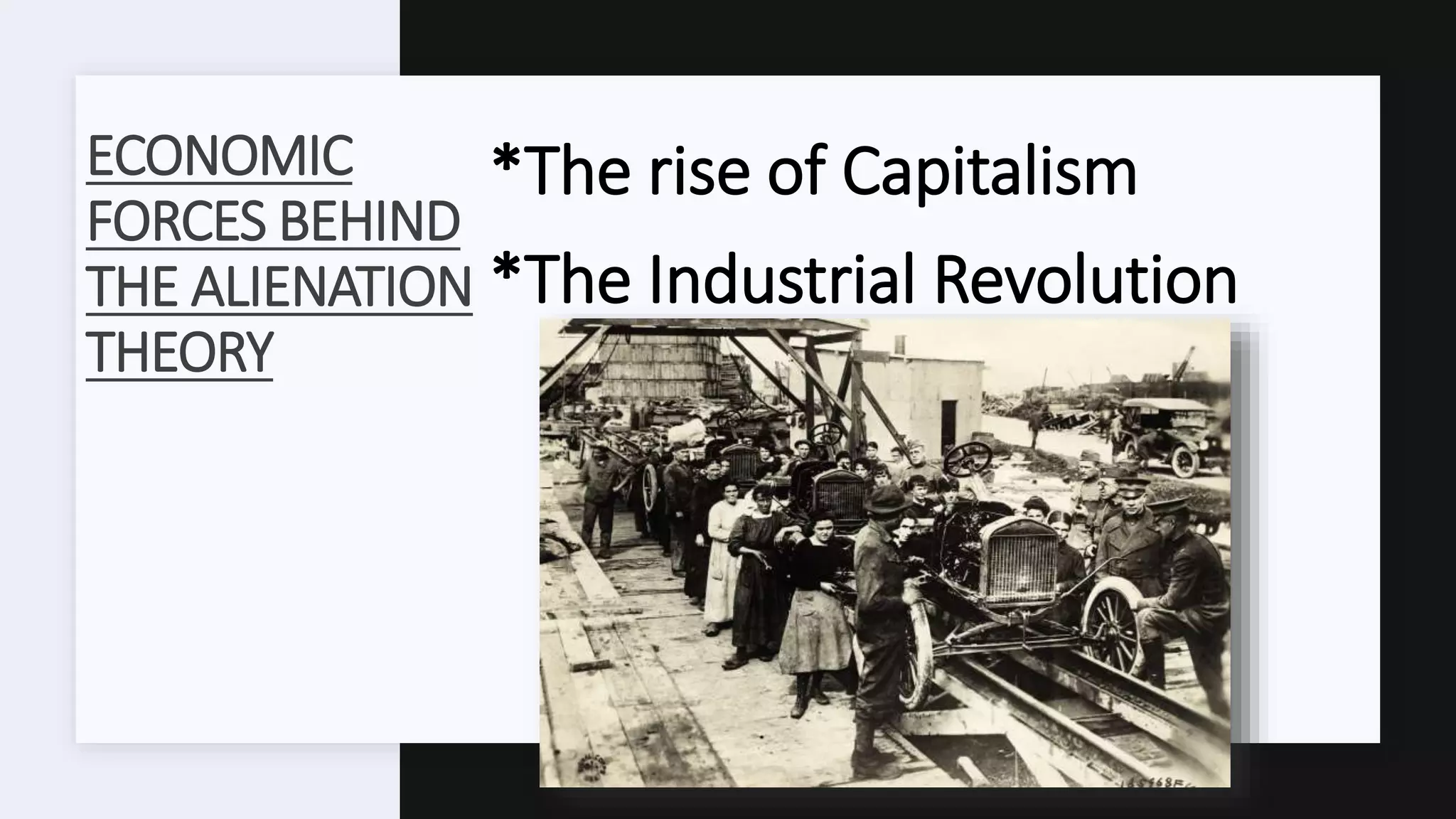
ECONOMIC
FORCES BEHIND
THE ALIENATION
THEORY
*The rise of Capitalism
*The Industrial Revolution
CONCLUSION
From the perspective of Karl Marx and within
the context of capitalism, alienation is the
surrender of control and the separation of an
essential aspect of the self. A society based on
a capitalist economic system promotes norms
and standards that reduces an individual
worker to a mere commodity or instrument of
production who lacks control over his or her
vocation. Simply put. for Marx and his
adherents, capitalism involves the
objectification and commodification of the
experiences and activities of workers.

Karl Marx's Alienation Theory

  • 1.
  • 2.
  • 3.
    ALIENATION In social sciences,the state of feeling estranged or separated from one’s milieu, work, products of work, or self.
  • 4.
    ALIENATION In social sciences,the state of feeling estranged or separated from one’s milieu, work, products of work, or self.
  • 5.
    4 TYPES OF ALIENATION 1)Alienation of the worker from their product 2) Alienation of the worker from the act of production 3) Alienation of the worker from their species- essence 4) Alienation of the worker from other workers
  • 6.
    ALIENATION OF THE WORKER FROMTHEIR PRODUCT The design and development of a production rest not in the hands of a worker but within the decisions of the capitalists. A worker does not have control over what he or she intends to produce or the specifications of his or her product.
  • 7.
    ALIENATION OF THE WORKER FROMTHE ACT OF PRODUCTION The production of goods and services within a capitalist society is repetitive and mechanical that offers little to no psychological satisfaction to the worker. Labor seems coerced because a worker undertakes this as a means of survival.
  • 8.
    ALIENATION OF THE WORKER FROMTHEIR SPECIES- ESSENCE The species-essence or “Gattungswesen” of an individual comprises all of his or her innate potentials. Under a capitalist mode of production, an individual losses identity and the opportunity for self-development as he or she is forced to sell his or her labor-power as a market commodity.
  • 9.
    ALIENATION OF THE WORKER FROMOTHER WORKERS The reduction of labor to a mere market commodity creates the so-called labor market in which a worker competes against another worker. Labor is traded in a competitive labor market instead of considering it as a constructive socioeconomic activity characterized by collective common effort.
  • 10.
    HISTORICAL FORCES BEHIND THE ALIENATION THEORY 7Main Historical Events of the 19th Century: 1) Napoleonic War (1802-1815) 2) The US expands with the Louisiana Purchase (1803) 3) Slavery abolished in the West (1807-1888) 4) The Opium Wars and fall of the Qing Dynasty (1839- 1860) 5) Widespread European Revolution (1848) 6) Japan opens its borders (1854) 7) Asiatic Flu wipes out one million people globally (1889-1890)
  • 11.
    ECONOMIC FORCES BEHIND THE ALIENATION THEORY *Therise of Capitalism *The Industrial Revolution
  • 12.
    CONCLUSION From the perspectiveof Karl Marx and within the context of capitalism, alienation is the surrender of control and the separation of an essential aspect of the self. A society based on a capitalist economic system promotes norms and standards that reduces an individual worker to a mere commodity or instrument of production who lacks control over his or her vocation. Simply put. for Marx and his adherents, capitalism involves the objectification and commodification of the experiences and activities of workers.