MARXISM
O
DISS
REVIEW
1.According him and other
functionalist,
crime is also functional for society
because it leads to heightened awareness
of shared moral bonds and increased
social cohesion.
2. Functions are consequences that
are intended and commonly
recognized.
3. Functions are
consequences that are
unintended and often
hidden.
4. It became the paradigm theory in
sociology for about twenty years or
so, because it saliently defined
society as a system with checks and
balances.
5. It offers a way to transmit a
society’s skills, knowledge, and
culture to its youth.
ANSWERS
:
1.Emile Durkheim
2.Manifest 3.Latent
4.Structural-
functional
5.Education
ACTIVITY
In a group of five, draw a caricature of
the rich and poor.
draw your output.
society showing the difference between
On a piece of cartolinaor manila paper,
Be ready to explain your
ANALYSIS
1. How did you come up with an
output
2. What is your priority in making
your ideas?
ABSTRACTION
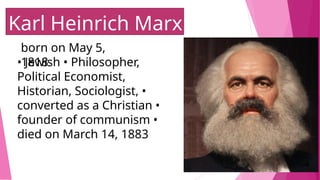
Karl Heinrich Marx
born on May 5,
1818
• Jewish • Philosopher,
Political Economist,
Historian, Sociologist, •
converted as a Christian •
founder of communism •
died on March 14, 1883
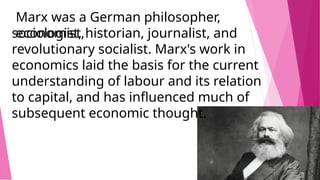
Marx was a German philosopher,
economist,
sociologist, historian, journalist, and
revolutionary socialist. Marx's work in
economics laid the basis for the current
understanding of labour and its relation
to capital, and has influenced much of
subsequent economic thought.
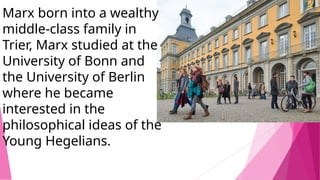
Marx born into a wealthy
middle-class family in
Trier, Marx studied at the
University of Bonn and
the University of Berlin
where he became
interested in the
philosophical ideas of the
Young Hegelians.
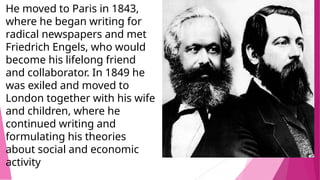
He moved to Paris in 1843,
where he began writing for
radical newspapers and met
Friedrich Engels, who would
become his lifelong friend
and collaborator. In 1849 he
was exiled and moved to
London together with his wife
and children, where he
continued writing and
formulating his theories
about social and economic
activity
For the future:
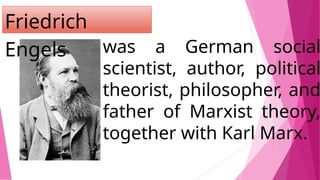
was a German social
scientist, author, political
theorist, philosopher, and
father of Marxist theory,
together with Karl Marx.
Friedrich
Engels
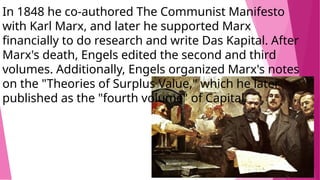
In 1848 he co-authored The Communist Manifesto
with Karl Marx, and later he supported Marx
financially to do research and write Das Kapital. After
Marx's death, Engels edited the second and third
volumes. Additionally, Engels organized Marx's notes
on the "Theories of Surplus Value," which he later
published as the "fourth volume" of Capital.
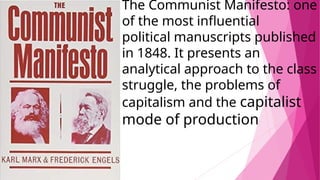
The Communist Manifesto: one
of the most influential
political manuscripts published
in 1848. It presents an
analytical approach to the class
struggle, the problems of
capitalism and the capitalist
mode of production
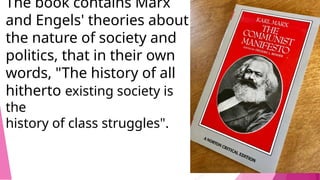
The book contains Marx
and Engels' theories about
the nature of society and
politics, that in their own
words, "The history of all
hitherto existing society is
the
history of class struggles".
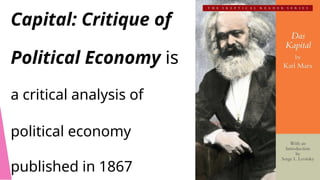
Capital: Critique of
Political Economy is
a critical analysis of
political economy
published in 1867
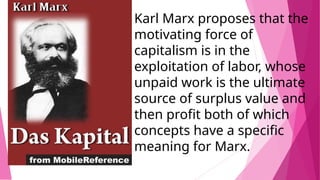
Karl Marx proposes that the
motivating force of
capitalism is in the
exploitation of labor, whose
unpaid work is the ultimate
source of surplus value and
then profit both of which
concepts have a specific
meaning for Marx.
MARXIS
M
Marxism is a philosophy of history.
It is also an economic doctrine.
the basic explanation societies go
Marxism is a theory of revolution
and
Marxist believes that they and they
alone have the analytical tools to
understand the process of
historical change, as well as the key
to predicting the future.
Marxistsbelieve
that they and they
alone have an
empirical, scientific
Marxistsis a way of
understanding and
analysing the organization
and structure of society. It is
also a way of understanding
how societies develop and
change.
Let us
make
a
change
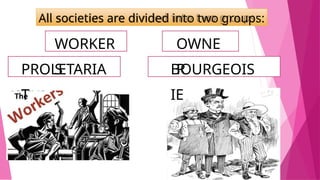
All societies are divided into two groups:
WORKER
S
PROLETARIA
T
OWNE
R
BOURGEOIS
IE
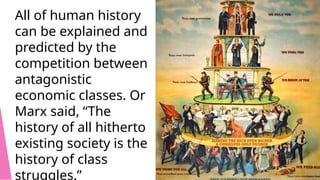
All of human history
can be explained and
predicted by the
competition between
antagonistic
economic classes. Or
Marx said, “The
history of all hitherto
existing society is the
history of class
struggles.”
Do it for
you
Owners exploit workers and live off the Owners
exploit
workers and live off the money which the workers earn.
money which the workers earn. Workers put up with this
inequality because: Workers put up with this inequality
because: 1. They are oppressed wage slaves and They
are oppressed wage slaves and cannot fight the system.
cannot fight the system. 2. They are indoctrinated by
ideology and They are indoctrinated by ideology and
religion into believing what they are told by religion into
believing what they are told by the powerful.
Social classes are competing in essence
for
control of the state.
As Marxists would put it: the class that controls
the Mode of Production also controls the
State.
Marx did not spend much time examining
the
state or political institutions. Political life is an
illusion or distortion of reality, so why study that
distortion? It is better to concentrate on the reality
behind the veil of politics: the economic structure
of society.
KEY IDEAS
Power was held by a minority (the elite or bourgeoisie) who
had access to capital and could use their money and power
to generate more wealth.
The majority of the population (the mass or proletariat) had
only their labor(strength and time) to help them make a
living.
Industrialization had meant that the elite were the only
ones who had access to the means of
production.
Without the ability to produce for
on the elite for survival.
to get as much labor from the mass
for a
themselves, the mass were
dependent
To maximize profits, the elite needed
The elite needed the mass to accept
their position as powerless workers.
APPLICATION
1. If you are a Marxist what is
your view regarding society
and government?

5 DISS Marxism powerpoint presentation..

  • 1.
  • 2.
  • 3.
    1.According him andother functionalist, crime is also functional for society because it leads to heightened awareness of shared moral bonds and increased social cohesion.
  • 4.
    2. Functions areconsequences that are intended and commonly recognized.
  • 5.
    3. Functions are consequencesthat are unintended and often hidden.
  • 6.
    4. It becamethe paradigm theory in sociology for about twenty years or so, because it saliently defined society as a system with checks and balances.
  • 7.
    5. It offersa way to transmit a society’s skills, knowledge, and culture to its youth.
  • 8.
  • 9.
    ACTIVITY In a groupof five, draw a caricature of the rich and poor. draw your output. society showing the difference between On a piece of cartolinaor manila paper, Be ready to explain your
  • 10.
    ANALYSIS 1. How didyou come up with an output 2. What is your priority in making your ideas?
  • 11.
  • 12.
    Karl Heinrich Marx bornon May 5, 1818 • Jewish • Philosopher, Political Economist, Historian, Sociologist, • converted as a Christian • founder of communism • died on March 14, 1883
  • 13.
    Marx was aGerman philosopher, economist, sociologist, historian, journalist, and revolutionary socialist. Marx's work in economics laid the basis for the current understanding of labour and its relation to capital, and has influenced much of subsequent economic thought.
  • 14.
    Marx born intoa wealthy middle-class family in Trier, Marx studied at the University of Bonn and the University of Berlin where he became interested in the philosophical ideas of the Young Hegelians.
  • 15.
    He moved toParis in 1843, where he began writing for radical newspapers and met Friedrich Engels, who would become his lifelong friend and collaborator. In 1849 he was exiled and moved to London together with his wife and children, where he continued writing and formulating his theories about social and economic activity
  • 16.
  • 17.
    was a Germansocial scientist, author, political theorist, philosopher, and father of Marxist theory, together with Karl Marx. Friedrich Engels
  • 18.
    In 1848 heco-authored The Communist Manifesto with Karl Marx, and later he supported Marx financially to do research and write Das Kapital. After Marx's death, Engels edited the second and third volumes. Additionally, Engels organized Marx's notes on the "Theories of Surplus Value," which he later published as the "fourth volume" of Capital.
  • 19.
    The Communist Manifesto:one of the most influential political manuscripts published in 1848. It presents an analytical approach to the class struggle, the problems of capitalism and the capitalist mode of production
  • 20.
    The book containsMarx and Engels' theories about the nature of society and politics, that in their own words, "The history of all hitherto existing society is the history of class struggles".
  • 22.
    Capital: Critique of PoliticalEconomy is a critical analysis of political economy published in 1867
  • 23.
    Karl Marx proposesthat the motivating force of capitalism is in the exploitation of labor, whose unpaid work is the ultimate source of surplus value and then profit both of which concepts have a specific meaning for Marx.
  • 25.
    MARXIS M Marxism is aphilosophy of history. It is also an economic doctrine. the basic explanation societies go Marxism is a theory of revolution and
  • 26.
    Marxist believes thatthey and they alone have the analytical tools to understand the process of historical change, as well as the key to predicting the future.
  • 27.
    Marxistsbelieve that they andthey alone have an empirical, scientific
  • 28.
    Marxistsis a wayof understanding and analysing the organization and structure of society. It is also a way of understanding how societies develop and change.
  • 29.
  • 30.
    All societies aredivided into two groups: WORKER S PROLETARIA T OWNE R BOURGEOIS IE
  • 31.
    All of humanhistory can be explained and predicted by the competition between antagonistic economic classes. Or Marx said, “The history of all hitherto existing society is the history of class struggles.”
  • 32.
  • 33.
    Owners exploit workersand live off the Owners exploit workers and live off the money which the workers earn. money which the workers earn. Workers put up with this inequality because: Workers put up with this inequality because: 1. They are oppressed wage slaves and They are oppressed wage slaves and cannot fight the system. cannot fight the system. 2. They are indoctrinated by ideology and They are indoctrinated by ideology and religion into believing what they are told by religion into believing what they are told by the powerful.
  • 34.
    Social classes arecompeting in essence for control of the state. As Marxists would put it: the class that controls the Mode of Production also controls the State. Marx did not spend much time examining the state or political institutions. Political life is an illusion or distortion of reality, so why study that distortion? It is better to concentrate on the reality behind the veil of politics: the economic structure of society.
  • 35.
    KEY IDEAS Power washeld by a minority (the elite or bourgeoisie) who had access to capital and could use their money and power to generate more wealth. The majority of the population (the mass or proletariat) had only their labor(strength and time) to help them make a living. Industrialization had meant that the elite were the only ones who had access to the means of production.
  • 36.
    Without the abilityto produce for on the elite for survival. to get as much labor from the mass for a themselves, the mass were dependent To maximize profits, the elite needed The elite needed the mass to accept their position as powerless workers.
  • 37.
    APPLICATION 1. If youare a Marxist what is your view regarding society and government?