CHAPTER THREE:  Portfolio Theory, Fund Separation and CAPM
Markowitz Portfolio Selection There is no single portfolio that is best for everyone. The Life Cycle  — different consumption preference Time Horizons — different terms preference Risk Tolerance — different risk aversion Limited Variety of Portfolio —  Limited “finished products”  in markets
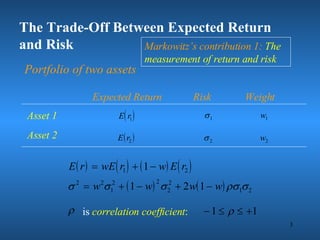
The Trade-Off Between Expected Return  and Risk Portfolio of two assets Markowitz’s contribution 1:   The measurement of return and risk Expected Return  Risk  Weight Asset 1 Asset 2 is   correlation coefficient :
Mini Case 1: Portfolio of the Riskless Asset and  a Single Risky Asset  Is the portfolio efficient  ? Suppose  , how to achieve a target expected return  ?
The Diversification Principle Mini Case 2: Portfolio of Two Risky Assets The Diversification Principle  —  The standard deviation of the combination is less than the combination of the standard deviations. Asset 1  Asset 2 Expected Return   0.14  0.08 Standard Deviation   0.20  0.15 Correlation Coefficient   0.6
Hyperbola Frontier of Two Risky Assets Combination Minimum Variance Portfolio The Optimal Combination of Two Risky Assets R 0 100% 8% 0.15 C 10% 90% 8.6% 0.1479 Minimum Variance Portfolio 17% 83% 9.02% 0.1474 D 50% 50% 11% 0.1569 Symbol Proportion in Asset 1 Proportion in Asset 2 Portfolio Expected Return Portfolio Standard Deviation S 100% 0 14% 0.20 .2000 C 0 .1569 .1500 .1479 .0860 .0902 .1100 .1400 S D R .0800
—  Diversification 0 Systematic Exposure Markowitz’s contribution 2:   Diversification. Suppose  , Then Let  , Let  ,
Mini Case 3: Portfolio of Many Risky Assets  ? Resolving the quadratic programming, get  the minimum variance frontier Expected return :  : Covariance :  :
Efficient Frontier of Risky Assets The Mean-Variance Frontier 0 Indifference Curve of Utility Optimal Portfolio of Risky Assets
Proposition! The variance of a diversified portfolio is irrelevant to the variance of individual assets. It is relevant to the covariance between them and equals the average of all the covariance.
Systematic risk cannot be diversified
Proposition! Only unsystematic risks can be diversified. Systematic risks cannot be diversified. They can be hedged and transferred only. Markowitz’s contribution 3:   Distinguishing systematic and unsystematic risks.
Proposition! There is systematic risk premium contained in the expected return. Unsystematic risk premium cannot be got through transaction in competitive markets.  Only systematic risk premium contained, no unsystematic risk premium contained. Both systematic and unsystematic volatilities contained
Two Fund Separation The portfolio frontier can be generated by any two distinct frontier portfolios. Theorem: Practice: If individuals prefer  frontier portfolios, they can simply hold a linear combination of two frontier portfolios or mutual funds. 0
Orthogonal Characterization of the Mean-Variance Frontier
P(x)=0 P(x)=1 R* 1 E=0 E=1 Re* Proposition: Every return r i   can be represented as   0
Efficient Frontier of Risky Assets The Portfolio Frontier: where is R*? 0 R* w 1 w 2 w 3
Some Properties of the Orthogonal Characterization
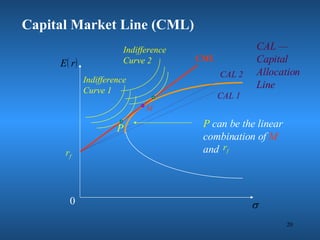
Capital Market Line (CML) CML CAL  — Capital Allocation Line 0 Indifference Curve 2 Indifference Curve 1 CAL 1 CAL 2 P   can be the linear combination of  M  and
Combination of  M  and  Risk-free Security —  The weight invested in   portfolio  M —  The weight invested in   risk-free security
Market Portfolio Definition: A portfolio that holds all assets in proportion to their observed market values is called the   Market Portfolio. M   is a  market portfolio of risky assets Two fund separation Market clearing ! Security  Market Value  Composition Stock A  $66 billion  66% Stock B  $22 billion  22% Treasury  $12 billion  12% Total  $100 billion  100% Substitute: Market Index
Capital Asset Pricing Model (CAPM) Assumptions: 1 . Many investors, they are price – takers. The market is perfectly competitive. 2 . All investors plan for one identical holding period. 3 . Investments to publicly traded financial assets. Financing at a fixed risk – free rate is unlimited. 4 . The market is frictionless, no tax, no transaction costs. 5 . All investors are rational mean – variance optimizers. 6 . No information asymmetry. All investors have their homogeneous expectations.
Derivation of CAPM The exposure of the market portfolio of risky assets is only related to the correlation between individual assets and the portfolio. Portfolio of risky assets The weights If  (market portfolio),
0 1.0 SML Derivation of CAPM: Security Market Line E(r M ) -r F
Security Market Line (SML) Model are additive
Understanding Risk in CAPM In CAPM, we can decompose an asset’s return into three pieces: where Three characteristic of an asset: Beta Sigma Aplha
1.0 SML The market becomes more aggressive The market becomes more conservative Risk neutral 0
Summary of Chapter Three The Key of Investments    Trade-Off Between Expected Return and Risk   Diversification    Only Systematic Risk Can Get Premium Two Fund Separation    Any Trade in the Market can be Considered as a Trade Between Two Mutual Funds CAPM  — Individual Asset Pricing

Markowitz Portfolio Selection

  • 1.
    CHAPTER THREE: Portfolio Theory, Fund Separation and CAPM
  • 2.
    Markowitz Portfolio SelectionThere is no single portfolio that is best for everyone. The Life Cycle — different consumption preference Time Horizons — different terms preference Risk Tolerance — different risk aversion Limited Variety of Portfolio — Limited “finished products” in markets
  • 3.
    The Trade-Off BetweenExpected Return and Risk Portfolio of two assets Markowitz’s contribution 1: The measurement of return and risk Expected Return Risk Weight Asset 1 Asset 2 is correlation coefficient :
  • 4.
    Mini Case 1:Portfolio of the Riskless Asset and a Single Risky Asset Is the portfolio efficient ? Suppose , how to achieve a target expected return ?
  • 5.
    The Diversification PrincipleMini Case 2: Portfolio of Two Risky Assets The Diversification Principle — The standard deviation of the combination is less than the combination of the standard deviations. Asset 1 Asset 2 Expected Return 0.14 0.08 Standard Deviation 0.20 0.15 Correlation Coefficient 0.6
  • 6.
    Hyperbola Frontier ofTwo Risky Assets Combination Minimum Variance Portfolio The Optimal Combination of Two Risky Assets R 0 100% 8% 0.15 C 10% 90% 8.6% 0.1479 Minimum Variance Portfolio 17% 83% 9.02% 0.1474 D 50% 50% 11% 0.1569 Symbol Proportion in Asset 1 Proportion in Asset 2 Portfolio Expected Return Portfolio Standard Deviation S 100% 0 14% 0.20 .2000 C 0 .1569 .1500 .1479 .0860 .0902 .1100 .1400 S D R .0800
  • 7.
    — Diversification0 Systematic Exposure Markowitz’s contribution 2: Diversification. Suppose , Then Let , Let ,
  • 8.
    Mini Case 3:Portfolio of Many Risky Assets ? Resolving the quadratic programming, get the minimum variance frontier Expected return : : Covariance : :
  • 9.
    Efficient Frontier ofRisky Assets The Mean-Variance Frontier 0 Indifference Curve of Utility Optimal Portfolio of Risky Assets
  • 10.
    Proposition! The varianceof a diversified portfolio is irrelevant to the variance of individual assets. It is relevant to the covariance between them and equals the average of all the covariance.
  • 11.
    Systematic risk cannotbe diversified
  • 12.
    Proposition! Only unsystematicrisks can be diversified. Systematic risks cannot be diversified. They can be hedged and transferred only. Markowitz’s contribution 3: Distinguishing systematic and unsystematic risks.
  • 13.
    Proposition! There issystematic risk premium contained in the expected return. Unsystematic risk premium cannot be got through transaction in competitive markets. Only systematic risk premium contained, no unsystematic risk premium contained. Both systematic and unsystematic volatilities contained
  • 14.
    Two Fund SeparationThe portfolio frontier can be generated by any two distinct frontier portfolios. Theorem: Practice: If individuals prefer frontier portfolios, they can simply hold a linear combination of two frontier portfolios or mutual funds. 0
  • 15.
    Orthogonal Characterization ofthe Mean-Variance Frontier
  • 16.
    Orthogonal Characterization ofthe Mean-Variance Frontier
  • 17.
    P(x)=0 P(x)=1 R*1 E=0 E=1 Re* Proposition: Every return r i can be represented as 0
  • 18.
    Efficient Frontier ofRisky Assets The Portfolio Frontier: where is R*? 0 R* w 1 w 2 w 3
  • 19.
    Some Properties ofthe Orthogonal Characterization
  • 20.
    Capital Market Line(CML) CML CAL — Capital Allocation Line 0 Indifference Curve 2 Indifference Curve 1 CAL 1 CAL 2 P can be the linear combination of M and
  • 21.
    Combination of M and Risk-free Security — The weight invested in portfolio M — The weight invested in risk-free security
  • 22.
    Market Portfolio Definition:A portfolio that holds all assets in proportion to their observed market values is called the Market Portfolio. M is a market portfolio of risky assets Two fund separation Market clearing ! Security Market Value Composition Stock A $66 billion 66% Stock B $22 billion 22% Treasury $12 billion 12% Total $100 billion 100% Substitute: Market Index
  • 23.
    Capital Asset PricingModel (CAPM) Assumptions: 1 . Many investors, they are price – takers. The market is perfectly competitive. 2 . All investors plan for one identical holding period. 3 . Investments to publicly traded financial assets. Financing at a fixed risk – free rate is unlimited. 4 . The market is frictionless, no tax, no transaction costs. 5 . All investors are rational mean – variance optimizers. 6 . No information asymmetry. All investors have their homogeneous expectations.
  • 24.
    Derivation of CAPMThe exposure of the market portfolio of risky assets is only related to the correlation between individual assets and the portfolio. Portfolio of risky assets The weights If (market portfolio),
  • 25.
    0 1.0 SMLDerivation of CAPM: Security Market Line E(r M ) -r F
  • 26.
    Security Market Line(SML) Model are additive
  • 27.
    Understanding Risk inCAPM In CAPM, we can decompose an asset’s return into three pieces: where Three characteristic of an asset: Beta Sigma Aplha
  • 28.
    1.0 SML Themarket becomes more aggressive The market becomes more conservative Risk neutral 0
  • 29.
    Summary of ChapterThree The Key of Investments  Trade-Off Between Expected Return and Risk Diversification  Only Systematic Risk Can Get Premium Two Fund Separation  Any Trade in the Market can be Considered as a Trade Between Two Mutual Funds CAPM — Individual Asset Pricing