



Marketing Strategy
You can download this presentation at: www.studyMarketing.org Visit  www.studyMarketing.org   for more presentations on Marketing, Strategy, Innovation, and Branding
Contents: Section 1 : Market Scope Strategy Section 2 : Market Entry Strategy Section 3 : Product Strategy Section 4 : Promotion Strategy Section 5 : Distribution Strategy Section 6 : Pricing Strategy
Market Scope Strategy Single Market Strategy Multi Market Strategy Total Market Strategy
1. Single Market Strategy Concentration of efforts in a single segment. Requirements: (a) Serve the market wholeheartedly despite initial difficulties (b) Avoid competition with established firms.
2. Multi Market Strategy Serving several distinct markets. Requirements: (a) Careful selection of segments to serve (b) Avoid confrontation with companies serving entire market.
3. Total Market Strategy Serving the entire spectrum of the market by selling differentiated products to different segments in the market. Requirements: (a) Employ different combinations of price, product, promotion, and distribution strategies in different segments (b) Top management commitment to embrace entire market (c) Strong financial position.
Market Entry Strategy First In Strategy Early Entry Strategy Laggard Entry Strategy
1. First In Strategy Entering the market before all others. Requirements: (a) Willingness and ability to take risks (b) Technological competence (c) Strive to stay ahead (d) Heavy promotion (e) Create primary demand (f) Carefully evaluate strengths.
2. Early Entry Strategy Entering the market in quick succession after the leader. Requirements: (a) Superior marketing strategy (b) Ample resources (c) Strong commitment to challenge market leader.
3. Laggard Entry Strategy Entering the market toward tail end of growth phase or during maturity phase. Two modes of entry are feasible:  (a) Imitator  - Entering market with me-too product  (b) Initiator  - Entering market with unconventional marketing strategies. Requirements:  Imitator  - (a) Market research ability (b) Production capability.  Initiator  - (a) Market research ability, (b) Ability to generate creative marketing strategies.
Product Strategy Product Positioning Strategy Product Repositioning Strategy Product Scope Strategy Product Design Strategy New Product Strategy
1. Product Positioning Strategy Placing a brand in that part of the market where it will have a favorable reception compared with competing brands. Requirements: (a) Successful management of  a single brand  requires positioning the brand in the market so that it can stand competition from the toughest rival and maintaining its unique position by creating  the aura of a distinctive product.
1. Product Positioning Strategy (b) Successful management of  multiple brands  requires careful positioning in the market so that multiple brands do not compete with nor cannibalize each other.
2. Product Repositioning Strategy Reviewing the current positioning of the product and its marketing mix and seeking a new position for it that seems more appropriate.
Requirements: (a) If this strategy is directed toward  existing customers , repositioning is sought through promotion of more varied uses of the product 2. Product Repositioning Strategy
(b) If the business unit wants to  reach new users , this strategy requires that the product be presented with a different twist to the people who have not been favorably inclined toward it.  In doing so, care should be taken to see that, in the process of enticing new customers, current ones are not alienated 2. Product Repositioning Strategy
(c) If this strategy aims at  presenting new uses of the product , it requires searching for latent uses of the product, if any.  Although all products may not have latent uses, there are products that may be used for purposes not originally intended. 2. Product Repositioning Strategy
3. Product Scope Strategy The product-scope strategy deals with the perspectives of the product mix of a company.  The company may adopt  a single-product strategy, a multiple-product strategy,  or  a system-of-products strategy.
Requirements: (a)  Single product : company must stay up-to-date on the product and even become the technology leader to avoid obsolescence (b)  Multiple products : products must complement one another in a portfolio of products 3. Product Scope Strategy
(c)  System of products : company must have a close understanding of customer needs and uses of the products. 3. Product Scope Strategy
4. Product Design Strategy The product-design strategy deals with the degree of standardization of a product.  The company has a choice among the following strategic options:  standard product, customized product,  and  standard product with modifications.
Objectives: (a)  Standard product  : to increase economies of scale of the company (b)  Customized product  : to compete against mass producers of standardized products through product-design flexibility (c)  Standard product with modifications  : to combine the benefits of the two previous strategies. 4. Product Design Strategy
5. New Product Strategy A set of operations that introduces (a)  within the business , a product new to its previous line of products (b)  on the market , a product that provides a new type of satisfaction.  Three alternatives emerge from the above:  product improvement/modification ,  product imitation , and  product innovation.
Requirements: A new-product strategy is difficult to implement if  a new product development system  does not exist within a company.  5. New Product Strategy
Five components  of this system should be assessed:  corporate aspirations toward new products  organizational openness to creativity  environmental favor toward creativity  screening method for new ideas, and  evaluation process.  5. New Product Strategy
Promotion Strategy Promotion Mix Strategy Media Selection Strategy Advertising Copy Strategy
Determination of a judicious mix of different types of promotion. Requirements :  (a) Product factors : (i) nature of product (ii) durable versus nondurable (iii) perceived risk (iv) typical purchase amount  1. Promotion Mix Strategy
1. Promotion Mix Strategy (b) Market factors:  (i) position in the life cycle, (ii); market share, (iii) industry concentra­tion, (iv) intensity of competition, and (v) demand perspectives (c) Customers factors:  (i) household versus business customers, (ii) number of customers, and (iii) concentration of customers
1. Promotion Mix Strategy (d) Budget factors:  (i) financial resources of the organization and (ii) traditional promotional perspectives  (e) Marketing mix factors:  (i) relative price/relative quality, (ii) distribution strategy, (iii) brand life cycle, and (iv) geographic scope of the market
2. Media Selection Strategy Choosing the channels (newspapers, magazines, television, radio, outdoor advertising, transit advertising, and direct mail) through which messages concerning a product/service are transmitted to the targets.
2. Media Selection Strategy Requirements: (a) Relate media-selection objectives to product/market objectives (b) Media chosen should have a unique way of promoting the business (c) Media should be measure-minded not only in frequency, in timing, and in reaching the target audience but also in evaluating the quality of the audience
2. Media Selection Strategy (d) Base media selection on factual not artificial grounds, (e) Media plan should be optimistic in that it takes advantage of the lessons learned from experience (f) Seek  information on customer profiles and audience characteristics.
3. Advertising Copy Strategy Designing the content of an advertisement. Objective: To transmit a particular product/service message to a particular target.
3. Advertising Copy Strategy Requirements:  (a) Eliminate "noise" for a clear transmission of message  (b) Consider importance of : source credibility balance of argument message repetition  rational versus emotional appeals  humor appeals  presentation of model's eyes in pictorial ads comparison advertising.
Distribution Strategy Distribution Scope Strategy Multiple Channel Strategy
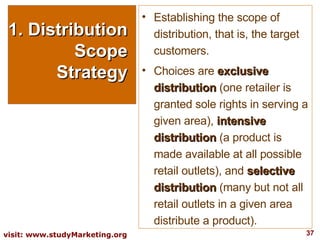
1. Distribution Scope Strategy Establishing the scope of distribution, that is, the target customers.  Choices are  exclusive distribution  (one retailer is granted sole rights in serving a given area),  intensive distribution  (a product is made available at all possible retail outlets), and  selective distribution  (many but not all retail outlets in a given area distribute a product).
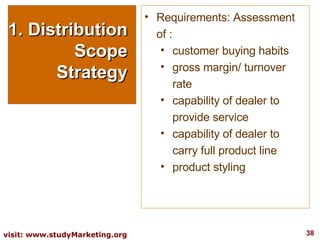
1. Distribution Scope Strategy Requirements: Assessment of : customer buying habits gross margin/ turnover rate capability of dealer to provide service capability of dealer to carry full product line product styling
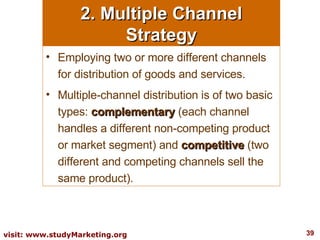
2. Multiple Channel Strategy Employing two or more different channels for distribution of goods and services.  Multiple-channel distribution is of two basic types:  complementary  (each channel handles a different non-competing product or market segment) and  competitive  (two different and competing channels sell the same product).
2. Multiple Channel Strategy Requirements: (a) Market segmentation, (b) Cost/benefit analysis.  Use of complementary channels prompted by (i) geographic considerations, (ii) volume of business, (iii) need to distribute non-competing items, and (iv) saturation of traditional distribution channels.  Use of competitive channels can be a response to environmental changes.
Pricing Strategy Pricing Strategies for New Products Pricing Strategies for Established Products Price Flexibility Strategy Price Leadership Strategy
1. Pricing for New Products Skimming Pricing Strategy Penetration Pricing Strategy
Skimming Pricing Strategy Setting a relatively high price during the initial stage of a product's life. Objectives: (a) To serve customers who are not price conscious while the market is at the upper end of the demand curve and competition has not yet entered the market
(b) To recover a significant portion of promotional and research and development costs through a high margin. Skimming Pricing Strategy
Requirements: (a) Heavy promotional expenditure to introduce product, educate consumers, and induce early buying (b) Relatively inelastic demand at the upper end of the demand curve (c) Lack of direct competition and substitutes. Skimming Pricing Strategy
Penetration Pricing Strategy Setting a relatively low price during the initial stages of a product's life.  Objective: To discourage competition from entering the market by quickly taking a large market share and by gaining a cost advantage through realizing economies of scale.
Penetration Pricing Strategy Requirements: (a) Product must appeal to a market large enough to support the cost advantage (b) Demand must be highly elastic in order for the firm to guard its cost advantage.
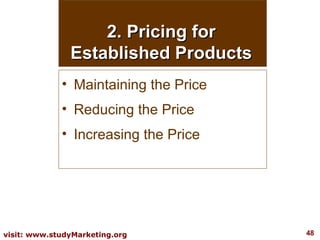
2. Pricing for Established Products Maintaining the Price Reducing the Price Increasing the Price
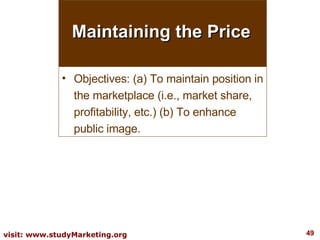
Maintaining the Price Objectives: (a) To maintain position in the marketplace (i.e., market share, profitability, etc.) (b) To enhance public image.
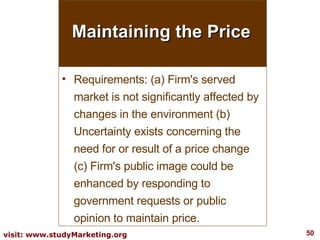
Maintaining the Price Requirements: (a) Firm's served market is not significantly affected by changes in the environment (b) Uncertainty exists concerning the need for or result of a price change (c) Firm's public image could be enhanced by responding to government requests or public opinion to maintain price.
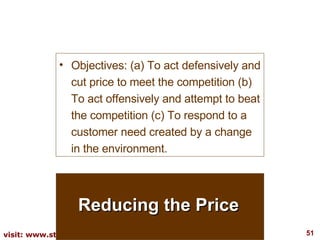
Reducing the Price Objectives: (a) To act defensively and cut price to meet the competition (b) To act offensively and attempt to beat the competition (c) To respond to a customer need created by a change in the environment.
Reducing the Price Requirements: (a) Firm must be financially and competitively strong to fight in a price war if that becomes necessary (b) Must have a good understanding of the demand function of its product.
Increasing the Price Objectives: (a) To maintain profitability during an inflationary period (b) To take advantage of product differences, real or perceived (c) To segment the current served market.
Increasing the Price Requirements: (a) Relatively low price elasticity but relatively high elasticity with respect to some other factor such as quality or distribution, (b) Reinforcement from other ingredients of the marketing mix
3. Pricing Flexibility Strategy One Price Strategy Flexible Pricing Strategy
One Price Strategy Charging the same price to all customers under similar conditions and for the same quantities. Objectives: (a) To simplify pricing decisions (b) To maintain goodwill among customers.
One Price Strategy Requirements:  Detailed analysis of the firm's position and cost structure as compared with the rest of the industry  Information concerning the cost variability of offering the same price to everyone
One Price Strategy Knowledge of the economies of scale available to the firm  Information on competitive prices; information on the price that customers are ready to pay.
Flexible Pricing Strategy Charging different prices to different customers for the same product and quantity. Objective: To maximize short-term profits and build traffic by allowing upward and downward adjustments in price depending on competitive conditions and how much the customer is willing to pay for the product.
Flexible Pricing Strategy Requirements: Have the information needed to implement the strategy.  Usually this strategy is implemented in one of four ways: (a) by market (b) by product (c) by timing (d) by technology.
Flexible Pricing Strategy Other requirements include : a customer-value analysis of the product,  an emphasis on profit margin rather than just volume, and  a record of competitive reactions to price moves in the past.
4. Price Leadership Strategy This strategy is used by the leading firm in an industry in making major pricing moves, which are followed by other firms in the industry.
4. Price Leadership Strategy Objective: To gain control of pricing decisions within an industry in order to support the leading firm's own marketing strategy (i.e., create barriers to entry, increase profit margin, etc.).
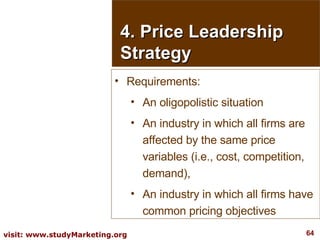
4. Price Leadership Strategy Requirements:  An oligopolistic situation An industry in which all firms are affected by the same price variables (i.e., cost, competition, demand),  An industry in which all firms have common pricing objectives
Source of Reference: Subhas Jain,  Marketing Planning and Strategy ,  Prentice Hall International.

Marketing Strategy

  • 1.
  • 2.
    You can downloadthis presentation at: www.studyMarketing.org Visit www.studyMarketing.org for more presentations on Marketing, Strategy, Innovation, and Branding
  • 3.
    Contents: Section 1: Market Scope Strategy Section 2 : Market Entry Strategy Section 3 : Product Strategy Section 4 : Promotion Strategy Section 5 : Distribution Strategy Section 6 : Pricing Strategy
  • 4.
    Market Scope StrategySingle Market Strategy Multi Market Strategy Total Market Strategy
  • 5.
    1. Single MarketStrategy Concentration of efforts in a single segment. Requirements: (a) Serve the market wholeheartedly despite initial difficulties (b) Avoid competition with established firms.
  • 6.
    2. Multi MarketStrategy Serving several distinct markets. Requirements: (a) Careful selection of segments to serve (b) Avoid confrontation with companies serving entire market.
  • 7.
    3. Total MarketStrategy Serving the entire spectrum of the market by selling differentiated products to different segments in the market. Requirements: (a) Employ different combinations of price, product, promotion, and distribution strategies in different segments (b) Top management commitment to embrace entire market (c) Strong financial position.
  • 8.
    Market Entry StrategyFirst In Strategy Early Entry Strategy Laggard Entry Strategy
  • 9.
    1. First InStrategy Entering the market before all others. Requirements: (a) Willingness and ability to take risks (b) Technological competence (c) Strive to stay ahead (d) Heavy promotion (e) Create primary demand (f) Carefully evaluate strengths.
  • 10.
    2. Early EntryStrategy Entering the market in quick succession after the leader. Requirements: (a) Superior marketing strategy (b) Ample resources (c) Strong commitment to challenge market leader.
  • 11.
    3. Laggard EntryStrategy Entering the market toward tail end of growth phase or during maturity phase. Two modes of entry are feasible: (a) Imitator - Entering market with me-too product (b) Initiator - Entering market with unconventional marketing strategies. Requirements: Imitator - (a) Market research ability (b) Production capability. Initiator - (a) Market research ability, (b) Ability to generate creative marketing strategies.
  • 12.
    Product Strategy ProductPositioning Strategy Product Repositioning Strategy Product Scope Strategy Product Design Strategy New Product Strategy
  • 13.
    1. Product PositioningStrategy Placing a brand in that part of the market where it will have a favorable reception compared with competing brands. Requirements: (a) Successful management of a single brand requires positioning the brand in the market so that it can stand competition from the toughest rival and maintaining its unique position by creating the aura of a distinctive product.
  • 14.
    1. Product PositioningStrategy (b) Successful management of multiple brands requires careful positioning in the market so that multiple brands do not compete with nor cannibalize each other.
  • 15.
    2. Product RepositioningStrategy Reviewing the current positioning of the product and its marketing mix and seeking a new position for it that seems more appropriate.
  • 16.
    Requirements: (a) Ifthis strategy is directed toward existing customers , repositioning is sought through promotion of more varied uses of the product 2. Product Repositioning Strategy
  • 17.
    (b) If thebusiness unit wants to reach new users , this strategy requires that the product be presented with a different twist to the people who have not been favorably inclined toward it. In doing so, care should be taken to see that, in the process of enticing new customers, current ones are not alienated 2. Product Repositioning Strategy
  • 18.
    (c) If thisstrategy aims at presenting new uses of the product , it requires searching for latent uses of the product, if any. Although all products may not have latent uses, there are products that may be used for purposes not originally intended. 2. Product Repositioning Strategy
  • 19.
    3. Product ScopeStrategy The product-scope strategy deals with the perspectives of the product mix of a company. The company may adopt a single-product strategy, a multiple-product strategy, or a system-of-products strategy.
  • 20.
    Requirements: (a) Single product : company must stay up-to-date on the product and even become the technology leader to avoid obsolescence (b) Multiple products : products must complement one another in a portfolio of products 3. Product Scope Strategy
  • 21.
    (c) Systemof products : company must have a close understanding of customer needs and uses of the products. 3. Product Scope Strategy
  • 22.
    4. Product DesignStrategy The product-design strategy deals with the degree of standardization of a product. The company has a choice among the following strategic options: standard product, customized product, and standard product with modifications.
  • 23.
    Objectives: (a) Standard product : to increase economies of scale of the company (b) Customized product : to compete against mass producers of standardized products through product-design flexibility (c) Standard product with modifications : to combine the benefits of the two previous strategies. 4. Product Design Strategy
  • 24.
    5. New ProductStrategy A set of operations that introduces (a) within the business , a product new to its previous line of products (b) on the market , a product that provides a new type of satisfaction. Three alternatives emerge from the above: product improvement/modification , product imitation , and product innovation.
  • 25.
    Requirements: A new-productstrategy is difficult to implement if a new product development system does not exist within a company. 5. New Product Strategy
  • 26.
    Five components of this system should be assessed: corporate aspirations toward new products organizational openness to creativity environmental favor toward creativity screening method for new ideas, and evaluation process. 5. New Product Strategy
  • 27.
    Promotion Strategy PromotionMix Strategy Media Selection Strategy Advertising Copy Strategy
  • 28.
    Determination of ajudicious mix of different types of promotion. Requirements : (a) Product factors : (i) nature of product (ii) durable versus nondurable (iii) perceived risk (iv) typical purchase amount 1. Promotion Mix Strategy
  • 29.
    1. Promotion MixStrategy (b) Market factors: (i) position in the life cycle, (ii); market share, (iii) industry concentra­tion, (iv) intensity of competition, and (v) demand perspectives (c) Customers factors: (i) household versus business customers, (ii) number of customers, and (iii) concentration of customers
  • 30.
    1. Promotion MixStrategy (d) Budget factors: (i) financial resources of the organization and (ii) traditional promotional perspectives (e) Marketing mix factors: (i) relative price/relative quality, (ii) distribution strategy, (iii) brand life cycle, and (iv) geographic scope of the market
  • 31.
    2. Media SelectionStrategy Choosing the channels (newspapers, magazines, television, radio, outdoor advertising, transit advertising, and direct mail) through which messages concerning a product/service are transmitted to the targets.
  • 32.
    2. Media SelectionStrategy Requirements: (a) Relate media-selection objectives to product/market objectives (b) Media chosen should have a unique way of promoting the business (c) Media should be measure-minded not only in frequency, in timing, and in reaching the target audience but also in evaluating the quality of the audience
  • 33.
    2. Media SelectionStrategy (d) Base media selection on factual not artificial grounds, (e) Media plan should be optimistic in that it takes advantage of the lessons learned from experience (f) Seek information on customer profiles and audience characteristics.
  • 34.
    3. Advertising CopyStrategy Designing the content of an advertisement. Objective: To transmit a particular product/service message to a particular target.
  • 35.
    3. Advertising CopyStrategy Requirements: (a) Eliminate "noise" for a clear transmission of message (b) Consider importance of : source credibility balance of argument message repetition rational versus emotional appeals humor appeals presentation of model's eyes in pictorial ads comparison advertising.
  • 36.
    Distribution Strategy DistributionScope Strategy Multiple Channel Strategy
  • 37.
    1. Distribution ScopeStrategy Establishing the scope of distribution, that is, the target customers. Choices are exclusive distribution (one retailer is granted sole rights in serving a given area), intensive distribution (a product is made available at all possible retail outlets), and selective distribution (many but not all retail outlets in a given area distribute a product).
  • 38.
    1. Distribution ScopeStrategy Requirements: Assessment of : customer buying habits gross margin/ turnover rate capability of dealer to provide service capability of dealer to carry full product line product styling
  • 39.
    2. Multiple ChannelStrategy Employing two or more different channels for distribution of goods and services. Multiple-channel distribution is of two basic types: complementary (each channel handles a different non-competing product or market segment) and competitive (two different and competing channels sell the same product).
  • 40.
    2. Multiple ChannelStrategy Requirements: (a) Market segmentation, (b) Cost/benefit analysis. Use of complementary channels prompted by (i) geographic considerations, (ii) volume of business, (iii) need to distribute non-competing items, and (iv) saturation of traditional distribution channels. Use of competitive channels can be a response to environmental changes.
  • 41.
    Pricing Strategy PricingStrategies for New Products Pricing Strategies for Established Products Price Flexibility Strategy Price Leadership Strategy
  • 42.
    1. Pricing forNew Products Skimming Pricing Strategy Penetration Pricing Strategy
  • 43.
    Skimming Pricing StrategySetting a relatively high price during the initial stage of a product's life. Objectives: (a) To serve customers who are not price conscious while the market is at the upper end of the demand curve and competition has not yet entered the market
  • 44.
    (b) To recovera significant portion of promotional and research and development costs through a high margin. Skimming Pricing Strategy
  • 45.
    Requirements: (a) Heavypromotional expenditure to introduce product, educate consumers, and induce early buying (b) Relatively inelastic demand at the upper end of the demand curve (c) Lack of direct competition and substitutes. Skimming Pricing Strategy
  • 46.
    Penetration Pricing StrategySetting a relatively low price during the initial stages of a product's life. Objective: To discourage competition from entering the market by quickly taking a large market share and by gaining a cost advantage through realizing economies of scale.
  • 47.
    Penetration Pricing StrategyRequirements: (a) Product must appeal to a market large enough to support the cost advantage (b) Demand must be highly elastic in order for the firm to guard its cost advantage.
  • 48.
    2. Pricing forEstablished Products Maintaining the Price Reducing the Price Increasing the Price
  • 49.
    Maintaining the PriceObjectives: (a) To maintain position in the marketplace (i.e., market share, profitability, etc.) (b) To enhance public image.
  • 50.
    Maintaining the PriceRequirements: (a) Firm's served market is not significantly affected by changes in the environment (b) Uncertainty exists concerning the need for or result of a price change (c) Firm's public image could be enhanced by responding to government requests or public opinion to maintain price.
  • 51.
    Reducing the PriceObjectives: (a) To act defensively and cut price to meet the competition (b) To act offensively and attempt to beat the competition (c) To respond to a customer need created by a change in the environment.
  • 52.
    Reducing the PriceRequirements: (a) Firm must be financially and competitively strong to fight in a price war if that becomes necessary (b) Must have a good understanding of the demand function of its product.
  • 53.
    Increasing the PriceObjectives: (a) To maintain profitability during an inflationary period (b) To take advantage of product differences, real or perceived (c) To segment the current served market.
  • 54.
    Increasing the PriceRequirements: (a) Relatively low price elasticity but relatively high elasticity with respect to some other factor such as quality or distribution, (b) Reinforcement from other ingredients of the marketing mix
  • 55.
    3. Pricing FlexibilityStrategy One Price Strategy Flexible Pricing Strategy
  • 56.
    One Price StrategyCharging the same price to all customers under similar conditions and for the same quantities. Objectives: (a) To simplify pricing decisions (b) To maintain goodwill among customers.
  • 57.
    One Price StrategyRequirements: Detailed analysis of the firm's position and cost structure as compared with the rest of the industry Information concerning the cost variability of offering the same price to everyone
  • 58.
    One Price StrategyKnowledge of the economies of scale available to the firm Information on competitive prices; information on the price that customers are ready to pay.
  • 59.
    Flexible Pricing StrategyCharging different prices to different customers for the same product and quantity. Objective: To maximize short-term profits and build traffic by allowing upward and downward adjustments in price depending on competitive conditions and how much the customer is willing to pay for the product.
  • 60.
    Flexible Pricing StrategyRequirements: Have the information needed to implement the strategy. Usually this strategy is implemented in one of four ways: (a) by market (b) by product (c) by timing (d) by technology.
  • 61.
    Flexible Pricing StrategyOther requirements include : a customer-value analysis of the product, an emphasis on profit margin rather than just volume, and a record of competitive reactions to price moves in the past.
  • 62.
    4. Price LeadershipStrategy This strategy is used by the leading firm in an industry in making major pricing moves, which are followed by other firms in the industry.
  • 63.
    4. Price LeadershipStrategy Objective: To gain control of pricing decisions within an industry in order to support the leading firm's own marketing strategy (i.e., create barriers to entry, increase profit margin, etc.).
  • 64.
    4. Price LeadershipStrategy Requirements: An oligopolistic situation An industry in which all firms are affected by the same price variables (i.e., cost, competition, demand), An industry in which all firms have common pricing objectives
  • 65.
    Source of Reference:Subhas Jain, Marketing Planning and Strategy , Prentice Hall International.