Guided By Prof. Rakesh ShiraseMBA-I
Vishal Patel | Drashti Shah | Jyotsana Iyer | Shruti Kumari | Pappu Kumar
What is the Value Chain?
The value chain is a tool for identifying
ways to create more customer value
because every firm is a synthesis of
primary and support activities
performed to design, produce, market,
deliver, and support its product.
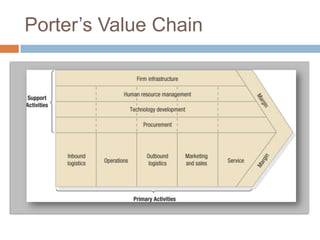
Porter’s Value Chain
Characteristics of Core Competencies
 A source of competitive advantage
 Applications in a wide variety of markets
 Difficult to imitate
What is a Marketing Plan?
 A marketing plan is the central instrument
for directing and coordinating the marketing
effort.
 It operates at a strategic and tactical level.
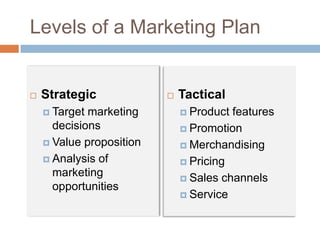
Levels of a Marketing Plan
 Strategic
 Target marketing
decisions
 Value proposition
 Analysis of
marketing
opportunities
 Tactical
 Product features
 Promotion
 Merchandising
 Pricing
 Sales channels
 Service
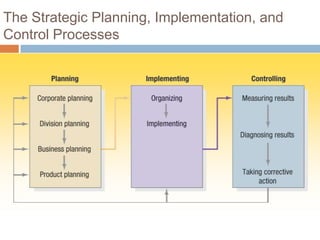
The Strategic Planning, Implementation, and
Control Processes
Corporate And Division Strategic Planning
 Defining the corporate mission
 Establishing strategic business units
 Assigning resources to each SBU
 Assessing growth opportunities
Defining the corporate mission
Mission statement includes the mission of
an organization which it needs to achieve
through careful marketing research by
carefully analyzing the needs and wants of
customer and providing him with the
same.
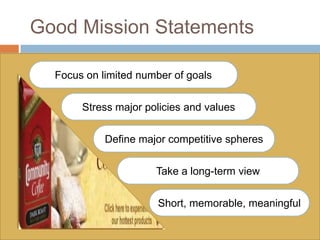
Good Mission Statements
Focus on limited number of goals
Stress major policies and values
Define major competitive spheres
Take a long-term view
Short, memorable, meaningful
Sample Mission Statements
MARRIOTT’S Mission Statement:
We are committed to being the best lodging and
food service company in the world, by treating
employees in ways that create extraordinary
customer service and shareholder value
Cont.
 Biocon
“To be an integrated biotechnology enterprise of
global distinction.”
 Infosys Technologies Limited
“To achieve our objectives in an environment of
fairness, honesty, and courtesy towards our
clients, employees, vendors and society at
large.”
 It is a single business or collection of related
businesses
 It has its own set of competitors
 It has a leader responsible for strategic planning
and profitability
Establish strategic business units (SBUs)
Characteristics of SBUs
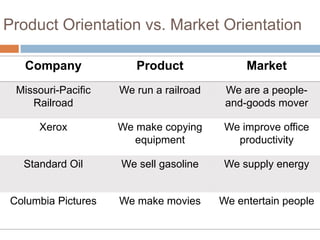
Product Orientation vs. Market Orientation
Company Product Market
Missouri-Pacific
Railroad
We run a railroad We are a people-
and-goods mover
Xerox We make copying
equipment
We improve office
productivity
Standard Oil We sell gasoline We supply energy
Columbia Pictures We make movies We entertain people
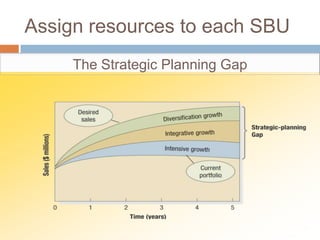
Assign resources to each SBU
The Strategic Planning Gap
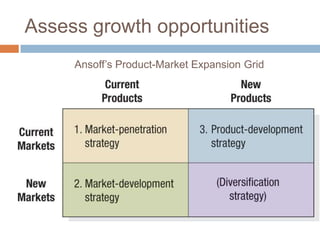
Assess growth opportunities
Ansoff’s Product-Market Expansion Grid
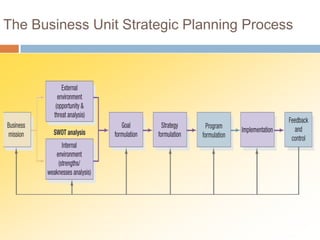
The Business Unit Strategic Planning Process
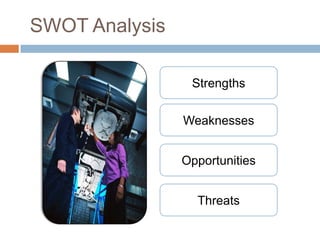
SWOT Analysis
Strengths
Weaknesses
Opportunities
Threats
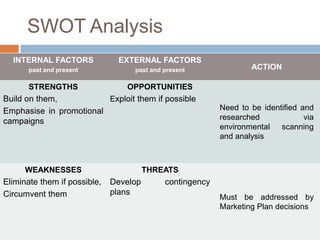
SWOT Analysis
INTERNAL FACTORS
past and present
EXTERNAL FACTORS
past and present ACTION
STRENGTHS
Build on them,
Emphasise in promotional
campaigns
OPPORTUNITIES
Exploit them if possible
Need to be identified and
researched via
environmental scanning
and analysis
WEAKNESSES
Eliminate them if possible,
Circumvent them
THREATS
Develop contingency
plans
Must be addressed by
Marketing Plan decisions
Market Opportunity Analysis (MOA)
 Can the benefits involved in the opportunity be
articulated convincingly to a defined target
market?
 Can the target market be located and reached
with cost-effective media and trade channels?
 Does the company possess or have access to the
critical capabilities and resources needed to
deliver the customer benefits?
MOA (cont.)
 Can the company deliver the benefits better
than any actual or potential competitors?
 Will the financial rate of return meet or exceed
the company’s required threshold for
investment?
Goal Formulation
 Hierarchically arranged from the most to the
least important.
 Quantitative objectives whenever possible
 Objectives should be realistic
 Objectives must be consistent
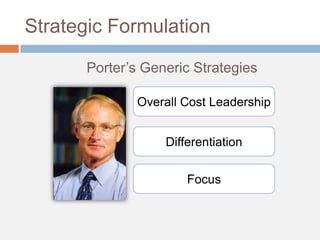
Strategic Formulation
Porter’s Generic Strategies
Overall Cost Leadership
Differentiation
Focus
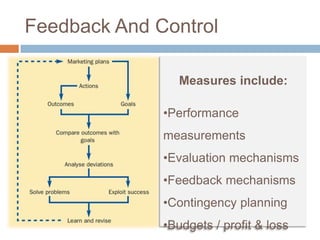
Feedback And Control
Measures include:
•Performance
measurements
•Evaluation mechanisms
•Feedback mechanisms
•Contingency planning
•Budgets / profit & loss
Problems with Planning
 Companies become obsessed with the process or
technique rather than the actual content and
delivery of the plan!!
 Unreliable or insufficient market research data can
make plans flawed from beginning!
 New companies
 too busy?
 Small companies
 not important/ no skills/ restrictive?
 Mature companies
 Unnecessary / cumbersome?
 Fast changing markets
 not useful / responsive?
However all organisations should plan!
Problems with Planning (Cont.)
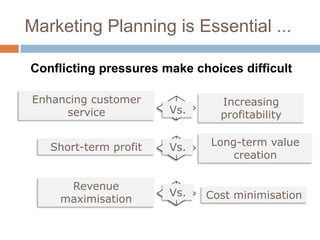
Marketing Planning is Essential ...
Conflicting pressures make choices difficult
Enhancing customer
service
Short-term profit
Revenue
maximisation Cost minimisation
Long-term value
creation
Increasing
profitabilityVs.
Vs.
Vs.
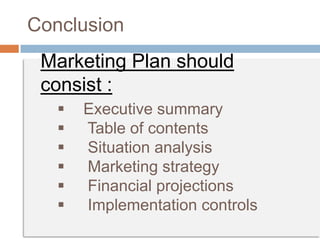
 Executive summary
 Table of contents
 Situation analysis
 Marketing strategy
 Financial projections
 Implementation controls
Marketing Plan should
consist :
Conclusion
Thank you

Marketing planning

  • 1.
    Guided By Prof.Rakesh ShiraseMBA-I Vishal Patel | Drashti Shah | Jyotsana Iyer | Shruti Kumari | Pappu Kumar
  • 2.
    What is theValue Chain? The value chain is a tool for identifying ways to create more customer value because every firm is a synthesis of primary and support activities performed to design, produce, market, deliver, and support its product.
  • 3.
  • 4.
    Characteristics of CoreCompetencies  A source of competitive advantage  Applications in a wide variety of markets  Difficult to imitate
  • 5.
    What is aMarketing Plan?  A marketing plan is the central instrument for directing and coordinating the marketing effort.  It operates at a strategic and tactical level.
  • 6.
    Levels of aMarketing Plan  Strategic  Target marketing decisions  Value proposition  Analysis of marketing opportunities  Tactical  Product features  Promotion  Merchandising  Pricing  Sales channels  Service
  • 7.
    The Strategic Planning,Implementation, and Control Processes
  • 8.
    Corporate And DivisionStrategic Planning  Defining the corporate mission  Establishing strategic business units  Assigning resources to each SBU  Assessing growth opportunities
  • 9.
    Defining the corporatemission Mission statement includes the mission of an organization which it needs to achieve through careful marketing research by carefully analyzing the needs and wants of customer and providing him with the same.
  • 10.
    Good Mission Statements Focuson limited number of goals Stress major policies and values Define major competitive spheres Take a long-term view Short, memorable, meaningful
  • 11.
    Sample Mission Statements MARRIOTT’SMission Statement: We are committed to being the best lodging and food service company in the world, by treating employees in ways that create extraordinary customer service and shareholder value
  • 12.
    Cont.  Biocon “To bean integrated biotechnology enterprise of global distinction.”  Infosys Technologies Limited “To achieve our objectives in an environment of fairness, honesty, and courtesy towards our clients, employees, vendors and society at large.”
  • 13.
     It isa single business or collection of related businesses  It has its own set of competitors  It has a leader responsible for strategic planning and profitability Establish strategic business units (SBUs) Characteristics of SBUs
  • 14.
    Product Orientation vs.Market Orientation Company Product Market Missouri-Pacific Railroad We run a railroad We are a people- and-goods mover Xerox We make copying equipment We improve office productivity Standard Oil We sell gasoline We supply energy Columbia Pictures We make movies We entertain people
  • 15.
    Assign resources toeach SBU The Strategic Planning Gap
  • 16.
    Assess growth opportunities Ansoff’sProduct-Market Expansion Grid
  • 17.
    The Business UnitStrategic Planning Process
  • 18.
  • 19.
    SWOT Analysis INTERNAL FACTORS pastand present EXTERNAL FACTORS past and present ACTION STRENGTHS Build on them, Emphasise in promotional campaigns OPPORTUNITIES Exploit them if possible Need to be identified and researched via environmental scanning and analysis WEAKNESSES Eliminate them if possible, Circumvent them THREATS Develop contingency plans Must be addressed by Marketing Plan decisions
  • 20.
    Market Opportunity Analysis(MOA)  Can the benefits involved in the opportunity be articulated convincingly to a defined target market?  Can the target market be located and reached with cost-effective media and trade channels?  Does the company possess or have access to the critical capabilities and resources needed to deliver the customer benefits?
  • 21.
    MOA (cont.)  Canthe company deliver the benefits better than any actual or potential competitors?  Will the financial rate of return meet or exceed the company’s required threshold for investment?
  • 22.
    Goal Formulation  Hierarchicallyarranged from the most to the least important.  Quantitative objectives whenever possible  Objectives should be realistic  Objectives must be consistent
  • 23.
    Strategic Formulation Porter’s GenericStrategies Overall Cost Leadership Differentiation Focus
  • 24.
    Feedback And Control Measuresinclude: •Performance measurements •Evaluation mechanisms •Feedback mechanisms •Contingency planning •Budgets / profit & loss
  • 25.
    Problems with Planning Companies become obsessed with the process or technique rather than the actual content and delivery of the plan!!  Unreliable or insufficient market research data can make plans flawed from beginning!
  • 26.
     New companies too busy?  Small companies  not important/ no skills/ restrictive?  Mature companies  Unnecessary / cumbersome?  Fast changing markets  not useful / responsive? However all organisations should plan! Problems with Planning (Cont.)
  • 27.
    Marketing Planning isEssential ... Conflicting pressures make choices difficult Enhancing customer service Short-term profit Revenue maximisation Cost minimisation Long-term value creation Increasing profitabilityVs. Vs. Vs.
  • 28.
     Executive summary Table of contents  Situation analysis  Marketing strategy  Financial projections  Implementation controls Marketing Plan should consist : Conclusion
  • 29.