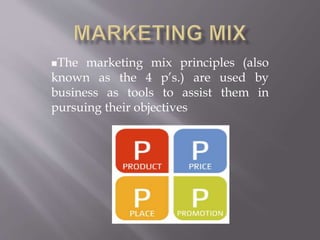
The marketing mix principles (also
known as the 4 p’s.) are used by
business as tools to assist them in
pursuing their objectives
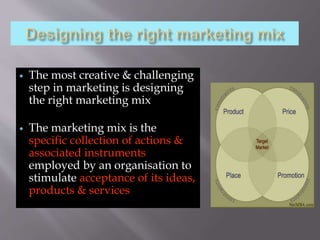
 The most creative & challenging
step in marketing is designing
the right marketing mix
 The marketing mix is the
specific collection of actions &
associated instruments
employed by an organisation to
stimulate acceptance of its ideas,
products & services
 The marketing mix principles are controllable variables, which
have to be carefully managed and must meet the needs of the
defined target group.
 marketing mix is apart of the organizations planning process
and consists of analyzing the following-
 How will you design, package and add value to the
product. Product strategies.
 What pricing strategy is appropriate to use Price strategies.
 Where will the firm locate? Place strategies.
 How will the firm promote its product Promotion
strategies.
 First, the firm chooses the product to meet the
identified need of the target segment
 Second, the right distribution channel is used
to make the product available
 Third, the firm undertakes eye catching
promotion
 Fourth, the price platform is acceptable to the
customer & firm
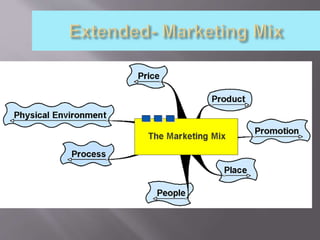
 Booms and Bitner included three additional 'Ps' to accommodate
trends towards a service or knowledge based economy:
 People – all people who directly or indirectly influence the
perceived value of the product or service, including knowledge
workers, employees, management and consumers.
 Process – procedures, mechanisms and flow of activities which
lead to an exchange of value.
 Physical evidence – the direct sensory experience of a product or
service that allows a customer to measure whether he or she has
received value. Examples might include the way a customer is
treated by a staff member, or the length of time a customer has to
wait, or a cover letter from an insurance company, or the
environment in which a product or service is delivered
 Broadly defined, optimizing the marketing mix
is the primary responsibility of marketing.
 By offering the product with the right
combination of the four Ps marketers can
improve their results and marketing
effectiveness.
 Strategic & Tactical Changes
 Making large changes in any of the four Ps can
be considered strategic.
 Making small changes in the marketing mix is
typically considered to be a tactical change.
 A tangible object or an intangible service that is
mass produced or manufactured on a large
scale with a specific volume of units.
 Intangible products are often service based like
the tourism industry & the hotel industry or
codes-based products like cell phone load and
credits.
 Instruments that aim at satisfaction of the
prospective exchange party’s needs
 Variety, Quality, Design, Features, Brand
Name, Packaging, Service
When an organization introduces a product into a
market they must ask themselves a number of
questions.
 Who is the product aimed at?
 What benefit will they expect?
 How do they plan to position the product
within the market?
 What differential advantage will the product
offer over their competitors?
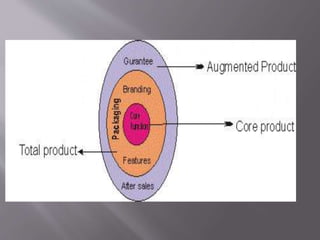
 Kotler suggested that a product should be viewed in
three levels.
 Level 1: Core Product. What is the core benefit your
product offers?. Customers who purchase a camera are
buying more then just a camera they are purchasing
memories.
 Level 2 Actual Product: All cameras capture memories.
The aim is to ensure that your potential customers
purchase your one. The strategy at this level involves
organizations branding, adding features and benefits to
ensure that their product offers a differential advantage
from their competitors.
 Level 3: Augmented product: What additional non-
tangible benefits can you offer? Competition at this level
is based around after sales service, warranties, delivery
and so on.
 Product design – Will the design be the selling point for the
organisation as we have seen with the iPad
 Product quality: Quality has to consistent with other elements of
the marketing mix. A premium based pricing strategy has to
reflect the quality a product offers.
 Product features: What features will you add that may increase
the benefit offered to your target market? Will the organisation
use a discriminatory pricing policy for offering these additional
benefits?
 Branding: One of the most important decisions a marketing
manager can make is about branding. The value of brands in
today’s environment is phenomenal. Brands have the power of
instant sales, they convey a message of confidence, quality and
reliability to their target market.
 Even today, manufacturers of products which are built
to customer order, for example, cars, aeroplanes and
medical equipment, offer such a large range of
combinations of product features that millions of
variants of a single product are possible.
 Commercially available software systems support the
automation of many aspects of the engineering process;
product databases enable the description of single
products and engineering applications can use these
product descriptions to carry out their tasks.
 A product or process that is reliable, and that
performs its intended function is said to be a
quality product.
 Quality in business, has an interpretation as
the non-inferiority or superiority of something.
 Quality is a perceptual, conditional and
somewhat subjective attribute and may be
understood differently by different people.
 Consumers may focus on the specification
quality of a product/service, or how it
compares to competitors in the marketplace.
 Product design can be defined as the idea
generation, concept development, testing and
manufacturing or implementation of a physical
object or service
 The brand name is often used interchangeably
within "brand", although it is more correctly
used to specifically denote written or spoken
linguistic elements of any product.
 In this context a "brand name" constitutes a
type of trademark, if the brand name
exclusively identifies the brand owner as the
commercial source of products or services
Pricing should take into account the following
factors:
 Fixed and variable costs.
 Competition
 Company objectives
 Proposed positioning strategies.
 Target group and willingness to pay.
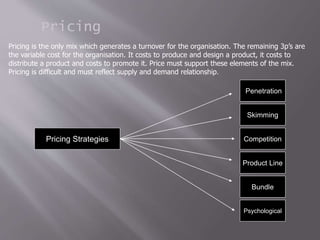
Pricing
Pricing Strategies
Penetration
Skimming
Competition
Product Line
Bundle
Psychological
Pricing is the only mix which generates a turnover for the organisation. The remaining 3p’s are
the variable cost for the organisation. It costs to produce and design a product, it costs to
distribute a product and costs to promote it. Price must support these elements of the mix.
Pricing is difficult and must reflect supply and demand relationship.
 Penetration pricing: Where the organisation sets
a low price to increase sales and market share.
 Skimming pricing: The organisation sets an
initial high price and then slowly lowers the
price to make the product available to a wider
market. The objective is to skim profits of the
market layer by layer.
 Competition pricing: Setting a price in
comparison with competitors.
 Product Line Pricing: Pricing different
products within the same product range at
different price points. An example would be a
Car manufacturer offering different Cars with
different features at different prices.
 Bundle Pricing: The organisation bundles a
group of products at a reduced price.
 Psychological pricing: The seller here will
consider the psychology of price and the
positioning of price within the market place.
The seller will therefore charge INR 999
instead of INR 1000
Refers to how an organisation will distribute the
product or service they are offering to the end
user.
 What channel of distribution will they use?
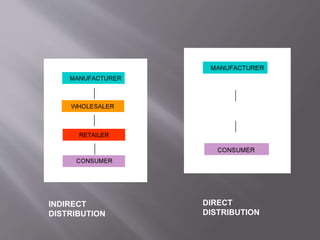
 Two types of channel of distribution methods are
available.
 Indirect distribution involves distributing your
product by the use of an intermediary.
 Direct distribution involves distributing direct from a
manufacturer to the consumer
INDIRECT
DISTRIBUTION
DIRECT
DISTRIBUTION
 Depending on the type of product being distributed there are three
common distribution strategies available:
 1. Intensive distribution: Used commonly to distribute low priced or
impulse purchase products eg chocolates, soft drinks.
 2. Exclusive distribution: Involves limiting distribution to a single outlet.
The product is usually highly priced, and requires the intermediary to
place much detail in its sell. An example of would be the sale of vehicles
through exclusive dealers.
 3. Selective Distribution: A small number of retail outlets are chosen to
distribute the product. Selective distribution is common with products
such as computers, televisions household appliances, where consumers
are willing to shop around and where manufacturers want a large
geographical spread.
 If a manufacturer decides to adopt an exclusive or selective strategy they
should select a intermediary which has experience of handling similar
products, credible and is known by the target audience.
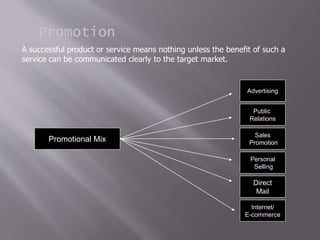
Promotion
Promotional Mix
Advertising
Public
Relations
Sales
Promotion
Personal
Selling
Direct
Mail
Internet/
E-commerce
A successful product or service means nothing unless the benefit of such a
service can be communicated clearly to the target market.
 A successful product or service means nothing unless the benefit of such a
service can be communicated clearly to the target market. An organisations
promotional strategy can consist of:
 Advertising: Is any non personal paid form of communication using any
form of mass media.
 Public relations: Involves developing positive relationships with the
organisation media public. The art of good public relations is not only to
obtain favorable publicity within the media, but it is also involves being able
to handle successfully negative attention.
 Sales promotion: Commonly used to obtain an increase in sales short term.
Could involve using money off coupons or special offers.
 Personal selling: Selling a product service one to one.
 Direct Mail: Is the sending of publicity material to a named person within
an organisation. There has been a massive growth in direct mail campaigns
over the last 5 years.

Marketingmix 1

  • 2.
    The marketing mixprinciples (also known as the 4 p’s.) are used by business as tools to assist them in pursuing their objectives
  • 3.
     The mostcreative & challenging step in marketing is designing the right marketing mix  The marketing mix is the specific collection of actions & associated instruments employed by an organisation to stimulate acceptance of its ideas, products & services
  • 4.
     The marketingmix principles are controllable variables, which have to be carefully managed and must meet the needs of the defined target group.  marketing mix is apart of the organizations planning process and consists of analyzing the following-  How will you design, package and add value to the product. Product strategies.  What pricing strategy is appropriate to use Price strategies.  Where will the firm locate? Place strategies.  How will the firm promote its product Promotion strategies.
  • 5.
     First, thefirm chooses the product to meet the identified need of the target segment  Second, the right distribution channel is used to make the product available  Third, the firm undertakes eye catching promotion  Fourth, the price platform is acceptable to the customer & firm
  • 6.
     Booms andBitner included three additional 'Ps' to accommodate trends towards a service or knowledge based economy:  People – all people who directly or indirectly influence the perceived value of the product or service, including knowledge workers, employees, management and consumers.  Process – procedures, mechanisms and flow of activities which lead to an exchange of value.  Physical evidence – the direct sensory experience of a product or service that allows a customer to measure whether he or she has received value. Examples might include the way a customer is treated by a staff member, or the length of time a customer has to wait, or a cover letter from an insurance company, or the environment in which a product or service is delivered
  • 8.
     Broadly defined,optimizing the marketing mix is the primary responsibility of marketing.  By offering the product with the right combination of the four Ps marketers can improve their results and marketing effectiveness.  Strategic & Tactical Changes
  • 9.
     Making largechanges in any of the four Ps can be considered strategic.  Making small changes in the marketing mix is typically considered to be a tactical change.
  • 10.
     A tangibleobject or an intangible service that is mass produced or manufactured on a large scale with a specific volume of units.  Intangible products are often service based like the tourism industry & the hotel industry or codes-based products like cell phone load and credits.
  • 11.
     Instruments thataim at satisfaction of the prospective exchange party’s needs  Variety, Quality, Design, Features, Brand Name, Packaging, Service
  • 12.
    When an organizationintroduces a product into a market they must ask themselves a number of questions.  Who is the product aimed at?  What benefit will they expect?  How do they plan to position the product within the market?  What differential advantage will the product offer over their competitors?
  • 14.
     Kotler suggestedthat a product should be viewed in three levels.  Level 1: Core Product. What is the core benefit your product offers?. Customers who purchase a camera are buying more then just a camera they are purchasing memories.  Level 2 Actual Product: All cameras capture memories. The aim is to ensure that your potential customers purchase your one. The strategy at this level involves organizations branding, adding features and benefits to ensure that their product offers a differential advantage from their competitors.  Level 3: Augmented product: What additional non- tangible benefits can you offer? Competition at this level is based around after sales service, warranties, delivery and so on.
  • 15.
     Product design– Will the design be the selling point for the organisation as we have seen with the iPad  Product quality: Quality has to consistent with other elements of the marketing mix. A premium based pricing strategy has to reflect the quality a product offers.  Product features: What features will you add that may increase the benefit offered to your target market? Will the organisation use a discriminatory pricing policy for offering these additional benefits?  Branding: One of the most important decisions a marketing manager can make is about branding. The value of brands in today’s environment is phenomenal. Brands have the power of instant sales, they convey a message of confidence, quality and reliability to their target market.
  • 16.
     Even today,manufacturers of products which are built to customer order, for example, cars, aeroplanes and medical equipment, offer such a large range of combinations of product features that millions of variants of a single product are possible.  Commercially available software systems support the automation of many aspects of the engineering process; product databases enable the description of single products and engineering applications can use these product descriptions to carry out their tasks.
  • 17.
     A productor process that is reliable, and that performs its intended function is said to be a quality product.  Quality in business, has an interpretation as the non-inferiority or superiority of something.  Quality is a perceptual, conditional and somewhat subjective attribute and may be understood differently by different people.  Consumers may focus on the specification quality of a product/service, or how it compares to competitors in the marketplace.
  • 18.
     Product designcan be defined as the idea generation, concept development, testing and manufacturing or implementation of a physical object or service
  • 19.
     The brandname is often used interchangeably within "brand", although it is more correctly used to specifically denote written or spoken linguistic elements of any product.  In this context a "brand name" constitutes a type of trademark, if the brand name exclusively identifies the brand owner as the commercial source of products or services
  • 20.
    Pricing should takeinto account the following factors:  Fixed and variable costs.  Competition  Company objectives  Proposed positioning strategies.  Target group and willingness to pay.
  • 21.
    Pricing Pricing Strategies Penetration Skimming Competition Product Line Bundle Psychological Pricingis the only mix which generates a turnover for the organisation. The remaining 3p’s are the variable cost for the organisation. It costs to produce and design a product, it costs to distribute a product and costs to promote it. Price must support these elements of the mix. Pricing is difficult and must reflect supply and demand relationship.
  • 22.
     Penetration pricing:Where the organisation sets a low price to increase sales and market share.  Skimming pricing: The organisation sets an initial high price and then slowly lowers the price to make the product available to a wider market. The objective is to skim profits of the market layer by layer.  Competition pricing: Setting a price in comparison with competitors.
  • 23.
     Product LinePricing: Pricing different products within the same product range at different price points. An example would be a Car manufacturer offering different Cars with different features at different prices.  Bundle Pricing: The organisation bundles a group of products at a reduced price.  Psychological pricing: The seller here will consider the psychology of price and the positioning of price within the market place. The seller will therefore charge INR 999 instead of INR 1000
  • 24.
    Refers to howan organisation will distribute the product or service they are offering to the end user.  What channel of distribution will they use?  Two types of channel of distribution methods are available.  Indirect distribution involves distributing your product by the use of an intermediary.  Direct distribution involves distributing direct from a manufacturer to the consumer
  • 25.
  • 26.
     Depending onthe type of product being distributed there are three common distribution strategies available:  1. Intensive distribution: Used commonly to distribute low priced or impulse purchase products eg chocolates, soft drinks.  2. Exclusive distribution: Involves limiting distribution to a single outlet. The product is usually highly priced, and requires the intermediary to place much detail in its sell. An example of would be the sale of vehicles through exclusive dealers.  3. Selective Distribution: A small number of retail outlets are chosen to distribute the product. Selective distribution is common with products such as computers, televisions household appliances, where consumers are willing to shop around and where manufacturers want a large geographical spread.  If a manufacturer decides to adopt an exclusive or selective strategy they should select a intermediary which has experience of handling similar products, credible and is known by the target audience.
  • 27.
    Promotion Promotional Mix Advertising Public Relations Sales Promotion Personal Selling Direct Mail Internet/ E-commerce A successfulproduct or service means nothing unless the benefit of such a service can be communicated clearly to the target market.
  • 28.
     A successfulproduct or service means nothing unless the benefit of such a service can be communicated clearly to the target market. An organisations promotional strategy can consist of:  Advertising: Is any non personal paid form of communication using any form of mass media.  Public relations: Involves developing positive relationships with the organisation media public. The art of good public relations is not only to obtain favorable publicity within the media, but it is also involves being able to handle successfully negative attention.  Sales promotion: Commonly used to obtain an increase in sales short term. Could involve using money off coupons or special offers.  Personal selling: Selling a product service one to one.  Direct Mail: Is the sending of publicity material to a named person within an organisation. There has been a massive growth in direct mail campaigns over the last 5 years.