CORE CONCEPTS OF MARKETING
Needs, wants,
and demands
Products
and services
Value and
satisfaction
Exchange, and
transactions,
Markets and marketers
CORE CONCEPTS OF MARKETING
 Need
 Basic human requirements
Example: Need food
 Wants
 Needs directed to specific objects
 The form of needs as shaped by culture
and the individual
Example: Want a Burger
 Demands
 Wants which are backed by buying
power
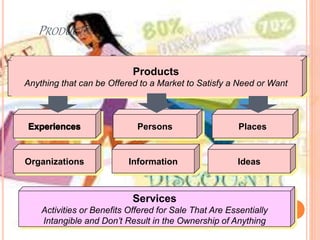
Products
Anything that can be Offered to a Market to Satisfy a Need or Want
Persons Places
Organizations IdeasInformation
PRODUCTS
Services
Activities or Benefits Offered for Sale That Are Essentially
Intangible and Don’t Result in the Ownership of Anything
2.VALUE AND SATISFACTION
Benefits
functional benefits
emotional benefits
Costs
Monetary costs
Time costs
Energy costs
Psychic costs
VALUE AND SATISFACTION
benefits
Value = -----------------
costs
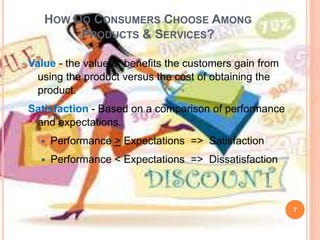
HOW DO CONSUMERS CHOOSE AMONG
PRODUCTS & SERVICES?
Value - the value or benefits the customers gain from
using the product versus the cost of obtaining the
product.
Satisfaction - Based on a comparison of performance
and expectations.
 Performance > Expectations => Satisfaction
 Performance < Expectations => Dissatisfaction
7
EXCHANGE
 Get something (product /service) by offering
something in return.
Eg. kind (barter) or money (value )
 Exchange is a value creating process because it
leaves both parties better off
(win – win situation)
CORE CONCEPTS OF MARKETING
 Market
Set of actual and potential
buyers of a product
Marketers seek buyers that
are profitable
MARKETING MANAGEMENT
Marketing management
is the marketing concept
in action.
DEFINITIONS OF MARKETING MANAGEMENT
 Traditional
 Narrow
 Whatever is produced
by the manufacturer
will be acceptable to
the consumer.
 Modern
 Boarder
 Emphasis on
satisfaction of the
consumers
Product oriented Customer oriented
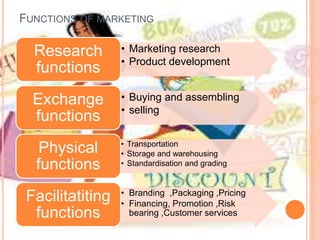
FUNCTIONS OF MARKETING
• Marketing research
• Product development
Research
functions
• Buying and assembling
• selling
Exchange
functions
• Transportation
• Storage and warehousing
• Standardisation and grading
Physical
functions
• Branding ,Packaging ,Pricing
• Financing, Promotion ,Risk
bearing ,Customer services
Facilitatiting
functions
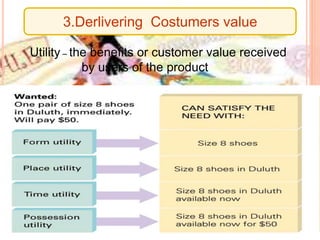
3.Derlivering Costumers value
Utility – the benefits or customer value received
by users of the product
FUNCTIONS OF MARKETING
 Gathering and Analysing Market Information
 Standardisation and Grading
 Packaging and Labelling
 Branding
 Customer Support Service
 Pricing of Products
 Promotion
 Physical Distribution
 Storage or Warehousing
BUYING AND ASSEMBLING
 It involves what to buy,
 of what quality,
 how much from whom,
 when and at what
price.
STANDARDISATION AND GRADING
 Standardisation refers to determining of standard
regarding:
 size,
 quality,
 design,
 weight,
 colour,
 raw material
to be used, etc., in respect of a particular product.
CUSTOMER SUPPORT SERVICE
 (i) After-sales-services
 (ii) Handling customers’ complaints
 (iii) Technical services
 (iv) Credit facilities
 (v) Maintenance services

PRICING OF PRODUCTS
 The price of a product is affected by its
 cost,
 rate of profit,
 price of competing product,
 policy of the government, etc
PROMOTION
 (i) Advertising,
 (ii) Personal selling,
 (iii) Sales promotion and
 (iv) Publicity.
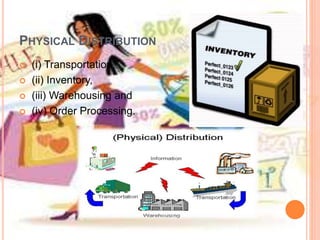
PHYSICAL DISTRIBUTION
 (i) Transportation,
 (ii) Inventory,
 (iii) Warehousing and
 (iv) Order Processing.
IMPORTANCE OF MARKETING
A. Importance of marketing for
the firms
 Helpful in business planning and
decision making
 Helpful in distribution
 Helpful in increasing profits
 Helpful in communication between
firm and society
IMPORTANCE OF MARKETING FOR THE
CONSUMERS
Increase in customer satisfaction
Facilitates choice
Increase in knowledge
Providing good quality products
Price stabilization
Increase in standard of living
IMPORTANCE OF MARKETING FOR THE
SOCIETY
Provides employment
Increase in national income
Reduction in distribution cost
Protection from depression
IMPORTANCE OF MARKETING AS A BUSINESS
ACTIVITY
Basis for business function
Basis for economic activity
Creation of utility
Production of socially useful
products

Marketing sf

  • 2.
    CORE CONCEPTS OFMARKETING Needs, wants, and demands Products and services Value and satisfaction Exchange, and transactions, Markets and marketers
  • 3.
    CORE CONCEPTS OFMARKETING  Need  Basic human requirements Example: Need food  Wants  Needs directed to specific objects  The form of needs as shaped by culture and the individual Example: Want a Burger  Demands  Wants which are backed by buying power
  • 4.
    Products Anything that canbe Offered to a Market to Satisfy a Need or Want Persons Places Organizations IdeasInformation PRODUCTS Services Activities or Benefits Offered for Sale That Are Essentially Intangible and Don’t Result in the Ownership of Anything
  • 5.
    2.VALUE AND SATISFACTION Benefits functionalbenefits emotional benefits Costs Monetary costs Time costs Energy costs Psychic costs
  • 6.
    VALUE AND SATISFACTION benefits Value= ----------------- costs
  • 7.
    HOW DO CONSUMERSCHOOSE AMONG PRODUCTS & SERVICES? Value - the value or benefits the customers gain from using the product versus the cost of obtaining the product. Satisfaction - Based on a comparison of performance and expectations.  Performance > Expectations => Satisfaction  Performance < Expectations => Dissatisfaction 7
  • 8.
    EXCHANGE  Get something(product /service) by offering something in return. Eg. kind (barter) or money (value )  Exchange is a value creating process because it leaves both parties better off (win – win situation)
  • 9.
    CORE CONCEPTS OFMARKETING  Market Set of actual and potential buyers of a product Marketers seek buyers that are profitable
  • 10.
    MARKETING MANAGEMENT Marketing management isthe marketing concept in action.
  • 11.
    DEFINITIONS OF MARKETINGMANAGEMENT  Traditional  Narrow  Whatever is produced by the manufacturer will be acceptable to the consumer.  Modern  Boarder  Emphasis on satisfaction of the consumers Product oriented Customer oriented
  • 12.
    FUNCTIONS OF MARKETING •Marketing research • Product development Research functions • Buying and assembling • selling Exchange functions • Transportation • Storage and warehousing • Standardisation and grading Physical functions • Branding ,Packaging ,Pricing • Financing, Promotion ,Risk bearing ,Customer services Facilitatiting functions
  • 13.
    3.Derlivering Costumers value Utility– the benefits or customer value received by users of the product
  • 14.
    FUNCTIONS OF MARKETING Gathering and Analysing Market Information  Standardisation and Grading  Packaging and Labelling  Branding  Customer Support Service  Pricing of Products  Promotion  Physical Distribution  Storage or Warehousing
  • 15.
    BUYING AND ASSEMBLING It involves what to buy,  of what quality,  how much from whom,  when and at what price.
  • 16.
    STANDARDISATION AND GRADING Standardisation refers to determining of standard regarding:  size,  quality,  design,  weight,  colour,  raw material to be used, etc., in respect of a particular product.
  • 17.
    CUSTOMER SUPPORT SERVICE (i) After-sales-services  (ii) Handling customers’ complaints  (iii) Technical services  (iv) Credit facilities  (v) Maintenance services 
  • 18.
    PRICING OF PRODUCTS The price of a product is affected by its  cost,  rate of profit,  price of competing product,  policy of the government, etc
  • 19.
    PROMOTION  (i) Advertising, (ii) Personal selling,  (iii) Sales promotion and  (iv) Publicity.
  • 20.
    PHYSICAL DISTRIBUTION  (i)Transportation,  (ii) Inventory,  (iii) Warehousing and  (iv) Order Processing.
  • 21.
    IMPORTANCE OF MARKETING A.Importance of marketing for the firms  Helpful in business planning and decision making  Helpful in distribution  Helpful in increasing profits  Helpful in communication between firm and society
  • 22.
    IMPORTANCE OF MARKETINGFOR THE CONSUMERS Increase in customer satisfaction Facilitates choice Increase in knowledge Providing good quality products Price stabilization Increase in standard of living
  • 23.
    IMPORTANCE OF MARKETINGFOR THE SOCIETY Provides employment Increase in national income Reduction in distribution cost Protection from depression
  • 24.
    IMPORTANCE OF MARKETINGAS A BUSINESS ACTIVITY Basis for business function Basis for economic activity Creation of utility Production of socially useful products