Chapter Seven Customer-Driven Marketing Strategy: Creating Value for Target Customers
Customer-Driven Marketing Strategy: Creating Value for Target Customers Market Segmentation Market Targeting Differentiation and Positioning  Topic Outline
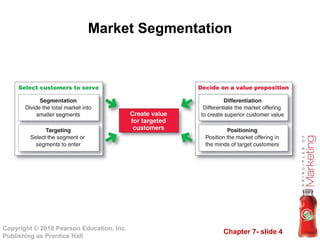
Market segmentation  is the process that companies use to divide large heterogeneous markets into small markets that can be reached more efficiently and effectively with products and services that match their unique needs Market Segmentation

Market Segmentation
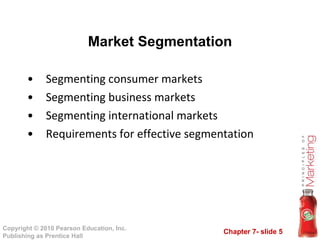
Segmenting consumer markets Segmenting business markets Segmenting international markets Requirements for effective segmentation Market Segmentation
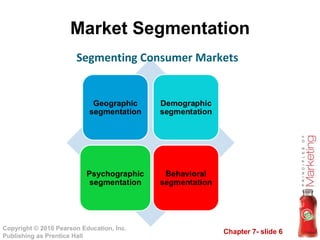
Market Segmentation Segmenting Consumer Markets
Market Segmentation Geographic segmentation divides the market into different geographical units such as nations, regions, states, counties, or cities Segmenting Consumer Markets
Market Segmentation Demographic segmentation  divides the market into groups based on variables such as age, gender, family size, family life cycle, income, occupation, education, religion, race, generation, and nationality Segmenting Consumer Markets
Market Segmentation Age and life-cycle stage segmentation  is the process of offering different products or using different marketing approaches for different age and life-cycle groups Gender segmentation  divides the market based on sex (male or female)
Market Segmentation Income segmentation  divides the market into affluent or low-income consumers Psychographic segmentation  divides buyers into different groups based on social class, lifestyle, or personality traits Segmenting Consumer Markets
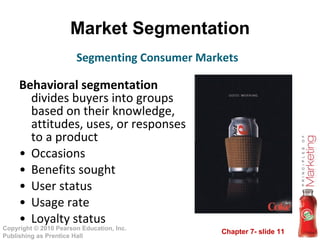
Market Segmentation Behavioral segmentation  divides buyers into groups based on their knowledge, attitudes, uses, or responses to a product Occasions Benefits sought User status Usage rate Loyalty status Segmenting Consumer Markets
Market Segmentation Multiple segmentation  is used to identify smaller, better-defined target groups Geodemographic segmentation  is an example of multivariable segmentation that divides groups into consumer lifestyle patterns Using Multiple Segmentation Bases
Market Segmentation PRIZM NE  classifies every American household into 66 unique segments organized into 14 different social groups.  These groups segment people and locations into marketable groups of like-minded consumers that exhibit unique characteristics and buying behavior based on a host of demographic factors Using Multiple Segmentation Bases
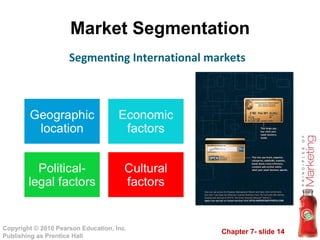
Market Segmentation Segmenting International markets
Market Segmentation Intermarket segmentation  divides consumers into groups with similar needs and buying behaviors even though they are located in different countries Segmenting Business Markets
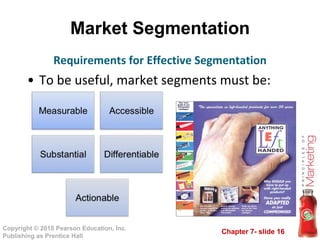
Market Segmentation To be useful, market segments must be: Requirements for Effective Segmentation
Market Targeting  Target market consists of a set of buyers who share common needs or characteristics that the company decides to serve Selecting Target Market Segments
Market Targeting Segment size and growth Segment structural attractiveness Company objectives and resources Evaluating Market Segments .
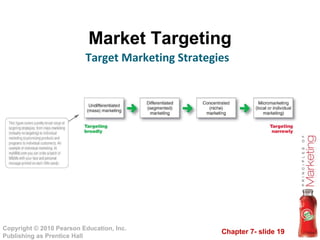
Market Targeting Target Marketing Strategies
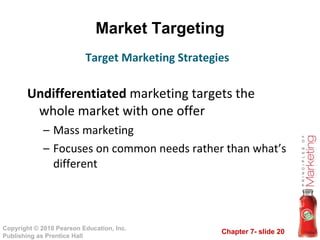
Market Targeting Undifferentiated  marketing targets the whole market with one offer Mass marketing Focuses on common needs rather than what’s different Target Marketing Strategies
Market Targeting Differentiated marketing  targets several different market segments and designs separate offers for each Goal is to achieve higher sales and stronger position More expensive than undifferentiated marketing Target Marketing Strategies
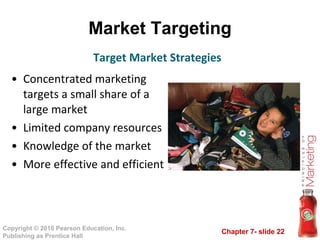
Market Targeting Concentrated marketing targets a small share of a large market Limited company resources Knowledge of the market More effective and efficient Target Market Strategies
Marketing Targeting Micromarketing  is the practice of tailoring products and marketing programs to suit the tastes of specific individuals and locations Local marketing Individual marketing Target Market Strategies
Market Targeting Local marketing  involves tailoring brands and promotion to the needs and wants of local customer groups Cities Neighborhoods Stores Target Market Strategies
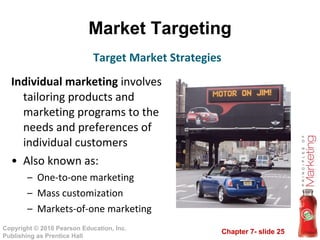
Market Targeting Individual marketing  involves tailoring products and marketing programs to the needs and preferences of individual customers Also known as: One-to-one marketing Mass customization Markets-of-one marketing Target Market Strategies
Market Targeting Depends on: Company resources Product variability Product life-cycle stage Market variability Competitor’s marketing strategies Choosing a Target Market
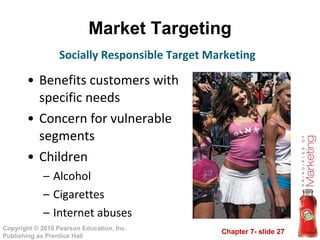
Market Targeting Benefits customers with specific needs Concern for vulnerable segments Children Alcohol Cigarettes Internet abuses Socially Responsible Target Marketing
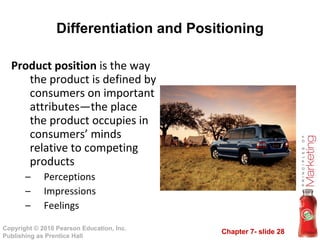
Differentiation and Positioning Product position  is the way the product is defined by consumers on important attributes—the place the product occupies in consumers’ minds relative to competing products Perceptions Impressions Feelings
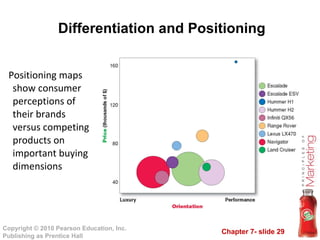
Differentiation and Positioning Positioning maps show consumer perceptions of their brands versus competing products on important buying dimensions
Differentiation and Positioning Identifying a set of possible competitive advantages to build a position Choosing the right competitive advantages Selecting an overall positioning strategy Developing a positioning statement Choosing a Differentiation and Positioning Strategy
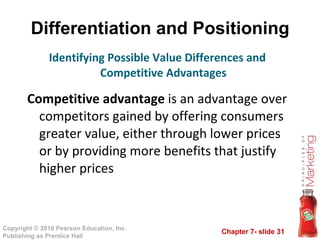
Differentiation and Positioning Competitive advantage  is an advantage over competitors gained by offering consumers greater value, either through lower prices or by providing more benefits that justify higher prices Identifying Possible Value Differences and Competitive Advantages
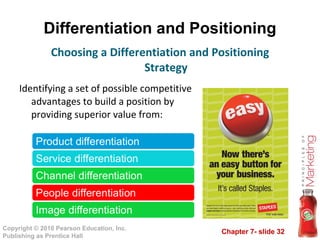
Differentiation and Positioning Identifying a set of possible competitive advantages to build a position by providing superior value from: Choosing a Differentiation and Positioning Strategy
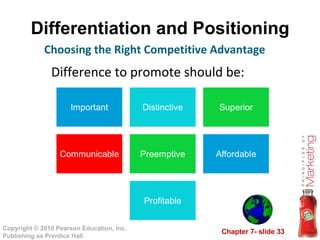
Differentiation and Positioning Difference to promote should be: Choosing the Right Competitive Advantage
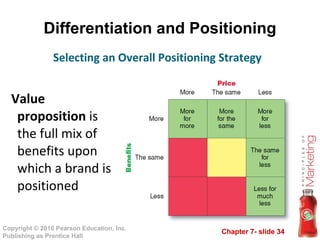
Differentiation and Positioning Value proposition  is the full mix of benefits upon which a brand is positioned Selecting an Overall Positioning Strategy
Differentiation and Positioning To (target segment and need) our (brand) is (concept) that (point of difference) Developing a Positioning Statement Web link
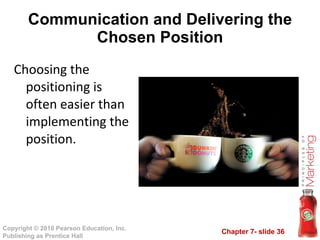
Communication and Delivering the Chosen Position Choosing the positioning is often easier than implementing the position.
All rights reserved. No part of this publication may be reproduced, stored in a retrieval system, or transmitted, in any form or by any means, electronic, mechanical, photocopying, recording, or otherwise, without the prior written permission of the publisher. Printed in the United States of America. Copyright © 2010 Pearson Education, Inc.   Publishing as Prentice Hall

Kotler pom13e instructor_07

  • 1.
    Chapter Seven Customer-DrivenMarketing Strategy: Creating Value for Target Customers
  • 2.
    Customer-Driven Marketing Strategy:Creating Value for Target Customers Market Segmentation Market Targeting Differentiation and Positioning Topic Outline
  • 3.
    Market segmentation is the process that companies use to divide large heterogeneous markets into small markets that can be reached more efficiently and effectively with products and services that match their unique needs Market Segmentation
  • 4.
  • 5.
    Segmenting consumer marketsSegmenting business markets Segmenting international markets Requirements for effective segmentation Market Segmentation
  • 6.
  • 7.
    Market Segmentation Geographicsegmentation divides the market into different geographical units such as nations, regions, states, counties, or cities Segmenting Consumer Markets
  • 8.
    Market Segmentation Demographicsegmentation divides the market into groups based on variables such as age, gender, family size, family life cycle, income, occupation, education, religion, race, generation, and nationality Segmenting Consumer Markets
  • 9.
    Market Segmentation Ageand life-cycle stage segmentation is the process of offering different products or using different marketing approaches for different age and life-cycle groups Gender segmentation divides the market based on sex (male or female)
  • 10.
    Market Segmentation Incomesegmentation divides the market into affluent or low-income consumers Psychographic segmentation divides buyers into different groups based on social class, lifestyle, or personality traits Segmenting Consumer Markets
  • 11.
    Market Segmentation Behavioralsegmentation divides buyers into groups based on their knowledge, attitudes, uses, or responses to a product Occasions Benefits sought User status Usage rate Loyalty status Segmenting Consumer Markets
  • 12.
    Market Segmentation Multiplesegmentation is used to identify smaller, better-defined target groups Geodemographic segmentation is an example of multivariable segmentation that divides groups into consumer lifestyle patterns Using Multiple Segmentation Bases
  • 13.
    Market Segmentation PRIZMNE classifies every American household into 66 unique segments organized into 14 different social groups. These groups segment people and locations into marketable groups of like-minded consumers that exhibit unique characteristics and buying behavior based on a host of demographic factors Using Multiple Segmentation Bases
  • 14.
    Market Segmentation SegmentingInternational markets
  • 15.
    Market Segmentation Intermarketsegmentation divides consumers into groups with similar needs and buying behaviors even though they are located in different countries Segmenting Business Markets
  • 16.
    Market Segmentation Tobe useful, market segments must be: Requirements for Effective Segmentation
  • 17.
    Market Targeting Target market consists of a set of buyers who share common needs or characteristics that the company decides to serve Selecting Target Market Segments
  • 18.
    Market Targeting Segmentsize and growth Segment structural attractiveness Company objectives and resources Evaluating Market Segments .
  • 19.
    Market Targeting TargetMarketing Strategies
  • 20.
    Market Targeting Undifferentiated marketing targets the whole market with one offer Mass marketing Focuses on common needs rather than what’s different Target Marketing Strategies
  • 21.
    Market Targeting Differentiatedmarketing targets several different market segments and designs separate offers for each Goal is to achieve higher sales and stronger position More expensive than undifferentiated marketing Target Marketing Strategies
  • 22.
    Market Targeting Concentratedmarketing targets a small share of a large market Limited company resources Knowledge of the market More effective and efficient Target Market Strategies
  • 23.
    Marketing Targeting Micromarketing is the practice of tailoring products and marketing programs to suit the tastes of specific individuals and locations Local marketing Individual marketing Target Market Strategies
  • 24.
    Market Targeting Localmarketing involves tailoring brands and promotion to the needs and wants of local customer groups Cities Neighborhoods Stores Target Market Strategies
  • 25.
    Market Targeting Individualmarketing involves tailoring products and marketing programs to the needs and preferences of individual customers Also known as: One-to-one marketing Mass customization Markets-of-one marketing Target Market Strategies
  • 26.
    Market Targeting Dependson: Company resources Product variability Product life-cycle stage Market variability Competitor’s marketing strategies Choosing a Target Market
  • 27.
    Market Targeting Benefitscustomers with specific needs Concern for vulnerable segments Children Alcohol Cigarettes Internet abuses Socially Responsible Target Marketing
  • 28.
    Differentiation and PositioningProduct position is the way the product is defined by consumers on important attributes—the place the product occupies in consumers’ minds relative to competing products Perceptions Impressions Feelings
  • 29.
    Differentiation and PositioningPositioning maps show consumer perceptions of their brands versus competing products on important buying dimensions
  • 30.
    Differentiation and PositioningIdentifying a set of possible competitive advantages to build a position Choosing the right competitive advantages Selecting an overall positioning strategy Developing a positioning statement Choosing a Differentiation and Positioning Strategy
  • 31.
    Differentiation and PositioningCompetitive advantage is an advantage over competitors gained by offering consumers greater value, either through lower prices or by providing more benefits that justify higher prices Identifying Possible Value Differences and Competitive Advantages
  • 32.
    Differentiation and PositioningIdentifying a set of possible competitive advantages to build a position by providing superior value from: Choosing a Differentiation and Positioning Strategy
  • 33.
    Differentiation and PositioningDifference to promote should be: Choosing the Right Competitive Advantage
  • 34.
    Differentiation and PositioningValue proposition is the full mix of benefits upon which a brand is positioned Selecting an Overall Positioning Strategy
  • 35.
    Differentiation and PositioningTo (target segment and need) our (brand) is (concept) that (point of difference) Developing a Positioning Statement Web link
  • 36.
    Communication and Deliveringthe Chosen Position Choosing the positioning is often easier than implementing the position.
  • 37.
    All rights reserved.No part of this publication may be reproduced, stored in a retrieval system, or transmitted, in any form or by any means, electronic, mechanical, photocopying, recording, or otherwise, without the prior written permission of the publisher. Printed in the United States of America. Copyright © 2010 Pearson Education, Inc.   Publishing as Prentice Hall

Editor's Notes

  • #10 Note to Instructor This link goes to gurl.com, a Web site for female teenagers and young adults. It is interesting to browse with the students to note what kind of content is of interest to this group. A look at the advertisers with banner ads, sponsorships, or contests on the site shows the importance of targeted locations to these advertisers.
  • #11 Note to Instructor There are a whole group of products which are targeted to the affluent including hotels like Four Seasons, which is mentioned in the book.Their products offerings are deluxe: Kids in the City package for $520 a night and, among other things, enjoy a visit in their room from the Ice Cream Man, who arrives with all the fixings to make any concoction they desire. The Benjamin Hotel in New York City provides dog beds in a variety of styles and doggie bathrobes, as well as canine room service and DVDs for dogs. At the Ritz-Carlton, Lake Las Vegas in Henderson, Nevada, the Love at Lake Las Vegas weekend package includes two nights in the 2,400 square foot presidential suite, helicopter and gondola rides, a champagne-tasting party on a yacht complete with rose petals strewn about and a string trio, use of a luxury car throughout the stay, in-room couples spa treatment, a $5,000 casino line of credit, a $50,000 shopping spree at Neiman Marcus, 14 dozen roses, and a butler-drawn Cristal champagne bath.
  • #12 Note to Instructor Students often get confused with the difference between behavioral and psychographic segmentation. Behavior is more tied into how consumers use the product. A good illustration is greeting cards—ask students how their purchasing would be different when buying a birthday card for their mother versus one for a new boyfriend. In addition, ask them how people might look for different benefits when purchasing a car? Some might look for safety while others will look for the best gas mileage.
  • #19 Note to Instructor Structural attractiveness includes factors that affect long-run attractiveness. These factors might include strong and aggressive competitors, substitute products, and high power of buyers or powerful suppliers.
  • #24 Note to Instructor In slideshow view, click on movie icon to launch Meredith video snippet. See accompanying DVD for full video segment.
  • #25 Note to Instructor Advances in communications technology have given rise to a new high-tech version of location-based marketing. By coupling mobile phone services with GPS devices, many marketers are now targeting customers wherever they are with what they want. This might include marketers reaching people near their stores, looking to make a decision. Discussion Question What are the drawbacks of local marketing? It can drive up manufacturing and marketing costs by reducing economies of scale. It can also create logistics problems as companies try to meet the varied requirements of different regional and local markets. Further, a brand’s overall image might be diluted if the product and message vary too much in different localities.
  • #26 Note to Instructor Mass customization is the process through which firms interact one-to-one with masses of customers to design products and services tailor-made to meet individual needs. Has made relationships with customers important in the new economy. Provides a way to distinguish the company against competitors.
  • #29 Note to Instructor Tide is positioned as a powerful, all-purpose family detergent; Ivory is positioned as the gentle detergent for fine washables and baby clothes. At Subway restaurants, you “Eat Fresh;” at Olive Garden, “When You’re Here, You’re Family;” and at Applebee’s you’re “Eatin’ Good in the Neighborhood.” In the automobile market, the Nissan Versa and Honda Fit are positioned on economy, Mercedes and Cadillac on luxury, and Porsche and BMW on performance. Volvo positions powerfully on safety. And Toyota positions its fuel efficient, hybrid Prius as a high-tech solution to the energy shortage. “How far will you go to save the planet?” it asks.
  • #34 Note to Instructor Discussion Question Are you familiar with GEICO advertisements? If so, what is their positioning? The Web link is to a YouTube ad. The question is what do they promote as their difference. It is that they cost less and they are easy to use. The instructor might want to play competitor’s ads to see what differences they promote (State Farm) is a good example.
  • #36 Note to Instructor Ask this discussion question after watching the ad? Discussion Question What is a positioning statement for Verizon? Verizon positioning is always that they have the best connections in any area.