KEY CONSUMER MARKETS
Key Customer Markets
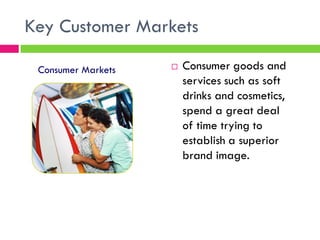
 Consumer goods and
services such as soft
drinks and cosmetics,
spend a great deal
of time trying to
establish a superior
brand image.
Consumer Markets
Key Customer Markets
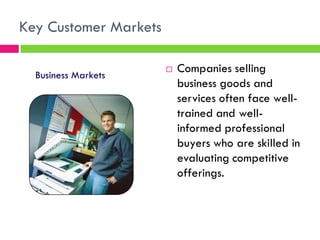
 Companies selling
business goods and
services often face well-
trained and well-
informed professional
buyers who are skilled in
evaluating competitive
offerings.
Business Markets
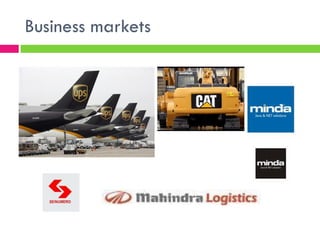
Business markets
Key Customer Markets
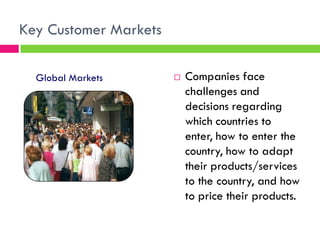
 Companies face
challenges and
decisions regarding
which countries to
enter, how to enter the
country, how to adapt
their products/services
to the country, and how
to price their products.
Global Markets
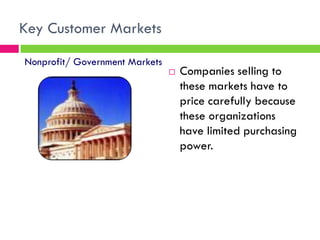
 Companies selling to
these markets have to
price carefully because
these organizations
have limited purchasing
power.
Nonprofit/ Government Markets
Key Customer Markets
CORE MARKETING
CONCEPTS
Core Marketing Concepts
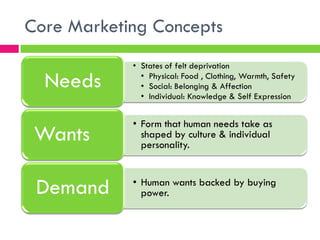
• States of felt deprivation
• Physical: Food , Clothing, Warmth, Safety
• Social: Belonging & Affection
• Individual: Knowledge & Self Expression
Needs
• Form that human needs take as
shaped by culture & individual
personality.
Wants
• Human wants backed by buying
power.Demand
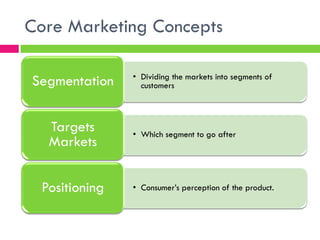
• Dividing the markets into segments of
customersSegmentation
• Which segment to go after
Targets
Markets
• Consumer’s perception of the product.Positioning
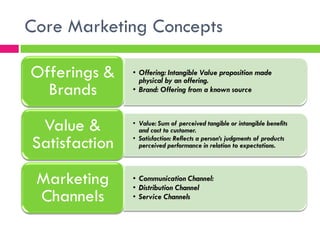
Core Marketing Concepts
• Offering: Intangible Value proposition made
physical by an offering.
• Brand: Offering from a known source
Offerings &
Brands
• Value: Sum of perceived tangible or intangible benefits
and cost to customer.
• Satisfaction: Reflects a person’s judgments of products
perceived performance in relation to expectations.
Value &
Satisfaction
• Communication Channel:
• Distribution Channel
• Service Channels
Marketing
Channels
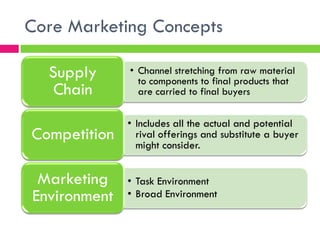
Core Marketing Concepts
• Channel stretching from raw material
to components to final products that
are carried to final buyers
Supply
Chain
• Includes all the actual and potential
rival offerings and substitute a buyer
might consider.
Competition
• Task Environment
• Broad Environment
Marketing
Environment
MARKETING MIX
Marketing MIX
 Marketing Mix is defined as the elements that an
organization controls that can be used to satisfy or
communicate with customers.
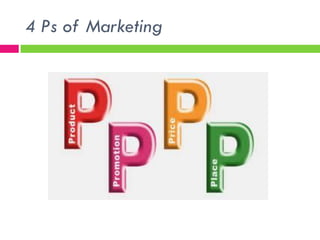
4 Ps of Marketing
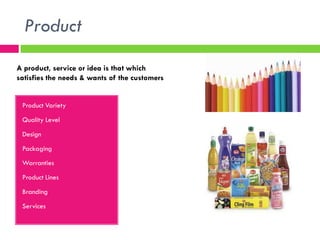
Product
•Product Variety
•Quality Level
•Design
•Packaging
•Warranties
•Product Lines
•Branding
•Services
A product, service or idea is that which
satisfies the needs & wants of the customers
Price
1. List Price
2. Discounts &
Allowances
3. Payment period
4. Credit terms
Price is the amount a consumer pays in exchange for the product or
service.
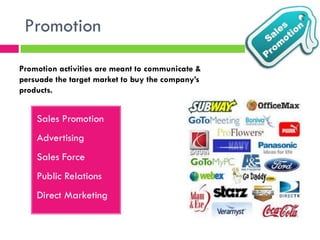
Promotion
Sales Promotion
Advertising
Sales Force
Public Relations
Direct Marketing
Promotion activities are meant to communicate &
persuade the target market to buy the company’s
products.
Place
Channels
Coverage
Assortments
Locations
Inventory
Transport
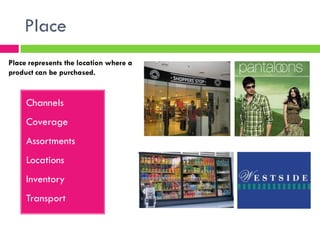
Place represents the location where a
product can be purchased.
People
Physical Evidence
Process
Extended 3 Ps
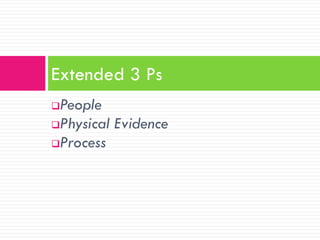
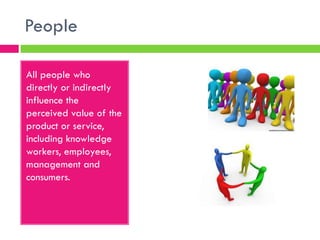
People
All people who
directly or indirectly
influence the
perceived value of the
product or service,
including knowledge
workers, employees,
management and
consumers.
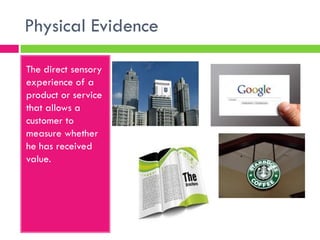
Physical Evidence
The direct sensory
experience of a
product or service
that allows a
customer to
measure whether
he has received
value.
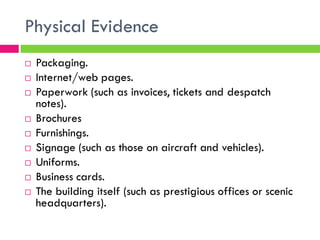
Physical Evidence
 Packaging.
 Internet/web pages.
 Paperwork (such as invoices, tickets and despatch
notes).
 Brochures
 Furnishings.
 Signage (such as those on aircraft and vehicles).
 Uniforms.
 Business cards.
 The building itself (such as prestigious offices or scenic
headquarters).
Process
Procedures, Mechanisms and Flow of Activities which lead to
an exchange of value
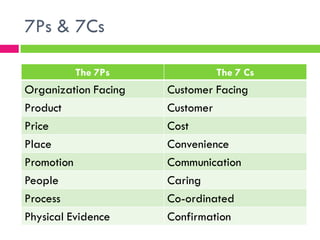
7Ps & 7Cs
The 7Ps The 7 Cs
Organization Facing Customer Facing
Product Customer
Price Cost
Place Convenience
Promotion Communication
People Caring
Process Co-ordinated
Physical Evidence Confirmation
Marketing Debate:
Take a Position!
Does marketing shape consumer needs?
or
Does marketing merely reflect the needs and wants
of consumers?

Class 2

  • 1.
  • 2.
    Key Customer Markets Consumer goods and services such as soft drinks and cosmetics, spend a great deal of time trying to establish a superior brand image. Consumer Markets
  • 3.
    Key Customer Markets Companies selling business goods and services often face well- trained and well- informed professional buyers who are skilled in evaluating competitive offerings. Business Markets
  • 4.
  • 5.
    Key Customer Markets Companies face challenges and decisions regarding which countries to enter, how to enter the country, how to adapt their products/services to the country, and how to price their products. Global Markets
  • 6.
     Companies sellingto these markets have to price carefully because these organizations have limited purchasing power. Nonprofit/ Government Markets Key Customer Markets
  • 7.
  • 8.
    Core Marketing Concepts •States of felt deprivation • Physical: Food , Clothing, Warmth, Safety • Social: Belonging & Affection • Individual: Knowledge & Self Expression Needs • Form that human needs take as shaped by culture & individual personality. Wants • Human wants backed by buying power.Demand
  • 9.
    • Dividing themarkets into segments of customersSegmentation • Which segment to go after Targets Markets • Consumer’s perception of the product.Positioning Core Marketing Concepts
  • 10.
    Core Marketing Concepts •Offering: Intangible Value proposition made physical by an offering. • Brand: Offering from a known source Offerings & Brands • Value: Sum of perceived tangible or intangible benefits and cost to customer. • Satisfaction: Reflects a person’s judgments of products perceived performance in relation to expectations. Value & Satisfaction • Communication Channel: • Distribution Channel • Service Channels Marketing Channels
  • 11.
    Core Marketing Concepts •Channel stretching from raw material to components to final products that are carried to final buyers Supply Chain • Includes all the actual and potential rival offerings and substitute a buyer might consider. Competition • Task Environment • Broad Environment Marketing Environment
  • 12.
  • 13.
    Marketing MIX  MarketingMix is defined as the elements that an organization controls that can be used to satisfy or communicate with customers.
  • 14.
    4 Ps ofMarketing
  • 15.
    Product •Product Variety •Quality Level •Design •Packaging •Warranties •ProductLines •Branding •Services A product, service or idea is that which satisfies the needs & wants of the customers
  • 16.
    Price 1. List Price 2.Discounts & Allowances 3. Payment period 4. Credit terms Price is the amount a consumer pays in exchange for the product or service.
  • 17.
    Promotion Sales Promotion Advertising Sales Force PublicRelations Direct Marketing Promotion activities are meant to communicate & persuade the target market to buy the company’s products.
  • 18.
  • 19.
  • 20.
    People All people who directlyor indirectly influence the perceived value of the product or service, including knowledge workers, employees, management and consumers.
  • 21.
    Physical Evidence The directsensory experience of a product or service that allows a customer to measure whether he has received value.
  • 22.
    Physical Evidence  Packaging. Internet/web pages.  Paperwork (such as invoices, tickets and despatch notes).  Brochures  Furnishings.  Signage (such as those on aircraft and vehicles).  Uniforms.  Business cards.  The building itself (such as prestigious offices or scenic headquarters).
  • 23.
    Process Procedures, Mechanisms andFlow of Activities which lead to an exchange of value
  • 24.
    7Ps & 7Cs The7Ps The 7 Cs Organization Facing Customer Facing Product Customer Price Cost Place Convenience Promotion Communication People Caring Process Co-ordinated Physical Evidence Confirmation
  • 25.
    Marketing Debate: Take aPosition! Does marketing shape consumer needs? or Does marketing merely reflect the needs and wants of consumers?