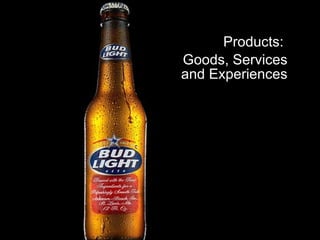
Products:  Goods, Services and Experiences
Chapter Objectives (1) Describe the nature of product in marketing management. Explain the concept of the goods–services continuum. Define the term product, including the core, actual and augmented product. Explain product classifications, and contrast the differing types of consumer products and business-to-business products. Explain services classifications and discuss the marketing of services.
Chapter Objectives (2) Discuss an extended notion of product that includes marketing persons, experiencing events, places, political ideas, causes, non-profit services, and fundraising endeavours. Outline the range of individual product decisions marketers make, discussing the product attributes of quality, features and design. Discuss branding, and contrast the differences among line extensions, brand extensions, multibrands and new brands.
Chapter Objectives (3) Illustrate product line and product mix decisions, describing stretching and filling the product line length, line modernisation, line featuring and line width. List some of the considerations marketers face in making international product decisions, including whether or not to standardise or adapt product and packaging.
What is a Product? A  product  is  anything  that  can  be  offered  to  a  market  with  the  objective  of  satisfying  a  consumer  need  or  want. It  can  include  physical  goods; services; people; places; organisations  and  ideas . It  is  everything, both  favourable  and unfavourable, that  the  consumer  receives  in  an  exchange  with  the  seller
Can be viewed on 3 levels The most basic level is the  core product , which addresses the question: -  what is the buyer really buying?  The  actual  product   may  have  as  many  as  five  elements: the quality level; the features; the styling; a brand name, and the packaging. The  augmented  product   -  the additional consumer services and benefits that are built around the core and actual products
Descriptions of a product's quality, features, style, brand name, and packaging identify the: core product actual product augmented product tangible product intangible product
The three Levels of Product
An example of each level
Product Classifications Consumer Products  are those bought by final consumers for  personal  consumption.  Four types: Convenience Products Consumer goods and services that the customer usually buys frequently, immediately, and with the minimum of comparison and buying effort . Shopping Products Consumer goods and services that the customer, in the process of selection and purchase, compares on the basis of suitability; quality; price; and style .
Cont’d Speciality Products Consumer goods and services with unique characteristics or brand identification, for which a significant group of buyers is willing to make a special purchase effort. Unsought Products Consumer goods and services that the consumer either doesn’t know about, or knows about but doesn’t normally think of buying.
Table 8.2 Marketing Considerations for Consumer Products
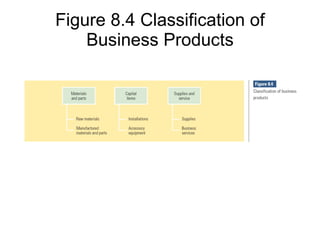
Business-to-Business Products Business-to-business (B2B) products are bought by organisations or individuals for further processing; for use in running a business; or to on-sell to others. The three groups of business products: Materials and parts  -  industrial goods that enter the manufacturer’s product completely, including raw materials and manufactured materials and parts. Capital items  -  industrial goods and services that enter the finished product partly, including installations and accessory equipment. Supplies and services  -  industrial goods and services that don’t enter the finished product at all.
Figure 8.4 Classification of Business Products
Business / Industrial product The  purpose  is  to: Manufacture  other  products; Assist in running a  firm’s  business; or Simply on-sell  to consumers and  end-users A  product  is  categorised  as  a  ‘Consumer’ product  or  as  a  ‘Business’  product,  based  on  the purpose  for  which  it  is  purchased  -  the  intended  use
Services  products Services products deliver something that is intangible: the buyer receives value from the purchase, but it does not result in the consumer owning anything that endures. Continuing significant growth in the number and value of Services products, particularly in the ‘developed’ nations.
Characteristics  of  Services The  key  characteristics  that  differentiate  Services  products  from  physical  goods: Intangibility Inseparability/ High personal involvement Variability Synchronous delivery/ consumption Perishability
Cont’d Intangibility Difficult  to  assess  the  suitability  of  the product  in  advance Because  of  this, the  physical  elements  become  extra  important Inseparability Purchase takes on extra significance Buyer involvement contributes to the outcome
Cont’d Variability Different level of quality in production Standardisation, and use of technology can help to minimise the variation Synchronous Increased importance of ‘people’ Product is often ‘sold’ before it is produced Perishability Product  is  not  produced  in  advance Need  for  firm  to  link  supply  with  demand
Service Quality Measures There is usually a much higher level of people involvement (both buyer and seller) with Services products than with goods.  Services  purchases  usually  involve  people  in  ‘service encounters’; Services  are  experiential  in  nature,  and  often  require  special  measures, such  as ‘mystery shoppers’, to  assess  the  quality  of  the  product.
Extending the Classification of Goods and Services Event marketing Combines the marketing of Services elements with the marketing of goods, particularly the experiential aspects of sporting, entertainment and other staged events. Person marketing People such as athletes/ sports stars need to be marketed as a ‘personality’ before being used for endorsements. Politicians can be marketed in a similar manner. Political marketing Politicians market themselves, their political ideologies, and their political party in an attempt to gain voter support.
Cont’d Cause marketing Marketing an idea or social cause such as nuclear-free living or catching public transport to and from work. In cause-related marketing, a firm might position its brand on the basis that it will donate part of the value of its sales to a particular cause. Not-for-profit marketing Conducted by organisations who are not motivated by profit. The aim is to make a sufficient trading surplus to enable the operation to continue. Experiences marketing Promoting the added-value elements available through customer participation and connection with the product, and managing all related aspects of the relationship.
The  Firm’s  Product  Decisions
1. Product  Attributes Product Quality   Is the ability of a product to perform its functions.  Includes the product’s durability; reliability; precision; ease of use; and repairability. Quality  should  not  be  viewed  as  a  problem  to  be  solved; it  is  a  competitive  opportunity.
Cont’d Product Features   May include several models of a product (e.g. cars) offering varying features. Helps to differentiate from competitors. Must relate cost of features to value. Product Design   Process of designing a product’s style and function. Creating a product that is attractive; easy, safe and inexpensive to use and service; simple and economical to produce and distribute.
2. Branding Branding is a major strategic decision that can add value to a product. Viewed by consumers as an important part of the product. Powerful brands will gain strong recognition and attract significant consumer loyalty, and can usually command a higher price Brands with strong consumer loyalty are better protected against the strategies of competitors.  This is high  brand equity .
Cont’d The  brand  is  the  combination  of  functional  and  emotional  benefits  delivered by  a  product.  Consumers  are  looking  for  something  they  can  associate  with  -  a  means  of  linking  with  a  particular  product  that  delivers  ‘value’. Consumers  are  attracted  to  a  product  that : Is dependable; has high quality; is consistent over a  period of time; offers ‘value-for-money’; and can  deliver a positive experience each time (satisfaction).
Cont’d A brand can be: A name; term; sign; symbol; or design (or a combination of these) intended to identify a firm’s product, and to help differentiate it from competing products
The most enduring meanings of a brand are its: attributes and benefits values, benefits, attributes, and personality personality, attributes, and benefits values, culture, and personality attributes, benefits, and values
To Brand or Not to Brand Branding can deliver significant benefit, so it is a major part of product marketing. Some products are classified as ‘generic’. These are plainly packaged, and are less expensive versions of everyday products. In Australia, the market share for generics tends to fluctuate, but major supermarkets are developing their own generic labels.
Manufacturers’ brand Created and owned by the producer of the product. Private brand Created and owned by a reseller of the product. Licensing Some companies are licensed to use brand names or symbols previously created by other manufacturers. Co-branding The practice of using the established brand names of two different companies to promote the same product. Brand Sponsor Decision
Co-branded  product
Arnott's biscuits with M&M candies in them would be an example of the use of a __________ strategy. line extension  co-branding repositioning  brand extension  line filling
Brand  repositioning It may be necessary for a firm to reposition its product, due to: a competitor launching a new brand that cuts  into the firm’s market share. a shift in consumer wants Repositioning could be an easier, more beneficial option than introducing a completely new brand. The firm might need to change both the product and the product image to better satisfy any new customer expectations.
Packaging/ Labelling Packaging  can: Promote  the  product Protect  the  product Enable  easy  storage Encourage  recycling Labelling  will: Help  consumes  with  selection Provide  information, e.g. how-to-use  instructions Highlight  product  features  and  benefits
Product Line Decisions A product line is a group of products that are closely related because they function in a similar manner; are sold to the same customer groups; are marketed through the same types of outlets; or fall within given price ranges. Product line length Stretching downward Stretching upward Stretching both ways
Figure 8.8 Product Line Stretching Decisions
Product Mix Decisions A product mix is the set of all product lines and  items that a particular seller offers for sale. The product mix can be described as having:  breadth; length; depth; and consistency. Breadth is the number of different product lines. Length is the total number of items the company offers. Depth is the number of versions of each product in the line. Consistency is how closely the various product lines are  in terms of consumer usage; production requirements; and methods of distribution.

Bus169 Kotler Chapter 08

  • 1.
    Products: Goods,Services and Experiences
  • 2.
    Chapter Objectives (1)Describe the nature of product in marketing management. Explain the concept of the goods–services continuum. Define the term product, including the core, actual and augmented product. Explain product classifications, and contrast the differing types of consumer products and business-to-business products. Explain services classifications and discuss the marketing of services.
  • 3.
    Chapter Objectives (2)Discuss an extended notion of product that includes marketing persons, experiencing events, places, political ideas, causes, non-profit services, and fundraising endeavours. Outline the range of individual product decisions marketers make, discussing the product attributes of quality, features and design. Discuss branding, and contrast the differences among line extensions, brand extensions, multibrands and new brands.
  • 4.
    Chapter Objectives (3)Illustrate product line and product mix decisions, describing stretching and filling the product line length, line modernisation, line featuring and line width. List some of the considerations marketers face in making international product decisions, including whether or not to standardise or adapt product and packaging.
  • 5.
    What is aProduct? A product is anything that can be offered to a market with the objective of satisfying a consumer need or want. It can include physical goods; services; people; places; organisations and ideas . It is everything, both favourable and unfavourable, that the consumer receives in an exchange with the seller
  • 6.
    Can be viewedon 3 levels The most basic level is the core product , which addresses the question: - what is the buyer really buying? The actual product may have as many as five elements: the quality level; the features; the styling; a brand name, and the packaging. The augmented product - the additional consumer services and benefits that are built around the core and actual products
  • 7.
    Descriptions of aproduct's quality, features, style, brand name, and packaging identify the: core product actual product augmented product tangible product intangible product
  • 8.
    The three Levelsof Product
  • 9.
    An example ofeach level
  • 10.
    Product Classifications ConsumerProducts are those bought by final consumers for personal consumption. Four types: Convenience Products Consumer goods and services that the customer usually buys frequently, immediately, and with the minimum of comparison and buying effort . Shopping Products Consumer goods and services that the customer, in the process of selection and purchase, compares on the basis of suitability; quality; price; and style .
  • 11.
    Cont’d Speciality ProductsConsumer goods and services with unique characteristics or brand identification, for which a significant group of buyers is willing to make a special purchase effort. Unsought Products Consumer goods and services that the consumer either doesn’t know about, or knows about but doesn’t normally think of buying.
  • 12.
    Table 8.2 MarketingConsiderations for Consumer Products
  • 13.
    Business-to-Business Products Business-to-business(B2B) products are bought by organisations or individuals for further processing; for use in running a business; or to on-sell to others. The three groups of business products: Materials and parts - industrial goods that enter the manufacturer’s product completely, including raw materials and manufactured materials and parts. Capital items - industrial goods and services that enter the finished product partly, including installations and accessory equipment. Supplies and services - industrial goods and services that don’t enter the finished product at all.
  • 14.
    Figure 8.4 Classificationof Business Products
  • 15.
    Business / Industrialproduct The purpose is to: Manufacture other products; Assist in running a firm’s business; or Simply on-sell to consumers and end-users A product is categorised as a ‘Consumer’ product or as a ‘Business’ product, based on the purpose for which it is purchased - the intended use
  • 16.
    Services productsServices products deliver something that is intangible: the buyer receives value from the purchase, but it does not result in the consumer owning anything that endures. Continuing significant growth in the number and value of Services products, particularly in the ‘developed’ nations.
  • 17.
    Characteristics of Services The key characteristics that differentiate Services products from physical goods: Intangibility Inseparability/ High personal involvement Variability Synchronous delivery/ consumption Perishability
  • 18.
    Cont’d Intangibility Difficult to assess the suitability of the product in advance Because of this, the physical elements become extra important Inseparability Purchase takes on extra significance Buyer involvement contributes to the outcome
  • 19.
    Cont’d Variability Differentlevel of quality in production Standardisation, and use of technology can help to minimise the variation Synchronous Increased importance of ‘people’ Product is often ‘sold’ before it is produced Perishability Product is not produced in advance Need for firm to link supply with demand
  • 20.
    Service Quality MeasuresThere is usually a much higher level of people involvement (both buyer and seller) with Services products than with goods. Services purchases usually involve people in ‘service encounters’; Services are experiential in nature, and often require special measures, such as ‘mystery shoppers’, to assess the quality of the product.
  • 21.
    Extending the Classificationof Goods and Services Event marketing Combines the marketing of Services elements with the marketing of goods, particularly the experiential aspects of sporting, entertainment and other staged events. Person marketing People such as athletes/ sports stars need to be marketed as a ‘personality’ before being used for endorsements. Politicians can be marketed in a similar manner. Political marketing Politicians market themselves, their political ideologies, and their political party in an attempt to gain voter support.
  • 22.
    Cont’d Cause marketingMarketing an idea or social cause such as nuclear-free living or catching public transport to and from work. In cause-related marketing, a firm might position its brand on the basis that it will donate part of the value of its sales to a particular cause. Not-for-profit marketing Conducted by organisations who are not motivated by profit. The aim is to make a sufficient trading surplus to enable the operation to continue. Experiences marketing Promoting the added-value elements available through customer participation and connection with the product, and managing all related aspects of the relationship.
  • 23.
    The Firm’s Product Decisions
  • 24.
    1. Product Attributes Product Quality Is the ability of a product to perform its functions. Includes the product’s durability; reliability; precision; ease of use; and repairability. Quality should not be viewed as a problem to be solved; it is a competitive opportunity.
  • 25.
    Cont’d Product Features May include several models of a product (e.g. cars) offering varying features. Helps to differentiate from competitors. Must relate cost of features to value. Product Design Process of designing a product’s style and function. Creating a product that is attractive; easy, safe and inexpensive to use and service; simple and economical to produce and distribute.
  • 26.
    2. Branding Brandingis a major strategic decision that can add value to a product. Viewed by consumers as an important part of the product. Powerful brands will gain strong recognition and attract significant consumer loyalty, and can usually command a higher price Brands with strong consumer loyalty are better protected against the strategies of competitors. This is high brand equity .
  • 27.
    Cont’d The brand is the combination of functional and emotional benefits delivered by a product. Consumers are looking for something they can associate with - a means of linking with a particular product that delivers ‘value’. Consumers are attracted to a product that : Is dependable; has high quality; is consistent over a period of time; offers ‘value-for-money’; and can deliver a positive experience each time (satisfaction).
  • 28.
    Cont’d A brandcan be: A name; term; sign; symbol; or design (or a combination of these) intended to identify a firm’s product, and to help differentiate it from competing products
  • 29.
    The most enduringmeanings of a brand are its: attributes and benefits values, benefits, attributes, and personality personality, attributes, and benefits values, culture, and personality attributes, benefits, and values
  • 30.
    To Brand orNot to Brand Branding can deliver significant benefit, so it is a major part of product marketing. Some products are classified as ‘generic’. These are plainly packaged, and are less expensive versions of everyday products. In Australia, the market share for generics tends to fluctuate, but major supermarkets are developing their own generic labels.
  • 31.
    Manufacturers’ brand Createdand owned by the producer of the product. Private brand Created and owned by a reseller of the product. Licensing Some companies are licensed to use brand names or symbols previously created by other manufacturers. Co-branding The practice of using the established brand names of two different companies to promote the same product. Brand Sponsor Decision
  • 32.
  • 33.
    Arnott's biscuits withM&M candies in them would be an example of the use of a __________ strategy. line extension co-branding repositioning brand extension line filling
  • 34.
    Brand repositioningIt may be necessary for a firm to reposition its product, due to: a competitor launching a new brand that cuts into the firm’s market share. a shift in consumer wants Repositioning could be an easier, more beneficial option than introducing a completely new brand. The firm might need to change both the product and the product image to better satisfy any new customer expectations.
  • 35.
    Packaging/ Labelling Packaging can: Promote the product Protect the product Enable easy storage Encourage recycling Labelling will: Help consumes with selection Provide information, e.g. how-to-use instructions Highlight product features and benefits
  • 36.
    Product Line DecisionsA product line is a group of products that are closely related because they function in a similar manner; are sold to the same customer groups; are marketed through the same types of outlets; or fall within given price ranges. Product line length Stretching downward Stretching upward Stretching both ways
  • 37.
    Figure 8.8 ProductLine Stretching Decisions
  • 38.
    Product Mix DecisionsA product mix is the set of all product lines and items that a particular seller offers for sale. The product mix can be described as having: breadth; length; depth; and consistency. Breadth is the number of different product lines. Length is the total number of items the company offers. Depth is the number of versions of each product in the line. Consistency is how closely the various product lines are in terms of consumer usage; production requirements; and methods of distribution.

Editor's Notes

  • #6 Refers to objectives 1 & 2
  • #8 Answer B. Comprises the total product as perceived by the consumer. The core is the basis of the product, augmented product supplements the core and tangible-intangible describe the components on the good-service continuum. Refers to objectives 1 & 2
  • #9 Refers to objectives 1 & 2
  • #10 Refers to objectives 1 & 2
  • #11 Refers to objectives 4 & 5
  • #12 Refers to objectives 4 & 5
  • #14 Refers to objective 4
  • #15 Refers to objective 4
  • #17 Refers to objectives 5 & 6
  • #18 Refers to objective 5
  • #21 Refers to objective 5
  • #22 Refers to objectives 5 & 6
  • #23 Refers to objectives 5 & 6
  • #24 Refers to objective 7
  • #25 Refers to objective 7
  • #26 Refers to objective 7
  • #27 Refers to objective 8
  • #29 Refers to objective 8
  • #30 Answer B These are the most memorable components of brand. Refers to objective 8
  • #31 Refers to objective 9
  • #32 Refers to objective 8
  • #34 Answer B. Two companies are combining products and brands. Refers to objective 8
  • #35 Refers to objective 8
  • #37 Refers to objectives 9 & 10
  • #38 Refers to objectives 9 & 10
  • #39 Refers to objectives 9 & 10