
MARKET FUNCTIONS
MARKETING
 The management task that links the business to the
customer by identifying and meeting the needs of
customers profitably.
 Get the right product at the right price to the
right place at the right time.
Marketing Management Functions
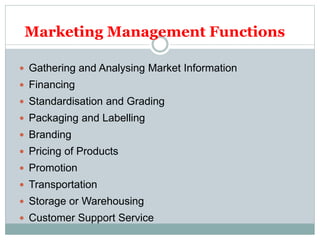
 Gathering and Analysing Market Information
 Financing
 Standardisation and Grading
 Packaging and Labelling
 Branding
 Pricing of Products
 Promotion
 Transportation
 Storage or Warehousing
 Customer Support Service
MARKET RESEARCH
 Process of collecting information about customer
trends, and competitor products.
 Used to determine customer buying habits, and
attitudes .
 Successful marketing involves using marketing
info to predict consumer demand and estimate
the right quantities of merchandise.
FINANCING
 Requires a company to budget for its own marketing
activities.
 It takes money to make money.
 Banks and other financial institutions provide money
for the production and marketing of products.
 Also provides customers with assistance in paying
for the company’s p/s.
PRICING
 Process of establishing and communicating to
customers the value of cost of goods and services.
 Prices assigned are directly related to consumer
demand.
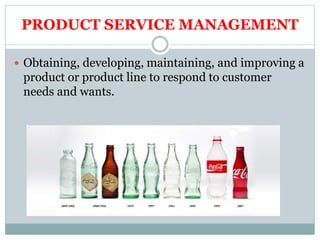
PRODUCT SERVICE MANAGEMENT
 Obtaining, developing, maintaining, and improving a
product or product line to respond to customer
needs and wants.
PROMOTION
 Conducts activities to capture attention about a good or service
o Advertising—e.g., television commercials
 Personal selling—e.g., door-to-door sales, professional sales
 Publicity—e.g., press releases
 Sales promotion—e.g., logo-imprinted giveaways
 Advertising products and services is essential to attract
new customers and keeping existing customers coming
back.
STANDARDISATION AND GRADING
 Determining of standard regarding size, quality,
design, weight, colour, raw material used.
 Products having the same characteristics are placed
in a given category or grade. This placing is called
grading.
 Makes sale-purchase easy.
PACKAGING AND LABELLING
 Packaging facilitates handling, lifting, conveying of
the goods.
 Label is a slip which is found on the product.
BRANDING
 Every producer/seller wants that his product should
have special identity in the market.
 Giving of distinct name to one’s product is called
branding.
SELLING
 Any direct and personal communication with customers to
asses and satisfy their needs and wants is considered selling
 Selling involves not only satisfying customers but also
anticipating their future needs.
 Making decisions about where to sell the product and how
it gets there.
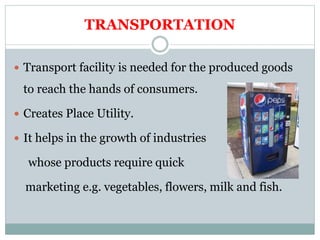
TRANSPORTATION
 Transport facility is needed for the produced goods
to reach the hands of consumers.
 Creates Place Utility.
 It helps in the growth of industries
whose products require quick
marketing e.g. vegetables, flowers, milk and fish.
STORAGE
 Time-lag between the purchase or production of
goods.
 Keeping of goods in godowns till the same are sold is
called storage.
 Time Utility.
CUSTOMER SUPPORT SERVICE
 Customer is the king of market.
 A marketer offers primarily the following services
to the customers:
(i) After-sales-services
(ii) Handling customers’ complaints
(iii) Technical services
(iv) Credit facilities
(v) Maintenance services
Market functions

Market functions

  • 1.
  • 2.
    MARKETING  The managementtask that links the business to the customer by identifying and meeting the needs of customers profitably.  Get the right product at the right price to the right place at the right time.
  • 3.
    Marketing Management Functions Gathering and Analysing Market Information  Financing  Standardisation and Grading  Packaging and Labelling  Branding  Pricing of Products  Promotion  Transportation  Storage or Warehousing  Customer Support Service
  • 4.
    MARKET RESEARCH  Processof collecting information about customer trends, and competitor products.  Used to determine customer buying habits, and attitudes .  Successful marketing involves using marketing info to predict consumer demand and estimate the right quantities of merchandise.
  • 5.
    FINANCING  Requires acompany to budget for its own marketing activities.  It takes money to make money.  Banks and other financial institutions provide money for the production and marketing of products.  Also provides customers with assistance in paying for the company’s p/s.
  • 6.
    PRICING  Process ofestablishing and communicating to customers the value of cost of goods and services.  Prices assigned are directly related to consumer demand.
  • 7.
    PRODUCT SERVICE MANAGEMENT Obtaining, developing, maintaining, and improving a product or product line to respond to customer needs and wants.
  • 8.
    PROMOTION  Conducts activitiesto capture attention about a good or service o Advertising—e.g., television commercials  Personal selling—e.g., door-to-door sales, professional sales  Publicity—e.g., press releases  Sales promotion—e.g., logo-imprinted giveaways  Advertising products and services is essential to attract new customers and keeping existing customers coming back.
  • 9.
    STANDARDISATION AND GRADING Determining of standard regarding size, quality, design, weight, colour, raw material used.  Products having the same characteristics are placed in a given category or grade. This placing is called grading.  Makes sale-purchase easy.
  • 10.
    PACKAGING AND LABELLING Packaging facilitates handling, lifting, conveying of the goods.  Label is a slip which is found on the product.
  • 11.
    BRANDING  Every producer/sellerwants that his product should have special identity in the market.  Giving of distinct name to one’s product is called branding.
  • 12.
    SELLING  Any directand personal communication with customers to asses and satisfy their needs and wants is considered selling  Selling involves not only satisfying customers but also anticipating their future needs.  Making decisions about where to sell the product and how it gets there.
  • 13.
    TRANSPORTATION  Transport facilityis needed for the produced goods to reach the hands of consumers.  Creates Place Utility.  It helps in the growth of industries whose products require quick marketing e.g. vegetables, flowers, milk and fish.
  • 14.
    STORAGE  Time-lag betweenthe purchase or production of goods.  Keeping of goods in godowns till the same are sold is called storage.  Time Utility.
  • 15.
    CUSTOMER SUPPORT SERVICE Customer is the king of market.  A marketer offers primarily the following services to the customers: (i) After-sales-services (ii) Handling customers’ complaints (iii) Technical services (iv) Credit facilities (v) Maintenance services