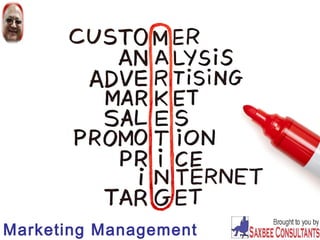

Mark eting Managem ent 1
What is Marketing? 
Marketing is the delivery of customer 
satisfaction at a profit. 
2
The Goal of Marketing is: 
To attract new customer by promising 
superior value, and to keep current 
customers by delivering satisfaction. 
3
 Marketing, more than any other business function, 
deals with customers. 
 Creating customer value and satisfaction are at the 
very heart of modern marketing thinking and practice. 
 Some people believe that only large business 
organizations operating in highly developed 
economies use marketing, but sound marketing is 
critical to the success of every organization – whether 
large or small, for profit or non – profit, domestic or 
global. 
4
5 
Marketing Defined 
 Many people think of marketing only as selling and advertising. 
 Selling and advertising are only the tip of the marketing ice-berg. 
 Marketing is one of three key core functions that are central to all 
organizations. 
 Marketers act as the customers’ voice within the firm and marketers are 
responsible for many more decisions than just advertising or sales: 
 Analyse industries to identify emerging trends. 
 Determine which national and international markets to enter or exit. 
 Conduct research to understand consumer behavior. 
 Design integrated marketing mixes – products, prices, channels of 
distribution, and promotion programs. 
Marketing is a social and managerial process by which individuals and 
groups obtain what they need and want through creating and 
exchanging products and value with others.
To explain marketing definition, we 
examine the following important terms : 
 Needs, wants, and demands 
 Products and services 
 Value, satisfaction and quality 
 Exchange, transactions, and relationships 
 Markets 
6
Needs, Wants, and Demands 
Needs: 
 The most basic concept underlying marketing is that of human needs. 
 Human needs are states of felt deprivation. 
 Human have many complex needs: 
7 
 Physical needs for food, clothing, warmth, and safety 
 Social needs or belonging and affection 
 Individual needs for knowledge and self – expression 
Wants: 
 Want are the form taken by human needs as they are shaped by culture and individual 
personality. 
 People have almost unlimited wants but limited resources. 
 They want to choose products that provide the most value and satisfaction for their money. 
Demands: 
 When backed by buying power, wants become demands. 
 Consumers view products as bundles of benefits and choose products that give them the 
best bundle for their money.
Products and Services 
Product: 
 Anything that can be offered to a market to satisfy a 
need or want. 
 The concept of product is not limited to physical 
objects – anything capable of satisfying a need can 
be called a product. 
Services: 
 In addition to tangible goods, products also include 
services, which are activities or benefits offered for 
sale that are essentially intangible and do not result in 
the ownership of anything. 
8
Values, Satisfaction, and Quality 
Values: 
 Customer value is the difference between the values the customer gains from 
owning and using a product and the costs of obtaining the products. 
 Customers often do not judge product value and costs accurately or objectively. 
9 
They act on perceived value. 
Satisfaction: 
 Customer satisfaction depends on a product’s perceived performance in 
delivering value relative to a buyer’s expectation. 
 If the product’s performance falls short of the customer’s expectations, the buyer 
is dissatisfied. 
Quality: 
 Customer satisfaction is closely linked to quality. 
 Quality has a direct impact on product performance. 
 Quality can be defined as “freedom from defects”. 
 TQM programs designed to constantly improve the quality of products, services, 
and marketing processes.
Exchange, Transactions, 
and Relationships 
Exchange : 
 The act of obtaining a desired object from someone 
by offering something in return 
Transaction : 
 A trade between two parties that involves at least two 
things of value, agreed – upon conditions a time of 
agreement, and a place of agreement. 
Relationship marketing : 
 The process of creating, maintaining, and enhancing 
strong, value – laden relationships with customers 
and other stakeholders 
10
11 
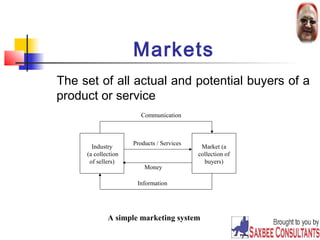
Markets 
The set of all actual and potential buyers of a 
product or service 
Industry 
(a collection 
of sellers) 
Market (a 
collection of 
buyers) 
Communication 
Products / Services 
Money 
Information 
A simple marketing system
12 
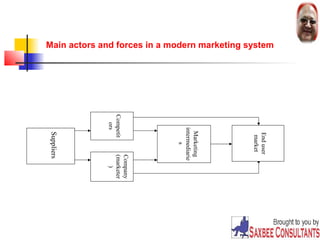
End user 
market 
Competit 
ors 
Company 
(marketer 
Suppliers 
) 
Marketing 
intermediarie 
s 
Main actors and forces in a modern marketing system
Marketing Management 
The analysis, planning, implementation, 
and control of programs designed to 
create, build, and maintain beneficial 
exchanges with target buyers for the 
purpose of achieving organizational 
objectives. 
13
Marketing Management Involves: 
 Demand Management : The organization has a 
desired level of demand for its products. At any point 
in time, There may be no demand, adequate 
demand, irregular demand, or too much demand, and 
marketing management must find ways to deal with 
these different demand states. 
 Building Profitable Customer Relationships : 
Beyond designing strategies to attract new customers 
and create transactions with them, companies now 
are striving to retain current customers and build 
lasting customer relationships. 
14
MARKETING MANAGEMENT PHILOSOPHIES 
 The role that marketing plays within a company 
varies according to the overall strategy and 
philosophy of each firm. 
 There are five alternative concepts under which 
organizations conduct their marketing activities: 
15 
 Production concept 
 Product concept 
 Selling concept 
 Marketing concept 
 Societal marketing concepts
Production Concept 
The philosophy that consumers will 
favour products that are available and 
highly affordable and that management 
should therefore focus on improving 
production and distribution efficiency. 
16
17 
Product Concept 
The philosophy that consumers will 
favour products that offer the most 
quality, performance, and innovative 
features.
Selling Concept 
The idea that consumers will not buy 
enough of the organization’s products 
unless the organization undertakes a 
large – scale selling and promotion 
effort. 
18
Marketing Concept 
The marketing management philosophy 
that holds that achieving organizational 
goals depends on determining the 
needs and wants of target markets and 
delivering the desired satisfactions 
more effectively and efficiently than 
competitors do. 
19
Societal Marketing Concept 
The idea that the organization should 
determine the needs, wants, and 
interests of target markets and deliver 
the desired satisfactions more 
effectively and efficiently than 
competitors in a way that maintains or 
improves the consumer’s and society’s 
well – being. 
20
21 
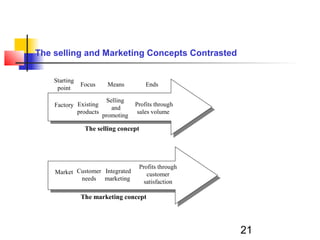
The selling and Marketing Concepts Contrasted 
Starting 
point Focus Means Ends 
Factory Existing 
products 
Selling 
and 
promoting 
Profits through 
sales volume 
The selling concept 
Market Customer 
needs 
Integrated 
marketing 
Profits through 
customer 
satisfaction 
The marketing concept
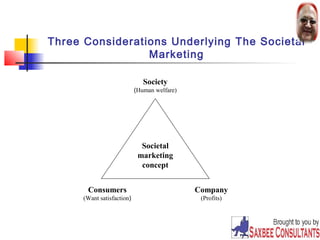
Three Considerations Underlying The Societal 
22 
Marketing 
Society 
(Human welfare) 
Societal 
marketing 
concept 
Company 
(Profits) 
Consumers 
(Want satisfaction)
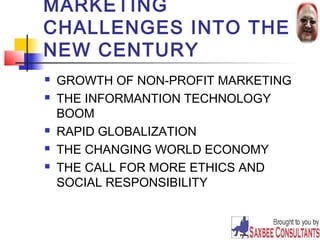
MARKETING 
CHALLENGES INTO THE 
NEW CENTURY 
 GROWTH OF NON-PROFIT MARKETING 
 THE INFORMANTION TECHNOLOGY 
BOOM 
 RAPID GLOBALIZATION 
 THE CHANGING WORLD ECONOMY 
 THE CALL FOR MORE ETHICS AND 
SOCIAL RESPONSIBILITY 
23
24 
THE NEW MARKETING 
LANDSCAPE 
The past decade taught business firms 
everywhere a humbling lesson. Domestic 
companies learned that they can no longer 
ignore global markets and competitors. 
Successful firms in mature industries learned 
that they cannot overlook emerging markets, 
technologies, and management approaches. 
Companies of every sort learned that they 
cannot remain inwardly focused, ignoring the 
needs of customers and their environment.
Parveen Kumar Chadha… THINK TANK 
(Founder and C.E.O of Saxbee Consultants & 
Other-Mother ) 
Email :-saxbeeconsultants@gmail.com 
Mobile No. +91-9818308353 
Address:-First Floor G-20(A), Kirti Nagar, New Delhi 
India Postal Code-110015 
25
26

Marketing management

  • 1.
  • 2.
    What is Marketing? Marketing is the delivery of customer satisfaction at a profit. 2
  • 3.
    The Goal ofMarketing is: To attract new customer by promising superior value, and to keep current customers by delivering satisfaction. 3
  • 4.
     Marketing, morethan any other business function, deals with customers.  Creating customer value and satisfaction are at the very heart of modern marketing thinking and practice.  Some people believe that only large business organizations operating in highly developed economies use marketing, but sound marketing is critical to the success of every organization – whether large or small, for profit or non – profit, domestic or global. 4
  • 5.
    5 Marketing Defined  Many people think of marketing only as selling and advertising.  Selling and advertising are only the tip of the marketing ice-berg.  Marketing is one of three key core functions that are central to all organizations.  Marketers act as the customers’ voice within the firm and marketers are responsible for many more decisions than just advertising or sales:  Analyse industries to identify emerging trends.  Determine which national and international markets to enter or exit.  Conduct research to understand consumer behavior.  Design integrated marketing mixes – products, prices, channels of distribution, and promotion programs. Marketing is a social and managerial process by which individuals and groups obtain what they need and want through creating and exchanging products and value with others.
  • 6.
    To explain marketingdefinition, we examine the following important terms :  Needs, wants, and demands  Products and services  Value, satisfaction and quality  Exchange, transactions, and relationships  Markets 6
  • 7.
    Needs, Wants, andDemands Needs:  The most basic concept underlying marketing is that of human needs.  Human needs are states of felt deprivation.  Human have many complex needs: 7  Physical needs for food, clothing, warmth, and safety  Social needs or belonging and affection  Individual needs for knowledge and self – expression Wants:  Want are the form taken by human needs as they are shaped by culture and individual personality.  People have almost unlimited wants but limited resources.  They want to choose products that provide the most value and satisfaction for their money. Demands:  When backed by buying power, wants become demands.  Consumers view products as bundles of benefits and choose products that give them the best bundle for their money.
  • 8.
    Products and Services Product:  Anything that can be offered to a market to satisfy a need or want.  The concept of product is not limited to physical objects – anything capable of satisfying a need can be called a product. Services:  In addition to tangible goods, products also include services, which are activities or benefits offered for sale that are essentially intangible and do not result in the ownership of anything. 8
  • 9.
    Values, Satisfaction, andQuality Values:  Customer value is the difference between the values the customer gains from owning and using a product and the costs of obtaining the products.  Customers often do not judge product value and costs accurately or objectively. 9 They act on perceived value. Satisfaction:  Customer satisfaction depends on a product’s perceived performance in delivering value relative to a buyer’s expectation.  If the product’s performance falls short of the customer’s expectations, the buyer is dissatisfied. Quality:  Customer satisfaction is closely linked to quality.  Quality has a direct impact on product performance.  Quality can be defined as “freedom from defects”.  TQM programs designed to constantly improve the quality of products, services, and marketing processes.
  • 10.
    Exchange, Transactions, andRelationships Exchange :  The act of obtaining a desired object from someone by offering something in return Transaction :  A trade between two parties that involves at least two things of value, agreed – upon conditions a time of agreement, and a place of agreement. Relationship marketing :  The process of creating, maintaining, and enhancing strong, value – laden relationships with customers and other stakeholders 10
  • 11.
    11 Markets Theset of all actual and potential buyers of a product or service Industry (a collection of sellers) Market (a collection of buyers) Communication Products / Services Money Information A simple marketing system
  • 12.
    12 End user market Competit ors Company (marketer Suppliers ) Marketing intermediarie s Main actors and forces in a modern marketing system
  • 13.
    Marketing Management Theanalysis, planning, implementation, and control of programs designed to create, build, and maintain beneficial exchanges with target buyers for the purpose of achieving organizational objectives. 13
  • 14.
    Marketing Management Involves:  Demand Management : The organization has a desired level of demand for its products. At any point in time, There may be no demand, adequate demand, irregular demand, or too much demand, and marketing management must find ways to deal with these different demand states.  Building Profitable Customer Relationships : Beyond designing strategies to attract new customers and create transactions with them, companies now are striving to retain current customers and build lasting customer relationships. 14
  • 15.
    MARKETING MANAGEMENT PHILOSOPHIES  The role that marketing plays within a company varies according to the overall strategy and philosophy of each firm.  There are five alternative concepts under which organizations conduct their marketing activities: 15  Production concept  Product concept  Selling concept  Marketing concept  Societal marketing concepts
  • 16.
    Production Concept Thephilosophy that consumers will favour products that are available and highly affordable and that management should therefore focus on improving production and distribution efficiency. 16
  • 17.
    17 Product Concept The philosophy that consumers will favour products that offer the most quality, performance, and innovative features.
  • 18.
    Selling Concept Theidea that consumers will not buy enough of the organization’s products unless the organization undertakes a large – scale selling and promotion effort. 18
  • 19.
    Marketing Concept Themarketing management philosophy that holds that achieving organizational goals depends on determining the needs and wants of target markets and delivering the desired satisfactions more effectively and efficiently than competitors do. 19
  • 20.
    Societal Marketing Concept The idea that the organization should determine the needs, wants, and interests of target markets and deliver the desired satisfactions more effectively and efficiently than competitors in a way that maintains or improves the consumer’s and society’s well – being. 20
  • 21.
    21 The sellingand Marketing Concepts Contrasted Starting point Focus Means Ends Factory Existing products Selling and promoting Profits through sales volume The selling concept Market Customer needs Integrated marketing Profits through customer satisfaction The marketing concept
  • 22.
    Three Considerations UnderlyingThe Societal 22 Marketing Society (Human welfare) Societal marketing concept Company (Profits) Consumers (Want satisfaction)
  • 23.
    MARKETING CHALLENGES INTOTHE NEW CENTURY  GROWTH OF NON-PROFIT MARKETING  THE INFORMANTION TECHNOLOGY BOOM  RAPID GLOBALIZATION  THE CHANGING WORLD ECONOMY  THE CALL FOR MORE ETHICS AND SOCIAL RESPONSIBILITY 23
  • 24.
    24 THE NEWMARKETING LANDSCAPE The past decade taught business firms everywhere a humbling lesson. Domestic companies learned that they can no longer ignore global markets and competitors. Successful firms in mature industries learned that they cannot overlook emerging markets, technologies, and management approaches. Companies of every sort learned that they cannot remain inwardly focused, ignoring the needs of customers and their environment.
  • 25.
    Parveen Kumar Chadha…THINK TANK (Founder and C.E.O of Saxbee Consultants & Other-Mother ) Email :-saxbeeconsultants@gmail.com Mobile No. +91-9818308353 Address:-First Floor G-20(A), Kirti Nagar, New Delhi India Postal Code-110015 25
  • 26.