Business environment
Made by : Bhupinder Kaur
DEPARTMENT OF COMMERCE
S.D.COLLEGE, AMBALA CANTT
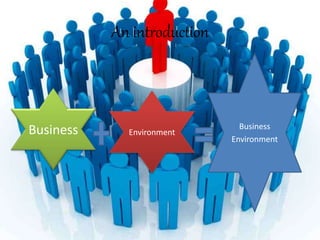
An introduction
Business Business
Environment
Environment
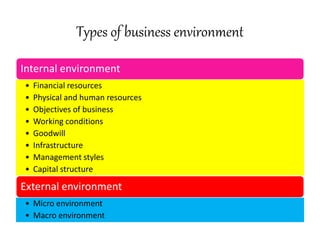
Types of business environment
Internal environment
• Financial resources
• Physical and human resources
• Objectives of business
• Working conditions
• Goodwill
• Infrastructure
• Management styles
• Capital structure
External environment
• Micro environment
• Macro environment
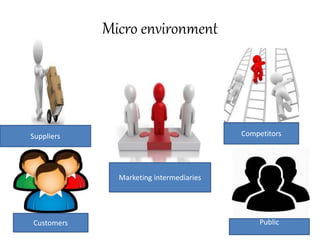
Micro environment
Suppliers
Customers
Marketing intermediaries
Competitors
Public
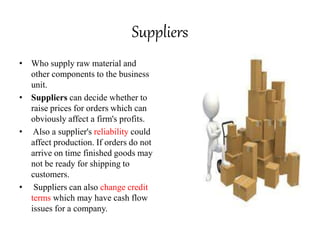
Suppliers
• Who supply raw material and
other components to the business
unit.
• Suppliers can decide whether to
raise prices for orders which can
obviously affect a firm's profits.
• Also a supplier's reliability could
affect production. If orders do not
arrive on time finished goods may
not be ready for shipping to
customers.
• Suppliers can also change credit
terms which may have cash flow
issues for a company.
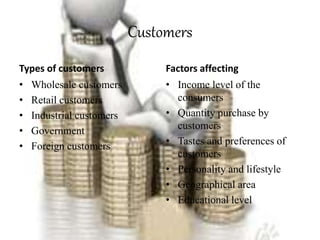
Customers
Types of customers
• Wholesale customers
• Retail customers
• Industrial customers
• Government
• Foreign customers
Factors affecting
• Income level of the
consumers
• Quantity purchase by
customers
• Tastes and preferences of
customers
• Personality and lifestyle
• Geographical area
• Educational level
MARKET INTERMEDIARIES
• Middlemen : wholesalers, retailers,
departmental stores .
• Marketing agencies : advertising agencies,
consultancy firms, media firms, market
research firms.
• Financial intermediaries : banks , insurance
firms, financial institutions .
• Physical intermediaries: warehouses,
transport.
DESTEP
• Demographic,
• Economic,
• Political,
• Ecological,
• Socio-Cultural,
• Technological forces
• Legal forces
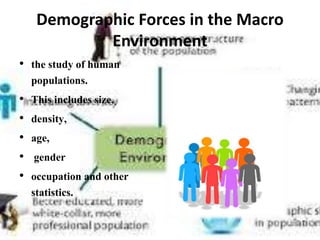
Demographic Forces in the Macro
Environment
• the study of human
populations.
• This includes size,
• density,
• age,
• gender
• occupation and other
statistics.
Demographic factors related to India
• Large Size and Fast Growth
• The current population of India is 1,346,716,939 as of
Wednesday, January 3, 2018, based on the latest
United Nations estimates.
• India population is equivalent to 17.74% of the total
world population.
• Rapidly Rising Density: The population density in India
is 450 per Km2 .
• Predominance of Rural Population:
• 32.8 % of the population is urban (439,801,466 people
in 2017)
• The median age in India is 27.0 years
Contd.
Low Life Expectancy:
• mean the average number of years a person is
expected to live. life expectancy is 63 lower in India
as compared to life expectancy of the developed
nations. Life expectancy is 80 year in Japan and 78
years in Norway.
Low Work Participation Rate:
• the ratio of working population to the total is
referred to as work participation rate.
• Low level of Education and Training
There’s No Beef or Pork in Any
McDonald’s in India
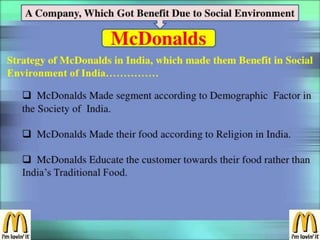
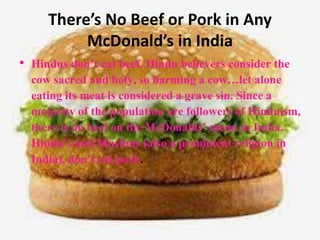
• Hindus don’t eat beef. Hindu believers consider the
cow sacred and holy, so harming a cow…let alone
eating its meat is considered a grave sin. Since a
majority of the population are followers of Hinduism,
there is no beef on the McDonalds’ menu in India.
Hindu’s and Muslims (also a prominent religion in
India), don’t eat pork.
Economic environment
 Economic conditions
• Income level
• Distribution of income
• Demand and supply
trends
• Phases of trade cycles
 Economic policies
• Monetary policy
• Fiscal policy
• EXIM policy
• New Industrial Policy
• Foreign Exchange
Management Act
(FEMA).
 economic system
• Capitalist
• Socialist
• Mixed
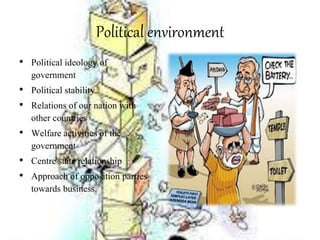
Political environment
• Political ideology of
government
• Political stability
• Relations of our nation with
other countries
• Welfare activities of the
government
• Centre state relationship
• Approach of opposition parties
towards business.
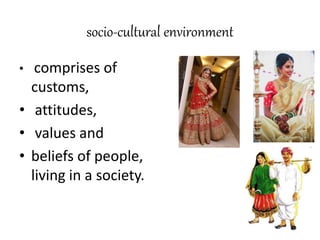
socio-cultural environment
• comprises of
customs,
• attitudes,
• values and
• beliefs of people,
living in a society.
Example
• For example, Americans
have a preference for
automatic cars whereas
majority of Europeans
have cars with manual
gears. Europeans prefer
to eat more varied and
balanced meals and less
fast food as compared
to Americans.
• For example, Nestle
makes a variety of
instant coffee to satisfy
tastes and preferences
of people of different
nations.
Cultural
• For example, Starbucks faced lot of difficulties while entering
the Chinese markets. The first and foremost being the non-
smoking policy of Starbucks which was against the high
smoking Chinese customers who would not feel happy to be
kept away from smoking while having a cup of coffee.
Secondly, while a majority of US customers drink coffee while
walking or driving to work, Chinese, on the other hand, prefer
to drink coffee inside the Starbucks coffeehouse with their
friends or colleagues. Customers in China visit Starbucks not
only for the coffee but to enjoy the relaxing environment
inside the coffeehouse. Moreover, as against Americans, they
never drink coffee alone and use to have a meal along with it.
So Starbucks had to introduce great meal options for their
Chinese customers.
Legal environment
• Protection to
Community
• Protection to
Employees
• Protection to Health
• Protection to
Consumers
• Protection to Business
Technological environment
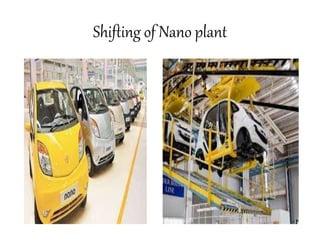
Shifting of Nano plant
Example
• The Tata Motors site is the most fertile one in the whole of the
Singur, and the Singur block, in turn, is among the most
highly fertile in West Bengal. Consequently, almost the entire
local population depends on agriculture with approximately
15000 making their livelihood directly from it. With the
number of direct jobs to be created no more than about 1,000,
many of which are expected to go to outsiders, the local
populace felt threatened for their livelihood. Environmental
degradation is also feared.
CONTD.
• Affected by the following factors :
• Media
• Political environment: opposed by opposition
parties
• Legal environment :land acquisition act, 1894
• Local public : farmers
• Physical environment
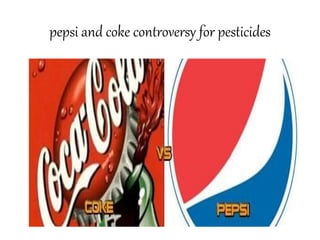
pepsi and coke controversy for pesticides
Example
• Farmers in India in the state of Chattisgarh use Coke and Pepsi as
pesticides because it’s cheaper than pesticides and gets the job done just as
well.
• the Farmers in the Durg, districts of Chhattisgarh disagree and have
successfully used Pepsi and Coke to protect their rice plantations against
pests..
• This is a trend that is seen across other parts of India, with farmers using
other Indian brands of colas too. The practice of using soft drinks instead
of pesticides, which are up to 10 times more expensive, is gaining so much
popularity that sales of soft drinks have increased dramatically in many
villages. Farmers say the use of pesticides can cost them about 70
rupees ($1.50) an acre. By comparison, if they mix up a bottle of Pepsi or
Coke with water and spray it on their crops it costs 55-60 rupees less per
acre.

Business environment

  • 1.
    Business environment Made by: Bhupinder Kaur DEPARTMENT OF COMMERCE S.D.COLLEGE, AMBALA CANTT
  • 2.
  • 3.
    Types of businessenvironment Internal environment • Financial resources • Physical and human resources • Objectives of business • Working conditions • Goodwill • Infrastructure • Management styles • Capital structure External environment • Micro environment • Macro environment
  • 4.
  • 5.
    Suppliers • Who supplyraw material and other components to the business unit. • Suppliers can decide whether to raise prices for orders which can obviously affect a firm's profits. • Also a supplier's reliability could affect production. If orders do not arrive on time finished goods may not be ready for shipping to customers. • Suppliers can also change credit terms which may have cash flow issues for a company.
  • 6.
    Customers Types of customers •Wholesale customers • Retail customers • Industrial customers • Government • Foreign customers Factors affecting • Income level of the consumers • Quantity purchase by customers • Tastes and preferences of customers • Personality and lifestyle • Geographical area • Educational level
  • 7.
    MARKET INTERMEDIARIES • Middlemen: wholesalers, retailers, departmental stores . • Marketing agencies : advertising agencies, consultancy firms, media firms, market research firms. • Financial intermediaries : banks , insurance firms, financial institutions . • Physical intermediaries: warehouses, transport.
  • 8.
    DESTEP • Demographic, • Economic, •Political, • Ecological, • Socio-Cultural, • Technological forces • Legal forces
  • 9.
    Demographic Forces inthe Macro Environment • the study of human populations. • This includes size, • density, • age, • gender • occupation and other statistics.
  • 10.
    Demographic factors relatedto India • Large Size and Fast Growth • The current population of India is 1,346,716,939 as of Wednesday, January 3, 2018, based on the latest United Nations estimates. • India population is equivalent to 17.74% of the total world population. • Rapidly Rising Density: The population density in India is 450 per Km2 . • Predominance of Rural Population: • 32.8 % of the population is urban (439,801,466 people in 2017) • The median age in India is 27.0 years
  • 11.
    Contd. Low Life Expectancy: •mean the average number of years a person is expected to live. life expectancy is 63 lower in India as compared to life expectancy of the developed nations. Life expectancy is 80 year in Japan and 78 years in Norway. Low Work Participation Rate: • the ratio of working population to the total is referred to as work participation rate. • Low level of Education and Training
  • 13.
    There’s No Beefor Pork in Any McDonald’s in India • Hindus don’t eat beef. Hindu believers consider the cow sacred and holy, so harming a cow…let alone eating its meat is considered a grave sin. Since a majority of the population are followers of Hinduism, there is no beef on the McDonalds’ menu in India. Hindu’s and Muslims (also a prominent religion in India), don’t eat pork.
  • 14.
    Economic environment  Economicconditions • Income level • Distribution of income • Demand and supply trends • Phases of trade cycles  Economic policies • Monetary policy • Fiscal policy • EXIM policy • New Industrial Policy • Foreign Exchange Management Act (FEMA).  economic system • Capitalist • Socialist • Mixed
  • 16.
    Political environment • Politicalideology of government • Political stability • Relations of our nation with other countries • Welfare activities of the government • Centre state relationship • Approach of opposition parties towards business.
  • 17.
    socio-cultural environment • comprisesof customs, • attitudes, • values and • beliefs of people, living in a society.
  • 19.
    Example • For example,Americans have a preference for automatic cars whereas majority of Europeans have cars with manual gears. Europeans prefer to eat more varied and balanced meals and less fast food as compared to Americans. • For example, Nestle makes a variety of instant coffee to satisfy tastes and preferences of people of different nations.
  • 20.
    Cultural • For example,Starbucks faced lot of difficulties while entering the Chinese markets. The first and foremost being the non- smoking policy of Starbucks which was against the high smoking Chinese customers who would not feel happy to be kept away from smoking while having a cup of coffee. Secondly, while a majority of US customers drink coffee while walking or driving to work, Chinese, on the other hand, prefer to drink coffee inside the Starbucks coffeehouse with their friends or colleagues. Customers in China visit Starbucks not only for the coffee but to enjoy the relaxing environment inside the coffeehouse. Moreover, as against Americans, they never drink coffee alone and use to have a meal along with it. So Starbucks had to introduce great meal options for their Chinese customers.
  • 21.
    Legal environment • Protectionto Community • Protection to Employees • Protection to Health • Protection to Consumers • Protection to Business
  • 22.
  • 23.
  • 24.
    Example • The TataMotors site is the most fertile one in the whole of the Singur, and the Singur block, in turn, is among the most highly fertile in West Bengal. Consequently, almost the entire local population depends on agriculture with approximately 15000 making their livelihood directly from it. With the number of direct jobs to be created no more than about 1,000, many of which are expected to go to outsiders, the local populace felt threatened for their livelihood. Environmental degradation is also feared.
  • 25.
    CONTD. • Affected bythe following factors : • Media • Political environment: opposed by opposition parties • Legal environment :land acquisition act, 1894 • Local public : farmers • Physical environment
  • 26.
    pepsi and cokecontroversy for pesticides
  • 27.
    Example • Farmers inIndia in the state of Chattisgarh use Coke and Pepsi as pesticides because it’s cheaper than pesticides and gets the job done just as well. • the Farmers in the Durg, districts of Chhattisgarh disagree and have successfully used Pepsi and Coke to protect their rice plantations against pests.. • This is a trend that is seen across other parts of India, with farmers using other Indian brands of colas too. The practice of using soft drinks instead of pesticides, which are up to 10 times more expensive, is gaining so much popularity that sales of soft drinks have increased dramatically in many villages. Farmers say the use of pesticides can cost them about 70 rupees ($1.50) an acre. By comparison, if they mix up a bottle of Pepsi or Coke with water and spray it on their crops it costs 55-60 rupees less per acre.