PRICING STRATEGIES
BY
Niño Lemuel L.
Concina
1. Pricing is one of the 4P’s of Marketing Mix
which plays a very Important role .All other
P’s are cost
for the company whereas pricing is revenue for
the
company
1. Pricing means determining the price of the
product a firm is selling or going to sell
2. While determining a price it involves various
pricing decisions which are to be taken
while deciding a price of a product
1. The price structure of a firm is a major
determinant
What is Pricing
?
● It is the activity under which the activities are aimed at finding the
optimum price of a product
● It typically includes the marketing objectives,Consumer
demand,product attributes,competitors price and market and
economic trends
● Finding the right pricing strategy is an important element in running a
successful business.
What is Pricing Strategy
?
Objectives of Pricing
Strategy
❏ To earn profits
❏ To increase sales volume
❏ Company Growth
❏ To maintain competitive edge
❏ Survival
❏ To create a good image of the product
as well as about the company
❏ To discourage the competitors to cut
the prices
Objectives of Pricing Strategy
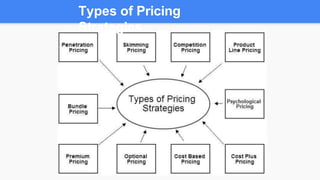
Types of Pricing
Strategies
Penetration
Pricing
1. It is a pricing strategy used by
business to attract customers to
new product or service
2. The price charged for products and
services is set artificially low in order
to gain market share. Once this is
achieved, the price is increased.
3. It is to lure the customers away from
competitors
Price
Skimming
1. Price skimming sees a company
charge a higher price because it has
a substantial competitive advantage.
2. The skimming strategy gets its name
from skimming successive layers of
cream, or customer segments, as
prices are lowered over time.
3. As it starts with high pricing
therefore it attracts new competitors
to enter the market as due to which
the price eventually fall
Competitive
Pricing
1. It is the pricing strategy under which
the companies use the prices of their
competitors
2. As the company thought that the
competitor has set this price by
assuming that the competitors
have thoroughly worked on the
price
3. Therefore, by setting the same price
as its competitors, a newly-launched
firm can avoid the trial and error
Product
Line
Pricing
1. Where there is a range of products or
services the pricing reflects the
benefits of parts of the range
2. It refers to the practice of reviewing
and setting prices for multiple
products that a company offers in
coordination with one another.
3. Effective product line pricing by a
business will usually involve putting
sufficient price gaps between
categories to inform prospective
buyers of quality differentials. Also
called price lining.
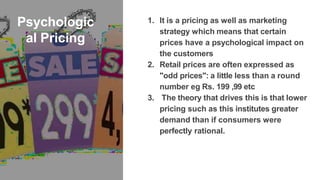
Psychologic
al Pricing
1. It is a pricing as well as marketing
strategy which means that certain
prices have a psychological impact on
the customers
2. Retail prices are often expressed as
"odd prices": a little less than a round
number eg Rs. 199 ,99 etc
3. The theory that drives this is that lower
pricing such as this institutes greater
demand than if consumers were
perfectly rational.
Premium
Pricing
1. It is also known as image pricing or
prestige pricing. It is used when there
is a unique brand
2. It is a practice of keeping price of a
product artificially high to attract
the favourable perceptions among
buyers
3. This approach is used where a
substantial competitive advantage
exists and the marketer is safe in the
knowledge that they can charge a
relatively higher price.
Optiona
l
Pricing
1. It is strategy when a company sells a
base product at a relatively low price,
but sells complementary accessories
at a higher price.
2. Companies will attempt to increase the
amount customers spend once they
start to buy.
3. Optional ‘extras’ increase the overall
price of the product or service.
Bundle
Pricing
1. It is a process where companies sell a
package or set of goods or services
for a lower price than they would
charge if they bought them separately.
2. It is a strategy where it allows the
company to increase its profits by
giving customers a discount.
3. It is an attempt to capture more of the
consumer’s consumer surplus.
Cost Based
Pricing
1. It is the pricing method in which the
company add a certain percentage in
the cost of making product to get
some profit.
1. It uses manufacturing cost as the
basis for coming to the final price
setting of the product.
2. It is a straightforward and simple
strategy.
Cost
Plus
Pricing
1. It is the simplest pricing strategy. It is also known
as mark -up pricing.
2. It is nothing else than adding a markup value to
the price of the product. This markup value is for
earning profit.
3. It appears to be simple but it ignores the demand
and competitors price. Therefore it doesn’t lead to
best prices.
THANK
YO
U

PRICING-STRATEGY.pptxxxxxxxxxxxxxxxxxxxx

  • 1.
  • 2.
    1. Pricing isone of the 4P’s of Marketing Mix which plays a very Important role .All other P’s are cost for the company whereas pricing is revenue for the company 1. Pricing means determining the price of the product a firm is selling or going to sell 2. While determining a price it involves various pricing decisions which are to be taken while deciding a price of a product 1. The price structure of a firm is a major determinant What is Pricing ?
  • 3.
    ● It isthe activity under which the activities are aimed at finding the optimum price of a product ● It typically includes the marketing objectives,Consumer demand,product attributes,competitors price and market and economic trends ● Finding the right pricing strategy is an important element in running a successful business. What is Pricing Strategy ?
  • 4.
    Objectives of Pricing Strategy ❏To earn profits ❏ To increase sales volume ❏ Company Growth ❏ To maintain competitive edge
  • 5.
    ❏ Survival ❏ Tocreate a good image of the product as well as about the company ❏ To discourage the competitors to cut the prices Objectives of Pricing Strategy
  • 6.
  • 7.
    Penetration Pricing 1. It isa pricing strategy used by business to attract customers to new product or service 2. The price charged for products and services is set artificially low in order to gain market share. Once this is achieved, the price is increased. 3. It is to lure the customers away from competitors
  • 8.
    Price Skimming 1. Price skimmingsees a company charge a higher price because it has a substantial competitive advantage. 2. The skimming strategy gets its name from skimming successive layers of cream, or customer segments, as prices are lowered over time. 3. As it starts with high pricing therefore it attracts new competitors to enter the market as due to which the price eventually fall
  • 9.
    Competitive Pricing 1. It isthe pricing strategy under which the companies use the prices of their competitors 2. As the company thought that the competitor has set this price by assuming that the competitors have thoroughly worked on the price 3. Therefore, by setting the same price as its competitors, a newly-launched firm can avoid the trial and error
  • 10.
    Product Line Pricing 1. Where thereis a range of products or services the pricing reflects the benefits of parts of the range 2. It refers to the practice of reviewing and setting prices for multiple products that a company offers in coordination with one another. 3. Effective product line pricing by a business will usually involve putting sufficient price gaps between categories to inform prospective buyers of quality differentials. Also called price lining.
  • 11.
    Psychologic al Pricing 1. Itis a pricing as well as marketing strategy which means that certain prices have a psychological impact on the customers 2. Retail prices are often expressed as "odd prices": a little less than a round number eg Rs. 199 ,99 etc 3. The theory that drives this is that lower pricing such as this institutes greater demand than if consumers were perfectly rational.
  • 12.
    Premium Pricing 1. It isalso known as image pricing or prestige pricing. It is used when there is a unique brand 2. It is a practice of keeping price of a product artificially high to attract the favourable perceptions among buyers 3. This approach is used where a substantial competitive advantage exists and the marketer is safe in the knowledge that they can charge a relatively higher price.
  • 13.
    Optiona l Pricing 1. It isstrategy when a company sells a base product at a relatively low price, but sells complementary accessories at a higher price. 2. Companies will attempt to increase the amount customers spend once they start to buy. 3. Optional ‘extras’ increase the overall price of the product or service.
  • 14.
    Bundle Pricing 1. It isa process where companies sell a package or set of goods or services for a lower price than they would charge if they bought them separately. 2. It is a strategy where it allows the company to increase its profits by giving customers a discount. 3. It is an attempt to capture more of the consumer’s consumer surplus.
  • 15.
    Cost Based Pricing 1. Itis the pricing method in which the company add a certain percentage in the cost of making product to get some profit. 1. It uses manufacturing cost as the basis for coming to the final price setting of the product. 2. It is a straightforward and simple strategy.
  • 16.
    Cost Plus Pricing 1. It isthe simplest pricing strategy. It is also known as mark -up pricing. 2. It is nothing else than adding a markup value to the price of the product. This markup value is for earning profit. 3. It appears to be simple but it ignores the demand and competitors price. Therefore it doesn’t lead to best prices.
  • 17.