

LEARNING by
     COACHING
     Midterm Exam Reviewer

     for Marketing Management
     from Questions
     submitted by v54 students
         Compiled and Edited by
Prof. Remigio Joseph A. De Ungria Jr., MBA
   Ateneo Graduate School of Business
Professor’s Note:
These test questions were….

   Made by students, for students.
   Selected from the hundreds of questions
   Chosen since these demonstrate key marketing
    concepts
   Posted on-line ahead of the test, to encourage
    students to prepare for the midterms instead of using
    common sense and luck.
   May be modified during the actual exam so that the
    right answer becomes different.
Exam Tip:
Learn the Concept


Don’t Memorize the Answer
1. Which of the following does not
     demonstrate a type of company
     orientation:

A.   MyPhone is the lowest priced, widely distributed
     value for money phone.
B.   Iphones are recognized for its cutting edge and
     innovative features.
C.   Samsung phones are advertised and promoted
     heavily in TV, radio, print & internet
D.   Blackberry employs the best people in its research,
     production & marketing departments.
E.   All of the above


                                                           4
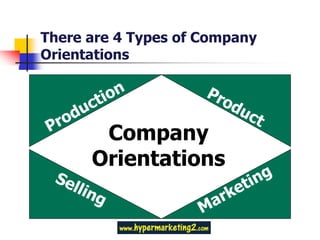
There are 4 Types of Company
Orientations


       Company
      Orientations
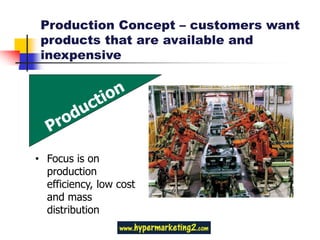
Production Concept – customers want
 products that are available and
 inexpensive


• Focus is on
  production
  efficiency, low cost
  and mass
  distribution
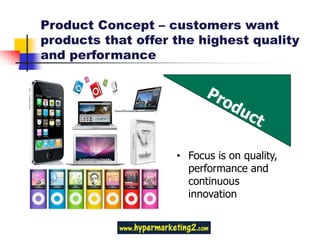
Product Concept – customers want
products that offer the highest quality
and performance


                    • Focus is on quality,
                      performance and
                      continuous
                      innovation
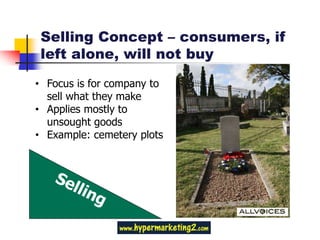
Selling Concept – consumers, if
 left alone, will not buy

• Focus is for company to
  sell what they make
• Applies mostly to
  unsought goods
• Example: cemetery plots
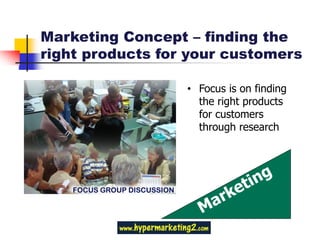
Marketing Concept – finding the
right products for your customers

                  • Focus is on finding
                    the right products
                    for customers
                    through research
1. Which of the following does not
     demonstrate a type of company
     orientation:

A.   MyPhone is the lowest priced, widely distributed
     value for money phone.
B.   Iphones are recognized for its cutting edge and
     innovative features.
C.   Samsung phones are advertised and promoted
     heavily in TV, radio, print & internet
D.   Blackberry employs the best people in its research,
     production & marketing departments.
E.   All of the above


                                                           10
2. _______,_______ and _____ are
Porter’s 3 Generic Strategies.

 A. Overall Value Creation, Value Communication, and
 Value Delivery
 B. Overall cost leadership, Differentiation and
     Focus
 C. Overall product leadership, Niche
     and Focus
 D. Overall cost leadership, Product Differentiation
 and Niche
 E. None of the above


                                                12
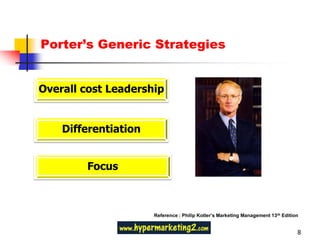
Porter’s Generic Strategies


Overall cost Leadership


    Differentiation


        Focus


                      Reference : Philip Kotler’s Marketing Management 13 th Edition


                                                                                   8
Explanation of Concept


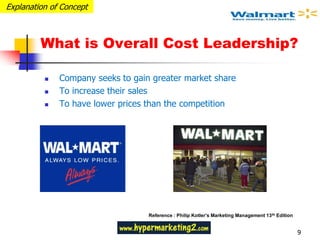
         What is Overall Cost Leadership?

             Company seeks to gain greater market share
             To increase their sales
             To have lower prices than the competition


                                   Reference : Philip Kotler’s Marketing Management 13 th Edition


                                                                                                    9
Explanation of Concept


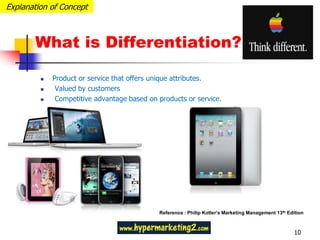
       What is Differentiation?

            Product or service that offers unique attributes.
             Valued by customers
             Competitive advantage based on products or service.


                                             Reference : Philip Kotler’s Marketing Management 13th Edition


                                                                                                      10
Explanation of Concept


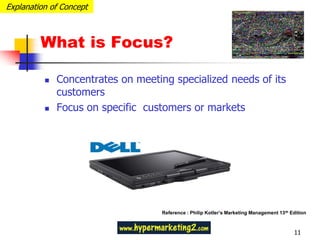
         What is Focus?

             Concentrates on meeting specialized needs of its
              customers
             Focus on specific customers or markets


                                    Reference : Philip Kotler’s Marketing Management 13 th Edition


                                                                                            11
2. _______,_______ and _____ are
Porter’s 3 Generic Strategies.

 A. Overall Value Creation, Value Communication, and
 Value Delivery
 B. Overall cost leadership, Differentiation and
     Focus
 C. Overall product leadership, Niche
     and Focus
 D. Overall cost leadership, Product Differentiation
 and Niche
 E. None of the above


                                                12
3. Which of the following is not a
measurement of customer satisfaction?

 A.   Customer loss Rate
 B.   First month sales performance for new
      product
 C.   Mystery Shopper
 D.   Periodic Surveys
 E.   Monitor Competitive Performance
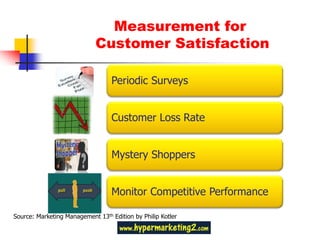
Measurement for
                             Customer Satisfaction

                                  Periodic Surveys


                                  Customer Loss Rate


                                  Mystery Shoppers


                                  Monitor Competitive Performance

Source: Marketing Management 13th Edition by Philip Kotler
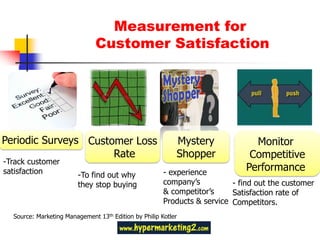
Measurement for
                               Customer Satisfaction


Periodic Surveys Customer Loss                             Mystery              Monitor
                      Rate                                 Shopper             Competitive
-Track customer
satisfaction                                           - experience
                                                                              Performance
                        -To find out why
                        they stop buying               company’s          - find out the customer
                                                       & competitor’s     Satisfaction rate of
                                                       Products & service Competitors.
  Source: Marketing Management 13th Edition by Philip Kotler
3. Which of the following is not a
measurement of customer satisfaction?

 A.   Customer loss Rate
 B.   First month sales performance for new
      product
 C.   Mystery Shopper
 D.   Periodic Surveys
 E.   Monitor Competitive Performance
4. _____________ is a term that refers to the
     tendency of people to interpret information in
     a way that will support what they already
     believe.

A.    Selective   Attention
B.    Selective   Distortion
C.    Selective   Retention
D.    Selective   Perception
E.    Selective   Interpretation
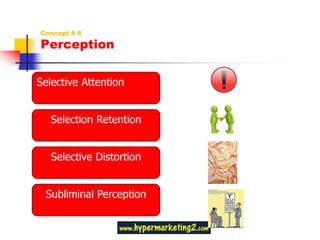
Concept # 8

Perception

Selective Attention


   Selection Retention


   Selective Distortion


 Subliminal Perception
4. _____________ is a term that refers to the
     tendency of people to interpret information in
     a way that will support what they already
     believe.


A.    Selective   Attention
B.    Selective   Distortion
C.    Selective   Retention
D.    Selective   Perception
E.    Selective   Interpretation
5. Promoting a visit to Star City
     is an example of marketing
     _________.

A.   A place
B.   An experience
C.   A service
D.   An event
E.   All of the above


                                         24
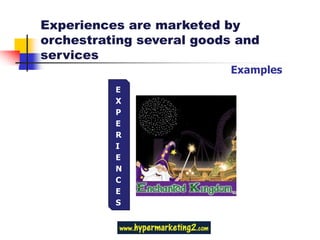
Experiences are marketed by
orchestrating several goods and
services
                          Examples
          E
          X
          P
          E
          R
          I
          E
          N
          C
          E
          S
5. Promoting a visit to Star City
     is an example of marketing
     _________.

A.   A place
B.   An experience
C.   A service
D.   An event
E.   All of the above


                                         26
6. The 12 M subscribers of SUN
cellular is an example of ____________

A. Potential market
B. Prequalified market
C. Target market
D. Penetrated market
E. Current market


                                         27
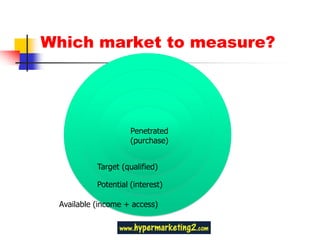
Which market to measure?


                     Penetrated
                     (purchase)


           Target (qualified)

           Potential (interest)

 Available (income + access)
6. The 12 M subscribers of SUN
cellular is an example of ____________

A. Potential market
B. Prequalified market
C. Target market
D. Penetrated market
E. Current market


                                         29
7. What step is not included in the
    consumer buying process?

   A. Problem Recognition
   B. Purchase Decision
   C. Evaluation
   D. Post-Purchase Behavior
   E. None of the above


                                          30
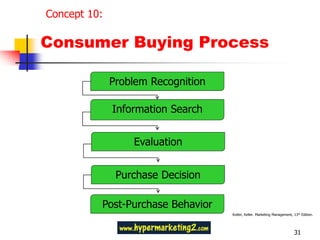
Concept 10:

Consumer Buying Process

              Problem Recognition

              Information Search


                  Evaluation


               Purchase Decision

          Post-Purchase Behavior
                                    Kotler, Keller. Marketing Management, 13th Edition.


                                                                           31
7. What step is not included in the
    consumer buying process?

   A. Problem Recognition
   B. Purchase Decision
   C. Evaluation
   D. Post-Purchase Behavior
   E. None of the above


                                          32
8. _________ are
associations/benefits that can
be shared with other brands.

a.   Points-of-Parity
b.   Points-of-Equality
c.   Points-of-Similarity
d.   Points-of-Uniformity
e.   None of the above


                                 33
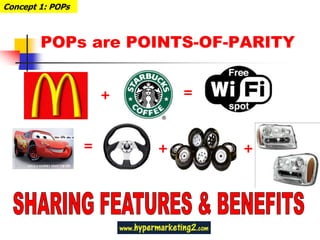
Concept 1: POPs


        POPs are POINTS-OF-PARITY


                      +       =


                  =       +       +
8. _________ are
associations/benefits that can
be shared with other brands.

a.   Points-of-Parity
b.   Points-of-Equality
c.   Points-of-Similarity
d.   Points-of-Uniformity
e.   None of the above


                                 35
9. High switching cost
 decreases _____________
a.   Supplier Power
b.   Threat of New Entrants
c.   Buyer Power
d.   Threat of Substitution
e.   All of the above


                              36
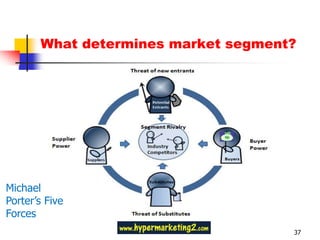
What determines market segment?


Michael
Porter’s Five
Forces
                                     37
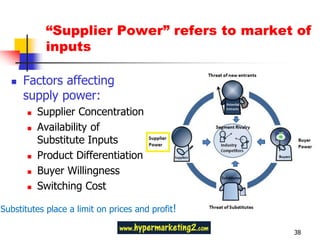
“Supplier Power” refers to market of
            inputs

     Factors affecting
      supply power:
          Supplier Concentration
          Availability of
           Substitute Inputs
          Product Differentiation
          Buyer Willingness
          Switching Cost

Substitutes place a limit on prices and profit!

                                                  38
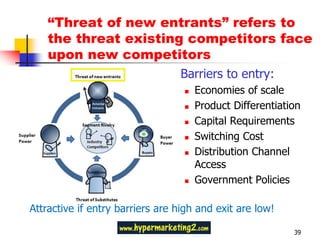
“Threat of new entrants” refers to
    the threat existing competitors face
    upon new competitors
                                  Barriers to entry:
                                      Economies of scale
                                      Product Differentiation
                                      Capital Requirements
                                      Switching Cost
                                      Distribution Channel
                                       Access
                                      Government Policies

Attractive if entry barriers are high and exit are low!

                                                            39
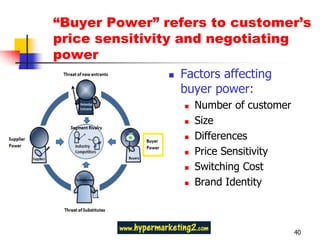
“Buyer Power” refers to customer’s
        price sensitivity and negotiating
        power
                               Factors affecting
                                buyer power:
                                   Number of customer
                                   Size
                                   Differences
                                   Price Sensitivity
                                   Switching Cost
Substitutes place a limit          Brand Identity
on prices and profit!


                                                         40
9. High switching cost
 decreases _____________
a.   Supplier Power
b.   Threat of New Entrants
c.   Buyer Power
d.   Threat of Substitution
e.   All of the above


                              41
10. Service positioning
 strategy can be made
 tangible through?

A.   Price, Place, People
B.   Place, Promotion, Price
C.   People, Product, Promotion
D.   Price, Position, Promotion
E.   Product, Place, People


                                  4
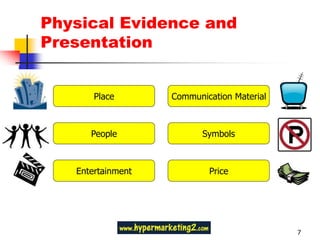
Physical Evidence and
Presentation


       Place       Communication Material


      People              Symbols


   Entertainment           Price


                                            7
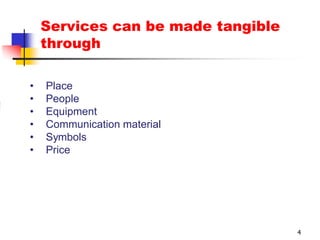
Services can be made tangible
    through

•   Place
•   People
•   Equipment
•   Communication material
•   Symbols
•   Price


                                    4
10. Service positioning
 strategy can be made
 tangible through?

A.   Price, Place, People
B.   Place, Promotion, Price
C.   People, Product, Promotion
D.   Price, Position, Promotion
E.   Product, Place, People


                                  4
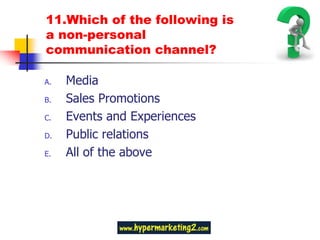
11.Which of the following is
a non-personal
communication channel?

A.   Media
B.   Sales Promotions
C.   Events and Experiences
D.   Public relations
E.   All of the above
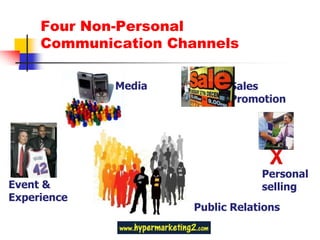
Four Non-Personal
     Communication Channels

             Media          Sales
                            Promotion


                                  Personal
Event &                           selling
Experience
                      Public Relations
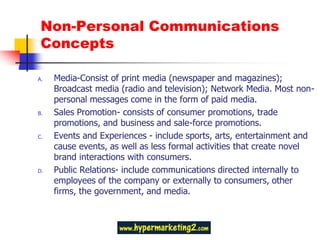
Non-Personal Communications
 Concepts

A.   Media-Consist of print media (newspaper and magazines);
     Broadcast media (radio and television); Network Media. Most non-
     personal messages come in the form of paid media.
B.   Sales Promotion- consists of consumer promotions, trade
     promotions, and business and sale-force promotions.
C.   Events and Experiences - include sports, arts, entertainment and
     cause events, as well as less formal activities that create novel
     brand interactions with consumers.
D.   Public Relations- include communications directed internally to
     employees of the company or externally to consumers, other
     firms, the government, and media.
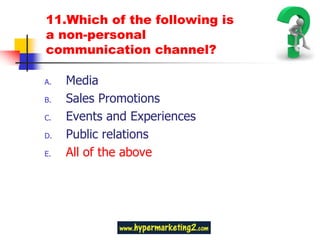
11.Which of the following is
a non-personal
communication channel?

A.   Media
B.   Sales Promotions
C.   Events and Experiences
D.   Public relations
E.   All of the above

Marketing Midterms Reviewer v54

  • 1.
    LEARNING by COACHING Midterm Exam Reviewer for Marketing Management from Questions submitted by v54 students Compiled and Edited by Prof. Remigio Joseph A. De Ungria Jr., MBA Ateneo Graduate School of Business
  • 2.
    Professor’s Note: These testquestions were….  Made by students, for students.  Selected from the hundreds of questions  Chosen since these demonstrate key marketing concepts  Posted on-line ahead of the test, to encourage students to prepare for the midterms instead of using common sense and luck.  May be modified during the actual exam so that the right answer becomes different.
  • 3.
    Exam Tip: Learn theConcept Don’t Memorize the Answer
  • 4.
    1. Which ofthe following does not demonstrate a type of company orientation: A. MyPhone is the lowest priced, widely distributed value for money phone. B. Iphones are recognized for its cutting edge and innovative features. C. Samsung phones are advertised and promoted heavily in TV, radio, print & internet D. Blackberry employs the best people in its research, production & marketing departments. E. All of the above 4
  • 5.
    There are 4Types of Company Orientations Company Orientations
  • 6.
    Production Concept –customers want products that are available and inexpensive • Focus is on production efficiency, low cost and mass distribution
  • 7.
    Product Concept –customers want products that offer the highest quality and performance • Focus is on quality, performance and continuous innovation
  • 8.
    Selling Concept –consumers, if left alone, will not buy • Focus is for company to sell what they make • Applies mostly to unsought goods • Example: cemetery plots
  • 9.
    Marketing Concept –finding the right products for your customers • Focus is on finding the right products for customers through research
  • 10.
    1. Which ofthe following does not demonstrate a type of company orientation: A. MyPhone is the lowest priced, widely distributed value for money phone. B. Iphones are recognized for its cutting edge and innovative features. C. Samsung phones are advertised and promoted heavily in TV, radio, print & internet D. Blackberry employs the best people in its research, production & marketing departments. E. All of the above 10
  • 11.
    2. _______,_______ and_____ are Porter’s 3 Generic Strategies. A. Overall Value Creation, Value Communication, and Value Delivery B. Overall cost leadership, Differentiation and Focus C. Overall product leadership, Niche and Focus D. Overall cost leadership, Product Differentiation and Niche E. None of the above 12
  • 12.
    Porter’s Generic Strategies Overallcost Leadership Differentiation Focus Reference : Philip Kotler’s Marketing Management 13 th Edition 8
  • 13.
    Explanation of Concept What is Overall Cost Leadership?  Company seeks to gain greater market share  To increase their sales  To have lower prices than the competition Reference : Philip Kotler’s Marketing Management 13 th Edition 9
  • 14.
    Explanation of Concept What is Differentiation?  Product or service that offers unique attributes.  Valued by customers  Competitive advantage based on products or service. Reference : Philip Kotler’s Marketing Management 13th Edition 10
  • 15.
    Explanation of Concept What is Focus?  Concentrates on meeting specialized needs of its customers  Focus on specific customers or markets Reference : Philip Kotler’s Marketing Management 13 th Edition 11
  • 16.
    2. _______,_______ and_____ are Porter’s 3 Generic Strategies. A. Overall Value Creation, Value Communication, and Value Delivery B. Overall cost leadership, Differentiation and Focus C. Overall product leadership, Niche and Focus D. Overall cost leadership, Product Differentiation and Niche E. None of the above 12
  • 17.
    3. Which ofthe following is not a measurement of customer satisfaction? A. Customer loss Rate B. First month sales performance for new product C. Mystery Shopper D. Periodic Surveys E. Monitor Competitive Performance
  • 18.
    Measurement for Customer Satisfaction Periodic Surveys Customer Loss Rate Mystery Shoppers Monitor Competitive Performance Source: Marketing Management 13th Edition by Philip Kotler
  • 19.
    Measurement for Customer Satisfaction Periodic Surveys Customer Loss Mystery Monitor Rate Shopper Competitive -Track customer satisfaction - experience Performance -To find out why they stop buying company’s - find out the customer & competitor’s Satisfaction rate of Products & service Competitors. Source: Marketing Management 13th Edition by Philip Kotler
  • 20.
    3. Which ofthe following is not a measurement of customer satisfaction? A. Customer loss Rate B. First month sales performance for new product C. Mystery Shopper D. Periodic Surveys E. Monitor Competitive Performance
  • 21.
    4. _____________ isa term that refers to the tendency of people to interpret information in a way that will support what they already believe. A. Selective Attention B. Selective Distortion C. Selective Retention D. Selective Perception E. Selective Interpretation
  • 22.
    Concept # 8 Perception SelectiveAttention Selection Retention Selective Distortion Subliminal Perception
  • 23.
    4. _____________ isa term that refers to the tendency of people to interpret information in a way that will support what they already believe. A. Selective Attention B. Selective Distortion C. Selective Retention D. Selective Perception E. Selective Interpretation
  • 24.
    5. Promoting avisit to Star City is an example of marketing _________. A. A place B. An experience C. A service D. An event E. All of the above 24
  • 25.
    Experiences are marketedby orchestrating several goods and services Examples E X P E R I E N C E S
  • 26.
    5. Promoting avisit to Star City is an example of marketing _________. A. A place B. An experience C. A service D. An event E. All of the above 26
  • 27.
    6. The 12M subscribers of SUN cellular is an example of ____________ A. Potential market B. Prequalified market C. Target market D. Penetrated market E. Current market 27
  • 28.
    Which market tomeasure? Penetrated (purchase) Target (qualified) Potential (interest) Available (income + access)
  • 29.
    6. The 12M subscribers of SUN cellular is an example of ____________ A. Potential market B. Prequalified market C. Target market D. Penetrated market E. Current market 29
  • 30.
    7. What stepis not included in the consumer buying process?  A. Problem Recognition  B. Purchase Decision  C. Evaluation  D. Post-Purchase Behavior  E. None of the above 30
  • 31.
    Concept 10: Consumer BuyingProcess Problem Recognition Information Search Evaluation Purchase Decision Post-Purchase Behavior Kotler, Keller. Marketing Management, 13th Edition. 31
  • 32.
    7. What stepis not included in the consumer buying process?  A. Problem Recognition  B. Purchase Decision  C. Evaluation  D. Post-Purchase Behavior  E. None of the above 32
  • 33.
    8. _________ are associations/benefitsthat can be shared with other brands. a. Points-of-Parity b. Points-of-Equality c. Points-of-Similarity d. Points-of-Uniformity e. None of the above 33
  • 34.
    Concept 1: POPs POPs are POINTS-OF-PARITY + = = + +
  • 35.
    8. _________ are associations/benefitsthat can be shared with other brands. a. Points-of-Parity b. Points-of-Equality c. Points-of-Similarity d. Points-of-Uniformity e. None of the above 35
  • 36.
    9. High switchingcost decreases _____________ a. Supplier Power b. Threat of New Entrants c. Buyer Power d. Threat of Substitution e. All of the above 36
  • 37.
    What determines marketsegment? Michael Porter’s Five Forces 37
  • 38.
    “Supplier Power” refersto market of inputs  Factors affecting supply power:  Supplier Concentration  Availability of Substitute Inputs  Product Differentiation  Buyer Willingness  Switching Cost Substitutes place a limit on prices and profit! 38
  • 39.
    “Threat of newentrants” refers to the threat existing competitors face upon new competitors  Barriers to entry:  Economies of scale  Product Differentiation  Capital Requirements  Switching Cost  Distribution Channel Access  Government Policies Attractive if entry barriers are high and exit are low! 39
  • 40.
    “Buyer Power” refersto customer’s price sensitivity and negotiating power  Factors affecting buyer power:  Number of customer  Size  Differences  Price Sensitivity  Switching Cost Substitutes place a limit  Brand Identity on prices and profit! 40
  • 41.
    9. High switchingcost decreases _____________ a. Supplier Power b. Threat of New Entrants c. Buyer Power d. Threat of Substitution e. All of the above 41
  • 42.
    10. Service positioning strategy can be made tangible through? A. Price, Place, People B. Place, Promotion, Price C. People, Product, Promotion D. Price, Position, Promotion E. Product, Place, People 4
  • 43.
    Physical Evidence and Presentation Place Communication Material People Symbols Entertainment Price 7
  • 44.
    Services can bemade tangible through • Place • People • Equipment • Communication material • Symbols • Price 4
  • 45.
    10. Service positioning strategy can be made tangible through? A. Price, Place, People B. Place, Promotion, Price C. People, Product, Promotion D. Price, Position, Promotion E. Product, Place, People 4
  • 46.
    11.Which of thefollowing is a non-personal communication channel? A. Media B. Sales Promotions C. Events and Experiences D. Public relations E. All of the above
  • 47.
    Four Non-Personal Communication Channels Media Sales Promotion Personal Event & selling Experience Public Relations
  • 48.
    Non-Personal Communications Concepts A. Media-Consist of print media (newspaper and magazines); Broadcast media (radio and television); Network Media. Most non- personal messages come in the form of paid media. B. Sales Promotion- consists of consumer promotions, trade promotions, and business and sale-force promotions. C. Events and Experiences - include sports, arts, entertainment and cause events, as well as less formal activities that create novel brand interactions with consumers. D. Public Relations- include communications directed internally to employees of the company or externally to consumers, other firms, the government, and media.
  • 49.
    11.Which of thefollowing is a non-personal communication channel? A. Media B. Sales Promotions C. Events and Experiences D. Public relations E. All of the above