
LEARNING by
     COACHING
     Midterm Exam Reviewer

     for Marketing Management
     from Questions
     submitted by v50 students
         Compiled and Edited by
Prof. Remigio Joseph A. De Ungria Jr., MBA
   Ateneo Graduate School of Business
Professor’s Note:
These test questions were….

   Made by students, for students.
   Selected from the hundreds of questions
   Chosen since these demonstrate key marketing
    concepts
   Posted on-line ahead of the test, to encourage
    students to prepare for the midterms instead of using
    common sense and luck.
   May be modified during the actual exam so that the
    right answer becomes different.
Exam Tip:
Learn the Concept


Don’t Memorize the Answer
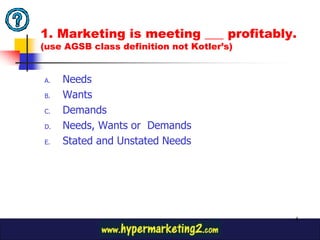
1. Marketing is meeting ___ profitably.
(use AGSB class definition not Kotler’s)


A.   Needs
B.   Wants
C.   Demands
D.   Needs, Wants or Demands
E.   Stated and Unstated Needs


                                           4
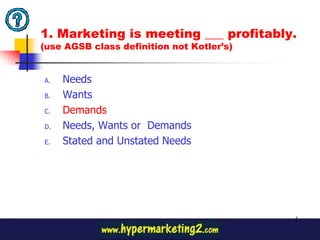
1. Marketing is meeting ___ profitably.
(use AGSB class definition not Kotler’s)


A.   Needs
B.   Wants
C.   Demands
D.   Needs, Wants or Demands
E.   Stated and Unstated Needs


                                           5
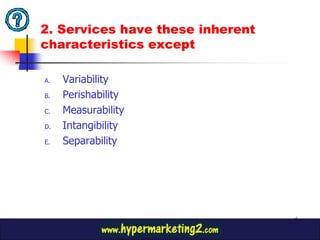
2. Services have these inherent
characteristics except

A.   Variability
B.   Perishability
C.   Measurability
D.   Intangibility
E.   Separability


                                  6
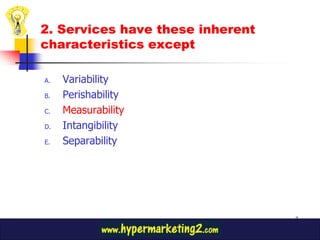
2. Services have these inherent
characteristics except

A.   Variability
B.   Perishability
C.   Measurability
D.   Intangibility
E.   Separability


                                  7
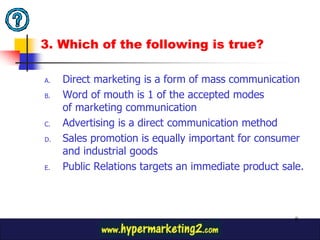
3. Which of the following is true?

A.   Direct marketing is a form of mass communication
B.   Word of mouth is 1 of the accepted modes
     of marketing communication
C.   Advertising is a direct communication method
D.   Sales promotion is equally important for consumer
     and industrial goods
E.   Public Relations targets an immediate product sale.


                                                      8
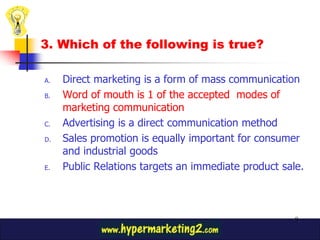
3. Which of the following is true?

A.   Direct marketing is a form of mass communication
B.   Word of mouth is 1 of the accepted modes of
     marketing communication
C.   Advertising is a direct communication method
D.   Sales promotion is equally important for consumer
     and industrial goods
E.   Public Relations targets an immediate product sale.


                                                      9
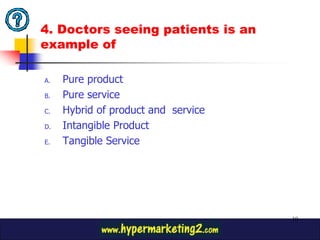
4. Doctors seeing patients is an
example of

A.   Pure product
B.   Pure service
C.   Hybrid of product and service
D.   Intangible Product
E.   Tangible Service


                                     10
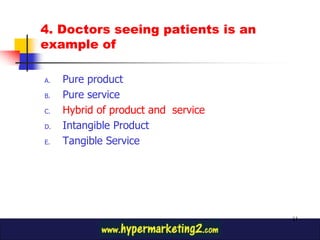
4. Doctors seeing patients is an
example of

A.   Pure product
B.   Pure service
C.   Hybrid of product and service
D.   Intangible Product
E.   Tangible Service


                                     11
5. Kotler considers this as the 5th P of the
marketing mix


A.   Profits
B.   Process
C.   Potential
D.   Packaging
E.   People


                                               12
5. Kotler considers this as the 5th P of the
marketing mix


A.   Profits
B.   Process
C.   Potential
D.   Packaging
E.   People


                                               13
TOP 10 LEARNING QUESTIONS in
         CHAPTER 2:
  Developing Marketing Strategies & Plans


                                            TEAM


                                                   14
6. Which of the following are
                 false about core competencies?


        A. It is a source of competitive advantage

B. It has applications in a wide variety of markets

                         C. It is difficult to imitate

   D. It can obtain better quality and lower costs

E. 2 Firms can have the same core compentencies
6. Which of the following are
                 false about core competencies?


        A. It is a source of competitive advantage

B. It has applications in a wide variety of markets

                         C. It is difficult to imitate

   D. It can obtain better quality and lower costs

E. 2 Firms can have the same core compentencies
7. To ensure execution of right
                activities, marketers must give
                                     priority to-


   A. Holistic marketing

   B. Core competencies

    C. Strategic planning

D. Value delivery process

     E. Market Research
7. To ensure execution of right
                activities, marketers must give
                                     priority to-


   A. Holistic marketing

   B. Core competencies

    C. Strategic planning

D. Value delivery process

     E. Market Research
TOP 10 LEARNING QUESTIONS


         CHAPTER 4: CONDUCTING
          MARKET RESEARCH AND
           FORECASTING DEMAND
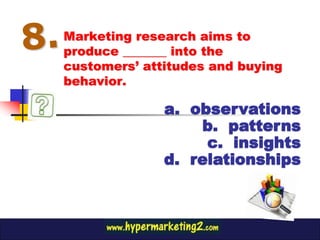
Marketing research aims to
produce _______ into the
customers’ attitudes and buying
behavior.

              a. observations
                  b. patterns
                   c. insights
              d. relationships
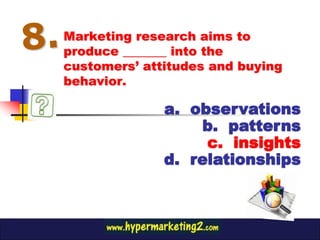
Marketing research aims to
produce _______ into the
customers’ attitudes and buying
behavior.

              a. observations
                  b. patterns
                   c. insights
              d. relationships
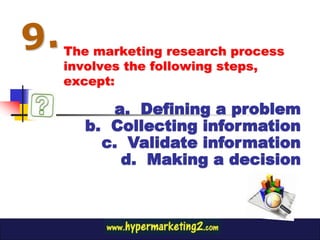
The marketing research process
involves the following steps,
except:

     a. Defining a problem
  b. Collecting information
    c. Validate information
      d. Making a decision
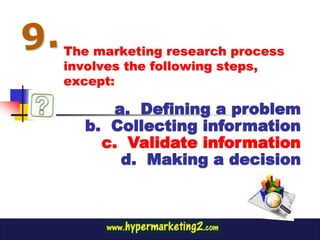
The marketing research process
involves the following steps,
except:

     a. Defining a problem
  b. Collecting information
    c. Validate information
      d. Making a decision
The following are ways to collect
primary data, except:

               a. Surveys
 b. Focus group discussion
         c. Published data
           d. Experiments
The following are ways to collect
primary data, except:

               a. Surveys
 b. Focus group discussion
         c. Published data
           d. Experiments
TOP 10 Learning
      Questions for

        Chapter 5
Creating Customer Value,
 Satisfaction and Loyalty
11. _________ describes the net present value
of the stream of future profits expected over
the customers lifetime purchases.


A.   Customer Perceived Lifetime Score
B.   Customer Lifetime Satisfaction
C.   Customer’s Repeat Sales
D.   Customer Lifetime Equity
E.   Customer Lifetime Value


                                           27
11. _________ describes the net present value
of the stream of future profits expected over
the customers lifetime purchases.


A.   Customer Perceived Lifetime Score
B.   Customer Lifetime Satisfaction
C.   Customer’s Repeat Sales
D.   Customer Lifetime Equity
E.   Customer Lifetime Value


                                           28
12. One problem that can deter a firm from
effectively using CRM is:


A.   Building customer databases can be expensive
B.   Not all customers want a relationship with the company
C.   Getting everyone in the company to be customer-
     oriented
D.   Assumptions of CRM may not always hold true
E.   All of the above


                                                        29
12. One problem that can deter a firm from
effectively using CRM is:


A.   Building customer databases can be expensive
B.   Not all customers want a relationship with the company
C.   Getting everyone in the company to be customer-
     oriented
D.   Assumptions of CRM may not always hold true
E.   All of the above


                                                        30
TOP 10 Learning Questions for
Analyzing Consumer Markets
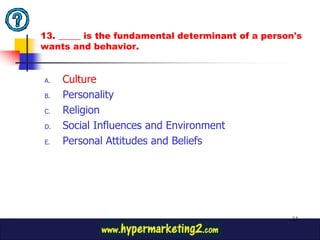
13. _____ is the fundamental determinant of a person's
wants and behavior.


A.   Culture
B.   Personality
C.   Religion
D.   Social Influences and Environment
E.   Personal Attitudes and Beliefs


                                                   32
13. _____ is the fundamental determinant of a person's
wants and behavior.


A.   Culture
B.   Personality
C.   Religion
D.   Social Influences and Environment
E.   Personal Attitudes and Beliefs


                                                   33
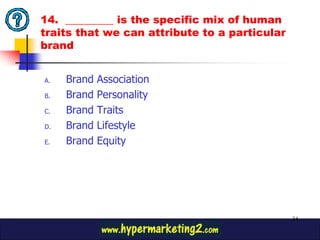
14. _________ is the specific mix of human
traits that we can attribute to a particular
brand


A.   Brand   Association
B.   Brand   Personality
C.   Brand   Traits
D.   Brand   Lifestyle
E.   Brand   Equity


                                               34
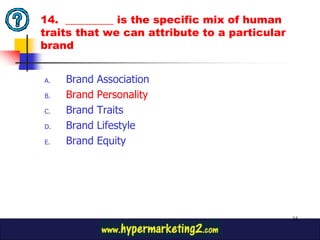
14. _________ is the specific mix of human
traits that we can attribute to a particular
brand


A.   Brand   Association
B.   Brand   Personality
C.   Brand   Traits
D.   Brand   Lifestyle
E.   Brand   Equity


                                               35
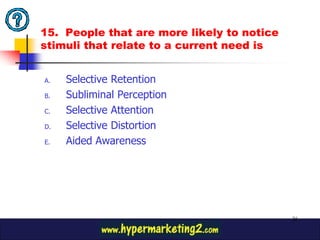
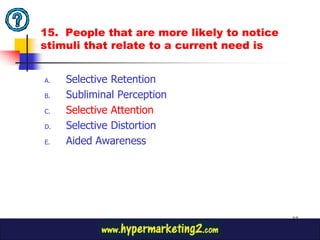
15. People that are more likely to notice
stimuli that relate to a current need is


A.   Selective Retention
B.   Subliminal Perception
C.   Selective Attention
D.   Selective Distortion
E.   Aided Awareness


                                            36
15. People that are more likely to notice
stimuli that relate to a current need is


A.   Selective Retention
B.   Subliminal Perception
C.   Selective Attention
D.   Selective Distortion
E.   Aided Awareness


                                            37
TOP 10 Learning Questions for :


Chapter 7 Analyzing Business
Marketing
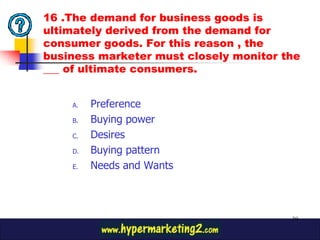
16 .The demand for business goods is
ultimately derived from the demand for
consumer goods. For this reason , the
business marketer must closely monitor the
___ of ultimate consumers.


    A.   Preference
    B.   Buying power
    C.   Desires
    D.   Buying pattern
    E.   Needs and Wants


                                        39
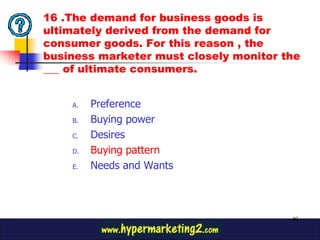
16 .The demand for business goods is
ultimately derived from the demand for
consumer goods. For this reason , the
business marketer must closely monitor the
___ of ultimate consumers.


    A.   Preference
    B.   Buying power
    C.   Desires
    D.   Buying pattern
    E.   Needs and Wants


                                        40
17. Business markets generally have
the following characteristics except:

A.   Larger buyers
B.   Fewer buyers
C.   Geographically concentrated markets
D.   Concentrated Buying Influence
E.   Derived Demand


                                           41
17. Business markets generally have
the following characteristics except:

A.   Larger buyers
B.   Fewer buyers
C.   Geographically concentrated markets
D.   Concentrated Buying Influence
E.   Derived Demand


                                           42
18. The following are all part of the buying
center except:


A.   Sellers
B.   Initiators
C.   Deciders
D.    Influencers
E.    Gatekeeper


                                           43
18. The following are all part of the buying
center except:


A.   Sellers
B.   Initiators
C.   Deciders
D.    Influencers
E.    Gatekeeper


                                           44
Top 10 Questions for Chapter 8:
Identifying Market Segments and Targets
19. In _____ segmentation, buyers are divided
 into groups on the basis of their knowledge of,
 attitude toward, use of, or response to a
 product.


a)   psychographic
b)   behavioral
c)   lifestyle
d)   attitudinal
e)   strategic


                                             p.263
19. In _____ segmentation, buyers are divided
 into groups on the basis of their knowledge of,
 attitude toward, use of, or response to a
 product.


a)   psychographic
b)   behavioral
c)   lifestyle
d)   attitudinal
e)   strategic


                                             p.263
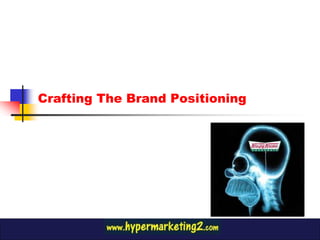
Crafting The Brand Positioning
20
20
21
21
TOP 10 Learning
Questions for


       Chapter 11
Dealing with Competition
22. Competitors is define as companies
    that satisfies the same customer______


A.   Wants
B.   Needs
C.   Demands
D.   Needs, Wants or Demands
E.   Stated and Unstated Needs


                                             54
22. Competitors is define as companies
    that satisfies the same customer______


A.   Wants
B.   Needs
C.   Demands
D.   Needs, Wants or Demands
E.   Stated and Unstated Needs


                                             55
23. In analyzing competition, companies must
determine the following except:


A.   Strength
B.   Weakness
C.   Objective
D.   Strategy
E.   Opportunities


                                               56
23. In analyzing competition, companies must
determine the following except:


A.   Strength
B.   Weakness
C.   Objective
D.   Strategy
E.   Opportunities


                                               57
24. Increasing the level of product consumption is an
example of:


A.   Defending market share strategy
B.   Expanding market share strategy
C.   Expanding total market strategy
D.   Market Follower strategy
E.   Market Nicher strategy


                                                   58
24. Increasing the level of product
consumption is an example of:


A.   Defending market share strategy
B.   Expanding market share strategy
C.   Expanding total market strategy
D.   Market Follower strategy
E.   Market Nicher strategy


                                       59
Chapter 12:

Setting Product Strategy
25. Which one of the 4 is not included
in the five product levels?


A. Potential Product
B. Basic Product
C. Internal Product
D. Core Benefit
E. Extended Product
25. Which one of the 4 is not included
in the five product levels?


A. Potential Product
B. Basic Product
C. Internal Product
D. Core Benefit
E. Extended Product
26. Packaging aims for the following
objectives except:


A. Assist at-home storage

B. Facilitate product transportation

C. Convey descriptive and persuasive information

D. Build consumer loyalty

E. Protect the product and its contents
26. Packaging aims for the following
objectives except:


A. Assist at-home storage

B. Facilitate product transportation

C. Convey descriptive and persuasive information

D. Build consumer loyalty

E. Protect the product and its contents
TOP 10 Learning
Questions for


       Chapter 13
 Designing and Managing
        Services
27. These strategies can produce better
match between demand and supply in a
service business, except?


A.   Differential pricing
B.   Reservation system
C.   Nonpeak demand
D.   Complementary services
E.   Customer Satisfaction Monitoring systems


                                                66
27. These strategies can produce better
match between demand and supply in a
service business, except?


A.   Differential pricing
B.   Reservation system
C.   Nonpeak demand
D.   Complementary services
E.   Customer Satisfaction Monitoring systems


                                                67
28. Which of the following is false?


A.   Top service companies are “customer obsessed”.
B.   The best service providers set high service quality
     standards.
C.   Consumers value convenience in services.
D.   Management have a thorough commitment to
     service quality.
E.   Top firms audit only their own service performance.


                                                   68
28. Which of the following is false?


A.   Top service companies are “customer obsessed”.
B.   The best service providers set high service quality
     standards.
C.   Consumers value convenience in services.
D.   Management have a thorough commitment to
     service quality.
E.   Top firms audit only their own service performance.


                                                   69
29. What is the supply strategy of self-
service gas stations?


A.   Part-time employees
B.    Peak-time efficiency
C.    Increased customer participation
D.    Shared services
E.    Facilities for future expansion


                                           70
29. What is the supply strategy of self-
service gas stations?


A.   Part-time employees
B.    Peak-time efficiency
C.    Increased customer participation
D.    Shared services
E.    Facilities for future expansion


                                           71
TOP 10 Learning
Questions for


   Developing Pricing
Strategies and Programs
       Chapter 14
30. Back-to-school sales at National
Bookstore is an example of


A.   Differentiated Pricing
B.   Special Discount Pricing
C.   Special-event Pricing
D.   Promotional Pricing
E.   Price Discounts and Allowances Pricing


                                              73
30. Back-to-school sales at National
Bookstore is an example of


A.   Differentiated Pricing
B.   Special Discount Pricing
C.   Special-event Pricing
D.   Promotional Pricing
E.   Price Discounts and Allowances Pricing


                                              74
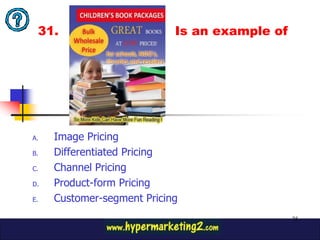
31.                        Is an example of


A.   Image Pricing
B.   Differentiated Pricing
C.   Channel Pricing
D.   Product-form Pricing
E.   Customer-segment Pricing
                                               75
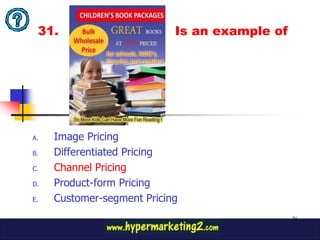
31.                        Is an example of


A.   Image Pricing
B.   Differentiated Pricing
C.   Channel Pricing
D.   Product-form Pricing
E.   Customer-segment Pricing
                                               76
TOP 10 Learning
Questions for


        Chapter 16
     Managing Retailing,
      Wholesaling, and
         Logistics
KOTLER P.482
                                       Paragraph 2


32. Selling to final consumers
may be done by a ___.

A.   Manufacturer
B.   Wholesaler
C.   Retailer
D.   Manufacturer, Wholesaler, or Retailer
E.   Wholesaler or Retailer


                                       78
KOTLER P.482

32. Selling to final consumers may be         Paragraph 2


done by a ___.

A.   Manufacturer
B.   Wholesaler
C.   Retailer
D.   Manufacturer, Wholesaler, or Retailer
E.   Wholesaler or Retailer


                                                79
33. Studying market logistics means
      finding the ___ way to deliver value.

A.    least-cost                         KOTLER P.502
                                        LAST SECTION

B.    fastest
C.    most customer service -oriented
D.    most ethical
E.    most efficient


                                               80
33. Studying market logistics means
 finding the ___ way to deliver value.
A.   least-cost                         KOTLER P.502
                                       LAST SECTION
B.   fastest
C.   most customer service -oriented
D.   most ethical
E.   most efficient


                                               81
TOP 10 Learning
Questions for


        Chapter 18
      Managing Mass
      Communications
34. Which factor has little or no effect on
the mass communications budget


 A.   Consumer base (number of consumers)
 B.   Market Share
 C.   Competition
 D.   Stage in Product Life Cycle
 E.   Product Pricing


                                              83
34. Which factor has little or no effect on
the mass communications budget


 A.   Consumer base (number of consumers)
 B.   Market Share
 C.   Competition
 D.   Stage in Product Life Cycle
 E.   Product Pricing


                                              84
35. Which of the following statements is
   false?

A. The Percentage of Sales Method, while commonly used is not
   the best way to set the IMC budget.
B. Although advertising is treated as a current expense, part of it
   is really an investment on building brand equity and customer
   loyalty
C. Media selection is finding the most cost-effective media to
   deliver the desired number and types of exposures to the target
   audience.
D. Sales promotion consists of a collection of incentive tools to
   stimulate quicker or greater purchase of a particular product or
   service.
E. Advertising is any form of nonpersonal presentation and
   promotion of ideas, goods or services by an identified sponsor.
35. Which of the following statements is
   false?
A. The Percentage of Sales Method, while commonly used is not
   the best way to set the IMC budget.
B. Although advertising is treated as a current expense, part of it
   is really an investment on building brand equity and customer
   loyalty
C. Media selection is finding the most cost-effective media to
   deliver the desired number and types of exposures to the target
   audience.
D. Sales promotion consists of a collection of incentive tools to
   stimulate quicker or greater purchase of a particular product or
   service.
E. Advertising is any form of nonpersonal presentation and
   promotion of ideas, goods or services by an identified sponsor.
TOP 10 Learning
Questions for


             Chapter 21:
  Tapping into the Global
                 Markets
36. Which of the following is false?

A.   One of the advantages of indirect export is less
     investment.
B.   Direct export is more risky than direct investment.
C.   Direct investment is the ultimate form of foreign
     involvement
D.   Control is shared by the foreign & local firms in a
     joint venture
E.   Franchising is a form of licensing


                                                      88
36. Which of the following is false?

A.   One of the advantages of indirect export is less
     investment.
B.   Direct export is more risky than direct investment.
C.   Direct investment is the ultimate form of foreign
     involvement
D.   Control is shared by the foreign & local firms in a
     joint venture
E.   Franchising is a form of licensing


                                                      89
37. Bench t-shirts, with no changes in
design, color or appearance, sold
overseas is an example of

A.   Straight extension
B.   Direct adaptation
C.   Thinking local, acting global
D.   Market penetration
E.   Brand consistency


                                     90
37. Bench t-shirts, with no changes in
design, color or appearance, sold
overseas is an example of

A.   Straight extension
B.   Direct adaptation
C.   Thinking local, acting global
D.   Market penetration
E.   Brand consistency


                                     91
38. McDonald’s “hamdesal” is an
example of

A.   Product extension
B.   Product adaptation
C.   Product invention
D.   Communication adaptation
E.   Dual adaptation


                                  92
38. McDonald’s “hamdesal” is an
example of

A.   Product extension
B.   Product adaptation
C.   Product invention
D.   Communication adaptation
E.   Dual adaptation


                                  93

Marketing Midterms Reviewer v50

  • 1.
    LEARNING by COACHING Midterm Exam Reviewer for Marketing Management from Questions submitted by v50 students Compiled and Edited by Prof. Remigio Joseph A. De Ungria Jr., MBA Ateneo Graduate School of Business
  • 2.
    Professor’s Note: These testquestions were….  Made by students, for students.  Selected from the hundreds of questions  Chosen since these demonstrate key marketing concepts  Posted on-line ahead of the test, to encourage students to prepare for the midterms instead of using common sense and luck.  May be modified during the actual exam so that the right answer becomes different.
  • 3.
    Exam Tip: Learn theConcept Don’t Memorize the Answer
  • 4.
    1. Marketing ismeeting ___ profitably. (use AGSB class definition not Kotler’s) A. Needs B. Wants C. Demands D. Needs, Wants or Demands E. Stated and Unstated Needs 4
  • 5.
    1. Marketing ismeeting ___ profitably. (use AGSB class definition not Kotler’s) A. Needs B. Wants C. Demands D. Needs, Wants or Demands E. Stated and Unstated Needs 5
  • 6.
    2. Services havethese inherent characteristics except A. Variability B. Perishability C. Measurability D. Intangibility E. Separability 6
  • 7.
    2. Services havethese inherent characteristics except A. Variability B. Perishability C. Measurability D. Intangibility E. Separability 7
  • 8.
    3. Which ofthe following is true? A. Direct marketing is a form of mass communication B. Word of mouth is 1 of the accepted modes of marketing communication C. Advertising is a direct communication method D. Sales promotion is equally important for consumer and industrial goods E. Public Relations targets an immediate product sale. 8
  • 9.
    3. Which ofthe following is true? A. Direct marketing is a form of mass communication B. Word of mouth is 1 of the accepted modes of marketing communication C. Advertising is a direct communication method D. Sales promotion is equally important for consumer and industrial goods E. Public Relations targets an immediate product sale. 9
  • 10.
    4. Doctors seeingpatients is an example of A. Pure product B. Pure service C. Hybrid of product and service D. Intangible Product E. Tangible Service 10
  • 11.
    4. Doctors seeingpatients is an example of A. Pure product B. Pure service C. Hybrid of product and service D. Intangible Product E. Tangible Service 11
  • 12.
    5. Kotler considersthis as the 5th P of the marketing mix A. Profits B. Process C. Potential D. Packaging E. People 12
  • 13.
    5. Kotler considersthis as the 5th P of the marketing mix A. Profits B. Process C. Potential D. Packaging E. People 13
  • 14.
    TOP 10 LEARNINGQUESTIONS in CHAPTER 2: Developing Marketing Strategies & Plans TEAM 14
  • 15.
    6. Which ofthe following are false about core competencies? A. It is a source of competitive advantage B. It has applications in a wide variety of markets C. It is difficult to imitate D. It can obtain better quality and lower costs E. 2 Firms can have the same core compentencies
  • 16.
    6. Which ofthe following are false about core competencies? A. It is a source of competitive advantage B. It has applications in a wide variety of markets C. It is difficult to imitate D. It can obtain better quality and lower costs E. 2 Firms can have the same core compentencies
  • 17.
    7. To ensureexecution of right activities, marketers must give priority to- A. Holistic marketing B. Core competencies C. Strategic planning D. Value delivery process E. Market Research
  • 18.
    7. To ensureexecution of right activities, marketers must give priority to- A. Holistic marketing B. Core competencies C. Strategic planning D. Value delivery process E. Market Research
  • 19.
    TOP 10 LEARNINGQUESTIONS CHAPTER 4: CONDUCTING MARKET RESEARCH AND FORECASTING DEMAND
  • 20.
    Marketing research aimsto produce _______ into the customers’ attitudes and buying behavior. a. observations b. patterns c. insights d. relationships
  • 21.
    Marketing research aimsto produce _______ into the customers’ attitudes and buying behavior. a. observations b. patterns c. insights d. relationships
  • 22.
    The marketing researchprocess involves the following steps, except: a. Defining a problem b. Collecting information c. Validate information d. Making a decision
  • 23.
    The marketing researchprocess involves the following steps, except: a. Defining a problem b. Collecting information c. Validate information d. Making a decision
  • 24.
    The following areways to collect primary data, except: a. Surveys b. Focus group discussion c. Published data d. Experiments
  • 25.
    The following areways to collect primary data, except: a. Surveys b. Focus group discussion c. Published data d. Experiments
  • 26.
    TOP 10 Learning Questions for Chapter 5 Creating Customer Value, Satisfaction and Loyalty
  • 27.
    11. _________ describesthe net present value of the stream of future profits expected over the customers lifetime purchases. A. Customer Perceived Lifetime Score B. Customer Lifetime Satisfaction C. Customer’s Repeat Sales D. Customer Lifetime Equity E. Customer Lifetime Value 27
  • 28.
    11. _________ describesthe net present value of the stream of future profits expected over the customers lifetime purchases. A. Customer Perceived Lifetime Score B. Customer Lifetime Satisfaction C. Customer’s Repeat Sales D. Customer Lifetime Equity E. Customer Lifetime Value 28
  • 29.
    12. One problemthat can deter a firm from effectively using CRM is: A. Building customer databases can be expensive B. Not all customers want a relationship with the company C. Getting everyone in the company to be customer- oriented D. Assumptions of CRM may not always hold true E. All of the above 29
  • 30.
    12. One problemthat can deter a firm from effectively using CRM is: A. Building customer databases can be expensive B. Not all customers want a relationship with the company C. Getting everyone in the company to be customer- oriented D. Assumptions of CRM may not always hold true E. All of the above 30
  • 31.
    TOP 10 LearningQuestions for Analyzing Consumer Markets
  • 32.
    13. _____ isthe fundamental determinant of a person's wants and behavior. A. Culture B. Personality C. Religion D. Social Influences and Environment E. Personal Attitudes and Beliefs 32
  • 33.
    13. _____ isthe fundamental determinant of a person's wants and behavior. A. Culture B. Personality C. Religion D. Social Influences and Environment E. Personal Attitudes and Beliefs 33
  • 34.
    14. _________ isthe specific mix of human traits that we can attribute to a particular brand A. Brand Association B. Brand Personality C. Brand Traits D. Brand Lifestyle E. Brand Equity 34
  • 35.
    14. _________ isthe specific mix of human traits that we can attribute to a particular brand A. Brand Association B. Brand Personality C. Brand Traits D. Brand Lifestyle E. Brand Equity 35
  • 36.
    15. People thatare more likely to notice stimuli that relate to a current need is A. Selective Retention B. Subliminal Perception C. Selective Attention D. Selective Distortion E. Aided Awareness 36
  • 37.
    15. People thatare more likely to notice stimuli that relate to a current need is A. Selective Retention B. Subliminal Perception C. Selective Attention D. Selective Distortion E. Aided Awareness 37
  • 38.
    TOP 10 LearningQuestions for : Chapter 7 Analyzing Business Marketing
  • 39.
    16 .The demandfor business goods is ultimately derived from the demand for consumer goods. For this reason , the business marketer must closely monitor the ___ of ultimate consumers. A. Preference B. Buying power C. Desires D. Buying pattern E. Needs and Wants 39
  • 40.
    16 .The demandfor business goods is ultimately derived from the demand for consumer goods. For this reason , the business marketer must closely monitor the ___ of ultimate consumers. A. Preference B. Buying power C. Desires D. Buying pattern E. Needs and Wants 40
  • 41.
    17. Business marketsgenerally have the following characteristics except: A. Larger buyers B. Fewer buyers C. Geographically concentrated markets D. Concentrated Buying Influence E. Derived Demand 41
  • 42.
    17. Business marketsgenerally have the following characteristics except: A. Larger buyers B. Fewer buyers C. Geographically concentrated markets D. Concentrated Buying Influence E. Derived Demand 42
  • 43.
    18. The followingare all part of the buying center except: A. Sellers B. Initiators C. Deciders D. Influencers E. Gatekeeper 43
  • 44.
    18. The followingare all part of the buying center except: A. Sellers B. Initiators C. Deciders D. Influencers E. Gatekeeper 44
  • 45.
    Top 10 Questionsfor Chapter 8: Identifying Market Segments and Targets
  • 46.
    19. In _____segmentation, buyers are divided into groups on the basis of their knowledge of, attitude toward, use of, or response to a product. a) psychographic b) behavioral c) lifestyle d) attitudinal e) strategic p.263
  • 47.
    19. In _____segmentation, buyers are divided into groups on the basis of their knowledge of, attitude toward, use of, or response to a product. a) psychographic b) behavioral c) lifestyle d) attitudinal e) strategic p.263
  • 48.
    Crafting The BrandPositioning
  • 49.
  • 50.
  • 51.
  • 52.
  • 53.
    TOP 10 Learning Questionsfor Chapter 11 Dealing with Competition
  • 54.
    22. Competitors isdefine as companies that satisfies the same customer______ A. Wants B. Needs C. Demands D. Needs, Wants or Demands E. Stated and Unstated Needs 54
  • 55.
    22. Competitors isdefine as companies that satisfies the same customer______ A. Wants B. Needs C. Demands D. Needs, Wants or Demands E. Stated and Unstated Needs 55
  • 56.
    23. In analyzingcompetition, companies must determine the following except: A. Strength B. Weakness C. Objective D. Strategy E. Opportunities 56
  • 57.
    23. In analyzingcompetition, companies must determine the following except: A. Strength B. Weakness C. Objective D. Strategy E. Opportunities 57
  • 58.
    24. Increasing thelevel of product consumption is an example of: A. Defending market share strategy B. Expanding market share strategy C. Expanding total market strategy D. Market Follower strategy E. Market Nicher strategy 58
  • 59.
    24. Increasing thelevel of product consumption is an example of: A. Defending market share strategy B. Expanding market share strategy C. Expanding total market strategy D. Market Follower strategy E. Market Nicher strategy 59
  • 60.
  • 61.
    25. Which oneof the 4 is not included in the five product levels? A. Potential Product B. Basic Product C. Internal Product D. Core Benefit E. Extended Product
  • 62.
    25. Which oneof the 4 is not included in the five product levels? A. Potential Product B. Basic Product C. Internal Product D. Core Benefit E. Extended Product
  • 63.
    26. Packaging aimsfor the following objectives except: A. Assist at-home storage B. Facilitate product transportation C. Convey descriptive and persuasive information D. Build consumer loyalty E. Protect the product and its contents
  • 64.
    26. Packaging aimsfor the following objectives except: A. Assist at-home storage B. Facilitate product transportation C. Convey descriptive and persuasive information D. Build consumer loyalty E. Protect the product and its contents
  • 65.
    TOP 10 Learning Questionsfor Chapter 13 Designing and Managing Services
  • 66.
    27. These strategiescan produce better match between demand and supply in a service business, except? A. Differential pricing B. Reservation system C. Nonpeak demand D. Complementary services E. Customer Satisfaction Monitoring systems 66
  • 67.
    27. These strategiescan produce better match between demand and supply in a service business, except? A. Differential pricing B. Reservation system C. Nonpeak demand D. Complementary services E. Customer Satisfaction Monitoring systems 67
  • 68.
    28. Which ofthe following is false? A. Top service companies are “customer obsessed”. B. The best service providers set high service quality standards. C. Consumers value convenience in services. D. Management have a thorough commitment to service quality. E. Top firms audit only their own service performance. 68
  • 69.
    28. Which ofthe following is false? A. Top service companies are “customer obsessed”. B. The best service providers set high service quality standards. C. Consumers value convenience in services. D. Management have a thorough commitment to service quality. E. Top firms audit only their own service performance. 69
  • 70.
    29. What isthe supply strategy of self- service gas stations? A. Part-time employees B. Peak-time efficiency C. Increased customer participation D. Shared services E. Facilities for future expansion 70
  • 71.
    29. What isthe supply strategy of self- service gas stations? A. Part-time employees B. Peak-time efficiency C. Increased customer participation D. Shared services E. Facilities for future expansion 71
  • 72.
    TOP 10 Learning Questionsfor Developing Pricing Strategies and Programs Chapter 14
  • 73.
    30. Back-to-school salesat National Bookstore is an example of A. Differentiated Pricing B. Special Discount Pricing C. Special-event Pricing D. Promotional Pricing E. Price Discounts and Allowances Pricing 73
  • 74.
    30. Back-to-school salesat National Bookstore is an example of A. Differentiated Pricing B. Special Discount Pricing C. Special-event Pricing D. Promotional Pricing E. Price Discounts and Allowances Pricing 74
  • 75.
    31. Is an example of A. Image Pricing B. Differentiated Pricing C. Channel Pricing D. Product-form Pricing E. Customer-segment Pricing 75
  • 76.
    31. Is an example of A. Image Pricing B. Differentiated Pricing C. Channel Pricing D. Product-form Pricing E. Customer-segment Pricing 76
  • 77.
    TOP 10 Learning Questionsfor Chapter 16 Managing Retailing, Wholesaling, and Logistics
  • 78.
    KOTLER P.482 Paragraph 2 32. Selling to final consumers may be done by a ___. A. Manufacturer B. Wholesaler C. Retailer D. Manufacturer, Wholesaler, or Retailer E. Wholesaler or Retailer 78
  • 79.
    KOTLER P.482 32. Sellingto final consumers may be Paragraph 2 done by a ___. A. Manufacturer B. Wholesaler C. Retailer D. Manufacturer, Wholesaler, or Retailer E. Wholesaler or Retailer 79
  • 80.
    33. Studying marketlogistics means finding the ___ way to deliver value. A. least-cost KOTLER P.502 LAST SECTION B. fastest C. most customer service -oriented D. most ethical E. most efficient 80
  • 81.
    33. Studying marketlogistics means finding the ___ way to deliver value. A. least-cost KOTLER P.502 LAST SECTION B. fastest C. most customer service -oriented D. most ethical E. most efficient 81
  • 82.
    TOP 10 Learning Questionsfor Chapter 18 Managing Mass Communications
  • 83.
    34. Which factorhas little or no effect on the mass communications budget A. Consumer base (number of consumers) B. Market Share C. Competition D. Stage in Product Life Cycle E. Product Pricing 83
  • 84.
    34. Which factorhas little or no effect on the mass communications budget A. Consumer base (number of consumers) B. Market Share C. Competition D. Stage in Product Life Cycle E. Product Pricing 84
  • 85.
    35. Which ofthe following statements is false? A. The Percentage of Sales Method, while commonly used is not the best way to set the IMC budget. B. Although advertising is treated as a current expense, part of it is really an investment on building brand equity and customer loyalty C. Media selection is finding the most cost-effective media to deliver the desired number and types of exposures to the target audience. D. Sales promotion consists of a collection of incentive tools to stimulate quicker or greater purchase of a particular product or service. E. Advertising is any form of nonpersonal presentation and promotion of ideas, goods or services by an identified sponsor.
  • 86.
    35. Which ofthe following statements is false? A. The Percentage of Sales Method, while commonly used is not the best way to set the IMC budget. B. Although advertising is treated as a current expense, part of it is really an investment on building brand equity and customer loyalty C. Media selection is finding the most cost-effective media to deliver the desired number and types of exposures to the target audience. D. Sales promotion consists of a collection of incentive tools to stimulate quicker or greater purchase of a particular product or service. E. Advertising is any form of nonpersonal presentation and promotion of ideas, goods or services by an identified sponsor.
  • 87.
    TOP 10 Learning Questionsfor Chapter 21: Tapping into the Global Markets
  • 88.
    36. Which ofthe following is false? A. One of the advantages of indirect export is less investment. B. Direct export is more risky than direct investment. C. Direct investment is the ultimate form of foreign involvement D. Control is shared by the foreign & local firms in a joint venture E. Franchising is a form of licensing 88
  • 89.
    36. Which ofthe following is false? A. One of the advantages of indirect export is less investment. B. Direct export is more risky than direct investment. C. Direct investment is the ultimate form of foreign involvement D. Control is shared by the foreign & local firms in a joint venture E. Franchising is a form of licensing 89
  • 90.
    37. Bench t-shirts,with no changes in design, color or appearance, sold overseas is an example of A. Straight extension B. Direct adaptation C. Thinking local, acting global D. Market penetration E. Brand consistency 90
  • 91.
    37. Bench t-shirts,with no changes in design, color or appearance, sold overseas is an example of A. Straight extension B. Direct adaptation C. Thinking local, acting global D. Market penetration E. Brand consistency 91
  • 92.
    38. McDonald’s “hamdesal”is an example of A. Product extension B. Product adaptation C. Product invention D. Communication adaptation E. Dual adaptation 92
  • 93.
    38. McDonald’s “hamdesal”is an example of A. Product extension B. Product adaptation C. Product invention D. Communication adaptation E. Dual adaptation 93