CASE ANALYSIS using SPADE Approach CONVERTING to ENERGY EFFICIENT  LIGHTING Bong De Ungria
Outline: SPADE model shows the way! Situation Problem Alternatives Decision Evaluation Old vs. New Bulbs How to Convert? Which P to Use? Sell on Benefits Setting Milestones
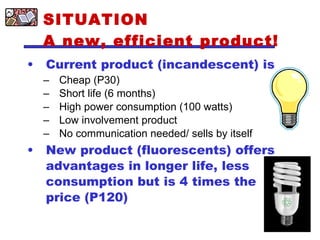
SITUATION A new, efficient product! Current product (incandescent) is Cheap (P30) Short life (6 months) High power consumption (100 watts) Low involvement product No communication needed/ sells by itself New product (fluorescents) offers advantages in longer life, less consumption but is 4 times the price (P120)
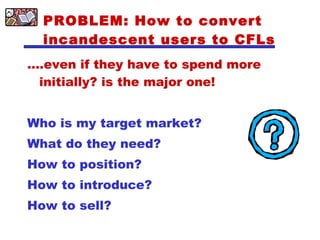
PROBLEM: How to convert incandescent users to CFLs … .even if they have to spend more initially? is the major one! Who is my target market? What do they need? How to position? How to introduce? How to sell?
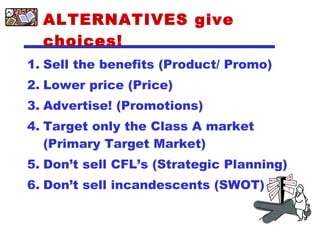
ALTERNATIVES give choices! Sell the benefits (Product/ Promo) Lower price (Price) Advertise! (Promotions) Target only the Class A market (Primary Target Market) Don’t sell CFL’s (Strategic Planning) Don’t sell incandescents (SWOT)
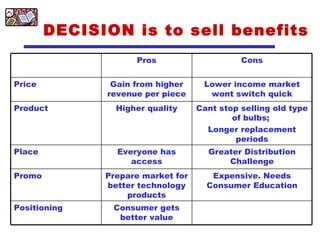
DECISION is to sell benefits Pros Cons Price Gain from higher revenue per piece Lower income market wont switch quick Product Higher quality Cant stop selling old type of bulbs;  Longer replacement periods Place Everyone has access Greater Distribution Challenge Promo Prepare market for better technology products Expensive. Needs Consumer Education Positioning Consumer gets better value
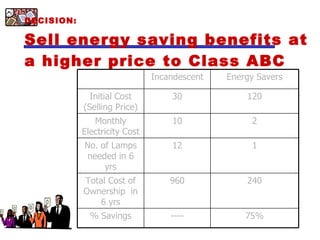
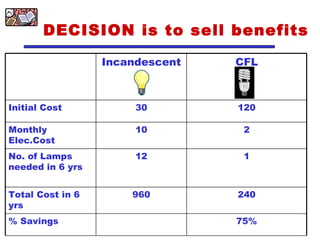
DECISION:   Sell energy saving benefits at a higher price to Class ABC Incandescent Energy Savers Initial Cost (Selling Price) 30 120 Monthly Electricity Cost 10 2 No. of Lamps needed in 6 yrs 12 1 Total Cost of Ownership  in 6 yrs 960 240 % Savings ---- 75%
DECISION is to sell benefits Incandescent CFL Initial Cost 30 120 Monthly Elec.Cost 10 2 No. of Lamps needed in 6 yrs 12 1 Total Cost in 6 yrs 960 240 % Savings 75%
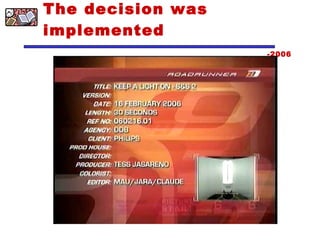
The decision was implemented -2006
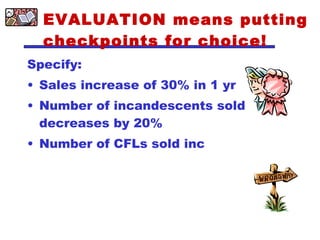
EVALUATION means putting checkpoints for choice! Specify: Sales increase of 30% in 1 yr Number of incandescents sold decreases by 20% Number of CFLs sold inc
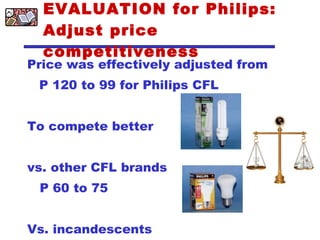
EVALUATION for Philips:  Adjust price competitiveness Price was effectively adjusted from  P 120 to 99 for Philips CFL To compete better  vs. other CFL brands P 60 to 75 Vs. incandescents P  15 to 25
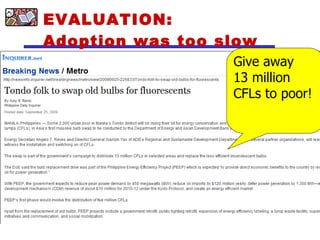
EVALUATION:  Adoption was too slow Give away 13 million CFLs to poor!
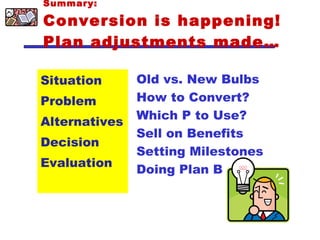
Summary: Conversion is happening!  Plan adjustments made… Situation Problem Alternatives Decision Evaluation Old vs. New Bulbs How to Convert? Which P to Use? Sell on Benefits Setting Milestones Doing Plan B

Prof. Remigio De Ungria Lecture Sample Spade Approach Used For Conversion To CFLs

  • 1.
    CASE ANALYSIS usingSPADE Approach CONVERTING to ENERGY EFFICIENT LIGHTING Bong De Ungria
  • 2.
    Outline: SPADE modelshows the way! Situation Problem Alternatives Decision Evaluation Old vs. New Bulbs How to Convert? Which P to Use? Sell on Benefits Setting Milestones
  • 3.
    SITUATION A new,efficient product! Current product (incandescent) is Cheap (P30) Short life (6 months) High power consumption (100 watts) Low involvement product No communication needed/ sells by itself New product (fluorescents) offers advantages in longer life, less consumption but is 4 times the price (P120)
  • 4.
    PROBLEM: How toconvert incandescent users to CFLs … .even if they have to spend more initially? is the major one! Who is my target market? What do they need? How to position? How to introduce? How to sell?
  • 5.
    ALTERNATIVES give choices!Sell the benefits (Product/ Promo) Lower price (Price) Advertise! (Promotions) Target only the Class A market (Primary Target Market) Don’t sell CFL’s (Strategic Planning) Don’t sell incandescents (SWOT)
  • 6.
    DECISION is tosell benefits Pros Cons Price Gain from higher revenue per piece Lower income market wont switch quick Product Higher quality Cant stop selling old type of bulbs; Longer replacement periods Place Everyone has access Greater Distribution Challenge Promo Prepare market for better technology products Expensive. Needs Consumer Education Positioning Consumer gets better value
  • 7.
    DECISION: Sell energy saving benefits at a higher price to Class ABC Incandescent Energy Savers Initial Cost (Selling Price) 30 120 Monthly Electricity Cost 10 2 No. of Lamps needed in 6 yrs 12 1 Total Cost of Ownership in 6 yrs 960 240 % Savings ---- 75%
  • 8.
    DECISION is tosell benefits Incandescent CFL Initial Cost 30 120 Monthly Elec.Cost 10 2 No. of Lamps needed in 6 yrs 12 1 Total Cost in 6 yrs 960 240 % Savings 75%
  • 9.
    The decision wasimplemented -2006
  • 10.
    EVALUATION means puttingcheckpoints for choice! Specify: Sales increase of 30% in 1 yr Number of incandescents sold decreases by 20% Number of CFLs sold inc
  • 11.
    EVALUATION for Philips: Adjust price competitiveness Price was effectively adjusted from P 120 to 99 for Philips CFL To compete better vs. other CFL brands P 60 to 75 Vs. incandescents P 15 to 25
  • 12.
    EVALUATION: Adoptionwas too slow Give away 13 million CFLs to poor!
  • 13.
    Summary: Conversion ishappening! Plan adjustments made… Situation Problem Alternatives Decision Evaluation Old vs. New Bulbs How to Convert? Which P to Use? Sell on Benefits Setting Milestones Doing Plan B