Marketing 5000

The Overview
Marketing Overview
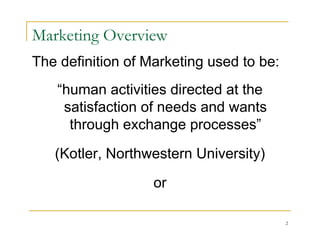
The definition of Marketing used to be:
   โ€œhuman activities directed at the
    satisfaction of needs and wants
     through exchange processesโ€

   (Kotler, Northwestern University)
                   or

                                          2
Marketing Overview

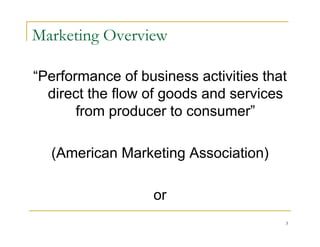
โ€œPerformance of business activities that
  direct the flow of goods and services
       from producer to consumerโ€

  (American Marketing Association)

                  or
                                       3
Marketing Overview
  โ€œthe process of identifying customer needs;
    conceptualizing those needs in terms of an
        organizationโ€™s capacity to produce;
   communicating the conceptualization to the
         appropriate laws of power in the
         organization; conceptualizing the
   consequent output in terms of the customer
   needs earlier identified; and communicating
      that conceptualization to the customerโ€
         (Howard, Columbia University)
                        or

                                             4
Marketing Overview
     โ€œthe process of creating, distributing,
  promoting, and pricing goods, services and
      ideas to facilitate satisfying exchange
   relationships with customers in a dynamic
                   environmentโ€

(Pride [Texas A&M] - Ferrell, [Colorado State])


                                                5
Marketing Overview
Is this enough?
Is knowing what the customer wants
  enough when all of your competitors
  know it as well?
Or is success based primarily on
  strategies and tactics?


                                        6
Marketing Overview

    A better definition of marketing:


     Marketing is War!


                                        7
Marketing Overview

    โ€œWar belongs to the province of
  business competition, which is also a
     conflict of human interests and
                 activities.โ€

    (Karl von Clausewitz, On War)


                                      8
Marketing Overview

  The true nature of marketing today
     involves the conflict between
             corporations.

     Not the satisfying of human
          needs and wants!

                                       9
Marketing Overview
    What is the role of Marketing in a company?
โ€ข   Understand the customer, the target market
โ€ข   Understand the competition
โ€ข   Support the sales function
โ€ข   Create shareholder value
โ€ข   Determine what products a company can sell
โ€ข   Providing customer value
โ€ข   What else?

                                              10
Marketing Overview
  What do we mean when we use the term
           โ€œMarketing Conceptโ€?

  A view from the perspective that we will
  offer to a given target audience what we
  can profitably sell using a clearly defined
                set of actions!


                                                11
Marketing Overview
      Define โ€œProviding value to customersโ€

โ€ข   In terms of the Price/Value ratio
โ€ข   In terms of product features
โ€ข   In terms of product benefits


                                              12
Marketing Overview
      What is the โ€œMarketing Mix?โ€


                                     13
Marketing Overview
        What is the โ€œMarketing Mix?โ€

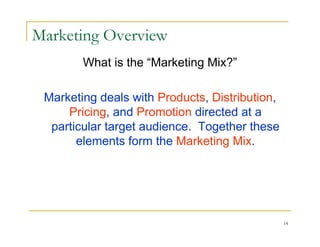
 Marketing deals with Products, Distribution,
     Pricing, and Promotion directed at a
  particular target audience. Together these
       elements form the Marketing Mix.


                                                14
Marketing Overview
     What is โ€œrelationship marketing?โ€


                                         15
Marketing Overview
      What is โ€œrelationship marketing?โ€

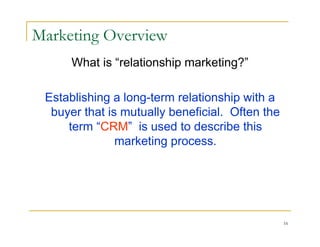
 Establishing a long-term relationship with a
  buyer that is mutually beneficial. Often the
     term โ€œCRMโ€ is used to describe this
               marketing process.


                                                 16
Marketing Overview
        What leads to defeat in both
          War and Marketing?

โ€ข   Over-pessimism (Fear of Failure)
โ€ข   Over-optimism (Failure to Fear Failure)


                                         17
Marketing Overview


  Good Marketing professionals need
   to understand the nature, causes,
     and cures of marketing failures


                                       18
Marketing Overview
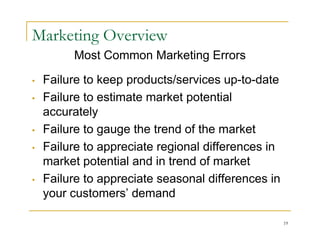
         Most Common Marketing Errors

โ€ข   Failure to keep products/services up-to-date
โ€ข   Failure to estimate market potential
    accurately
โ€ข   Failure to gauge the trend of the market
โ€ข   Failure to appreciate regional differences in
    market potential and in trend of market
โ€ข   Failure to appreciate seasonal differences in
    your customersโ€™ demand

                                                    19
Marketing Overview
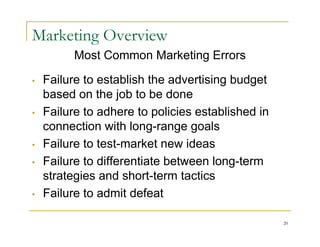
          Most Common Marketing Errors

โ€ข   Failure to establish the advertising budget
    based on the job to be done
โ€ข   Failure to adhere to policies established in
    connection with long-range goals
โ€ข   Failure to test-market new ideas
โ€ข   Failure to differentiate between long-term
    strategies and short-term tactics
โ€ข   Failure to admit defeat

                                                   20
Marketing Overview
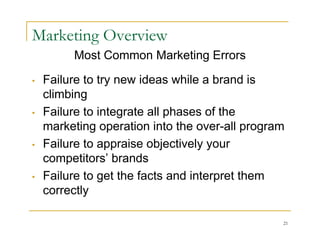
         Most Common Marketing Errors

โ€ข   Failure to try new ideas while a brand is
    climbing
โ€ข   Failure to integrate all phases of the
    marketing operation into the over-all program
โ€ข   Failure to appraise objectively your
    competitorsโ€™ brands
โ€ข   Failure to get the facts and interpret them
    correctly

                                                21
Marketing Overview
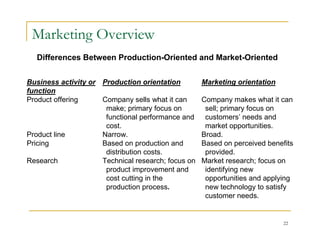
  Differences Between Production-Oriented and Market-Oriented


Business activity or Production orientation         Marketing orientation
function
Product offering     Company sells what it can      Company makes what it can
                      make; primary focus on         sell; primary focus on
                      functional performance and     customersโ€™ needs and
                      cost.                          market opportunities.
Product line         Narrow.                        Broad.
Pricing              Based on production and        Based on perceived benefits
                      distribution costs.            provided.
Research             Technical research; focus on   Market research; focus on
                      product improvement and        identifying new
                      cost cutting in the            opportunities and applying
                      production process.            new technology to satisfy
                                                     customer needs.


                                                                            22
Marketing Overview
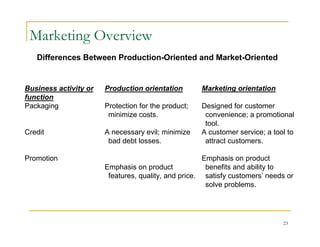
   Differences Between Production-Oriented and Market-Oriented


Business activity or   Production orientation        Marketing orientation
function
Packaging              Protection for the product;   Designed for customer
                        minimize costs.               convenience; a promotional
                                                      tool.
Credit                 A necessary evil; minimize    A customer service; a tool to
                        bad debt losses.              attract customers.

Promotion                                             Emphasis on product
                       Emphasis on product             benefits and ability to
                        features, quality, and price. satisfy customersโ€™ needs or
                                                       solve problems.


                                                                              23
Strategic Planning
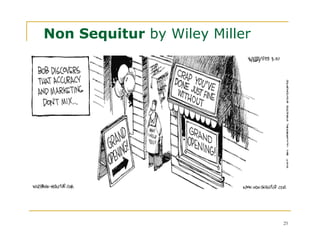
Non Sequitur by Wiley Miller


                               25
Goals and Objectives
  Whatโ€™s the difference between
    a Goal and a Strategy?

Goals are commitments. Inflexible,
rigid, unwavering, focused.
Strategies can be changed, modified
or eliminated based on market
conditions

               MRKT 5000              26
Strategy
     Companies often talk about
          their strategies.
      What does strategy mean?
 A fundamental pattern of present and
 planned objectives, resource deployments,
 and interactions of an organization with
 markets, competitors, and other
 environmental factors.

                                         27
Components of Strategy
  Scope
  Goals and objectives
  Resource deployments
  Identification of sustainable competitive
  advantage
  Synergy


                                              28
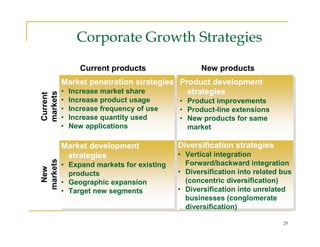
Corporate Growth Strategies

                 Current products               New products
          Market penetration strategies Product development
          โ€ข Increase market share         strategies
markets
Current


          โ€ข   Increase product usage      โ€ข Product improvements
          โ€ข   Increase frequency of use   โ€ข Product-line extensions
          โ€ข   Increase quantity used      โ€ข New products for same
          โ€ข   New applications              market

          Market development              Diversification strategies
           strategies                     โ€ข Vertical integration
markets


          โ€ข Expand markets for existing     Forward/backward integration
 New


            products                      โ€ข Diversification into related bus
          โ€ข Geographic expansion            (concentric diversification)
          โ€ข Target new segments           โ€ข Diversification into unrelated
                                            businesses (conglomerate
                                            diversification)

                                                                         29
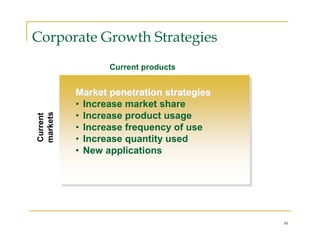
Corporate Growth Strategies
                 Current products


          Market penetration strategies
          โ€ข Increase market share
markets


          โ€ข Increase product usage
Current


          โ€ข Increase frequency of use
          โ€ข Increase quantity used
          โ€ข New applications


                                          30
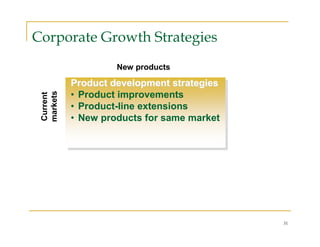
Corporate Growth Strategies
                    New products

           Product development strategies
           โ€ข Product improvements
 markets
 Current


           โ€ข Product-line extensions
           โ€ข New products for same market


                                            31
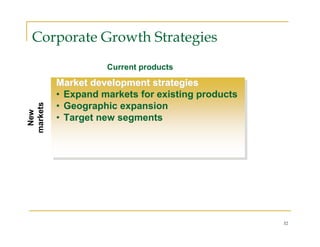
Corporate Growth Strategies
                    Current products
          Market development strategies
          โ€ข Expand markets for existing products
markets


          โ€ข Geographic expansion
 New


          โ€ข Target new segments


                                                   32
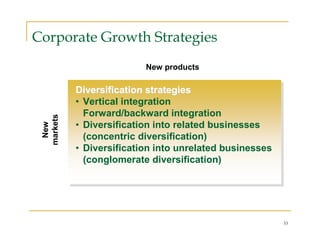
Corporate Growth Strategies
                          New products

           Diversification strategies
           โ€ข Vertical integration
             Forward/backward integration
 markets


           โ€ข Diversification into related businesses
  New


             (concentric diversification)
           โ€ข Diversification into unrelated businesses
             (conglomerate diversification)


                                                         33
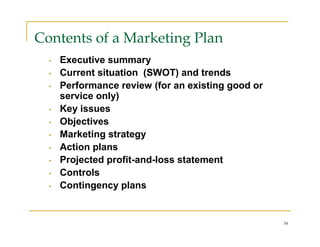
Contents of a Marketing Plan
  โ€ข   Executive summary
  โ€ข   Current situation (SWOT) and trends
  โ€ข   Performance review (for an existing good or
      service only)
  โ€ข   Key issues
  โ€ข   Objectives
  โ€ข   Marketing strategy
  โ€ข   Action plans
  โ€ข   Projected profit-and-loss statement
  โ€ข   Controls
  โ€ข   Contingency plans


                                                    34
Strategic Planning

       What is a SWOT Analysis?


                                  35
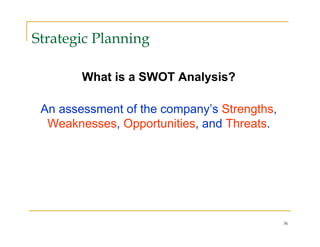
Strategic Planning

        What is a SWOT Analysis?

 An assessment of the companyโ€™s Strengths,
  Weaknesses, Opportunities, and Threats.


                                             36
Marketing Jeopardy
       What are Stars, Cash Cows,
       Question Marks, and Dogs?

          The four cells in the
        Boston Consulting Group
          growth share matrix


                                    37
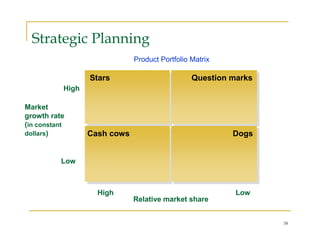
Strategic Planning
                              Product Portfolio Matrix

                  Stars                         Question marks
           High

Market
growth rate
(in constant
dollars)          Cash cows                              Dogs


           Low


                    High                                  Low
                              Relative market share


                                                                 38
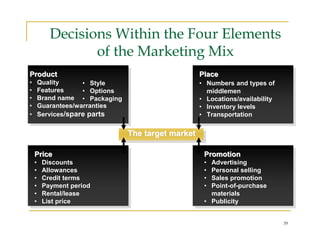
Decisions Within the Four Elements
                  of the Marketing Mix
Product                                              Place
โ€ข       Quality      โ€ข Style                         โ€ข Numbers and types of
โ€ข       Features     โ€ข Options                         middlemen
โ€ข       Brand name โ€ข Packaging                       โ€ข Locations/availability
โ€ข       Guarantees/warranties                        โ€ข Inventory levels
โ€ข       Services/spare parts                         โ€ข Transportation


                                 The target market

    Price                                             Promotion
    โ€ข    Discounts                                    โ€ข Advertising
    โ€ข    Allowances                                   โ€ข Personal selling
    โ€ข    Credit terms                                 โ€ข Sales promotion
    โ€ข    Payment period                               โ€ข Point-of-purchase
    โ€ข    Rental/lease                                   materials
    โ€ข    List price                                   โ€ข Publicity


                                                                                39
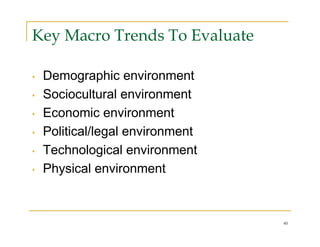
Key Macro Trends To Evaluate

โ€ข   Demographic environment
โ€ข   Sociocultural environment
โ€ข   Economic environment
โ€ข   Political/legal environment
โ€ข   Technological environment
โ€ข   Physical environment


                                  40
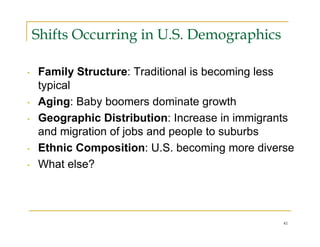
Shifts Occurring in U.S. Demographics

โ€ข   Family Structure: Traditional is becoming less
    typical
โ€ข   Aging: Baby boomers dominate growth
โ€ข   Geographic Distribution: Increase in immigrants
    and migration of jobs and people to suburbs
โ€ข   Ethnic Composition: U.S. becoming more diverse
โ€ข   What else?


                                                 41
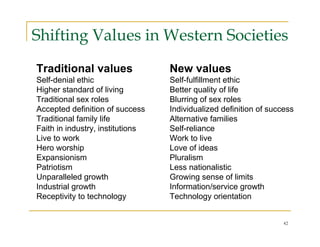
Shifting Values in Western Societies
Traditional values                New values
Self-denial ethic                 Self-fulfillment ethic
Higher standard of living         Better quality of life
Traditional sex roles             Blurring of sex roles
Accepted definition of success    Individualized definition of success
Traditional family life           Alternative families
Faith in industry, institutions   Self-reliance
Live to work                      Work to live
Hero worship                      Love of ideas
Expansionism                      Pluralism
Patriotism                        Less nationalistic
Unparalleled growth               Growing sense of limits
Industrial growth                 Information/service growth
Receptivity to technology         Technology orientation


                                                                   42
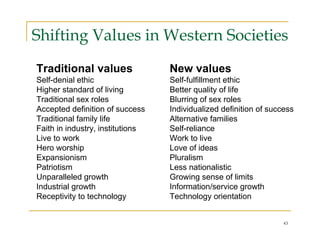
Shifting Values in Western Societies
Traditional values                New values
Self-denial ethic                 Self-fulfillment ethic
Higher standard of living         Better quality of life
Traditional sex roles             Blurring of sex roles
Accepted definition of success    Individualized definition of success
Traditional family life           Alternative families
Faith in industry, institutions   Self-reliance
Live to work                      Work to live
Hero worship                      Love of ideas
Expansionism                      Pluralism
Patriotism                        Less nationalistic
Unparalleled growth               Growing sense of limits
Industrial growth                 Information/service growth
Receptivity to technology         Technology orientation


                                                                   43
Economic Environment

โ€ข   GDP has increased between rich and poor
    countries
โ€ข   Worldโ€™s economic growth continues to
    increase
โ€ข   Developing countries are expected to have
    higher growth rates than developed
    countries


                                            44
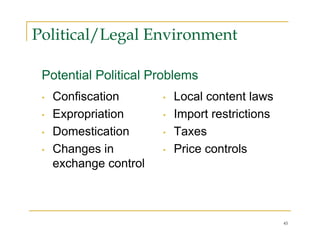
Political/Legal Environment

 Potential Political Problems
 โ€ข   Confiscation       โ€ข   Local content laws
 โ€ข   Expropriation      โ€ข   Import restrictions
 โ€ข   Domestication      โ€ข   Taxes
 โ€ข   Changes in         โ€ข   Price controls
     exchange control


                                                  45
Technological Environment

โ€ข   Development of Fiber-optic Cables
โ€ข   Storage devices developed to handle the
    increasing volume of data
โ€ข   Use of flexible low-cost wireless
    transmission
โ€ข   Development of low-cost multimedia chip
โ€ข   Advances in biology
โ€ข   Progress in agriculture

                                              46
Physical Environment

โ€ข   Depletion of valuable resources
โ€ข   Deserts growing
โ€ข   Forests shrinking
โ€ข   Lakes dying
โ€ข   Quality and quantity of groundwater declining
โ€ข   Rise in temperature


                                                47

marketing

  • 1.
  • 2.
    Marketing Overview The definitionof Marketing used to be: โ€œhuman activities directed at the satisfaction of needs and wants through exchange processesโ€ (Kotler, Northwestern University) or 2
  • 3.
    Marketing Overview โ€œPerformance ofbusiness activities that direct the flow of goods and services from producer to consumerโ€ (American Marketing Association) or 3
  • 4.
    Marketing Overview โ€œthe process of identifying customer needs; conceptualizing those needs in terms of an organizationโ€™s capacity to produce; communicating the conceptualization to the appropriate laws of power in the organization; conceptualizing the consequent output in terms of the customer needs earlier identified; and communicating that conceptualization to the customerโ€ (Howard, Columbia University) or 4
  • 5.
    Marketing Overview โ€œthe process of creating, distributing, promoting, and pricing goods, services and ideas to facilitate satisfying exchange relationships with customers in a dynamic environmentโ€ (Pride [Texas A&M] - Ferrell, [Colorado State]) 5
  • 6.
    Marketing Overview Is thisenough? Is knowing what the customer wants enough when all of your competitors know it as well? Or is success based primarily on strategies and tactics? 6
  • 7.
    Marketing Overview A better definition of marketing: Marketing is War! 7
  • 8.
    Marketing Overview โ€œWar belongs to the province of business competition, which is also a conflict of human interests and activities.โ€ (Karl von Clausewitz, On War) 8
  • 9.
    Marketing Overview The true nature of marketing today involves the conflict between corporations. Not the satisfying of human needs and wants! 9
  • 10.
    Marketing Overview What is the role of Marketing in a company? โ€ข Understand the customer, the target market โ€ข Understand the competition โ€ข Support the sales function โ€ข Create shareholder value โ€ข Determine what products a company can sell โ€ข Providing customer value โ€ข What else? 10
  • 11.
    Marketing Overview What do we mean when we use the term โ€œMarketing Conceptโ€? A view from the perspective that we will offer to a given target audience what we can profitably sell using a clearly defined set of actions! 11
  • 12.
    Marketing Overview Define โ€œProviding value to customersโ€ โ€ข In terms of the Price/Value ratio โ€ข In terms of product features โ€ข In terms of product benefits 12
  • 13.
    Marketing Overview What is the โ€œMarketing Mix?โ€ 13
  • 14.
    Marketing Overview What is the โ€œMarketing Mix?โ€ Marketing deals with Products, Distribution, Pricing, and Promotion directed at a particular target audience. Together these elements form the Marketing Mix. 14
  • 15.
    Marketing Overview What is โ€œrelationship marketing?โ€ 15
  • 16.
    Marketing Overview What is โ€œrelationship marketing?โ€ Establishing a long-term relationship with a buyer that is mutually beneficial. Often the term โ€œCRMโ€ is used to describe this marketing process. 16
  • 17.
    Marketing Overview What leads to defeat in both War and Marketing? โ€ข Over-pessimism (Fear of Failure) โ€ข Over-optimism (Failure to Fear Failure) 17
  • 18.
    Marketing Overview Good Marketing professionals need to understand the nature, causes, and cures of marketing failures 18
  • 19.
    Marketing Overview Most Common Marketing Errors โ€ข Failure to keep products/services up-to-date โ€ข Failure to estimate market potential accurately โ€ข Failure to gauge the trend of the market โ€ข Failure to appreciate regional differences in market potential and in trend of market โ€ข Failure to appreciate seasonal differences in your customersโ€™ demand 19
  • 20.
    Marketing Overview Most Common Marketing Errors โ€ข Failure to establish the advertising budget based on the job to be done โ€ข Failure to adhere to policies established in connection with long-range goals โ€ข Failure to test-market new ideas โ€ข Failure to differentiate between long-term strategies and short-term tactics โ€ข Failure to admit defeat 20
  • 21.
    Marketing Overview Most Common Marketing Errors โ€ข Failure to try new ideas while a brand is climbing โ€ข Failure to integrate all phases of the marketing operation into the over-all program โ€ข Failure to appraise objectively your competitorsโ€™ brands โ€ข Failure to get the facts and interpret them correctly 21
  • 22.
    Marketing Overview Differences Between Production-Oriented and Market-Oriented Business activity or Production orientation Marketing orientation function Product offering Company sells what it can Company makes what it can make; primary focus on sell; primary focus on functional performance and customersโ€™ needs and cost. market opportunities. Product line Narrow. Broad. Pricing Based on production and Based on perceived benefits distribution costs. provided. Research Technical research; focus on Market research; focus on product improvement and identifying new cost cutting in the opportunities and applying production process. new technology to satisfy customer needs. 22
  • 23.
    Marketing Overview Differences Between Production-Oriented and Market-Oriented Business activity or Production orientation Marketing orientation function Packaging Protection for the product; Designed for customer minimize costs. convenience; a promotional tool. Credit A necessary evil; minimize A customer service; a tool to bad debt losses. attract customers. Promotion Emphasis on product Emphasis on product benefits and ability to features, quality, and price. satisfy customersโ€™ needs or solve problems. 23
  • 24.
  • 25.
    Non Sequitur byWiley Miller 25
  • 26.
    Goals and Objectives Whatโ€™s the difference between a Goal and a Strategy? Goals are commitments. Inflexible, rigid, unwavering, focused. Strategies can be changed, modified or eliminated based on market conditions MRKT 5000 26
  • 27.
    Strategy Companies often talk about their strategies. What does strategy mean? A fundamental pattern of present and planned objectives, resource deployments, and interactions of an organization with markets, competitors, and other environmental factors. 27
  • 28.
    Components of Strategy Scope Goals and objectives Resource deployments Identification of sustainable competitive advantage Synergy 28
  • 29.
    Corporate Growth Strategies Current products New products Market penetration strategies Product development โ€ข Increase market share strategies markets Current โ€ข Increase product usage โ€ข Product improvements โ€ข Increase frequency of use โ€ข Product-line extensions โ€ข Increase quantity used โ€ข New products for same โ€ข New applications market Market development Diversification strategies strategies โ€ข Vertical integration markets โ€ข Expand markets for existing Forward/backward integration New products โ€ข Diversification into related bus โ€ข Geographic expansion (concentric diversification) โ€ข Target new segments โ€ข Diversification into unrelated businesses (conglomerate diversification) 29
  • 30.
    Corporate Growth Strategies Current products Market penetration strategies โ€ข Increase market share markets โ€ข Increase product usage Current โ€ข Increase frequency of use โ€ข Increase quantity used โ€ข New applications 30
  • 31.
    Corporate Growth Strategies New products Product development strategies โ€ข Product improvements markets Current โ€ข Product-line extensions โ€ข New products for same market 31
  • 32.
    Corporate Growth Strategies Current products Market development strategies โ€ข Expand markets for existing products markets โ€ข Geographic expansion New โ€ข Target new segments 32
  • 33.
    Corporate Growth Strategies New products Diversification strategies โ€ข Vertical integration Forward/backward integration markets โ€ข Diversification into related businesses New (concentric diversification) โ€ข Diversification into unrelated businesses (conglomerate diversification) 33
  • 34.
    Contents of aMarketing Plan โ€ข Executive summary โ€ข Current situation (SWOT) and trends โ€ข Performance review (for an existing good or service only) โ€ข Key issues โ€ข Objectives โ€ข Marketing strategy โ€ข Action plans โ€ข Projected profit-and-loss statement โ€ข Controls โ€ข Contingency plans 34
  • 35.
    Strategic Planning What is a SWOT Analysis? 35
  • 36.
    Strategic Planning What is a SWOT Analysis? An assessment of the companyโ€™s Strengths, Weaknesses, Opportunities, and Threats. 36
  • 37.
    Marketing Jeopardy What are Stars, Cash Cows, Question Marks, and Dogs? The four cells in the Boston Consulting Group growth share matrix 37
  • 38.
    Strategic Planning Product Portfolio Matrix Stars Question marks High Market growth rate (in constant dollars) Cash cows Dogs Low High Low Relative market share 38
  • 39.
    Decisions Within theFour Elements of the Marketing Mix Product Place โ€ข Quality โ€ข Style โ€ข Numbers and types of โ€ข Features โ€ข Options middlemen โ€ข Brand name โ€ข Packaging โ€ข Locations/availability โ€ข Guarantees/warranties โ€ข Inventory levels โ€ข Services/spare parts โ€ข Transportation The target market Price Promotion โ€ข Discounts โ€ข Advertising โ€ข Allowances โ€ข Personal selling โ€ข Credit terms โ€ข Sales promotion โ€ข Payment period โ€ข Point-of-purchase โ€ข Rental/lease materials โ€ข List price โ€ข Publicity 39
  • 40.
    Key Macro TrendsTo Evaluate โ€ข Demographic environment โ€ข Sociocultural environment โ€ข Economic environment โ€ข Political/legal environment โ€ข Technological environment โ€ข Physical environment 40
  • 41.
    Shifts Occurring inU.S. Demographics โ€ข Family Structure: Traditional is becoming less typical โ€ข Aging: Baby boomers dominate growth โ€ข Geographic Distribution: Increase in immigrants and migration of jobs and people to suburbs โ€ข Ethnic Composition: U.S. becoming more diverse โ€ข What else? 41
  • 42.
    Shifting Values inWestern Societies Traditional values New values Self-denial ethic Self-fulfillment ethic Higher standard of living Better quality of life Traditional sex roles Blurring of sex roles Accepted definition of success Individualized definition of success Traditional family life Alternative families Faith in industry, institutions Self-reliance Live to work Work to live Hero worship Love of ideas Expansionism Pluralism Patriotism Less nationalistic Unparalleled growth Growing sense of limits Industrial growth Information/service growth Receptivity to technology Technology orientation 42
  • 43.
    Shifting Values inWestern Societies Traditional values New values Self-denial ethic Self-fulfillment ethic Higher standard of living Better quality of life Traditional sex roles Blurring of sex roles Accepted definition of success Individualized definition of success Traditional family life Alternative families Faith in industry, institutions Self-reliance Live to work Work to live Hero worship Love of ideas Expansionism Pluralism Patriotism Less nationalistic Unparalleled growth Growing sense of limits Industrial growth Information/service growth Receptivity to technology Technology orientation 43
  • 44.
    Economic Environment โ€ข GDP has increased between rich and poor countries โ€ข Worldโ€™s economic growth continues to increase โ€ข Developing countries are expected to have higher growth rates than developed countries 44
  • 45.
    Political/Legal Environment PotentialPolitical Problems โ€ข Confiscation โ€ข Local content laws โ€ข Expropriation โ€ข Import restrictions โ€ข Domestication โ€ข Taxes โ€ข Changes in โ€ข Price controls exchange control 45
  • 46.
    Technological Environment โ€ข Development of Fiber-optic Cables โ€ข Storage devices developed to handle the increasing volume of data โ€ข Use of flexible low-cost wireless transmission โ€ข Development of low-cost multimedia chip โ€ข Advances in biology โ€ข Progress in agriculture 46
  • 47.
    Physical Environment โ€ข Depletion of valuable resources โ€ข Deserts growing โ€ข Forests shrinking โ€ข Lakes dying โ€ข Quality and quantity of groundwater declining โ€ข Rise in temperature 47