Group 5
ANAND KUMAR 12P127
ANKUSH SINGLA 12P129
ASHWIN BHOOMI 12P131
ADITYA CHADHA 12P132
SIDDHARTH BHARADWAJ 12P170
SOUMYAJIT SENGUPTA 12P171
STRATEGIC MANAGEMENT II, Section C
TURNAROUND
Apple Inc.
A Tribute to Steve Jobs
Here's to the crazy ones.
The misfits. The rebels. The troublemakers.
The round pegs in the square holes.
The ones who see things differently.
They're not fond of rules. And they have no respect for the status quo.
You can quote them, disagree with them, glorify or vilify them.
About the only thing you can't do is ignore them.
Because they change things. They push the human race forward.
And while some may see them as the crazy ones, we see genius.
Because the people who are crazy enough to think they can change the world, are
the ones who do.
-Steve Jobs
Executive Summary
 This project looks at the turnaround that Apple had gone through under the vision and command
of Steve Jobs from 1997 to 2010-11
 Apple has gone through every possible business emotion in its existence of nearly 44 years. It has
seen the euphoria surrounding its first product, the Apple 1 to the uncertainty that prevailed
during the end of Steve Jobs’ initial reign to the meandering and stagnant phase it got stuck in
between 1984 to 1997. The company literally rose from the ashes in 1997 under Jobs to become
the biggest titan in the technology industry and finally in the entire business world.
 The entire chronology has been divided into 4 phases and each of the major aspects of Apple
like Strategy, Innovation and Marketing approaches undertaken have been discussed under the
ambit of these 4 phases.
 Inception Phase (1969 – 1984)
 Jobs-less Apple (1984-1997)
 Return of Steve Jobs (1997-2010/11)
 Post Jobs Era @ Apple (2011-Present)
 This presentation also looks at the successful creation of blue oceans by Apple and the
subsequent highs that the company achieved as it sustained its remarkable innovations with even
more innovative products as follow-ups.
 Finally the project looks at the current situation of the company and we have recommended a
more proactive approach to new product development and a cautious outlook on its evolving
strategy to go low-cost in emerging markets.
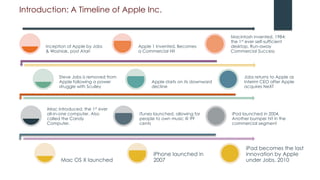
Introduction: A Timeline of Apple Inc.
Inception of Apple by Jobs
& Wozniak, post Atari
Apple 1 Invented, Becomes
a Commercial Hit
Macintosh invented, 1984:
the 1st ever self-sufficient
desktop, Run-away
Commercial Success
Steve Jobs is removed from
Apple following a power
struggle with Sculley
Apple starts on its downward
decline
Jobs returns to Apple as
Interim CEO after Apple
acquires NeXT
iMac introduced, the 1st ever
all-in-one computer. Also
called the Candy
Computer.
iTunes launched, allowing for
people to own music @ 99
cents
iPod launched in 2004.
Another bumper hit in the
commercial segment
Mac OS X launched
iPhone launched in
2007
iPad becomes the last
innovation by Apple
under Jobs, 2010
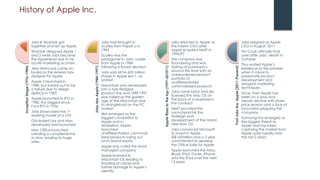
History of Apple Inc.
InceptionStage(1976-1984)
Jobs & Wozniak got
together and set up Apple
Wozniak designed Apple 1
and 2 while Jobs became
the figurehead due to his
acute marketing acumen
Jerry Mancock came on
board as the exterior box
designer for Apple
Apple 3 launched in
1980, but turned out to be
a failure due to design
defects in 1983
Apple launched its IPO in
1980, the biggest since
Ford IPO in 1956
Jobs showcased the 1st
working model of a GUI
GUI-based Lisa and Mac
developed and launched
Mac Office launched
creating a complementor
to Mac leading to huge
sales
Jobs-lessApple(1984-1997)
Jobs had brought in
Sculley from PepsiCo in
1983
Sculley was the
protagonist in Jobs’ ouster
from Apple in 1984
following a Board decision
Jobs sold all his 605 million
shares in Apple less 1, as
protest
Macintosh was developed
into a fully-fledged
product line and 1989-1991
was hailed as the golden
age of the Macintosh due
to stranglehold on the PC
market
IBM emerged as the
biggest competitor to
Apple and in
retaliation, Apple
launched
undifferentiated, commodi
tized products losing out
on its brand equity.
Apple was voted the worst
managed company
Apple licensed its
Macintosh OS leading to
flooding of clones and
further damage to Apple’s
identity
AppleRisestothetop(1997-201011)
Jobs returned to Apple as
the interim CEO after
Apple acquired NeXT in
1996/97
The company was
floundering and was
staring at bankruptcy
around this time with an
overburdened product
portfolio of
undifferentiated
commoditized products
Jobs came back and de-
licensed the Mac OS on
the back of a loophole in
the contract
NeXT provided the
Launchpad for the
redesign and
development of the brand
new Mac OS
Jobs convinced Microsoft
to invest in Apple
@$150million and a 5 year
commitment to develop
the Office Suite for Apple
Apple launched the iMac,
iBook, iPod, iTunes, iPhone
and the iPad over the next
13 years
PostJobsEra,Apple(2011-Present)
Jobs resigned as Apple
CEO in August, 2011
Tim Cook officially took
over after Jobs’ death in
October
Thus ended Apple’s
existence as the pioneer
when it came to
passionate product
development and
arrogant marketing
techniques
Since, then Apple has
been on a slow and
steady decline with share
price erosion and a lack of
innovation plaguing the
company
Samsung has emerged as
the biggest threat to
Apple and has been
capturing the market from
Apple quite rapidly over
the last 2 years
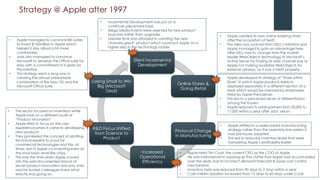
Strategy @ Apple after 1997
Silent Incremental
Development
Online Stores &
Going Retail
Protocol Change
in Manufacturing
Increased
Operational
Efficiency
R&D Focus shifted
from Science to
Product
Losing Small to Win
Big (Microsoft
Deal)
• Incremental Development was put on a
continual, piecemeal basis
• Mega Media-Events were reserved for new product
launches rather than upgrades
• Greater time was afforded to creating the next
“insanely great” product which could put Apple on a
higher step in the technology ladder
• Apple created its own online ordering store
after the acquisition of NeXT.
• The idea was sourced from DELL’s initiative and
Apple managed to gain an advantage here
after DELL had to change from the market
leader WebObjects technology to Microsoft’s
Active Server for hosting its web channel due to
Apple not making available WebObjects for
external vendors, as it was a NeXT property.
• Apple developed its strategy of “Store within
Store” in which Apple products were to
displayed separately in a different section of a
store which would be manned by employees
hired by Apple themselves.
• This led to a perceived sense of differentiation
among the buyers
• Apple reduced its retail partners from 20,000 to
11,000 within a year after Jobs’ return
• Apple shifted to a order-based manufacturing
strategy rather than the assembly-line system it
had previously adopted
• This led to reduced inventory levels that were
hampering Apple’s profitability earlier
• Apple hired Tim Cook, the current CEO as the COO of Apple
• He was instrumental in clearing up the clutter that Apple had accumulated
over the years due to incorrect demand forecasts & loose cost control
mechanisms
• Inventory held was reduced from 90 days to 2 days within a year
• Cash Interim duration increased from 10 days to 60 days under Cook
• The sector focused on inventions while
Apple took on a different route of
“Product Innovation”
• Apple tried to focus on the user
experience when it came to developing
new products
• They pioneered the concept of allotting
technical experts to scout for
commercial technologies and this, at
times, led to Apple co-inventing even at
the most basic level like chips.
• This was the time when Apple moved
into the well-documented shroud of
secret product innovation and only Jobs
and his trusted colleagues knew what
exactly was going on.
• Apple managed to convince Bill Gates
to invest $150million in Apple which
helped it stay afloat a bit more
comfortably
• Jobs also managed to convince
Microsoft to develop the Office suite for
Mac with a commitment of 5 years for
this initiative
• This strategy went a long way in
creating the almost unbeatable
combination of the Mac OS and the
Microsoft Office Suite
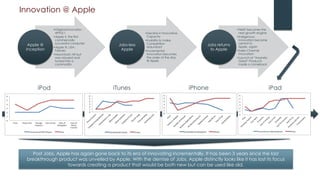
Innovation @ Apple
•Original Innovator:
APPLE I
•Apple II, the first
commercially
successful computer
•Apple III, LISA :
Failures
•Macintosh: Hit but
was misused and
turned into a
commodity
Apple @
Inception
•Decline in Innovative
Capacity
•Inability to make
Competition
redundant
•Incremental
Innovation becomes
the order of the day
@ Apple
Jobs-less
Apple
•NeXT becomes the
next growth engine
•Indigenous
Innovation became
central to
Apple, again
•Sales Channel
Innovation
•Launch of “Insanely
Great” Products
made a comeback
Jobs returns
to Apple
iPod iTunes iPhone iPad
Post Jobs, Apple has again gone back to its era of innovating incrementally. It has been 3 years since the last
breakthrough product was unveiled by Apple. With the demise of Jobs, Apple distinctly looks like it has lost its focus
towards creating a product that would be both new but can be used like old.
Trend Identification
Commoditization of PC
Industry & a Digital Boom
were key drivers along
Apple’s Marketing
Campaign
iPod and iTunes were
developed keeping these in
mind
Analyze Competitors
De-licensing led to market
share erosion
Apple tied up with
Microsoft & Intel to produce
software and chips. This
allowed it to become even
more stronger against
competitors
Innovate
Apple’s design has been
unparalleled throughout
history
Apple’s marketing
campaigns have also been
innovative like Think
Different which included all
the world’s leading thought
agents as their ambassador
Product Positioning
Complementors are central
to extended life of a
computing device
Apple’s App Store has
been instrumental in
creating the eco-system
that has helped position
Apple as a premium
product
Brand Awareness
Building
Creative Advertising & Use
of Non-Traditional Media
Channels helped create
the aura of Apple in the
minds of potential
customers
The use of simple but
sophisticated colors has
also increased the brand
equity of Apple
Distribution
Optimization
Apple moved from small
regional stores to national
chains to increase its reach
Individual retail stores were
also opened to get 1st hand
access to customers
Online selling was
introduced leading to higher
inventory optimization
Customer Focus
Apple pioneered the
concept of “Participatory
Design” in which company
executives would observe
people and their habits to
draw conclusions on how a
product should function
Ease of use and product
quality were at the forefront
of anything Apple did
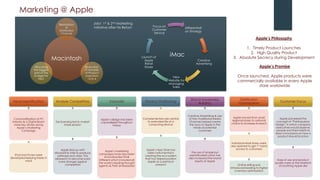
Marketing @ Apple
Macintosh
Restoration
of
Distribution
Channel
Reduction
of Number
of Product
Lines from
16 to 4
Allocating
the biggest
part of the
budget for
R&D
Differentiati
on Strategy
Creative
Advertising
New
Website for
Managing
Sales
Launch of
Apple
Retail
Stores
Focus on
Customer
Service
iMac
Apple’s Philosophy
1. Timely Product Launches
2. High Quality Product
3. Absolute Secrecy during Development
Apple’s Promise
Once launched, Apple products were
commercially available in every Apple
store worldwide
Jobs’ 1st & 2nd Marketing
Initiative after his Return
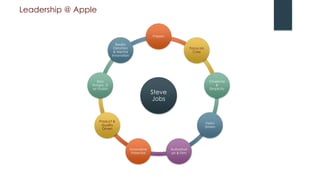
Leadership @ Apple
Steve
Jobs
Passion
Focus on
Core
Charisma
&
Simplicity
Vision
Driven
Authoritari
an & Firm
Innovative
Potential
Product &
Quality
Driven
Stay
Hungry, St
ay Foolish
Reality
Distortion
& Mental
Innovation
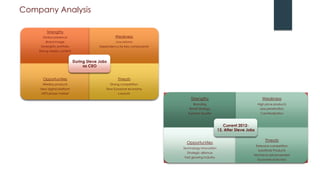
Company Analysis
Strengths
Global presence
Brand image
Synergistic portfolio
Strong media content
Weakness
Low returns
Dependency for key components
Opportunities
Wireless products
New digital platform
MP3 player market
Threats
Strong competition
Slow Eurozone economy
Lawsuits
During Steve Jobs
as CEO
Strengths
Branding
Retail Strategy
Superior Quality
Weakness
High price products
Less penetration
Cannibalization
Opportunities
Technology Innovation
Strategic alliance
Fast growing Industry
Threats
Extensive competition
Substitute Products
Technical advancement
Economical factors
Current 2012-
13, After Steve Jobs
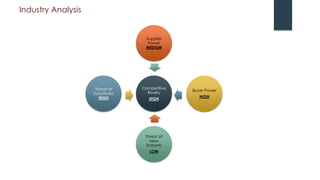
Industry Analysis
Competitive
Rivalry
HIGH
Supplier
Power
MEDIUM
Buyer Power
HIGH
Threat of
New
Entrants
LOW
Threat of
Substitutes
HIGH
Current Scenario @ Apple
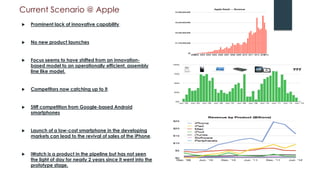
 Prominent lack of innovative capability.
 No new product launches
 Focus seems to have shifted from an innovation-
based model to an operationally efficient, assembly
line like model.
 Competitors now catching up to it,
 Stiff competition from Google-based Android
smartphones
 Launch of a low-cost smartphone in the developing
markets can lead to the revival of sales of the iPhone,
 iWatch is a product in the pipeline but has not seen
the light of day for nearly 2 years since it went into the
prototype stage.
Recommendation & Conclusion
CONCLUSION
• One of the greatest turnaround in corporate history, possibly the greatest
in the last two decades has been the turnaround of Apple.
• From near bankruptcy to the pinnacle of the world corporate ladder.
• Growth rates of over 50% Y-o-Y for over a decade was maintained by the
company as it went on launching one gadget after gadget which
captured the imagination of one and all.
• Steve Jobs was the single most important factor when it comes to
outlining the causes, which helped Apple turn the corner.
• His leadership and his vision were instrumental in leading Apple out from
the brink of non-existence
• Disruptive innovation became a norm rather than a chance event while
incremental innovation was always on the horizon as Apple released a
new version of its current offerings, every year.
• Apple is on the brink of another important milestone in its life as a
corporate entity. The sluggish growth has led to a change in the strategy
which has shifted from innovation to operational excellence under Tim
Cook.
• Low cost models are a form of diversification of the product portfolio and
acts as a medium of entry into markets which cannot afford the premium
products Apple has in its portfolio.
• It is a fascinating story that Apple has lived through its existence and
expecting more of the same may not be that outlandish an idea.
Recommendation 1:
Active Innovation
Recommendation 2:
Perfect Market Timing
& Properly Tested
Products should be
launched as a Priority
Recommendation 3:
Cautious Approach for
the new Low-Cost
Model that has been
broached
Thank You 

Apple: Turnaround

  • 1.
    Group 5 ANAND KUMAR12P127 ANKUSH SINGLA 12P129 ASHWIN BHOOMI 12P131 ADITYA CHADHA 12P132 SIDDHARTH BHARADWAJ 12P170 SOUMYAJIT SENGUPTA 12P171 STRATEGIC MANAGEMENT II, Section C TURNAROUND Apple Inc.
  • 2.
    A Tribute toSteve Jobs Here's to the crazy ones. The misfits. The rebels. The troublemakers. The round pegs in the square holes. The ones who see things differently. They're not fond of rules. And they have no respect for the status quo. You can quote them, disagree with them, glorify or vilify them. About the only thing you can't do is ignore them. Because they change things. They push the human race forward. And while some may see them as the crazy ones, we see genius. Because the people who are crazy enough to think they can change the world, are the ones who do. -Steve Jobs
  • 3.
    Executive Summary  Thisproject looks at the turnaround that Apple had gone through under the vision and command of Steve Jobs from 1997 to 2010-11  Apple has gone through every possible business emotion in its existence of nearly 44 years. It has seen the euphoria surrounding its first product, the Apple 1 to the uncertainty that prevailed during the end of Steve Jobs’ initial reign to the meandering and stagnant phase it got stuck in between 1984 to 1997. The company literally rose from the ashes in 1997 under Jobs to become the biggest titan in the technology industry and finally in the entire business world.  The entire chronology has been divided into 4 phases and each of the major aspects of Apple like Strategy, Innovation and Marketing approaches undertaken have been discussed under the ambit of these 4 phases.  Inception Phase (1969 – 1984)  Jobs-less Apple (1984-1997)  Return of Steve Jobs (1997-2010/11)  Post Jobs Era @ Apple (2011-Present)  This presentation also looks at the successful creation of blue oceans by Apple and the subsequent highs that the company achieved as it sustained its remarkable innovations with even more innovative products as follow-ups.  Finally the project looks at the current situation of the company and we have recommended a more proactive approach to new product development and a cautious outlook on its evolving strategy to go low-cost in emerging markets.
  • 4.
    Introduction: A Timelineof Apple Inc. Inception of Apple by Jobs & Wozniak, post Atari Apple 1 Invented, Becomes a Commercial Hit Macintosh invented, 1984: the 1st ever self-sufficient desktop, Run-away Commercial Success Steve Jobs is removed from Apple following a power struggle with Sculley Apple starts on its downward decline Jobs returns to Apple as Interim CEO after Apple acquires NeXT iMac introduced, the 1st ever all-in-one computer. Also called the Candy Computer. iTunes launched, allowing for people to own music @ 99 cents iPod launched in 2004. Another bumper hit in the commercial segment Mac OS X launched iPhone launched in 2007 iPad becomes the last innovation by Apple under Jobs, 2010
  • 5.
    History of AppleInc. InceptionStage(1976-1984) Jobs & Wozniak got together and set up Apple Wozniak designed Apple 1 and 2 while Jobs became the figurehead due to his acute marketing acumen Jerry Mancock came on board as the exterior box designer for Apple Apple 3 launched in 1980, but turned out to be a failure due to design defects in 1983 Apple launched its IPO in 1980, the biggest since Ford IPO in 1956 Jobs showcased the 1st working model of a GUI GUI-based Lisa and Mac developed and launched Mac Office launched creating a complementor to Mac leading to huge sales Jobs-lessApple(1984-1997) Jobs had brought in Sculley from PepsiCo in 1983 Sculley was the protagonist in Jobs’ ouster from Apple in 1984 following a Board decision Jobs sold all his 605 million shares in Apple less 1, as protest Macintosh was developed into a fully-fledged product line and 1989-1991 was hailed as the golden age of the Macintosh due to stranglehold on the PC market IBM emerged as the biggest competitor to Apple and in retaliation, Apple launched undifferentiated, commodi tized products losing out on its brand equity. Apple was voted the worst managed company Apple licensed its Macintosh OS leading to flooding of clones and further damage to Apple’s identity AppleRisestothetop(1997-201011) Jobs returned to Apple as the interim CEO after Apple acquired NeXT in 1996/97 The company was floundering and was staring at bankruptcy around this time with an overburdened product portfolio of undifferentiated commoditized products Jobs came back and de- licensed the Mac OS on the back of a loophole in the contract NeXT provided the Launchpad for the redesign and development of the brand new Mac OS Jobs convinced Microsoft to invest in Apple @$150million and a 5 year commitment to develop the Office Suite for Apple Apple launched the iMac, iBook, iPod, iTunes, iPhone and the iPad over the next 13 years PostJobsEra,Apple(2011-Present) Jobs resigned as Apple CEO in August, 2011 Tim Cook officially took over after Jobs’ death in October Thus ended Apple’s existence as the pioneer when it came to passionate product development and arrogant marketing techniques Since, then Apple has been on a slow and steady decline with share price erosion and a lack of innovation plaguing the company Samsung has emerged as the biggest threat to Apple and has been capturing the market from Apple quite rapidly over the last 2 years
  • 6.
    Strategy @ Appleafter 1997 Silent Incremental Development Online Stores & Going Retail Protocol Change in Manufacturing Increased Operational Efficiency R&D Focus shifted from Science to Product Losing Small to Win Big (Microsoft Deal) • Incremental Development was put on a continual, piecemeal basis • Mega Media-Events were reserved for new product launches rather than upgrades • Greater time was afforded to creating the next “insanely great” product which could put Apple on a higher step in the technology ladder • Apple created its own online ordering store after the acquisition of NeXT. • The idea was sourced from DELL’s initiative and Apple managed to gain an advantage here after DELL had to change from the market leader WebObjects technology to Microsoft’s Active Server for hosting its web channel due to Apple not making available WebObjects for external vendors, as it was a NeXT property. • Apple developed its strategy of “Store within Store” in which Apple products were to displayed separately in a different section of a store which would be manned by employees hired by Apple themselves. • This led to a perceived sense of differentiation among the buyers • Apple reduced its retail partners from 20,000 to 11,000 within a year after Jobs’ return • Apple shifted to a order-based manufacturing strategy rather than the assembly-line system it had previously adopted • This led to reduced inventory levels that were hampering Apple’s profitability earlier • Apple hired Tim Cook, the current CEO as the COO of Apple • He was instrumental in clearing up the clutter that Apple had accumulated over the years due to incorrect demand forecasts & loose cost control mechanisms • Inventory held was reduced from 90 days to 2 days within a year • Cash Interim duration increased from 10 days to 60 days under Cook • The sector focused on inventions while Apple took on a different route of “Product Innovation” • Apple tried to focus on the user experience when it came to developing new products • They pioneered the concept of allotting technical experts to scout for commercial technologies and this, at times, led to Apple co-inventing even at the most basic level like chips. • This was the time when Apple moved into the well-documented shroud of secret product innovation and only Jobs and his trusted colleagues knew what exactly was going on. • Apple managed to convince Bill Gates to invest $150million in Apple which helped it stay afloat a bit more comfortably • Jobs also managed to convince Microsoft to develop the Office suite for Mac with a commitment of 5 years for this initiative • This strategy went a long way in creating the almost unbeatable combination of the Mac OS and the Microsoft Office Suite
  • 7.
    Innovation @ Apple •OriginalInnovator: APPLE I •Apple II, the first commercially successful computer •Apple III, LISA : Failures •Macintosh: Hit but was misused and turned into a commodity Apple @ Inception •Decline in Innovative Capacity •Inability to make Competition redundant •Incremental Innovation becomes the order of the day @ Apple Jobs-less Apple •NeXT becomes the next growth engine •Indigenous Innovation became central to Apple, again •Sales Channel Innovation •Launch of “Insanely Great” Products made a comeback Jobs returns to Apple iPod iTunes iPhone iPad Post Jobs, Apple has again gone back to its era of innovating incrementally. It has been 3 years since the last breakthrough product was unveiled by Apple. With the demise of Jobs, Apple distinctly looks like it has lost its focus towards creating a product that would be both new but can be used like old.
  • 8.
    Trend Identification Commoditization ofPC Industry & a Digital Boom were key drivers along Apple’s Marketing Campaign iPod and iTunes were developed keeping these in mind Analyze Competitors De-licensing led to market share erosion Apple tied up with Microsoft & Intel to produce software and chips. This allowed it to become even more stronger against competitors Innovate Apple’s design has been unparalleled throughout history Apple’s marketing campaigns have also been innovative like Think Different which included all the world’s leading thought agents as their ambassador Product Positioning Complementors are central to extended life of a computing device Apple’s App Store has been instrumental in creating the eco-system that has helped position Apple as a premium product Brand Awareness Building Creative Advertising & Use of Non-Traditional Media Channels helped create the aura of Apple in the minds of potential customers The use of simple but sophisticated colors has also increased the brand equity of Apple Distribution Optimization Apple moved from small regional stores to national chains to increase its reach Individual retail stores were also opened to get 1st hand access to customers Online selling was introduced leading to higher inventory optimization Customer Focus Apple pioneered the concept of “Participatory Design” in which company executives would observe people and their habits to draw conclusions on how a product should function Ease of use and product quality were at the forefront of anything Apple did Marketing @ Apple Macintosh Restoration of Distribution Channel Reduction of Number of Product Lines from 16 to 4 Allocating the biggest part of the budget for R&D Differentiati on Strategy Creative Advertising New Website for Managing Sales Launch of Apple Retail Stores Focus on Customer Service iMac Apple’s Philosophy 1. Timely Product Launches 2. High Quality Product 3. Absolute Secrecy during Development Apple’s Promise Once launched, Apple products were commercially available in every Apple store worldwide Jobs’ 1st & 2nd Marketing Initiative after his Return
  • 9.
    Leadership @ Apple Steve Jobs Passion Focuson Core Charisma & Simplicity Vision Driven Authoritari an & Firm Innovative Potential Product & Quality Driven Stay Hungry, St ay Foolish Reality Distortion & Mental Innovation
  • 10.
    Company Analysis Strengths Global presence Brandimage Synergistic portfolio Strong media content Weakness Low returns Dependency for key components Opportunities Wireless products New digital platform MP3 player market Threats Strong competition Slow Eurozone economy Lawsuits During Steve Jobs as CEO Strengths Branding Retail Strategy Superior Quality Weakness High price products Less penetration Cannibalization Opportunities Technology Innovation Strategic alliance Fast growing Industry Threats Extensive competition Substitute Products Technical advancement Economical factors Current 2012- 13, After Steve Jobs
  • 11.
  • 12.
    Current Scenario @Apple  Prominent lack of innovative capability.  No new product launches  Focus seems to have shifted from an innovation- based model to an operationally efficient, assembly line like model.  Competitors now catching up to it,  Stiff competition from Google-based Android smartphones  Launch of a low-cost smartphone in the developing markets can lead to the revival of sales of the iPhone,  iWatch is a product in the pipeline but has not seen the light of day for nearly 2 years since it went into the prototype stage.
  • 13.
    Recommendation & Conclusion CONCLUSION •One of the greatest turnaround in corporate history, possibly the greatest in the last two decades has been the turnaround of Apple. • From near bankruptcy to the pinnacle of the world corporate ladder. • Growth rates of over 50% Y-o-Y for over a decade was maintained by the company as it went on launching one gadget after gadget which captured the imagination of one and all. • Steve Jobs was the single most important factor when it comes to outlining the causes, which helped Apple turn the corner. • His leadership and his vision were instrumental in leading Apple out from the brink of non-existence • Disruptive innovation became a norm rather than a chance event while incremental innovation was always on the horizon as Apple released a new version of its current offerings, every year. • Apple is on the brink of another important milestone in its life as a corporate entity. The sluggish growth has led to a change in the strategy which has shifted from innovation to operational excellence under Tim Cook. • Low cost models are a form of diversification of the product portfolio and acts as a medium of entry into markets which cannot afford the premium products Apple has in its portfolio. • It is a fascinating story that Apple has lived through its existence and expecting more of the same may not be that outlandish an idea. Recommendation 1: Active Innovation Recommendation 2: Perfect Market Timing & Properly Tested Products should be launched as a Priority Recommendation 3: Cautious Approach for the new Low-Cost Model that has been broached
  • 14.