Managing and Sustaining Profitable Growth Group Presentation :
Procter & Gamble : Organization 2005 (A)
Haris Suhendra 1140003494 | Pramita Wardani 1140003121
                                                                 1
Table of Contents:
About Procter & Gamble
              Problems
      Business Analysis
      Recommendation


                          2
From Candle and Soap to multinational empire
Founded in Cincinnati, Ohio by William Procter and James Gamble.
Differentiation of P&G is an aggressive investment strategy building a large factory in the 1850s despite rumors of
impending civil wars. Keywords for P&G : Rapid growth, innovations in HR managements, R&D, Distributions, Marketing
and organizational designs.

   About Procter and Gamble | P&G History                                                                     3
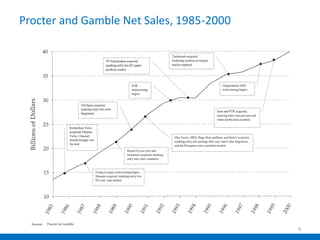
Procter and Gamble Net Sales, 1985-2000


                                          4
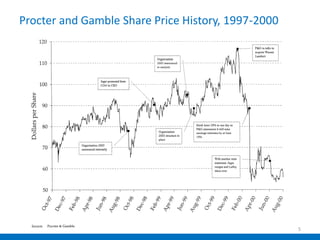
Procter and Gamble Share Price History, 1997-2000


                                                    5
About Procter and Gamble | The Organizational Structure Changes


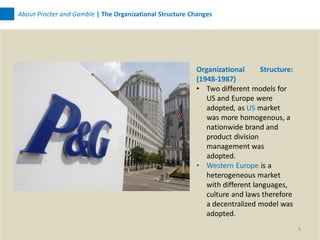
                                                         Organizational      Structure:
                                                         (1948-1987)
                                                         • Two different models for
                                                            US and Europe were
                                                            adopted, as US market
                                                            was more homogenous, a
                                                            nationwide brand and
                                                            product division
                                                            management was
                                                            adopted.
                                                         • Western Europe is a
                                                            heterogeneous market
                                                            with different languages,
                                                            culture and laws therefore
                                                            a decentralized model was
                                                            adopted.
                                                                                          6
About Procter and Gamble | The Organizational Structure Changes


United States
The organizational model was developed
on two key dimensions: functions and
brand.
In 1987 structure was changed and
functional units were centralized.
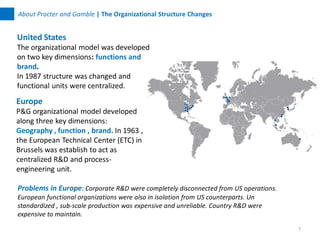
Europe
P&G organizational model developed
along three key dimensions:
Geography , function , brand. In 1963 ,
the European Technical Center (ETC) in
Brussels was establish to act as
centralized R&D and process-
engineering unit.

Problems in Europe: Corporate R&D were completely disconnected from US operations.
European functional organizations were also in isolation from US counterparts. Un
standardized , sub-scale production was expensive and unreliable. Country R&D were
expensive to maintain.

                                                                                     7
About Procter and Gamble | The Organizational Structure Changes


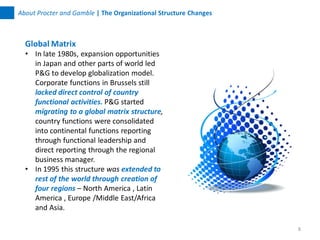
  Global Matrix
  • In late 1980s, expansion opportunities
    in Japan and other parts of world led
    P&G to develop globalization model.
    Corporate functions in Brussels still
    lacked direct control of country
    functional activities. P&G started
    migrating to a global matrix structure,
    country functions were consolidated
    into continental functions reporting
    through functional leadership and
    direct reporting through the regional
    business manager.
  • In 1995 this structure was extended to
    rest of the world through creation of
    four regions – North America , Latin
    America , Europe /Middle East/Africa
    and Asia.

                                                                  8
About Procter and Gamble | The Organizational Structure Changes


  Global Matrix Problems
  • Most functions nominally had straight line reporting through regional
    management and also reporting through functional management, the function
    retained a high degree of de-facto control.
  • They develop their own strategic agenda, maximize power, do not coordinate
    with other functions and business units.
  • As regional managers were responsible for profit and loss they were hesitate to
    launch new product.


                                                                                      9
About Procter and Gamble | The Organizational Structure Changes


  Organization 2005
  • Introduced by Durk Jager as an aggressive restructuring program
  • Designed to generate bolder innovations and accelerate their global rollout in
     order to double P&G sales to 70billion in 2005 and achieve annual earning
     growth of 13-15%
  • P&G chain of formal command was based on Geographical, Product, Function.
     It changed to : product, geography, business process
  • The Plan also called to eliminate 6 management layers, reducing from 13 to 7
  • Focus was more on rolling out new products at faster rate. Implementation of
     3M concept i.e product launched in last 3 year should make up certain
     percentage of total turnover.
  • Previously organization was more decentralized and centralization coupled
     with separations and negative growth rate has weaken moral of employees
  • Jager decided that P&G would sell its products under the same name all
     around the world. So in Germany, the name of its dishwashing liquid suddenly
     changed from Fairy to Dawn
  • Large level of transfers (2000 from Europe to Geneva ) and relocation led to
     moral and behavioral changes.

                                                                                     10
Situation (2)


Standardization of Work Processes

• One of the major objectives of Organization 2005 program was to
  significantly improve all inefficient work processes of P&G including its
  product development, supply chain management and marketing
  functions.
• In order to achieve this objective, P&G undertook several IT initiatives
  including collaborative technologies, B2C e-commerce, web-enabled
  supply chain and a data warehouse project for supplying timely data to
  company’s various operations located globally.


                                                                              11
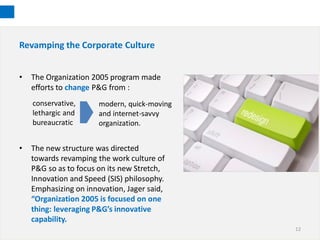
Revamping the Corporate Culture


•   The Organization 2005 program made
    efforts to change P&G from :
    conservative,      modern, quick-moving
    lethargic and      and internet-savvy
    bureaucratic       organization.


•   The new structure was directed
    towards revamping the work culture of
    P&G so as to focus on its new Stretch,
    Innovation and Speed (SIS) philosophy.
    Emphasizing on innovation, Jager said,
    “Organization 2005 is focused on one
    thing: leveraging P&G’s innovative
    capability.
                                              12
About Procter and Gamble | The Organizational Structure Changes


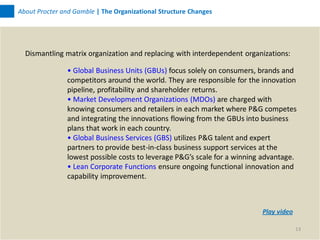
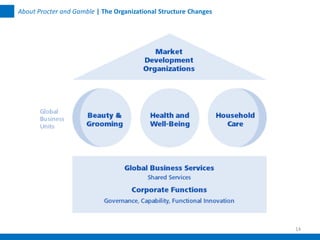
  Dismantling matrix organization and replacing with interdependent organizations:

               • Global Business Units (GBUs) focus solely on consumers, brands and
               competitors around the world. They are responsible for the innovation
               pipeline, profitability and shareholder returns.
               • Market Development Organizations (MDOs) are charged with
               knowing consumers and retailers in each market where P&G competes
               and integrating the innovations flowing from the GBUs into business
               plans that work in each country.
               • Global Business Services (GBS) utilizes P&G talent and expert
               partners to provide best-in-class business support services at the
               lowest possible costs to leverage P&G’s scale for a winning advantage.
               • Lean Corporate Functions ensure ongoing functional innovation and
               capability improvement.


                                                                          Play video

                                                                                       13
About Procter and Gamble | The Organizational Structure Changes


                                                                  14
Problems


           Problems


                      15
Problems


Durk Jager , had introduced a restructuring program named “Organization 2005” –
designed to accelerate sales and innovations. In past P&G chain of formal
command put geography first, followed by product and function.

In new design, P&G was structured as 3 interdependent global organizations, one
organized by product category, one by geography and one by business process.


Problems
 • Missed Earnings in 2000
     • In the fourth-quarter profits were flat against the expectation 15-17%
        increase
     • P&G lowered its future quarterly sales growth estimates to 2-3%
 • P&G Stock lost 7%, falling to $57 after the announcement
 • Loss of US market share in 16 out of 30 categories
 • Lack of immediate results, job reductions, reduced employee morale led to
   reduced profits and stock price reduced to half in last six months.
                                                                                  16
Business Analysis


                    17
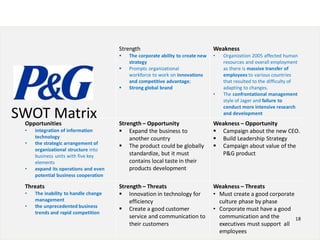
Strength                                  Weakness
                                         The corporate ability to create new   •   Organization 2005 affected human
                                          strategy                                  resources and overall employment
                                         Prompts organizational                    as there is massive transfer of
                                          workforce to work on innovations          employees to various countries
                                          and competitive advantage;                that resulted to the difficulty of
                                         Strong global brand                       adapting to changes.
                                                                                •   The confrontational management
                                                                                    style of Jager and failure to
                                                                                    conduct more intensive research
SWOT Matrix
 Opportunities                        Strength – Opportunity
                                                                                    and development
                                                                                Weakness – Opportunity
 •   integration of information        Expand the business to                   Campaign about the new CEO.
     technology                           another country                        Build Leadership Strategy
 •   the strategic arrangement of
                                       The product could be globally            Campaign about value of the
     organizational structure into
     business units with five key         standardize, but it must                P&G product
     elements                             contains local taste in their
 •   expand its operations and even       products development
     potential business cooperation

 Threats                              Strength – Threats                        Weakness – Threats
 •   The inability to handle change    Innovation in technology for            • Must create a good corporate
     management                           efficiency                              culture phase by phase
 •   the unprecedented business
                                       Create a good customer                  • Corporate must have a good
     trends and rapid competition
                                          service and communication to            communication and the        18
                                          their customers                         executives must support all
                                                                                  employees                    18
Recommendations
Not just strategy but Organization


                                19
Recommendation - To ensure the success out change program “organization 2005”


                                        Building an organization with the
                                        competences, capabilities, and resource
                                        strengths to execute strategy successfully.
                                         •   The key to success full transformation is
                                             employee buy in.
                                         •   Proactive two way communication is the
                                             key to achieve that.
                                         •   The top management of the organization
                                             has to meet a good number of employee
                                             across all level, functions and countries to
                                             seek feedback and provide clarification on
                                             Organizations 2005


                                                                                            20
Recommendation - To ensure the success out change program “organization 2005”


                                          Shaping the work environment and corporate
                                          culture to fit the strategy.
                                         •   The Change should be implemented
                                             globally at a rapid speed
                                         •   It requires aggressive plan and executives to
                                             implement the same
                                         •   The new structure and work has to be
                                             designed across all global operations,
                                             assignment of people finalized and
                                             communicated and the new organizations
                                             started up on schedule


                                                                                       21
Recommendation - To ensure the success out change program “organization 2005”


                                         Marshaling resources behind the drive for good
                                         strategy execution and operating excellence.
                                         •   An important element should be to give the
                                             great degree of standardizations to the local
                                             management align their own design with
                                             global strategy
                                         •   This will give a feeling of independence to
                                             the local management while the global
                                             standard will also be met


                                                                                       22
- not just strategy but organization -


                                         23

Group assignment pn g organization 2005

  • 1.
    Managing and SustainingProfitable Growth Group Presentation : Procter & Gamble : Organization 2005 (A) Haris Suhendra 1140003494 | Pramita Wardani 1140003121 1
  • 2.
    Table of Contents: AboutProcter & Gamble Problems Business Analysis Recommendation 2
  • 3.
    From Candle andSoap to multinational empire Founded in Cincinnati, Ohio by William Procter and James Gamble. Differentiation of P&G is an aggressive investment strategy building a large factory in the 1850s despite rumors of impending civil wars. Keywords for P&G : Rapid growth, innovations in HR managements, R&D, Distributions, Marketing and organizational designs. About Procter and Gamble | P&G History 3
  • 4.
    Procter and GambleNet Sales, 1985-2000 4
  • 5.
    Procter and GambleShare Price History, 1997-2000 5
  • 6.
    About Procter andGamble | The Organizational Structure Changes Organizational Structure: (1948-1987) • Two different models for US and Europe were adopted, as US market was more homogenous, a nationwide brand and product division management was adopted. • Western Europe is a heterogeneous market with different languages, culture and laws therefore a decentralized model was adopted. 6
  • 7.
    About Procter andGamble | The Organizational Structure Changes United States The organizational model was developed on two key dimensions: functions and brand. In 1987 structure was changed and functional units were centralized. Europe P&G organizational model developed along three key dimensions: Geography , function , brand. In 1963 , the European Technical Center (ETC) in Brussels was establish to act as centralized R&D and process- engineering unit. Problems in Europe: Corporate R&D were completely disconnected from US operations. European functional organizations were also in isolation from US counterparts. Un standardized , sub-scale production was expensive and unreliable. Country R&D were expensive to maintain. 7
  • 8.
    About Procter andGamble | The Organizational Structure Changes Global Matrix • In late 1980s, expansion opportunities in Japan and other parts of world led P&G to develop globalization model. Corporate functions in Brussels still lacked direct control of country functional activities. P&G started migrating to a global matrix structure, country functions were consolidated into continental functions reporting through functional leadership and direct reporting through the regional business manager. • In 1995 this structure was extended to rest of the world through creation of four regions – North America , Latin America , Europe /Middle East/Africa and Asia. 8
  • 9.
    About Procter andGamble | The Organizational Structure Changes Global Matrix Problems • Most functions nominally had straight line reporting through regional management and also reporting through functional management, the function retained a high degree of de-facto control. • They develop their own strategic agenda, maximize power, do not coordinate with other functions and business units. • As regional managers were responsible for profit and loss they were hesitate to launch new product. 9
  • 10.
    About Procter andGamble | The Organizational Structure Changes Organization 2005 • Introduced by Durk Jager as an aggressive restructuring program • Designed to generate bolder innovations and accelerate their global rollout in order to double P&G sales to 70billion in 2005 and achieve annual earning growth of 13-15% • P&G chain of formal command was based on Geographical, Product, Function. It changed to : product, geography, business process • The Plan also called to eliminate 6 management layers, reducing from 13 to 7 • Focus was more on rolling out new products at faster rate. Implementation of 3M concept i.e product launched in last 3 year should make up certain percentage of total turnover. • Previously organization was more decentralized and centralization coupled with separations and negative growth rate has weaken moral of employees • Jager decided that P&G would sell its products under the same name all around the world. So in Germany, the name of its dishwashing liquid suddenly changed from Fairy to Dawn • Large level of transfers (2000 from Europe to Geneva ) and relocation led to moral and behavioral changes. 10
  • 11.
    Situation (2) Standardization ofWork Processes • One of the major objectives of Organization 2005 program was to significantly improve all inefficient work processes of P&G including its product development, supply chain management and marketing functions. • In order to achieve this objective, P&G undertook several IT initiatives including collaborative technologies, B2C e-commerce, web-enabled supply chain and a data warehouse project for supplying timely data to company’s various operations located globally. 11
  • 12.
    Revamping the CorporateCulture • The Organization 2005 program made efforts to change P&G from : conservative, modern, quick-moving lethargic and and internet-savvy bureaucratic organization. • The new structure was directed towards revamping the work culture of P&G so as to focus on its new Stretch, Innovation and Speed (SIS) philosophy. Emphasizing on innovation, Jager said, “Organization 2005 is focused on one thing: leveraging P&G’s innovative capability. 12
  • 13.
    About Procter andGamble | The Organizational Structure Changes Dismantling matrix organization and replacing with interdependent organizations: • Global Business Units (GBUs) focus solely on consumers, brands and competitors around the world. They are responsible for the innovation pipeline, profitability and shareholder returns. • Market Development Organizations (MDOs) are charged with knowing consumers and retailers in each market where P&G competes and integrating the innovations flowing from the GBUs into business plans that work in each country. • Global Business Services (GBS) utilizes P&G talent and expert partners to provide best-in-class business support services at the lowest possible costs to leverage P&G’s scale for a winning advantage. • Lean Corporate Functions ensure ongoing functional innovation and capability improvement. Play video 13
  • 14.
    About Procter andGamble | The Organizational Structure Changes 14
  • 15.
    Problems Problems 15
  • 16.
    Problems Durk Jager ,had introduced a restructuring program named “Organization 2005” – designed to accelerate sales and innovations. In past P&G chain of formal command put geography first, followed by product and function. In new design, P&G was structured as 3 interdependent global organizations, one organized by product category, one by geography and one by business process. Problems • Missed Earnings in 2000 • In the fourth-quarter profits were flat against the expectation 15-17% increase • P&G lowered its future quarterly sales growth estimates to 2-3% • P&G Stock lost 7%, falling to $57 after the announcement • Loss of US market share in 16 out of 30 categories • Lack of immediate results, job reductions, reduced employee morale led to reduced profits and stock price reduced to half in last six months. 16
  • 17.
  • 18.
    Strength Weakness  The corporate ability to create new • Organization 2005 affected human strategy resources and overall employment  Prompts organizational as there is massive transfer of workforce to work on innovations employees to various countries and competitive advantage; that resulted to the difficulty of  Strong global brand adapting to changes. • The confrontational management style of Jager and failure to conduct more intensive research SWOT Matrix Opportunities Strength – Opportunity and development Weakness – Opportunity • integration of information  Expand the business to  Campaign about the new CEO. technology another country  Build Leadership Strategy • the strategic arrangement of  The product could be globally  Campaign about value of the organizational structure into business units with five key standardize, but it must P&G product elements contains local taste in their • expand its operations and even products development potential business cooperation Threats Strength – Threats Weakness – Threats • The inability to handle change  Innovation in technology for • Must create a good corporate management efficiency culture phase by phase • the unprecedented business  Create a good customer • Corporate must have a good trends and rapid competition service and communication to communication and the 18 their customers executives must support all employees 18
  • 19.
  • 20.
    Recommendation - Toensure the success out change program “organization 2005” Building an organization with the competences, capabilities, and resource strengths to execute strategy successfully. • The key to success full transformation is employee buy in. • Proactive two way communication is the key to achieve that. • The top management of the organization has to meet a good number of employee across all level, functions and countries to seek feedback and provide clarification on Organizations 2005 20
  • 21.
    Recommendation - Toensure the success out change program “organization 2005” Shaping the work environment and corporate culture to fit the strategy. • The Change should be implemented globally at a rapid speed • It requires aggressive plan and executives to implement the same • The new structure and work has to be designed across all global operations, assignment of people finalized and communicated and the new organizations started up on schedule 21
  • 22.
    Recommendation - Toensure the success out change program “organization 2005” Marshaling resources behind the drive for good strategy execution and operating excellence. • An important element should be to give the great degree of standardizations to the local management align their own design with global strategy • This will give a feeling of independence to the local management while the global standard will also be met 22
  • 23.
    - not juststrategy but organization - 23