University Computing Centre 
Market Segmentation and Market 
Structure 
DBE1 
9/4/2014 Marketing Management 1
Markets 
• Markets are a group of potential buyers with 
needs and wants and the purchasing power to 
satisfy them. 
9/4/2014 Marketing Management 2
Markets 
• The market can be defined as an economic 
entity because in most cases, a market is 
characterized by a dynamic system of 
economic forces including supply, demand, 
competition, and government intervention.. 
9/4/2014 Marketing Management 3
Market Structure 
• Market structure is the number of firms 
producing identical products which are 
homogeneous. 
9/4/2014 Marketing Management 4
Market Structure 
• The types of market structures include the 
following: 
Monopolistic competition 
Oligopoly 
Monopoly 
Perfect competition 
9/4/2014 Marketing Management 5
Perfect competition 
• A theoretical market structure that features 
no barriers to entry, an unlimited number of 
producers and consumers, and a perfectly 
elastic demand curve. 
9/4/2014 Marketing Management 6
Basic structural characteristics 
• Infinite buyers and sellers - An infinite 
number of consumers with the willingness 
and ability to buy the product at a certain 
price, and infinite producers with the 
willingness and ability to supply the product at 
a certain price 
9/4/2014 Marketing Management 7
Basic structural characteristics 
• Zero entry and exit barriers - A lack of entry 
and exit barriers makes it extremely easy to 
enter or exit a perfectly competitive market. 
• Perfect information - All consumers and 
producers are assumed to have perfect 
knowledge of price, utility, quality and 
production methods of products 
9/4/2014 Marketing Management 8
Basic structural characteristics 
• Zero transaction costs - Buyers and sellers do 
not incur costs in making an exchange of 
goods in a perfectly competitive market. 
• Profit maximization - Firms are assumed to 
sell where marginal costs meet marginal 
revenue, where the most profit is generated. 
9/4/2014 Marketing Management 9
Basic structural characteristics 
• Homogenous products - The qualities and 
characteristics of a market good or service do 
not vary between different suppliers. 
• Property rights - Well defined property rights 
determine what may be sold, as well as what 
rights are conferred on the buyer 
9/4/2014 Marketing Management 10
Monopolistic competition 
• Monopolistic competition is a type of 
imperfect competition such that many 
producers sell products that are differentiated 
from one another as goods but not perfect 
substitutes (such as from branding, quality, or 
location). 
9/4/2014 Marketing Management 11
Monopolistic competition 
• In monopolistic competition, a firm takes the 
prices charged by its rivals as given and 
ignores the impact of its own prices on the 
prices of other firms 
9/4/2014 Marketing Management 12
Monopolistic competition 
• Monopolistically competitive markets have 
the following characteristics; 
There are many producers and many 
consumers in the market, and no business has 
total control over the market price. 
Consumers perceive that there are non-price 
differences among the competitors' products 
9/4/2014 Marketing Management 13
Monopolistic competition 
There are few barriers to entry and exit. 
Producers have a degree of control over price 
The long-run characteristics of a 
monopolistically competitive market are 
almost the same as a perfectly competitive 
market 
9/4/2014 Marketing Management 14
Monopolistic competition 
• There are six characteristics of monopolistic 
competition (MC): 
Product differentiation 
Many firms 
Free entry and exit in the long run 
9/4/2014 Marketing Management 15
Monopolistic competition 
Free entry and exit in the long run 
Independent decision making 
Market Power - Market power means that the 
firm has control over the terms and conditions 
of exchange. 
Buyers and Sellers do not have perfect 
information (Imperfect Information) 
9/4/2014 Marketing Management 16
Oligopoly 
• Oligopoly - is a market form in which a market 
or industry is dominated by a small number of 
sellers (oligopolists). Oligopolies can result 
from various forms of collusion which reduce 
competition and lead to higher costs for 
consumers. 
9/4/2014 Marketing Management 17
Oligopoly 
• With few sellers, each oligopolist is likely to be 
aware of the actions of the others. The 
decisions of one firm therefore influence and 
are influenced by the decisions of other firms 
9/4/2014 Marketing Management 18
Oligopoly 
• Strategic planning by oligopolists needs to 
take into account the likely responses of the 
other market participants. 
9/4/2014 Marketing Management 19
Characteristics 
• Profit maximization conditions: An oligopoly 
maximizes profits by producing where 
marginal revenue equals marginal costs 
• Ability to set price: Oligopolies are price 
setters rather than price takers. 
9/4/2014 Marketing Management 20
Characteristics 
• Entry and exit: Barriers to entry are high. 
barriers to entry often result from government 
regulation favoring existing firms making it 
difficult for new firms to enter the market. 
• Number of firms: "Few" – a "handful" of 
sellers. There are so few firms that the actions 
of one firm can influence the actions of the 
other firms 
9/4/2014 Marketing Management 21
Characteristics 
• Product differentiation: Product may be 
homogeneous or differentiated (automobiles) 
• Perfect knowledge: Oligopolies have perfect 
knowledge of their own cost and demand 
functions but their inter-firm information may 
be incomplete. Buyers have only 
unsatisfactory knowledge as to price, cost and 
product quality 
9/4/2014 Marketing Management 22
Characteristics 
• Interdependence: The distinctive feature of an 
oligopoly is interdependence. Oligopolies are 
typically composed of a few large firms. Each 
firm is so large that its actions affect market 
conditions 
9/4/2014 Marketing Management 23
Characteristics 
• Therefore the competing firms will be aware 
of a firm's market actions and will respond 
appropriately. 
9/4/2014 Marketing Management 24
Characteristics 
• Non-Price Competition: Oligopolies tend to 
compete on terms other than price. 
advertisement, and product differentiation are 
all examples of non-price competition 
9/4/2014 Marketing Management 25
Quick Reference to Basic Market 
Structures 
Market 
Structure 
Seller Entry 
barriers 
Seller 
Number 
Buyer 
Entry 
barriers 
Buyer 
Number 
Perfect 
Competitio 
n 
No Many No Many 
Monopolist 
ic 
competitio 
n 
No Many No Many 
9/4/2014 Marketing Management 26
Quick Reference to Basic Market 
Structures 
Market 
Structure 
Seller 
Entry 
barriers 
Seller 
Number 
Buyer 
Entry 
barriers 
Buyer 
Number 
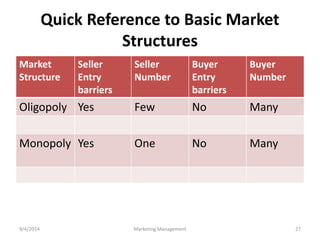
Oligopoly Yes Few No Many 
Monopoly Yes One No Many 
9/4/2014 Marketing Management 27
Market segmentation 
• With growing diversity in the tastes of modern 
consumers, firms are taking note of the 
benefit of servicing a multiplicity of new 
markets. 
9/4/2014 Marketing Management 28
Market segmentation 
• The market segmentation and corresponding 
product differentiation strategy can give a firm 
a temporary commercial advantage. Most 
market segmentations are the techniques 
used to attract the right customer. 
9/4/2014 Marketing Management 29
Market segmentation 
• Due to limited resources, a firm must make 
choices in servicing specific groups of 
consumers. 
9/4/2014 Marketing Management 30
Market Segmentation 
• Market segmentation can be defined as the 
process of dividing a market into different 
homogeneous groups of consumers 
9/4/2014 Marketing Management 31
Market Segmentation 
• Market segmentation pertains to the division 
of a set of consumers into persons with similar 
needs and wants. Market segmentation allows 
for a better allocation of a firm's finite 
resources. 
9/4/2014 Marketing Management 32
Objectives of segmentation 
• To reduce risk in deciding where, when, how, 
and to whom a product, service, or brand will 
be marketed. 
• To increase marketing efficiency by directing 
effort specifically toward the designated 
segment in a manner consistent with that 
segment's characteristics. 
9/4/2014 Marketing Management 33
Product differentiation 
• The process of creating perceived differences 
between the product of one firm and that of 
its rivals so that some customers value it more 
9/4/2014 Marketing Management 34
Target 
• A person (or group of people) that a person or 
organization is trying to employ or to have as a 
customer, audience etc. 
9/4/2014 Marketing Management 35
Market segmentation 
• Market segmentation is a twofold process that 
includes: 
Identifying and classifying people into 
homogeneous groupings, called segments 
Determining which of these segments are 
viable target markets 
9/4/2014 Marketing Management 36
The Segmented Market 
• The premise of segmenting the market 
theorizes that people and/or organizations can 
be most effectively approached by recognizing 
their differences and adjusting accordingly. 
9/4/2014 Marketing Management 37
The Segmented Market 
• By emphasizing a segmentation approach, the 
exchange process should be enhanced, since a 
company can more precisely match the needs 
and wants of the customer. 
9/4/2014 Marketing Management 38
The Segmented Market 
• While product differentiation is an effective 
strategy to distinguish a brand from 
competitors', it also differentiates one product 
from another. 
9/4/2014 Marketing Management 39
The Segmented Market 
• The objective is to sell more product, to more 
people, more often. The problem is not 
competition; the problem is the 
acknowledgment that people within markets 
are different and that successful marketers 
must respond to these differences. 
9/4/2014 Marketing Management 40
Choosing a Target Market from within 
a Defined Segment 
• While it is relatively easy to identify segments 
of consumers, most firms do not have the 
capabilities or the need to effectively market 
their product to all of the segments that can 
be identified. Rather, one or more target 
markets (segments) must be selected. 
9/4/2014 Marketing Management 41
Choosing a Target Market from within 
a Defined Segment 
• A company selects its target market because it 
exhibits the strongest affinity to a particular 
product or brand. It is in essence the most 
likely to buy the product. 
9/4/2014 Marketing Management 42
Psychographic segmentation 
The division of the market into subsets 
according to consumers' lifestyle, personality, 
values and social class 
9/4/2014 Marketing Management 43

Market segmentation

  • 1.
    University Computing Centre Market Segmentation and Market Structure DBE1 9/4/2014 Marketing Management 1
  • 2.
    Markets • Marketsare a group of potential buyers with needs and wants and the purchasing power to satisfy them. 9/4/2014 Marketing Management 2
  • 3.
    Markets • Themarket can be defined as an economic entity because in most cases, a market is characterized by a dynamic system of economic forces including supply, demand, competition, and government intervention.. 9/4/2014 Marketing Management 3
  • 4.
    Market Structure •Market structure is the number of firms producing identical products which are homogeneous. 9/4/2014 Marketing Management 4
  • 5.
    Market Structure •The types of market structures include the following: Monopolistic competition Oligopoly Monopoly Perfect competition 9/4/2014 Marketing Management 5
  • 6.
    Perfect competition •A theoretical market structure that features no barriers to entry, an unlimited number of producers and consumers, and a perfectly elastic demand curve. 9/4/2014 Marketing Management 6
  • 7.
    Basic structural characteristics • Infinite buyers and sellers - An infinite number of consumers with the willingness and ability to buy the product at a certain price, and infinite producers with the willingness and ability to supply the product at a certain price 9/4/2014 Marketing Management 7
  • 8.
    Basic structural characteristics • Zero entry and exit barriers - A lack of entry and exit barriers makes it extremely easy to enter or exit a perfectly competitive market. • Perfect information - All consumers and producers are assumed to have perfect knowledge of price, utility, quality and production methods of products 9/4/2014 Marketing Management 8
  • 9.
    Basic structural characteristics • Zero transaction costs - Buyers and sellers do not incur costs in making an exchange of goods in a perfectly competitive market. • Profit maximization - Firms are assumed to sell where marginal costs meet marginal revenue, where the most profit is generated. 9/4/2014 Marketing Management 9
  • 10.
    Basic structural characteristics • Homogenous products - The qualities and characteristics of a market good or service do not vary between different suppliers. • Property rights - Well defined property rights determine what may be sold, as well as what rights are conferred on the buyer 9/4/2014 Marketing Management 10
  • 11.
    Monopolistic competition •Monopolistic competition is a type of imperfect competition such that many producers sell products that are differentiated from one another as goods but not perfect substitutes (such as from branding, quality, or location). 9/4/2014 Marketing Management 11
  • 12.
    Monopolistic competition •In monopolistic competition, a firm takes the prices charged by its rivals as given and ignores the impact of its own prices on the prices of other firms 9/4/2014 Marketing Management 12
  • 13.
    Monopolistic competition •Monopolistically competitive markets have the following characteristics; There are many producers and many consumers in the market, and no business has total control over the market price. Consumers perceive that there are non-price differences among the competitors' products 9/4/2014 Marketing Management 13
  • 14.
    Monopolistic competition Thereare few barriers to entry and exit. Producers have a degree of control over price The long-run characteristics of a monopolistically competitive market are almost the same as a perfectly competitive market 9/4/2014 Marketing Management 14
  • 15.
    Monopolistic competition •There are six characteristics of monopolistic competition (MC): Product differentiation Many firms Free entry and exit in the long run 9/4/2014 Marketing Management 15
  • 16.
    Monopolistic competition Freeentry and exit in the long run Independent decision making Market Power - Market power means that the firm has control over the terms and conditions of exchange. Buyers and Sellers do not have perfect information (Imperfect Information) 9/4/2014 Marketing Management 16
  • 17.
    Oligopoly • Oligopoly- is a market form in which a market or industry is dominated by a small number of sellers (oligopolists). Oligopolies can result from various forms of collusion which reduce competition and lead to higher costs for consumers. 9/4/2014 Marketing Management 17
  • 18.
    Oligopoly • Withfew sellers, each oligopolist is likely to be aware of the actions of the others. The decisions of one firm therefore influence and are influenced by the decisions of other firms 9/4/2014 Marketing Management 18
  • 19.
    Oligopoly • Strategicplanning by oligopolists needs to take into account the likely responses of the other market participants. 9/4/2014 Marketing Management 19
  • 20.
    Characteristics • Profitmaximization conditions: An oligopoly maximizes profits by producing where marginal revenue equals marginal costs • Ability to set price: Oligopolies are price setters rather than price takers. 9/4/2014 Marketing Management 20
  • 21.
    Characteristics • Entryand exit: Barriers to entry are high. barriers to entry often result from government regulation favoring existing firms making it difficult for new firms to enter the market. • Number of firms: "Few" – a "handful" of sellers. There are so few firms that the actions of one firm can influence the actions of the other firms 9/4/2014 Marketing Management 21
  • 22.
    Characteristics • Productdifferentiation: Product may be homogeneous or differentiated (automobiles) • Perfect knowledge: Oligopolies have perfect knowledge of their own cost and demand functions but their inter-firm information may be incomplete. Buyers have only unsatisfactory knowledge as to price, cost and product quality 9/4/2014 Marketing Management 22
  • 23.
    Characteristics • Interdependence:The distinctive feature of an oligopoly is interdependence. Oligopolies are typically composed of a few large firms. Each firm is so large that its actions affect market conditions 9/4/2014 Marketing Management 23
  • 24.
    Characteristics • Thereforethe competing firms will be aware of a firm's market actions and will respond appropriately. 9/4/2014 Marketing Management 24
  • 25.
    Characteristics • Non-PriceCompetition: Oligopolies tend to compete on terms other than price. advertisement, and product differentiation are all examples of non-price competition 9/4/2014 Marketing Management 25
  • 26.
    Quick Reference toBasic Market Structures Market Structure Seller Entry barriers Seller Number Buyer Entry barriers Buyer Number Perfect Competitio n No Many No Many Monopolist ic competitio n No Many No Many 9/4/2014 Marketing Management 26
  • 27.
    Quick Reference toBasic Market Structures Market Structure Seller Entry barriers Seller Number Buyer Entry barriers Buyer Number Oligopoly Yes Few No Many Monopoly Yes One No Many 9/4/2014 Marketing Management 27
  • 28.
    Market segmentation •With growing diversity in the tastes of modern consumers, firms are taking note of the benefit of servicing a multiplicity of new markets. 9/4/2014 Marketing Management 28
  • 29.
    Market segmentation •The market segmentation and corresponding product differentiation strategy can give a firm a temporary commercial advantage. Most market segmentations are the techniques used to attract the right customer. 9/4/2014 Marketing Management 29
  • 30.
    Market segmentation •Due to limited resources, a firm must make choices in servicing specific groups of consumers. 9/4/2014 Marketing Management 30
  • 31.
    Market Segmentation •Market segmentation can be defined as the process of dividing a market into different homogeneous groups of consumers 9/4/2014 Marketing Management 31
  • 32.
    Market Segmentation •Market segmentation pertains to the division of a set of consumers into persons with similar needs and wants. Market segmentation allows for a better allocation of a firm's finite resources. 9/4/2014 Marketing Management 32
  • 33.
    Objectives of segmentation • To reduce risk in deciding where, when, how, and to whom a product, service, or brand will be marketed. • To increase marketing efficiency by directing effort specifically toward the designated segment in a manner consistent with that segment's characteristics. 9/4/2014 Marketing Management 33
  • 34.
    Product differentiation •The process of creating perceived differences between the product of one firm and that of its rivals so that some customers value it more 9/4/2014 Marketing Management 34
  • 35.
    Target • Aperson (or group of people) that a person or organization is trying to employ or to have as a customer, audience etc. 9/4/2014 Marketing Management 35
  • 36.
    Market segmentation •Market segmentation is a twofold process that includes: Identifying and classifying people into homogeneous groupings, called segments Determining which of these segments are viable target markets 9/4/2014 Marketing Management 36
  • 37.
    The Segmented Market • The premise of segmenting the market theorizes that people and/or organizations can be most effectively approached by recognizing their differences and adjusting accordingly. 9/4/2014 Marketing Management 37
  • 38.
    The Segmented Market • By emphasizing a segmentation approach, the exchange process should be enhanced, since a company can more precisely match the needs and wants of the customer. 9/4/2014 Marketing Management 38
  • 39.
    The Segmented Market • While product differentiation is an effective strategy to distinguish a brand from competitors', it also differentiates one product from another. 9/4/2014 Marketing Management 39
  • 40.
    The Segmented Market • The objective is to sell more product, to more people, more often. The problem is not competition; the problem is the acknowledgment that people within markets are different and that successful marketers must respond to these differences. 9/4/2014 Marketing Management 40
  • 41.
    Choosing a TargetMarket from within a Defined Segment • While it is relatively easy to identify segments of consumers, most firms do not have the capabilities or the need to effectively market their product to all of the segments that can be identified. Rather, one or more target markets (segments) must be selected. 9/4/2014 Marketing Management 41
  • 42.
    Choosing a TargetMarket from within a Defined Segment • A company selects its target market because it exhibits the strongest affinity to a particular product or brand. It is in essence the most likely to buy the product. 9/4/2014 Marketing Management 42
  • 43.
    Psychographic segmentation Thedivision of the market into subsets according to consumers' lifestyle, personality, values and social class 9/4/2014 Marketing Management 43