
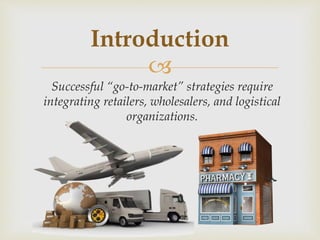
Successful “go-to-market” strategies require
integrating retailers, wholesalers, and logistical
organizations.
Introduction

(a) Consumer Marketing Channels
(b) Industrial Marketing Channels
Marketing channels

Retailing includes all the activities involved in
selling goods or services directly to final
customers for their personal, nonbusiness use. A
retailer is any business enterprise whose sales
volume comes primarily from retailing.
Retailing
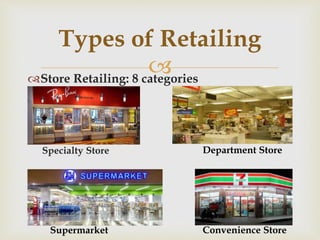
Store Retailing: 8 categories
Specialty Store
Types of Retailing
Department Store
Supermarket Convenience Store

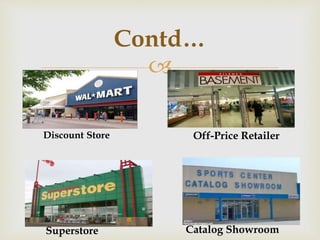
Contd…
Discount Store Off-Price Retailer
Superstore Catalog Showroom

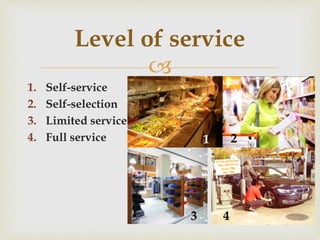
1. Self-service
2. Self-selection
3. Limited service
4. Full service
Level of service
1 2
3 4

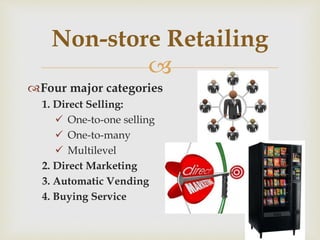
Four major categories
1. Direct Selling:
 One-to-one selling
 One-to-many
 Multilevel
2. Direct Marketing
3. Automatic Vending
4. Buying Service
Non-store Retailing

Corporate Chain Stores
Voluntary Chain
Retailer Cooperative
Consumer Cooperative
Franchise Organization
Merchandising Conglomerate
Corporate Retailing

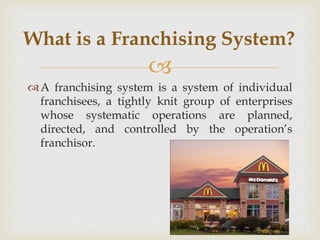
A franchising system is a system of individual
franchisees, a tightly knit group of enterprises
whose systematic operations are planned,
directed, and controlled by the operation’s
franchisor.
What is a Franchising System?
 The franchisor owns a trade or service mark and
licenses it to franchisees in return for royalty
payments.
 The franchisee pays for the right to be part of the
system.
 The franchisor provides its franchisees with a
system for doing business.
Characteristics of Franchises

 Target-market decision
 Product Assortment-&-procurement decision
 Services-&- store- atmosphere decision
 Price Decision
 Promotion Decision
 Place Decision
Marketing Decisions

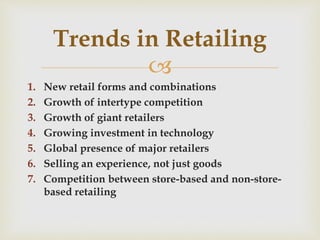
1. New retail forms and combinations
2. Growth of intertype competition
3. Growth of giant retailers
4. Growing investment in technology
5. Global presence of major retailers
6. Selling an experience, not just goods
7. Competition between store-based and non-store-
based retailing
Trends in Retailing

 Founder- Kishore Biyani (MD & CEO)
 Headquarters- Mumbai
 Products- Integrated foods and other FMCGs
 Services- Supermarkets, hypermarkets, discount
stores, insurance, logistics, media
 Incorporated in 1987 (as Manz wear Pvt. Ltd)
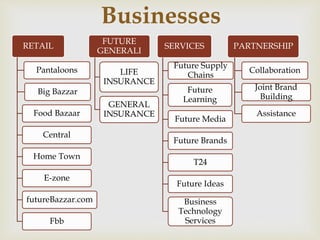
Businesses
RETAIL
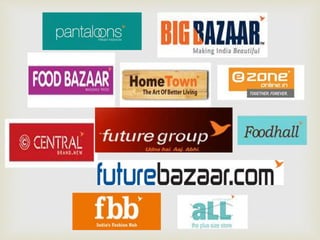
Pantaloons
Big Bazzar
Food Bazaar
Central
Home Town
E-zone
futureBazzar.com
Fbb
FUTURE
GENERALI
LIFE
INSURANCE
GENERAL
INSURANCE
SERVICES
Future Supply
Chains
Future
Learning
Future Media
Future Brands
T24
Future Ideas
Business
Technology
Services
PARTNERSHIP
Collaboration
Joint Brand
Building
Assistance

 As India’s leading retailer, Future Retail inspires trust
through innovative offerings, quality products and
affordable prices that help customers achieve a better
quality of life every day. They serve customers in 95
cities across the country through over 10 million square
feet of retail space.
 Their strategy is based on a deep understanding of
Indian consumers the products they want, and making
these products available in every city in every store
format.

 Pantaloon Retail (India) Limited, is India’s leading
retailer that operates multiple retail formats in both
the value and lifestyle segment of the Indian
consumer market.
 Headquartered in Mumbai
 The company operates over 12 million square feet of
retail space, has over 1000 stores across 73 cities in
India and employs over 30,000 people.
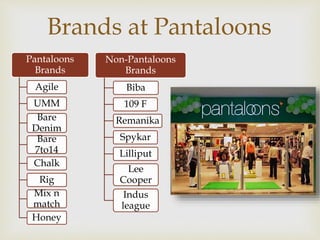
Pantaloons
Brands
Agile
UMM
Bare
Denim
Bare
7to14
Chalk
Rig
Mix n
match
Honey
Non-Pantaloons
Brands
Biba
109 F
Remanika
Spykar
Lilliput
Lee
Cooper
Indus
league
Brands at Pantaloons

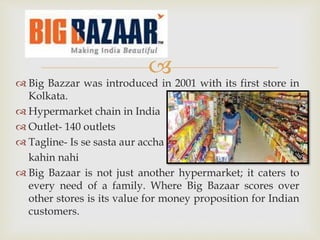
 Big Bazzar was introduced in 2001 with its first store in
Kolkata.
 Hypermarket chain in India
 Outlet- 140 outlets
 Tagline- Is se sasta aur accha
kahin nahi
 Big Bazaar is not just another hypermarket; it caters to
every need of a family. Where Big Bazaar scores over
other stores is its value for money proposition for Indian
customers.
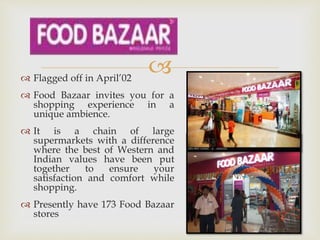
 Flagged off in April’02
 Food Bazaar invites you for a
shopping experience in a
unique ambience.
 It is a chain of large
supermarkets with a difference
where the best of Western and
Indian values have been put
together to ensure your
satisfaction and comfort while
shopping.
 Presently have 173 Food Bazaar
stores
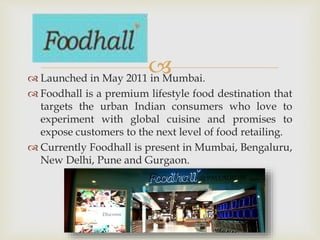
 Launched in May 2011 in Mumbai.
 Foodhall is a premium lifestyle food destination that
targets the urban Indian consumers who love to
experiment with global cuisine and promises to
expose customers to the next level of food retailing.
 Currently Foodhall is present in Mumbai, Bengaluru,
New Delhi, Pune and Gurgaon.
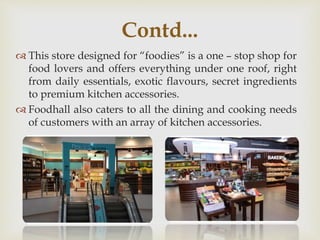
 This store designed for “foodies” is a one – stop shop for
food lovers and offers everything under one roof, right
from daily essentials, exotic flavours, secret ingredients
to premium kitchen accessories.
 Foodhall also caters to all the dining and cooking needs
of customers with an array of kitchen accessories.
Contd...
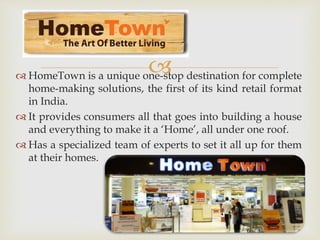
 HomeTown is a unique one-stop destination for complete
home-making solutions, the first of its kind retail format
in India.
 It provides consumers all that goes into building a house
and everything to make it a ‘Home’, all under one roof.
 Has a specialized team of experts to set it all up for them
at their homes.

Contd…
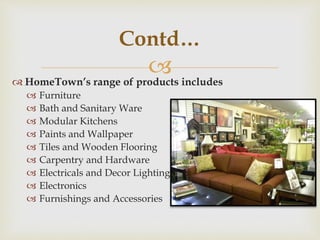
 HomeTown’s range of products includes
 Furniture
 Bath and Sanitary Ware
 Modular Kitchens
 Paints and Wallpaper
 Tiles and Wooden Flooring
 Carpentry and Hardware
 Electricals and Decor Lighting
 Electronics
 Furnishings and Accessories
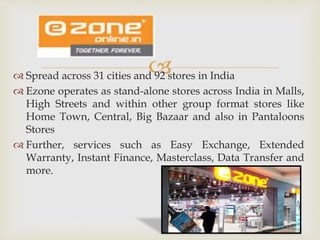
 Spread across 31 cities and 92 stores in India
 Ezone operates as stand-alone stores across India in Malls,
High Streets and within other group format stores like
Home Town, Central, Big Bazaar and also in Pantaloons
Stores
 Further, services such as Easy Exchange, Extended
Warranty, Instant Finance, Masterclass, Data Transfer and
more.
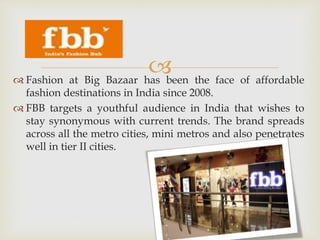
 Fashion at Big Bazaar has been the face of affordable
fashion destinations in India since 2008.
 FBB targets a youthful audience in India that wishes to
stay synonymous with current trends. The brand spreads
across all the metro cities, mini metros and also penetrates
well in tier II cities.
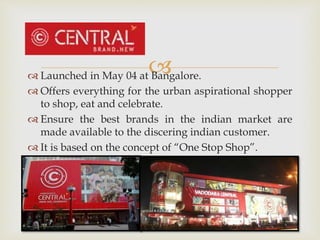
 Launched in May 04 at Bangalore.
 Offers everything for the urban aspirational shopper
to shop, eat and celebrate.
 Ensure the best brands in the indian market are
made available to the discering indian customer.
 It is based on the concept of “One Stop Shop”.

All the activities involved in selling goods or
services to those who buy for resale or business use.
 Excludes manufacturers, farmers & retailers.
 They are also called distributors.
 Pay less attention to promotion, atmosphere &
location.
 Transactions are larger than in retailing.
Wholesaling

 Merchant wholesalers
 Full-service wholesalers
 Limited-service wholesalers
 Brokers & agents
 Manufacturers’ & retailers’ branches & offices
 Specialised Wholesalers
Types of Wholesalers

 Selling and promoting
 Buying and assortment building
 Bulk breaking
 Warehousing
 Transportation
 Financing
 Risk bearing
 Market information
 Management services and counseling
Wholesalers’ functions:
Wholesale Market system
AN
Overview

Overview about the Mart
 Location-Opposite Ckali, Near Swaminarayan Chowk, Dr
Ambedkar Rd, shahibaugh, Dudhe
 Total area-Spread across 165,000 square feet of shopping area
 Total products catered - 95,000 ( Approx)
 Products and services –
1.fresh produce
2.food & grocery
3.home care products
4.apparel and accessories
5.non-food FMCG products
6.consumer durables and IT
7.automotive accessories
8.lifestyle products

 Reliance mart towards providing international shopping
experience
 Unmatched affordability for distributed customer base.
 Guaranteed quality and choice of products and services
 Location being the asset to the Mart
 catering to all classes and customer base.
 lucid transaction & efficient of payment and goods
delivery.
 loyalty and customer retention programs
USP’s of the MART

 A complete solution” to the customer – AIM
 10:00 a.m. to 10:00 p.m., seven days a week
 intensive product range and services
( catering every possible product and service
requirements)
 Exclusive distribution network
Layout
DISTRIBUTION
MANAGEMENT
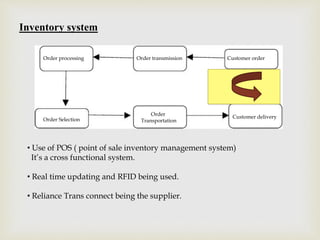
Inventory system
Order processing Customer orderOrder transmission
Order
TransportationOrder Selection
Customer delivery
• Use of POS ( point of sale inventory management system)
It’s a cross functional system.
• Real time updating and RFID being used.
• Reliance Trans connect being the supplier.
 positives
• India largest company
• Market value US$ 35 billion
• Turn over of US$ 27 billion in 2007
• World’s Largest producer of polyester
• RIL has grown exponentially to diversify
 negatives
• It has a strategy to phase out service gradually and thus customer
doesn’t have that consistent loyalty.
• No help and real time assistance in separate retail spaces by
merchandisers
• Wide range of products and services ( but less variety)
• Less customer centric approach and more emphasis on “private labels”
• less brands and less products and service coverage.
Strengths and Weakness of the
Mart

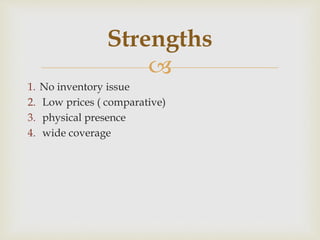
1. No inventory issue
2. Low prices ( comparative)
3. physical presence
4. wide coverage
Strengths

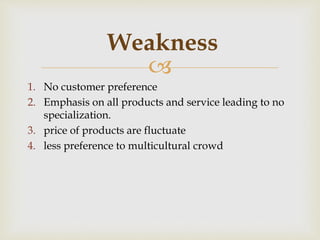
1. No customer preference
2. Emphasis on all products and service leading to no
specialization.
3. price of products are fluctuate
4. less preference to multicultural crowd
Weakness

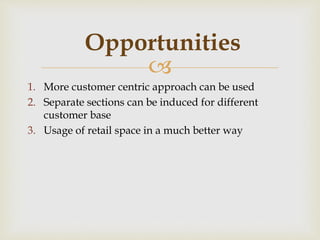
1. More customer centric approach can be used
2. Separate sections can be induced for different
customer base
3. Usage of retail space in a much better way
Opportunities

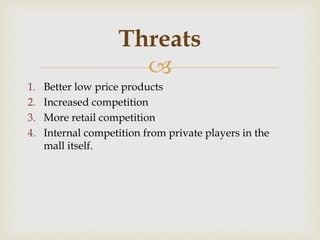
1. Better low price products
2. Increased competition
3. More retail competition
4. Internal competition from private players in the
mall itself.
Threats

 Involves planning, implementing & controlling the
physical flows of materials & final goods from points
of origin to points of use
 Management of the supplies and transport required
for an operation
 Physical Distribution starts at the factory. Managers
choose a set of warehouses (stocking points) and
transportation carriers that will deliver the goods to
final destinations in the desired time or at the lowest
total cost.
Market Logistics

 ILS include material management, material flow
systems, and physical distribution, aided by
Information Technology (IT).
 Third Party suppliers, such as FedEx Logistics
Services or Ryder Integrated Logistics, often
participate in designing or managing these systems.
Integrated Logistics Systems
 Many companies state their market-logistic objectives as
“getting the right goods to the right places at the right time for
the least cost”
 No system can simultaneously maximize customer service and
minimise distribution cost.
 Each possible market-logistics system will lead to the
following cost:
M= T + FW + VW + S
where M= total market-logistics cost of proposed system
T= total freight cost of proposed system
FW= total fixed warehouse cost of proposed system
VW= total valuable warehouse cost of proposed system
S= total cost of lost sales
Market-Logistics Objectives
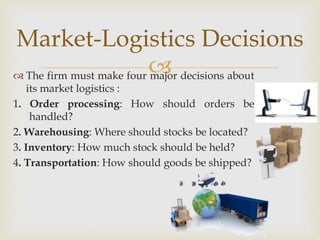
 The firm must make four major decisions about
its market logistics :
1. Order processing: How should orders be
handled?
2. Warehousing: Where should stocks be located?
3. Inventory: How much stock should be held?
4. Transportation: How should goods be shipped?
Market-Logistics Decisions

 Reference
 •Philip Kotler, and Kevin Keller. Marketing
Management. 13th ed. Prentice Hall, 2008
Reference

Managing retailing, wholesaling and logistics

  • 2.
     Successful “go-to-market” strategiesrequire integrating retailers, wholesalers, and logistical organizations. Introduction
  • 3.
     (a) Consumer MarketingChannels (b) Industrial Marketing Channels Marketing channels
  • 4.
     Retailing includes allthe activities involved in selling goods or services directly to final customers for their personal, nonbusiness use. A retailer is any business enterprise whose sales volume comes primarily from retailing. Retailing
  • 5.
    Store Retailing: 8categories Specialty Store Types of Retailing Department Store Supermarket Convenience Store
  • 6.
     Contd… Discount Store Off-PriceRetailer Superstore Catalog Showroom
  • 7.
     1. Self-service 2. Self-selection 3.Limited service 4. Full service Level of service 1 2 3 4
  • 8.
     Four major categories 1.Direct Selling:  One-to-one selling  One-to-many  Multilevel 2. Direct Marketing 3. Automatic Vending 4. Buying Service Non-store Retailing
  • 9.
     Corporate Chain Stores VoluntaryChain Retailer Cooperative Consumer Cooperative Franchise Organization Merchandising Conglomerate Corporate Retailing
  • 10.
     A franchising systemis a system of individual franchisees, a tightly knit group of enterprises whose systematic operations are planned, directed, and controlled by the operation’s franchisor. What is a Franchising System?
  • 11.
     The franchisorowns a trade or service mark and licenses it to franchisees in return for royalty payments.  The franchisee pays for the right to be part of the system.  The franchisor provides its franchisees with a system for doing business. Characteristics of Franchises
  • 12.
      Target-market decision Product Assortment-&-procurement decision  Services-&- store- atmosphere decision  Price Decision  Promotion Decision  Place Decision Marketing Decisions
  • 13.
     1. New retailforms and combinations 2. Growth of intertype competition 3. Growth of giant retailers 4. Growing investment in technology 5. Global presence of major retailers 6. Selling an experience, not just goods 7. Competition between store-based and non-store- based retailing Trends in Retailing
  • 15.
      Founder- KishoreBiyani (MD & CEO)  Headquarters- Mumbai  Products- Integrated foods and other FMCGs  Services- Supermarkets, hypermarkets, discount stores, insurance, logistics, media  Incorporated in 1987 (as Manz wear Pvt. Ltd)
  • 16.
    Businesses RETAIL Pantaloons Big Bazzar Food Bazaar Central HomeTown E-zone futureBazzar.com Fbb FUTURE GENERALI LIFE INSURANCE GENERAL INSURANCE SERVICES Future Supply Chains Future Learning Future Media Future Brands T24 Future Ideas Business Technology Services PARTNERSHIP Collaboration Joint Brand Building Assistance
  • 17.
      As India’sleading retailer, Future Retail inspires trust through innovative offerings, quality products and affordable prices that help customers achieve a better quality of life every day. They serve customers in 95 cities across the country through over 10 million square feet of retail space.  Their strategy is based on a deep understanding of Indian consumers the products they want, and making these products available in every city in every store format.
  • 19.
      Pantaloon Retail(India) Limited, is India’s leading retailer that operates multiple retail formats in both the value and lifestyle segment of the Indian consumer market.  Headquartered in Mumbai  The company operates over 12 million square feet of retail space, has over 1000 stores across 73 cities in India and employs over 30,000 people.
  • 20.
  • 21.
      Big Bazzarwas introduced in 2001 with its first store in Kolkata.  Hypermarket chain in India  Outlet- 140 outlets  Tagline- Is se sasta aur accha kahin nahi  Big Bazaar is not just another hypermarket; it caters to every need of a family. Where Big Bazaar scores over other stores is its value for money proposition for Indian customers.
  • 22.
     Flagged offin April’02  Food Bazaar invites you for a shopping experience in a unique ambience.  It is a chain of large supermarkets with a difference where the best of Western and Indian values have been put together to ensure your satisfaction and comfort while shopping.  Presently have 173 Food Bazaar stores
  • 23.
     Launched inMay 2011 in Mumbai.  Foodhall is a premium lifestyle food destination that targets the urban Indian consumers who love to experiment with global cuisine and promises to expose customers to the next level of food retailing.  Currently Foodhall is present in Mumbai, Bengaluru, New Delhi, Pune and Gurgaon.
  • 24.
     This storedesigned for “foodies” is a one – stop shop for food lovers and offers everything under one roof, right from daily essentials, exotic flavours, secret ingredients to premium kitchen accessories.  Foodhall also caters to all the dining and cooking needs of customers with an array of kitchen accessories. Contd...
  • 25.
     HomeTown isa unique one-stop destination for complete home-making solutions, the first of its kind retail format in India.  It provides consumers all that goes into building a house and everything to make it a ‘Home’, all under one roof.  Has a specialized team of experts to set it all up for them at their homes.
  • 26.
     Contd…  HomeTown’s rangeof products includes  Furniture  Bath and Sanitary Ware  Modular Kitchens  Paints and Wallpaper  Tiles and Wooden Flooring  Carpentry and Hardware  Electricals and Decor Lighting  Electronics  Furnishings and Accessories
  • 27.
     Spread across31 cities and 92 stores in India  Ezone operates as stand-alone stores across India in Malls, High Streets and within other group format stores like Home Town, Central, Big Bazaar and also in Pantaloons Stores  Further, services such as Easy Exchange, Extended Warranty, Instant Finance, Masterclass, Data Transfer and more.
  • 28.
     Fashion atBig Bazaar has been the face of affordable fashion destinations in India since 2008.  FBB targets a youthful audience in India that wishes to stay synonymous with current trends. The brand spreads across all the metro cities, mini metros and also penetrates well in tier II cities.
  • 29.
     Launched inMay 04 at Bangalore.  Offers everything for the urban aspirational shopper to shop, eat and celebrate.  Ensure the best brands in the indian market are made available to the discering indian customer.  It is based on the concept of “One Stop Shop”.
  • 30.
     All the activitiesinvolved in selling goods or services to those who buy for resale or business use.  Excludes manufacturers, farmers & retailers.  They are also called distributors.  Pay less attention to promotion, atmosphere & location.  Transactions are larger than in retailing. Wholesaling
  • 31.
      Merchant wholesalers Full-service wholesalers  Limited-service wholesalers  Brokers & agents  Manufacturers’ & retailers’ branches & offices  Specialised Wholesalers Types of Wholesalers
  • 32.
      Selling andpromoting  Buying and assortment building  Bulk breaking  Warehousing  Transportation  Financing  Risk bearing  Market information  Management services and counseling Wholesalers’ functions:
  • 33.
  • 34.
     Overview about theMart  Location-Opposite Ckali, Near Swaminarayan Chowk, Dr Ambedkar Rd, shahibaugh, Dudhe  Total area-Spread across 165,000 square feet of shopping area  Total products catered - 95,000 ( Approx)  Products and services – 1.fresh produce 2.food & grocery 3.home care products 4.apparel and accessories 5.non-food FMCG products 6.consumer durables and IT 7.automotive accessories 8.lifestyle products
  • 35.
      Reliance marttowards providing international shopping experience  Unmatched affordability for distributed customer base.  Guaranteed quality and choice of products and services  Location being the asset to the Mart  catering to all classes and customer base.  lucid transaction & efficient of payment and goods delivery.  loyalty and customer retention programs USP’s of the MART
  • 36.
      A completesolution” to the customer – AIM  10:00 a.m. to 10:00 p.m., seven days a week  intensive product range and services ( catering every possible product and service requirements)  Exclusive distribution network Layout
  • 37.
  • 38.
    Inventory system Order processingCustomer orderOrder transmission Order TransportationOrder Selection Customer delivery • Use of POS ( point of sale inventory management system) It’s a cross functional system. • Real time updating and RFID being used. • Reliance Trans connect being the supplier.
  • 39.
     positives • Indialargest company • Market value US$ 35 billion • Turn over of US$ 27 billion in 2007 • World’s Largest producer of polyester • RIL has grown exponentially to diversify  negatives • It has a strategy to phase out service gradually and thus customer doesn’t have that consistent loyalty. • No help and real time assistance in separate retail spaces by merchandisers • Wide range of products and services ( but less variety) • Less customer centric approach and more emphasis on “private labels” • less brands and less products and service coverage. Strengths and Weakness of the Mart
  • 40.
     1. No inventoryissue 2. Low prices ( comparative) 3. physical presence 4. wide coverage Strengths
  • 41.
     1. No customerpreference 2. Emphasis on all products and service leading to no specialization. 3. price of products are fluctuate 4. less preference to multicultural crowd Weakness
  • 42.
     1. More customercentric approach can be used 2. Separate sections can be induced for different customer base 3. Usage of retail space in a much better way Opportunities
  • 43.
     1. Better lowprice products 2. Increased competition 3. More retail competition 4. Internal competition from private players in the mall itself. Threats
  • 44.
      Involves planning,implementing & controlling the physical flows of materials & final goods from points of origin to points of use  Management of the supplies and transport required for an operation  Physical Distribution starts at the factory. Managers choose a set of warehouses (stocking points) and transportation carriers that will deliver the goods to final destinations in the desired time or at the lowest total cost. Market Logistics
  • 45.
      ILS includematerial management, material flow systems, and physical distribution, aided by Information Technology (IT).  Third Party suppliers, such as FedEx Logistics Services or Ryder Integrated Logistics, often participate in designing or managing these systems. Integrated Logistics Systems
  • 46.
     Many companiesstate their market-logistic objectives as “getting the right goods to the right places at the right time for the least cost”  No system can simultaneously maximize customer service and minimise distribution cost.  Each possible market-logistics system will lead to the following cost: M= T + FW + VW + S where M= total market-logistics cost of proposed system T= total freight cost of proposed system FW= total fixed warehouse cost of proposed system VW= total valuable warehouse cost of proposed system S= total cost of lost sales Market-Logistics Objectives
  • 47.
     The firmmust make four major decisions about its market logistics : 1. Order processing: How should orders be handled? 2. Warehousing: Where should stocks be located? 3. Inventory: How much stock should be held? 4. Transportation: How should goods be shipped? Market-Logistics Decisions
  • 48.
      Reference  •PhilipKotler, and Kevin Keller. Marketing Management. 13th ed. Prentice Hall, 2008 Reference