



By Mohit Rajput (12216014)
• Market structure (also known as market form)
describes the state of a market with respect to
competition.
• Market Structure is identified as how the market is
madeup of the certain factors lke the number of firm
operating, the nature of the product being produced,
the level of profit, the degree of monopoly that each
firm enjoys, the firm behaviour, the pricing stratergy
the level of output and the efficiency of the market
and the market and the entry and exit into the
market.
• All these factors are collectively called as the market
structure.
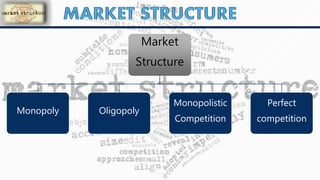
Market
Structure
Monopoly Oligopoly
Monopolistic
Competition
Perfect
competition
Perfect Competition: A perfect competition market is
characterized by the presence of an infinite number of
buyers of homogeneous products and an equally infinite
number of sellers. The price of such a product is decided
by the automatic demand-supply mechanism. The price
of the product would be fixed at such a price at which
the buyer can willingly afford to purchase the product
and the seller is willing to supply the product. Therefore,
the point of intersection of the demand and supply
curves that denotes the point of equilibrium between the
two is taken as the price of the product.
• Free entry and exit to industry
• Homogenous product – identical so no consumer
preference
• Large number of buyers and sellers – no individual seller
can influence price
• Sellers are price takers – have to accept the market price
• Perfect information available to buyers and sellers
• Examples of perfect competition:
–Financial markets – stock exchange, currency
markets, bond markets?
–Agriculture?
• Advantages of Perfect Competition:
• High degree of competition helps allocate resources to most
efficient use
• Price = marginal costs
• Normal profit made in the long run
• Firms operate at maximum efficiency
• Consumers benefit
Monopoly:
This structure is characterized by the presence of a single seller
or manufacturing enterprise for a single product that lacks any
close substitute, thereby ruling out any sort of competition. The
number of buyers is large and due to the fact that a single seller
holds monopoly of production and supply of a particular product
which has no close substitute, the price of such a product is
determined by the seller and the buyers have no other option
but to agree to pay such a price if they wish to procure that
product. Chief among all characteristics of monopoly is the
absence of an alternative product or supplier for the buyer.
• Monopoly:
– High barriers to entry
– Firm controls price OR output/supply
– Abnormal profits in long run
– Possibility of price discrimination
– Consumer choice limited
– Prices in excess of MC
Advantages and disadvantages of monopoly:
Advantages:
May be appropriate if natural monopoly
Encourages R&D
Encourages innovation
Development of some products not likely without some guarantee of monopoly
in production
Economies of scale can be gained – consumer may benefit
• Monopoly:
• Pure monopoly – industry is the firm!
• Actual monopoly – where firm has >25% market
share
• Natural Monopoly – high fixed costs – gas, electricity,
water, telecommunications, rail
• Disadvantages:
– Exploitation of consumer – higher prices
– Potential for supply to be limited - less
choice
– Potential for inefficiency –
X-inefficiency – complacency over
controls on costs
Monopoly Examples
Present day monopoly market examples include SAQ (Société
des alcools du Québec) and LIPA (Long Island Power Authority).
Monopolistic Competition:
This is a form of imperfect competition where there are
many sellers and many buyers but the product in question
is neither homogeneous nor heterogeneous - each seller
differentiates the same product a bit, say, add or remove a
feature, so as to influence the price.
• Imperfect or Monopolistic Competition
– Many buyers and sellers
– Products differentiated
– Relatively free entry and exit
– Each firm may have a tiny ‘monopoly’ because of the
differentiation of their product
– Firm has some control over price
– Examples – restaurants, professions – solicitors, etc., building
firms – plasterers, plumbers, etc.
Monopolistic Competition Example
Customized products
Say, for instance, there are 5 firms selling bathing soap.
Firm1 sells a moisturizing soap for dry skin,
Firm2 sells astringent soap for oily skin,
Firm3 sells antiseptic soap,
Firm4 sells anti-pimple soap and
Firm5 sells exfoliating soap.
Each of these firms uses the same basic material that is used for
soap in their products but each adds a different feature to it in order
to suit the needs of different customers. This way, although the price
of each firm's offering differs from the others, each firm manages to
have its own share of customers in the market.
Oligopoly:
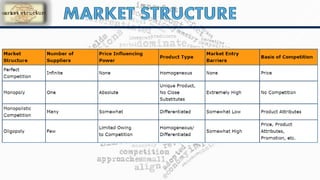
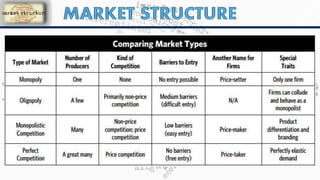
An oligopoly market is characterized by the presence of a few
suppliers or sellers to fulfil the demands of a large number of
buyers.
In this market setup, we can see various competitive tactics by
these few suppliers to attract maximum customers towards
their product.
Such tactics may include manipulating the marketing mix in
such a way as to outstrip the marketing efforts and revenue
earnings of the other competitors.
Price wars and promotional battles are common in an
oligopolistic market structure.
• Oligopoly – Competition amongst the few
– Industry dominated by small number of large firms
– Many firms may make up the industry
– High barriers to entry
– Products could be highly differentiated – branding or homogenous
– Non–price competition
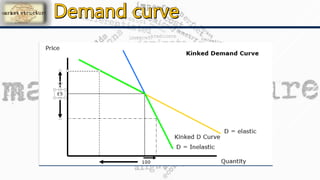
– Price stability within the market - kinked demand curve?
– Potential for collusion?
– Abnormal profits
– High degree of interdependence between firms
• Examples of oligopolistic structures:
– Supermarkets
– Banking industry
– Chemicals
– Oil
– Medicinal drugs
– Broadcasting
• Measuring Oligopoly:
• Concentration ratio – the proportion of market share
accounted for by top X number of firms:
– E.g. 5 firm concentration ratio of 80% - means top 5 five firms
account for 80% of market share
– 3 firm CR of 72% - top 3 firms account for 72% of market
share
Oligopoly Example
Price wars and promotional battles are common in an
oligopolistic market structure.
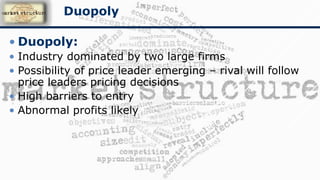
• Duopoly:
• Industry dominated by two large firms
• Possibility of price leader emerging – rival will follow
price leaders pricing decisions
• High barriers to entry
• Abnormal profits likely
Duopoly
Presentation - Market structure (incomplete)

Presentation - Market structure (incomplete)

  • 1.
    By Mohit Rajput(12216014)
  • 2.
    • Market structure(also known as market form) describes the state of a market with respect to competition. • Market Structure is identified as how the market is madeup of the certain factors lke the number of firm operating, the nature of the product being produced, the level of profit, the degree of monopoly that each firm enjoys, the firm behaviour, the pricing stratergy the level of output and the efficiency of the market and the market and the entry and exit into the market.
  • 3.
    • All thesefactors are collectively called as the market structure.
  • 4.
  • 5.
    Perfect Competition: Aperfect competition market is characterized by the presence of an infinite number of buyers of homogeneous products and an equally infinite number of sellers. The price of such a product is decided by the automatic demand-supply mechanism. The price of the product would be fixed at such a price at which the buyer can willingly afford to purchase the product and the seller is willing to supply the product. Therefore, the point of intersection of the demand and supply curves that denotes the point of equilibrium between the two is taken as the price of the product.
  • 6.
    • Free entryand exit to industry • Homogenous product – identical so no consumer preference • Large number of buyers and sellers – no individual seller can influence price • Sellers are price takers – have to accept the market price • Perfect information available to buyers and sellers
  • 7.
    • Examples ofperfect competition: –Financial markets – stock exchange, currency markets, bond markets? –Agriculture?
  • 8.
    • Advantages ofPerfect Competition: • High degree of competition helps allocate resources to most efficient use • Price = marginal costs • Normal profit made in the long run • Firms operate at maximum efficiency • Consumers benefit
  • 9.
    Monopoly: This structure ischaracterized by the presence of a single seller or manufacturing enterprise for a single product that lacks any close substitute, thereby ruling out any sort of competition. The number of buyers is large and due to the fact that a single seller holds monopoly of production and supply of a particular product which has no close substitute, the price of such a product is determined by the seller and the buyers have no other option but to agree to pay such a price if they wish to procure that product. Chief among all characteristics of monopoly is the absence of an alternative product or supplier for the buyer.
  • 10.
    • Monopoly: – Highbarriers to entry – Firm controls price OR output/supply – Abnormal profits in long run – Possibility of price discrimination – Consumer choice limited – Prices in excess of MC
  • 11.
    Advantages and disadvantagesof monopoly: Advantages: May be appropriate if natural monopoly Encourages R&D Encourages innovation Development of some products not likely without some guarantee of monopoly in production Economies of scale can be gained – consumer may benefit
  • 12.
    • Monopoly: • Puremonopoly – industry is the firm! • Actual monopoly – where firm has >25% market share • Natural Monopoly – high fixed costs – gas, electricity, water, telecommunications, rail
  • 13.
    • Disadvantages: – Exploitationof consumer – higher prices – Potential for supply to be limited - less choice – Potential for inefficiency – X-inefficiency – complacency over controls on costs
  • 14.
    Monopoly Examples Present daymonopoly market examples include SAQ (Société des alcools du Québec) and LIPA (Long Island Power Authority).
  • 15.
    Monopolistic Competition: This isa form of imperfect competition where there are many sellers and many buyers but the product in question is neither homogeneous nor heterogeneous - each seller differentiates the same product a bit, say, add or remove a feature, so as to influence the price.
  • 16.
    • Imperfect orMonopolistic Competition – Many buyers and sellers – Products differentiated – Relatively free entry and exit – Each firm may have a tiny ‘monopoly’ because of the differentiation of their product – Firm has some control over price – Examples – restaurants, professions – solicitors, etc., building firms – plasterers, plumbers, etc.
  • 17.
    Monopolistic Competition Example Customizedproducts Say, for instance, there are 5 firms selling bathing soap. Firm1 sells a moisturizing soap for dry skin, Firm2 sells astringent soap for oily skin, Firm3 sells antiseptic soap, Firm4 sells anti-pimple soap and Firm5 sells exfoliating soap. Each of these firms uses the same basic material that is used for soap in their products but each adds a different feature to it in order to suit the needs of different customers. This way, although the price of each firm's offering differs from the others, each firm manages to have its own share of customers in the market.
  • 18.
    Oligopoly: An oligopoly marketis characterized by the presence of a few suppliers or sellers to fulfil the demands of a large number of buyers. In this market setup, we can see various competitive tactics by these few suppliers to attract maximum customers towards their product. Such tactics may include manipulating the marketing mix in such a way as to outstrip the marketing efforts and revenue earnings of the other competitors. Price wars and promotional battles are common in an oligopolistic market structure.
  • 19.
    • Oligopoly –Competition amongst the few – Industry dominated by small number of large firms – Many firms may make up the industry – High barriers to entry – Products could be highly differentiated – branding or homogenous – Non–price competition – Price stability within the market - kinked demand curve? – Potential for collusion? – Abnormal profits – High degree of interdependence between firms
  • 20.
    • Examples ofoligopolistic structures: – Supermarkets – Banking industry – Chemicals – Oil – Medicinal drugs – Broadcasting
  • 21.
    • Measuring Oligopoly: •Concentration ratio – the proportion of market share accounted for by top X number of firms: – E.g. 5 firm concentration ratio of 80% - means top 5 five firms account for 80% of market share – 3 firm CR of 72% - top 3 firms account for 72% of market share
  • 22.
    Oligopoly Example Price warsand promotional battles are common in an oligopolistic market structure.
  • 23.
    • Duopoly: • Industrydominated by two large firms • Possibility of price leader emerging – rival will follow price leaders pricing decisions • High barriers to entry • Abnormal profits likely Duopoly