SCARCITY
             
 is the basic and central economic
 problem confronting every society.
 It is the heart of the study of
 economics and the reason behind
 its establishment.
Scarcity defined in various ways:
 a commodity or service being in short
 supply, relative to its demand.
 in quantitative terms, it is said to exist
 when at a zero price there is a unit of
 demand.
 it pertains to the limited availability of
 economic resources relative to society’s
 unlimited demand for good and services
 (Kapur 1997).
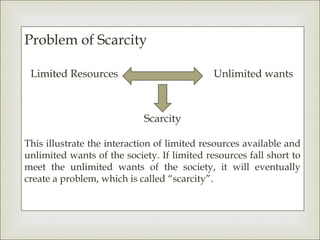
Problem of Scarcity

 Limited Resources                           Unlimited wants


                            Scarcity

This illustrate the interaction of limited resources available and
unlimited wants of the society. If limited resources fall short to
meet the unlimited wants of the society, it will eventually
create a problem, which is called “scarcity”.
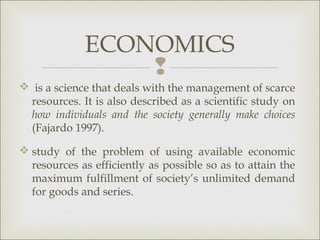
ECONOMICS
                 
 is a science that deals with the management of scarce
 resources. It is also described as a scientific study on
 how individuals and the society generally make choices
 (Fajardo 1997).

 study of the problem of using available economic
  resources as efficiently as possible so as to attain the
  maximum fulfillment of society’s unlimited demand
  for goods and series.
 is simply scarcity and choice (Slavin
 2005).

 assist individuals and societies in
 making proper choices –-- that is, the
 allocation and utilization of economic
 resources, with the end in view of
 satisfying human wants for goods and
 services.
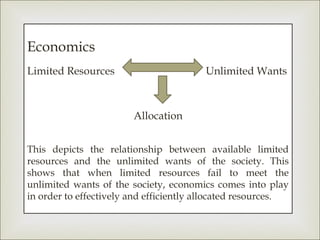
Economics
Limited Resources                       Unlimited Wants


                        Allocation


This depicts the relationship between available limited
resources and the unlimited wants of the society. This
shows that when limited resources fail to meet the
unlimited wants of the society, economics comes into play
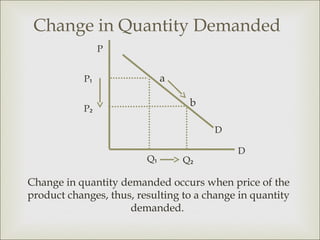
in order to effectively and efficiently allocated resources.
Relationship between
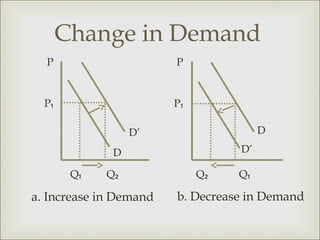
    Economics and Scarcity
                    
      The problem of scarcity gave birth to
the    study     of   economics.     Their
relationship is such that if there is no
scarcity, there is no need for economics.
The study of economics was essentially
founded in order to address the issue of
resource allocation and distribution, in
response to scarcity.
Origin of the term “economics”
     Two Greek roots of the word economics are oikos-
meaning household and nomus- meaning system of
management.    Oikonomia    or   oikonomus     means
“management of household.”

       With the growth of the Greek society until its
development into city-states, the word became known as
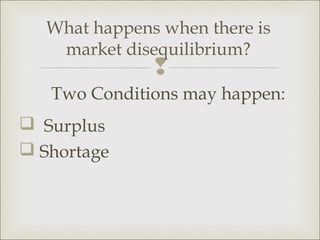
“state management.”

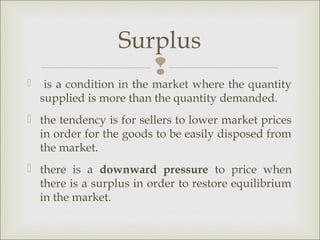
     The term, “management of household” pertains to
the microeconomic branch of economics while “state
management” refers to the macroeconomic branch of
economics.
Ceteris Paribus Assumption
                 
- means “all other things held
constant or all else equal.” This
assumption is used as a device to
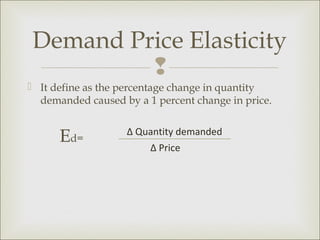
analyze the relationship between
two variables while the other factors
are held unchanged.
Brief History: The Classical,
Keynesian and Modern Economics
                 
      Brief historical introduction
 aims to give a background on
 most profound names in the
 study of economics and their
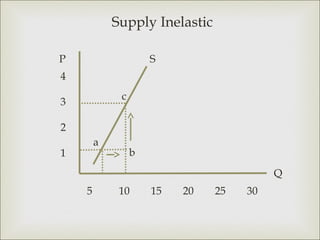
 important contributions in this
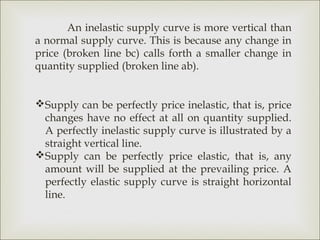
 field of study.
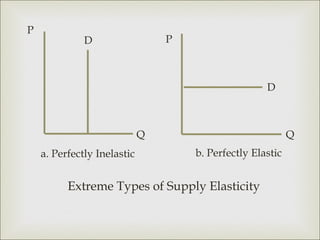
Birth of Economic Theory:
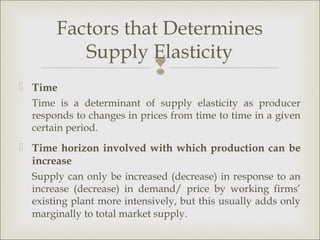
        Classical Economics
                        birth during the mid 1700s
 Economic theory saw its
  and 1800s.
 Adam Smith- regarded as “Father of Economics.”
  His book, “Wealth of the Nations”, became known
  as “the bible in economics” for a hundred years.
 His major contributions was his analysis of the
 relationship between consumers and producers
 through demand and supply, which ultimately
 explained how the market works through the
 invisible hand.
John Stuart Mill was the heir to David Ricardo,
 who developed the basic analysis of the political
 economy or the importance of a state’s role in
 its national economy.
 Political economy- applies management to an
 entire polis (state).
Karl Marx- a German, is much influenced by
 the conditions brought about by the industrial
 revolution upon the working classes.
His major work, Das Kapital, is the centerpiece
 from which major socialist thought was to
 emerge.
Neoclassical Economics (1870s)

                              around the year 1870.
     Believed to have transpired
 Its main concern was market system efficiencies.

 Leon Walras- introduced the general economic
  system. Also developed the analysis of equilibrium
  in several markets.
 Alfred Marshall- most influential economist because
  of his book Principles in Economics. He developed the
  analysis of equilibrium of a particular market and the
  concept of “marginalism”.
Keynes’ General Theory of
    Employment, Interest and Money
                          
     John Maynard Keynes- an English economist,
    offered an explanation of mass unemployment and
    suggestions for government policy to cure
    unemployment in his influential book: The General
    Theory of Employment, Interest and Money.
 He argued that there is no assurance that savings
  would accumulate during a depression and depress
  interest rates, since savings depend on income and
  with high unemployment incomes are low.
Non-Walrasian Economics (1939)

                             for his analysis of the IS-LM
    John Hicks- was recognized
    model, an important macroeconomic model.
 IS- refers to the goods market for a given interest rate.

 LM- means money market for a given value of aggregate
  output or income.
 IS-LM model is a theoretical construct that integrates the
  real, IS (investment saving), and the monetary, LM
  (demand for, and supply for money), sides of the
  economy simultaneously to present a determinate general
  equilibrium position for the economy as a whole.
Post-Keynesian Economics
             (1940 and 1950s)
                          
   saw the development of the rules and regulations of
    different private and public institutions.
 Introduced major post-Keynesian, neoclassical
  economists, whose views known as the post-
  Keynesian “mainstream economics”.
 This period welcomed various economists like Paul
  A. Samuelson, Kenneth J. Arrow, James Tobin and
  many more.
New Classical Economics
                        
     highlighted the importance of adherence to
    national expectations hypothesis and analysis,
    includes various economic phenomena in
    formulating different kinds of studies and new
    theories in economics.
     it is applicable to concerns of developing
    countries, and was largely an outcome of
    concern for the growth of developed countries.
Positive Economics

                               considers economic conditions
     is an economic analysis that
    “as they are”, or considers economics “as it is”.

 Uses objective or scientific explanation in analyzing the
  different transactions in the economy.

   It simply answers the question ‘what it is’.

    Example of positive statements:
    The economy is now experiencing a slowdown because of
    too much politicking and corruption in the government.
Normative Economics
    economic analysis which judges economic conditions “as it
    should be’. Concerned with human welfare.
 deals with ethics, personal value judgments and obligations
  analyzing economic phenomena.
 It answers the question ‘what should be’.

    referred to as policy economics because it deals with the
    formulation of policies to regulate economic activities.

    Examples of normative statements:
    The Philippine government should initiate political
    reforms in order to regain investor confidence, and
    consequently uplift the economy.
Four Basic Economic
        Questions
            
1. What to produce?
2. How to produce?
3. How much to produce?
4. For whom to produce?
Relationship of Economics to other
              Sciences
        Economics is considered the “queen” of all social
sciences because it covers almost every activity of man in
relation to the society.

1. Business Management- business basically provides
employment opportunities to members of the society, and is an
important vehicle in the balance of economic activity.
2. History- economic ideas provides information regarding
theories that can be revisited in order to evaluate present and
future economic issues.

3. Finance- management of money, credit , banking and
investment. Money & Finance are important in economics.
4. Physics- innovations and output brought
about by physics greatly affect the study of
economics.

5. Sociology- study of the behavior of societies.
In relation to sociology, economics essentially
deals with the behavior of economic subjects.

6. Psychology- is primarily useful in the study
of microeconomics, which scrutinizes and
focuses on the smallest units of the economy.
Importance of Studying
            Economics
                             
1. To understand the Society
       -economics seeks to analyze transactions made by
the society and its members.

2. To understand Global Affairs
       -economics seeks to explain the internal operation
and trade policies of countries.

3. To be Informed Voter
       -understanding of economics develops individuals to
be a wise voters.
3 Es in Economics
1. Efficiency
                   
       -refers to productivity and proper allocation of
economic resources. Also it refers to the relationship
between scarce factor inputs and outputs of goods and
services.

2. Equity
       -means justice and fairness.

3. Effectiveness
       -means attainment of goals and objective.
Important Economic Terms
1. Wealth -refers to anything that has a functional value
(usually money), which can be traded for goods and services.
2. Consumption - refers to the direct utilization or usage of the
available goods and services by the buyer or the consumer
sector.
3. Production -defined as the formation by firms of an output
(products or services).
4. Exchange- process of trading goods and/or services for
money and/or its equivalent.
5. Distribution- process of allocating or apportioning scarce
resources to be utilized by the household, business sector and
the rest of the world.
Microeconomics
                  
 Branch of economics which deals with the individual
  decisions of units of the economy- firms, households, and
  how their choices determine relative prices of goods and
  factors of production. The market is its central concept. It
  focuses in two main players- the buyer and the seller, and
  their interaction with one another.
 Microeconomics discussed the theories of demand and
  supply, individual decision making, theories of production,
  output, and cost of firm’s profit maximization objective,
  different types of business organizations and kinds of
  market structure.
Macroeconomics
                
 It is a branch of economics that study the relationship
  among the broad economic aggregates like national
  income, national output, money supply, bank deposits,
  total volume of savings, investment, consumption,
  expenditure, general price level of commodities,
  government spending, inflation, recession, employment,
  and money supply (Kapur 1997).
 Macro implies that it seeks to understand the behavior of
  the economy as whole.
Macroeconomics focuses on the four
     specific sectors of economy:
1.The  behavior    of   the   aggregate    household
(consumption);
2.The decision making of the aggregate business
(investment);
3.The policies and projects    of   the   government
(government spending); and
4.The behavior of external/foreign economic agents,
through trading (export and import).
The Concept of
           Opportunity Cost
                           
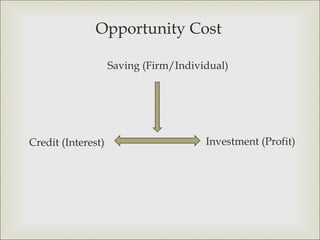
 Opportunity cost refers to the foregone value of
  the next best alternative. It is the value of what is
  given-up when one makes a choice. The thing
  thus given-up is called the opportunity cost of one
  choice.
 It is expressed in relative price.
Opportunity Cost

                    Saving (Firm/Individual)


Credit (Interest)                      Investment (Profit)
Factors of Production
1. Land- refers to all natural resources, which are given by,
   and found in nature, and are, therefore, not made by
   man. This includes the forest, mountain, rivers, oceans,
   minerals, air, and sunshine, light, etc. Compensation for
   use of land is called rent.

2. Labor- is any form of human effort exerted in the
   production of goods and services. It covers a wide range
   of skills, abilities, and characteristics.
3. Capital- is man-made goods used in the production
of other goods and services. This includes the
buildings, machinery, and other physical facilities used
in the production process.
savings- refers to the part of person’s income, which
is not spent on consumption.
Depreciation- reduction of productivity of capital.
Interest- reward for the use of capital.
4. Entrepreneurship- an economic good that
commands a price referred to as profit or loss. An
entrepreneur is a person who organizes, manages and
assumes the risks of a firm, taking a new idea or new
product and turning it into a successful business.
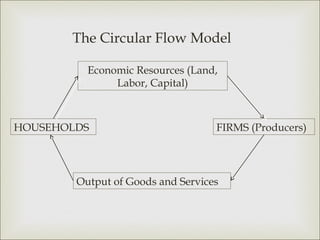
The Circular Flow Model

          Economic Resources (Land,
               Labor, Capital)


HOUSEHOLDS                         FIRMS (Producers)


        Output of Goods and Services
Basic Decision Problem
1. Consumption- determine what types of goods, or services
   they want to utilize or consume, and the corresponding
   amounts of thereof that they should purchase and utilize. It is
   the basic decision problem that the consumers must always
   deal with in their day to day activities.
2. Production- a problem generally concern of producers. They
   determine the needs, wants , and demand of consumers, and
   decide how to allocate their resources to meet these
   demands.
3. Distribution- this problem addressed to the government.
   There must be proper allocation of all the resources for the
   benefits of the whole society.
4. Growth over Time- the last basic decision that a society or
   nation must deal with. All the problems of choice,
   consumption, production, and distribution have to be seen in
   the context of how they will affect future event.
Types of Economic Systems
1. Traditional economy- it is a subsistence economy. A
family produces goods only for its own consumption. The
decisions on what, how, how much, and for whom to
produce are made by the family head, in accordance with
traditional means of production.
2. Command Economy- type of economy wherein the
manner of production is dictated by the government. It is an
economic system characterized by collective ownership of
most resources, and the existence of central planning
agency of the state. In this system, all productive enterprises
are owned by the people and administered by the state.
3. Market Economy or Capitalism- characterized by that the
resources are privately owned, and that the people themselves
make the decisions. Under this economic system, factors of
production are owned and controlled by individuals, and people
are free to produce goods and services to meet the demand of
consumers who, in turn, are also free to choose goods according to
their own likes.
4. Socialism- economic system wherein key enterprises are owned
by the state. It recognizes private ownership. In this system, state
has no control over a large portion of capital assets, and is
generally responsible for production and distribution of important
goods. The main emphasis of this system is on equitable
distribution of income and wealth. It is considered as an economy
bordering between capitalism and communism.
5. Mixed Economy- this economy is a mixture of market system
and the command system. However, it is more market-oriented
rather than command or traditional.
The Basic Analysis of Demand
             and Supply
     Demand is usually
                           
                           affected   by the behavior of
    consumers.
 Supply is usually affected by the conduct of producers.
 The consumers identifies his/her needs, wants, and
  demands.
    The producers address these by accordingly producing
    goods and services.
 The consumer gains satisfaction while the producer
  gains profit.
Market
                      
  where buyers and sellers meet.
  the place where they both trade or exchange goods or
  services and it is where their transaction takes place.
  2 Kinds of Market
 Wet market- where people usually buy vegetables,
  meat, etc.
 Dry market- where people buy shoes, clothes or other
  dry goods.
 it does not necessarily refer to a tangible area where
  buyers and sellers could be seen transacting.
Demand
                     
   pertains as to the quantity of a good or service that
    people are ready to buy at given prices within a
    given time period.
   Demand implies three things:
       desire to possess a thing;
       the ability to pay for it or means of
        purchasing it; and
       willingness in utilizing it.
Law of Demand
                
        The Law of Demand states that if price goes UP,
the quantity demanded will go Down. Conversely, if
price goes DOWN, the quantity demanded will go UP
ceteris paribus.

       The reason for this is because consumers always
tend to MAXIMIZE SATISFACTION.
Demand Schedule
            
 is a table that shows the relationship of prices
and the specific quantities demanded at each of
these prices.
 the information provided by a demand
schedule can be used to construct a demand
curve showing the price-quantity demanded
relationship in graphical form.
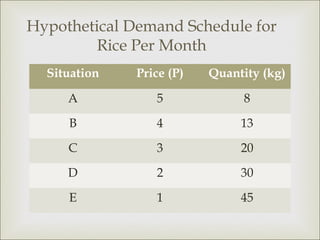
Hypothetical Demand Schedule for
         Rice Per Month
  Situation   Price (P)   Quantity (kg)

     A           5             8
     B           4             13
     C           3             20
     D           2             30
     E           1             45
Demand Curve
     it is
                         
            a graphical representation showing      the
    relationship between price and quantities demanded
    per time period.
 Most demand curves slopes downwards because:
  a. as the price of the product falls, consumers will
  tend to substitute this (now relatively cheaper)
  product for others in their purchases.
  b. as the price falls, this serves to increase their real
  income allowing them to buy more products.
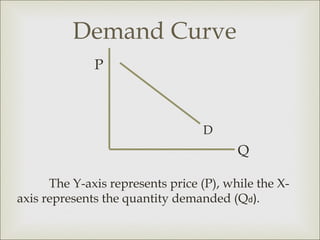
Demand Curve
              P


                                  D
                                         Q

      The Y-axis represents price (P), while the X-
axis represents the quantity demanded (Qd).
Demand Function
              
    shows the relationship between demand for a
    commodity and the factors that determine or
    influence this demand.
    these factors are --- the price of the commodity
    itself, prices of other related commodities,
    consumers’ level of incomes, taste and
    preferences, size and composition of level of
    population, distribution of income etc.
Change in Quantity Demanded vs.
      Change in Demand
                       
Change in Quantity Demanded
       - There is a change in quantity demanded if
the movement is along the same demand curve.
       A change in quantity demanded is brought
about by an increase (decrease) in the product’s
price.
       The direction of the movement however is
inverse considering the Law of Demand.
Change in Quantity Demanded
                 P


            P₁                a

                                   b
            P₂

                                        D

                                            D
                         Q₁       Q₂

Change in quantity demanded occurs when price of the
product changes, thus, resulting to a change in quantity
                     demanded.
Change in Demand
       There is a change in demand if the entire
demand curve shifts to the right side resulting to an
increase in demand. At the same price, therefore,
more amounts of goods and service are demanded by
consumer.
       Conversely demand decreases or falls if the
entire demand curve shifts downward or to the left.
At the same price, less amounts of a good or service
are demanded by the consumers.
Change in Demand
  P                     P


  P₁                    P₁

                  D’                   D

              D                   D’

        Q₁   Q₂              Q₂   Q₁

a. Increase in Demand   b. Decrease in Demand
4. Population change- an increasing population results
to an increase in the demand for some types of goods or
services, and vice versa.
5. Substitute goods- are goods that are interchanged
with another good. In a situation where the price of a
particular good increases a consumer will tend to look
for closely related commodities.
6. Expectations of future prices- if the buyers expect the
price of a good or service to rise (or fall) in the future, it
may cause the current demand to increase (or decrease).
Expectations about the future may alter demand for a
specific commodity.
Supply (Firms/Seller’s side)
                           
 Supply is the quantity of goods or services that firms
  are ready and willing to sell at a given price within a
  period of time, other factors being held constant .

 It is a product made available for sale of firms.
Law of Supply
              
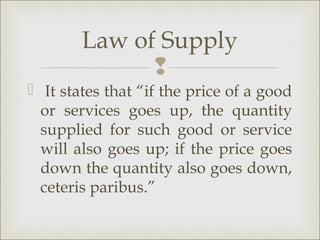
 It states that “if the price of a good
  or services goes up, the quantity
  supplied for such good or service
  will also goes up; if the price goes
  down the quantity also goes down,
  ceteris paribus.”
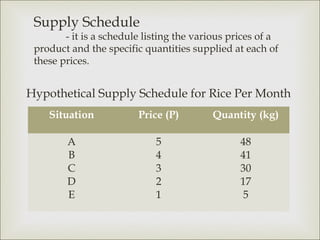
Supply Schedule
        - it is a schedule listing the various prices of a
 product and the specific quantities supplied at each of
 these prices.


Hypothetical Supply Schedule for Rice Per Month
    Situation            Price (P)        Quantity (kg)

        A                    5                   48
        B                    4                   41
        C                    3                   30
        D                    2                   17
        E                    1                    5
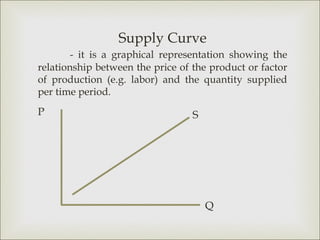
Supply Curve
        - it is a graphical representation showing the
relationship between the price of the product or factor
of production (e.g. labor) and the quantity supplied
per time period.
P                                 S


                                      Q
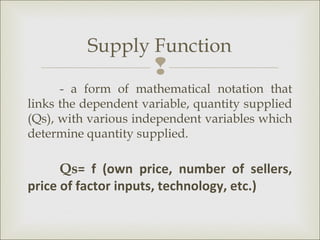
Supply Function
                      
      - a form of mathematical notation that
links the dependent variable, quantity supplied
(Qs), with various independent variables which
determine quantity supplied.

      Qs= f (own price, number of sellers,
price of factor inputs, technology, etc.)
Change in Quantity vs. Change in
              Supply
                         
Change in Quantity Supplied
       -a change in quantity supplied if the movement
is along the same supply curve. It is brought about by
an increase (decrease) in the product’s own price.
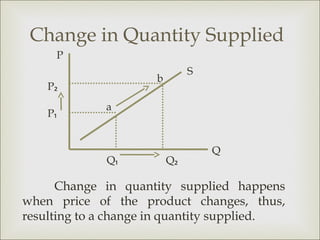
Change in Quantity Supplied
     P
                               S
                      b
    P₂
             a
    P₁


                                   Q
             Q₁           Q₂

      Change in quantity supplied happens
when price of the product changes, thus,
resulting to a change in quantity supplied.
Change in Supply
 There is a change in supply when the entire demand
  supply curve shifts rightward or leftward. At the same
  price, therefore, more amounts of a good or service are
  supplied by producers or sellers.

 Supply decreases if the entire supply curve shifts to the left.
  At the same price, fewer amounts of a good or service are
  sold by producers.

 Increase (decrease) in supply is caused by factors other
  than the price of the good itself such as change in
  technology, business goals, etc. resulting to the movement
  of the entire supply curve rightward (leftward).
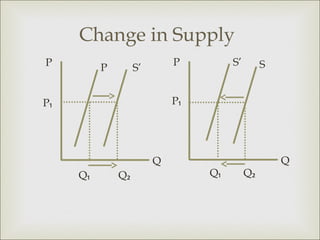
Change in Supply
P                           P         S’        S
          P        S’


P₁                          P₁


                        Q                           Q
     Q₁       Q₂                 Q₁        Q₂
Forces that cause the supply curve to change
1. Optimization in the use of factors of production
        - optimization in the utilization of resources will
increase supply, while a failure to achieve such will result to a
decrease in supply.
        Optimization- refers to the process, or methodology of
making something as fully perfect, functional, or effective as
possible.
2. Technological change- introduction of cost-reducing
innovations in production technology increase supply.
3. Future expectations- impacts sellers as much as buyers. If
sellers anticipate a rise in prices, they may choose to hold back
the current supply to take advantage of the future increase in
price, thus decreasing market supply. If sellers however expect
a decline in the price for their products, they will increase
present supply.
4. Number of sellers- has a direct impact on quantity
supplied. The more sellers there are in the market the
greater supply of goods and services are available.

5. Weather Conditions- bad weather, such as typhoons,
drought or other natural disasters, reduces supply of
agricultural commodities while good weather has an
opposite impact.

6. Government policy- removing quotas and tariffs on
imported products also affect supply. Lower trade
restrictions and lower quotas or tariffs boost imports,
thereby adding more supply of goods in the market.
Market Equilibrium
The meeting of supply and demand results to what is
referred to as ‘market equilibrium.’

                    Equilibrium
        -understood as a “state of balance.” Pertains to a
balance that exists when quantity demanded equals quantity
supplied. It is the general agreement of the buyer and the
seller at a particular price at a particular quantity.

               Equilibrium Point
      -there are always two sides of the story, the side of
the buyer and that of the seller.
Equilibrium Market Price
                     
 is the price agreed by the seller to offer
  its good or service for sale and for the
  buyer to pay for it.
     it is the price at which quantity
    demanded of a good is exactly equal to
    the quantity supplied.
What happens when there is
    market disequilibrium?
               
   Two Conditions may happen:
 Surplus
 Shortage
Surplus
                      
    is a condition in the market where the quantity
    supplied is more than the quantity demanded.
 the tendency is for sellers to lower market prices
  in order for the goods to be easily disposed from
  the market.
 there is a downward pressure to price when
  there is a surplus in order to restore equilibrium
  in the market.
Equilibrium Market Price and
  P
          Quantity
                                         S
   50
                  b           a
   40
                                  Equilibrium point
   30
   20                     c
                  d
                                  Shortage
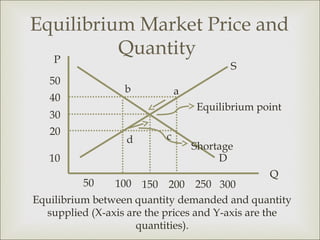
   10                                  D
                                                Q
          50    100   150 200 250 300
Equilibrium between quantity demanded and quantity
  supplied (X-axis are the prices and Y-axis are the
                     quantities).
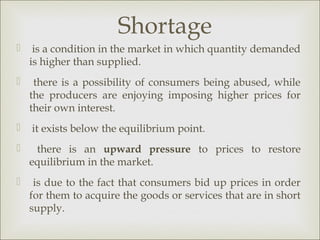
Shortage
    is a condition in the market in which quantity demanded
    is higher than supplied.
    there is a possibility of consumers being abused, while
    the producers are enjoying imposing higher prices for
    their own interest.
   it exists below the equilibrium point.
    there is an upward pressure to prices to restore
    equilibrium in the market.
    is due to the fact that consumers bid up prices in order
    for them to acquire the goods or services that are in short
    supply.
What happens if disequilibrium in
    the market persists at longer period
                 of time?

                             by imposing price
    the government may intervene
    controls.
    Price control- is the specification by the government of
    minimum and/or maximum prices for goods and
    services.
    the price may be fixed at a level below the market
    equilibrium price or above it depending on the objective
    in mind.
    price controls may be applied across a wide range of
    goods and services as part of prices and incomes policy
    aimed at combating inflation.
Price controls are classified into two
    types: floor price and price ceiling
                         
                   Floor Price
legal minimum price imposed by the government.
undertaken if a surplus in the economy persists.
is a form of assistance to producers by the
government for them to survive business.
imposed by the government on agricultural
products especially when there is bumper harvest.
Price Ceiling
legal maximum     price   imposed   by   the
government.

utilized by the government if there is a
persistent shortage of goods in the economy.

imposed by the government to protect
consumers from abusive producers or sellers
who take advantage of the situation.
The Concept of Elasticity
                        
 Elasticity means responsiveness.
 It is a ratio of the percent change in one variable
  to the percent change in another variable.
 It is a tool used by economist for measuring the
  reaction of a function to changes in parameters
  in a relative way.
Elasticity of Demand
                
    It is a measure of the degree of
    responsiveness        of    quantity
    demanded of a product to a given
    change in one of the independent
    variable which affect demand for that
    product.
Classification of demand elasticity
 according to factors that cause the
               change
1.Price Elasticity of demand is a responsiveness of
consumers’ demand to change in price of the good sold.
2.Income Elasticity of demand is the responsiveness of
consumers’ demand to change in their incomes.
3.Cross Elasticity of demand is the responsiveness of
demand for a certain good, in relation to changes in price
of other related goods.
Demand Price Elasticity
         
 It define as the percentage change in quantity
  demanded caused by a 1 percent change in price.


      Ed=          ∆ Quantity demanded
                        ∆ Price
Interpretation of the Elasticity
          Coefficient
                         
 Demand for a product is said to be inelastic if
  consumers will pay almost any price of the product,
  while demand for a product may be elastic if the
  consumers will only pay a certain price, or a narrow
  range of prices, for the product.
 Demand is inelastic if the computed elasticity
  coefficient is less than 1(Ep< 1).
 Demand is elastic if the computed elasticity
  coefficient is greater than 1(Ep> 1).
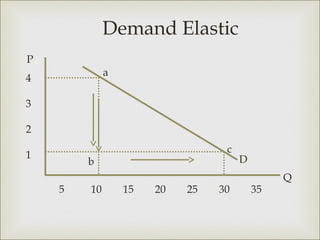
Demand Elastic
P
             a
4

3

2
                                 c
1                                    D
        b
                                              Q
    5   10       15   20   25   30       35
An elastic demand curve is flatter
than a typical demand curve. This is
because a smaller change in price (broken
line ab) calls forth a greater change in
quantity demanded, (broken line bc).
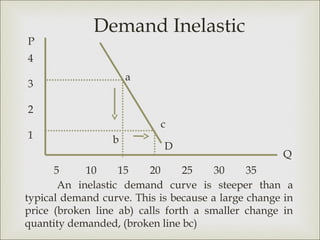
Demand Inelastic
P
4
                      a
3

2
                           c
1                 b
                            D
                                                    Q
      5     10     15    20      25    30     35
       An inelastic demand curve is steeper than a
typical demand curve. This is because a large change in
price (broken line ab) calls forth a smaller change in
quantity demanded, (broken line bc)
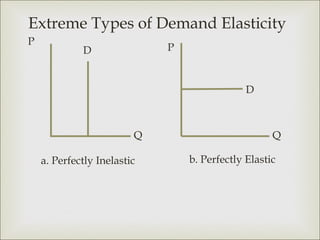
Extreme Types of Demand Elasticity
P
             D               P


                                              D


                         Q                          Q

    a. Perfectly Inelastic       b. Perfectly Elastic
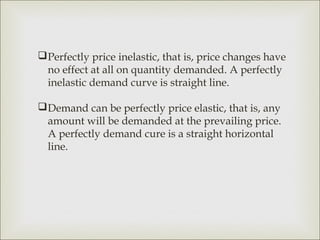
 Perfectly price inelastic, that is, price changes have
  no effect at all on quantity demanded. A perfectly
  inelastic demand curve is straight line.

 Demand can be perfectly price elastic, that is, any
  amount will be demanded at the prevailing price.
  A perfectly demand cure is a straight horizontal
  line.
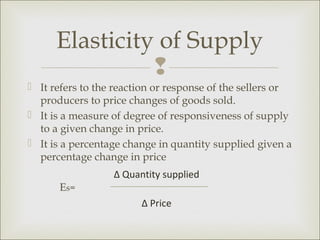
Elasticity of Supply
                
 It refers to the reaction or response of the sellers or
  producers to price changes of goods sold.
 It is a measure of degree of responsiveness of supply
  to a given change in price.
 It is a percentage change in quantity supplied given a
  percentage change in price
                  ∆ Quantity supplied
      Es=
                        ∆ Price
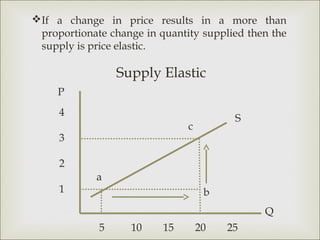
If a change in price results in a more than
 proportionate change in quantity supplied then the
 supply is price elastic.

                 Supply Elastic
     P
     4
                                         S
                               c
     3

     2
            a
     1                              b
                                              Q
             5     10     15       20   25
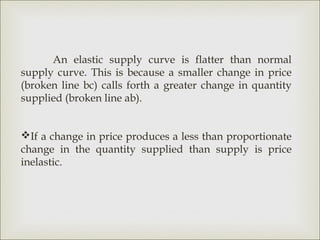
An elastic supply curve is flatter than normal
supply curve. This is because a smaller change in price
(broken line bc) calls forth a greater change in quantity
supplied (broken line ab).


If a change in price produces a less than proportionate
change in the quantity supplied than supply is price
inelastic.
Supply Inelastic

P                    S
4
             c
3

2
        a
1                b
                                         Q
    5        10      15   20   25   30
An inelastic supply curve is more vertical than
a normal supply curve. This is because any change in
price (broken line bc) calls forth a smaller change in
quantity supplied (broken line ab).


Supply can be perfectly price inelastic, that is, price
 changes have no effect at all on quantity supplied.
 A perfectly inelastic supply curve is illustrated by a
 straight vertical line.
Supply can be perfectly price elastic, that is, any
 amount will be supplied at the prevailing price. A
 perfectly elastic supply curve is straight horizontal
 line.
P
              D                  P


                                                     D


                             Q                              Q
    a. Perfectly Inelastic           b. Perfectly Elastic


          Extreme Types of Supply Elasticity
Factors that Determines
           Supply Elasticity
                             
 Time
  Time is a determinant of supply elasticity as producer
  responds to changes in prices from time to time in a given
  certain period.
 Time horizon involved with which production can be
  increase
  Supply can only be increased (decrease) in response to an
  increase (decrease) in demand/ price by working firms’
  existing plant more intensively, but this usually adds only
  marginally to total market supply.


Economics

  • 2.
    SCARCITY   is the basic and central economic problem confronting every society. It is the heart of the study of economics and the reason behind its establishment.
  • 3.
    Scarcity defined invarious ways:  a commodity or service being in short supply, relative to its demand.  in quantitative terms, it is said to exist when at a zero price there is a unit of demand.  it pertains to the limited availability of economic resources relative to society’s unlimited demand for good and services (Kapur 1997).
  • 4.
    Problem of Scarcity Limited Resources Unlimited wants Scarcity This illustrate the interaction of limited resources available and unlimited wants of the society. If limited resources fall short to meet the unlimited wants of the society, it will eventually create a problem, which is called “scarcity”.
  • 5.
    ECONOMICS   is a science that deals with the management of scarce resources. It is also described as a scientific study on how individuals and the society generally make choices (Fajardo 1997).  study of the problem of using available economic resources as efficiently as possible so as to attain the maximum fulfillment of society’s unlimited demand for goods and series.
  • 6.
     is simplyscarcity and choice (Slavin 2005).  assist individuals and societies in making proper choices –-- that is, the allocation and utilization of economic resources, with the end in view of satisfying human wants for goods and services.
  • 7.
    Economics Limited Resources Unlimited Wants Allocation This depicts the relationship between available limited resources and the unlimited wants of the society. This shows that when limited resources fail to meet the unlimited wants of the society, economics comes into play in order to effectively and efficiently allocated resources.
  • 8.
    Relationship between Economics and Scarcity  The problem of scarcity gave birth to the study of economics. Their relationship is such that if there is no scarcity, there is no need for economics. The study of economics was essentially founded in order to address the issue of resource allocation and distribution, in response to scarcity.
  • 9.
    Origin of theterm “economics” Two Greek roots of the word economics are oikos- meaning household and nomus- meaning system of management. Oikonomia or oikonomus means “management of household.” With the growth of the Greek society until its development into city-states, the word became known as “state management.” The term, “management of household” pertains to the microeconomic branch of economics while “state management” refers to the macroeconomic branch of economics.
  • 10.
    Ceteris Paribus Assumption  - means “all other things held constant or all else equal.” This assumption is used as a device to analyze the relationship between two variables while the other factors are held unchanged.
  • 11.
    Brief History: TheClassical, Keynesian and Modern Economics  Brief historical introduction aims to give a background on most profound names in the study of economics and their important contributions in this field of study.
  • 12.
    Birth of EconomicTheory: Classical Economics birth during the mid 1700s  Economic theory saw its and 1800s.  Adam Smith- regarded as “Father of Economics.” His book, “Wealth of the Nations”, became known as “the bible in economics” for a hundred years.  His major contributions was his analysis of the relationship between consumers and producers through demand and supply, which ultimately explained how the market works through the invisible hand.
  • 13.
    John Stuart Millwas the heir to David Ricardo, who developed the basic analysis of the political economy or the importance of a state’s role in its national economy.  Political economy- applies management to an entire polis (state). Karl Marx- a German, is much influenced by the conditions brought about by the industrial revolution upon the working classes. His major work, Das Kapital, is the centerpiece from which major socialist thought was to emerge.
  • 14.
    Neoclassical Economics (1870s)   around the year 1870. Believed to have transpired  Its main concern was market system efficiencies.  Leon Walras- introduced the general economic system. Also developed the analysis of equilibrium in several markets.  Alfred Marshall- most influential economist because of his book Principles in Economics. He developed the analysis of equilibrium of a particular market and the concept of “marginalism”.
  • 15.
    Keynes’ General Theoryof Employment, Interest and Money   John Maynard Keynes- an English economist, offered an explanation of mass unemployment and suggestions for government policy to cure unemployment in his influential book: The General Theory of Employment, Interest and Money.  He argued that there is no assurance that savings would accumulate during a depression and depress interest rates, since savings depend on income and with high unemployment incomes are low.
  • 16.
    Non-Walrasian Economics (1939)   for his analysis of the IS-LM John Hicks- was recognized model, an important macroeconomic model.  IS- refers to the goods market for a given interest rate.  LM- means money market for a given value of aggregate output or income.  IS-LM model is a theoretical construct that integrates the real, IS (investment saving), and the monetary, LM (demand for, and supply for money), sides of the economy simultaneously to present a determinate general equilibrium position for the economy as a whole.
  • 17.
    Post-Keynesian Economics (1940 and 1950s)   saw the development of the rules and regulations of different private and public institutions.  Introduced major post-Keynesian, neoclassical economists, whose views known as the post- Keynesian “mainstream economics”.  This period welcomed various economists like Paul A. Samuelson, Kenneth J. Arrow, James Tobin and many more.
  • 18.
    New Classical Economics   highlighted the importance of adherence to national expectations hypothesis and analysis, includes various economic phenomena in formulating different kinds of studies and new theories in economics.  it is applicable to concerns of developing countries, and was largely an outcome of concern for the growth of developed countries.
  • 20.
    Positive Economics  considers economic conditions is an economic analysis that “as they are”, or considers economics “as it is”.  Uses objective or scientific explanation in analyzing the different transactions in the economy.  It simply answers the question ‘what it is’. Example of positive statements: The economy is now experiencing a slowdown because of too much politicking and corruption in the government.
  • 21.
    Normative Economics  economic analysis which judges economic conditions “as it should be’. Concerned with human welfare.  deals with ethics, personal value judgments and obligations analyzing economic phenomena.  It answers the question ‘what should be’.  referred to as policy economics because it deals with the formulation of policies to regulate economic activities. Examples of normative statements: The Philippine government should initiate political reforms in order to regain investor confidence, and consequently uplift the economy.
  • 22.
    Four Basic Economic Questions  1. What to produce? 2. How to produce? 3. How much to produce? 4. For whom to produce?
  • 23.
    Relationship of Economicsto other Sciences Economics is considered the “queen” of all social sciences because it covers almost every activity of man in relation to the society. 1. Business Management- business basically provides employment opportunities to members of the society, and is an important vehicle in the balance of economic activity. 2. History- economic ideas provides information regarding theories that can be revisited in order to evaluate present and future economic issues. 3. Finance- management of money, credit , banking and investment. Money & Finance are important in economics.
  • 24.
    4. Physics- innovationsand output brought about by physics greatly affect the study of economics. 5. Sociology- study of the behavior of societies. In relation to sociology, economics essentially deals with the behavior of economic subjects. 6. Psychology- is primarily useful in the study of microeconomics, which scrutinizes and focuses on the smallest units of the economy.
  • 25.
    Importance of Studying Economics  1. To understand the Society -economics seeks to analyze transactions made by the society and its members. 2. To understand Global Affairs -economics seeks to explain the internal operation and trade policies of countries. 3. To be Informed Voter -understanding of economics develops individuals to be a wise voters.
  • 26.
    3 Es inEconomics 1. Efficiency  -refers to productivity and proper allocation of economic resources. Also it refers to the relationship between scarce factor inputs and outputs of goods and services. 2. Equity -means justice and fairness. 3. Effectiveness -means attainment of goals and objective.
  • 27.
    Important Economic Terms 1.Wealth -refers to anything that has a functional value (usually money), which can be traded for goods and services. 2. Consumption - refers to the direct utilization or usage of the available goods and services by the buyer or the consumer sector. 3. Production -defined as the formation by firms of an output (products or services). 4. Exchange- process of trading goods and/or services for money and/or its equivalent. 5. Distribution- process of allocating or apportioning scarce resources to be utilized by the household, business sector and the rest of the world.
  • 29.
    Microeconomics   Branch of economics which deals with the individual decisions of units of the economy- firms, households, and how their choices determine relative prices of goods and factors of production. The market is its central concept. It focuses in two main players- the buyer and the seller, and their interaction with one another.  Microeconomics discussed the theories of demand and supply, individual decision making, theories of production, output, and cost of firm’s profit maximization objective, different types of business organizations and kinds of market structure.
  • 30.
    Macroeconomics   It is a branch of economics that study the relationship among the broad economic aggregates like national income, national output, money supply, bank deposits, total volume of savings, investment, consumption, expenditure, general price level of commodities, government spending, inflation, recession, employment, and money supply (Kapur 1997).  Macro implies that it seeks to understand the behavior of the economy as whole.
  • 31.
    Macroeconomics focuses onthe four specific sectors of economy: 1.The behavior of the aggregate household (consumption); 2.The decision making of the aggregate business (investment); 3.The policies and projects of the government (government spending); and 4.The behavior of external/foreign economic agents, through trading (export and import).
  • 32.
    The Concept of Opportunity Cost   Opportunity cost refers to the foregone value of the next best alternative. It is the value of what is given-up when one makes a choice. The thing thus given-up is called the opportunity cost of one choice.  It is expressed in relative price.
  • 33.
    Opportunity Cost Saving (Firm/Individual) Credit (Interest) Investment (Profit)
  • 34.
    Factors of Production 1.Land- refers to all natural resources, which are given by, and found in nature, and are, therefore, not made by man. This includes the forest, mountain, rivers, oceans, minerals, air, and sunshine, light, etc. Compensation for use of land is called rent. 2. Labor- is any form of human effort exerted in the production of goods and services. It covers a wide range of skills, abilities, and characteristics.
  • 35.
    3. Capital- isman-made goods used in the production of other goods and services. This includes the buildings, machinery, and other physical facilities used in the production process. savings- refers to the part of person’s income, which is not spent on consumption. Depreciation- reduction of productivity of capital. Interest- reward for the use of capital. 4. Entrepreneurship- an economic good that commands a price referred to as profit or loss. An entrepreneur is a person who organizes, manages and assumes the risks of a firm, taking a new idea or new product and turning it into a successful business.
  • 36.
    The Circular FlowModel Economic Resources (Land, Labor, Capital) HOUSEHOLDS FIRMS (Producers) Output of Goods and Services
  • 37.
    Basic Decision Problem 1.Consumption- determine what types of goods, or services they want to utilize or consume, and the corresponding amounts of thereof that they should purchase and utilize. It is the basic decision problem that the consumers must always deal with in their day to day activities. 2. Production- a problem generally concern of producers. They determine the needs, wants , and demand of consumers, and decide how to allocate their resources to meet these demands. 3. Distribution- this problem addressed to the government. There must be proper allocation of all the resources for the benefits of the whole society. 4. Growth over Time- the last basic decision that a society or nation must deal with. All the problems of choice, consumption, production, and distribution have to be seen in the context of how they will affect future event.
  • 38.
    Types of EconomicSystems 1. Traditional economy- it is a subsistence economy. A family produces goods only for its own consumption. The decisions on what, how, how much, and for whom to produce are made by the family head, in accordance with traditional means of production. 2. Command Economy- type of economy wherein the manner of production is dictated by the government. It is an economic system characterized by collective ownership of most resources, and the existence of central planning agency of the state. In this system, all productive enterprises are owned by the people and administered by the state.
  • 39.
    3. Market Economyor Capitalism- characterized by that the resources are privately owned, and that the people themselves make the decisions. Under this economic system, factors of production are owned and controlled by individuals, and people are free to produce goods and services to meet the demand of consumers who, in turn, are also free to choose goods according to their own likes. 4. Socialism- economic system wherein key enterprises are owned by the state. It recognizes private ownership. In this system, state has no control over a large portion of capital assets, and is generally responsible for production and distribution of important goods. The main emphasis of this system is on equitable distribution of income and wealth. It is considered as an economy bordering between capitalism and communism. 5. Mixed Economy- this economy is a mixture of market system and the command system. However, it is more market-oriented rather than command or traditional.
  • 40.
    The Basic Analysisof Demand and Supply  Demand is usually  affected by the behavior of consumers.  Supply is usually affected by the conduct of producers.  The consumers identifies his/her needs, wants, and demands.  The producers address these by accordingly producing goods and services.  The consumer gains satisfaction while the producer gains profit.
  • 41.
    Market   where buyers and sellers meet.  the place where they both trade or exchange goods or services and it is where their transaction takes place. 2 Kinds of Market  Wet market- where people usually buy vegetables, meat, etc.  Dry market- where people buy shoes, clothes or other dry goods.  it does not necessarily refer to a tangible area where buyers and sellers could be seen transacting.
  • 42.
    Demand   pertains as to the quantity of a good or service that people are ready to buy at given prices within a given time period.  Demand implies three things:  desire to possess a thing;  the ability to pay for it or means of purchasing it; and  willingness in utilizing it.
  • 43.
    Law of Demand  The Law of Demand states that if price goes UP, the quantity demanded will go Down. Conversely, if price goes DOWN, the quantity demanded will go UP ceteris paribus. The reason for this is because consumers always tend to MAXIMIZE SATISFACTION.
  • 44.
    Demand Schedule   is a table that shows the relationship of prices and the specific quantities demanded at each of these prices.  the information provided by a demand schedule can be used to construct a demand curve showing the price-quantity demanded relationship in graphical form.
  • 45.
    Hypothetical Demand Schedulefor Rice Per Month Situation Price (P) Quantity (kg) A 5 8 B 4 13 C 3 20 D 2 30 E 1 45
  • 46.
    Demand Curve  it is  a graphical representation showing the relationship between price and quantities demanded per time period.  Most demand curves slopes downwards because: a. as the price of the product falls, consumers will tend to substitute this (now relatively cheaper) product for others in their purchases. b. as the price falls, this serves to increase their real income allowing them to buy more products.
  • 47.
    Demand Curve P D Q The Y-axis represents price (P), while the X- axis represents the quantity demanded (Qd).
  • 48.
    Demand Function   shows the relationship between demand for a commodity and the factors that determine or influence this demand.  these factors are --- the price of the commodity itself, prices of other related commodities, consumers’ level of incomes, taste and preferences, size and composition of level of population, distribution of income etc.
  • 49.
    Change in QuantityDemanded vs. Change in Demand  Change in Quantity Demanded - There is a change in quantity demanded if the movement is along the same demand curve. A change in quantity demanded is brought about by an increase (decrease) in the product’s price. The direction of the movement however is inverse considering the Law of Demand.
  • 50.
    Change in QuantityDemanded P P₁ a b P₂ D D Q₁ Q₂ Change in quantity demanded occurs when price of the product changes, thus, resulting to a change in quantity demanded.
  • 51.
    Change in Demand There is a change in demand if the entire demand curve shifts to the right side resulting to an increase in demand. At the same price, therefore, more amounts of goods and service are demanded by consumer. Conversely demand decreases or falls if the entire demand curve shifts downward or to the left. At the same price, less amounts of a good or service are demanded by the consumers.
  • 52.
    Change in Demand P P P₁ P₁ D’ D D D’ Q₁ Q₂ Q₂ Q₁ a. Increase in Demand b. Decrease in Demand
  • 54.
    4. Population change-an increasing population results to an increase in the demand for some types of goods or services, and vice versa. 5. Substitute goods- are goods that are interchanged with another good. In a situation where the price of a particular good increases a consumer will tend to look for closely related commodities. 6. Expectations of future prices- if the buyers expect the price of a good or service to rise (or fall) in the future, it may cause the current demand to increase (or decrease). Expectations about the future may alter demand for a specific commodity.
  • 55.
    Supply (Firms/Seller’s side)   Supply is the quantity of goods or services that firms are ready and willing to sell at a given price within a period of time, other factors being held constant .  It is a product made available for sale of firms.
  • 56.
    Law of Supply   It states that “if the price of a good or services goes up, the quantity supplied for such good or service will also goes up; if the price goes down the quantity also goes down, ceteris paribus.”
  • 57.
    Supply Schedule - it is a schedule listing the various prices of a product and the specific quantities supplied at each of these prices. Hypothetical Supply Schedule for Rice Per Month Situation Price (P) Quantity (kg) A 5 48 B 4 41 C 3 30 D 2 17 E 1 5
  • 58.
    Supply Curve - it is a graphical representation showing the relationship between the price of the product or factor of production (e.g. labor) and the quantity supplied per time period. P S Q
  • 59.
    Supply Function  - a form of mathematical notation that links the dependent variable, quantity supplied (Qs), with various independent variables which determine quantity supplied. Qs= f (own price, number of sellers, price of factor inputs, technology, etc.)
  • 60.
    Change in Quantityvs. Change in Supply  Change in Quantity Supplied -a change in quantity supplied if the movement is along the same supply curve. It is brought about by an increase (decrease) in the product’s own price.
  • 61.
    Change in QuantitySupplied P S b P₂ a P₁ Q Q₁ Q₂ Change in quantity supplied happens when price of the product changes, thus, resulting to a change in quantity supplied.
  • 62.
    Change in Supply There is a change in supply when the entire demand supply curve shifts rightward or leftward. At the same price, therefore, more amounts of a good or service are supplied by producers or sellers.  Supply decreases if the entire supply curve shifts to the left. At the same price, fewer amounts of a good or service are sold by producers.  Increase (decrease) in supply is caused by factors other than the price of the good itself such as change in technology, business goals, etc. resulting to the movement of the entire supply curve rightward (leftward).
  • 63.
    Change in Supply P P S’ S P S’ P₁ P₁ Q Q Q₁ Q₂ Q₁ Q₂
  • 64.
    Forces that causethe supply curve to change 1. Optimization in the use of factors of production - optimization in the utilization of resources will increase supply, while a failure to achieve such will result to a decrease in supply. Optimization- refers to the process, or methodology of making something as fully perfect, functional, or effective as possible. 2. Technological change- introduction of cost-reducing innovations in production technology increase supply. 3. Future expectations- impacts sellers as much as buyers. If sellers anticipate a rise in prices, they may choose to hold back the current supply to take advantage of the future increase in price, thus decreasing market supply. If sellers however expect a decline in the price for their products, they will increase present supply.
  • 65.
    4. Number ofsellers- has a direct impact on quantity supplied. The more sellers there are in the market the greater supply of goods and services are available. 5. Weather Conditions- bad weather, such as typhoons, drought or other natural disasters, reduces supply of agricultural commodities while good weather has an opposite impact. 6. Government policy- removing quotas and tariffs on imported products also affect supply. Lower trade restrictions and lower quotas or tariffs boost imports, thereby adding more supply of goods in the market.
  • 66.
    Market Equilibrium The meetingof supply and demand results to what is referred to as ‘market equilibrium.’ Equilibrium -understood as a “state of balance.” Pertains to a balance that exists when quantity demanded equals quantity supplied. It is the general agreement of the buyer and the seller at a particular price at a particular quantity. Equilibrium Point -there are always two sides of the story, the side of the buyer and that of the seller.
  • 67.
    Equilibrium Market Price   is the price agreed by the seller to offer its good or service for sale and for the buyer to pay for it.  it is the price at which quantity demanded of a good is exactly equal to the quantity supplied.
  • 68.
    What happens whenthere is market disequilibrium?  Two Conditions may happen:  Surplus  Shortage
  • 69.
    Surplus   is a condition in the market where the quantity supplied is more than the quantity demanded.  the tendency is for sellers to lower market prices in order for the goods to be easily disposed from the market.  there is a downward pressure to price when there is a surplus in order to restore equilibrium in the market.
  • 70.
    Equilibrium Market Priceand P Quantity S 50 b a 40 Equilibrium point 30 20 c d Shortage 10 D Q 50 100 150 200 250 300 Equilibrium between quantity demanded and quantity supplied (X-axis are the prices and Y-axis are the quantities).
  • 71.
    Shortage  is a condition in the market in which quantity demanded is higher than supplied.  there is a possibility of consumers being abused, while the producers are enjoying imposing higher prices for their own interest.  it exists below the equilibrium point.  there is an upward pressure to prices to restore equilibrium in the market.  is due to the fact that consumers bid up prices in order for them to acquire the goods or services that are in short supply.
  • 72.
    What happens ifdisequilibrium in the market persists at longer period of time?   by imposing price the government may intervene controls. Price control- is the specification by the government of minimum and/or maximum prices for goods and services.  the price may be fixed at a level below the market equilibrium price or above it depending on the objective in mind.  price controls may be applied across a wide range of goods and services as part of prices and incomes policy aimed at combating inflation.
  • 73.
    Price controls areclassified into two types: floor price and price ceiling  Floor Price legal minimum price imposed by the government. undertaken if a surplus in the economy persists. is a form of assistance to producers by the government for them to survive business. imposed by the government on agricultural products especially when there is bumper harvest.
  • 74.
    Price Ceiling legal maximum price imposed by the government. utilized by the government if there is a persistent shortage of goods in the economy. imposed by the government to protect consumers from abusive producers or sellers who take advantage of the situation.
  • 75.
    The Concept ofElasticity   Elasticity means responsiveness.  It is a ratio of the percent change in one variable to the percent change in another variable.  It is a tool used by economist for measuring the reaction of a function to changes in parameters in a relative way.
  • 76.
    Elasticity of Demand   It is a measure of the degree of responsiveness of quantity demanded of a product to a given change in one of the independent variable which affect demand for that product.
  • 77.
    Classification of demandelasticity according to factors that cause the change 1.Price Elasticity of demand is a responsiveness of consumers’ demand to change in price of the good sold. 2.Income Elasticity of demand is the responsiveness of consumers’ demand to change in their incomes. 3.Cross Elasticity of demand is the responsiveness of demand for a certain good, in relation to changes in price of other related goods.
  • 78.
    Demand Price Elasticity   It define as the percentage change in quantity demanded caused by a 1 percent change in price. Ed= ∆ Quantity demanded ∆ Price
  • 79.
    Interpretation of theElasticity Coefficient   Demand for a product is said to be inelastic if consumers will pay almost any price of the product, while demand for a product may be elastic if the consumers will only pay a certain price, or a narrow range of prices, for the product.  Demand is inelastic if the computed elasticity coefficient is less than 1(Ep< 1).  Demand is elastic if the computed elasticity coefficient is greater than 1(Ep> 1).
  • 80.
    Demand Elastic P a 4 3 2 c 1 D b Q 5 10 15 20 25 30 35
  • 81.
    An elastic demandcurve is flatter than a typical demand curve. This is because a smaller change in price (broken line ab) calls forth a greater change in quantity demanded, (broken line bc).
  • 82.
    Demand Inelastic P 4 a 3 2 c 1 b D Q 5 10 15 20 25 30 35 An inelastic demand curve is steeper than a typical demand curve. This is because a large change in price (broken line ab) calls forth a smaller change in quantity demanded, (broken line bc)
  • 83.
    Extreme Types ofDemand Elasticity P D P D Q Q a. Perfectly Inelastic b. Perfectly Elastic
  • 84.
     Perfectly priceinelastic, that is, price changes have no effect at all on quantity demanded. A perfectly inelastic demand curve is straight line.  Demand can be perfectly price elastic, that is, any amount will be demanded at the prevailing price. A perfectly demand cure is a straight horizontal line.
  • 85.
    Elasticity of Supply   It refers to the reaction or response of the sellers or producers to price changes of goods sold.  It is a measure of degree of responsiveness of supply to a given change in price.  It is a percentage change in quantity supplied given a percentage change in price ∆ Quantity supplied Es= ∆ Price
  • 86.
    If a changein price results in a more than proportionate change in quantity supplied then the supply is price elastic. Supply Elastic P 4 S c 3 2 a 1 b Q 5 10 15 20 25
  • 87.
    An elastic supplycurve is flatter than normal supply curve. This is because a smaller change in price (broken line bc) calls forth a greater change in quantity supplied (broken line ab). If a change in price produces a less than proportionate change in the quantity supplied than supply is price inelastic.
  • 88.
    Supply Inelastic P S 4 c 3 2 a 1 b Q 5 10 15 20 25 30
  • 89.
    An inelastic supplycurve is more vertical than a normal supply curve. This is because any change in price (broken line bc) calls forth a smaller change in quantity supplied (broken line ab). Supply can be perfectly price inelastic, that is, price changes have no effect at all on quantity supplied. A perfectly inelastic supply curve is illustrated by a straight vertical line. Supply can be perfectly price elastic, that is, any amount will be supplied at the prevailing price. A perfectly elastic supply curve is straight horizontal line.
  • 90.
    P D P D Q Q a. Perfectly Inelastic b. Perfectly Elastic Extreme Types of Supply Elasticity
  • 91.
    Factors that Determines Supply Elasticity   Time Time is a determinant of supply elasticity as producer responds to changes in prices from time to time in a given certain period.  Time horizon involved with which production can be increase Supply can only be increased (decrease) in response to an increase (decrease) in demand/ price by working firms’ existing plant more intensively, but this usually adds only marginally to total market supply.
  • 92.