MARC 21, FRBR, RDA
2
Objectives
 Connect MARC fields and subfields to the
appropriate entity and attribute of FRBR
 Recognize how RDA uses MARC
3
What is the difference?
 FRBR is a conceptual model
 How information is described and organized
 RDA is a content standard (as is AACR2)
 What information is recorded and how
 MARC is a communication format
 Computer code to consistently handle the data
recorded
 They are not the same thing
 Be careful of your vocabulary
4
MARC field ≠ RDA instruction
 MARC fields are
containers for
content
 Not a one-to-
one relationship
to a specific
RDA instruction
 RDA describes
content to be
recorded that
sometimes ends
up in different
fields
5
MARC data
 What does the MARC bibliographic record
contain?
 A “mashup” of WEMI and sometimes also
person/family/corporate body information
 What does the MARC authority record
contain?
 Identifying information for the described entity
(person, family, corporate body,
creator/work/expression), including the
“authorized access point” to be used in the
MARC environment
Change in RDA from AACR2/MARC-
thinking
 No “main entry” in RDA
 No “entry under” a heading in RDA
7
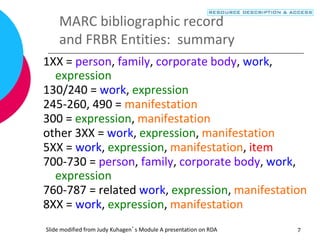
MARC bibliographic record
and FRBR Entities: summary
1XX = person, family, corporate body, work,
expression
130/240 = work, expression
245-260, 490 = manifestation
300 = expression, manifestation
other 3XX = work, expression, manifestation
5XX = work, expression, manifestation, item
700-730 = person, family, corporate body, work,
expression
760-787 = related work, expression, manifestation
8XX = work, expression, manifestation
Slide modified from Judy Kuhagen’s Module A presentation on RDA
COIN 8
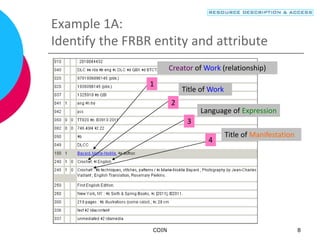
Example 1A:
Identify the FRBR entity and attribute
Creator of Work (relationship)
Title of Work
Language of Expression
Title of Manifestation
1
2
3
4
COIN 9
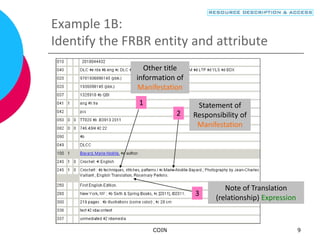
Example 1B:
Identify the FRBR entity and attribute
Other title
information of
Manifestation
Note of Translation
(relationship) Expression
Statement of
Responsibility of
Manifestation
1
2
3
COIN 10
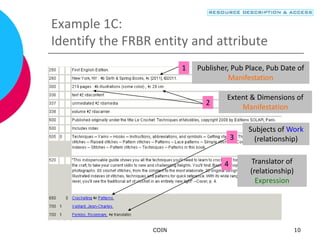
Example 1C:
Identify the FRBR entity and attribute
Publisher, Pub Place, Pub Date of
Manifestation
Extent & Dimensions of
Manifestation
Subjects of Work
(relationship)
Translator of
(relationship)
Expression
1
2
3
4
COIN 11
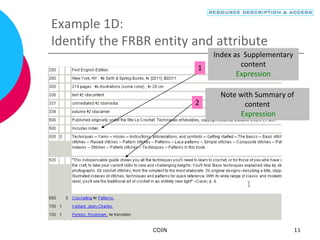
Example 1D:
Identify the FRBR entity and attribute
Note with Summary of
content
Expression
Index as Supplementary
content
Expression
1
2
12
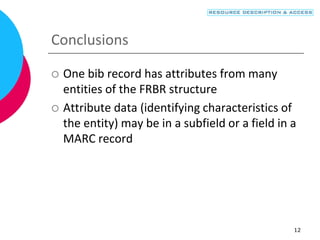
Conclusions
 One bib record has attributes from many
entities of the FRBR structure
 Attribute data (identifying characteristics of
the entity) may be in a subfield or a field in a
MARC record
13
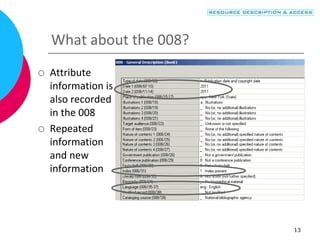
What about the 008?
 Attribute
information is
also recorded
in the 008
 Repeated
information
and new
information
14
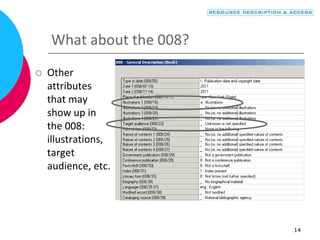
What about the 008?
 Other
attributes
that may
show up in
the 008:
illustrations,
target
audience, etc.
15
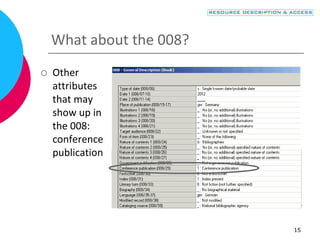
What about the 008?
 Other
attributes
that may
show up in
the 008:
conference
publication
16
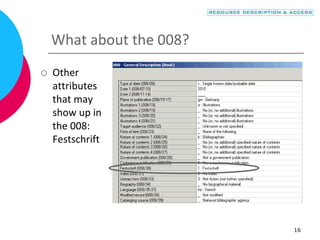
What about the 008?
 Other
attributes
that may
show up in
the 008:
Festschrift
17
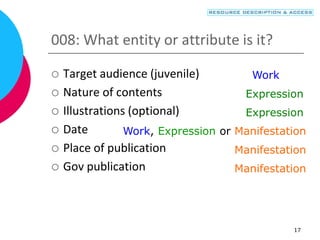
008: What entity or attribute is it?
 Target audience (juvenile)
 Nature of contents
 Illustrations (optional)
 Date
 Place of publication
 Gov publication
Work, Expression or Manifestation
Manifestation
Expression
Work
Expression
Manifestation
18
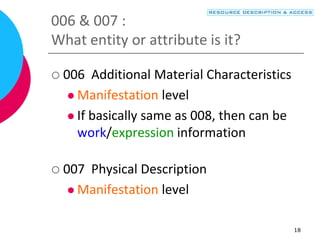
006 & 007 :
What entity or attribute is it?
 006 Additional Material Characteristics
 Manifestation level
 If basically same as 008, then can be
work/expression information
 007 Physical Description
 Manifestation level
19
So, now what?
 So, now we will look at specific fields that
may offer challenges as we apply RDA
20
Fields with things to note
 1XX, 7XX fields can use the $e or $i subfield
(relationship designators)
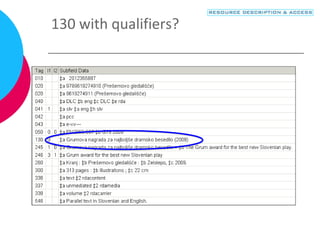
 130 for the contained work
-may be seen more, with qualifiers to break title
conflicts in some cases
-will be seen less for some compilations
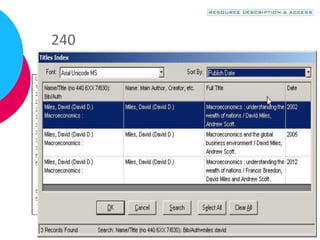
 240 may be used in places it wasn’t used
before for some compilations
130 with qualifiers?
22
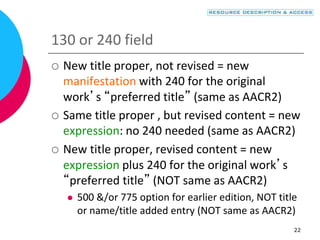
130 or 240 field
 New title proper, not revised = new
manifestation with 240 for the original
work’s “preferred title” (same as AACR2)
 Same title proper , but revised content = new
expression: no 240 needed (same as AACR2)
 New title proper, revised content = new
expression plus 240 for the original work’s
“preferred title” (NOT same as AACR2)
 500 &/or 775 option for earlier edition, NOT title
or name/title added entry (NOT same as AACR2)
23
240
24
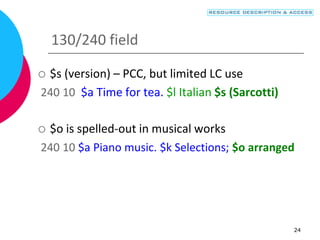
130/240 field
 $s (version) – PCC, but limited LC use
240 10 $a Time for tea. $l Italian $s (Sarcotti)
 $o is spelled-out in musical works
240 10 $a Piano music. $k Selections; $o arranged
25
Fields with things to note
 300
 Repetition of the field
 $b for illustrative content is now optional except
for resources intended for children (Expression
attribute)
 use of $e (not new, but possibly more frequent)
 recording duration for Music (Expression attribute)
 5XX
 500 – more variety of information
 502 – we now use subfields instead of just text
 505 – more frequent usage
 546 – not just for language; non-Roman uses it for
script; Music uses this for form of musical notation
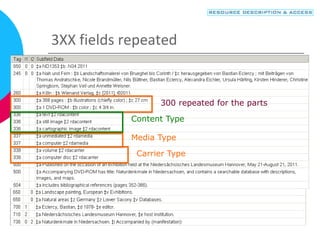
3XX fields repeated
Content Type
Media Type
Carrier Type
300 repeated for the parts
27
Fields with things to note
 7XX is used in many more ways, though
many of them are optional
 The use of the $e or $i subfield to describe
relationships
 700/710/711/730/740 : not truly different
 7XX name/title entries used more for some
compilations
 Linking fields offer many more options
28
Fields with things to note
 7XX linking fields
 Serials use is unchanged
 Now available
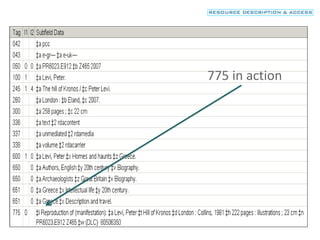
 775 : Other edition (i.e., other expression)
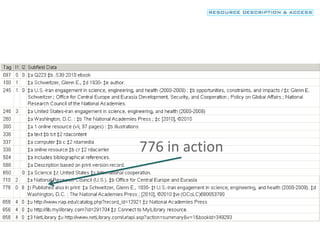
 776 : Additional physical form entry (i.e., other
manifestation)
 Can be used to express FRBR relationships,
especially the content relationships, such as
adaptation of, contains (expression), reprint of,
revision of, etc.
 Use the $i subfield
 Found in RDA Appendix J
775 in action
776 in action
New bibliographic fields
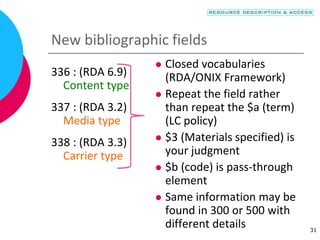
336 : (RDA 6.9)
Content type
337 : (RDA 3.2)
Media type
338 : (RDA 3.3)
Carrier type
 Closed vocabularies
(RDA/ONIX Framework)
 Repeat the field rather
than repeat the $a (term)
(LC policy)
 $3 (Materials specified) is
your judgment
 $b (code) is pass-through
element
 Same information may be
found in 300 or 500 with
different details 31
32
Turning to the authority record
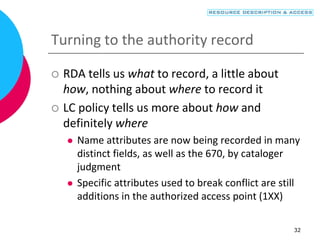
 RDA tells us what to record, a little about
how, nothing about where to record it
 LC policy tells us more about how and
definitely where
 Name attributes are now being recorded in many
distinct fields, as well as the 670, by cataloger
judgment
 Specific attributes used to break conflict are still
additions in the authorized access point (1XX)
33
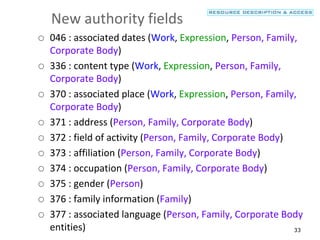
New authority fields
 046 : associated dates (Work, Expression, Person, Family,
Corporate Body)
 336 : content type (Work, Expression, Person, Family,
Corporate Body)
 370 : associated place (Work, Expression, Person, Family,
Corporate Body)
 371 : address (Person, Family, Corporate Body)
 372 : field of activity (Person, Family, Corporate Body)
 373 : affiliation (Person, Family, Corporate Body)
 374 : occupation (Person, Family, Corporate Body)
 375 : gender (Person)
 376 : family information (Family)
 377 : associated language (Person, Family, Corporate Body
entities)
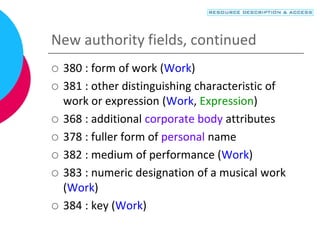
New authority fields, continued
 380 : form of work (Work)
 381 : other distinguishing characteristic of
work or expression (Work, Expression)
 368 : additional corporate body attributes
 378 : fuller form of personal name
 382 : medium of performance (Work)
 383 : numeric designation of a musical work
(Work)
 384 : key (Work)
35
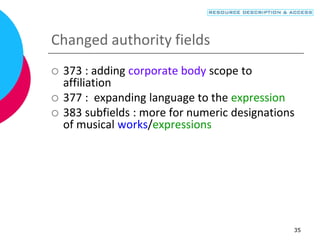
Changed authority fields
 373 : adding corporate body scope to
affiliation
 377 : expanding language to the expression
 383 subfields : more for numeric designations
of musical works/expressions
36
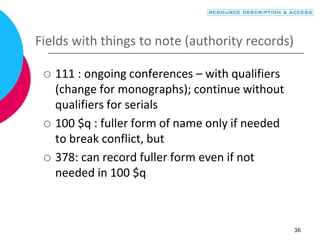
Fields with things to note (authority records)
 111 : ongoing conferences – with qualifiers
(change for monographs); continue without
qualifiers for serials
 100 $q : fuller form of name only if needed
to break conflict, but
 378: can record fuller form even if not
needed in 100 $q
37
Relationships
Entities and attributes (“elements” in
RDA) are found in the bibliographic and
authority fields. Where are the
relationships?
 Given by the cataloger: 1XX & 7XX $e/$i, 7XX
linking fields, 5XX text notes, 490
 Transcribed from the resource: 245 $c
 Sometimes not specified
 Examples in authority records: earlier/later,
links between persons/corporate bodies, etc.
38
SUMMARY Work attributes found in what field?
(bibliographic/authority record)
 preferred title : 1XX $t, 130, 240, 245, 7XX $t
 date of work : 130 $f
 other distinguishing characteristic of the work : depends
on what the distinguishing characteristic is
 intended audience : 008/22 ; 6XX $v [Juvenile resources]
 key : 240, 130, 7XX
 medium of performance : 240, 130, 7XX
 numeric designation of a musical work : 240, 130, 7XX
 coordinates of cartographic content : 255
 equinox : 255 $e
39
SUMMARY Expression attributes found in what
field? (bibliographic/authority record)
 content type : 336
 date of expression : $f of expression access point
 language of expression : 008/35-37, 041, 546,
130/240 $l, 7XX $l
 summarization of content : 520
 other distinguishing characteristic : depends on
the characteristic
 Scale [Core for cartographic resources] : 507
40
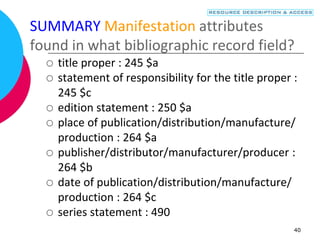
SUMMARY Manifestation attributes
found in what bibliographic record field?
 title proper : 245 $a
 statement of responsibility for the title proper :
245 $c
 edition statement : 250 $a
 place of publication/distribution/manufacture/
production : 264 $a
 publisher/distributor/manufacturer/producer :
264 $b
 date of publication/distribution/manufacture/
production : 264 $c
 series statement : 490
41
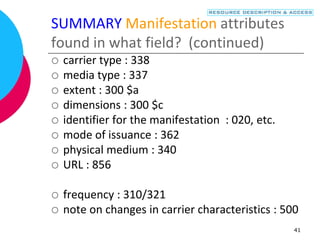
SUMMARY Manifestation attributes
found in what field? (continued)
 carrier type : 338
 media type : 337
 extent : 300 $a
 dimensions : 300 $c
 identifier for the manifestation : 020, etc.
 mode of issuance : 362
 physical medium : 340
 URL : 856
 frequency : 310/321
 note on changes in carrier characteristics : 500
42
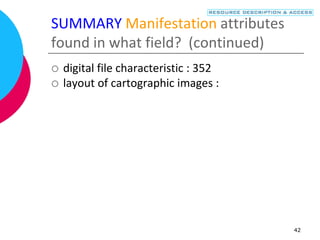
SUMMARY Manifestation attributes
found in what field? (continued)
 digital file characteristic : 352
 layout of cartographic images :
43
SUMMARY Item attributes found in what
bibliographic record or item record field?
 restrictions on use : 5XX
 item identifier : barcode in Item record
 access restrictions on the item : 5XX
44
SUMMARY Person attributes found in what
field? (authority/bibliographic record)
 preferred name for the person: 100 $a, 700
$a
 title of person : 100 $c, 670
 dates associated with the person
(birth/death/period of activity) : 100 $d,
046
 place of birth : 370 $a, 670
 place of death : 370 $b, 670
 associated country : 370 $c, 670
 place of residence : 370 $e, 670
45
SUMMARY Person attributes found in what
field? (continued)
 fuller form of name: 100 $q, 378
 other designation associated with the
person (for saints or spirits): 100/700 $c
 profession or occupation : 100/700 $c,
374, 670
46
SUMMARY Person attributes found in
what field? (continued)
Also may include in authority records (not
Core):
affiliation : 373, 670
address : 371
language of person : 377, 670
field of activity : 372, 670
biography / history : 670, 678
undifferentiated name identifier : 008/32
other informational elements associated
with the person : 670
47
SUMMARY Family attributes found in what
field? (authority/bibliographic record)
 preferred name for the family : 100 $a
 type of family : 100, 376 $a, 670
 date associated with the family : 100 $d,
046, 670
 place associated with family : 100 $c,
370, 670
 prominent member of the family : 100
$c (no real place for it in MARC)
48
SUMMARY Corporate Body attributes found in
what field? (authority/bibliographic record)
 preferred name of the corporate body: 110 or
111 $a
 number of a conference, etc. : 111 $n
 place associated : 110, 111 $c, 370, 670
 date associated : 046, 110, 111 $d, 670
 associated institution: 111 $670
 other designation associated with the
corporate body: 368
 other information associated with the
corporate body : 670
Tools and Workflows
The RDA Planning Group have selected tools
and prepared a checklist to help you begin to
practice cataloging using RDA:
 PCC RDA BIBCO Standard Record (BSR)
 OCLC RDA Guidelines
 Hybrid Bibliographic Records Guidelines
 UCSD RDA checklist
 LC workflow for monographs

FRBR RDA MARC format for cataloguing and

  • 1.
  • 2.
    2 Objectives  Connect MARCfields and subfields to the appropriate entity and attribute of FRBR  Recognize how RDA uses MARC
  • 3.
    3 What is thedifference?  FRBR is a conceptual model  How information is described and organized  RDA is a content standard (as is AACR2)  What information is recorded and how  MARC is a communication format  Computer code to consistently handle the data recorded  They are not the same thing  Be careful of your vocabulary
  • 4.
    4 MARC field ≠RDA instruction  MARC fields are containers for content  Not a one-to- one relationship to a specific RDA instruction  RDA describes content to be recorded that sometimes ends up in different fields
  • 5.
    5 MARC data  Whatdoes the MARC bibliographic record contain?  A “mashup” of WEMI and sometimes also person/family/corporate body information  What does the MARC authority record contain?  Identifying information for the described entity (person, family, corporate body, creator/work/expression), including the “authorized access point” to be used in the MARC environment
  • 6.
    Change in RDAfrom AACR2/MARC- thinking  No “main entry” in RDA  No “entry under” a heading in RDA
  • 7.
    7 MARC bibliographic record andFRBR Entities: summary 1XX = person, family, corporate body, work, expression 130/240 = work, expression 245-260, 490 = manifestation 300 = expression, manifestation other 3XX = work, expression, manifestation 5XX = work, expression, manifestation, item 700-730 = person, family, corporate body, work, expression 760-787 = related work, expression, manifestation 8XX = work, expression, manifestation Slide modified from Judy Kuhagen’s Module A presentation on RDA
  • 8.
    COIN 8 Example 1A: Identifythe FRBR entity and attribute Creator of Work (relationship) Title of Work Language of Expression Title of Manifestation 1 2 3 4
  • 9.
    COIN 9 Example 1B: Identifythe FRBR entity and attribute Other title information of Manifestation Note of Translation (relationship) Expression Statement of Responsibility of Manifestation 1 2 3
  • 10.
    COIN 10 Example 1C: Identifythe FRBR entity and attribute Publisher, Pub Place, Pub Date of Manifestation Extent & Dimensions of Manifestation Subjects of Work (relationship) Translator of (relationship) Expression 1 2 3 4
  • 11.
    COIN 11 Example 1D: Identifythe FRBR entity and attribute Note with Summary of content Expression Index as Supplementary content Expression 1 2
  • 12.
    12 Conclusions  One bibrecord has attributes from many entities of the FRBR structure  Attribute data (identifying characteristics of the entity) may be in a subfield or a field in a MARC record
  • 13.
    13 What about the008?  Attribute information is also recorded in the 008  Repeated information and new information
  • 14.
    14 What about the008?  Other attributes that may show up in the 008: illustrations, target audience, etc.
  • 15.
    15 What about the008?  Other attributes that may show up in the 008: conference publication
  • 16.
    16 What about the008?  Other attributes that may show up in the 008: Festschrift
  • 17.
    17 008: What entityor attribute is it?  Target audience (juvenile)  Nature of contents  Illustrations (optional)  Date  Place of publication  Gov publication Work, Expression or Manifestation Manifestation Expression Work Expression Manifestation
  • 18.
    18 006 & 007: What entity or attribute is it?  006 Additional Material Characteristics  Manifestation level  If basically same as 008, then can be work/expression information  007 Physical Description  Manifestation level
  • 19.
    19 So, now what? So, now we will look at specific fields that may offer challenges as we apply RDA
  • 20.
    20 Fields with thingsto note  1XX, 7XX fields can use the $e or $i subfield (relationship designators)  130 for the contained work -may be seen more, with qualifiers to break title conflicts in some cases -will be seen less for some compilations  240 may be used in places it wasn’t used before for some compilations
  • 21.
  • 22.
    22 130 or 240field  New title proper, not revised = new manifestation with 240 for the original work’s “preferred title” (same as AACR2)  Same title proper , but revised content = new expression: no 240 needed (same as AACR2)  New title proper, revised content = new expression plus 240 for the original work’s “preferred title” (NOT same as AACR2)  500 &/or 775 option for earlier edition, NOT title or name/title added entry (NOT same as AACR2)
  • 23.
  • 24.
    24 130/240 field  $s(version) – PCC, but limited LC use 240 10 $a Time for tea. $l Italian $s (Sarcotti)  $o is spelled-out in musical works 240 10 $a Piano music. $k Selections; $o arranged
  • 25.
    25 Fields with thingsto note  300  Repetition of the field  $b for illustrative content is now optional except for resources intended for children (Expression attribute)  use of $e (not new, but possibly more frequent)  recording duration for Music (Expression attribute)  5XX  500 – more variety of information  502 – we now use subfields instead of just text  505 – more frequent usage  546 – not just for language; non-Roman uses it for script; Music uses this for form of musical notation
  • 26.
    3XX fields repeated ContentType Media Type Carrier Type 300 repeated for the parts
  • 27.
    27 Fields with thingsto note  7XX is used in many more ways, though many of them are optional  The use of the $e or $i subfield to describe relationships  700/710/711/730/740 : not truly different  7XX name/title entries used more for some compilations  Linking fields offer many more options
  • 28.
    28 Fields with thingsto note  7XX linking fields  Serials use is unchanged  Now available  775 : Other edition (i.e., other expression)  776 : Additional physical form entry (i.e., other manifestation)  Can be used to express FRBR relationships, especially the content relationships, such as adaptation of, contains (expression), reprint of, revision of, etc.  Use the $i subfield  Found in RDA Appendix J
  • 29.
  • 30.
  • 31.
    New bibliographic fields 336: (RDA 6.9) Content type 337 : (RDA 3.2) Media type 338 : (RDA 3.3) Carrier type  Closed vocabularies (RDA/ONIX Framework)  Repeat the field rather than repeat the $a (term) (LC policy)  $3 (Materials specified) is your judgment  $b (code) is pass-through element  Same information may be found in 300 or 500 with different details 31
  • 32.
    32 Turning to theauthority record  RDA tells us what to record, a little about how, nothing about where to record it  LC policy tells us more about how and definitely where  Name attributes are now being recorded in many distinct fields, as well as the 670, by cataloger judgment  Specific attributes used to break conflict are still additions in the authorized access point (1XX)
  • 33.
    33 New authority fields 046 : associated dates (Work, Expression, Person, Family, Corporate Body)  336 : content type (Work, Expression, Person, Family, Corporate Body)  370 : associated place (Work, Expression, Person, Family, Corporate Body)  371 : address (Person, Family, Corporate Body)  372 : field of activity (Person, Family, Corporate Body)  373 : affiliation (Person, Family, Corporate Body)  374 : occupation (Person, Family, Corporate Body)  375 : gender (Person)  376 : family information (Family)  377 : associated language (Person, Family, Corporate Body entities)
  • 34.
    New authority fields,continued  380 : form of work (Work)  381 : other distinguishing characteristic of work or expression (Work, Expression)  368 : additional corporate body attributes  378 : fuller form of personal name  382 : medium of performance (Work)  383 : numeric designation of a musical work (Work)  384 : key (Work)
  • 35.
    35 Changed authority fields 373 : adding corporate body scope to affiliation  377 : expanding language to the expression  383 subfields : more for numeric designations of musical works/expressions
  • 36.
    36 Fields with thingsto note (authority records)  111 : ongoing conferences – with qualifiers (change for monographs); continue without qualifiers for serials  100 $q : fuller form of name only if needed to break conflict, but  378: can record fuller form even if not needed in 100 $q
  • 37.
    37 Relationships Entities and attributes(“elements” in RDA) are found in the bibliographic and authority fields. Where are the relationships?  Given by the cataloger: 1XX & 7XX $e/$i, 7XX linking fields, 5XX text notes, 490  Transcribed from the resource: 245 $c  Sometimes not specified  Examples in authority records: earlier/later, links between persons/corporate bodies, etc.
  • 38.
    38 SUMMARY Work attributesfound in what field? (bibliographic/authority record)  preferred title : 1XX $t, 130, 240, 245, 7XX $t  date of work : 130 $f  other distinguishing characteristic of the work : depends on what the distinguishing characteristic is  intended audience : 008/22 ; 6XX $v [Juvenile resources]  key : 240, 130, 7XX  medium of performance : 240, 130, 7XX  numeric designation of a musical work : 240, 130, 7XX  coordinates of cartographic content : 255  equinox : 255 $e
  • 39.
    39 SUMMARY Expression attributesfound in what field? (bibliographic/authority record)  content type : 336  date of expression : $f of expression access point  language of expression : 008/35-37, 041, 546, 130/240 $l, 7XX $l  summarization of content : 520  other distinguishing characteristic : depends on the characteristic  Scale [Core for cartographic resources] : 507
  • 40.
    40 SUMMARY Manifestation attributes foundin what bibliographic record field?  title proper : 245 $a  statement of responsibility for the title proper : 245 $c  edition statement : 250 $a  place of publication/distribution/manufacture/ production : 264 $a  publisher/distributor/manufacturer/producer : 264 $b  date of publication/distribution/manufacture/ production : 264 $c  series statement : 490
  • 41.
    41 SUMMARY Manifestation attributes foundin what field? (continued)  carrier type : 338  media type : 337  extent : 300 $a  dimensions : 300 $c  identifier for the manifestation : 020, etc.  mode of issuance : 362  physical medium : 340  URL : 856  frequency : 310/321  note on changes in carrier characteristics : 500
  • 42.
    42 SUMMARY Manifestation attributes foundin what field? (continued)  digital file characteristic : 352  layout of cartographic images :
  • 43.
    43 SUMMARY Item attributesfound in what bibliographic record or item record field?  restrictions on use : 5XX  item identifier : barcode in Item record  access restrictions on the item : 5XX
  • 44.
    44 SUMMARY Person attributesfound in what field? (authority/bibliographic record)  preferred name for the person: 100 $a, 700 $a  title of person : 100 $c, 670  dates associated with the person (birth/death/period of activity) : 100 $d, 046  place of birth : 370 $a, 670  place of death : 370 $b, 670  associated country : 370 $c, 670  place of residence : 370 $e, 670
  • 45.
    45 SUMMARY Person attributesfound in what field? (continued)  fuller form of name: 100 $q, 378  other designation associated with the person (for saints or spirits): 100/700 $c  profession or occupation : 100/700 $c, 374, 670
  • 46.
    46 SUMMARY Person attributesfound in what field? (continued) Also may include in authority records (not Core): affiliation : 373, 670 address : 371 language of person : 377, 670 field of activity : 372, 670 biography / history : 670, 678 undifferentiated name identifier : 008/32 other informational elements associated with the person : 670
  • 47.
    47 SUMMARY Family attributesfound in what field? (authority/bibliographic record)  preferred name for the family : 100 $a  type of family : 100, 376 $a, 670  date associated with the family : 100 $d, 046, 670  place associated with family : 100 $c, 370, 670  prominent member of the family : 100 $c (no real place for it in MARC)
  • 48.
    48 SUMMARY Corporate Bodyattributes found in what field? (authority/bibliographic record)  preferred name of the corporate body: 110 or 111 $a  number of a conference, etc. : 111 $n  place associated : 110, 111 $c, 370, 670  date associated : 046, 110, 111 $d, 670  associated institution: 111 $670  other designation associated with the corporate body: 368  other information associated with the corporate body : 670
  • 49.
    Tools and Workflows TheRDA Planning Group have selected tools and prepared a checklist to help you begin to practice cataloging using RDA:  PCC RDA BIBCO Standard Record (BSR)  OCLC RDA Guidelines  Hybrid Bibliographic Records Guidelines  UCSD RDA checklist  LC workflow for monographs