CANONS OF
CLASSIFICATION
Dr. YESAN S
Assistant Professor, DLIS
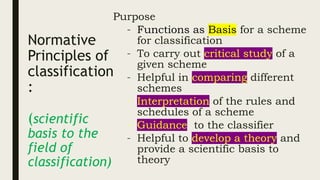
Normative
Principles of
classification
:
(scientific
basis to the
field of
classification)
Purpose
– Functions as Basis for a scheme
for classification
– To carry out critical study of a
given scheme
– Helpful in comparing different
schemes
– Interpretation of the rules and
schedules of a scheme
– Guidance to the classifier
– Helpful to develop a theory and
provide a scientific basis to
theory
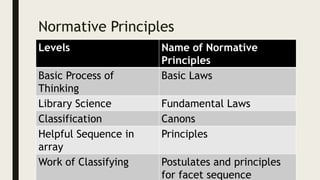
Normative Principles
Levels Name of Normative
Principles
Basic Process of
Thinking
Basic Laws
Library Science Fundamental Laws
Classification Canons
Helpful Sequence in
array
Principles
Work of Classifying Postulates and principles
for facet sequence
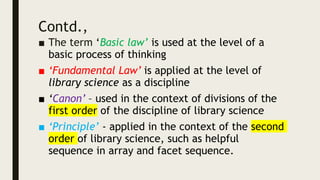
Contd.,
■ The term ‘Basic law’ is used at the level of a
basic process of thinking
■ ‘Fundamental Law’ is applied at the level of
library science as a discipline
■ ‘Canon’ – used in the context of divisions of the
first order of the discipline of library science
■ ‘Principle’ - applied in the context of the second
order of library science, such as helpful
sequence in array and facet sequence.
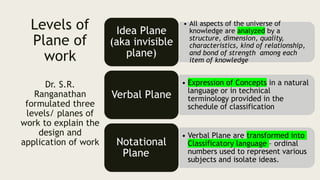
Levels of
Plane of
work
Dr. S.R.
Ranganathan
formulated three
levels/ planes of
work to explain the
design and
application of work
• All aspects of the universe of
knowledge are analyzed by a
structure, dimension, quality,
characteristics, kind of relationship,
and bond of strength among each
item of knowledge
Idea Plane
(aka invisible
plane)
• Expression of Concepts in a natural
language or in technical
terminology provided in the
schedule of classification
Verbal Plane
• Verbal Plane are transformed into
Classificatory language – ordinal
numbers used to represent various
subjects and isolate ideas.
Notational
Plane
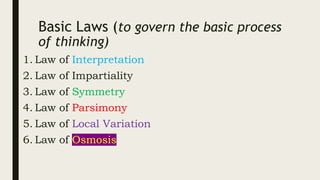
Basic Laws (to govern the basic process
of thinking)
1. Law of Interpretation
2. Law of Impartiality
3. Law of Symmetry
4. Law of Parsimony
5. Law of Local Variation
6. Law of Osmosis
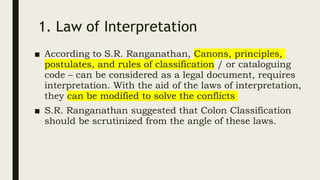
1. Law of Interpretation
■ According to S.R. Ranganathan, Canons, principles,
postulates, and rules of classification / or cataloguing
code – can be considered as a legal document, requires
interpretation. With the aid of the laws of interpretation,
they can be modified to solve the conflicts
■ S.R. Ranganathan suggested that Colon Classification
should be scrutinized from the angle of these laws.
2. Law of Impartiality
■ The law states that between two or more claimants
(Example: In case of joint authorship in cataloguing or
choice of position among two facets of subjects in
classification) preference to be given only on sufficient
grounds and not arbitrarily.
■ The law of impartiality directs that the sequence of
facets in different subjects or choice of heading in
authorship. The sequence should be based on some
guiding principles of general nature, equally applicable
to all subjects or headings.
■ SRR suggested for equal weightage to the names of all
the authors for choice of headings.
3. Law of Symmetry
■ Symmetry Means ‘correct proportions’ or ‘balance’ or
‘equal weightage’
■ This law advocates equal weightage to two entities in an
entry.
■ Eg. In case of a joint authorship work, law of symmetry
suggests that in the heading of the Main Entry, we
should write the names of the both authors in the
sequence in which they occur on the title page.
4. Law of Parsimony
■ Parsimony literary means “thrift, or quality of being stingy or
using money and other resources carefully and not wastefully”.
■ Achieve overall economy in all library affairs
■ The law advocates that between two or more possible alternatives
relating to a particular phenomenon, the one leading to overall
economy of manpower, material, money and time, considered
together with proper weightage, is to be preferred.
■ Eg. Reclassification of library materials
– Reclassify only those part of the collections that are known to
be in much use
– Full or Short description in catalogue entry
– Printed or Handwritten catalogue
5. Law of Local Variation
■ The law of local variation says that in any discipline and
technique, there should be provision for users of them to
secure, for strictly local use, results alternative to those for
general use
■ This law guides in case of problems of local variations and
directs towards the formation of special collections of
documents separate from the general collection.
■ The word ‘local’ refers to a geographical area of any size
– American Interests
– Indian Interests
– Tamil interests
6. Law of Osmosis
■ Osmosis means ‘the process of gradual or unconscious
assimilation of ideas, knowledge’
■ The law suggests that if there is a change in the cataloging
code or in the scheme of classification as advocated by the
canon of context, the library should gradually start
catalogue or classify newly acquired material according to
the new code and scheme. Then gradually classify the old
collections which is known to be in much use and so on.
■ This approach is practicable, can be done without affecting
the budget and routine service of the library and also cost-
effective
Meaning of Canon
Canon of Classification is an established general law, rule,
principle, or criterion by which something is judged of the
classification
First use of “Canons of library classification” by WCB Sayers
Dr. S.R. Ranganathan – in his book Prolegomena to Library
Classification (1937) presented this Canon as a classification
method
Canon for Characteristics
■ Arranging according to their likeness, or dislike-
ness.
■ Different principles that recommended certain
characteristics to be selected for the process of
classification called Canons for Classification
Canon of Differentiation

Canon.pptx

  • 1.
    CANONS OF CLASSIFICATION Dr. YESANS Assistant Professor, DLIS
  • 2.
    Normative Principles of classification : (scientific basis tothe field of classification) Purpose – Functions as Basis for a scheme for classification – To carry out critical study of a given scheme – Helpful in comparing different schemes – Interpretation of the rules and schedules of a scheme – Guidance to the classifier – Helpful to develop a theory and provide a scientific basis to theory
  • 3.
    Normative Principles Levels Nameof Normative Principles Basic Process of Thinking Basic Laws Library Science Fundamental Laws Classification Canons Helpful Sequence in array Principles Work of Classifying Postulates and principles for facet sequence
  • 4.
    Contd., ■ The term‘Basic law’ is used at the level of a basic process of thinking ■ ‘Fundamental Law’ is applied at the level of library science as a discipline ■ ‘Canon’ – used in the context of divisions of the first order of the discipline of library science ■ ‘Principle’ - applied in the context of the second order of library science, such as helpful sequence in array and facet sequence.
  • 5.
    Levels of Plane of work Dr.S.R. Ranganathan formulated three levels/ planes of work to explain the design and application of work • All aspects of the universe of knowledge are analyzed by a structure, dimension, quality, characteristics, kind of relationship, and bond of strength among each item of knowledge Idea Plane (aka invisible plane) • Expression of Concepts in a natural language or in technical terminology provided in the schedule of classification Verbal Plane • Verbal Plane are transformed into Classificatory language – ordinal numbers used to represent various subjects and isolate ideas. Notational Plane
  • 6.
    Basic Laws (togovern the basic process of thinking) 1. Law of Interpretation 2. Law of Impartiality 3. Law of Symmetry 4. Law of Parsimony 5. Law of Local Variation 6. Law of Osmosis
  • 7.
    1. Law ofInterpretation ■ According to S.R. Ranganathan, Canons, principles, postulates, and rules of classification / or cataloguing code – can be considered as a legal document, requires interpretation. With the aid of the laws of interpretation, they can be modified to solve the conflicts ■ S.R. Ranganathan suggested that Colon Classification should be scrutinized from the angle of these laws.
  • 8.
    2. Law ofImpartiality ■ The law states that between two or more claimants (Example: In case of joint authorship in cataloguing or choice of position among two facets of subjects in classification) preference to be given only on sufficient grounds and not arbitrarily. ■ The law of impartiality directs that the sequence of facets in different subjects or choice of heading in authorship. The sequence should be based on some guiding principles of general nature, equally applicable to all subjects or headings. ■ SRR suggested for equal weightage to the names of all the authors for choice of headings.
  • 9.
    3. Law ofSymmetry ■ Symmetry Means ‘correct proportions’ or ‘balance’ or ‘equal weightage’ ■ This law advocates equal weightage to two entities in an entry. ■ Eg. In case of a joint authorship work, law of symmetry suggests that in the heading of the Main Entry, we should write the names of the both authors in the sequence in which they occur on the title page.
  • 10.
    4. Law ofParsimony ■ Parsimony literary means “thrift, or quality of being stingy or using money and other resources carefully and not wastefully”. ■ Achieve overall economy in all library affairs ■ The law advocates that between two or more possible alternatives relating to a particular phenomenon, the one leading to overall economy of manpower, material, money and time, considered together with proper weightage, is to be preferred. ■ Eg. Reclassification of library materials – Reclassify only those part of the collections that are known to be in much use – Full or Short description in catalogue entry – Printed or Handwritten catalogue
  • 11.
    5. Law ofLocal Variation ■ The law of local variation says that in any discipline and technique, there should be provision for users of them to secure, for strictly local use, results alternative to those for general use ■ This law guides in case of problems of local variations and directs towards the formation of special collections of documents separate from the general collection. ■ The word ‘local’ refers to a geographical area of any size – American Interests – Indian Interests – Tamil interests
  • 12.
    6. Law ofOsmosis ■ Osmosis means ‘the process of gradual or unconscious assimilation of ideas, knowledge’ ■ The law suggests that if there is a change in the cataloging code or in the scheme of classification as advocated by the canon of context, the library should gradually start catalogue or classify newly acquired material according to the new code and scheme. Then gradually classify the old collections which is known to be in much use and so on. ■ This approach is practicable, can be done without affecting the budget and routine service of the library and also cost- effective
  • 13.
    Meaning of Canon Canonof Classification is an established general law, rule, principle, or criterion by which something is judged of the classification First use of “Canons of library classification” by WCB Sayers Dr. S.R. Ranganathan – in his book Prolegomena to Library Classification (1937) presented this Canon as a classification method
  • 14.
    Canon for Characteristics ■Arranging according to their likeness, or dislike- ness. ■ Different principles that recommended certain characteristics to be selected for the process of classification called Canons for Classification
  • 15.